

ASTM F2398-11(2020)
(Test Method)Standard Test Method for Measuring Moment of Inertia and Center of Percussion of a Baseball or Softball Bat
General Information
- Abstract
SIGNIFICANCE AND USE
4.1 This test method offers a laboratory means to measure the inertial properties of bats, specifically weight, balance point, center of percussion, and MOI, in support of other test methods including the ASTM standards referenced in this document.
4.2 Use of this test method can provide sports governing bodies the means to establish rules regarding the physical properties of bats, specifically MOI.
SCOPE
1.1 Method for determining the moment of inertia (MOI), the center of percussion (COP), and the balance point (BP) of baseball and softball bats. These physical properties are used in Test Method F1881, Test Method F1890, and Test Methods F2219.
1.2 The MOI, COP, and BP are measured in the laboratory on test equipment meeting the requirements defined in this test method.
1.3 The values stated in inch-pound units are to be regarded as standard. The values given in parentheses are mathematical conversions to SI units that are provided for information only and are not considered standard.
1.4 This standard does not purport to address all of the safety concerns, if any, associated with its use. It is the responsibility of the user of this standard to establish appropriate safety, health, and environmental practices and determine the applicability of regulatory limitations prior to use.
1.5 This international standard was developed in accordance with internationally recognized principles on standardization established in the Decision on Principles for the Development of International Standards, Guides and Recommendations issued by the World Trade Organization Technical Barriers to Trade (TBT) Committee.
- Status
- Published
- Publication Date
- 30-Jun-2020
- Technical Committee
- F08 - Sports Equipment, Playing Surfaces, and Facilities
- Drafting Committee
- F08.26 - Baseball and Softball Equipment


Overview
ASTM F2398-11(2020), titled Standard Test Method for Measuring Moment of Inertia and Center of Percussion of a Baseball or Softball Bat, is a laboratory-focused standard developed by ASTM International. This document outlines methods for determining crucial inertial properties of baseball and softball bats, including the moment of inertia (MOI), center of percussion (COP), and balance point (BP). These properties have direct influence on bat performance and are essential for manufacturers, testing labs, and sports governing bodies to establish and verify compliance with equipment regulations.
Key Topics
- Moment of Inertia (MOI): Defines the bat’s resistance to changes in its rotational rate around a specific pivot point. Measuring MOI helps assess the swing characteristics of bats.
- Center of Percussion (COP): Also referred to as the “sweet spot,” COP is the location where a struck ball induces minimal reaction at the pivot point. Accurate COP measurement is important for performance analysis.
- Balance Point (BP): The position along the bat where its mass is evenly distributed. BP directly affects bat control and handling.
- Lab-Based Measurements: Testing protocols mandate laboratory conditions and specialized equipment, such as calibrated scales, electronic timers, and pendulum stands, to ensure reliable and repeatable results.
- Support for Governing Rules: The data obtained from this method provides a foundation for sports organizations to create and enforce bat performance standards.
Applications
ASTM F2398-11(2020) is widely used in the following contexts:
- Product Certification: Bat manufacturers and test facilities use this standard to certify that their baseball and softball bats conform to league or regulatory requirements for inertial properties.
- Rule Enforcement: Sports governing bodies (e.g., baseball and softball associations) rely on results from this method to establish and maintain equipment standards, particularly those focused on MOI to ensure fair play and athlete safety.
- Research and Development: Organizations engaged in R&D utilize these measurements to assess and optimize new bat designs for improved performance and compliance with international standards.
- Quality Control: Regular testing following this method helps manufacturers maintain consistent product quality and performance characteristics.
- Reference for Other Testing: The results of this procedure support additional test methods such as those established under ASTM F1881, F1890, and F2219, which further evaluate bat performance metrics.
Related Standards
Several other ASTM standards interlink with or are supported by ASTM F2398-11(2020):
- ASTM F1881: Withdrawn, but previously used for measuring the performance factor of baseball bats.
- ASTM F1890: Method for measuring softball and baseball bat performance factor, complementing inertial property measurement.
- ASTM F2219: Focuses on measuring high-speed bat performance, utilizing MOI, COP, and BP data for holistic evaluation.
Practical Value
Implementing ASTM F2398-11(2020) ensures standardized, precise measurement of baseball and softball bat inertial properties, supporting objective compliance verification, enhancing product development, and contributing to player safety and fairness in sport. This standard serves as a critical reference point for laboratories, sporting bodies, and equipment manufacturers worldwide.
Keywords: ASTM F2398-11, baseball bat testing, softball bat standards, moment of inertia, center of percussion, balance point, lab test method, bat compliance, inertial properties, sports equipment standards.
Relations
- Effective Date
- 01-Jul-2020
- Refers
ASTM F1890-17 - Standard Test Method for Measuring Softball and Baseball Bat Performance Factor - Effective Date
- 15-Aug-2017
- Effective Date
- 01-Jun-2013
- Effective Date
- 01-Nov-2011
- Effective Date
- 01-Nov-2011
- Effective Date
- 01-May-2010
- Effective Date
- 01-Jun-2009
- Effective Date
- 01-Jun-2009
- Effective Date
- 01-Jun-2009
- Effective Date
- 01-Oct-2007
- Effective Date
- 15-Oct-2005
- Effective Date
- 01-Oct-2005
- Effective Date
- 01-Oct-2005
- Effective Date
- 01-Jul-2004
- Effective Date
- 01-Jul-2004
Frequently Asked Questions
ASTM F2398-11(2020) is a standard published by ASTM International. Its full title is "Standard Test Method for Measuring Moment of Inertia and Center of Percussion of a Baseball or Softball Bat". This standard covers: SIGNIFICANCE AND USE 4.1 This test method offers a laboratory means to measure the inertial properties of bats, specifically weight, balance point, center of percussion, and MOI, in support of other test methods including the ASTM standards referenced in this document. 4.2 Use of this test method can provide sports governing bodies the means to establish rules regarding the physical properties of bats, specifically MOI. SCOPE 1.1 Method for determining the moment of inertia (MOI), the center of percussion (COP), and the balance point (BP) of baseball and softball bats. These physical properties are used in Test Method F1881, Test Method F1890, and Test Methods F2219. 1.2 The MOI, COP, and BP are measured in the laboratory on test equipment meeting the requirements defined in this test method. 1.3 The values stated in inch-pound units are to be regarded as standard. The values given in parentheses are mathematical conversions to SI units that are provided for information only and are not considered standard. 1.4 This standard does not purport to address all of the safety concerns, if any, associated with its use. It is the responsibility of the user of this standard to establish appropriate safety, health, and environmental practices and determine the applicability of regulatory limitations prior to use. 1.5 This international standard was developed in accordance with internationally recognized principles on standardization established in the Decision on Principles for the Development of International Standards, Guides and Recommendations issued by the World Trade Organization Technical Barriers to Trade (TBT) Committee.
SIGNIFICANCE AND USE 4.1 This test method offers a laboratory means to measure the inertial properties of bats, specifically weight, balance point, center of percussion, and MOI, in support of other test methods including the ASTM standards referenced in this document. 4.2 Use of this test method can provide sports governing bodies the means to establish rules regarding the physical properties of bats, specifically MOI. SCOPE 1.1 Method for determining the moment of inertia (MOI), the center of percussion (COP), and the balance point (BP) of baseball and softball bats. These physical properties are used in Test Method F1881, Test Method F1890, and Test Methods F2219. 1.2 The MOI, COP, and BP are measured in the laboratory on test equipment meeting the requirements defined in this test method. 1.3 The values stated in inch-pound units are to be regarded as standard. The values given in parentheses are mathematical conversions to SI units that are provided for information only and are not considered standard. 1.4 This standard does not purport to address all of the safety concerns, if any, associated with its use. It is the responsibility of the user of this standard to establish appropriate safety, health, and environmental practices and determine the applicability of regulatory limitations prior to use. 1.5 This international standard was developed in accordance with internationally recognized principles on standardization established in the Decision on Principles for the Development of International Standards, Guides and Recommendations issued by the World Trade Organization Technical Barriers to Trade (TBT) Committee.
ASTM F2398-11(2020) is classified under the following ICS (International Classification for Standards) categories: 97.220.40 - Outdoor and water sports equipment. The ICS classification helps identify the subject area and facilitates finding related standards.
ASTM F2398-11(2020) has the following relationships with other standards: It is inter standard links to ASTM F2398-11(2015), ASTM F1890-17, ASTM F2219-13, ASTM F2219-11, ASTM F1890-11, ASTM F2219-10, ASTM F2219-09, ASTM F1881-09, ASTM F1890-09, ASTM F2219-07, ASTM F2219-05, ASTM F1890-05, ASTM F1881-05, ASTM F1890-04, ASTM F1881-04. Understanding these relationships helps ensure you are using the most current and applicable version of the standard.
ASTM F2398-11(2020) is available in PDF format for immediate download after purchase. The document can be added to your cart and obtained through the secure checkout process. Digital delivery ensures instant access to the complete standard document.
Standards Content (Sample)
This international standard was developed in accordance with internationally recognized principles on standardization established in the Decision on Principles for the
Development of International Standards, Guides and Recommendations issued by the World Trade Organization Technical Barriers to Trade (TBT) Committee.
Designation: F2398 − 11 (Reapproved 2020) An American National Standard
Standard Test Method for
Measuring Moment of Inertia and Center of Percussion of a
Baseball or Softball Bat
This standard is issued under the fixed designation F2398; the number immediately following the designation indicates the year of
original adoption or, in the case of revision, the year of last revision. A number in parentheses indicates the year of last reapproval. A
superscript epsilon (´) indicates an editorial change since the last revision or reapproval.
1. Scope F2219 Test Methods for Measuring High-Speed Bat Perfor-
mance
1.1 Method for determining the moment of inertia (MOI),
the center of percussion (COP), and the balance point (BP) of
3. Terminology
baseball and softball bats.These physical properties are used in
3.1 Definitions of Terms Specific to This Standard:
Test Method F1881, Test Method F1890, and Test Methods
3.1.1 balance point (BP), n—the distance to the center of
F2219.
mass measured from the knob end of the bat.
1.2 The MOI, COP, and BP are measured in the laboratory
3.1.2 center of percussion (COP), n—also known as the
on test equipment meeting the requirements defined in this test
center of oscillation. Forces and impacts at this location will
method.
not induce reactions at the pivot point, 6 in. (152 mm) from the
1.3 The values stated in inch-pound units are to be regarded
knob end of the bat.
as standard. The values given in parentheses are mathematical
3.1.3 cycle, n—one complete oscillation of a pendulum
conversions to SI units that are provided for information only
supported at the pivot point, 6 in. (152 mm) from the knob end
and are not considered standard.
of the bat.
1.4 This standard does not purport to address all of the
3.1.4 moment of inertia (MOI), n—also known as the mass
safety concerns, if any, associated with its use. It is the
moment of inertia, the measure of the bat’s resistance to
responsibility of the user of this standard to establish appro-
changes in its rotation rate about the pivot point, 6 in. (152
priate safety, health, and environmental practices and deter-
mm) from the knob end of the bat.
mine the applicability of regulatory limitations prior to use.
3.1.5 period, n—the time required for a pendulum to oscil-
1.5 This international standard was developed in accor-
late through one complete cycle.
dance with internationally recognized principles on standard-
ization established in the Decision on Principles for the
4. Significance and Use
Development of International Standards, Guides and Recom-
4.1 This test method offers a laboratory means to measure
mendations issued by the World Trade Organization Technical
the inertial properties of bats, specifically weight, balance
Barriers to Trade (TBT) Committee.
point, center of percussion, and MOI, in support of other test
methods including the ASTM standards referenced in this
2. Referenced Documents
document.
2.1 ASTM Standards:
4.2 Use of this test method can provide sports governing
F1881 Test Method for Measuring Baseball Bat Perfor-
bodies the means to establish rules regarding the physical
mance Factor (Withdrawn 2014)
properties of bats, specifically MOI.
F1890 Test Method for Measuring Softball and Baseball Bat
Performance Factor
5. Apparatus
5.1 Bat MOI Test Apparatus:
This test method is under the jurisdiction of ASTM Committee F08 on Sports
5.1.1 Ruler, suitable for measuring lengths up to 42 in.
Equipment, Playing Surfaces, and Facilities and is the direct responsibility of
Subcommittee F08.26 on Baseball and Softball Equipment.
(1067 mm) to the nearest 0.03 in. (0.8 mm).
Current edition approved July 1, 2020. Published August 2020. Originally
5.1.2 Weight Scales, suitable for measuring weight up to 48
approved in 2004. Last previous edition approved in 2015 as F2398 – 11 (2015).
oz (1361 g) to the nearest 0.0035 oz (0.1 g).
DOI: 10.1520/F2398-11R20.
5.1.3 Electronic Timer, suitable device sufficiently accurate
For referenced ASTM standards, visit the ASTM website, www.astm.org, or
contact ASTM Customer Service at service@astm.org. For Annual Book of ASTM
for measuring time to the nearest 1 µs (0.000001 s).
Standards volume information, refer to the standard’s Document Summary page on
5.1.4 Pendulum Stand—A frame with a pivoting bat collar-
the ASTM website.
3 clamp large enough to allow a bat held in a vertical position to
The last approved version of this historical standard is referenced on
www.astm.org. swing freely (see Fig. 1).
Copyright © ASTM International, 100 Barr Harbor Drive, PO Box C700, West Conshohocken, PA 19428-2959. United States
F2398 − 11 (2020)
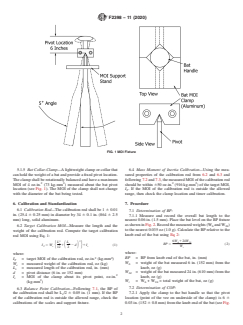
FIG. 1 MOI Fixture
5.1.5 Bat Collar-Clamp—Alightweight clamp or collar that 6.4 Mass Moment of Inertia Calibration—Using the mea-
can hold the weight of a bat and provide a fixed pivot location. sured properties of the calibration rod from 6.2 and 6.3 and
The clamp shall be rotationally balanced and have a maximum following 7.2 and 7.3, the measured MOI of the calibration rod
2 2 2 2
MOI of 4 oz-in. (73 kg-mm ) measured about the bat pivot should be within 650 oz-in. (916 kg-mm ) of the target MOI,
location (see Fig. 1). The MOI of the clamp shall not change I . If t
...