

ASTM F1890-23
(Test Method)Standard Test Method for Measuring Softball and Baseball Bat Performance Factor
General Information
- Abstract
SIGNIFICANCE AND USE
4.1 These test methods offer a laboratory means to quantitatively compare the performance of softball and baseball bats.
SCOPE
1.1 A method for determining bat performance by measuring the bat-ball coefficient of restitution (BBCOR) and deriving the bat performance factor (BPF). It is applicable to softball and baseball bats of any construction or material. The method provides a quantitative measure of bat dynamic performance that may be used for comparison purposes.
1.2 The BBCOR and BPF are calculated from measurements taken in the laboratory on test equipment meeting the requirements defined in this method.
1.3 Bat performance is found in this standard assuming the bat is pivoted.
1.4 The values stated in inch-pound units are to be regarded as standard. The values given in parentheses are units that are provided for information only and are not considered standard.
1.5 This standard does not purport to address all of the safety concerns, if any, associated with its use. It is the responsibility of the user of this standard to establish appropriate safety, health, and environmental practices and determine the applicability of regulatory limitations prior to use.
1.6 This international standard was developed in accordance with internationally recognized principles on standardization established in the Decision on Principles for the Development of International Standards, Guides and Recommendations issued by the World Trade Organization Technical Barriers to Trade (TBT) Committee.
- Status
- Published
- Publication Date
- 31-Mar-2023
- Technical Committee
- F08 - Sports Equipment, Playing Surfaces, and Facilities
- Drafting Committee
- F08.26 - Baseball and Softball Equipment
Buy Documents
ASTM F1890-23 - Standard Test Method for Measuring Softball and Baseball Bat Performance Factor
REDLINE ASTM F1890-23 - Standard Test Method for Measuring Softball and Baseball Bat Performance Factor
Overview
ASTM F1890-23 is the internationally recognized standard test method for measuring the performance factor of softball and baseball bats. Developed by ASTM International, this standard provides a precise laboratory method for quantitatively comparing bat performance using the bat-ball coefficient of restitution (BBCOR) and Bat Performance Factor (BPF). Applicable to bats of any construction or material, ASTM F1890-23 ensures consistent and reliable results that are critical for manufacturers, regulatory bodies, and sports organizations involved in quality assurance and compliance for baseball and softball equipment.
Key Topics
- Bat-Ball Coefficient of Restitution (BBCOR): Measures the ratio of the relative speed after impact to the relative speed before impact between a bat and a ball.
- Bat Performance Factor (BPF): Derived as the ratio of BBCOR to the ball's coefficient of restitution (COR), offering a single, comparative figure for bat performance.
- Test Applicability: Suitable for all types of softball and baseball bats, regardless of material or construction method.
- Laboratory Test Equipment: Outlines requirements for test balls (tested for weight, compression, size, and COR) and precise apparatus for measuring inbound and rebound speeds of both bat and ball.
- Test Conditions: Specifies environmental controls for temperature and humidity to ensure repeatable and accurate results.
- Reporting Requirements: Details the essential data points to be recorded, such as test operator identity, calibration data, equipment used, and detailed performance results.
Applications
The ASTM F1890-23 standard test method is widely used across the following areas:
- Bat Manufacturing and Product Development: Bat manufacturers utilize this method to test and demonstrate compliance of their products with industry regulations and performance expectations.
- Certification and Quality Assurance: Organizations, leagues, and regulatory bodies use the standard to verify that bats conform to designated performance limits, such as BBCOR regulations set for competitive play.
- Research and Development: R&D teams in sporting goods companies apply the method to compare current products, innovate new designs, and analyze bat dynamic performance quantitatively.
- Comparative Analysis: Enables objective benchmarking of different bat models, aiding selection for both consumers and professional teams.
- Safety and Fairness in Sport: By standardizing bat performance testing, the method helps to maintain a level playing field and ensures equipment safety for players.
Related Standards
ASTM F1890-23 references and complements several important standards for baseball and softball equipment testing:
- ASTM F1887 - Test Method for Measuring the Coefficient of Restitution (COR) of Baseballs and Softballs: Used for determining the energy restitution properties of balls.
- ASTM F1888 - Test Method for Compression-Displacement of Baseballs and Softballs: Assesses the compression characteristics of balls for consistency and safety.
- ASTM F2398 - Test Method for Measuring Moment of Inertia and Center of Percussion of a Baseball or Softball Bat: Measures key physical properties of bats relevant to their performance.
By adhering to ASTM F1890-23 and its related standards, stakeholders in the baseball and softball industries can ensure consistency, comparability, and regulatory compliance in bat performance testing. This contributes to product quality, player safety, and fair competition in the sport.
Keywords: ASTM F1890-23, baseball bat test method, softball bat performance, bat-ball coefficient of restitution, BBCOR, bat performance factor, BPF, sports equipment standards, bat testing laboratory, baseball equipment compliance.
Relations
- Effective Date
- 01-Jul-2020
- Effective Date
- 01-Apr-2019
- Effective Date
- 01-Apr-2019
- Effective Date
- 01-Oct-2015
- Effective Date
- 01-May-2014
- Refers
ASTM F1888-09(2014) - Standard Test Method for Compression-Displacement of Baseballs and Softballs - Effective Date
- 01-Mar-2014
- Effective Date
- 01-Apr-2011
- Effective Date
- 01-May-2010
- Effective Date
- 01-Jun-2009
- Effective Date
- 01-Jun-2009
- Effective Date
- 01-May-2004
- Effective Date
- 01-May-2004
- Effective Date
- 10-Dec-2002
- Effective Date
- 10-Dec-2002
Buy Documents
ASTM F1890-23 - Standard Test Method for Measuring Softball and Baseball Bat Performance Factor
REDLINE ASTM F1890-23 - Standard Test Method for Measuring Softball and Baseball Bat Performance Factor
Frequently Asked Questions
ASTM F1890-23 is a standard published by ASTM International. Its full title is "Standard Test Method for Measuring Softball and Baseball Bat Performance Factor". This standard covers: SIGNIFICANCE AND USE 4.1 These test methods offer a laboratory means to quantitatively compare the performance of softball and baseball bats. SCOPE 1.1 A method for determining bat performance by measuring the bat-ball coefficient of restitution (BBCOR) and deriving the bat performance factor (BPF). It is applicable to softball and baseball bats of any construction or material. The method provides a quantitative measure of bat dynamic performance that may be used for comparison purposes. 1.2 The BBCOR and BPF are calculated from measurements taken in the laboratory on test equipment meeting the requirements defined in this method. 1.3 Bat performance is found in this standard assuming the bat is pivoted. 1.4 The values stated in inch-pound units are to be regarded as standard. The values given in parentheses are units that are provided for information only and are not considered standard. 1.5 This standard does not purport to address all of the safety concerns, if any, associated with its use. It is the responsibility of the user of this standard to establish appropriate safety, health, and environmental practices and determine the applicability of regulatory limitations prior to use. 1.6 This international standard was developed in accordance with internationally recognized principles on standardization established in the Decision on Principles for the Development of International Standards, Guides and Recommendations issued by the World Trade Organization Technical Barriers to Trade (TBT) Committee.
SIGNIFICANCE AND USE 4.1 These test methods offer a laboratory means to quantitatively compare the performance of softball and baseball bats. SCOPE 1.1 A method for determining bat performance by measuring the bat-ball coefficient of restitution (BBCOR) and deriving the bat performance factor (BPF). It is applicable to softball and baseball bats of any construction or material. The method provides a quantitative measure of bat dynamic performance that may be used for comparison purposes. 1.2 The BBCOR and BPF are calculated from measurements taken in the laboratory on test equipment meeting the requirements defined in this method. 1.3 Bat performance is found in this standard assuming the bat is pivoted. 1.4 The values stated in inch-pound units are to be regarded as standard. The values given in parentheses are units that are provided for information only and are not considered standard. 1.5 This standard does not purport to address all of the safety concerns, if any, associated with its use. It is the responsibility of the user of this standard to establish appropriate safety, health, and environmental practices and determine the applicability of regulatory limitations prior to use. 1.6 This international standard was developed in accordance with internationally recognized principles on standardization established in the Decision on Principles for the Development of International Standards, Guides and Recommendations issued by the World Trade Organization Technical Barriers to Trade (TBT) Committee.
ASTM F1890-23 is classified under the following ICS (International Classification for Standards) categories: 97.220.40 - Outdoor and water sports equipment. The ICS classification helps identify the subject area and facilitates finding related standards.
ASTM F1890-23 has the following relationships with other standards: It is inter standard links to ASTM F2398-11(2020), ASTM F1887-14(2019)e1, ASTM F1887-14(2019), ASTM F2398-11(2015), ASTM F1887-14, ASTM F1888-09(2014), ASTM F2398-11, ASTM F2398-10, ASTM F1887-09, ASTM F1888-09, ASTM F2398-04, ASTM F2398-04e1, ASTM F1887-02, ASTM F1888-02. Understanding these relationships helps ensure you are using the most current and applicable version of the standard.
ASTM F1890-23 is available in PDF format for immediate download after purchase. The document can be added to your cart and obtained through the secure checkout process. Digital delivery ensures instant access to the complete standard document.
Standards Content (Sample)
This international standard was developed in accordance with internationally recognized principles on standardization established in the Decision on Principles for the
Development of International Standards, Guides and Recommendations issued by the World Trade Organization Technical Barriers to Trade (TBT) Committee.
Designation: F1890 − 23 An American National Standard
Standard Test Method for
Measuring Softball and Baseball Bat Performance Factor
This standard is issued under the fixed designation F1890; the number immediately following the designation indicates the year of
original adoption or, in the case of revision, the year of last revision. A number in parentheses indicates the year of last reapproval. A
superscript epsilon (´) indicates an editorial change since the last revision or reapproval.
1. Scope F2398 Test Method for Measuring Moment of Inertia and
Center of Percussion of a Baseball or Softball Bat
1.1 A method for determining bat performance by measur-
ing the bat-ball coefficient of restitution (BBCOR) and deriving
3. Terminology
the bat performance factor (BPF). It is applicable to softball
3.1 Definitions of Terms Specific to This Standard:
and baseball bats of any construction or material. The method
3.1.1 balance point (BP), n—distance to the center of mass
provides a quantitative measure of bat dynamic performance
of a bat when measured from the knob end of the bat.
that may be used for comparison purposes.
3.1.2 coeffıcient of restitution (COR), n—the relative speed
1.2 The BBCOR and BPF are calculated from measure-
of the objects after impact divided by the relative speed of the
ments taken in the laboratory on test equipment meeting the
objects before impact.
requirements defined in this method.
3.1.3 bat-ball coeffıcient of restitution (BBCOR), n—COR
1.3 Bat performance is found in this standard assuming the
of a specific ball colliding with a bat as defined in this test
bat is pivoted.
method.
1.4 The values stated in inch-pound units are to be regarded
3.1.4 bat performance factor (BPF), n—ratio of BBCOR to
as standard. The values given in parentheses are units that are
ball COR as defined in this test method.
provided for information only and are not considered standard.
3.1.5 center of percussion (COP), n—impact location on the
1.5 This standard does not purport to address all of the
bat that produces no reaction force at the pivot point and causes
safety concerns, if any, associated with its use. It is the
the bat to rotate about the pivot point, taken 6 in. (152 mm)
responsibility of the user of this standard to establish appro-
from the knob end of the bat.
priate safety, health, and environmental practices and deter-
3.1.6 moment of inertia (MOI), n—measure of mass distri-
mine the applicability of regulatory limitations prior to use.
bution relative to a pivot point, taken 6 in. (152 mm) from the
1.6 This international standard was developed in accor-
knob end of the bat.
dance with internationally recognized principles on standard-
ization established in the Decision on Principles for the
4. Significance and Use
Development of International Standards, Guides and Recom-
4.1 These test methods offer a laboratory means to quanti-
mendations issued by the World Trade Organization Technical
tatively compare the performance of softball and baseball bats.
Barriers to Trade (TBT) Committee.
5. Apparatus
2. Referenced Documents
5.1 Test Balls—Softballs or baseballs as determined by
2.1 ASTM Standards:
those specifying the bat test requirements and tested in
F1887 Test Method for Measuring the Coefficient of Resti-
accordance with the following procedures. Perform ball com-
tution (COR) of Baseballs and Softballs
pression test of Test Method F1888 prior to ball COR test of
F1888 Test Method for Compression-Displacement of Base-
Test Method F1887.
balls and Softballs
5.1.1 Softballs:
5.1.1.1 Compression—350 to 375 lb (1557 to 1688 N) (Test
This test method is under the jurisdiction of ASTM Committee F08 on Sports
Method F1888.)
Equipment, Playing Surfaces, and Facilities and is the direct responsibility of
5.1.1.2 Weight—6.25 to 6.75 oz (177.2 to 191.4 g).
Subcommittee F08.26 on Baseball and Softball Equipment.
5.1.1.3 Size—12.00 to 12.25-in. (304.8 to 311.1-mm) cir-
Current edition approved April 1, 2023. Published April 2023. Originally
cumference (Test Method F1888).
approved in 1998. Last previous edition approved in 2022 as F1890 – 17 (2022).
DOI: 10.1520/F1890-23.
5.1.1.4 Ball COR—0.465 to 0.475 (Test Method F1887).
For referenced ASTM standards, visit the ASTM website, www.astm.org, or
5.1.2 Baseballs:
contact ASTM Customer Service at service@astm.org. For Annual Book of ASTM
5.1.2.1 Compression—175 to 200 lb (778 to 890 N) (Test
Standards volume information, refer to the standard’s Document Summary page on
the ASTM website. Method F1888 using 0.20 in. (5.08 mm) deflection).
Copyright © ASTM International, 100 Barr Harbor Drive, PO Box C700, West Conshohocken, PA 19428-2959. United States
F1890 − 23
5.1.2.2 Weight—5.00 to 5.25 oz (141.8 to 148.8 g). and shaft assembly shall not weigh more than 6 lb (2.7 kg) and
5.1.2.3 Size—9.00 to 9.50 in. (228.6 to 241.3 mm) circum- shall spin freely via ball bearings (see Fig. 1). The polar MOI
ference (Test Method F1888). for the clamp turntable assembly shall not exceed 300 oz-
2 2
5.1.2.4 Ball COR—0.545 to 0.555 (Test Method F1887). in. (5498 kg-mm ).
5.2 Bat-Ball COR Test Apparatus:
6. Calibration and Standardization
5.2.1 Ball Cannon—A device capable of shooting a ball at a
6.1 Ball Speed Gate—The distances between the sensors of
speed of at least 88 ft/s (26.8 m/s). The ball shall not have a
the speed gates must be measured and recorded to the stated
spin rate in excess of 10 rpm. Typical pitching machines cannot
tolerances. The accuracy of the timers used in the velocity
yield the aiming accuracy required by this test method. Cannon
sensors must be adequate to provide the stated velocity
exhaust air must not cause motion of the bat in the absence of
accuracy at maximum stated speeds. The timers used shall be
an impact. The ball cannon can be any distance from impact
calibrated on at least a yearly basis.
location, as long as it can meet the ball aim requirements and
provide six valid impacts in twelve shots or less.
6.2 Reference Standards and Blanks—A standard bat and
5.2.2 Bat Speed Gate—A light-trap device, or an equivalent,
ball shall be used for reference purposes to verify proper
capable of measuring an edge traveling at speeds of between 5
machine operation.
and 15 ft/s with a resolution of 0.01 ft/s (0.003 m/s) and an
6.3 Calibration:
accuracy of at least 61 %. The first sensor shall trigger after
6.3.1 Determine the balance point (BP), MOI, and COP of a
the bat rotates between 5 to 10° from its start position. The
large calibration mass (MOI ≥ 30 000 oz-in. (549 000 kg-
second sensor shall trigger 30 to 35° after the first sensor.
mm )) in accordance with Test Method F2398.
Reference Fig. 1.
6.3.2 Mount the large calibration mass in the bat pivot
5.2.2.1 Optional Bat Speed Sensor—Device to measure bat
support clamps per 8.2.4.
rotational speed for at least 100° after impact. Device shall read
6.3.3 Select a test ball in accordance with 5.1 as determined
speeds up to 3000°/s with an accuracy of at least 1°/s (found to
by those specifying the bat test, and record the actual values of
be achievable using an optical encoder). Bat speed is taken
compression, weight, size, and COR of the ball in accordance
from the slope of the linear least-squares fit to the bat rotation
with 5.1.
angle versus time data between 5 and 95° after impact.
6.3.4 Shoot the ball at the calibration mass COP, observing
5.2.3 Ball Speed Gate—A light-trap device, or an
the necessary safety precautions and in accordance with
equivalent, capable of measuring a sphere traveling at speeds
Section 8 except as noted.
in excess of 88 ft/s (26.8 m/s) with an accuracy of 0.5 ft/s (0.2
6.3.5 Determine K as follows:
calibration
m/s) or better. The device shall measure across a length of no
11Ball COR 11Ball COR
less than half the ball diameter to avoid centering error. The
K 5 5
calibration
I1I t D R I1I V
distance between the two sensors shall be determined to within p p bat
1 1 1 1
S DS DS DS D S DS D
2 2
mR d T r mR v
60.03 in. (60.76 mm) and must be between 6 and 12 in. (152 i
and 305 mm). Prior to impact, the sensor closest to the bat must (1)
be between 4 and 6 in. (102 and 152 mm) from the bat.
where:
Reference Fig. 1.
Ball COR = ball COR (Test Method F1887) of the ball used
5.2.4 Bat Pivot Support—A turntable, rotating in the hori-
in each impact,
zontal plane, with clamps to support and align the bat in the
I = moment of inertia (MOI) of mass, Test Method
path of the ball. The clamp surfaces shall be a 45° v-clamp with
2 2
F2398, oz-in. (kg-m ),
a radius no greater than 2.0 in. (50.8 mm). The rotating clamp
FIG. 1 Bat Testing Machine
F1890 − 23
8.2.6 Locate the bat against the start position reference to
I = moment of inertia (MOI) of bat pivot, oz-in.
p
obtain a ball rebound parallel to the inbound ball line of travel.
(kg-m ),
(See Fig. 1.)
R = COP distance, Test Method F2398, in. (m),
r = radius to bat speed sensors, in. (m),
8.2.7 Verify that all speed sensors are reset and ready to take
T = time for bat to travel through bat speed sensors,
data.
s,
8.2.8 Orient the test ball in ball cannon so that its impact
t = time for ball to travel through ball speed
with the bat will occur between the stitches of
...
This document is not an ASTM standard and is intended only to provide the user of an ASTM standard an indication of what changes have been made to the previous version. Because
it may not be technically possible to adequately depict all changes accurately, ASTM recommends that users consult prior editions as appropriate. In all cases only the current version
of the standard as published by ASTM is to be considered the official document.
Designation: F1890 − 17 (Reapproved 2022) F1890 − 23 An American National Standard
Standard Test Method for
Measuring Softball and Baseball Bat Performance Factor
This standard is issued under the fixed designation F1890; the number immediately following the designation indicates the year of
original adoption or, in the case of revision, the year of last revision. A number in parentheses indicates the year of last reapproval. A
superscript epsilon (´) indicates an editorial change since the last revision or reapproval.
1. Scope
1.1 A method for determining bat performance by measuring the bat-ball coefficient of restitution (BBCOR) and deriving the bat
performance factor (BPF). It is applicable to softball and baseball bats of any construction or material. The method provides a
quantitative measure of bat dynamic performance that may be used for comparison purposes.
1.2 The BBCOR and BPF are calculated from measurements taken in the laboratory on test equipment meeting the requirements
defined in this method.
1.3 Bat performance is found in this standard assuming the bat is pivoted.
1.4 The values stated in inch-pound units are to be regarded as standard. The values given in parentheses are units that are provided
for information only and are not considered standard.
1.5 This standard does not purport to address all of the safety concerns, if any, associated with its use. It is the responsibility
of the user of this standard to establish appropriate safety, health, and environmental practices and determine the applicability of
regulatory limitations prior to use.
1.6 This international standard was developed in accordance with internationally recognized principles on standardization
established in the Decision on Principles for the Development of International Standards, Guides and Recommendations issued
by the World Trade Organization Technical Barriers to Trade (TBT) Committee.
2. Referenced Documents
2.1 ASTM Standards:
F1887 Test Method for Measuring the Coefficient of Restitution (COR) of Baseballs and Softballs
F1888 Test Method for Compression-Displacement of Baseballs and Softballs
F2398 Test Method for Measuring Moment of Inertia and Center of Percussion of a Baseball or Softball Bat
3. Terminology
3.1 Definitions of Terms Specific to This Standard:
3.1.1 balance point (BP), n—distance to the center of mass of a bat when measured from the knob end of the bat.
This test method is under the jurisdiction of ASTM Committee F08 on Sports Equipment, Playing Surfaces, and Facilities and is the direct responsibility of Subcommittee
F08.26 on Baseball and Softball Equipment.
Current edition approved Sept. 1, 2022April 1, 2023. Published October 2022April 2023. Originally approved in 1998. Last previous edition approved in 20172022 as
ɛ1
F1890 – 17 (2022). . DOI: 10.1520/F1890-17R22.10.1520/F1890-23.
For referenced ASTM standards, visit the ASTM website, www.astm.org, or contact ASTM Customer Service at service@astm.org. For Annual Book of ASTM Standards
volume information, refer to the standard’s Document Summary page on the ASTM website.
Copyright © ASTM International, 100 Barr Harbor Drive, PO Box C700, West Conshohocken, PA 19428-2959. United States
F1890 − 23
3.1.2 coeffıcient of restitution (COR), n—the relative speed of the objects after impact divided by the relative speed of the objects
before impact.
3.1.3 bat-ball coeffıcient of restitution (BBCOR), n—COR of a specific ball colliding with a bat as defined in this test method.
3.1.4 bat performance factor (BPF), n—ratio of BBCOR to ball COR as defined in this test method.
3.1.5 center of percussion (COP), n—impact location on the bat that produces no reaction force at the pivot point and causes the
bat to rotate about the pivot point, taken 6 in. (152 mm) from the knob end of the bat.
3.1.6 moment of inertia (MOI), n—measure of mass distribution relative to a pivot point, taken 6 in. (152 mm) from the knob end
of the bat.
4. Significance and Use
4.1 These test methods offer a laboratory means to quantitatively compare the performance of softball and baseball bats.
5. Apparatus
5.1 Test Balls—Softballs or baseballs as determined by those specifying the bat test requirements and tested in accordance with
the following procedures. Perform ball compression test of Test Method F1888 prior to ball COR test of Test Method F1887.
5.1.1 Softballs:
5.1.1.1 Compression—350 to 375 lb (1557 to 1688 N) (Test Method F1888.)
5.1.1.2 Weight—6.25 to 6.75 oz (177.2 to 191.4 g).
5.1.1.3 Size—12.00 to 12.25-in. (304.8 to 311.1-mm) circumference (Test Method F1888).
5.1.1.4 Ball COR—0.465 to 0.475 (Test Method F1887).
5.1.2 Baseballs:
5.1.2.1 Compression—175 to 200 lb (778 to 890 N) (Test Method F1888 using 0.20 in. (5.08 mm) deflection).
5.1.2.2 Weight—5.00 to 5.25 oz (141.8 to 148.8 g).
5.1.2.3 Size—9.00 to 9.50 in. (228.6 to 241.3 mm) circumference (Test Method F1888).
5.1.2.4 Ball COR—0.545 to 0.555 (Test Method F1887).
5.2 Bat-Ball COR Test Apparatus:
5.2.1 Ball Cannon—A device capable of shooting a ball at a speed of at least 88 ft/s (26.8 m/s). The ball shall not have a spin rate
in excess of 10 rpm. Typical pitching machines cannot yield the aiming accuracy required by this test method. Cannon exhaust
air must not cause motion of the bat in the absence of an impact. The ball cannon can be any distance from impact location, as
long as it can meet the ball aim requirements and provide six valid impacts in twelve shots or less.
5.2.2 Bat Speed Gate—A light-trap device, or an equivalent, capable of measuring an edge traveling at speeds of between 5 and
15 ft/s with a resolution of 0.01 ft/s (0.003 m/s) and an accuracy of at least 61 %. The first sensor shall trigger after the bat rotates
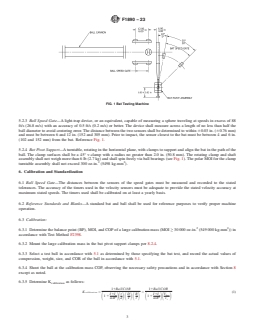
between 5 to 10° from its start position. The second sensor shall trigger 30 to 35° after the first sensor. Reference Fig. 1.
5.2.2.1 Optional Bat Speed Sensor—Device to measure bat rotational speed for at least 100° after impact. Device shall read speeds
up to 3000°/s with an accuracy of at least 1°/s (found to be achievable using an optical encoder). Bat speed is taken from the slope
of the linear least-squares fit to the bat rotation angle versus time data between 5 and 95° after impact.
F1890 − 23
FIG. 1 Bat Testing Machine
5.2.3 Ball Speed Gate—A light-trap device, or an equivalent, capable of measuring a sphere traveling at speeds in excess of 88
ft/s (26.8 m/s) with an accuracy of 0.5 ft/s (0.2 m/s) or better. The device shall measure across a length of no less than half the
ball diameter to avoid centering error. The distance between the two sensors shall be determined to within 60.03 in. (60.76 mm)
and must be between 6 and 12 in. (152 and 305 mm). Prior to impact, the sensor closest to the bat must be between 4 and 6 in.
(102 and 152 mm) from the bat. Reference Fig. 1.
5.2.4 Bat Pivot Support—A turntable, rotating in the horizontal plane, with clamps to support and align the bat in the path of the
ball. The clamp surfaces shall be a 45° v-clamp with a radius no greater than 2.0 in. (50.8 mm). The rotating clamp and shaft
assembly shall not weigh more than 6 lb (2.7 kg) and shall spin freely via ball bearings (see Fig. 1). The polar MOI for the clamp
2 2
turntable assembly shall not exceed 300 oz-in. (5498 kg-mm ).
6. Calibration and Standardization
6.1 Ball Speed Gate—The distances between the sensors of the speed gates must be measured and recorded to the stated
tolerances. The accuracy of the timers used in the velocity sensors must be adequate to provide the stated velocity accuracy at
maximum stated speeds. The timers used shall be calibrated on at least a yearly basis.
6.2 Reference Standards and Blanks—A standard bat and ball shall be used for reference purposes to verify proper machine
operation.
6.3 Calibration:
2 2
6.3.1 Determine the balance point (BP), MOI, and COP of a large calibration mass (MOI ≥ 30 000 oz-in. (549 000 kg-mm )) in
accordance with Test Method F2398.
6.3.2 Mount the large calibration mass in the bat pivot support clamps per 8.2.4.
6.3.3 Select a test ball in accordance with 5.1 as determined by those specifying the bat test, and record the actual values of
compression, weight, size, and COR of the ball in accordance with 5.1.
6.3.4 Shoot the ball at the calibration mass COP, observing the necessary safety precautions and in accordance with Section 8
except as noted.
6.3.5 Determine K as follows:
calibration
11BallCOR 11BallCOR
K 5 5 (1)
calibration
I1I t D R I1I V
p p bat
1 1 1 1
S DS DS DS D S DS D
2 2
mR d T r mR v
i
F1890 − 23
where:
Ball COR = ball COR (Test Method F1887) of the ball used in each impact,
2 2
I = moment of inertia (MOI) of mass, Test Method F2398, oz-in. (kg-m ),
2 2
I = moment of inertia (MOI) of bat pivot, oz-in. (kg-m ),
p
R = COP distance, Test Method F2398, in. (m),
r = radius to bat speed sensors, in. (m),
T = time for bat to travel through bat speed sensors, s,
t = time for ball to travel through ball speed sensors, s,
D = distance between bat speed sensors, in. (m),
d = distance between ball speed sensors, in. (m),
v = ball inbound speed, in./s (m/s),
i
V = bat recoiling speed at the impact location, in./s (m/s), and
bat
m = weight of the test bal
...