

ASTM F2278-19(2023)
(Test Method)Standard Test Method for Evaluating Paintball Barrier Netting
General Information
- Abstract
SIGNIFICANCE AND USE
4.1 This method is performed to evaluate if paintball barrier netting will prevent an intact paintball or shell fragments exceeding 3 by 5 mm (0.118 by 0.197 in.) from passing through the netting.
4.2 This test method provides accurate results about the current effectiveness of the test specimen when field-tested in an existing installation. Laboratory results are particularly useful for testing the relative effectiveness of multiple test specimens.
4.3 The results stemming from the use of this test method may be used to evaluate the effectiveness of paintball barrier netting represented by the test specimen for use in delineating “goggles-on” areas found at paintball playing fields.
4.4 The base procedure outlined below is applicable to “field-testing.” Additional requirements for “laboratory” testing are noted.
SCOPE
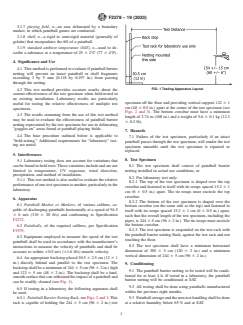
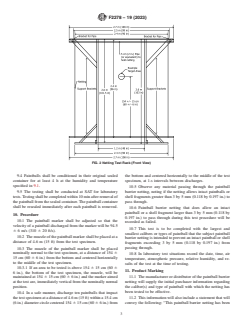
1.1 This test method is designed to evaluate paintball barrier netting that may be used to delineate playing fields, chronograph areas, target ranges, and other “goggle-on” areas of an active paintball site. An apparatus is suggested to evaluate paintball barrier netting in a laboratory. On site testing does not require such an apparatus.
1.2 This standard is designed to be used in conjunction with Guide F2184.
1.3 The values stated in SI units are to be regarded as the standard; the inch-pound units in parentheses are provided for information only.
1.4 This standard does not purport to address all of the safety concerns, if any, associated with its use. It is the responsibility of the user of this standard to establish appropriate safety, health, and environmental practices and determine the applicability of regulatory limitations prior to use.
1.5 This international standard was developed in accordance with internationally recognized principles on standardization established in the Decision on Principles for the Development of International Standards, Guides and Recommendations issued by the World Trade Organization Technical Barriers to Trade (TBT) Committee.
- Status
- Published
- Publication Date
- 31-Mar-2023
- Technical Committee
- F08 - Sports Equipment, Playing Surfaces, and Facilities
- Drafting Committee
- F08.24 - Paintball and Equipment

Overview
ASTM F2278-19(2023), Standard Test Method for Evaluating Paintball Barrier Netting, is an internationally recognized standard developed by ASTM International. This test method provides a comprehensive procedure to determine whether paintball barrier netting effectively prevents an intact paintball or significant shell fragments from passing through. The standard is designed to support safety at paintball facilities by ensuring only qualified barrier netting is used to delineate high-risk areas where eye protection, such as goggles, is mandatory.
This document serves manufacturers, facility operators, and safety inspectors by delivering consistent, reliable field and laboratory testing guidance. It helps verify the current effectiveness of paintball netting installations and enables comparison among different netting products under controlled conditions.
Key Topics
- Barrier Netting Effectiveness: The test evaluates whether netting can stop whole paintballs or shell fragments larger than 3 by 5 mm (0.118 by 0.197 in.) from penetrating.
- Field and Laboratory Testing: Provides procedures for evaluating installed netting on-site and for comparing multiple netting specimens in a controlled laboratory environment.
- Safety Assurance: Supports risk management in “goggles-on” areas, such as paintball playing fields, chronograph stations, and target ranges.
- Reference to Related Standards: Used in conjunction with ASTM F2184 (Guide for Installation of Paintball Barrier Netting) and other relevant ASTM specifications for paintballs and markers.
- Environmental Considerations: Notes that laboratory and field testing conditions may differ due to environmental factors such as temperature, humidity, and UV exposure.
Applications
- Paintball Field Operators: Ensures the protective netting installed at playing fields, spectator zones, and target ranges is capable of preventing paintball and fragment passage, enhancing overall facility safety.
- Netting Manufacturers and Distributors: Provides a standard method to test, certify, and market paintball barrier netting products. Certified netting must meet or exceed ASTM F2278 to be deemed effective.
- Regulatory Compliance: Assists authorities and inspectors in verifying that safety regulations regarding barrier netting at paintball sites are met.
- Comparative Product Evaluation: Laboratory testing allows facilities and purchasers to objectively compare different barrier netting products for performance and quality assurance.
- Maintenance and Upkeep: Helps determine when installed netting requires repair or replacement due to failure during standardized testing procedures.
Related Standards
- ASTM F2184 - Guide for Installation of Paintball Barrier Netting. Complements F2278 by detailing proper installation methods to maintain protective performance.
- ASTM F1979 - Specification for Projectiles Used in the Sport of Paintball. Defines the requirements for paintballs used in barrier netting evaluations.
- ASTM F2272 - Specification for Paintball Markers. Outlines the standards for markers used during netting testing.
- World Trade Organization (WTO) TBT Principles - Ensures harmonization with international standardization best practices.
Practical Value
Implementing ASTM F2278-19(2023) significantly increases safety in paintball environments by establishing a reliable, repeatable method for barrier netting evaluation. Adhering to this standard helps:
- Protect spectators, staff, and bystanders from stray paintballs and fragments.
- Maintain compliance with safety governing bodies.
- Build trust with players and visitors by demonstrating commitment to recognized safety procedures.
- Streamline incident response and maintenance decisions through objective test outcomes.
Correct application of this standard-aligned with installation guidance from ASTM F2184-ensures that paintball facilities operate with the highest levels of safety and product reliability.
Relations
- Effective Date
- 01-May-2014
- Effective Date
- 01-May-2014
- Effective Date
- 01-May-2013
- Effective Date
- 01-Jul-2012
- Effective Date
- 01-May-2011
- Effective Date
- 01-Jul-2010
- Effective Date
- 01-Jul-2010
- Effective Date
- 01-Feb-2010
- Effective Date
- 01-Nov-2009
- Effective Date
- 01-Nov-2009
- Effective Date
- 01-Jun-2009
- Effective Date
- 15-Jul-2008
- Effective Date
- 01-Nov-2004
- Effective Date
- 10-Jun-2003
- Effective Date
- 10-May-2002
Frequently Asked Questions
ASTM F2278-19(2023) is a standard published by ASTM International. Its full title is "Standard Test Method for Evaluating Paintball Barrier Netting". This standard covers: SIGNIFICANCE AND USE 4.1 This method is performed to evaluate if paintball barrier netting will prevent an intact paintball or shell fragments exceeding 3 by 5 mm (0.118 by 0.197 in.) from passing through the netting. 4.2 This test method provides accurate results about the current effectiveness of the test specimen when field-tested in an existing installation. Laboratory results are particularly useful for testing the relative effectiveness of multiple test specimens. 4.3 The results stemming from the use of this test method may be used to evaluate the effectiveness of paintball barrier netting represented by the test specimen for use in delineating “goggles-on” areas found at paintball playing fields. 4.4 The base procedure outlined below is applicable to “field-testing.” Additional requirements for “laboratory” testing are noted. SCOPE 1.1 This test method is designed to evaluate paintball barrier netting that may be used to delineate playing fields, chronograph areas, target ranges, and other “goggle-on” areas of an active paintball site. An apparatus is suggested to evaluate paintball barrier netting in a laboratory. On site testing does not require such an apparatus. 1.2 This standard is designed to be used in conjunction with Guide F2184. 1.3 The values stated in SI units are to be regarded as the standard; the inch-pound units in parentheses are provided for information only. 1.4 This standard does not purport to address all of the safety concerns, if any, associated with its use. It is the responsibility of the user of this standard to establish appropriate safety, health, and environmental practices and determine the applicability of regulatory limitations prior to use. 1.5 This international standard was developed in accordance with internationally recognized principles on standardization established in the Decision on Principles for the Development of International Standards, Guides and Recommendations issued by the World Trade Organization Technical Barriers to Trade (TBT) Committee.
SIGNIFICANCE AND USE 4.1 This method is performed to evaluate if paintball barrier netting will prevent an intact paintball or shell fragments exceeding 3 by 5 mm (0.118 by 0.197 in.) from passing through the netting. 4.2 This test method provides accurate results about the current effectiveness of the test specimen when field-tested in an existing installation. Laboratory results are particularly useful for testing the relative effectiveness of multiple test specimens. 4.3 The results stemming from the use of this test method may be used to evaluate the effectiveness of paintball barrier netting represented by the test specimen for use in delineating “goggles-on” areas found at paintball playing fields. 4.4 The base procedure outlined below is applicable to “field-testing.” Additional requirements for “laboratory” testing are noted. SCOPE 1.1 This test method is designed to evaluate paintball barrier netting that may be used to delineate playing fields, chronograph areas, target ranges, and other “goggle-on” areas of an active paintball site. An apparatus is suggested to evaluate paintball barrier netting in a laboratory. On site testing does not require such an apparatus. 1.2 This standard is designed to be used in conjunction with Guide F2184. 1.3 The values stated in SI units are to be regarded as the standard; the inch-pound units in parentheses are provided for information only. 1.4 This standard does not purport to address all of the safety concerns, if any, associated with its use. It is the responsibility of the user of this standard to establish appropriate safety, health, and environmental practices and determine the applicability of regulatory limitations prior to use. 1.5 This international standard was developed in accordance with internationally recognized principles on standardization established in the Decision on Principles for the Development of International Standards, Guides and Recommendations issued by the World Trade Organization Technical Barriers to Trade (TBT) Committee.
ASTM F2278-19(2023) is classified under the following ICS (International Classification for Standards) categories: 97.220.40 - Outdoor and water sports equipment. The ICS classification helps identify the subject area and facilitates finding related standards.
ASTM F2278-19(2023) has the following relationships with other standards: It is inter standard links to ASTM F1979-10(2014), ASTM F2184-10(2014), ASTM F2272-13, ASTM F2272-12, ASTM F2272-11, ASTM F2272-10, ASTM F1979-10, ASTM F2184-10, ASTM F2272-09, ASTM F2184-09, ASTM F1979-09, ASTM F2272-08, ASTM F1979-04, ASTM F2272-03, ASTM F2184-02. Understanding these relationships helps ensure you are using the most current and applicable version of the standard.
ASTM F2278-19(2023) is available in PDF format for immediate download after purchase. The document can be added to your cart and obtained through the secure checkout process. Digital delivery ensures instant access to the complete standard document.
Standards Content (Sample)
This international standard was developed in accordance with internationally recognized principles on standardization established in the Decision on Principles for the
Development of International Standards, Guides and Recommendations issued by the World Trade Organization Technical Barriers to Trade (TBT) Committee.
Designation: F2278 − 19 (Reapproved 2023) An American National Standard
Standard Test Method for
Evaluating Paintball Barrier Netting
This standard is issued under the fixed designation F2278; the number immediately following the designation indicates the year of
original adoption or, in the case of revision, the year of last revision. A number in parentheses indicates the year of last reapproval. A
superscript epsilon (´) indicates an editorial change since the last revision or reapproval.
INTRODUCTION
This standard is intended to provide a basic test method that would allow the user to determine the
effectiveness of paintball barrier netting. The use of safe paintball barrier netting at paintball playing
facilities is critical to protect non-players from accidental impact of a paintball.
This specification is written within the current state-of-the-art of paintball barrier netting
technology. The intent is to revise this specification whenever substantive information becomes
available which justifies revising existing requirements or adding new requirements.
1. Scope 2. Referenced Documents
2.1 ASTM Standards:
1.1 This test method is designed to evaluate paintball barrier
F1979 Specification for Projectiles Used in the Sport of
netting that may be used to delineate playing fields, chrono-
Paintball
graph areas, target ranges, and other “goggle-on” areas of an
F2184 Guide for Installation of Paintball Barrier Netting
active paintball site. An apparatus is suggested to evaluate
F2272 Specification for Paintball Markers
paintball barrier netting in a laboratory. On site testing does not
require such an apparatus.
3. Terminology
1.2 This standard is designed to be used in conjunction with 3.1 Definitions of Terms Specific to This Standard:
Guide F2184. 3.1.1 caliber, n—the term used to refer to the size of a
paintball projectile. Related to the measurement of the diam-
1.3 The values stated in SI units are to be regarded as the
eter of the paintball as described in Specification F1979.
standard; the inch-pound units in parentheses are provided for
3.1.2 “goggles-on” area, n—areas in which all persons are
information only.
required to wear paintball goggles, such as and not limited to
1.4 This standard does not purport to address all of the
playing fields, game areas, chronograph areas, and target
safety concerns, if any, associated with its use. It is the
ranges.
responsibility of the user of this standard to establish appro-
3.1.3 muzzle, n—the end of the paintball marker through
priate safety, health, and environmental practices and deter-
which the paintball is discharged, also referred to as the end of
mine the applicability of regulatory limitations prior to use.
the barrel.
1.5 This international standard was developed in accor-
3.1.4 paintball, n—a projectile comprised of a shell and a
dance with internationally recognized principles on standard-
fill, designed to be expelled from a paintball marker and
ization established in the Decision on Principles for the
conforms to Specification F1979.
Development of International Standards, Guides and Recom-
3.1.5 paintball barrier netting, n—netting used in the sport
mendations issued by the World Trade Organization Technical
of paintball as a protective barrier.
Barriers to Trade (TBT) Committee.
3.1.6 paintball marker, n—a device specifically designed to
discharge paintballs. The device is sometimes referred to as a
paintball gun.
This test method is under the jurisdiction of ASTM Committee F08 on Sports
Equipment, Playing Surfaces, and Facilities and is the direct responsibility of
Subcommittee F08.24 on Paintball and Equipment. For referenced ASTM standards, visit the ASTM website, www.astm.org, or
Current edition approved April 1, 2023. Published April 2023. Originally contact ASTM Customer Service at service@astm.org. For Annual Book of ASTM
approved in 2003. Last previous edition approved in 2019 as F2278 – 19. DOI: Standards volume information, refer to the standard’s Document Summary page on
10.1520/F2278-19R23. the ASTM website.
Copyright © ASTM International, 100 Barr Harbor Drive, PO Box C700, West Conshohocken, PA 19428-2959. United States
F2278 − 19 (2023)
3.1.7 playing field, n—an area delineated by a boundary
marker, in which paintball games are conducted.
3.1.8 shell, n—a rigid to semi-rigid material (generally of
gelatin) that encapsulates the fill of a paintball.
3.1.9 standard ambient temperature (SAT), n—used to de-
scribe a substance at a temperature of 25 6 2°C (77 6 4°F).
4. Significance and Use
4.1 This method is performed to evaluate if paintball barrier
netting will prevent an intact paintball or shell fragments
exceeding 3 by 5 mm (0.118 by 0.197 in.) from passing
through the netting.
FIG. 1 Testing Apparatus Layout
4.2 This test method provides accurate results about the
current effectiveness of the test specimen when field-tested in
an existing installation. Laboratory results are particularly
specimen off the floor and providing vertical support 122 6 1
useful for testing the relative effectiveness of multiple test
cm (48 6 0.5 in.) apart at the center of the test specimen (see
specimens.
Figs. 2 and 3). The bottom crossbar must have a minimum
4.3 The results stemming from the use of this test method
length of 2.74 m (108 in.) and a weight of 5.6 6 0.1 kg (12.3
may be used to evaluate the effectiveness of paintball barrier
6 0.2 lb).
netting represented by the test specimen for use in delineating
“goggles-on” areas found at paintball playing fields.
7. Hazards
4.4 The base procedure outlined below is applicable to
7.1 Failure of the test specimen, particularly if an intact
“field-testing.” Additional requirements for “laboratory” test-
paintball passes through the test specimen, will render the test
ing are noted.
specimen unusable until the test specimen is repaired or
replaced.
5. Interferences
8. Test Specimen
5.1 Laboratory testing does not account for variations that
can be found in field tests. These variations include and are not
8.1 The test specimen shall consist of paintball barrier
limited to temperature, UV exposure, wind direction,
netting installed in actual use conditions, or
precipitation, and method of installation.
8.2 For laboratory test only:
5.1.1 This test method is also useful to evaluate the relative
8.2.1 The top of the test specimen is draped over the top
performance of one test specimen to another, particularly in the
crossbar and fastened to itself with tie-wraps spaced 15.2 6 1
laboratory.
cm (6 6 0.5 in.) apart. The tie-wraps must encircle the top
crossbar.
6.
...