

ASTM F2272-23
(Specification)Standard Specification for Paintball Markers
General Information
- Abstract
ABSTRACT
This specification covers the performance requirements and test methods for paintball markers that propel paintballs using energy released from compressed air, compressed gas, or a combination of compressed air and gas. This does not cover non-recreational paintball markers such as those used in law enforcement, scientific, military or theatrical entities. All paintball markers should be supplied with appropriate literature, packaging, finish, design, and disabling device and shipped according to the specified shipping conditions. Under no circumstances should the cocking or pumping mechanism of a paintball marker cause a marker to discharge unintentionally while the marker is being cocked in accordance to instructions. Markers should not accidentally discharge when exposed to jolts strengths within the specified range.
SCOPE
1.1 This specification covers paintball markers, which propel a paintball by means of energy released by compressed air, compressed gas, or other means.
1.2 Limitations—This specification does not cover non-recreational paintball markers, for example, those used by law enforcement, scientific, military or theatrical entities.
1.3 The values stated in SI units are to be regarded as the standard; the inch-pound units in parentheses are provided for information only.
1.4 The following precautionary caveat pertains only to the test method portion, Section 8, of this specification. This standard does not purport to address all of the safety concerns, if any, associated with its use. It is the responsibility of the user of this standard to establish appropriate safety, health, and environmental practices and determine the applicability of regulatory limitations prior to use.
1.5 This international standard was developed in accordance with internationally recognized principles on standardization established in the Decision on Principles for the Development of International Standards, Guides and Recommendations issued by the World Trade Organization Technical Barriers to Trade (TBT) Committee.
- Status
- Published
- Publication Date
- 31-May-2023
- Technical Committee
- F08 - Sports Equipment, Playing Surfaces, and Facilities
- Drafting Committee
- F08.24 - Paintball and Equipment
Overview
ASTM F2272-23: Standard Specification for Paintball Markers establishes the minimum performance requirements, test methods, and safety guidelines for recreational paintball markers. These markers use compressed air, gas, or a combination to propel paintballs. The standard ensures that paintball markers are designed, produced, packaged, and labeled with safety and performance in mind for recreational use, excluding law enforcement, scientific, military, or theatrical applications.
This ASTM specification is critical for manufacturers, distributors, retailers, and end-users involved in the paintball industry. It underlines safe operation, robust design, and clear labeling to help minimize risks and ensure a positive, injury-free experience.
Key Topics
Performance Criteria
- Paintball markers must not discharge unintentionally during cocking or pumping.
- All disabling devices (such as safeties) must prevent trigger activation under a specific force (13.6 kg/30 lb).
- Markers must withstand accidental jolts without firing, according to set test procedures.
Design and Construction
- Exposed triggers must include a guard for user protection.
- Markers must be robust enough to withstand specified input pressures, particularly if designed for refillable cylinders.
- Only specified firing modes are permitted, restricting the potential for unsafe modifications.
Packaging and Labeling
- Each marker must ship degassed and unloaded with a velocity below 91.44 m/s (300 ft/s).
- Literature with cautionary statements, operating instructions, and safety warnings must be included with every product.
- Packaging must display warnings, age recommendations, and instructions as specified by the standard.
- A barrel blocking device must be provided to prevent accidental discharge during transport and storage.
Markings and Warnings
- Permanent and conspicuous warnings on the marker itself, including a clear “WARNING” label.
- Safety and operational markings, including "safe" and "fire" positions for disabling devices.
- All warnings must follow ANSI Z535.1 safety color codes and be prominent on packaging and in literature.
Applications
ASTM F2272-23 applies to:
- Paintball marker manufacturers: As a benchmark for product development, design validation, and quality assurance.
- Distributors and retailers: To ensure compliance with safety labeling and packaging requirements for all paintball markers sold.
- Paintball field operators: For safety checks, user education, and confirmation of marker compliance before field use.
- Consumers: Providing clear safety, operational, and maintenance instructions, reducing misuse and enhancing safety.
Compliance with ASTM F2272-23 supports product liability defense, improves consumer trust, and elevates the overall safety standards in paintball sports.
Related Standards
- ASTM F1776: Specification for Eye Protective Devices for Paintball Sports - covers protective eyewear requirements for paintball participants.
- ASTM F1979: Specification for Paintball Projectiles - defines requirements for the paintballs themselves, including caliber and construction.
- ANSI Z535.1: Safety Color Code - provides guidance on color schemes for clear and effective safety communications.
Following ASTM F2272-23 and its related standards is essential for advancing safety, quality, and performance in the recreational paintball industry. By meeting these specifications, manufacturers, distributors, and users contribute to a safer and more enjoyable paintball experience.
Relations
- Effective Date
- 01-Jul-2018
- Effective Date
- 15-Nov-2016
- Effective Date
- 01-Sep-2014
- Effective Date
- 01-May-2014
- Effective Date
- 01-Jul-2012
- Effective Date
- 01-Jul-2010
- Effective Date
- 01-Jul-2010
- Effective Date
- 01-Jun-2009
- Effective Date
- 01-Feb-2009
- Effective Date
- 01-Nov-2004
- Effective Date
- 10-May-2001
- Effective Date
- 10-May-2001
- Effective Date
- 10-Jun-1999
Frequently Asked Questions
ASTM F2272-23 is a technical specification published by ASTM International. Its full title is "Standard Specification for Paintball Markers". This standard covers: ABSTRACT This specification covers the performance requirements and test methods for paintball markers that propel paintballs using energy released from compressed air, compressed gas, or a combination of compressed air and gas. This does not cover non-recreational paintball markers such as those used in law enforcement, scientific, military or theatrical entities. All paintball markers should be supplied with appropriate literature, packaging, finish, design, and disabling device and shipped according to the specified shipping conditions. Under no circumstances should the cocking or pumping mechanism of a paintball marker cause a marker to discharge unintentionally while the marker is being cocked in accordance to instructions. Markers should not accidentally discharge when exposed to jolts strengths within the specified range. SCOPE 1.1 This specification covers paintball markers, which propel a paintball by means of energy released by compressed air, compressed gas, or other means. 1.2 Limitations—This specification does not cover non-recreational paintball markers, for example, those used by law enforcement, scientific, military or theatrical entities. 1.3 The values stated in SI units are to be regarded as the standard; the inch-pound units in parentheses are provided for information only. 1.4 The following precautionary caveat pertains only to the test method portion, Section 8, of this specification. This standard does not purport to address all of the safety concerns, if any, associated with its use. It is the responsibility of the user of this standard to establish appropriate safety, health, and environmental practices and determine the applicability of regulatory limitations prior to use. 1.5 This international standard was developed in accordance with internationally recognized principles on standardization established in the Decision on Principles for the Development of International Standards, Guides and Recommendations issued by the World Trade Organization Technical Barriers to Trade (TBT) Committee.
ABSTRACT This specification covers the performance requirements and test methods for paintball markers that propel paintballs using energy released from compressed air, compressed gas, or a combination of compressed air and gas. This does not cover non-recreational paintball markers such as those used in law enforcement, scientific, military or theatrical entities. All paintball markers should be supplied with appropriate literature, packaging, finish, design, and disabling device and shipped according to the specified shipping conditions. Under no circumstances should the cocking or pumping mechanism of a paintball marker cause a marker to discharge unintentionally while the marker is being cocked in accordance to instructions. Markers should not accidentally discharge when exposed to jolts strengths within the specified range. SCOPE 1.1 This specification covers paintball markers, which propel a paintball by means of energy released by compressed air, compressed gas, or other means. 1.2 Limitations—This specification does not cover non-recreational paintball markers, for example, those used by law enforcement, scientific, military or theatrical entities. 1.3 The values stated in SI units are to be regarded as the standard; the inch-pound units in parentheses are provided for information only. 1.4 The following precautionary caveat pertains only to the test method portion, Section 8, of this specification. This standard does not purport to address all of the safety concerns, if any, associated with its use. It is the responsibility of the user of this standard to establish appropriate safety, health, and environmental practices and determine the applicability of regulatory limitations prior to use. 1.5 This international standard was developed in accordance with internationally recognized principles on standardization established in the Decision on Principles for the Development of International Standards, Guides and Recommendations issued by the World Trade Organization Technical Barriers to Trade (TBT) Committee.
ASTM F2272-23 is classified under the following ICS (International Classification for Standards) categories: 97.220.40 - Outdoor and water sports equipment. The ICS classification helps identify the subject area and facilitates finding related standards.
ASTM F2272-23 has the following relationships with other standards: It is inter standard links to ASTM F1776-18, ASTM F1776-16, ASTM F1776-14, ASTM F1979-10(2014), ASTM F1776-12, ASTM F1979-10, ASTM F1776-10, ASTM F1979-09, ASTM F1776-09, ASTM F1979-04, ASTM F1776-01, ASTM F1776-99a, ASTM F1979-99. Understanding these relationships helps ensure you are using the most current and applicable version of the standard.
ASTM F2272-23 is available in PDF format for immediate download after purchase. The document can be added to your cart and obtained through the secure checkout process. Digital delivery ensures instant access to the complete standard document.
Standards Content (Sample)
This international standard was developed in accordance with internationally recognized principles on standardization established in the Decision on Principles for the
Development of International Standards, Guides and Recommendations issued by the World Trade Organization Technical Barriers to Trade (TBT) Committee.
Designation: F2272 − 23 An American National Standard
Standard Specification for
Paintball Markers
This standard is issued under the fixed designation F2272; the number immediately following the designation indicates the year of
original adoption or, in the case of revision, the year of last revision. A number in parentheses indicates the year of last reapproval. A
superscript epsilon (´) indicates an editorial change since the last revision or reapproval.
1. Scope 3. Terminology
1.1 This specification covers paintball markers, which pro- 3.1 Definitions of Terms Specific to This Standard:
pel a paintball by means of energy released by compressed air,
3.1.1 auto-trigger—a trigger which, when held in the dis-
compressed gas, or other means.
charge position, will automatically cause the paintball marker
to discharge when the pump or bolt action is manipulated.
1.2 Limitations—This specification does not cover non-
recreational paintball markers, for example, those used by law
3.1.2 backstop—an object intended to stop a paintball.
enforcement, scientific, military or theatrical entities.
3.1.3 barrel—that portion of a paintball marker through
1.3 The values stated in SI units are to be regarded as the
which the paintball is discharged.
standard; the inch-pound units in parentheses are provided for
3.1.4 barrel blocking device—a muzzle blocking safety
information only.
device which, when properly installed, reduces the likelihood
1.4 The following precautionary caveat pertains only to the
of an intact paintball discharging from the marker or leaving
test method portion, Section 8, of this specification. This
the confines of the barrel blocking device. The device is often
standard does not purport to address all of the safety concerns,
referred to as a barrel plug or barrel bag.
if any, associated with its use. It is the responsibility of the user
3.1.5 burst mode marker—a burst mode marker may dis-
of this standard to establish appropriate safety, health, and
charge two or more times per trigger cycle or may discharge
environmental practices and determine the applicability of
two or more times with the pull and release of the trigger.
regulatory limitations prior to use.
1.5 This international standard was developed in accor-
3.1.6 caliber—the term used to refer to the size of a
dance with internationally recognized principles on standard-
paintball projectile. Related to the measurement of the diam-
ization established in the Decision on Principles for the
eter of the paintball as described in Specification F1979.
Development of International Standards, Guides and Recom-
3.1.7 cautionary statement—the warning outlined in Section
mendations issued by the World Trade Organization Technical
8 of this standard, which is to be placed on paintball markers,
Barriers to Trade (TBT) Committee.
packaging and literature.
2. Referenced Documents
3.1.8 de-gassed, n—the state of the marker in which the
propellant source and any internal propellant has been removed
2.1 ASTM Standards:
from the marker.
F1776 Specification for Eye Protective Devices for Paintball
Sports
3.1.9 disabling device—a device which, when activated,
F1979 Specification for Projectiles Used in the Sport of
disables a part of the paintball marker, usually the trigger, to
Paintball
prevent unintentional discharges and must be released to allow
2.2 ANSI Standard:
the marker to be discharged by the movement of the trigger.
Z535.1 Safety Color Code
The device is sometimes referred to as the “safety,” “safety
button,” or “safety lever.” An electronic on/off switch is
1 considered a disabling device when placing it in the “off”
This specification is under the jurisdiction of ASTM Committee F08 on Sports
Equipment, Playing Surfaces, and Facilities and is the direct responsibility of
position renders the marker inoperable.
Subcommittee F08.24 on Paintball and Equipment.
3.1.10 discharge mode—a mode that controls the number of
Current edition approved June 1, 2023. Published June 2023. Originally
approved in 2003. Last previous edition approved in 2021 as F2272 – 13 (2021).
paintballs discharged per trigger cycle.
DOI: 10.1520/F2272-23.
3.1.11 enhanced trigger mode marker—a paintball marker
For referenced ASTM standards, visit the ASTM website, www.astm.org, or
contact ASTM Customer Service at service@astm.org. For Annual Book of ASTM
that at some point discharges more than one paintball per
Standards volume information, refer to the standard’s Document Summary page on
trigger cycle. This includes markers that “store” the number of
the ASTM website.
trigger pulls and discharge more than one paintball at some
Available from American National Standards Institute (ANSI), 25 W. 43rd St.,
4th Floor, New York, NY 10036. point.
Copyright © ASTM International, 100 Barr Harbor Drive, PO Box C700, West Conshohocken, PA 19428-2959. United States
F2272 − 23
3.1.12 feed mechanism—a mechanism that stores, transports 3.1.20 pump mode marker—a marker that requires the
and facilitates the loading of paintballs. It may be gravity, operator to manually cock or engage the sear of the marker
mechanically or air assisted or automatic in its actions.
before each shot by a means of a pump, bolt, lever, cocking
handle or similar device.
3.1.13 fully-automatic mode marker—a marker that dis-
charges when the triggering device is actuated and continues to
3.1.21 range—the maximum distance to which an object
discharge until the trigger returns to its reset or recycle
may be propelled, whether limited by energy or an obstacle.
position.
3.1.22 response trigger—a semi-automatic paintball marker
3.1.14 hopper—a device used with a paintball marker to
in which after firing the trigger is assisted back to the reset
store paintballs.
position.
3.1.15 impact tester—device used to test for accidental
3.1.23 sear—the catch that holds the mechanism in the
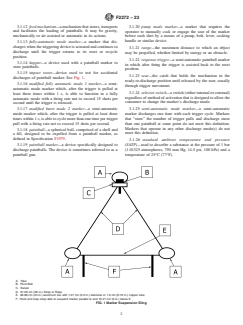
discharges of paintball marker. See Fig. 1.
ready-to-discharge position until released by the user, usually
3.1.16 modified fully automatic mode 1 marker—a semi-
through trigger movement.
automatic mode marker which, after the trigger is pulled at
3.1.24 selector switch—a switch (either internal or external)
least three times within 1 s, is able to function in a fully
regardless of method of activation that is designed to allow the
automatic mode with a firing rate not to exceed 15 shots per
consumer to change the marker’s discharge mode.
second until the trigger is released.
3.1.17 modified burst mode 2 marker—a semi-automatic 3.1.25 semi-automatic mode marker—a semi-automatic
mode marker which, after the trigger is pulled at least three
marker discharges one time with each trigger cycle. Markers
times within 1 s, is able to cycle more than one time per trigger that “store” the number of trigger pulls and discharge more
pull with a firing rate not to exceed 15 shots per second.
than one paintball at some point do not meet this definition.
Markers that operate in any other discharge mode(s) do not
3.1.18 paintball—a spherical ball, comprised of a shell and
meet this definition.
a fill, designed to be expelled from a paintball marker, as
defined in Specification F1979.
3.1.26 standard ambient temperature and pressure
3.1.19 paintball marker—a device specifically designed to (SATP)—used to describe a substance at the pressure of 1 bar
discharge paintballs. The device is sometimes referred to as a (1.01325 atmospheres, 750 mm Hg, 14.5 psi, 100 kPa) and a
paintball gun. temperature of 25°C (77°F).
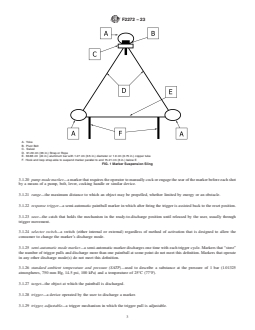
A. Yoke
B. Pivot Bolt
C. Swivel
D. 91.29 cm (36 in.) Strap or Rope
E. 60.86 cm (24 in.) aluminum bar with 1.27 cm (0.5 in.) diameter or 1.9 cm (0.75 in.) copper tube
F. Hook and loop strap able to suspend marker parallel to and 15.21 cm (6 in.) below E
FIG. 1 Marker Suspension Sling
F2272 − 23
3.1.27 target—the object at which the paintball is dis- 6.5 Design:
charged. 6.5.1 All paintball markers with an exposed trigger shall
have a trigger guard.
3.1.28 trigger—a device operated by the user to discharge a
6.5.2 All paintball markers intended to be used with refill-
marker.
able cylinders shall be able to withstand input pressure of three
3.1.29 trigger, adjustable—a trigger mechanism in which
thousand pounds per square inch 207 bar (3000 psi) without
the trigger pull is adjustable.
catastrophic failure. Leaking in a manner which would not
3.1.30 trigger cycle—the movement of the trigger through
cause injury to the operator shall not constitute failure.
discharge and returning to a reset or recycle position.
6.5.3 A marker’s performance may not be enhanced, includ-
3.1.31 trigger, double-action—a trigger mechanism in ing but not limited to increasing the markers’ velocity, without
the use of tools or the need for disassembly. In the event that
which a single continuous action of the trigger moves the
hammer to the discharging position and then releases it to a marker requires an internal switch, jumper or other device to
be set prior to using outside adjustments, it will be considered
discharge the paintball.
to meet this requirement provided that tools or disassembly are
3.1.32 trigger guard—a rigid, firmly attached component. It
required to access the switch, jumper or similar device.
must totally enclose the trigger area and be wider than the
6.5.4 All paintball markers shall only operate in pump,
trigger. There can be no more than 38 mm (1.5 in.) of space
semi-automatic, modified fully automatic mode 1, or modified
from any point on the face of the trigger to the trigger guard,
burst mode 2, response trigger, or a combination thereof, as
and no more than 13 mm (0.5 in.) from the lowest point of the
defined in this standard.
trigger to the trigger guard. All measurements under this rule
are to be taken after excluding any removable attachments to
7. Performance Requirements
the trigger.
7.1 Marker Function—The cocking or pumping mechanism
3.1.33 trigger pull—the force required to move the trigger
of a paintball marker shall not cause a marker to discharge
from its start or recycle/reset position to a position that
unintentionally while a marker is being cocked in accordance
discharges the marker.
with the manufacturer’s instructions. This does not limit the
3.1.34 velocity adjuster—a device designed to establish the
use of “auto-triggers.” Markers shall be pump, semi-automatic,
velocity at which a paintball is discharged.
modified fully automatic mode 1, or modified burst mode 2,
response trigger, or a combination thereof, as defined in this
4. Significance and Use
standard.
4.1 This specification establishes performance requirements
7.2 Gas Propellant Source Retention—Markers shall be
and test methods for paintball markers.
designed so that a gas propellant source does not inadvertently
4.2 This specification identifies the minimum warnings and
eject from the marker during use or otherwise.
instructions that are to be provided in literature, on labels, on
7.3 Disabling Device—Disabling devices shall be provided
packaging and on the marker itself.
on all paintball markers and all such devices can be ended
5. Conformance
whether or not the marker is cocked. All such devices shall be
5.1 Paintball markers shall not, either by label or other clearly marked to indicate the “safe” and “fire” or “on” and
means, indicate conformance with this specification unless, at “off” positions in accordance with 8.6.4. All such devices shall
be capable of preventing the markers from being discharged
the time of manufacture, they conform with all applicable
requirements contained herein. when a weight of 13.6 kg (30 lb) is applied to the trigger. Tests
shall be conducted in accordance with 8.3.
6. General Requirements
7.4 Accidental Discharge—Markers should not accidentally
6.1 Literature—Literature shall be provided with each paint-
discharge when exposed to a moderate jolt in accordance with
ball marker and shall include, as applicable, the instructions,
8.3.
cautionary statements and safety tips specified in Section 8.
8. Test Methods
6.2 Packaging:
6.2.1 Packaging shall be labeled in a prominent and con-
8.1 No precision statement on any of the following test
spicuous manner in accordance with the provisions of 8.5.
methods is available at this time.
6.2.2 All paintball markers that include a barrel must be
8.2 Disabling Device Test:
packaged with a barrel blocking device.
8.2.1 Significance—This method determines if the disabling
6.3 Finish—The exposed edges of all paintball markers
device will withstand a 13.6 kg (30 lb) applied weight without
shall be smooth and free of sharp edges and burrs. The exposed
failure, causing the marker to discharge.
surface of all wood parts shall be smooth and free of splinters.
8.2.2 Apparatus—A trigger weight system having a 13.6 6
6.4 Shipping: 0.02 kg (30 6 0.05 lb) weight. Arrange the weight system so
6.4.1 Each paintball marker shall be shipped in an unloaded that the weights can be picked up by the trigger of the marker
and degassed condition. with the marker in a vertical position, muzzle up. (A spring
6.4.2 All paintball markers must shoot at a velocity under gage, capable of measuring the trigger force, can be used
91.44 m/s (300 ft/s) at the time of shipment at SATP. instead of weight system.)
F2272 − 23
8.2.3 Test Specimen—The test specimen shall consist of a 8.5 Product Packaging—The packaging of all paintball
new paintball marker, selected in accordance with the manu- markers shall contain a cautionary statement. The statement
facturer’s usual quality assurance practices. shall be placed prominently on the package and set distinc-
8.2.4 Procedure: tively apart from other wording or designs.
8.2.4.1 Conduct the test at SATP.
8.5.1 Prominence of the statement shall be achieved by
8.2.4.2 Conduct all tests without paintballs
...
This document is not an ASTM standard and is intended only to provide the user of an ASTM standard an indication of what changes have been made to the previous version. Because
it may not be technically possible to adequately depict all changes accurately, ASTM recommends that users consult prior editions as appropriate. In all cases only the current version
of the standard as published by ASTM is to be considered the official document.
Designation: F2272 − 13 (Reapproved 2021) F2272 − 23 An American National Standard
Standard Specification for
Paintball Markers
This standard is issued under the fixed designation F2272; the number immediately following the designation indicates the year of
original adoption or, in the case of revision, the year of last revision. A number in parentheses indicates the year of last reapproval. A
superscript epsilon (´) indicates an editorial change since the last revision or reapproval.
1. Scope
1.1 This specification covers paintball markers, which propel a paintball by means of energy released by compressed air,
compressed gas, or other means.
1.2 Limitations—This specification does not cover non-recreational paintball markers, for example, those used by law
enforcement, scientific, military or theatrical entities.
1.3 The values stated in SI units are to be regarded as the standard; the inch-pound units in parentheses are provided for
information only.
1.4 The following precautionary caveat pertains only to the test method portion, Section 8, of this specification. This standard
does not purport to address all of the safety concerns, if any, associated with its use. It is the responsibility of the user of this
standard to establish appropriate safety, health, and environmental practices and determine the applicability of regulatory
limitations prior to use.
1.5 This international standard was developed in accordance with internationally recognized principles on standardization
established in the Decision on Principles for the Development of International Standards, Guides and Recommendations issued
by the World Trade Organization Technical Barriers to Trade (TBT) Committee.
2. Referenced Documents
2.1 ASTM Standards:
F1776 Specification for Eye Protective Devices for Paintball Sports
F1979 Specification for Projectiles Used in the Sport of Paintball
2.2 ANSI Standard:
Z535.1 Safety Color Code
3. Terminology
3.1 Definitions of Terms Specific to This Standard:
3.1.1 auto-trigger—a trigger which, when held in the discharge position, will automatically cause the paintball marker to discharge
when the pump or bolt action is manipulated.
This specification is under the jurisdiction of ASTM Committee F08 on Sports Equipment, Playing Surfaces, and Facilities and is the direct responsibility of
Subcommittee F08.24 on Paintball and Equipment.
Current edition approved May 1, 2021June 1, 2023. Published July 2021June 2023. Originally approved in 2003. Last previous edition approved in 20172021 as
F2272 – 13 (2017).(2021). DOI: 10.1520/F2272-13R21.10.1520/F2272-23.
For referenced ASTM standards, visit the ASTM website, www.astm.org, or contact ASTM Customer Service at service@astm.org. For Annual Book of ASTM Standards
volume information, refer to the standard’s Document Summary page on the ASTM website.
Available from American National Standards Institute (ANSI), 25 W. 43rd St., 4th Floor, New York, NY 10036.
Copyright © ASTM International, 100 Barr Harbor Drive, PO Box C700, West Conshohocken, PA 19428-2959. United States
F2272 − 23
3.1.2 backstop—an object intended to stop a paintball.
3.1.3 barrel—that portion of a paintball marker through which the paintball is discharged.
3.1.4 barrel blocking device—a muzzle blocking safety device which, when properly installed, reduces the likelihood of an intact
paintball discharging from the marker or leaving the confines of the barrel blocking device. The device is often referred to as a
barrel plug or barrel bag.
3.1.5 burst mode marker—a burst mode marker may discharge two or more times per trigger cycle or may discharge two or more
times with the pull and release of the trigger.
3.1.6 caliber—the term used to refer to the size of a paintball projectile. Related to the measurement of the diameter of the
paintball as described in Specification F1979.
3.1.7 cautionary statement—the warning outlined in Section 8 of this standard, which is to be placed on paintball markers,
packaging and literature.
3.1.8 de-gassed, n—the state of the marker in which the propellant source and any internal propellant has been removed from the
marker.
3.1.9 disabling device—a device which, when activated, disables a part of the paintball marker, usually the trigger, to prevent
unintentional discharges and must be released to allow the marker to be discharged by the movement of the trigger. The device
is sometimes referred to as the “safety,” “safety button,” or “safety lever.” An electronic on/off switch is considered a disabling
device when placing it in the “off” position renders the marker inoperable.
3.1.10 discharge mode—a mode that controls the number of paintballs discharged per trigger cycle.
3.1.11 enhanced trigger mode marker—a paintball marker that at some point discharges more than one paintball per trigger cycle.
This includes markers that “store” the number of trigger pulls and discharge more than one paintball at some point.
3.1.12 feed mechanism—a mechanism that stores, transports and facilitates the loading of paintballs. It may be gravity,
mechanically or air assisted or automatic in its actions.
3.1.13 fully-automatic mode marker—a marker that discharges when the triggering device is actuated and continues to discharge
until the trigger returns to its reset or recycle position.
3.1.14 hopper—a device used with a paintball marker to store paintballs.
3.1.15 impact tester—device used to test for accidental discharges of paintball marker. See Fig. 1.
3.1.16 modified fully automatic mode 1 marker—a semi-automatic mode marker which, after the trigger is pulled at least three
times within 1 s, is able to function in a fully automatic mode with a firing rate not to exceed 15 shots per second until the trigger
is released.
3.1.17 modified burst mode 2 marker—a semi-automatic mode marker which, after the trigger is pulled at least three times within
1 s, is able to cycle more than one time per trigger pull with a firing rate not to exceed 15 shots per second.
3.1.18 paintball—a spherical ball, comprised of a shell and a fill, designed to be expelled from a paintball marker, as defined in
Specification F1979.
3.1.19 paintball marker—a device specifically designed to discharge paintballs. The device is sometimes referred to as a paintball
gun.
F2272 − 23
A. Yoke
B. Pivot Bolt
C. Swivel
D. 91.29 cm (36 in.) Strap or Rope
E. 60.86 cm (24 in.) aluminum bar with 1.27 cm (0.5 in.) diameter or 1.9 cm (0.75 in.) copper tube
F. Hook and loop strap able to suspend marker parallel to and 15.21 cm (6 in.) below E
FIG. 1 Marker Suspension Sling
3.1.20 pump mode marker—a marker that requires the operator to manually cock or engage the sear of the marker before each shot
by a means of a pump, bolt, lever, cocking handle or similar device.
3.1.21 range—the maximum distance to which an object may be propelled, whether limited by energy or an obstacle.
3.1.22 response trigger—a semi-automatic paintball marker in which after firing the trigger is assisted back to the reset position.
3.1.23 sear—the catch that holds the mechanism in the ready-to-discharge position until released by the user, usually through
trigger movement.
3.1.24 selector switch—a switch (either internal or external) regardless of method of activation that is designed to allow the
consumer to change the marker’s discharge mode.
3.1.25 semi-automatic mode marker—a semi-automatic marker discharges one time with each trigger cycle. Markers that “store”
the number of trigger pulls and discharge more than one paintball at some point do not meet this definition. Markers that operate
in any other discharge mode(s) do not meet this definition.
3.1.26 standard ambient temperature and pressure (SATP)—used to describe a substance at the pressure of 1 bar (1.01325
atmospheres, 750 mm Hg, 14.5 psi, 100 kPa) and a temperature of 25°C (77°F).
3.1.27 target—the object at which the paintball is discharged.
3.1.28 trigger—a device operated by the user to discharge a marker.
3.1.29 trigger, adjustable—a trigger mechanism in which the trigger pull is adjustable.
F2272 − 23
3.1.30 trigger cycle—the movement of the trigger through discharge and returning to a reset or recycle position.
3.1.31 trigger, double-action—a trigger mechanism in which a single continuous action of the trigger moves the hammer to the
discharging position and then releases it to discharge the paintball.
3.1.32 trigger guard—a rigid, firmly attached component. It must totally enclose the trigger area and be wider than the trigger.
There can be no more than 38 mm (1.5 in.) of space from any point on the face of the trigger to the trigger guard, and no more
than 13 mm (0.5 in.) from the lowest point of the trigger to the trigger guard. All measurements under this rule are to be taken
after excluding any removable attachments to the trigger.
3.1.33 trigger pull—the force required to move the trigger from its start or recycle/reset position to a position that discharges the
marker.
3.1.34 velocity adjuster—a device designed to establish the velocity at which a paintball is discharged.
4. Significance and Use
4.1 This specification establishes performance requirements and test methods for paintball markers.
4.2 This specification identifies the minimum warnings and instructions that are to be provided in literature, on labels, on
packaging and on the marker itself.
5. Conformance
5.1 Paintball markers shall not, either by label or other means, indicate conformance with this specification unless, at the time of
manufacture, they conform with all applicable requirements contained herein.
6. General Requirements
6.1 Literature—Literature shall be provided with each paintball marker and shall include, as applicable, the instructions,
cautionary statements and safety tips specified in Section 8.
6.2 Packaging:
6.2.1 Packaging shall be labeled in a prominent and conspicuous manner in accordance with the provisions of 8.5.
6.2.2 All paintball markers that include a barrel must be packaged with a barrel blocking device.
6.3 Finish—The exposed edges of all paintball markers shall be smooth and free of sharp edges and burrs. The exposed surface
of all wood parts shall be smooth and free of splinters.
6.4 Shipping:
6.4.1 Each paintball marker shall be shipped in an unloaded and degassed condition.
6.4.2 All paintball markers must shoot at a velocity under 91.44 m/s (300 ft/s) at the time of shipment at SATP.
6.5 Design:
6.5.1 All paintball markers with an exposed trigger shall have a trigger guard.
6.5.2 All paintball markers intended to be used with refillable cylinders shall be able to withstand input pressure of three thousand
pounds per square inch 207 bar (3000 psi) without catastrophic failure. Leaking in a manner which would not cause injury to the
operator shall not constitute failure.
F2272 − 23
6.5.3 A marker’s performance may not be enhanced, including but not limited to increasing the markers’ velocity, without the use
of tools or the need for disassembly. In the event that a marker requires an internal switch, jumper or other device to be set prior
to using outside adjustments, it will be considered to meet this requirement provided that tools or disassembly are required to
access the switch, jumper or similar device.
6.5.4 All paintball markers shall only operate in pump, semi-automatic, modified fully automatic mode 1, or modified burst mode
2, response trigger, or a combination thereof, as defined in this standard.
7. Performance Requirements
7.1 Marker Function—The cocking or pumping mechanism of a paintball marker shall not cause a marker to discharge
unintentionally while a marker is being cocked in accordance with the manufacturer’s instructions. This does not limit the use of
“auto-triggers.” Markers shall be pump, semi-automatic, modified fully automatic mode 1, or modified burst mode 2, response
trigger, or a combination thereof, as defined in this standard.
7.2 Gas Propellant Source Retention—Markers shall be designed so that a gas propellant source does not inadvertently eject from
the marker during use or otherwise.
7.3 Disabling Device—Disabling devices shall be provided on all paintball markers and all such devices can be ended whether
or not the marker is cocked. All such devices shall be clearly marked to indicate the “safe” and “fire” or “on” and “off” positions
in accordance with 8.6.4. All such devices shall be capable of preventing the markers from being discharged when a weight of 13.6
kg (30 lb) is applied to the trigger. Tests shall be conducted in accordance with 8.3.
7.4 Accidental Discharge—Markers should not accidentally discharge when exposed to a moderate jolt in accordance with 8.3.
8. Test Methods
8.1 No precision statement on any of the following test methods is available at this time.
8.2 Disabling Device Test:
8.2.1 Significance—This method determines if the disabling device will withstand a 13.6 kg (30 lb) applied weight without failure,
causing the marker to discharge.
8.2.2 Apparatus—A trigger weight system having a 13.6 6 0.02 kg (30 6 0.05 lb) weight. Arrange the weight system so that the
weights can be picked up by the trigger of the marker with the marker in a vertical position, muzzle up. (A spring gage, capable
of measuring the trigger force, can be used instead of weight system.)
8.2.3 Test Specimen—The test specimen shall consist of a new paintball marker, selected in accordance with the manufacturer’s
usual quality assurance practices.
8.2.4 Procedure:
8.2.4.1 Conduct the test at SATP.
8.2.4.2 Conduct all tests without paintballs in the marker.
8.2.4.3 Place disabling device in “safe” position or the electronic switch in the “off” position.
8.2.4.4 Apply a 13.6 kg (30 lb) load at the center point of the trigger for 30 s with the load applied to t
...