

ASTM F1099M-18(2023)
(Specification)Standard Specification for Rat Guards, Ship’s (Metric)
General Information
- Abstract
ABSTRACT
This specification covers the materials, dimensions, and assembly of steel and aluminum rat guards intended to prevent rats from boarding ships by way of mooring lines. Rat guards shall be classified into three types, namely: Type I, Type II, and Type III. Type I rat guards shall be made of the prescribed aluminum-alloy sheet metal; Type II rat guards shall be made of the prescribed galvanized sheet steel; and Type III rat guards shall be made of either of these specified materials. Types I and II rat guards shall be provided with the following: hinge bolt, guide and tie rope, and grommet. Type III rat guards shall consist of two half disks and two half tapered sleeves and the hinge bolt provided with each rat guard shall consist of a commercial hexagon head bolt, nut, and washer, all made of corrosion resistant steel. The dimensional requirements such as thickness of disk, sleeve, and guide for galvanized steel or aluminum sleeve of Type III rat guard are specified. Type I and Type II rat guard configurations and Type III rat guard assembly are detailed and illustrated.
SCOPE
1.1 This specification covers the materials, dimensions, and assembly of steel and aluminum rat guards.
1.2 Rat guards are intended to prevent rats from boarding ships by way of mooring lines.
1.3 The values stated in SI units are to be regarded as standard. No other units of measurement are included in this standard.
1.4 This standard does not purport to address all of the safety concerns, if any, associated with its use. It is the responsibility of the user of this standard to establish appropriate safety, health, and environmental practices and determine the applicability of regulatory limitations prior to use.
1.5 This international standard was developed in accordance with internationally recognized principles on standardization established in the Decision on Principles for the Development of International Standards, Guides and Recommendations issued by the World Trade Organization Technical Barriers to Trade (TBT) Committee.
- Status
- Published
- Publication Date
- 30-Apr-2023
- Technical Committee
- F25 - Ships and Marine Technology
- Drafting Committee
- F25.07 - General Requirements
Overview
ASTM F1099M-18(2023), Standard Specification for Rat Guards, Ship’s (Metric), defines the requirements for materials, dimensions, and assembly of steel and aluminum rat guards used on ships. These rat guards are critical for maritime operations, specifically designed to prevent rats from boarding ships via mooring lines. By establishing minimum standards, the specification supports effective pest control, protecting cargo, vessel integrity, and port ecosystems.
ASTM F1099M-18(2023) is recognized internationally and is approved for use by various organizations, including the U.S. Department of Defense. The document ensures uniformity and quality in the production and application of rat guards for ship mooring lines, contributing to improved safety, public health, and compliance with port regulations.
Key Topics
Classification: Rat guards are classified into three types:
- Type I: Made from aluminum-alloy sheet metal, suited for multiple-line configurations, and self-adjustable to accommodate different mooring line arrangements.
- Type II: Made from galvanized sheet steel, designed for single-line application, self-adjustable for mooring lines from 5 mm up to 76 mm in diameter.
- Type III: Conical, composed of two half disks and tapered, slotted sleeves, made from either aluminum-alloy or galvanized steel. Available in 75 mm, 125 mm, and 200 mm sizes.
Materials and Construction:
- Aluminum-alloy and galvanized steel are the primary materials, ensuring corrosion resistance and durability.
- Components such as hinge bolts, ropes, and grommets must be of commercial quality, with corrosion-resistant fasteners and appropriate assembly techniques like riveting, spot welding, or soldering.
Dimensional Requirements: Sizes, thicknesses, and permissible variation of disks and sleeves are specified for each type to ensure functional compatibility with mooring lines and consistent product performance.
Marking and Packaging:
- Each rat guard must be clearly marked with the ASTM standard and size for identification.
- Packaging and shipping must follow specified practices to prevent damage and facilitate handling from manufacturer to installation site.
Quality Assurance: Sampling, inspection, trial assembly, and classification of defects ensure conformity to the standard, supporting reliability in service.
Applications
- Shipboard Pest Control: Rat guards are a crucial component of integrated pest management on ships, stopping rodents from accessing vessels and preventing the spread of diseases and infestation.
- Port Compliance: Many ports and regulatory authorities require rat guards during berthing as part of biosecurity protocols, making compliance straightforward when equipment meets ASTM F1099M.
- Military and Commercial Fleets: The standard is referenced by defense agencies and commercial shipping companies to ensure vessel protection during docking and mooring operations.
By providing performance-based requirements, ASTM F1099M-18(2023) helps ship operators, suppliers, port authorities, and regulatory bodies ensure effective, consistent rodent prevention on maritime vessels.
Related Standards
- ASTM A653M: Specification for Steel Sheet, Zinc-Coated (Galvanized) or Zinc-Iron Alloy-Coated, used as a material basis for Type II rat guards.
- B209M: Specification for Aluminum and Aluminum-Alloy Sheet and Plate (currently withdrawn), referenced for Type I and Type III rat guards.
- MIL-STD-129: Standard for Marking for Shipment and Storage, often applied for packaging and logistical requirements.
- PPP-B-601 / PPP-B-621: Specifications for wood packaging containers, referenced for shipping requirements.
- National Motor Freight Classification: Industry standards for freight packaging and transport.
For ship owners, technical buyers, and shipbuilders, adhering to ASTM F1099M-18(2023) not only improves operational hygiene but also aligns with international requirements for safe and secure marine transport.
Relations
- Refers
ASTM B209M-10 - Standard Specification for Aluminum and Aluminum-Alloy Sheet and Plate (Metric) - Effective Date
- 01-Nov-2010
- Refers
ASTM B209M-07 - Standard Specification for Aluminum and Aluminum-Alloy Sheet and Plate [Metric] - Effective Date
- 01-Aug-2007
- Refers
ASTM B209M-06 - Standard Specification for Aluminum and Aluminum-Alloy Sheet and Plate [Metric] - Effective Date
- 01-Jul-2006
- Refers
ASTM B209M-04 - Standard Specification for Aluminum and Aluminum-Alloy Sheet and Plate [Metric] - Effective Date
- 01-Mar-2004
- Refers
ASTM B209M-03 - Standard Specification for Aluminum and Aluminum-Alloy Sheet and Plate [Metric] - Effective Date
- 10-Apr-2003
- Refers
ASTM B209M-01 - Standard Specification for Aluminum and Aluminum-Alloy Sheet and Plate [Metric] - Effective Date
- 10-Apr-2002
- Refers
ASTM B209M-00 - Standard Specification for Aluminum and Aluminum-Alloy Sheet and Plate [Metric] - Effective Date
- 10-Apr-2002
- Refers
ASTM B209M-02e1 - Standard Specification for Aluminum and Aluminum-Alloy Sheet and Plate [Metric] - Effective Date
- 10-Apr-2002
- Refers
ASTM B209M-02 - Standard Specification for Aluminum and Aluminum-Alloy Sheet and Plate [Metric] - Effective Date
- 10-Apr-2002
Get Certified
Connect with accredited certification bodies for this standard

DNV
DNV is an independent assurance and risk management provider.

Lloyd's Register
Lloyd's Register is a global professional services organisation specialising in engineering and technology.

FSC International
Forest Stewardship Council certification.
Sponsored listings
Frequently Asked Questions
ASTM F1099M-18(2023) is a technical specification published by ASTM International. Its full title is "Standard Specification for Rat Guards, Ship’s (Metric)". This standard covers: ABSTRACT This specification covers the materials, dimensions, and assembly of steel and aluminum rat guards intended to prevent rats from boarding ships by way of mooring lines. Rat guards shall be classified into three types, namely: Type I, Type II, and Type III. Type I rat guards shall be made of the prescribed aluminum-alloy sheet metal; Type II rat guards shall be made of the prescribed galvanized sheet steel; and Type III rat guards shall be made of either of these specified materials. Types I and II rat guards shall be provided with the following: hinge bolt, guide and tie rope, and grommet. Type III rat guards shall consist of two half disks and two half tapered sleeves and the hinge bolt provided with each rat guard shall consist of a commercial hexagon head bolt, nut, and washer, all made of corrosion resistant steel. The dimensional requirements such as thickness of disk, sleeve, and guide for galvanized steel or aluminum sleeve of Type III rat guard are specified. Type I and Type II rat guard configurations and Type III rat guard assembly are detailed and illustrated. SCOPE 1.1 This specification covers the materials, dimensions, and assembly of steel and aluminum rat guards. 1.2 Rat guards are intended to prevent rats from boarding ships by way of mooring lines. 1.3 The values stated in SI units are to be regarded as standard. No other units of measurement are included in this standard. 1.4 This standard does not purport to address all of the safety concerns, if any, associated with its use. It is the responsibility of the user of this standard to establish appropriate safety, health, and environmental practices and determine the applicability of regulatory limitations prior to use. 1.5 This international standard was developed in accordance with internationally recognized principles on standardization established in the Decision on Principles for the Development of International Standards, Guides and Recommendations issued by the World Trade Organization Technical Barriers to Trade (TBT) Committee.
ABSTRACT This specification covers the materials, dimensions, and assembly of steel and aluminum rat guards intended to prevent rats from boarding ships by way of mooring lines. Rat guards shall be classified into three types, namely: Type I, Type II, and Type III. Type I rat guards shall be made of the prescribed aluminum-alloy sheet metal; Type II rat guards shall be made of the prescribed galvanized sheet steel; and Type III rat guards shall be made of either of these specified materials. Types I and II rat guards shall be provided with the following: hinge bolt, guide and tie rope, and grommet. Type III rat guards shall consist of two half disks and two half tapered sleeves and the hinge bolt provided with each rat guard shall consist of a commercial hexagon head bolt, nut, and washer, all made of corrosion resistant steel. The dimensional requirements such as thickness of disk, sleeve, and guide for galvanized steel or aluminum sleeve of Type III rat guard are specified. Type I and Type II rat guard configurations and Type III rat guard assembly are detailed and illustrated. SCOPE 1.1 This specification covers the materials, dimensions, and assembly of steel and aluminum rat guards. 1.2 Rat guards are intended to prevent rats from boarding ships by way of mooring lines. 1.3 The values stated in SI units are to be regarded as standard. No other units of measurement are included in this standard. 1.4 This standard does not purport to address all of the safety concerns, if any, associated with its use. It is the responsibility of the user of this standard to establish appropriate safety, health, and environmental practices and determine the applicability of regulatory limitations prior to use. 1.5 This international standard was developed in accordance with internationally recognized principles on standardization established in the Decision on Principles for the Development of International Standards, Guides and Recommendations issued by the World Trade Organization Technical Barriers to Trade (TBT) Committee.
ASTM F1099M-18(2023) is classified under the following ICS (International Classification for Standards) categories: 47.020.85 - Cargo spaces. The ICS classification helps identify the subject area and facilitates finding related standards.
ASTM F1099M-18(2023) has the following relationships with other standards: It is inter standard links to ASTM B209M-10, ASTM B209M-07, ASTM B209M-06, ASTM B209M-04, ASTM B209M-03, ASTM B209M-01, ASTM B209M-00, ASTM B209M-02e1, ASTM B209M-02. Understanding these relationships helps ensure you are using the most current and applicable version of the standard.
ASTM F1099M-18(2023) is available in PDF format for immediate download after purchase. The document can be added to your cart and obtained through the secure checkout process. Digital delivery ensures instant access to the complete standard document.
Standards Content (Sample)
This international standard was developed in accordance with internationally recognized principles on standardization established in the Decision on Principles for the
Development of International Standards, Guides and Recommendations issued by the World Trade Organization Technical Barriers to Trade (TBT) Committee.
Designation: F1099M − 18 (Reapproved 2023) An American National Standard
Standard Specification for
Rat Guards, Ship’s (Metric)
This standard is issued under the fixed designation F1099M; the number immediately following the designation indicates the year of
original adoption or, in the case of revision, the year of last revision. A number in parentheses indicates the year of last reapproval. A
superscript epsilon (´) indicates an editorial change since the last revision or reapproval.
This standard has been approved for use by agencies of the U.S. Department of Defense.
1. Scope 3.1.1 Type I—Multiple-line (doubling up), self-adjustable,
accommodating the mooring line combinations listed in Table
1.1 This specification covers the materials, dimensions, and
1.
assembly of steel and aluminum rat guards.
3.1.2 Type II—Single-line, self-adjustable, accommodating
1.2 Rat guards are intended to prevent rats from boarding
a single 5 mm wire to a 76 mm diameter mooring line.
ships by way of mooring lines.
3.1.3 Type III—Conical shape with tapered, slotted sleeve.
1.3 The values stated in SI units are to be regarded as Type III rat guards shall be of the following sizes: (a) 75 mm,
(b) 125 mm, and (c) 200 mm.
standard. No other units of measurement are included in this
standard.
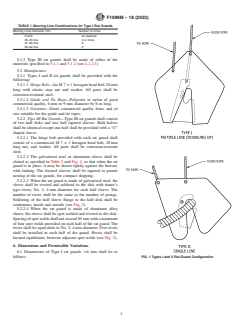
3.2 Types I and II rat guards (see 3.1.1 and 3.1.2) are
1.4 This standard does not purport to address all of the designed to be installed from the deck or pier without a person
safety concerns, if any, associated with its use. It is the
physically coming in contact with the mooring lines or hawser,
responsibility of the user of this standard to establish appro- by lowering and positioning the guards away from the ship’s
priate safety, health, and environmental practices and deter-
hull with two ropes that are permanently attached as guide and
mine the applicability of regulatory limitations prior to use. tie ropes (see Fig. 1).
1.5 This international standard was developed in accor-
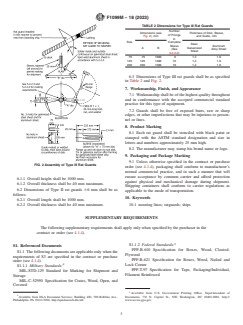
3.3 Type III rat guards (see 3.1.3) require a person to contact
dance with internationally recognized principles on standard-
the mooring line to pull the two halves of the conical guard
ization established in the Decision on Principles for the
around the mooring line, wrap the slotted sleeves (see Fig. 2)
Development of International Standards, Guides and Recom-
to the line, and physically close any opening between the
mendations issued by the World Trade Organization Technical
mooring line and the circular opening at the center of the
Barriers to Trade (TBT) Committee.
guard.
2. Referenced Documents
4. Ordering Information
2.1 ASTM Standards:
4.1 Orders for rat guards under this specification shall
A653M Specification for Steel Sheet, Zinc-Coated (Galva-
include the following information:
nized) or Zinc-Iron Alloy-Coated (Galvannealed) by the
4.1.1 ASTM designation.
Hot-Dip Process
4.1.2 Type required (see 3.1):
B209M Specification for Aluminum and Aluminum-Alloy
4.1.2.1 If Type III, material required (see 5.1.3).
Sheet and Plate (Metric) (Withdrawn 2021)
4.1.2.2 If Type III, size required (see 3.1.3).
4.1.3 Quantity required.
3. Classification
4.1.4 Optional requirements, if any (see Supplementary
3.1 Rat guards shall be classified into three types as follows:
Requirements S1 through S3).
5. Materials and Manufacture
This specification is under the jurisdiction of ASTM Committee F25 on Ships
5.1 Materials:
and Marine Technology and is the direct responsibility of Subcommittee F25.07 on
General Requirements.
5.1.1 Type I rat guards shall be made of aluminum-alloy
Current edition approved May 1, 2023. Published May 2023. Originally
sheet metal conforming to the requirements of Specification
approved in 1987. Last previous edition approved in 2018 as F1099M – 18. DOI:
B209M, 6061-T6, or 5052-H32.
10.1520/F1099M-18R23.
5.1.2 Type II rat guards shall be made of galvanized sheet
For referenced ASTM standards, visit the ASTM website, www.astm.org, or
contact ASTM Customer Service at service@astm.org. For Annual Book of ASTM
steel conforming to the requirements of Specification A653M,
Standards volume information, refer to the standard’s Document Summary page on
Coating Designation 450. The coating shall be a minimum of
the ASTM website.
3 450 g/m in accordance with the triple-spot test of Specifica-
The last approved version of this historical standard is referenced on
www.astm.org. tion A653M.
Copyright © ASTM International, 100 Barr Harbor Drive, PO Box C700, West Conshohocken, PA 19428-2959. United States
F1099M − 18 (2023)
TABLE 1 Mooring Line Combinations for Type I Rat Guards
Mooring Lines Diameter, mm Number of Lines
5 wire as required
25–33 line 3 or more
41–50 line 3
50–82 line 2
5.1.3 Type III rat guards shall be made of either of the
materials specified in 5.1.1 and 5.1.2 (see 4.1.2.1).
5.2 Manufacture:
5.2.1 Types I and II rat guards shall be provided with the
following:
5.2.1.1 Hinge Bolt—An M 7 × 1 hexagon head bolt 20 mm
long with elastic stop nut and washer. All parts shall be
corrosion-resistant steel.
5.2.1.2 Guide and Tie Rope—Polyester or nylon of good
commercial quality, 6 mm or 9 mm diameter by 6 m long.
5.2.1.3 Grommet—Good commercial quality brass and of
size suitable for the guide and tie ropes.
5.2.2 Type III Rat Guards—Type III rat guards shall consist
of two half disks and two half tapered sleeves. Both halves
shall be identical except one half shall be provided with a “U”
shaped sleeve.
5.2.2.1 The hinge bolt provided with each rat guard shall
consist of a commercial M 7 × 1 hexagon head bolt, 20 mm
long nut, and washer. All parts shall be corrosion-resistant
steel.
5.2.2.2 The galvanized steel or aluminum sleeve shall be
slotted as specified in Table 2 and Fig. 2, so that when the rat
guard is in place, it may be drawn tightly against the hawser,
with lashing. The formed sleeves shall be tapered to permit
nesting of the rat guards, for compact shipping.
5.2.2.3 When the rat guard is made of galvanized steel, the
sleeve shall be riveted and soldered to the disk with tinner’s
type rivets, No. 3, 4 mm diameter for each half sleeve. The
number of rivets shall be the same as the number of prongs.
Soldering of the half sleeve flange to the half disk shall be
continuous, inside and outside (see Fig. 2).
5.2.2.4 When the rat guard is made of aluminum alloy
sheets, the sleeve shall be spot welded and riveted to the disk.
Spacing of spot welds shall not exceed 50 mm with a minimum
of four spot welds provided on each half of the rat guard. The
rivets shall be equivalent to No. 3, 4 mm diameter. Five rivets
shall be installed in each half of the guard. Rivets shall be
located equidistant, between adjacent spot welds (see Fig. 2).
6. Dimensions and Permissible Variations
6.1 Dimensions of Type I rat guards 66 mm shall be as
follows: FIG. 1 Types I and II Rat Guard Configuration
F1099M − 18 (2023)
TABLE 2 Dimensions for Type III Rat Guards
Number
Dimensions (see Thickness of Disk, Sleeve,
of Prongs
Fig. 2), mm and Guide, mm
in
Size Complete
Steel,
Sleeve
Aluminum
A B Galvanized
(See
Alloy Sheet
Sheet
5.2.2.2)
75 75 1000 6 1.4 1.6
125 125 1300 10 1.4 1.6
200 200 1300 16 1.4 1.6
6.3 Dimensions of Type III rat guards shall be as specified
in Table 2 and Fig. 2.
7. Workmanship, Finish, and Appearance
7.1 Workmanship shall be of the highest quality throughout
and in conformance with the accepted commercial standard
practice for this type of equipment.
7.2 Guards shall be free of exposed burrs, raw or sharp
edges, or other imperfections that may be injurious to person-
nel or lines.
8. Product Marking
8.1 Each rat guard shall be stenciled with black paint or
stamped with the ASTM standard designation and size in
letters and numbers approximately 25 mm high.
8.2 The manufacturer may stamp his brand name or logo.
9. Packaging and Package Marking
9.1 Unless otherwise specified in the contract or purchase
FIG. 2 Assembly of Type III Rat Guards
order (see 4.1.4), packaging shall conform to manufacturer’s
normal commercial practice, and in such a manner that will
ensure acceptance by common carrier and afford protection
6.1.1 Overall height shall be 1000 mm.
against physical and mechanical damage during shipment.
6.1.2 Overall thickness shall be 40 mm maximum.
Shipping containers shall conform to carrier regulations as
6.2 Dimensions of Type II rat g
...