

ASTM D7036-16
(Practice)Standard Practice for Competence of Air Emission Testing Bodies
General Information
- Abstract
SIGNIFICANCE AND USE
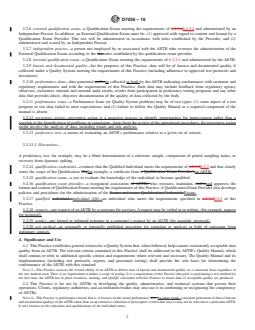
4.1 This Practice establishes general criteria for a Quality System that, when followed, helps ensure consistently acceptable data quality from an AETB. The relevant criteria contained in this Practice shall be addressed in the AETB’s Quality Manual, which shall contain or refer to additional specific criteria and requirements where relevant and necessary. The Quality Manual and its implementation (including test protocols, reports, and personnel testing) shall provide the sole basis for determining the conformance of the AETB with this standard.
Note 3: This Practice assesses the overall ability of an AETB to deliver data of known and documented quality on a consistent basis regardless of the test method used. There is no requirement to define a scope of testing. It is a requirement of this Practice that prior to performing a test method for the first time, the AETB has in place resources, training, and QA/QC consistent with this Practice to insure data of acceptable quality are produced.
4.2 This Practice is for use by AETBs in developing the quality, administrative, and technical systems that govern their operations. Clients, regulatory authorities, and accreditation bodies may also use it in confirming or recognizing the competency of AETBs.
Note 4: This Practice is performance-based; that is, it focuses on the actual performance (in other words, consistent generation of data of known and documented quality) of the AETB rather than on an extensive collection of prescriptive criteria that may or may not be relevant to a particular AETB. It also focuses on the education and qualifications of the individual tester.
Note 5: There has been an effort in the development of this Practice to keep the paperwork and administrative burdens on affected AETBs to the minimum required for an effective program.
SCOPE
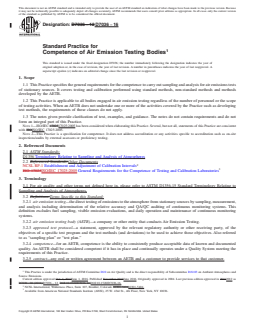
1.1 This Practice specifies the general requirements for the competence to carry out sampling and analysis for air emissions tests of stationary sources. It covers testing and calibration performed using standard methods, non-standard methods and methods developed by the AETB.
1.2 This Practice is applicable to all bodies engaged in air emission testing regardless of the number of personnel or the scope of testing activities. When an AETB does not undertake one or more of the activities covered by the Practice such as developing test methods, the requirements of those clauses do not apply.
1.3 The notes given provide clarification of text, examples, and guidance. The notes do not contain requirements and do not form an integral part of this Practice.
Note 1: ISO/IEC 17025:2005 has been considered when elaborating this Practice. Several, but not all, statements of this Practice are consistent with ISO/IEC 17025:2005.
Note 2: This Practice is a specification for competence. It does not address accreditation or any activities specific to accreditation such as on-site inspections/audits by external assessors or proficiency testing.
- Status
- Published
- Publication Date
- 31-May-2016
- Technical Committee
- D22 - Air Quality
- Drafting Committee
- D22.03 - Ambient Atmospheres and Source Emissions
Overview
ASTM D7036-16 is the Standard Practice for Competence of Air Emission Testing Bodies, developed by ASTM International. This standard outlines the general and technical requirements for organizations - referred to as Air Emission Testing Bodies (AETBs) - that perform sampling and analysis of air emissions from stationary sources. The primary aim is to ensure that data generated by AETBs is consistently of known and documented quality, regardless of the specific test method or scope of testing.
ASTM D7036-16 addresses the quality, administrative, and technical systems necessary for AETBs to demonstrate competence. It also provides guidance for regulatory authorities, clients, and accreditation bodies seeking to evaluate or recognize the competence of testing organizations.
Key Topics
Quality System Requirements
- Establishes the need for a documented Quality System, including a Quality Manual.
- Requires procedures for document control, purchasing, service to clients, and complaint handling.
- Stresses continual improvement and periodic management review.
Organizational Structure
- Defines roles such as Quality Manager, Technical Manager, and Qualified Individuals.
- Outlines responsibilities to ensure independence, adequate supervision, and legal compliance.
Personnel Competence and Qualifications
- Sets criteria for personnel qualification, training, and ongoing competency tests (including both internal and external qualification exams).
- Specifies the minimum experience required and mandates regular requalification of individuals conducting tests.
Technical Procedures
- Covers method validation, calibration, equipment selection, and traceability of measurements.
- Addresses sampling, analytical methods, and handling of test items.
Records and Audits
- Requires thorough documentation, record retention, and security.
- Mandates internal audits and encourages participation in external proficiency testing.
Applications
ASTM D7036-16 is essential for organizations and stakeholders involved in air quality and environmental compliance. Typical applications include:
- Air Emission Testing Services: Ensuring emission testing bodies provide credible, high-quality data for stationary sources such as industrial plants and power stations.
- Regulatory Compliance: Facilitating recognition of competent AETBs by regulatory authorities and supporting permit applications or environmental impact assessments.
- Accreditation and Auditing: Serving as a reference for accreditation bodies to confirm technical competence and as a checklist for internal quality audits.
- Client Assurance: Providing clients with confidence that their chosen AETB follows established best practices to generate reliable and defensible air emission data.
Organizations implementing ASTM D7036-16 benefit from improved operational effectiveness, reduced errors, and enhanced trust from stakeholders and regulators.
Related Standards
ASTM D7036-16 references and aligns with several key industry standards, including:
- ISO/IEC 17025:2005 - General requirements for the competence of testing and calibration laboratories.
- ASTM D1356 - Terminology relating to sampling and analysis of atmospheres.
- NCSL RP-1 - Establishment and adjustment of calibration intervals.
Compliance with ASTM D7036-16 ensures compatibility with internationally recognized quality frameworks and supports global acceptance of air emission testing results.
Keywords: ASTM D7036-16, air emission testing, AETB, quality system, competence, environmental compliance, stationary sources, air quality standards, calibration, quality manual, regulatory authorities, accreditation, personnel qualification
Relations
- Effective Date
- 01-Jun-2016
- Effective Date
- 15-Mar-2020
- Effective Date
- 15-Oct-2015
- Effective Date
- 01-Jul-2015
- Effective Date
- 01-Dec-2014
- Effective Date
- 01-May-2014
- Effective Date
- 15-Jan-2014
- Effective Date
- 01-Apr-2010
- Effective Date
- 01-May-2005
- Effective Date
- 10-Nov-2000
- Effective Date
- 01-Jun-2016
- Effective Date
- 01-Jun-2016
- Effective Date
- 01-Jun-2016
- Effective Date
- 01-Jun-2016
Get Certified
Connect with accredited certification bodies for this standard

CIS Institut d.o.o.
Personal Protective Equipment (PPE) certification body. Notified Body NB-2890 for EU Regulation 2016/425 PPE.

Kiwa BDA Testing
Building and construction product certification.
Kmetijski inštitut Slovenije
Agricultural Institute of Slovenia. Soil testing, plant health, agricultural product analysis.
Sponsored listings
Frequently Asked Questions
ASTM D7036-16 is a standard published by ASTM International. Its full title is "Standard Practice for Competence of Air Emission Testing Bodies". This standard covers: SIGNIFICANCE AND USE 4.1 This Practice establishes general criteria for a Quality System that, when followed, helps ensure consistently acceptable data quality from an AETB. The relevant criteria contained in this Practice shall be addressed in the AETB’s Quality Manual, which shall contain or refer to additional specific criteria and requirements where relevant and necessary. The Quality Manual and its implementation (including test protocols, reports, and personnel testing) shall provide the sole basis for determining the conformance of the AETB with this standard. Note 3: This Practice assesses the overall ability of an AETB to deliver data of known and documented quality on a consistent basis regardless of the test method used. There is no requirement to define a scope of testing. It is a requirement of this Practice that prior to performing a test method for the first time, the AETB has in place resources, training, and QA/QC consistent with this Practice to insure data of acceptable quality are produced. 4.2 This Practice is for use by AETBs in developing the quality, administrative, and technical systems that govern their operations. Clients, regulatory authorities, and accreditation bodies may also use it in confirming or recognizing the competency of AETBs. Note 4: This Practice is performance-based; that is, it focuses on the actual performance (in other words, consistent generation of data of known and documented quality) of the AETB rather than on an extensive collection of prescriptive criteria that may or may not be relevant to a particular AETB. It also focuses on the education and qualifications of the individual tester. Note 5: There has been an effort in the development of this Practice to keep the paperwork and administrative burdens on affected AETBs to the minimum required for an effective program. SCOPE 1.1 This Practice specifies the general requirements for the competence to carry out sampling and analysis for air emissions tests of stationary sources. It covers testing and calibration performed using standard methods, non-standard methods and methods developed by the AETB. 1.2 This Practice is applicable to all bodies engaged in air emission testing regardless of the number of personnel or the scope of testing activities. When an AETB does not undertake one or more of the activities covered by the Practice such as developing test methods, the requirements of those clauses do not apply. 1.3 The notes given provide clarification of text, examples, and guidance. The notes do not contain requirements and do not form an integral part of this Practice. Note 1: ISO/IEC 17025:2005 has been considered when elaborating this Practice. Several, but not all, statements of this Practice are consistent with ISO/IEC 17025:2005. Note 2: This Practice is a specification for competence. It does not address accreditation or any activities specific to accreditation such as on-site inspections/audits by external assessors or proficiency testing.
SIGNIFICANCE AND USE 4.1 This Practice establishes general criteria for a Quality System that, when followed, helps ensure consistently acceptable data quality from an AETB. The relevant criteria contained in this Practice shall be addressed in the AETB’s Quality Manual, which shall contain or refer to additional specific criteria and requirements where relevant and necessary. The Quality Manual and its implementation (including test protocols, reports, and personnel testing) shall provide the sole basis for determining the conformance of the AETB with this standard. Note 3: This Practice assesses the overall ability of an AETB to deliver data of known and documented quality on a consistent basis regardless of the test method used. There is no requirement to define a scope of testing. It is a requirement of this Practice that prior to performing a test method for the first time, the AETB has in place resources, training, and QA/QC consistent with this Practice to insure data of acceptable quality are produced. 4.2 This Practice is for use by AETBs in developing the quality, administrative, and technical systems that govern their operations. Clients, regulatory authorities, and accreditation bodies may also use it in confirming or recognizing the competency of AETBs. Note 4: This Practice is performance-based; that is, it focuses on the actual performance (in other words, consistent generation of data of known and documented quality) of the AETB rather than on an extensive collection of prescriptive criteria that may or may not be relevant to a particular AETB. It also focuses on the education and qualifications of the individual tester. Note 5: There has been an effort in the development of this Practice to keep the paperwork and administrative burdens on affected AETBs to the minimum required for an effective program. SCOPE 1.1 This Practice specifies the general requirements for the competence to carry out sampling and analysis for air emissions tests of stationary sources. It covers testing and calibration performed using standard methods, non-standard methods and methods developed by the AETB. 1.2 This Practice is applicable to all bodies engaged in air emission testing regardless of the number of personnel or the scope of testing activities. When an AETB does not undertake one or more of the activities covered by the Practice such as developing test methods, the requirements of those clauses do not apply. 1.3 The notes given provide clarification of text, examples, and guidance. The notes do not contain requirements and do not form an integral part of this Practice. Note 1: ISO/IEC 17025:2005 has been considered when elaborating this Practice. Several, but not all, statements of this Practice are consistent with ISO/IEC 17025:2005. Note 2: This Practice is a specification for competence. It does not address accreditation or any activities specific to accreditation such as on-site inspections/audits by external assessors or proficiency testing.
ASTM D7036-16 is classified under the following ICS (International Classification for Standards) categories: 13.040.01 - Air quality in general. The ICS classification helps identify the subject area and facilitates finding related standards.
ASTM D7036-16 has the following relationships with other standards: It is inter standard links to ASTM D7036-12, ASTM D1356-20, ASTM D1356-15a, ASTM D1356-15, ASTM D1356-14b, ASTM D1356-14a, ASTM D1356-14, ASTM D1356-05(2010), ASTM D1356-05, ASTM D1356-00a, ASTM D6784-16, ASTM D4844-16, ASTM D1356-20a, ASTM D3614-07(2021). Understanding these relationships helps ensure you are using the most current and applicable version of the standard.
ASTM D7036-16 is available in PDF format for immediate download after purchase. The document can be added to your cart and obtained through the secure checkout process. Digital delivery ensures instant access to the complete standard document.
Standards Content (Sample)
This international standard was developed in accordance with internationally recognized principles on standardization established in the Decision on Principles for the
Development of International Standards, Guides and Recommendations issued by the World Trade Organization Technical Barriers to Trade (TBT) Committee.
Designation: D7036 − 16
Standard Practice for
Competence of Air Emission Testing Bodies
This standard is issued under the fixed designation D7036; the number immediately following the designation indicates the year of
original adoption or, in the case of revision, the year of last revision. A number in parentheses indicates the year of last reapproval. A
superscript epsilon (´) indicates an editorial change since the last revision or reapproval.
1. Scope ISO/IEC 17025:2005 General Requirements for the Compe-
tence of Testing and Calibration Laboratories
1.1 This Practice specifies the general requirements for the
competence to carry out sampling and analysis for air emis-
3. Terminology
sions tests of stationary sources. It covers testing and calibra-
tion performed using standard methods, non-standard methods 3.1 For air quality and other terms not defined here in,
and methods developed by the AETB. please refer to ASTM D1356-15 Standard Terminology Relat-
ing to Sampling and Analysis of Atmospheres.
1.2 This Practice is applicable to all bodies engaged in air
emission testing regardless of the number of personnel or the 3.2 Terms Specific to this Standard:
scope of testing activities. When an AETB does not undertake 3.2.1 air emission testing—the direct testing of emissions to
one or more of the activities covered by the Practice such as the atmosphere from stationary sources by sampling,
developing test methods, the requirements of those clauses do measurement, and analysis including determination of the
not apply. relative accuracy and QA/QC auditing of continuous monitor-
ing systems. This definition excludes fuel sampling, visible
1.3 The notes given provide clarification of text, examples,
emission evaluations, and daily operation and maintenance of
and guidance. The notes do not contain requirements and do
continuous monitoring systems.
not form an integral part of this Practice.
NOTE 1—ISO/IEC 17025:2005 has been considered when elaborating 3.2.2 air emission testing body (AETB)—a company or
this Practice. Several, but not all, statements of this Practice are consistent
other entity that conducts Air Emission Testing.
with ISO/IEC 17025:2005.
3.2.3 approved test protocol—a statement, approved by the
NOTE 2—This Practice is a specification for competence. It does not
address accreditation or any activities specific to accreditation such as relevant regulatory authority or other receiving party, of the
on-site inspections/audits by external assessors or proficiency testing.
objectives of a specific test program and the test methods (and
deviations) to be used to achieve those objectives. Also
1.4 This international standard was developed in accor-
dance with internationally recognized principles on standard- referred to as “sampling plan” or “test plan.”
ization established in the Decision on Principles for the
3.2.4 competence—for an AETB, competence is the ability
Development of International Standards, Guides and Recom-
to consistently produce acceptable data of known and docu-
mendations issued by the World Trade Organization Technical
mented quality. An AETB shall be considered competent if it
Barriers to Trade (TBT) Committee.
has in place and continually operates under a Quality System
meeting the requirements of this Practice.
2. Referenced Documents
3.2.5 contract—any oral or written agreement between an
2.1 ASTM Standards:
AETB and a customer to provide services to that customer.
D1356 Terminology Relating to Sampling and Analysis of
3.2.6 external qualification exam—a Qualification Exam
Atmospheres
meeting the requirements of 6.2.3.4 and administered by an
2.2 Other Documents
Independent Proctor. In addition, an External Qualification
NCSL RP-1 Establishment and Adjustment of Calibration
Exam must be: (1) approved with regard to content and format
Intervals
by a Qualification Exam Provider. This test will be adminis-
tered in accordance with rules established by the Provider; and
(2) administered and scored by an Independent Proctor.
This Practice is under the jurisdiction ofASTM Committee D22 on Air Quality
3.2.7 independent proctor—a person not employed by or
and is the direct responsibility of Subcommittee D22.03 on Ambient Atmospheres
associated with the AETB who oversees the administration of
and Source Emissions.
Current edition approved June 1, 2016. Published June 2016. Originally
approved in 2004. Last previous edition approved in 2012 as D7036 – 12.
DOI:10.1520/D7036-16.
2 3
NCSL International, Wilderness Place, Suite 107, Boulder, Colorado 80301- Available from American National Standards Institute (ANSI), 25 W. 43rd St.,
5404. 4th Floor, New York, NY 10036.
Copyright © ASTM International, 100 Barr Harbor Drive, PO Box C700, West Conshohocken, PA 19428-2959. United States
D7036 − 16
the External Qualification Exam according to the rules estab- 4. Significance and Use
lished by the qualification exam provider.
4.1 This Practice establishes general criteria for a Quality
3.2.8 internal qualification exam—a Qualification Exam
System that, when followed, helps ensure consistently accept-
meeting the requirements of 6.2.3.4 and administered by the
able data quality from an AETB. The relevant criteria con-
AETB.
tainedinthisPracticeshallbeaddressedintheAETB’sQuality
Manual, which shall contain or refer to additional specific
3.2.9 known and documented quality—for the purposes of
criteria and requirements where relevant and necessary. The
this Practice, data will be of known and documented quality if
Quality Manual and its implementation (including test
collected under a Quality System meeting the requirements of
protocols, reports, and personnel testing) shall provide the sole
this Practice (including adherence to approved test protocols
basis for determining the conformance of the AETB with this
and deviations).
standard.
3.2.10 performance data—data generated or collected or
NOTE 3—This Practice assesses the overall ability of an AETB to
both by the AETB indicating conformance with customer and
deliver data of known and documented quality on a consistent basis
regulatory requirements and with the requirements of this
regardless of the test method used. There is no requirement to define a
Practice. Such data may include feedback from regulatory
scope of testing. It is a requirement of this Practice that prior to
performing a test method for the first time, the AETB has in place
agency observers, customers, internal and external audit
resources, training, and QA/QC consistent with this Practice to insure data
results, results from participation in proficiency testing pro-
of acceptable quality are produced.
grams and any other data that provides direct, objective
documentation of the quality of data collected by the body. 4.2 This Practice is for use by AETBs in developing the
quality, administrative, and technical systems that govern their
3.2.11 performance issue—a Performance Issue (or Quality
operations. Clients, regulatory authorities, and accreditation
Systemproblem)maybeoftwotypes: (1)someaspectofatest
bodies may also use it in confirming or recognizing the
program or test data failed to meet expectations; and (2) failure
competency of AETBs.
to follow the Quality Manual or a required component of the
NOTE 4—This Practice is performance-based; that is, it focuses on the
manual is absent.
actual performance (in other words, consistent generation of data of
3.2.12 preventive action—preventive action is a proactive known and documented quality) of theAETB rather than on an extensive
collection of prescriptive criteria that may or may not be relevant to a
process to identify opportunities for improvement rather than a
particularAETB. It also focuses on the education and qualifications of the
reaction to the identification of problems or complaints. Apart
individual tester.
from the review of the operational procedures, the preventive
NOTE 5—There has been an effort in the development of this Practice to
action might involve the analysis of data, including trends and
keep the paperwork and administrative burdens on affectedAETBs to the
risk analysis.
minimum required for an effective program.
3.2.13 proficiency test—a means of evaluating an AETB’s
5. Organization and Management
performance relative to a given set of criteria.
3.2.13.1 Discussion—A proficiency test, for example, may
5.1 Organization:
be a blind determination of a reference sample, comparison of
5.1.1 TheAETB shall have in place a structure, including a
paired sampling trains, or recovery from dynamic spiking.
Quality System that enables it to continually monitor and
3.2.14 qualificationcredentials—evidencethattheQualified
improve its ability to deliver its scope of services. This ability
Individual meets the requirements of 6.2.3 and that clearly shall be measured by Performance Data.
states the scope of the Qualification for example, a certificate
5.1.2 The organization of theAETB shall be clearly defined
from an AETB.
including its place in any parent organization, and the relation-
ships between quality management, technical operations, and
3.2.15 qualification exam—a test to evaluate the knowledge
support services.
of the individual to become qualified.
5.1.3 It is the responsibility of the AETB to carry out its
3.2.16 qualification exam provider—a recognized associa-
activities in such a way as to meet the requirements of this
tion who oversees, maintains, and approves the format and
Practice, the requirements of local, state and federal laws and
content of Qualification Exams meeting the requirements of
regulations, and to meet the needs of the client and regulatory
this Practice. A Qualification Exam Provider also develops
authorities.
policies and procedures for the administration of the Exams.
5.1.4 The AETB shall:
3.2.17 qualified individual (QI)—an individual who meets
5.1.4.1 Have in place a system to collect and document
the requirements specified in 6.2.3 of this Practice.
Performance Data from all relevant sources.
3.2.18 request—any request of an AETB by a customer for
5.1.4.2 Provideitsemployeeswiththeresourcesandauthor-
services. A request may be verbal or in writing. (for example,
ity to initiate corrective actions and to verify and document
request for proposal).
their effectiveness.
3.2.19 tender—any formal or informal response to a cus-
5.1.4.3 Be legally identifiable, that is, it shall meet the
tomer’s request by an AETB (for example, proposal).
applicable legal requirements of the governmental jurisdiction
3.2.20 test method—an externally or internally published in which it conducts business. It shall be organized and shall
procedure for sampling or analysis or both of emissions from operate so that its facilities and resources meet the require-
stationary sources. ments of this Practice.
D7036 − 16
5.1.4.4 Beorganizedsothatstaffmembersarenotsubjectto ensuring that its operations are appropriate to providing air
undue pressure or inducement that might inappropriately emission testing services and meet the requirements of this
influence their judgment or results of their work, including Practice.
quality issues. 5.2.2.1 The Quality System shall be designed to ensure the
5.1.4.5 Be organized so that confidence in its independence required degree of completeness, representativeness,
of judgment and integrity is maintained at all times. comparability, and uncertainty (within the limits of uncertainty
5.1.4.6 Beorganizedsothatstaffmembersareawareofboth documented in the test method) needed to meet the data quality
the extent and limitations of their responsibilities. objectives of each project undertaken by the AETB.
5.1.4.7 Provide adequate supervision of technical staff,
5.2.2.2 TheQualitySystemandtheAETB’sconformanceto
including trainees, by persons familiar with relevant methods theQualitySystemshallbedocumentedtotheextentnecessary
and procedures, the purpose of the test project, and with to ensure consistent achievement of data quality objectives for
assessment of testing results. Only Qualified Individuals may projects undertaken by the AETB.
supervise a test.
NOTE 7—Data quality objectives (however named) have always been a
5.1.4.8 Have a Technical Manager or Director (however
part of any test program. Subsections 5.2.2.1 and 5.2.2.2 do not establish
named) who has overall responsibility for the technical opera-
new requirements. Data quality objectives may be defined in the testing
method (for example, bias <5 %, leak rate 60.6.5 in. H2O, conversion
tions of the AETB and has demonstrated competence in air
efficiency > 6.30%) or may be defined by regulation or by the client.)
emissions testing activities through education or professional
experience, or both. 5.2.3 Quality Manual—The Quality System shall be docu-
5.1.4.9 Have a Quality Manager (however named) who has
mented in a Quality Manual and supporting Quality System
responsibility for the Quality System and its implementation. documentation. If an existing, Quality Manual adequately
The quality manager shall have authority and responsibility for
addresses each of these topics in the standard, it should not
ensuringthattherequirementsofthisPracticeareimplemented need to be rewritten. Portions not relevant to the scope of the
and maintained. The quality manager must have direct access
AETB’s services may be eliminated. This documentation shall
to the highest levels of management at which decision are be available for use by the AETB staff and for review by
made on policies affecting the AETB.
clients, regulatory authorities, and accreditation bodies upon
request. The Quality System documents shall be maintained
NOTE 6—The Quality Manager may also be the Technical Manager in
current under the responsibility of the Quality Manager.
AETBs with limited staff. Whenever possible, the quality and technical
manager positions should be filled independently.
NOTE 8—The following link provides one option for structuring a
5.1.4.10 Have a Qualified Individual on-site for each test Quality Manual, but AETBs will be audited against this standard and
should consider addressing the elements of this standard in the AETB’s
project who is qualified for each test method performed.
QA Manual in the order in which they are presented in the standard to
5.1.4.11 Be able to provide documentation or otherwise
simplify the process of conducting an audit against this standard. (Link:
demonstrate, on request from the persons or organizations
http://www2.epa.gov/quality/epa-qar-2-epa-requirements-
evaluating its competence, that it complies with the relevant
qualitymanagement-plans)
and appropriate federal, state, and local requirements for
5.3 Document Control:
conducting testing procedures under its scope, including com-
5.3.1 General—The AETB shall establish and maintain
pliance with this Practice.
procedures to control all documents that form part of its
5.1.4.12 Be able to provide documentation or otherwise
QualitySystem(internallygeneratedorfromexternalsources),
demonstrate, on request from the persons or organizations
such as regulations, standards, other normative documents, test
evaluating its competence, that it complies with applicable
or calibration methods or both, as well as drawings, software,
local, state, and federal requirements governing health and
specifications, instructions and manuals. These procedures
safety, transportation, shipping and other relevant require-
shall be sufficient to preclude the use of invalid or obsolete
ments.
documents or both.
5.2 Management System: 5.3.2 Quality system documents generated by the AETB
5.2.1 Quality Policy—The AETB shall develop and dis- shall be uniquely identified. Such identification shall include
seminateaqualitypolicy.Aqualitypolicyisaformalstatement the date of issue or revision or both identification, page
signed by top management that states the commitment by top numbering, the total number of pages or a mark to signify the
management and staff to conform to the requirements docu- end of the document, and the issuing authority(ies).
mented in the Quality Manual and to this Practice. 5.3.3 Changes to documents shall be reviewed and ap-
5.2.1.1 The management of the AETB shall define and proved by the same organizational group that performed the
document its quality policy, quality objectives, and commit- original review unless specifically designated otherwise. Per-
ment to quality. sonnel conducting the review shall have access to pertinent
5.2.1.2 The AETB shall ensure that its quality policy in- background information upon which to base their review and
cludes recognition of the needs and expectations of its custom- approval. Where practicable, the altered or new text shall be
ers. The AETB shall also ensure that its quality policy is identified in the document or the appropriate attachments.
understood, implemented, and maintained at all levels within
5.3.4 If the AETB’s documentation control system allows
the AETB. for the amendment of documents by hand pending the re-issue
5.2.2 Quality System—The AETB shall establish, maintain, of the documents, the procedures and authorities for such
and operate under a documented Quality System as a means of amendments shall be defined. Amendments shall be clearly
D7036 − 16
marked, initialed and dated. A revised document shall be 5.6.2 The AETB shall ensure that purchased supplies and
formally re-issued as soon as practicable. reagents and consumable materials that affect the quality of
tests are not used until they have been inspected or otherwise
5.3.5 Procedures shall be established to describe how
changes in documents maintained in computerized systems are verified as complying with standard specifications or require-
ments defined in the methods for the tests concerned. These
made and controlled.
services and supplies used shall comply with specified require-
5.4 Review of Requests, Tenders, and Contracts:
ments. Records of actions taken to check compliance shall be
5.4.1 TheAETB shall establish and maintain procedures for
maintained.
the review of requests, tenders and contracts. The policies and
5.6.3 Purchasing documents for items affecting the quality
procedures for these reviews leading to a contract shall ensure
of AETB output shall contain data describing the services and
that:
supplies ordered. These purchasing documents shall be re-
(a) Therequirements,includingthemethodstobeused,are
viewed and approved for technical content prior to release.
adequately defined, documented and understood by theAETB;
5.7 Service to the Customer:
(b) TheAETB has the capability and resources to meet the
requirements of the customer; 5.7.1 TheAETB shall be willing to cooperate with custom-
ers or their representatives in providing access to the AETB’s
(c) The appropriate test methods are selected and are
capable of meeting the customer’s requirements. facilities for the purpose of witnessing the tests performed for
that customer provided that the AETB ensures confidentiality
Any differences between the request or tender and the
to other customers.
contract shall be resolved before any work begins. Each
5.7.2 The AETB shall seek feedback, both positive and
contract shall be acceptable both to the AETB and the
negative, from its customers for example by customer satisfac-
customer.
tion surveys or during review of test reports or both. The
5.4.2 Records of reviews, including any changes, shall be
feedback shall be used and analyzed to improve the Quality
maintained. Records shall also be maintained of pertinent
System, services provided by theAETB and customer service.
discussions with a customer relating to the customer’s require-
ments or the results of the work during the period of execution
5.8 Complaints:
of the contract.
5.8.1 The AETB shall have a policy and procedure for the
5.4.3 The review shall also cover any work that is to be
resolution of complaints received from customers or other
subcontracted by the AETB.
parities.
5.4.4 The customer shall be informed of any deviation from
5.8.2 Records shall be maintained of all complaints, the
the contract prior to or during its execution.
investigations undertaken and the corrective actions taken by
5.4.5 If a contract needs to be amended after work has
the AETB.
commenced,theamendmentshallbereviewedandanyamend-
5.9 Non-conforming Work:
ments shall be communicated to all affected personnel.
5.9.1 The AETB shall have policies and procedures that
5.5 Subcontracting:
shall be implemented when any aspect of its testing or
5.5.1 When an AETB subcontracts work it normally per-
calibration work or both, or the results of this work, do not
forms whether because of unforeseen reasons (for example,
conform to its own procedures or the agreed requirements of
workload, need for further expertise or temporary lack of
the client. The policies and procedures shall ensure that:
capacity) or on a continuing basis (for example, through
(a) The responsibilities and authorities for the management
permanent subcontracting, agency or franchising
of nonconforming work are designated and actions (including
arrangements), this work shall be placed with a competent
halting of work and withholding of test reports, as necessary)
subcontractor. A competent subcontractor is one that, for
are defined and taken when nonconforming work is identified;
example, complies with this Practice for the work in question.
(b) An evaluation of the significance of the nonconforming
5.5.2 The AETB shall advise the client of the arrangement
work is made;
in writing and, when appropriate, gain the approval of the
(c) Corrective actions are taken within an appropriate time
client, preferably in writing.
period, together with any decision about the acceptability of
5.5.3 The AETB is responsible to the client for the subcon-
the nonconforming work;
tractor’s work, except in the case where the client or a (d) Where necessary, the client is notified and work is
regulatory authority specifies which subcontractor is to be
halted or re-done.
used.
5.9.2 Where the evaluation indicates that the nonconform-
5.5.4 TheAETB shall maintain a register of all subcontrac- ing work could recur or that there is doubt about the compli-
torsthatitusesandarecordoftheevidenceofcompliancewith
ance of the AETB’s operations with its own policies and
this Practice for the work in question. procedures, the corrective action procedures given in 5.11 of
this Practice shall be followed.
5.6 Purchasing of Services and Supplies:
5.6.1 TheAETBshallhaveapolicyandprocedure(s)forthe 5.10 Improvement:
selection and purchasing of services and supplies it uses that 5.10.1 The AETB shall continually improve the effective-
affect the quality of the tests. Procedures shall exist for the nessofitsQualitySystemthroughtheuseofthequalitypolicy,
purchase, reception and storage of reagents and laboratory qualityobjectives,auditresults,analysisofdata,correctiveand
consumable materials relevant for the tests. preventive actions and management reviews.
D7036 − 16
5.11 Corrective Action: facilities that provide a suitable environment to prevent dam-
5.11.1 General—The AETB shall establish a policy and age or deterioration and to prevent loss. Retention times of
records shall be established.
procedureandshalldesignateappropriateauthoritiesforimple-
menting corrective action when nonconforming work or depar- 5.13.1.3 All records shall be held secure and in confidence.
tures from the policies and procedures in the Quality System or
5.13.1.4 The AETB shall have procedures to protect and
technical operations have been identified.
back-up records stored electronically and to prevent unauthor-
ized access to or amendment of these records.
NOTE 9—Causes of non-conforming work may be of two types: (1)
5.13.2 Technical Records:
Common causes are attributed to random variation in any system and are
not correctable through a corrective action process. Common causes are
5.13.2.1 The AETB shall retain records of original
not likely to be repeated. An example may be an experienced field
observations, derived data and sufficient information to estab-
technician forgetting to sign a data sheet. (2) Special causes are the result
lish an audit trail, calibration records, staff records and a copy
of some systematic flaw in the Quality System and are thus likely to be
of each test report or calibration certificate issued, for a defined
repeated. While in some instances a special cause can be identified after
a single instance (for example, inadequate technician training) sometimes period. The records for each test or calibration shall contain
an analysis of performance feedback must be made to determine which
sufficient information to facilitate, if possible, identification of
quality problems are of a systematic nature. It is these systematic
factors affecting the uncertainty and to enable the test or
problems that should be addressed by the corrective action procedures in
calibration to be repeated under conditions as close as possible
this section.
to the original. The records shall include the identity of
5.11.2 Cause Analysis—The procedure for corrective action
personnel responsible for the sampling, performance of each
shall start with an investigation to determine the root cause(s)
test or calibration or both and checking of results.
of the problem.
5.13.2.2 Other records include but are not limited to quality
5.11.3 Selection and Implementation of Corrective
records, results of internal and external audits, training and
Actions—Where corrective action is needed, the AETB shall
qualification records for personnel, performance feedback, gas
identify potential corrective actions. It shall select and imple-
certifications, and chain of custody records.
ment the action(s) most likely to eliminate the problem and to
5.13.2.3 Observations, data and calculations shall be re-
prevent recurrence.
corded at the time they are made and shall be identifiable to the
5.11.4 Corrective actions shall be to a degree appropriate to
specific task.
the magnitude and the risk of the problem. The AETB shall
5.13.2.4 Whenmistakesoccurinrecords,eachmistakeshall
document and implement any required changes resulting from
be crossed out, not erased, made illegible or deleted, and the
corrective action investigations.
correct value entered alongside.All such alterations to records
5.11.5 Monitoring of Corrective Actions—The AETB shall
shall be dated and signed or initialed by the person making the
monitor the results to ensure that the corrective actions taken
correction. In the case of records stored electronically, equiva-
have been effective.
lent measures shall be taken to avoid loss or change of original
5.11.6 Additional Audits—Where the identification of non-
data.
conformances or departures casts doubts on the AETB’s
5.14 Internal Audits:
compliance with its own policies and procedures, or on its
5.14.1 The AETB shall annually conduct internal audits of
compliance with this Practice, the AETB shall ensure that the
its activities to verify that its operations continue to conform to
appropriateareasofactivityareauditedinaccordancewiththis
Practice as soon as possible. the requirements of the Quality System. Such audits shall be
carried out by qualified personnel who, whenever practical, are
5.12 Preventive Action:
independent of the activity audited.
5.12.1 Needed improvements and potential sources of
nonconformities, either technical or concerning the Quality
NOTE 10—Nothing in this section should be inferred to require or allow
a breach of client confidentiality.
System, shall be identified. When improvement opportunities
are identified or if preventive action is required, action plans
5.14.2 Internal Audit Procedure:
shall be developed, implemented and monitored to reduce the
5.14.2.1 Conformance to this Practice shall be determined
likelihood of the occurrence of such nonconformities and to
in stages as follows:
take advantage of the opportunities of improvement.
(a) An evaluation of theAETB’s Quality Manual to ensure
5.12.2 Procedures for preventive actions shall include the
that it addresses all relevant requirements of this Practice.
initiation of such actions and the application of controls to
(b) A determination of the AETB’s conformance to its
ensure that they are effective.
Quality Manual as indicated by a review of the AETB’s
Performance Data and subsequent corrective actions.
5.13 Control of Records:
5.14.2.2 Deficiencies identified from internal audits must be
5.13.1 General:
linked to specific Performance Issues.
5.13.1.1 TheAETB shall establish and maintain procedures
for handling and storage of quality and technical records. 5.14.2.3 Determination of effective corrective actions un-
dertaken in response to deficiencies is at the discretion of the
Quality records shall include reports from customer and
regulatory authority feedback, internal audits and manage
...
This document is not an ASTM standard and is intended only to provide the user of an ASTM standard an indication of what changes have been made to the previous version. Because
it may not be technically possible to adequately depict all changes accurately, ASTM recommends that users consult prior editions as appropriate. In all cases only the current version
of the standard as published by ASTM is to be considered the official document.
Designation: D7036 − 12 D7036 − 16
Standard Practice for
Competence of Air Emission Testing Bodies
This standard is issued under the fixed designation D7036; the number immediately following the designation indicates the year of
original adoption or, in the case of revision, the year of last revision. A number in parentheses indicates the year of last reapproval. A
superscript epsilon (´) indicates an editorial change since the last revision or reapproval.
1. Scope
1.1 This Practice specifies the general requirements for the competence to carry out sampling and analysis for air emissions tests
of stationary sources. It covers testing and calibration performed using standard methods, non-standard methods and methods
developed by the AETB.
1.2 This Practice is applicable to all bodies engaged in air emission testing regardless of the number of personnel or the scope
of testing activities. When an AETB does not undertake one or more of the activities covered by the Practice such as developing
test methods, the requirements of those clauses do not apply.
1.3 The notes given provide clarification of text, examples, and guidance. The notes do not contain requirements and do not
form an integral part of this Practice.
NOTE 1—ISO/IEC 1702517025:2005 has been considered when elaborating this Practice. Several, but not all, statements of this Practice are consistent
with ISOISO/IEC 17025:2005.
NOTE 2—This Practice is a specification for competence. It does not address accreditation or any activities specific to accreditation such as on-site
inspections/audits by external assessors or proficiency testing.
2. Referenced Documents
2.1 ASTM Standards:
D1356 Terminology Relating to Sampling and Analysis of Atmospheres
2.2 Referenced Standards:Other Documents
NCSL RP-1 Establishment and Adjustment of Calibration Intervals
ISO 17025ISO/IEC 17025:2005 General Requirements for the Competence of Testing and Calibration Laboratories
3. Terminology
3.1 For air quality and other terms not defined here in, please refer to ASTM D1356-15 Standard Terminology Relating to
Sampling and Analysis of Atmospheres.
3.2 Definitions:Terms Specific to this Standard:
3.2.1 air emission testing—the direct testing of emissions to the atmosphere from stationary sources by sampling, measurement,
and analysis including determination of the relative accuracy and QA/QC auditing of continuous monitoring systems. This
definition excludes fuel sampling, visible emission evaluations, and daily operation and maintenance of continuous monitoring
systems.
3.2.2 air emission testing body (AETB)—a company or other entity that conducts Air Emission Testing.
3.2.3 approved test protocol—a statement, approved by the relevant regulatory authority or other receiving party, of the
objectives of a specific test program and the test methods (and deviations) to be used to achieve those objectives. Also referred
to as “sampling plan” or “test plan.”
3.2.4 competence—for an AETB, competence is the ability to consistently produce acceptable data of known and documented
quality. An AETB shall be considered competent if it has in place and continually operates under a Quality System meeting the
requirements of this Practice.
3.2.5 contract—any oral or written agreement between an AETB and a customer to provide services to that customer.
This Practice is under the jurisdiction of ASTM Committee D22 on Air Quality and is the direct responsibility of Subcommittee D22.03 on Ambient Atmospheres and
Source Emissions.
Current edition approved Oct. 1, 2012June 1, 2016. Published November 2012June 2016. Originally approved in 2004. Last previous edition approved in 20112012 as
D7036 - 04 (2011).D7036 – 12. DOI:10.1520/D7036-12.DOI:10.1520/D7036-16.
NCSL International, Wilderness Place, Suite 107, Boulder, Colorado 80301-540480301-5404.
Available from American National Standards Institute (ANSI), 25 W. 43rd St., 4th Floor, New York, NY 10036.
Copyright © ASTM International, 100 Barr Harbor Drive, PO Box C700, West Conshohocken, PA 19428-2959. United States
D7036 − 16
3.2.6 external qualification exam—a Qualification Exam meeting the requirements of 6.2.3.66.2.3.4 and administered by an
Independent Proctor. In addition, an External Qualification Exam must be: (1) approved with regard to content and format by a
Qualification Exam Provider. This test will be administered in accordance with rules established by the Provider; and (2)
administered and scored by an Independent Proctor.
3.2.7 independent proctor—a person not employed by or associated with the AETB who oversees the administration of the
External Qualification Exam according to the the rules established by the qualification exam provider.
3.2.8 internal qualification exam—a Qualification Exam meeting the requirements of 6.2.3.4 and administered by the AETB.
3.2.9 known and documented quality—for the purposes of this Practice, data will be of known and documented quality if
collected under a Quality System meeting the requirements of this Practice (including adherence to approved test protocols and
deviations).
3.2.10 performance data—data generated and/oror collected or both by the AETB indicating conformance with customer and
regulatory requirements and with the requirements of this Practice. Such data may include feedback from regulatory agency
observers, customers, internal and external audit results, results from participation in proficiency testing programs and any other
data that provides direct, objective documentation of the quality of data collected by the body.
3.2.11 performance issue—a Performance Issue (or Quality System problem) may be of two types: (1) some aspect of a test
program or test data failed to meet expectations; and (2) failure to follow the Quality Manual or a required component of the
manual is absent.
3.2.12 preventive action—preventive action is a proactive process to identify opportunities for improvement rather than a
reaction to the identification of problems or complaints. Apart from the review of the operational procedures, the preventive action
might involve the analysis of data, including trends and risk analysis.
3.2.13 proficiency test—a means of evaluating an AETB’s performance relative to a given set of criteria.
3.2.13.1 Discussion—
A proficiency test, for example, may be a blind determination of a reference sample, comparison of paired sampling trains, or
recovery from dynamic spiking.
3.2.14 qualification credentials—evidence that the Qualified Individual meets the requirements of 6.2.3.26.2.3 and that clearly
states the scope of the Qualification (forfor example, a certificate from a Qualification Exam Provider).an AETB.
3.2.15 qualification exam—a test to evaluate the knowledge of the individual to become qualified.
3.2.16 qualification exam provider—a recognized association of AETBs who oversees, maintains, and/orand approves the
format and content of Qualification Exams meeting the requirements of this Practice. A Qualification Exam Provider also develops
policies and procedures for the administration of the Exams and issues Qualification Credentials.Exams.
3.2.17 qualified individual—individual (QI)—an individual who meets the requirements specified in 6.2.3.26.2.3 of this
Practice.
3.2.18 request—any request of an AETB by a customer for services. A request may be verbal or in writing. (for example, request
for proposal).
3.2.19 tender—any formal or informal response to a customer’s request by an AETB (for example, proposal).
3.2.20 test method—an externally or internally published procedure for sampling or analysis or both of emissions from
stationary sources.
4. Significance and Use
4.1 This Practice establishes general criteria for a Quality System that, when followed, helps ensure consistently acceptable data
quality from an AETB. The relevant criteria contained in this Practice shall be addressed in the AETB’s Quality Manual, which
shall contain or refer to additional specific criteria and requirements where relevant and necessary. The Quality Manual and its
implementation (including test protocols, reports, and personnel testing) shall provide the sole basis for determining the
conformance of the AETB with this standard.
NOTE 3—This Practice assesses the overall ability of an AETB to deliver data of known and documented quality on a consistent basis regardless of
the test method used. There is no requirement to define a scope of testing. It is a requirement of this Practice that prior to performing a test method for
the first time, the AETB has in place resources, training, and QA/QC consistent with this Practice to insure data of acceptable quality are produced.
4.2 This Practice is for use by AETBs in developing the quality, administrative, and technical systems that govern their
operations. Clients, regulatory authorities, and accreditation bodies may also use it in confirming or recognizing the competency
of AETBs.
NOTE 4—This Practice is performance-based; that is, it focuses on the actual performance (i.e., (in other words, consistent generation of data of known
and documented quality) of the AETB rather than on an extensive collection of prescriptive criteria that may or may not be relevant to a particular AETB.
It also focuses on the education and qualifications of the individual tester.
D7036 − 16
NOTE 5—There has been an effort in the development of this Practice to keep the paperwork and administrative burdens on affected AETBs to the
minimum required for an effective program.
5. Organization and Management
5.1 Organization:
5.1.1 The AETB shall have in place a structure, including a Quality System that enables it to continually monitor and improve
its ability to deliver its scope of services. This ability shall be measured by Performance Data.
5.1.2 The organization of the AETB shall be clearly defined including its place in any parent organization, and the relationships
between quality management, technical operations, and support services.
5.1.3 It is the responsibility of the AETB to carry out its activities in such a way as to meet the requirements of this Practice,
the requirements of local, state and federal laws and regulations, and to meet the needs of the client and regulatory authorities.
5.1.4 The AETB shall:
5.1.4.1 Have in place a system to collect and document Performance Data from all relevant sources.
5.1.4.2 Provide its employees with the resources and authority to initiate corrective actions and to verify and document their
effectiveness.
5.1.4.3 Be legally identifiable, that is, it shall meet the applicable legal requirements of the governmental jurisdiction in which
it conducts business. It shall be organized and shall operate so that its facilities and resources meet the requirements of this Practice.
5.1.4.4 Be organized so that staff members are not subject to undue pressure or inducement that might inappropriately influence
their judgment or results of their work, including quality issues.
5.1.4.5 Be organized so that confidence in its independence of judgment and integrity is maintained at all times.
5.1.4.6 Be organized so that staff members are aware of both the extent and limitations of their responsibilities.
5.1.4.7 Provide adequate supervision of technical staff, including trainees, by persons familiar with relevant methods and
procedures, the purpose of the test project, and with assessment of testing results. Only qualified individualsQualified Individuals
may supervise a test.
5.1.4.8 Have a Technical Manager or Director (however named) who has overall responsibility for the technical operations of
the AETB and has demonstrated competence in air emissions testing activities through education or professional experience, or
both.
5.1.4.9 Have a Quality Manager (however named) who has responsibility for the Quality System and its implementation. The
quality manager shall have authority and responsibility for ensuring that the requirements of this Practice are implemented and
maintained. The quality manager must have direct access to the highest levels of management at which decision are made on
policies affecting the AETB.
NOTE 6—The Quality Manager may also be the Technical Manager in AETBs with limited staff. Whenever possible, the quality and technical manager
positions should be filled independently.
5.1.4.10 Have a Qualified Individual on-site for each test project who is qualified for each test method performed.
5.1.4.11 Be able to provide documentation or otherwise demonstrate, on request from the persons or organizations evaluating
its competence, that it complies with the relevant and appropriate federal, state, and local requirements for conducting testing
procedures under its scope, including compliance with this Practice.
5.1.4.12 Be able to provide documentation or otherwise demonstrate, on request from the persons or organizations evaluating
its competence, that it complies with applicable local, state, and federal requirements governing health and safety, transportation,
shipping and other relevant requirements.
5.2 Management System:
5.2.1 Quality Policy—The AETB shall develop and disseminate a quality policy. A quality policy is a formal statement signed
by top management that states the commitment by top management and staff to conform to the requirements documented in the
Quality Manual and to this Practice.
5.2.1.1 The management of the AETB shall define and document its quality policy, quality objectives, and commitment to
quality.
5.2.1.2 The AETB shall ensure that its quality policy includes recognition of the needs and expectations of its customers. The
AETB shall also ensure that its quality policy is understood, implemented, and maintained at all levels within the AETB.
5.2.2 Quality System—The AETB shall establish, maintain, and operate under a documented Quality System as a means of
ensuring that its operations are appropriate to providing air emission testing services and meet the requirements of this Practice.
5.2.2.1 The Quality System shall be designed to ensure the required degree of completeness, representativeness, comparability,
and uncertainty (within the limits of uncertainty documented in the test method) needed to meet the data quality objectives of each
project undertaken by the AETB.
5.2.2.2 The Quality System and the AETB’s conformance to the Quality System shall be documented to the extent necessary
to ensure consistent achievement of data quality objectives for projects undertaken by the AETB.
NOTE 7—Data quality objectives (however named) have always been a part of any test program. SectionsSubsections 5.2.2.15.2.2.1 and 5.2.2.2 and
5.2.2.2do not establish new requirements. Data quality objectives may be defined in the testing method (e.g., bias < 5%, (for example, bias <5 %, leak
rate 60.6.5 in. HH2O, O, conversion efficiency > 6.30%) or may be defined by regulation or by the client.)
D7036 − 16
5.2.3 Quality Manual—The Quality System shall be documented in a Quality Manual and supporting Quality System
documentation. The manual shall be structured according to the outline provided If an existing, Quality Manual adequately
addresses each of these topics in Appendix X1 of this Practice. the standard, it should not need to be rewritten. Portions not relevant
to the scope of the AETB’s services may be eliminated. This documentation shall be available for use by the AETB staff. staff and
for review by clients, regulatory authorities, and accreditation bodies upon request. The Quality System documents shall be
maintained current under the responsibility of the Quality Manager.
NOTE 8—The following link provides one option for structuring a Quality Manual, but AETBs will be audited against this standard and should consider
addressing the elements of this standard in the AETB’s QA Manual in the order in which they are presented in the standard to simplify the process of
conducting an audit against this standard. (Link: http://www2.epa.gov/quality/epa-qar-2-epa-requirements-qualitymanagement-plans)
5.3 Document Control:
5.3.1 General—The AETB shall establish and maintain procedures to control all documents that form part of its Quality System
(internally generated or from external sources), such as regulations, standards, other normative documents, test and/or calibration
methods, or calibration methods or both, as well as drawings, software, specifications, instructions and manuals. These procedures
shall be sufficient to preclude the use of invalid and/or obsolete documents.or obsolete documents or both.
5.3.2 Quality system documents generated by the AETB shall be uniquely identified. Such identification shall include the date
of issue and/oror revision or both identification, page numbering, the total number of pages or a mark to signify the end of the
document, and the issuing authority(ies).
5.3.3 Changes to documents shall be reviewed and approved by the same organizational group that performed the original
review unless specifically designated otherwise. Personnel conducting the review shall have access to pertinent background
information upon which to base their review and approval. Where practicable, the altered or new text shall be identified in the
document or the appropriate attachments.
5.3.4 If the AETB’s documentation control system allows for the amendment of documents by hand pending the re-issue of the
documents, the procedures and authorities for such amendments shall be defined. Amendments shall be clearly marked, initialed
and dated. A revised document shall be formally re-issued as soon as practicable.
5.3.5 Procedures shall be established to describe how changes in documents maintained in computerized systems are made and
controlled.
5.4 Review of Requests, Tenders, and Contracts:
[RESERVED]
5.4.1 The AETB shall establish and maintain procedures for the review of requests, tenders and contracts. The policies and
procedures for these reviews leading to a contract shall ensure that:
(a) The requirements, including the methods to be used, are adequately defined, documented and understood by the AETB;
(b) The AETB has the capability and resources to meet the requirements of the customer;
(c) The appropriate test methods are selected and are capable of meeting the customer’s requirements.
Any differences between the request or tender and the contract shall be resolved before any work begins. Each contract shall
be acceptable both to the AETB and the customer.
5.4.2 Records of reviews, including any changes, shall be maintained. Records shall also be maintained of pertinent discussions
with a customer relating to the customer’s requirements or the results of the work during the period of execution of the contract.
5.4.3 The review shall also cover any work that is to be subcontracted by the AETB.
5.4.4 The customer shall be informed of any deviation from the contract prior to or during its execution.
5.4.5 If a contract needs to be amended after work has commenced, the amendment shall be reviewed and any amendments shall
be communicated to all affected personnel.
5.5 Subcontracting:
5.5.1 When an AETB subcontracts work it normally performs whether because of unforeseen reasons (e.g. (for example,
workload, need for further expertise or temporary incapacity) lack of capacity) or on a continuing basis (e.g. (for example, through
permanent subcontracting, agency or franchising arrangements), this work shall be placed with a competent subcontractor. A
competent subcontractor is one that, for example, complies with this Practice for the work in question.
5.5.2 The AETB shall advise the client of the arrangement in writing and, when appropriate, gain the approval of the client,
preferably in writing.
5.5.3 The AETB is responsible to the client for the subcontractor’s work, except in the case where the client or a regulatory
authority specifies which subcontractor is to be used.
5.5.4 The AETB shall maintain a register of all subcontractors that it uses and a record of the evidence of compliance with this
Practice for the work in question.
5.6 Purchasing of Services and Supplies:
5.6.1 The AETB shall have a policy and procedure(s) for the selection and purchasing of services and supplies it uses that affect
the quality of the tests and/or calibrations. tests. Procedures shall exist for the purchase, reception and storage of reagents and
laboratory consumable materials relevant for the tests and calibrations.tests.
D7036 − 16
5.6.2 The AETB shall ensure that purchased supplies and reagents and consumable materials that affect the quality of tests
and/or calibrations are not used until they have been inspected or otherwise verified as complying with standard specifications or
requirements defined in the methods for the tests and/or calibrations concerned. These services and supplies used shall comply with
specified requirements. Records of actions taken to check compliance shall be maintained.
5.6.3 Purchasing documents for items affecting the quality of AETB output shall contain data describing the services and
supplies ordered. These purchasing documents shall be reviewed and approved for technical content prior to release.
5.7 Service to the Customer:
[RESERVED]
5.7.1 The AETB shall be willing to cooperate with customers or their representatives in providing access to the AETB’s
facilities for the purpose of witnessing the tests performed for that customer provided that the AETB ensures confidentiality to
other customers.
5.7.2 The AETB shall seek feedback, both positive and negative, from its customers for example by customer satisfaction
surveys or during review of test reports or both. The feedback shall be used and analyzed to improve the Quality System, services
provided by the AETB and customer service.
5.8 Complaints:
[RESERVED]
5.8.1 The AETB shall have a policy and procedure for the resolution of complaints received from customers or other parities.
5.8.2 Records shall be maintained of all complaints, the investigations undertaken and the corrective actions taken by the AETB.
5.9 Non-conforming Work:
5.9.1 The AETB shall have policies and procedures that shall be implemented when any aspect of its testing and/oror calibration
work,work or both, or the results of this work, do not conform to its own procedures or the agreed requirements of the client. The
policies and procedures shall ensure that:
(a) theThe responsibilities and authorities for the management of nonconforming work are designated and actions (including
halting of work and withholding of test reports, as necessary) are defined and taken when nonconforming work is identified;
(b) anAn evaluation of the significance of the nonconforming work is made;
(c) correctiveCorrective actions are taken within an appropriate time period, together with any decision about the acceptability
of the nonconforming work;
(d) whereWhere necessary, the client is notified and work is halted or re-done;re-done.
5.9.2 Where the evaluation indicates that the nonconforming work could recur or that there is doubt about the compliance of
the AETB’s operations with its own policies and procedures, the corrective action procedures given in 5.5.35.11 of this Practice
shall be followed.
5.10 Improvement:
[RESERVED]
5.10.1 The AETB shall continually improve the effectiveness of its Quality System through the use of the quality policy, quality
objectives, audit results, analysis of data, corrective and preventive actions and management reviews.
5.11 Corrective Action:
5.11.1 General—The AETB shall establish a policy and procedure and shall designate appropriate authorities for implementing
corrective action when nonconforming work or departures from the policies and procedures in the Quality System or technical
operations have been identified.
NOTE 9—Causes of non-conforming work may be of two types: (1) Common causes are attributed to random variation in any system and are not
correctable through a corrective action process. Common causes are not likely to be repeated. An example may be an experienced field technician
forgetting to sign a data sheet. (2) Special causes are the result of some systematic flaw in the Quality System and are thus likely to be repeated. While
in some instances a special cause can be identified after a single instance (e.g. (for example, inadequate technician training) sometimes an analysis of
performance feedback must be made to determine which quality problems are of a systematic nature. It is these systematic problems that should be
addressed by the corrective action procedures in this section.
5.11.2 Cause Analysis—The procedure for corrective action shall start with an investigation to determine the root cause(s) of
the problem.
5.11.3 Selection and Implementation of Corrective Actions—Where corrective action is needed, the AETB shall identify
potential corrective actions. It shall select and implement the action(s) most likely to eliminate the problem and to prevent
recurrence.
5.11.4 Corrective actions shall be to a degree appropriate to the magnitude and the risk of the problem. The AETB shall
document and implement any required changes resulting from corrective action investigations.
5.11.5 Monitoring of Corrective Actions—The AETB shall monitor the results to ensure that the corrective actions taken have
been effective.
5.11.6 Additional Audits—Where the identification of nonconformances or departures casts doubts on the AETB’s compliance
with its own policies and procedures, or on its compliance with this Practice, the AETB shall ensure that the appropriate areas of
activity are audited in accordance with this Practice as soon as possible.
D7036 − 16
5.12 Preventive Action:
[RESERVED]
5.12.1 Needed improvements and potential sources of nonconformities, either technical or concerning the Quality System, shall
be identified. When improvement opportunities are identified or if preventive action is required, action plans shall be developed,
implemented and monitored to reduce the likelihood of the occurrence of such nonconformities and to take advantage of the
opportunities of improvement.
5.12.2 Procedures for preventive actions shall include the initiation of such actions and the application of controls to ensure that
they are effective.
5.13 Control of Records:
5.13.1 General:
5.13.1.1 The AETB shall establish and maintain procedures for handling and storage of quality and technical records. Quality
records shall include reports from customer and regulatory authority feedback, internal audits and management reviews as well as
records of corrective and preventive actions.
5.13.1.2 All records shall be legible and shall be stored and retained in such a way that they are readily retrievable in facilities
that provide a suitable environment to prevent damage or deterioration and to prevent loss. Retention times of records shall be
established.
5.13.1.3 All records shall be held secure and in confidence.
5.13.1.4 The AETB shall have procedures to protect and back-up records stored electronically and to prevent unauthorized
access to or amendment of these records.
5.13.2 Technical Records:
5.13.2.1 The AETB shall retain records of original observations, derived data and sufficient information to establish an audit
trail, calibration records, staff records and a copy of each test report or calibration certificate issued, for a defined period. The
records for each test or calibration shall contain sufficient information to facilitate, if possible, identification of factors affecting
the uncertainty and to enable the test or calibration to be repeated under conditions as close as possible to the original. The records
shall include the identity of personnel responsible for the sampling, performance of each test and/oror calibration or both and
checking of results.
5.13.2.2 Other records include but are not limited to quality records, results of internal and external audits, training and
qualification records for personnel, performance feedback, gas certifications, and chain of custody records.
5.13.2.3 Observations, data and calculations shall be recorded at the time they are made and shall be identifiable to the specific
task.
5.13.2.4 When mistakes occur in records, each mistake shall be crossed out, not erased, made illegible or deleted, and the correct
value entered alongside. All such alterations to records shall be dated and signed or initialed by the person making the correction.
In the case of records stored electronically, equivalent measures shall be taken to avoid loss or change of original data.
5.14 Internal Audits:
5.14.1 The AETB shall annually conduct internal audits of its activities to verify that its operations continue to conform to the
requirements of the Quality System. Such audits shall be carried out by qualified personnel who, whenever practical, are
independent of the activity audited.
NOTE 10—Nothing in this section should be inferred to require or allow a breach of client confidentiality.
5.14.2 Internal Audit Procedure:
5.14.2.1 Conformance to this Practice shall be determined in stages as follows:
(a) An evaluation of the AETB’s Quality Manual to ensure that it addresses all relevant requirements of this Practice and all
relevant topics listed in the outline provided in Appendix X1 of this Practice.
(b) A determination of the AETB’s conformance to its Quality Manual as indicated by a review of the AETB’s Performance
Data and subsequent corrective actions.
5.14.2.2 Deficiencies identified from internal audits must be linked to specific Performance Issues.
5.14.2.3 Determination of effective corrective actions undertaken in response to deficiencies is at the discretion of the AETB.
The AETB shall document the effectiveness of any corrective actions undertaken.undertaken.
5.14.3 The AETB shall participate in third party Proficiency Testing programs if available and relevant to their scope of work
(as determined by organizations requiring use of Proficiency Testing). Results from these programs shall be used to assess the
effectiveness of the quality program. Upon failure of any Proficiency Test, the AETB shall initiate corrective action.
5.14.4 The AETB shall collect Performance Data. Results of this data, along with any testing company comments, shall be
accessible to clients, potential clients, and regulatory authorities. The AETB shall inform clients that this data is available for
review.
NOTE 11—Nothing in this section should be inferred to require or allow a breach of client confidentiality.
NOTE 12—If a national database for dissemination of AETB performance data becomes available, AETBs are encouraged to make use of this tool to
meet the requirements of 5.14.4.
NOTE 13—AETBs are encouraged to seek a periodic, independent, external assessment of conformity to this Practice. Because air emission testing is
D7036 − 16
a field intensive activity, a thorough assessment may consist solely of a field audit (rather than a “home base” audit) if adequate documentation is available
in the field.
5.15 Management Reviews:
[RESERVED]
5.15.1 The AETB’s top management shall periodically conduct a review of the AETB’s Quality System and services to ensure
their continuing suitability and effectiveness. The review shall include assessing opportunities for improvement and the need for
changes to the Quality System.
5.15.1.1 Management review shall take into account the following inputs:
(a) Tesults of recent internal and external audits;
(b) Status of corrective and preventive actions;
(c) Changes in the volume and type of work;
(d) Customer feedback;
(e) Follow-up actions from previous management reviews;
(f) Recommendations for improvement.
5.15.1.2 Management review shall include any decisions and actions related to:
(a) Improvement of the effectiveness of the Quality System;
(b) Improvement of the services offered by the AETB;
(c) Any resource needs.
5.15.2 Findings of management reviews and the actions that arise from them shall be recorded. The management shall ensure
that those actions are carried out within an appropriate and agreed timescale.
6. Technical Requirements
6.1 General:
[RESERVED]
6.1.1 Many factors are involved in determining the effectiveness and reliability of the services provided by the AETB. These
factors include contributions from:
(a) Personnel (see 6.2);
(b) Accommodation and environmental (see 6.3);
(c) Test methods and method validation (see 6.4);
(d) Equipment (see 6.5);
(e) Measurement traceability (see 6.6);
(f) Sampling (see 6.7);
(g) The handling of test items (see 6.8).
6.1.2 These factors affect the total uncertainty of measurement depending on the type of test method. The AETB shall take into
account these factors in developing and implementing test methods and procedures, in training and qualification of personnel and
in the selection of equipment.
6.2 Personnel:
6.2.1 The AETB management shall ensure the competence of all who operate specific equipment, perform tests and/or
calibrations, or calibrations or both, evaluate results, and sign test reports and calibration certificates. When using staff undergoing
training, appropriate supervision shall be provided. Personnel performing specific tasks shall be qualified on the basis of
appropriate education, qualification, training, experience, examination, and/or demonstrated skills, or demonstrated skills or
combination thereof, as required.
NOTE 14—The personnel responsible for the opinions and interpretation included in test reports should, in addition to appropriate qualification, training,
experience and satisfactory knowledge of the test methods carried out, also have understanding of the processes tested and the significance of any
deviations occurring in test data.
NOTE 13—The personnel responsible for the opinions and interpretation included in test reports should, in addition to appropriate qualification, training,
experience and satisfactory knowledge of the test methods carried out, also have understanding of the processes tested and the significance of any
deviations occurring in test data.
6.2.2 The management of the AETB shall formulate requirements with respect to the education, training and skills of the AETB
personnel. The AETB shall have a policy and procedures for identifying training needs and providing training to personnel. The
AETB shall also have procedures to evaluate the effectiveness of such training. The training program shall be relevant to the
present and anticipated tasks of the AETB.
6.2.3 The Qualified Individual: The AETB shall provide Qualified Individuals to oversee and supervise test projects. The AETB
must provide a least one Qualified Individual on-site at all times during a test project who is qualified in the test methods employed
for that test project.
6.2.3.1 The AETB shall provide Qualified Individuals to oversee and supervise test projects. The AETB must provide a least
one Qualified Individual on-site at all times during a test project who is qualified in the Methods employed for that test project.
6.2.3.1 To be deemed initially qualify as a Qualified Individual under this Practice an individual shall:
D7036 − 16
(a) Meet the experience requirements of 6.2.3.46.2.3.3.;
(b) Pass a Qualification Exam meeting the requirements of 6.2.3.4.;
(c) Sign a statement, to be kept on file with the AETB, agreeing that all test projects conducted under his/her supervision will
conform to the AETB’s Quality Manual and to this Practice in all respects.
6.2.3.2 A Qualified Individual must re-take and pass a Qualification Exam at least once requalify every five years to retain their
status as a Qualified Individual.for the methods for which he or she is qualified, by retaking and passing a qualification exam that
meets the requirements of 6.2.3.4 covering the methods for which the individual is seeking requalification.
6.2.3.3 At a minimum, an individual seeking Qualification shall meet the following experience requirements prior to taking the
Qualification Exam.
(1) Participation in at least ten tests that employ the Method(s) for which they are seeking qualification, or
(2) Completion of at least one year of general air emissions testing. Such experience should include, where applicable:
(a) Instrument calibration;
(b) Equipment Preparation and Packing;
(c) Field set up;
(d) Equipment operation and data recording;
(e) Sample recovery, handling, and custody;
(f) Sample analysis;
(g) Data Reduction including relevant calculations;
(h) Quality Control;
(i) Reporting.
(a) Instrument calibration
(b) Equipment Preparation and Packing
(c) Field set up
(d) Equipment operation and data recording
(e) Sample recovery, handling, and custody
(f) Sample analysis
(g) Data Reduction including relevant calculations
(h) Quality Control
(i) Reporting
6.2.3.4 Each Qualification Exam shall:
(1) Define clearly the scope of knowledge and experience it is designed to evaluate. This shall include the Method or Methods
covered.
(2) Be sufficiently rigorous to assess not only knowledge of the applicable Method(s) as written but also degree of field
experience.
(3) Consist of questions covering (where relevant):
(a) Knowledge of the Methods as written;
(b) Limitations of the Methods;
(c) Potential field conditions that may affect results;
(d) Any special considerations needed for low-level
measurements;
(e) Shipping and packing considerations;
(f) Sources of uncertainty associated with Methods;
(g) Knowledge of proper operation and calibration of
equipment.
(a) Knowledge of the Methods as written
(b) Limitations of the Methods
(c) Potential field conditions that may affect results
(d) Any special considerations needed for low-level measurements
(e) Shipping and packing considerations
(f) Sources of uncertainty associated with Methods
(g) Knowledge of proper operation and calibration of equipment
6.2.3.5 External Qualification Exams shall be used if available. An individual that has been qualified with an Internal
Qualification Exam,Exam shall re-qualifyrequalify with an External Qualification Exam within three years of the initial availability
of the External Exam, or when taking the re-test required inthe individual requalifies within 6.2.3.3, five years after prior
qualification, whichever is sooner.
6.2.3.6 The Qualification Credentials of each Qualified Individual shall be available for inspection at the test site.
NOTE 15—Qualification of individuals by itself, does not ensure quality data. It remains the responsibility of the AETB to ensure that all personnel,
equipment, and other resources deployed on any testing project are appropriate to the specific circumstances and conditions of that project and that the
D7036 − 16
total requirements of this Practice are followed at all times. Also, having a Qualified Individual on-site should not relieve the regulatory authority from
their established observation and oversight role.
NOTE 14—Qualification testing, by itself, does not ensure quality data. It remains the responsibility of the AETB to ensure that all personnel, equipment,
and other resources deployed on any testing project are appropriate to the specific circumstances and conditions of that project and that the total
requirements of this Practice are followed at all times. Also, having a Qualified Individual on-site should not relieve the regulatory authority from their
established observation and oversight role.
6.2.4 The management of the AETB shall authorize specific personnel to perform particular types of sampling, test and/or
calibration, or calibration or both, to issue test reports, to give opinions and interpretations and to operate particular types of
equipment. The AETB shall maintain records of the relevant authorizations(s), competence, educational and professional
qualifications, training, skills and experience of all technical personnel, including contracted personnel. This information shall be
readily available and shall include the date on which authorization and/oror competence or both is confirmed.
NOTE 16—The term “contracted personnel” includes only personnel not directly employed by the AETB but under the direct supervision of the AETB.
It is not necessary to maintain records for personnel employed by and supervised by outside contractors or sub-contractors.
NOTE 15—The term “contracted personnel” includes only personnel not directly employed by the AETB but under the direct supervision of the AETB.
It is not necessary to maintain records for personnel employed by and supervised by outside contractors or sub-contractors.
6.2.5 The AETB shall use personnel who are employed by, or under contract to, the AETB. Where contracted and additional
technical and key support personnel are used, the AETB shall ensure that such personnel are supervised (see 6.2.3.1) and competent
and that they work in accordance with the AETB’s Quality System.
6.2.6 The AETB shall maintain current job descriptions for managerial, technical and key support personnel involved in tests
and/or calibrations.or calibrations or both.
NOTE 17—Job descriptions are dependent on a company’s operational model and for that reason can be defined in many ways. A company should
consider identifying key functions within its operations and writing job descriptions that convey the duties, responsibilities, authorities, and expertise (in
other words, experience, education, and or training) of an individual performing the required function. Job descriptions need not be linked to specific
individuals, but may be developed for categories of jobs performed (in other words, crew leader, technician, and so forth).
NOTE 16—Job descriptions are dependent on a company’s operational model and for that reason can be defined in many ways. A company should
consider identifying key functions within its operations and writing job descriptions that convey the duties, responsibilities, authorities, and expertise (i.e.,
experience, education, and or training) of an individual performing the required function. Job descriptions need not be linked to specific individuals, but
may be developed for categories of jobs performed (i.e. crew leader, technician, etc).
6.3 Accommodation and Environmental Conditions:
6.3.1 The AETB shall ensure, to the extent practical, that environmental conditions do not invalidate the results or adversely
affect the required quality of any measurement. Environmental conditions that can affect the results of tests and calibrations shall
be documented.
NOTE 18—In many cases, the environmental conditions under which an air emission test takes place are not under the control of the AETB. It is the
responsibility of the AETB to inform the client or regulatory authority of the possible effects of environmental conditions on data quality. The decision
to abort or delay a test due to environmental conditions rests with the client or regulatory authority unless the conditions pose a safety threat to personnel
performing the test, in which case, the AETB shall have the authority to abort or delay the test.
6.3.2 To the extent practical, concurrent activities that are incompatible with the collection or analysis of quality data shall be
avoided. Measures shall be taken to avoid cross-contamination.
6.3.3 Access to and use of areas affecting the quality of the tests and/or calibrations shall be controlled. The AETB shall
determine the extent of control based on the particular circumstances and requirements of the test project.
6.3.4 Measures shall be taken to ensure good housekeeping in all locations where testing or analysis activities are conducted.
Special procedures shall be prepared where necessary.
6.4 Test Methods:
6.4.1 The AETB shall use appropriate methods and procedures for all testing performed. These include sampling, analysis,
handling, transport, storage and preparation of items to be tested and/or calibrated, tested, and, where appropriate an estimation
of the measurement uncertainty as well as statistical techniques for analysis of test data.
6.4.2 Methods for air emission testing performed for compliance purposes are currently defined by applicable regulations.
Alternatives or deviations from these methods shall be detailed in the test protocol and/oror the test report
...