

ASTM E384-22
(Test Method)Standard Test Method for Microindentation Hardness of Materials
General Information
- Abstract
SIGNIFICANCE AND USE
5.1 Hardness tests have been found to be very useful for materials evaluation, quality control of manufacturing processes and research and development efforts. Hardness, although empirical in nature, can be correlated to tensile strength for many metals and alloys, and is also an indicator of machinability, wear resistance, toughness and ductility.
5.2 Microindentation tests are utilized to evaluate and quantify hardness variations that occur over a small distance. These variations may be intentional, such as produced by localized surface hardening, for example, from shot blasting, cold drawing, flame hardening, induction hardening, etc., or from processes such as carburization, nitriding, carbonitriding, etc.; or, they may be unintentional variations due to problems, such as decarburization, localized softening in service, or from compositional/microstructural segregation problems. Low test forces also extend hardness testing to materials too thin or too small for macroindentation tests. Microindentation tests permit hardness testing of specific phases or constituents and regions or gradients too small for evaluation by macroindentation tests.
5.3 Because microindentation hardness tests will reveal hardness variations that commonly exist within most materials, a single test value may not be representative of the bulk hardness. Vickers tests at 1000 gf can be utilized for determination of the bulk hardness, but, as for any hardness test, it is recommended that a number of indents are made and the average and standard deviation are calculated, as needed or as required.
5.4 Microindentation hardness testing is generally performed to quantify variations in hardness that occur over small distances. To determine these differences requires a very small physical indentation. Testers that create indents at very low test forces must be carefully constructed to accurately apply the test forces exactly at the desired location and must have a high-quality optical syste...
SCOPE
1.1 This test method covers determination of the microindentation hardness of materials.
1.2 This test method covers microindentation tests made with Knoop and Vickers indenters under test forces in the range from 9.8 × 10⁻³ to 9.8 N (1 to 1000 gf).
1.3 This test method includes an analysis of the possible sources of errors that can occur during microindentation testing and how these factors affect the precision, bias, repeatability, and reproducibility of test results.
1.4 Information pertaining to the requirements for direct verification and calibration of the testing machine and the requirements for the manufacture and calibration of Vickers and Knoop reference hardness test blocks are in Test Method E92.
Note 1: While Committee E04 is primarily concerned with metals, the test procedures described are applicable to other materials.
1.5 Units—The values stated in SI units are to be regarded as standard. No other units of measurement are included in this standard.
1.6 This standard does not purport to address all of the safety concerns, if any, associated with its use. It is the responsibility of the user of this standard to establish appropriate safety, health, and environmental practices and determine the applicability of regulatory limitations prior to use.
1.7 This international standard was developed in accordance with internationally recognized principles on standardization established in the Decision on Principles for the Development of International Standards, Guides and Recommendations issued by the World Trade Organization Technical Barriers to Trade (TBT) Committee.
- Status
- Published
- Publication Date
- 30-Sep-2022
- Technical Committee
- E04 - Metallography
- Drafting Committee
- E04.05 - Microindentation Hardness Testing
Overview
ASTM E384-22 specifies the standard test method for determining the microindentation hardness of materials using the Knoop and Vickers hardness tests. Microindentation hardness testing is essential for evaluating material properties, quality control, and research and development, especially for applications where thin, small, or heterogeneous samples are involved. This standard helps users perform consistent and accurate microhardness measurements on metals, alloys, and other materials, supporting engineering, manufacturing, and material science sectors.
Key Topics
- Microindentation Hardness Testing: The standard covers procedures for both Knoop and Vickers indentation tests, which use diamond-shaped indenters at low test forces (from 1 to 1000 gf) to measure the hardness on a micro scale.
- Significance of Hardness: Hardness is an important indicator of material properties like tensile strength, wear resistance, toughness, and ductility. Microhardness can help identify local variations caused by processes (e.g., surface hardening, carburization, decarburization) or material imperfections.
- Precision and Repeatability: ASTM E384-22 discusses possible error sources in microindentation testing, how these errors affect precision, and protocols to maintain repeatability and reproducibility.
- Equipment and Calibration: The standard details requirements for test machines, indenters, optical measurement devices, and references calibration standards, including the need for proper machine and indenter verification as per ASTM E92.
- Reporting Results: Guidance is provided on how to report microhardness test results, including specifying test force, hardness values, and any unusual test conditions.
Applications
- Metals and Alloys: Commonly applied to steel, nonferrous alloys, and surface-treated metals to evaluate case depths, hardness gradients, or localized hardening effects.
- Thin Films and Coatings: Microindentation is ideal for measuring the hardness of surface coatings, diffusion layers, and small regions that are inaccessible to macroindentation tests.
- Material Development: Used in R&D to characterize new materials or processing methods, especially where compositional or microstructural variations are critical.
- Quality Control: Essential for manufacturing industries requiring stringent hardness verification for small components, microfeatures, or zones affected by heat treatment or mechanical processing.
- Other Materials: While primarily focused on metals, the standard is suitable for ceramics and composites when using appropriate procedures and referenced ASTM and ISO standards.
Related Standards
- ASTM E92: Test methods for Vickers and Knoop hardness of metallic materials; referenced for calibration of test machines and indenters.
- ASTM E140: Provides conversion tables for different hardness scales, including relationships among Brinell, Vickers, Rockwell, Knoop, and others.
- ASTM E3: Guide for preparation of metallographic specimens, relevant for ensuring sample quality and reliability of hardness results.
- ASTM C1326 / C1327: Test methods for indentation hardness of advanced ceramics (Knoop and Vickers).
- ISO/IEC 17025: Requirements for competence of testing and calibration laboratories, cited for laboratory practices.
Practical Value
Implementing ASTM E384-22 ensures reliable assessment of microindentation hardness, supporting product development, compliance, and performance validation. Its use is crucial in fields such as metallurgy, aerospace, automotive manufacturing, electronics, and academic research, where precise characterization and control of material properties at the micro scale are vital. By adhering to this standard, laboratories and manufacturers can improve consistency, reduce error, and confidently compare hardness data across different operations and over time.
Keywords: ASTM E384-22, microindentation hardness, Vickers test, Knoop test, material hardness testing, metallography standard, quality control, hardness testing equipment, calibration, precision, manufacturing standards.
Relations
- Effective Date
- 01-Nov-2019
- Refers
ASTM C1327-15(2019) - Standard Test Method for Vickers Indentation Hardness of Advanced Ceramics - Effective Date
- 01-Jul-2019
- Effective Date
- 01-Apr-2018
- Effective Date
- 01-Apr-2018
- Effective Date
- 01-Jun-2015
- Effective Date
- 01-Apr-2015
- Effective Date
- 01-Jan-2015
- Effective Date
- 01-Nov-2014
- Effective Date
- 01-Oct-2014
- Effective Date
- 01-Oct-2014
- Effective Date
- 01-May-2014
- Refers
ASTM E766-14 - Standard Practice for Calibrating the Magnification of a Scanning Electron Microscope - Effective Date
- 01-Jan-2014
- Effective Date
- 01-Jan-2014
- Effective Date
- 01-Aug-2013
- Effective Date
- 01-May-2013
Get Certified
Connect with accredited certification bodies for this standard

IMP NDT d.o.o.
Non-destructive testing services. Radiography, ultrasonic, magnetic particle, penetrant, visual inspection.
Inštitut za kovinske materiale in tehnologije
Institute of Metals and Technology. Materials testing, metallurgical analysis, NDT.
Q Techna d.o.o.
NDT and quality assurance specialist. 30+ years experience. NDT personnel certification per ISO 9712, nuclear and thermal power plant inspections, QA/
Sponsored listings
Frequently Asked Questions
ASTM E384-22 is a standard published by ASTM International. Its full title is "Standard Test Method for Microindentation Hardness of Materials". This standard covers: SIGNIFICANCE AND USE 5.1 Hardness tests have been found to be very useful for materials evaluation, quality control of manufacturing processes and research and development efforts. Hardness, although empirical in nature, can be correlated to tensile strength for many metals and alloys, and is also an indicator of machinability, wear resistance, toughness and ductility. 5.2 Microindentation tests are utilized to evaluate and quantify hardness variations that occur over a small distance. These variations may be intentional, such as produced by localized surface hardening, for example, from shot blasting, cold drawing, flame hardening, induction hardening, etc., or from processes such as carburization, nitriding, carbonitriding, etc.; or, they may be unintentional variations due to problems, such as decarburization, localized softening in service, or from compositional/microstructural segregation problems. Low test forces also extend hardness testing to materials too thin or too small for macroindentation tests. Microindentation tests permit hardness testing of specific phases or constituents and regions or gradients too small for evaluation by macroindentation tests. 5.3 Because microindentation hardness tests will reveal hardness variations that commonly exist within most materials, a single test value may not be representative of the bulk hardness. Vickers tests at 1000 gf can be utilized for determination of the bulk hardness, but, as for any hardness test, it is recommended that a number of indents are made and the average and standard deviation are calculated, as needed or as required. 5.4 Microindentation hardness testing is generally performed to quantify variations in hardness that occur over small distances. To determine these differences requires a very small physical indentation. Testers that create indents at very low test forces must be carefully constructed to accurately apply the test forces exactly at the desired location and must have a high-quality optical syste... SCOPE 1.1 This test method covers determination of the microindentation hardness of materials. 1.2 This test method covers microindentation tests made with Knoop and Vickers indenters under test forces in the range from 9.8 × 10⁻³ to 9.8 N (1 to 1000 gf). 1.3 This test method includes an analysis of the possible sources of errors that can occur during microindentation testing and how these factors affect the precision, bias, repeatability, and reproducibility of test results. 1.4 Information pertaining to the requirements for direct verification and calibration of the testing machine and the requirements for the manufacture and calibration of Vickers and Knoop reference hardness test blocks are in Test Method E92. Note 1: While Committee E04 is primarily concerned with metals, the test procedures described are applicable to other materials. 1.5 Units—The values stated in SI units are to be regarded as standard. No other units of measurement are included in this standard. 1.6 This standard does not purport to address all of the safety concerns, if any, associated with its use. It is the responsibility of the user of this standard to establish appropriate safety, health, and environmental practices and determine the applicability of regulatory limitations prior to use. 1.7 This international standard was developed in accordance with internationally recognized principles on standardization established in the Decision on Principles for the Development of International Standards, Guides and Recommendations issued by the World Trade Organization Technical Barriers to Trade (TBT) Committee.
SIGNIFICANCE AND USE 5.1 Hardness tests have been found to be very useful for materials evaluation, quality control of manufacturing processes and research and development efforts. Hardness, although empirical in nature, can be correlated to tensile strength for many metals and alloys, and is also an indicator of machinability, wear resistance, toughness and ductility. 5.2 Microindentation tests are utilized to evaluate and quantify hardness variations that occur over a small distance. These variations may be intentional, such as produced by localized surface hardening, for example, from shot blasting, cold drawing, flame hardening, induction hardening, etc., or from processes such as carburization, nitriding, carbonitriding, etc.; or, they may be unintentional variations due to problems, such as decarburization, localized softening in service, or from compositional/microstructural segregation problems. Low test forces also extend hardness testing to materials too thin or too small for macroindentation tests. Microindentation tests permit hardness testing of specific phases or constituents and regions or gradients too small for evaluation by macroindentation tests. 5.3 Because microindentation hardness tests will reveal hardness variations that commonly exist within most materials, a single test value may not be representative of the bulk hardness. Vickers tests at 1000 gf can be utilized for determination of the bulk hardness, but, as for any hardness test, it is recommended that a number of indents are made and the average and standard deviation are calculated, as needed or as required. 5.4 Microindentation hardness testing is generally performed to quantify variations in hardness that occur over small distances. To determine these differences requires a very small physical indentation. Testers that create indents at very low test forces must be carefully constructed to accurately apply the test forces exactly at the desired location and must have a high-quality optical syste... SCOPE 1.1 This test method covers determination of the microindentation hardness of materials. 1.2 This test method covers microindentation tests made with Knoop and Vickers indenters under test forces in the range from 9.8 × 10⁻³ to 9.8 N (1 to 1000 gf). 1.3 This test method includes an analysis of the possible sources of errors that can occur during microindentation testing and how these factors affect the precision, bias, repeatability, and reproducibility of test results. 1.4 Information pertaining to the requirements for direct verification and calibration of the testing machine and the requirements for the manufacture and calibration of Vickers and Knoop reference hardness test blocks are in Test Method E92. Note 1: While Committee E04 is primarily concerned with metals, the test procedures described are applicable to other materials. 1.5 Units—The values stated in SI units are to be regarded as standard. No other units of measurement are included in this standard. 1.6 This standard does not purport to address all of the safety concerns, if any, associated with its use. It is the responsibility of the user of this standard to establish appropriate safety, health, and environmental practices and determine the applicability of regulatory limitations prior to use. 1.7 This international standard was developed in accordance with internationally recognized principles on standardization established in the Decision on Principles for the Development of International Standards, Guides and Recommendations issued by the World Trade Organization Technical Barriers to Trade (TBT) Committee.
ASTM E384-22 is classified under the following ICS (International Classification for Standards) categories: 19.060 - Mechanical testing. The ICS classification helps identify the subject area and facilitates finding related standards.
ASTM E384-22 has the following relationships with other standards: It is inter standard links to ASTM E766-14(2019), ASTM C1327-15(2019), ASTM E2554-18, ASTM E2554-18e1, ASTM E7-15, ASTM E2587-15, ASTM C1327-15, ASTM E7-14, ASTM E2587-14e1, ASTM E2587-14, ASTM E177-14, ASTM E766-14, ASTM E766-14e1, ASTM C1326-13, ASTM E177-13. Understanding these relationships helps ensure you are using the most current and applicable version of the standard.
ASTM E384-22 is available in PDF format for immediate download after purchase. The document can be added to your cart and obtained through the secure checkout process. Digital delivery ensures instant access to the complete standard document.
Standards Content (Sample)
This international standard was developed in accordance with internationally recognized principles on standardization established in the Decision on Principles for the
Development of International Standards, Guides and Recommendations issued by the World Trade Organization Technical Barriers to Trade (TBT) Committee.
Designation: E384 − 22
Standard Test Method for
Microindentation Hardness of Materials
This standard is issued under the fixed designation E384; the number immediately following the designation indicates the year of
original adoption or, in the case of revision, the year of last revision.Anumber in parentheses indicates the year of last reapproval.A
superscript epsilon (´) indicates an editorial change since the last revision or reapproval.
This standard has been approved for use by agencies of the U.S. Department of Defense.
1. Scope* 2. Referenced Documents
1.1 This test method covers determination of the microin-
2.1 ASTM Standards:
dentation hardness of materials.
C1326Test Method for Knoop Indentation Hardness of
Advanced Ceramics
1.2 This test method covers microindentation tests made
withKnoopandVickersindentersundertestforcesintherange C1327Test Method for Vickers Indentation Hardness of
-3
from 9.8 × 10 to 9.8 N (1 to 1000 gf). Advanced Ceramics
E3Guide for Preparation of Metallographic Specimens
1.3 This test method includes an analysis of the possible
E7Terminology Relating to Metallography
sourcesoferrorsthatcanoccurduringmicroindentationtesting
E92Test Methods for Vickers Hardness and Knoop Hard-
and how these factors affect the precision, bias, repeatability,
ness of Metallic Materials
and reproducibility of test results.
E140Hardness Conversion Tables for Metals Relationship
1.4 Information pertaining to the requirements for direct
Among Brinell Hardness, Vickers Hardness, Rockwell
verification and calibration of the testing machine and the
Hardness, Superficial Hardness, Knoop Hardness, Sclero-
requirements for the manufacture and calibration of Vickers
scope Hardness, and Leeb Hardness
and Knoop reference hardness test blocks are in Test Method
E175Terminology of Microscopy (Withdrawn 2019)
E92.
E177Practice for Use of the Terms Precision and Bias in
NOTE1—WhileCommitteeE04isprimarilyconcernedwithmetals,the
ASTM Test Methods
test procedures described are applicable to other materials.
E691Practice for Conducting an Interlaboratory Study to
1.5 Units—The values stated in SI units are to be regarded
Determine the Precision of a Test Method
asstandard.Nootherunitsofmeasurementareincludedinthis
E766Practice for Calibrating the Magnification of a Scan-
standard.
ning Electron Microscope
1.6 This standard does not purport to address all of the
E1268Practice for Assessing the Degree of Banding or
safety concerns, if any, associated with its use. It is the
Orientation of Microstructures
responsibility of the user of this standard to establish appro-
E2554Practice for Estimating and Monitoring the Uncer-
priate safety, health, and environmental practices and deter-
tainty of Test Results of a Test Method Using Control
mine the applicability of regulatory limitations prior to use.
Chart Techniques
1.7 This international standard was developed in accor-
E2587Practice for Use of Control Charts in Statistical
dance with internationally recognized principles on standard-
Process Control
ization established in the Decision on Principles for the
2.2 ISO Standard:
Development of International Standards, Guides and Recom-
ISO/IEC 17025 General Requirements for the Competence
mendations issued by the World Trade Organization Technical
Barriers to Trade (TBT) Committee. of Testing and Calibration Laboratories
1 2
This test method is under the jurisdiction of ASTM Committee E04 on For referenced ASTM standards, visit the ASTM website, www.astm.org, or
Metallography and is the direct responsibility of Subcommittee E04.05 on Micro- contact ASTM Customer Service at service@astm.org. For Annual Book of ASTM
indentation Hardness Testing. With this revision the test method was expanded to Standards volume information, refer to the standard’s Document Summary page on
include the requirements previously defined in E28.92, Standard Test Method for the ASTM website.
Vickers Hardness Testing of Metallic Material that was under the jurisdiction of The last approved version of this historical standard is referenced on
E28.06 www.astm.org.
Current edition approved Oct. 1, 2022. Published November 2022. Originally Available from International Organization for Standardization (ISO), 1, ch. de
approved in 1969. Last previous edition approved in 2017 as E384–17. DOI: la Voie-Creuse, Case postale 56, CH-1211, Geneva 20, Switzerland, http://
10.1520/E0384-22 www.iso.org.
*A Summary of Changes section appears at the end of this standard
Copyright © ASTM International, 100 Barr Harbor Drive, PO Box C700, West Conshohocken, PA 19428-2959. United States
E384 − 22
3. Terminology 3.3 Formulae—The formulae presented in 3.3.1 – 3.3.4 for
calculating microindentation hardness are based upon an ideal
3.1 Definitions—For definitions of terms used in this test
tester and conditions. The measured value of the microinden-
method, see Terminology E7.
tation hardness of a material is subjected to several sources of
3.2 Definitions of Terms Specific to This Standard:
errors. Based on Eq 1-9, variations in the applied force,
3.2.1 calibrating, v—determining the values of the signifi-
geometrical variations between diamond indenters, and human
cant parameters by comparison with values indicated by a
errorsinmeasuringindentationlengthswillaffecttheprecision
reference instrument or by a set of reference standards.
ofthecalculatedmaterialhardness.Themagnitudeoftheerror
3.2.2 Knoop hardness number, HK, n—an expression of that variations of each of these parameters have on the
hardness obtained by dividing the force applied to the Knoop
calculated value of a microindentation measurement is dis-
indenter by the projected area of the permanent impression cussed in Section 10.
made by the indenter.
3.3.1 For Knoop hardness tests, in practice, test loads are in
grams-forceandindentationdiagonalsareinmicrometers.The
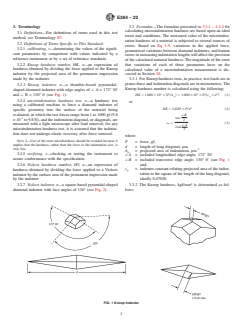
3.2.3 Knoop indenter, n—a rhombic-based pyramidal-
Knoop hardness number is calculated using the following:
shaped diamond indenter with edge angles of/ A = 172° 30'
3 3 2
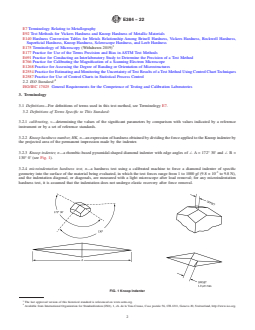
and/ B = 130° 0' (see Fig. 1).
HK 51.000 310 3 P/A 51.000 310 3 P/ c 3 d (1)
~ ! ~ !
p p
3.2.4 microindentation hardness test, n—a hardness test
or
using a calibrated machine to force a diamond indenter of
HK 514229 3 P/d (2)
specific geometry into the surface of the material being
evaluated,inwhichthetestforcesrangefrom1to1000gf(9.8 /B
tan
-3
×10 to9.8N),andtheindentationdiagonal,ordiagonals,are 2
c 5 (3)
p
measured with a light microscope after load removal; for any
/A
2tan
microindentation hardness test, it is assumed that the indenta- 2
tion does not undergo elastic recovery after force removal.
where:
NOTE 2—Use of the term microhardness should be avoided because it
P = force, gf,
implies that the hardness, rather than the force or the indentation size, is
d = length of long diagonal, µm,
very low.
A = projected area of indentation, µm
p
3.2.5 verifying, v—checking or testing the instrument to
/A = included longitudinal edge angle, 172° 30’
assure conformance with the specification.
/B = included transverse edge angle, 130° 0’ (see Fig. 1
and,
3.2.6 Vickers hardness number, HV, n—an expression of
c = indenter constant relating projected area of the inden-
hardness obtained by dividing the force applied to a Vickers p
tation to the square of the length of the long diagonal,
indenterbythesurfaceareaofthepermanentimpressionmade
ideally 0.07028.
by the indenter.
3.2.7 Vickers indenter, n—a square-based pyramidal-shaped 3.3.2 The Knoop hardness, kgf/mm is determined as fol-
diamond indenter with face angles of 136° (see Fig. 2). lows:
FIG. 1 Knoop Indenter
E384 − 22
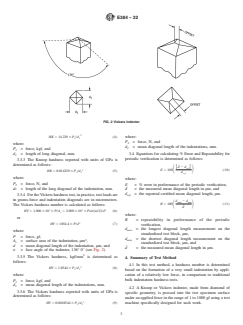
FIG. 2 Vickers Indenter
HK 514.229 3 P /d (4) where:
1 1
P = force, N, and
where:
d = mean diagonal length of the indentations, mm.
P = force, kgf, and
d = length of long diagonal, mm.
3.4 Equations for calculating % Error and Repeatability for
periodic verification is determined as follows:
3.3.3 The Knoop hardness reported with units of GPa is
determined as follows:
¯
d 2 d
? ref?
2 E 5100S D (10)
HK 50.014229 3 P /d (5)
2 2 d
ref
where:
where:
P = force, N, and
2 E = % error in performance of the periodic verification,
d = length of the long diagonal of the indentation, mm. ¯
d = the measured mean diagonal length in µm, and
d = the reported certified mean diagonal length, µm.
ref
3.3.4 FortheVickershardnesstest,inpractice,testloadsare
in grams-force and indentation diagonals are in micrometers.
d 2 d
max min
R 5100 (11)
The Vickers hardness number is calculated as follows:
S D
¯
d
3 3 2
HV 51.000 310 3 P/A 52.000 310 3 Psin α/2 /d (6)
~ !
s
where:
or
R = repeatability in performance of the periodic
HV 51854.4 3 P/d (7)
verification,
d = the longest diagonal length measurement on the
max
where:
standardized test block, µm,
P = force, gf,
d = the shortest diagonal length measurement on the
2 min
A = surface area of the indentation, µm ,
s
standardized test block, µm, and
d = mean diagonal length of the indentation, µm, and
¯
d = the measured mean diagonal length in µm.
α = face angle of the indenter, 136° 0’ (see Fig. 2).
3.3.5 The Vickers hardness, kgf/mm is determined as
4. Summary of Test Method
follows:
4.1 In this test method, a hardness number is determined
HV 51.8544 3 P /d (8)
1 1
based on the formation of a very small indentation by appli-
where:
cation of a relatively low force, in comparison to traditional
bulk indentation hardness tests.
P = force, kgf, and
d = mean diagonal length of the indentations, mm.
4.2 A Knoop or Vickers indenter, made from diamond of
3.3.6 The Vickers hardness reported with units of GPa is
specific geometry, is pressed into the test specimen surface
determined as follows:
under an applied force in the range of 1 to 1000 gf using a test
HV 50.0018544 3 P /d (9) machine specifically designed for such work.
2 2
E384 − 22
4.3 The size of the indentation is measured using a light metrically identical as a function of depth and there will be
microscope equipped with a filar type eyepiece, or other type variations in Knoop hardness, particularly at test forces <200
of measuring device (see Terminology E175). gf, over the force range defined in 1.2 (and above this range);
consequently, Knoop hardness is not normally used to define
4.4 The Knoop hardness number is based upon the force
bulk hardness, except at 500 gf where E140 gives conversions
divided by the projected area of the indentation. The Vickers
toothertestscales,andKnooptestsshouldnotbeperformedat
hardnessnumberisbasedupontheforcedividedbythesurface
test forces above 1000 gf. The majority of Knoop tests of case
area of the indentation.
hardness variations are conducted at forces from 100gf to 500
4.5 It is assumed that elastic recovery does not occur when
gf. If the test is being conducted to meet a specified bulk
the indenter is removed after the loading cycle, that is, it is
hardness value, such as HRC, then most such tests will be
assumed that the indentation retains the shape of the indenter
conducted with Knoop at a 500 gf load. Because of the large
aftertheforceisremoved,butthisisnotalwaystrue.InKnoop
difference between the long and short Knoop diagonals, the
testing, it is assumed that the ratio of the long diagonal to the
Knoopindenterisoftenbettersuitedfordeterminingvariations
shortdiagonaloftheimpressionisthesameasfortheindenter,
of hardness over very small distances compared to the Vickers
7.114, but this is not always true due to elastic recovery.
indenter. Vickers and Knoop tests at forces ≤25 gf are
susceptible to imprecision due to the difficulty in measuring
5. Significance and Use
extremely small indents (<20 µm) by light microscopy with
5.1 Hardness tests have been found to be very useful for
high precision and reproducibility.Tests made at forces≤25 gf
materials evaluation, quality control of manufacturing pro-
should be considered to be qualitative in nature. Likewise, test
cesses and research and development efforts. Hardness, al-
forces that create indents <20 µm in length should be avoided
thoughempiricalinnature,canbecorrelatedtotensilestrength
whenever possible and should be considered to be qualitative
for many metals and alloys, and is also an indicator of
innature.Thesuccessofthespecimenpreparationprocedurein
machinability, wear resistance, toughness and ductility.
removing preparation-induced damage can, and will, influence
testresults;thisproblembecomesmorecriticalasthetestforce
5.2 Microindentationtestsareutilizedtoevaluateandquan-
decreases.
tify hardness variations that occur over a small distance.These
variations may be intentional, such as produced by localized
6. Apparatus
surface hardening, for example, from shot blasting, cold
drawing, flame hardening, induction hardening, etc., or from
6.1 Test Machine—The test machine must support the test
processes such as carburization, nitriding, carbonitriding, etc.;
specimen and control the movement of the indenter into the
or, they may be unintentional variations due to problems, such
specimenunderapreselectedtestforce,andshouldhavealight
as decarburization, localized softening in service, or from
optical microscope to select the desired test locations and to
compositional/microstructural segregation problems. Low test
measure the size of the indentations produced by the test. The
forces also extend hardness testing to materials too thin or too
planeofthesurfaceofthetestspecimenmustbeperpendicular
smallformacroindentationtests.Microindentationtestspermit
to the axis of the indenter and the direction of the force
hardness testing of specific phases or constituents and regions
application.Theplaneofthetestspecimensurfacemustbeflat,
orgradientstoosmallforevaluationbymacroindentationtests.
and free of surface relief, in order to obtain valid, usable test
data. The hardness test machine must meet the verification
5.3 Because microindentation hardness tests will reveal
requirements defined in Test Method E92.
hardnessvariationsthatcommonlyexistwithinmostmaterials,
6.1.1 Force Application—The test machine shall be capable
a single test value may not be representative of the bulk
of applying the test forces according to the following:
hardness. Vickers tests at 1000 gf can be utilized for determi-
6.1.1.1 The time from the initial application of the force
nation of the bulk hardness, but, as for any hardness test, it is
recommended that a number of indents are made and the until the full test force is reached shall not exceed 10 s.
6.1.1.2 Theindentershallcontactthespecimenatavelocity
average and standard deviation are calculated, as needed or as
required. between 15 µm/s and 70 µm/s. Indenter velocity is not usually
adjustable by the user.
5.4 Microindentation hardness testing is generally per-
6.1.1.3 The full test force shall be applied for 10s to 15 s
formedtoquantifyvariationsinhardnessthatoccuroversmall
unless otherwise specified.
distances.To determine these differences requires a very small
6.1.1.4 For some applications it may be necessary to apply
physicalindentation.Testersthatcreateindentsatverylowtest
the test force for longer times. In these instances the tolerance
forcesmustbecarefullyconstructedtoaccuratelyapplythetest
for the time of the applied force is 62s.
forces exactly at the desired location and must have a high-
6.1.2 Vibration Control—During the entire test cycle, the
quality optical system to precisely measure the diagonal (or
test machine should be protected from shock or vibration. To
diagonals) of the small indents. Test forces in the upper range
minimize vibrations, the operator should avoid contacting the
of the force range defined in 1.2 may be used to evaluate bulk
machine, or the support table, in any manner during the entire
hardness. In general, the Vickers indenter is better suited for
test cycle.
determining bulk (average) properties as Vickers hardness is
not altered by the choice of the test force, from 25gf to 1000 6.2 Vickers Indenter—The Vickers indenter normally pro-
gf, because the indent geometry is constant as a function of duces geometrically-similar indentation shapes at all test
indent depth. The Knoop indentation, however, is not geo- forces. Except for tests at very low forces that produce
E384 − 22
indentations with diagonals smaller than about 20 µm, the separated from the mounting material. Never touch the in-
Vickers hardness number will be the same, within statistical denter tip with your finger.
precision limits, as produced using test forces that produce
6.4 Measuring Equipment—The test machine’s measuring
diagonal lengths ≥20 µm, using either a microindentation test
deviceshouldreportthediagonallengthsin0.1µmincrements
machineupto1000gforamacroindentationtestmachinewith
for indentations with diagonals from 1 to 200 µm.
test forces ≥ 1 kgf, as long as the material being tested is
NOTE3—Thisisthereportedlengthandnottheresolutionofthesystem
reasonably homogeneous and the magnification and image
used for performing the measurements.As an example, if a length of 200
qualityareoptimal(seeAppendixX4).Forisotropicmaterials,
µm corresponds to 300 filar units or pixels, the corresponding calibration
the two diagonals of a Vickers indentation are equal in size.
constant would be 200/300 = 0.66666667. This value would be used to
Metals/alloys with preferred crystallographic textures may
compute diagonal lengths, but the reported length would only be reported
produce distorted indents and invalid or questionable test to the nearest 0.1 µm.
results. The Vickers indenter must meet the verification re-
6.4.1 The optical portion of the measuring device should
quirements defined in Test Method E92.
utilizeKöhlerillumination.Consultthemanufacturer’sinstruc-
6.2.1 The ideal Vickers indenter is a highly polished,
tion manual for the adjustments that can be made on your
pointed, square-based pyramidal diamond with face angles of
tester.
136° 0'. The effect that geometrical variations of these angles
6.4.2 To obtain maximum resolution, the measuring micro-
have on the measured values of Vickers hardness is discussed
scope should have high quality objectives with adequate
in Section 10.
numerical apertures, a suitable eyepiece, adjustable illumina-
6.2.2 ThefourfacesoftheVickersindentershallbeequally
tion intensity, adjustable alignment and aperture and field
inclined to the axis of the indenter (within 6 30') and shall
diaphragms. These are adjusted in the same manner as on a
meet at a sharp point. The line of junction between opposite
reflected light microscope or metallograph. Some systems are
faces (offset) shall be not more than 0.5 µm in length as shown
now designed using computer monitors and indent length
in Fig. 2.
detection by image analysis and may not utilize a traditional
eyepiece, but have a projection lens connected to a CCD
6.3 Knoop Indenter—The Knoop indenter does not produce
camera. While a traditional eyepiece has a circular field of
geometrically-similar indentation shapes as a function of test
view, the computer monitor is rectangular and its height-to-
forceandindentdepth.Consequently,theKnoophardnesswill
width ratio can vary.
vary with test force (see Appendix X4). Due to its rhombic
6.4.3 Magnifications should be provided so that the diago-
shape, the indentation depth is shallower for a Knoop inden-
nal can be enlarged to greater than 25 % but less than 75 % of
tation compared to a Vickers indentation under identical test
the field width. If the computer screen hasa4to3 ratio of
conditions. But, for the same test force, the Knoop long
width to height, or a greater difference between the screen
diagonal will be substantially longer than the mean of the two
width and height, the maximum field height must be <75% of
Vickers diagonals. The two diagonals of a Knoop indentation
the width to measure both Vickers diagonals. A 40× or 50×
aremarkedlydifferent.Ideally,thelongdiagonalis7.114times
objective may not be adequate for precise measurement of
longer than the short diagonal, but this ratio is influenced by
indents <30 µm in length. Measurements of diagonal lengths
elastic recovery. Because of its shape, the Knoop indenter is
<20 µm in length with the light microscope may be imprecise,
very useful for evaluating hardness gradients or thin coatings.
regardless of the objective magnification used, with the prob-
The Knoop test is not recommended for use above a 1 kgf test
lem becoming more acute as the diagonal length decreases
load. The Knoop indenter must meet the verification require-
below 20 µm.
ments defined in Test Method E92.
6.3.1 The Knoop indenter is a highly polished, pointed,
7. Test Specimen
rhombic-based, pyramidal diamond (1). The ideal included
longitudinal edge angles are 172° 30' and 130° 0'. The ideal
7.1 For optimum accuracy of measurement, the test should
indenter constant, c , is 0.07028. The effect that geometrical
p beperformedonaflatspecimenwithapolishedsurfacefreeof
variations of these angles have on the measured values of
preparation-induced damage. The surface must be free of any
Knoop hardness is discussed in Section 10.
problems that could affect the indentation or the subsequent
6.3.2 The four faces of the Knoop indenter shall be equally
measurement of the diagonals. Conducting tests on non-planar
inclined to the axis of the indenter (within 6 30') and shall
surfaces is not recommended. Results will be affected even in
meet at a sharp point. The line of junction between opposite
the case of the Knoop test where the radius of curvature is in
faces (offset) shall be not more than 1.0 µm in length for
the direction of the short diagonal.
indentations greater than 20 µm in length, as shown in Fig. 1.
7.1.1 In all tests, the indentation perimeter, and the inden-
For shorter indentations, the offset should be proportionately
tation tips in particular, must be clearly defined in the micro-
less.
scope field of view.
6.3.3 Indenters should be examined periodically and re-
7.1.2 For best results, the specimen surface should not be
placed if they become worn, dulled, chipped, cracked or
etched before making an indentation (2), although etching is
often necessary to aid indent location. Deeply etched surfaces
will obscure the edge of the indentation, making an accurate
measurement of the size of the indentation difficult or impos-
Theboldfacenumbersinparenthesesrefertothelistofreferencesattheendof
this standard. sible. When determining the microindentation hardness of an
E384 − 22
isolated phase or constituent, or when evaluating segregated 8.7 Adjust the tester so that the indenter is in the proper
comparedtonon-segregatedareas,andothersimilarsituations, place for force application. Select the desired force.
alightetchisrequiredtodelineatetheobjectorareaofinterest
8.8 Activate the tester so that the indenter is automatically
so that the indentations can be placed in the desired locations.
loweredandmakescontactwiththespecimenforthenormally
The necessary quality of the required surface preparation does
required time period. Then, remove the force either manually
vary with the forces and magnifications used in microindenta-
or automatically.
tion hardness testing. The lighter the force and the smaller the
8.9 After the force is removed, switch to the measuring
indentation size, the more critical is the surface preparation.
Some materials are more sensitive to preparation-induced mode, and select the proper objective lens. Focus the image,
adjust the light intensity if necessary, and adjust the apertures
damagethanothers.Ingeneral,face-centeredcubicmetals(for
example, austenitic stainless steels, copper and its alloys, for maximum resolution and contrast.
nickel and its alloys, gold and silver) exhibit a larger deforma-
8.10 Examine the indentation for its position relative to the
tionfieldaroundtheindentthananindentofthesametestforce
desired location and for its symmetry.
made in a body-centered cubic metal (for example, ferritic and
8.10.1 If the indentation did not occur at the desired spot,
martensitic steels).
the tester is out of alignment. Consult the manufacturer’s
7.1.3 Due to the small size of the indentations, special
instruction manual for the proper procedure to produce align-
precautions must be taken during specimen preparation. It is
ment. Make another indentation and recheck the indentation
well known that improper preparation can alter test results.
location. Readjust and repeat as necessary.
Specimen preparation must remove any damage introduced
8.10.2 For a Knoop indentation, if one half of the long
during these steps, either due to excessive heating or cold
diagonalismorethan10%longerthantheotherdiagonalhalf,
work, for example.
orifbothendsoftheindentationarenotinsharpfocus,thetest
7.1.4 Specimen preparation should be performed in accor-
specimen surface may not be perpendicular to the indenter
dance with Guide E3.
axis.Suchanindentmayyieldincorrectdataandthecalculated
7.2 Inmanyinstances,itisnecessarytomountthespecimen
HK based upon it should be reported outside these limits.
for convenience in preparation and for best edge retention.
Checkthespecimenalignmentandmakeanothertesttobesure
When mounting is required, the specimen must be adequately
that the test data is correct.
supported by the mounting medium so that the specimen does
8.10.3 For a Vickers indentation, if one half of either
not move during force application, such as might happen in an
diagonal is more than 5 % longer than the other half of that
improperly cured polymer mount.
diagonal, or if the four corners of the indentation are not in
sharp focus, the test surface may not be perpendicular to the
8. Procedure
indenter axis. Such an indent may yield incorrect data and the
calculated HV based upon it should be reported outside these
8.1 Turnontheilluminationsystemandpowerforthetester.
limits. Check the specimen alignment and make another test to
8.2 Select the desired indenter. If it is necessary to physi-
be sure that the test data is correct.
callychangeindenters,refertothemanufacturer’sinstructions.
8.10.4 Ifthediagonallegsareunequalasdescribedin8.10.2
With some machines, both indenters can be mounted on the
or 8.10.3, rotate the specimen 90° and make another indenta-
turret and changed by a simple switch or computer command.
tion in an untested region. If the nonsymmetrical aspect of the
Occasionally clean the indenter with a cotton swab and
indentations has rotated 90°, then the specimen surface is not
alcohol. Avoid creating static charges during cleaning. Never
perpendicular to the indenter axis. If the nonsymmetrical
touch the indenter tip with your fingers as this will alter the
natureoftheindentationremainsinthesameorientation,check
measurements.
the indenter for misalignment or damage.
8.3 Place the specimen on the stage or in the stage clamps,
8.10.5 Some materials may have nonsymmetrical indenta-
so that the specimen surface is perpendicular to the indenter
tions even if the indenter and the specimen surface are
axis. A top-referenced clamping system for mounts is an
perfectly aligned. Tests on single crystals or on textured
excellentdeviceforaligningthetestplaneperpendiculartothe
materials may produce such results. When this occurs, check
indenter, particularly if the back face of the mount is not
thealignmentusingatestspecimen,suchasastandard,known
parallel to the polished front surface. If clay is used on a slide,
to produce uniformly shaped indentations.
use very stiff clay and use high pressure when seating the
8.10.6 Brittle materials, such as ceramics, may crack as a
specimen against the clay.
result of being indented. Specific details for testing ceramics
8.4 Focus the measuring microscope with a low power
are contained in Test Methods C1326 and C1327.
objective so that the specimen surface can be observed.
8.11 Measure the long diagonal of a Knoop indentation, or
8.5 Adjust the light intensity and adjust the apertures for
bothdiagonalsofaVickersindentation,inaccordancewiththe
optimum resolution and contrast. Zero the measuring device
manufacturer’s instruction manual.
according to the manufacturer’s recommended method.
8.11.1 DeterminethelengthofthelongdiagonalofaKnoop
8.6 Select the area desired for hardness determination. indentationorbothdiagonalsofaVickersindentationtowithin
Before applying the force, make a final focus using the 0.1 µm (see 6.3). For theVickers indentations, average the two
measuring objective. diagonal length measurements.
E384 − 22
8.12 ComputetheKnooporVickershardnessnumberusing part of the SI system, the calculated numbers will be reported
the appropriate equation in Section 3 or using tables supplied without mention of the units.Also, due to the general unfamil-
with the tester, respectively. Modern testers usually give an iarity of the metallurgical community with hardness numbers
automatic readout of the hardness after the diagonal or diago- in GPa, and the rather narrow range of GPa values for metals,
nals have been measured. a “soft” SI system approach is recommended.
9.1.2 Test force, and
8.13 Spacing of Indentations—Generally, more than one
9.1.3 Any unusual conditions encountered during the test.
indentationismadeonatestspecimen.Itisnecessarytoensure
that the spacing between indentations is large enough so that
9.2 The symbols HK for Knoop hardness and HV for
adjacent tests do not interfere with each other. Because
Vickers hardness shall be used with the reported numerical
face-centered cubic (FCC) metals (for example, austenitic
values.
stainless steels, copper, nickel, silver and gold) work harden
9.2.1 For this standard, the microindentation hardness test
more dramatically than body-centered cubic (BCC) metals
results can be reported in several different ways. For example,
(ferritic steels, for example), the indent spacing distance is
if the Knoop hardness was found to be 400, and the test force
more critical for FCC metals as the deformation zone around
was 100 gf, the test results may be reported as follows:
the indent is larger than for a BCC metal, as mentioned in
9.2.1.1 For microindentation hardness tests, where the test
7.1.2.
forceisgenerallyingramforceunits,withtestforces≤1000gf,
8.13.1 For most testing purposes, the minimum recom-
this result can be reported as 400 HK 0.1, for example, when
mended spacing between separate tests and the minimum
a test at 100 gf yields a Knoop hardness of 400. The same
distance between an indentation and the surface of the
approach is used to report the Vickers hardness.
specimen, are illustrated in Fig. 3.
9.2.1.2 In the SI system the hardness would be reported as
8.13.2 Forsomeapplications,closerspacingofindentations
3.92 GPa, but this practice is not preferred for the reasons
than those shown in Fig. 3 may be necessary. If a closer
stated in 9.1.1.
indentation spacing is used, it shall be the responsibility of the
9.2.1.3 Fornonstandarddwelltimes,otherthan10sto15s,
testing laboratory to verify the accuracy of the testing proce-
the hardness would be reported as 400 HK 0.1/22 s. In this
dure. Parallel, staggered bands of indents from the surface
case, 22 s would be the actual time of the full load dwell time.
inward can be utilized to obtain closer overall spacing of
9.2.1.4 For macro-Vickers tests with forces >1 kgf, seeTest
indents with respect to the distance from the surface than can
Method E92 for the recommended notation.
be safely done with a single line of indents from the surface
9.3 Examplesofthecalculationofmeasurementuncertainty
inward, or within the interior of the specimen.
are given in Test Method E92.
9. Report
10. Precision and Bias
9.1 Report the following information:
9.1.1 The number of tests and, where appropriate or 10.1 The precision and bias of microindentation hardness
required, the mean, standard deviation and 95% confidence measurements depend on strict adherence to the stated test
interval for the tests. Due to the long history of hardness procedure and are influenced by instrumental and material
calculations, and because the traditional kg/mm unit is not factors and indentation measurement errors.
FIG. 3 Minimum Recommended Spacing for Knoop and Vickers Indentations
E384 − 22
10.2 The consistency of agreement for repeated tests on the variables:force,indentergeometryanddiagonalmeasurement.
samematerialisdependentonthehomogeneityofthematerial, For theVickers test, the error in measuring the diagonals has a
reproducibility of the hardness tester, and consistent, careful bigger effect on the precision of the HV value than a larger
measurement of the indents by a competent operator. error in the test force or the face geometry. For the Knoop test,
an error in measuring the long diagonal has a bigger influence
10.3 Instrumental factors that can affect test results include:
on the precision of the HK value than a larger error in the test
accuracy of loading; inertia effects; speed of loading; vibra-
force. But, errors in the two face angles, Fig. 1, have a very
tions; the angle of indentation; lateral movement of the
significant effect on the precision of the HK value.
indenter or specimen; and, indentation and indenter shape
deviations. 10.8 Three separate interlaboratory studies have been con-
10.3.1 Vibrations during indenting will produce larger in- ducted in accordance with Practice E691 to determine the
dentations with the potential influence of vibrations becoming precision,repeatability,andreproducibilityofthistestmethod.
greater as the force decreases (2, 3). Thethreestudiesaredefinedasfollows: (a)KnoopandVickers
10.3.2 Theanglebetweentheindenterandspecimensurface tests, six test forces in the micro range, twelve laboratories,
shouldbewithin2°ofperpendicular.Greateramountsoftilting manual measurements, and seven different hardness level
may produce non-uniform indentations and incorrect test specimens (see 10.8.1 and Appendix X1). Results were pub-
lished in 1989 (7, 8) and in ASTM Research Report RR:E04-
results.
1004. (b)KnoopandVickerstests,twotestforcesinthemicro
10.4 Material factors that can affect test results include:
range, seven laboratories, image analysis and manual
specimenhomogeneity,orientationortextureeffects;improper
measurements, four different hardness level specimens (see
specimen preparation; low specimen surface reflectivity; and,
10.8.2, Appendix X2 and ASTM Research Report RR:E04-
transparency of the specimen.
1006). (c)KnoopandVickerstests,sixtestforcesinthemicro
10.4.1 Residual deformation from mechanical polishing
range, twenty-five laboratories, manual measurements, six
must be removed, particularly for low-force (≤200 gf) testing.
different hardness level specimens (see 10.8.3, Appendix X3
10.4.2 Distortion of the indentation shape, due to either
and ASTM Research Report RR:E04-1007).
crystallographicormicrostructuraltexture,influencesdiagonal
10.8.1 An interlaboratory test program was conducted in
lengths and the validity of the calculated hardness.
accordance with Practice E691 to develop information regard-
10.4.3 Plastic deformation during indentation can produce
ing the precision, repeatability, and reproducibility of the
ridging around the indentation periphery that will affect diago-
measurement of Knoop and Vickers indentations (supporting
nal measurement accuracy.
data have been filed atASTM Headquarters; request RR:E04-
10.4.4 Testing of etched surfaces, depending on the extent
1004). Thetestforceswere25,50,100,200,500,and1000gf
of etching, may produce results that are different from those
on three ferrous and four nonferrous specimens (7, 8). Twelve
obtained on unetched surfaces (2).
laboratories measured the indentations, five of each type at
10.5 Measurement errors that can affect test results include:
each force on each sample.Additional details of this study are
inaccurate calibration of the measuring device; inadequate
given in Appendix X1.
resolving power of the objective; insufficient magnification;
10.8.1.1 Tests of the three ferrous specimens revealed that
operator bias in sizing the indentations; poor image contrast;
nine laboratories produced similar measurements while two
non-uniform illumination; and, improper zeroing of the mea-
laboratories consistently undersized the indentations and one
suring device.
laboratory consistently oversized the indentations; that is,
10.5.1 The accuracy of microindentation hardness testing is
biased results were produced. These latter results were most
strongly influenced by the accuracy to which the indentations
pronounced as the force decreased and specimen hardness
can be measured.
increased (that is, as the diagonal size decreased) and were
10.5.2 Theerrorinmeasuringthediagonalsincreasesasthe
observed for bothVickers and Knoop indentations. Results for
numericalapertureofthemeasuringobjectivedecreases (4, 5).
the lower hardness nonferrous indentations produced better
In general, indents <30 µm in length should be measured with
agreement. However, none of the laboratories that obtained
objectives having greater magnification than 40 or 50×. Image
higher or lower results on the ferrous specimens measured the
contrast between the indent and the specimen is critical for
nonferrous indentations.
precise measurement of diagonal length.
10.8.1.2 Repeatability Interval—The difference due to test
10.5.3 Bias is introduced if the operator consistently under-
error between two test results in the same laboratory on the
sizes or over-sizes the indentations.
samematerialincreaseswithincreasingspecimenhardnessand
with decreasing test force (see X1.4.4).
10.6 Some of the factors that affect test results produce
systematic errors that influence all test results while others
primarily influence low-force (≤25 gf) test results (6). Some of
Supporting data have been filed atASTM International Headquarters and may
beobtainedbyrequestingResearchReportRR:E04-1004.ContactASTMCustomer
these problems occur continually, others may occur in an
Service at service@astm.org.
undefined, sporadic manner. Low-force hardness tests are
Supporting data have been filed atASTM International Headquarters and may
influencedbythesefactorstoagreaterextentthanhigherforce
beobtainedbyrequestingResearchReportRR:E04-1006.ContactASTMCustomer
tests. Service at service@astm.org.
Supporting data have been filed atASTM International Headquarters and may
10.7 For both the Vickers and Knoop hardness tests, the
beobtainedbyrequestingResearchReportRR:E04-1007.ContactASTMCustomer
calculated microindentation hardness is a function of three Service at service@astm.org.
E384 − 22
10.8.1.3 Reproducibility Interval—The difference in test 10.8.2.3 Neither Practice E691, nor any other ASTM
results on the same material tested in different laboratories standard, deals with comparing test results of a single property
increasedwithincreasingspecimenhardnessandwithdecreas- madebytwodifferenttestmethods.Hence,itisnotpossibleto
ing test force (see X1.4.5). statistically and accurately compare the hardness measure-
10.8.1.4 The within-laboratory and between-laboratory pre- ments made by the manual and automated procedures.
cision values improved as specimen hardness decreased and However, this information is graphically represented for com-
test force increased. The repeatability interval and reproduc- parative purposes, X2.6.
ibility interval were generally larger than the precision 10.8.3 Tests of six ferrous alloys with hardness values of
estimate, particularly at low test forces and high specimen <20HRC,30,40,50,60and67HRCweretestedusingKnoop
hardness. andVickerstestsatavarietyoftestforces,usually25,50,100,
10.8.2 An interlaboratory test program was conducted in 300, 500 and 1000 gf (except that the lowest test forces for
accordance with Practice E691 to develop information regard- Vickers tests of the 60 and 67 HRC specimens were not
ing the repeatability and reproducibility of Knoop and Vickers performed). Twenty-five different laboratories tested the steels
measurements made with automated image analysis systems using the Vickers test while thirteen different laboratories
compared to measurements by manual procedures. Four fer- testedthesteelsusingtheKnooptest.Additionaldetailsofthis
study are given in Appendix X3.
rous specimens were used in the round robin. The tests were
conducted at 100 gf and 300 gf. The participants in the test 10.8.3.1 Repeatability and reproducibility statistics were
determinedfortheKnoopandVickersdiagonalmeasurements.
program measured the same indentations on the four speci-
mens. Seven labs measured the specimens using both proce- Results are tabulated in Table X3.1 and Table X3.2 and are
shown graphically in Fig. X3.1 and Fig. X3.2.
dures. The Knoop indentations on specimen C1 were too long
for accurate measurements to be made by one lab; hence, only 10.8.3.2 Repeatability and reproducibility statistics were
determinedfortheKnoopandVickershardnessvalues.Results
sixsetsofmeasurementsweremadeonthisspecimen.Nearthe
endofthetestprogram,specimenB1waslostinshipping;thus are tabulated in Table X3.3 and Table X3.4 and are shown
only six sets of measurements were made on this specimen. graphically in Fig. X3.3 and Fig. X3.4.
Additional details of the study are contained in Appendix X2.
11. Conversion to Other Hardness Scales or Tensile
10.8.2.1 Repeatability concerns the variability between in-
Strength Values
dividual test results obtained within a single laboratory by a
single operator with a specific set of test apparatus. For both 11.1 There is no generally accepted method for precise
the manual and automated measurements, the repeatability conversion of Knoop or Vickers microindentation hardness
interval increased with specimen hardness and decreasing test numbers to other hardness scales or tensile strength values.
force, Appendix X2. For equivalent testing conditions, the Suchconversionsareempiricalandarelimitedinprecisionand
repeatabilityintervalforautomatedmeasurementswasslightly should be used with caution, except for special cases where a
larger than for manual measurements. reliable basis for the conversion has been obtained by com-
10.8.2.2 Reproducibility deals with the variability between parison tests. For loads ≥ 25 gf microindentation Vickers
single test results obtained by different laboratories applying hardness numbers are in statistical agreement with macro-
the same test methods to the same or similar test specimens. Vickers hardness numbers. Refer to Standard Hardness Con-
For both the manual and automated measurements, the repro- version Tables in E140.
ducibility interval increased with specimen hardness and de-
12. Keywords
creasing test force, Appendix X2. For equivalent testing
conditions, the reproducibility interval for automated measure- 12.1 hardness; indentation; Knoop; microindentation; Vick-
ments was slightly larger than for manual measurements. ers
ANNEXES
(Mandatory Information)
A1. VERIFICATION OF KNOOP AND VICKERS HARDNESS TESTING MACHINES AND INDENTERS
A1.1 Scope ing the consistency of microindentation measurements based
on the periodic verification tests and detecting measurement
A1.1.1 Annex A1 specifies three types of procedures for
deviations is described in Practices E2554 and E2587.
verifying microindentation (Knoop andVickers) hardness test-
ing machines: direct verification, indirect verification, and A1.1.2 Direct verification is a process normally performed
periodicverification.Thisannexalsocontainsgeometricspeci- bythemanufactureforverifyingthatcriticalcomponentsofthe
fications for the indenter. A control chart method for monitor- hardness testing machine are within allowable tolerances by
E384 − 22
direct measurement of the applied test forces, the indentation formedinaccordancewiththeschedulegiveninTableA1.1for
measuring system, and the testing cycle. For additional infor- each microindentation hardness indenter that will be used.
mation about direct verification see Test Method E92.
A1.3.2 It is recommended that the periodic verification
A1.1.3 Indirect verification is a process performed by the procedures be performed whenever the indenter is changed,
user of the machine, or by an outside certification agency, to that is, if one indenter is physically removed from t
...
This document is not an ASTM standard and is intended only to provide the user of an ASTM standard an indication of what changes have been made to the previous version. Because
it may not be technically possible to adequately depict all changes accurately, ASTM recommends that users consult prior editions as appropriate. In all cases only the current version
of the standard as published by ASTM is to be considered the official document.
Designation: E384 − 17 E384 − 22
Standard Test Method for
Microindentation Hardness of Materials
This standard is issued under the fixed designation E384; the number immediately following the designation indicates the year of
original adoption or, in the case of revision, the year of last revision. A number in parentheses indicates the year of last reapproval. A
superscript epsilon (´) indicates an editorial change since the last revision or reapproval.
This standard has been approved for use by agencies of the U.S. Department of Defense.
1. Scope*
1.1 This test method covers determination of the microindentation hardness of materials.
1.2 This test method covers microindentation tests made with Knoop and Vickers indenters under test forces in the range from
-3
9.8 × 10 to 9.8 N (1 to 1000 gf).
1.3 This test method includes an analysis of the possible sources of errors that can occur during microindentation testing and how
these factors affect the precision, bias, repeatability, and reproducibility of test results.
1.4 Information pertaining to the requirements for direct verification and calibration of the testing machine and the requirements
for the manufacture and calibration of Vickers and Knoop reference hardness test blocks are in Test Method E92.
NOTE 1—While Committee E04 is primarily concerned with metals, the test procedures described are applicable to other materials.
1.5 Units—The values stated in SI units are to be regarded as standard. No other units of measurement are included in this
standard.
1.6 This standard does not purport to address all of the safety concerns, if any, associated with its use. It is the responsibility
of the user of this standard to establish appropriate safety safety, health, and healthenvironmental practices and determine the
applicability of regulatory limitations prior to use.
1.7 This international standard was developed in accordance with internationally recognized principles on standardization
established in the Decision on Principles for the Development of International Standards, Guides and Recommendations issued
by the World Trade Organization Technical Barriers to Trade (TBT) Committee.
2. Referenced Documents
2.1 ASTM Standards:
C1326 Test Method for Knoop Indentation Hardness of Advanced Ceramics
C1327 Test Method for Vickers Indentation Hardness of Advanced Ceramics
E3 Guide for Preparation of Metallographic Specimens
This test method is under the jurisdiction of ASTM Committee E04 on Metallography and is the direct responsibility of Subcommittee E04.05 on Microindentation
Hardness Testing. With this revision the test method was expanded to include the requirements previously defined in E28.92, Standard Test Method for Vickers Hardness
Testing of Metallic Material that was under the jurisdiction of E28.06
Current edition approved June 1, 2017Oct. 1, 2022. Published August 2017November 2022. Originally approved in 1969. Last previous edition approved in 20162017
as E384 – 16.E384 – 17. DOI: 10.1520/E0384-1710.1520/E0384-22
For referenced ASTM standards, visit the ASTM website, www.astm.org, or contact ASTM Customer Service at service@astm.org. For Annual Book of ASTM Standards
volume information, refer to the standard’s Document Summary page on the ASTM website.
*A Summary of Changes section appears at the end of this standard
Copyright © ASTM International, 100 Barr Harbor Drive, PO Box C700, West Conshohocken, PA 19428-2959. United States
E384 − 22
E7 Terminology Relating to Metallography
E92 Test Methods for Vickers Hardness and Knoop Hardness of Metallic Materials
E140 Hardness Conversion Tables for Metals Relationship Among Brinell Hardness, Vickers Hardness, Rockwell Hardness,
Superficial Hardness, Knoop Hardness, Scleroscope Hardness, and Leeb Hardness
E175 Terminology of Microscopy (Withdrawn 2019)
E177 Practice for Use of the Terms Precision and Bias in ASTM Test Methods
E691 Practice for Conducting an Interlaboratory Study to Determine the Precision of a Test Method
E766 Practice for Calibrating the Magnification of a Scanning Electron Microscope
E1268 Practice for Assessing the Degree of Banding or Orientation of Microstructures
E2554 Practice for Estimating and Monitoring the Uncertainty of Test Results of a Test Method Using Control Chart Techniques
E2587 Practice for Use of Control Charts in Statistical Process Control
2.2 ISO Standard:
ISO/IEC 17025 General Requirements for the Competence of Testing and Calibration Laboratories
3. Terminology
3.1 Definitions—For definitions of terms used in this test method, see Terminology E7.
3.2 Definitions of Terms Specific to This Standard:
3.2.1 calibrating, v—determining the values of the significant parameters by comparison with values indicated by a reference
instrument or by a set of reference standards.
3.2.2 Knoop hardness number, HK, n—an expression of hardness obtained by dividing the force applied to the Knoop indenter by
the projected area of the permanent impression made by the indenter.
3.2.3 Knoop indenter, n—a rhombic-based pyramidal-shaped diamond indenter with edge angles of / A = 172° 30' and / B =
130° 0' (see Fig. 1).
3.2.4 microindentation hardness test, n—a hardness test using a calibrated machine to force a diamond indenter of specific
-3
geometry into the surface of the material being evaluated, in which the test forces range from 1 to 1000 gf (9.8 × 10 to 9.8 N),
and the indentation diagonal, or diagonals, are measured with a light microscope after load removal; for any microindentation
hardness test, it is assumed that the indentation does not undergo elastic recovery after force removal.
FIG. 1 Knoop Indenter
The last approved version of this historical standard is referenced on www.astm.org.
Available from International Organization for Standardization (ISO), 1, ch. de la Voie-Creuse, Case postale 56, CH-1211, Geneva 20, Switzerland, http://www.iso.org.
E384 − 22
FIG. 2 Vickers Indenter
NOTE 2—Use of the term microhardness should be avoided because it implies that the hardness, rather than the force or the indentation size, is very low.
3.2.5 verifying, v—checking or testing the instrument to assure conformance with the specification.
3.2.6 Vickers hardness number, HV, n—an expression of hardness obtained by dividing the force applied to a Vickers indenter by
the surface area of the permanent impression made by the indenter.
3.2.7 Vickers indenter, n—a square-based pyramidal-shaped diamond indenter with face angles of 136° (see Fig. 2).
3.3 Formulae—The formulae presented in 3.3.1 – 3.3.4 for calculating microindentation hardness are based upon an ideal tester
and conditions. The measured value of the microindentation hardness of a material is subjected to several sources of errors. Based
on Eq 1-9, variations in the applied force, geometrical variations between diamond indenters, and human errors in measuring
indentation lengths will affect the precision of the calculated material hardness. The magnitude of the error that variations of each
of these parameters have on the calculated value of a microindentation measurement is discussed in Section 10.
3.3.1 For Knoop hardness tests, in practice, test loads are in grams-force and indentation diagonals are in micrometers. The Knoop
hardness number is calculated using the following:
3 3 2
HK 5 1.000 310 3~P/A ! 5 1.000 310 3P/~c 3d ! (1)
p p
or
HK 5 14229 3P/d (2)
/B
tan
c 5 (3)
p
/A
2tan
where:
P = force, gf,
d = length of long diagonal, μm,
A = projected area of indentation, μm
p
/A = included longitudinal edge angle, 172° 30’
/B = included transverse edge angle, 130° 0’ (see Fig. 1 and,
E384 − 22
c = indenter constant relating projected area of the indentation to the square of the length of the long diagonal, ideally
p
0.07028.
3.3.2 The Knoop hardness, kgf/mm is determined as follows:
HK 5 14.229 3P /d (4)
1 1
where:
P = force, kgf, and
d = length of long diagonal, mm.
3.3.3 The Knoop hardness reported with units of GPa is determined as follows:
HK 5 0.014229 3P /d (5)
2 2
where:
P = force, N, and
d = length of the long diagonal of the indentation, mm.
3.3.4 For the Vickers hardness test, in practice, test loads are in grams-force and indentation diagonals are in micrometers. The
Vickers hardness number is calculated as follows:
3 3 2
HV 5 1.000 310 3P/A 5 2.000 310 3Psin~α/2!/d (6)
s
or
HV 5 1854.4 3P/d (7)
where:
P = force, gf,
A = surface area of the indentation, μm ,
s
d = mean diagonal length of the indentation, μm, and
α = face angle of the indenter, 136° 0’ (see Fig. 2).
3.3.5 The Vickers hardness, kgf/mm is determined as follows:
HV 5 1.8544 3P /d (8)
1 1
where:
P = force, kgf, and
d = mean diagonal length of the indentations, mm.
3.3.6 The Vickers hardness reported with units of GPa is determined as follows:
HV 5 0.0018544 3P /d (9)
2 2
where:
P = force, N, and
d = mean diagonal length of the indentations, mm.
3.4 Equations for calculating % Error and Repeatability for periodic verification is determined as follows:
¯
d 2 d
ref
E 5 100S D (10)
d
ref
¯
d 2 d
? ref?
E 5 100S D (10)
d
ref
E384 − 22
where:
E = % error in performance of the periodic verification,
d¯ = the measured mean diagonal length in μm, and
d = the reported certified mean diagonal length, μm.
ref
d 2 d
max min
R 5 100 (11)
S D
¯
d
where:
R = repeatability in performance of the periodic verification,
d = the longest diagonal length measurement on the standardized test block, μm,
max
d = the shortest diagonal length measurement on the standardized test block, μm, and
min
d¯ = the measured mean diagonal length in μm.
4. Summary of Test Method
4.1 In this test method, a hardness number is determined based on the formation of a very small indentation by application of a
relatively low force, in comparison to traditional bulk indentation hardness tests.
4.2 A Knoop or Vickers indenter, made from diamond of specific geometry, is pressed into the test specimen surface under an
applied force in the range of 1 to 1000 gf using a test machine specifically designed for such work.
4.3 The size of the indentation is measured using a light microscope equipped with a filar type eyepiece, or other type of measuring
device (see Terminology E175).
4.4 The Knoop hardness number is based upon the force divided by the projected area of the indentation. The Vickers hardness
number is based upon the force divided by the surface area of the indentation.
4.5 It is assumed that elastic recovery does not occur when the indenter is removed after the loading cycle, that is, it is assumed
that the indentation retains the shape of the indenter after the force is removed, but this is not always true. In Knoop testing, it is
assumed that the ratio of the long diagonal to the short diagonal of the impression is the same as for the indenter, 7.114, but this
is not always true due to elastic recovery.
5. Significance and Use
5.1 Hardness tests have been found to be very useful for materials evaluation, quality control of manufacturing processes and
research and development efforts. Hardness, although empirical in nature, can be correlated to tensile strength for many metals and
alloys, and is also an indicator of machinability, wear resistance, toughness and ductility.
5.2 Microindentation tests are utilized to evaluate and quantify hardness variations that occur over a small distance. These
variations may be intentional, such as produced by localized surface hardening, for example, from shot blasting, cold drawing,
flame hardening, induction hardening, etc., or from processes such as carburization, nitriding, carbonitriding, etc.; or, they may be
unintentional variations due to problems, such as decarburization, localized softening in service, or from compositional/
microstructural segregation problems. Low test forces also extend hardness testing to materials too thin or too small for
macroindentation tests. Microindentation tests permit hardness testing of specific phases or constituents and regions or gradients
too small for evaluation by macroindentation tests.
5.3 Because microindentation hardness tests will reveal hardness variations that commonly exist within most materials, a single
test value may not be representative of the bulk hardness. Vickers tests at 1000 gf can be utilized for determination of the bulk
hardness, but, as for any hardness test, it is recommended that a number of indents are made and the average and standard deviation
are calculated, as needed or as required.
5.4 Microindentation hardness testing is generally performed to quantify variations in hardness that occur over small distances.
To determine these differences requires a very small physical indentation. Testers that create indents at very low test forces must
be carefully constructed to accurately apply the test forces exactly at the desired location and must have a high-quality optical
system to precisely measure the diagonal (or diagonals) of the small indents. Test forces in the upper range of the force range
E384 − 22
defined in 1.2 may be used to evaluate bulk hardness. In general, the Vickers indenter is better suited for determining bulk (average)
properties as Vickers hardness is not altered by the choice of the test force, from 2525 gf to 1000 gf, because the indent geometry
is constant as a function of indent depth. The Knoop indentation, however, is not geometrically identical as a function of depth
and there will be variations in Knoop hardness, particularly at test forces <200 gf, over the force range defined in 1.2 (and above
this range); consequently, Knoop hardness is not normally used to define bulk hardness, except at 500 gf where E140 gives
conversions to other test scales, and Knoop tests should not be performed at test forces above 1000 gf. The majority of Knoop tests
of case hardness variations are conducted at forces from 100100 gf to 500 gf. If the test is being conducted to meet a specified bulk
hardness value, such as HRC, then most such tests will be conducted with Knoop at a 500 gf load. Because of the large difference
between the long and short Knoop diagonals, the Knoop indenter is often better suited for determining variations of hardness over
very small distances compared to the Vickers indenter. Vickers and Knoop tests at forces ≤25 gf are susceptible to imprecision due
to the difficulty in measuring extremely small indents (<20 μm) by light microscopy with high precision and reproducibility. Tests
made at forces ≤25 gf should be considered to be qualitative in nature. Likewise, test forces that create indents <20 μm in length
should be avoided whenever possible and should be considered to be qualitative in nature. The success of the specimen preparation
procedure in removing preparation-induced damage can, and will, influence test results; this problem becomes more critical as the
test force decreases.
6. Apparatus
6.1 Test Machine—The test machine must support the test specimen and control the movement of the indenter into the specimen
under a preselected test force, and should have a light optical microscope to select the desired test locations and to measure the
size of the indentations produced by the test. The plane of the surface of the test specimen must be perpendicular to the axis of
the indenter and the direction of the force application. The plane of the test specimen surface must be flat, and free of surface relief,
in order to obtain valid, usable test data. The hardness test machine must meet the verification requirements defined in Test Method
E92.
6.1.1 Force Application—The test machine shall be capable of applying the test forces according to the following:
6.1.1.1 The time from the initial application of the force until the full test force is reached shall not exceed 10 s.
6.1.1.2 The indenter shall contact the specimen at a velocity between 15 μm/s and 70 μm/s. Indenter velocity is not usually
adjustable by the user.
6.1.1.3 The full test force shall be applied for 1010 s to 15 s unless otherwise specified.
6.1.1.4 For some applications it may be necessary to apply the test force for longer times. In these instances the tolerance for the
time of the applied force is 6 2 s.
6.1.2 Vibration Control—During the entire test cycle, the test machine should be protected from shock or vibration. To minimize
vibrations, the operator should avoid contacting the machine, or the support table, in any manner during the entire test cycle.
6.2 Vickers Indenter—The Vickers indenter normally produces geometrically-similar indentation shapes at all test forces. Except
for tests at very low forces that produce indentations with diagonals smaller than about 20 μm, the Vickers hardness number will
be the same, within statistical precision limits, as produced using test forces that produce diagonal lengths ≥20 μm, using either
a microindentation test machine up to 1000 gf or a macroindentation test machine with test forces ≥ 1 kgf, as long as the material
being tested is reasonably homogeneous and the magnification and image quality are optimal (see Appendix X4). For isotropic
materials, the two diagonals of a Vickers indentation are equal in size. Metals/alloys with preferred crystallographic textures may
produce distorted indents and invalid or questionable test results. The Vickers indenter must meet the verification requirements
defined in Test Method E92.
6.2.1 The ideal Vickers indenter is a highly polished, pointed, square-based pyramidal diamond with face angles of 136° 0'. The
effect that geometrical variations of these angles have on the measured values of Vickers hardness is discussed in Section 10.
6.2.2 The four faces of the Vickers indenter shall be equally inclined to the axis of the indenter (within 6 30') and shall meet at
a sharp point. The line of junction between opposite faces (offset) shall be not more than 0.5 μm in length as shown in Fig. 2.
6.3 Knoop Indenter—The Knoop indenter does not produce geometrically-similar indentation shapes as a function of test force
and indent depth. Consequently, the Knoop hardness will vary with test force (see Appendix X4). Due to its rhombic shape, the
indentation depth is shallower for a Knoop indentation compared to a Vickers indentation under identical test conditions. But, for
E384 − 22
the same test force, the Knoop long diagonal will be substantially longer than the mean of the two Vickers diagonals. The two
diagonals of a Knoop indentation are markedly different. Ideally, the long diagonal is 7.114 times longer than the short diagonal,
but this ratio is influenced by elastic recovery. Because of its shape, the Knoop indenter is very useful for evaluating hardness
gradients or thin coatings. The Knoop test is not recommended for use above a 1 kgf test load. The Knoop indenter must meet the
verification requirements defined in Test Method E92.
6.3.1 The Knoop indenter is a highly polished, pointed, rhombic-based, pyramidal diamond (1). The ideal included longitudinal
edge angles are 172° 30' and 130° 0'. The ideal indenter constant, c , is 0.07028. The effect that geometrical variations of these
p
angles have on the measured values of Knoop hardness is discussed in Section 10.
6.3.2 The four faces of the Knoop indenter shall be equally inclined to the axis of the indenter (within 6 30') and shall meet at
a sharp point. The line of junction between opposite faces (offset) shall be not more than 1.0 μm in length for indentations greater
than 20 μm in length, as shown in Fig. 1. For shorter indentations, the offset should be proportionately less.
6.3.3 Indenters should be examined periodically and replaced if they become worn, dulled, chipped, cracked or separated from
the mounting material. Never touch the indenter tip with your finger.
6.4 Measuring Equipment—The test machine’s measuring device should report the diagonal lengths in 0.1 μm increments for
indentations with diagonals from 1 to 200 μm.
NOTE 3—This is the reported length and not the resolution of the system used for performing the measurements. As an example, if a length of 200 μm
corresponds to 300 filar units or pixels, the corresponding calibration constant would be 200/300 = 0.66666667. This value would be used to compute
diagonal lengths, but the reported length would only be reported to the nearest 0.1 μm.
6.4.1 The optical portion of the measuring device should utilize Köhler illumination. Consult the manufacturer’s instruction
manual for the adjustments that can be made on your tester.
6.4.2 To obtain maximum resolution, the measuring microscope should have high quality objectives with adequate numerical
apertures, a suitable eyepiece, adjustable illumination intensity, adjustable alignment and aperture and field diaphragms. These are
adjusted in the same manner as on a reflected light microscope or metallograph. Some systems are now designed using computer
monitors and indent length detection by image analysis and may not utilize a traditional eyepiece, but have a projection lens
connected to a CCD camera. While a traditional eyepiece has a circular field of view, the computer monitor is rectangular and its
height-to-width ratio can vary.
6.4.3 Magnifications should be provided so that the diagonal can be enlarged to greater than 25 % but less than 75 % of the field
width. If the computer screen has a 4 to 3 ratio of width to height, or a greater difference between the screen width and height,
the maximum field height must be <75%<75 % of the width to measure both Vickers diagonals. A 40× or 50× objective may not
be adequate for precise measurement of indents <30 μm in length. Measurements of diagonal lengths <20 μm in length with the
light microscope may be imprecise, regardless of the objective magnification used, with the problem becoming more acute as the
diagonal length decreases below 20 μm.
7. Test Specimen
7.1 For optimum accuracy of measurement, the test should be performed on a flat specimen with a polished surface free of
preparation-induced damage. The surface must be free of any problems that could affect the indentation or the subsequent
measurement of the diagonals. Conducting tests on non-planar surfaces is not recommended. Results will be affected even in the
case of the Knoop test where the radius of curvature is in the direction of the short diagonal.
7.1.1 In all tests, the indentation perimeter, and the indentation tips in particular, must be clearly defined in the microscope field
of view.
7.1.2 For best results, the specimen surface should not be etched before making an indentation (2), although etching is often
necessary to aid indent location. Deeply etched surfaces will obscure the edge of the indentation, making an accurate measurement
of the size of the indentation difficult or impossible. When determining the microindentation hardness of an isolated phase or
constituent, or when evaluating segregated compared to non-segregated areas, and other similar situations, a light etch is required
The boldface numbers in parentheses refer to the list of references at the end of this standard.
E384 − 22
to delineate the object or area of interest so that the indentations can be placed in the desired locations. The necessary quality of
the required surface preparation does vary with the forces and magnifications used in microindentation hardness testing. The lighter
the force and the smaller the indentation size, the more critical is the surface preparation. Some materials are more sensitive to
preparation-induced damage than others. In general, face-centered cubic metals (for example, austenitic stainless steels, copper and
its alloys, nickel and its alloys, gold and silver) exhibit a larger deformation field around the indent than an indent of the same test
force made in a body-centered cubic metal (for example, ferritic and martensitic steels).
7.1.3 Due to the small size of the indentations, special precautions must be taken during specimen preparation. It is well known
that improper preparation can alter test results. Specimen preparation must remove any damage introduced during these steps,
either due to excessive heating or cold work, for example.
7.1.4 Specimen preparation should be performed in accordance with Guide E3.
7.2 In many instances, it is necessary to mount the specimen for convenience in preparation and for best edge retention. When
mounting is required, the specimen must be adequately supported by the mounting medium so that the specimen does not move
during force application, such as might happen in an improperly cured polymer mount.
8. Procedure
8.1 Turn on the illumination system and power for the tester.
8.2 Select the desired indenter. If it is necessary to physically change indenters, refer to the manufacturer’s instructions. With some
machines, both indenters can be mounted on the turret and changed by a simple switch or computer command. Occasionally clean
the indenter with a cotton swab and alcohol. Avoid creating static charges during cleaning. Never touch the indenter tip with your
fingers as this will alter the measurements.
8.3 Place the specimen on the stage or in the stage clamps, so that the specimen surface is perpendicular to the indenter axis. A
top-referenced clamping system for mounts is an excellent device for aligning the test plane perpendicular to the indenter,
particularly if the back face of the mount is not parallel to the polished front surface. If clay is used on a slide, use very stiff clay
and use high pressure when seating the specimen against the clay.
8.4 Focus the measuring microscope with a low power objective so that the specimen surface can be observed.
8.5 Adjust the light intensity and adjust the apertures for optimum resolution and contrast. Zero the measuring device according
to the manufacturer’s recommended method.
8.6 Select the area desired for hardness determination. Before applying the force, make a final focus using the measuring objective.
8.7 Adjust the tester so that the indenter is in the proper place for force application. Select the desired force.
8.8 Activate the tester so that the indenter is automatically lowered and makes contact with the specimen for the normally required
time period. Then, remove the force either manually or automatically.
8.9 After the force is removed, switch to the measuring mode, and select the proper objective lens. Focus the image, adjust the
light intensity if necessary, and adjust the apertures for maximum resolution and contrast.
8.10 Examine the indentation for its position relative to the desired location and for its symmetry.
8.10.1 If the indentation did not occur at the desired spot, the tester is out of alignment. Consult the manufacturer’s instruction
manual for the proper procedure to produce alignment. Make another indentation and recheck the indentation location. Readjust
and repeat as necessary.
8.10.2 For a Knoop indentation, if one half of the long diagonal is more than 10 % longer than the other diagonal half, or if both
ends of the indentation are not in sharp focus, the test specimen surface may not be perpendicular to the indenter axis. Such an
E384 − 22
indent may yield incorrect data and the calculated HK based upon it should be reported outside these limits. Check the specimen
alignment and make another test to be sure that the test data is correct.
8.10.3 For a Vickers indentation, if one half of either diagonal is more than 5 % longer than the other half of that diagonal, or if
the four corners of the indentation are not in sharp focus, the test surface may not be perpendicular to the indenter axis. Such an
indent may yield incorrect data and the calculated HV based upon it should be reported outside these limits. Check the specimen
alignment and make another test to be sure that the test data is correct.
8.10.4 If the diagonal legs are unequal as described in 8.10.2 or 8.10.3, rotate the specimen 90° and make another indentation in
an untested region. If the nonsymmetrical aspect of the indentations has rotated 90°, then the specimen surface is not perpendicular
to the indenter axis. If the nonsymmetrical nature of the indentation remains in the same orientation, check the indenter for
misalignment or damage.
8.10.5 Some materials may have nonsymmetrical indentations even if the indenter and the specimen surface are perfectly aligned.
Tests on single crystals or on textured materials may produce such results. When this occurs, check the alignment using a test
specimen, such as a standard, known to produce uniformly shaped indentations.
8.10.6 Brittle materials, such as ceramics, may crack as a result of being indented. Specific details for testing ceramics are
contained in Test Methods C1326 and C1327.
8.11 Measure the long diagonal of a Knoop indentation, or both diagonals of a Vickers indentation, in accordance with the
manufacturer’s instruction manual.
8.11.1 Determine the length of the long diagonal of a Knoop indentation or both diagonals of a Vickers indentation to within 0.1
μm (see 6.3). For the Vickers indentations, average the two diagonal length measurements.
8.12 Compute the Knoop or Vickers hardness number using the appropriate equation in Section 3 or using tables supplied with
the tester, respectively. Modern testers usually give an automatic readout of the hardness after the diagonal or diagonals have been
measured.
8.13 Spacing of Indentations—Generally, more than one indentation is made on a test specimen. It is necessary to ensure that the
spacing between indentations is large enough so that adjacent tests do not interfere with each other. Because face-centered cubic
(FCC) metals (for example, austenitic stainless steels, copper, nickel, silver and gold) work harden more dramatically than
body-centered cubic (BCC) metals (ferritic steels, for example), the indent spacing distance is more critical for FCC metals as the
deformation zone around the indent is larger than for a BCC metal, as mentioned in 7.1.2.
8.13.1 For most testing purposes, the minimum recommended spacing between separate tests and the minimum distance between
an indentation and the surface of the specimen, are illustrated in Fig. 3.
8.13.2 For some applications, closer spacing of indentations than those shown in Fig. 3 may be necessary. If a closer indentation
spacing is used, it shall be the responsibility of the testing laboratory to verify the accuracy of the testing procedure. Parallel,
staggered bands of indents from the surface inward can be utilized to obtain closer overall spacing of indents with respect to the
distance from the surface than can be safely done with a single line of indents from the surface inward, or within the interior of
the specimen.
9. Report
9.1 Report the following information:
9.1.1 The number of tests and, where appropriate or required, the mean, standard deviation and 95%95 % confidence interval for
the tests. Due to the long history of hardness calculations, and because the traditional kg/mm unit is not part of the SI system,
the calculated numbers will be reported without mention of the units. Also, due to the general unfamiliarity of the metallurgical
community with hardness numbers in GPa, and the rather narrow range of GPa values for metals, a “soft” SI system approach is
recommended.
9.1.2 Test force, and
E384 − 22
FIG. 3 Minimum Recommended Spacing for Knoop and Vickers Indentations
9.1.3 Any unusual conditions encountered during the test.
9.2 The symbols HK for Knoop hardness and HV for Vickers hardness shall be used with the reported numerical values.
9.2.1 For this standard, the microindentation hardness test results can be reported in several different ways. For example, if the
Knoop hardness was found to be 400, and the test force was 100 gf, the test results may be reported as follows:
9.2.1.1 For microindentation hardness tests, where the test force is generally in gram force units, with test forces ≤1000 gf, this
result can be reported as 400 HK 0.1, for example, when a test at 100 gf yields a Knoop hardness of 400. The same approach is
used to report the Vickers hardness.
9.2.1.2 In the SI system the hardness would be reported as 3.92 GPa, but this practice is not preferred for the reasons stated in
9.1.1.
9.2.1.3 For nonstandard dwell times, other than 1010 s to 15 s, the hardness would be reported as 400 HK 0.1/22 s. In this case,
22 s would be the actual time of the full load dwell time.
9.2.1.4 For macro-Vickers tests with forces >1 kgf, see Test Method E92 for the recommended notation.
9.3 Examples of the calculation of measurement uncertainty are given in Test Method E92.
10. Precision and Bias
10.1 The precision and bias of microindentation hardness measurements depend on strict adherence to the stated test procedure
and are influenced by instrumental and material factors and indentation measurement errors.
10.2 The consistency of agreement for repeated tests on the same material is dependent on the homogeneity of the material,
reproducibility of the hardness tester, and consistent, careful measurement of the indents by a competent operator.
10.3 Instrumental factors that can affect test results include: accuracy of loading; inertia effects; speed of loading; vibrations; the
angle of indentation; lateral movement of the indenter or specimen; and, indentation and indenter shape deviations.
10.3.1 Vibrations during indenting will produce larger indentations with the potential influence of vibrations becoming greater as
the force decreases (2, 3).
E384 − 22
10.3.2 The angle between the indenter and specimen surface should be within 2° of perpendicular. Greater amounts of tilting may
produce non-uniform indentations and incorrect test results.
10.4 Material factors that can affect test results include: specimen homogeneity, orientation or texture effects; improper specimen
preparation; low specimen surface reflectivity; and, transparency of the specimen.
10.4.1 Residual deformation from mechanical polishing must be removed, particularly for low-force (≤200 gf) testing.
10.4.2 Distortion of the indentation shape, due to either crystallographic or microstructural texture, influences diagonal lengths and
the validity of the calculated hardness.
10.4.3 Plastic deformation during indentation can produce ridging around the indentation periphery that will affect diagonal
measurement accuracy.
10.4.4 Testing of etched surfaces, depending on the extent of etching, may produce results that are different from those obtained
on unetched surfaces (2).
10.5 Measurement errors that can affect test results include: inaccurate calibration of the measuring device; inadequate resolving
power of the objective; insufficient magnification; operator bias in sizing the indentations; poor image contrast; non-uniform
illumination; and, improper zeroing of the measuring device.
10.5.1 The accuracy of microindentation hardness testing is strongly influenced by the accuracy to which the indentations can be
measured.
10.5.2 The error in measuring the diagonals increases as the numerical aperture of the measuring objective decreases (4, 5). In
general, indents <30 μm in length should be measured with objectives having greater magnification than 40 or 50×. Image contrast
between the indent and the specimen is critical for precise measurement of diagonal length.
10.5.3 Bias is introduced if the operator consistently under-sizes or over-sizes the indentations.
10.6 Some of the factors that affect test results produce systematic errors that influence all test results while others primarily
influence low-force (≤25 gf) test results (6). Some of these problems occur continually, others may occur in an undefined, sporadic
manner. Low-force hardness tests are influenced by these factors to a greater extent than higher force tests.
10.7 For both the Vickers and Knoop hardness tests, the calculated microindentation hardness is a function of three variables:
force, indenter geometry and diagonal measurement. For the Vickers test, the error in measuring the diagonals has a bigger effect
on the precision of the HV value than a larger error in the test force or the face geometry. For the Knoop test, an error in measuring
the long diagonal has a bigger influence on the precision of the HK value than a larger error in the test force. But, errors in the
two face angles, Fig. 1, have a very significant effect on the precision of the HK value.
10.8 Three separate interlaboratory studies have been conducted in accordance with Practice E691 to determine the precision,
repeatability, and reproducibility of this test method. The three studies are defined as follows: (a) Knoop and Vickers tests, six test
forces in the micro range, twelve laboratories, manual measurements, and seven different hardness level specimens (see 10.8.1 and
Appendix X1). Results were published in 1989 (7, 8) and in ASTM Research Report RR:E04-1004. (b) Knoop and Vickers tests,
two test forces in the micro range, seven laboratories, image analysis and manual measurements, four different hardness level
specimens (see 10.8.2, Appendix X2 and ASTM Research Report RR:E04-1006). (c) Knoop and Vickers tests, six test forces in
the micro range, twenty-five laboratories, manual measurements, six different hardness level specimens (see 10.8.3, Appendix X3
and ASTM Research Report RR:E04-1007).
10.8.1 An interlaboratory test program was conducted in accordance with Practice E691 to develop information regarding the
Supporting data have been filed at ASTM International Headquarters and may be obtained by requesting Research Report RR:E04-1004. Contact ASTM Customer
Service at service@astm.org.
Supporting data have been filed at ASTM International Headquarters and may be obtained by requesting Research Report RR:E04-1006. Contact ASTM Customer
Service at service@astm.org.
Supporting data have been filed at ASTM International Headquarters and may be obtained by requesting Research Report RR:E04-1007. Contact ASTM Customer
Service at service@astm.org.
E384 − 22
precision, repeatability, and reproducibility of the measurement of Knoop and Vickers indentations (supporting data have been filed
at ASTM Headquarters; request RR:E04-1004). The test forces were 25, 50, 100, 200, 500, and 1000 gf on three ferrous and four
nonferrous specimens (7, 8). Twelve laboratories measured the indentations, five of each type at each force on each sample.
Additional details of this study are given in Appendix X1.
10.8.1.1 Tests of the three ferrous specimens revealed that nine laboratories produced similar measurements while two laboratories
consistently undersized the indentations and one laboratory consistently oversized the indentations; that is, biased results were
produced. These latter results were most pronounced as the force decreased and specimen hardness increased (that is, as the
diagonal size decreased) and were observed for both Vickers and Knoop indentations. Results for the lower hardness nonferrous
indentations produced better agreement. However, none of the laboratories that obtained higher or lower results on the ferrous
specimens measured the nonferrous indentations.
10.8.1.2 Repeatability Interval—The difference due to test error between two test results in the same laboratory on the same
material increases with increasing specimen hardness and with decreasing test force (see X1.4.4).
10.8.1.3 Reproducibility Interval—The difference in test results on the same material tested in different laboratories increased with
increasing specimen hardness and with decreasing test force (see X1.4.5).
10.8.1.4 The within-laboratory and between-laboratory precision values improved as specimen hardness decreased and test force
increased. The repeatability interval and reproducibility interval were generally larger than the precision estimate, particularly at
low test forces and high specimen hardness.
10.8.2 An interlaboratory test program was conducted in accordance with Practice E691 to develop information regarding the
repeatability and reproducibility of Knoop and Vickers measurements made with automated image analysis systems compared to
measurements by manual procedures. Four ferrous specimens were used in the round robin. The tests were conducted at 100 gf
and 300 gf. The participants in the test program measured the same indentations on the four specimens. Seven labs measured the
specimens using both procedures. The Knoop indentations on specimen C1 were too long for accurate measurements to be made
by one lab; hence, only six sets of measurements were made on this specimen. Near the end of the test program, specimen B1 was
lost in shipping; thus only six sets of measurements were made on this specimen. Additional details of the study are contained in
Appendix X2.
10.8.2.1 Repeatability concerns the variability between individual test results obtained within a single laboratory by a single
operator with a specific set of test apparatus. For both the manual and automated measurements, the repeatability interval increased
with specimen hardness and decreasing test force, Appendix X2. For equivalent testing conditions, the repeatability interval for
automated measurements was slightly larger than for manual measurements.
10.8.2.2 Reproducibility deals with the variability between single test results obtained by different laboratories applying the same
test methods to the same or similar test specimens. For both the manual and automated measurements, the reproducibility interval
increased with specimen hardness and decreasing test force, Appendix X2. For equivalent testing conditions, the reproducibility
interval for automated measurements was slightly larger than for manual measurements.
10.8.2.3 Neither Practice E691, nor any other ASTM standard, deals with comparing test results of a single property made by two
different test methods. Hence, it is not possible to statistically and accurately compare the hardness measurements made by the
manual and automated procedures. However, this information is graphically represented for comparative purposes, X2.6.
10.8.3 Tests of six ferrous alloys with hardness values of <20 HRC, 30, 40, 50, 60 and 67 HRC were tested using Knoop and
Vickers tests at a variety of test forces, usually 25, 50, 100, 300, 500 and 1000 gf (except that the lowest test forces for Vickers
tests of the 60 and 67 HRC specimens were not performed). Twenty-five different laboratories tested the steels using the Vickers
test while thirteen different laboratories tested the steels using the Knoop test. Additional details of this study are given in Appendix
X3.
10.8.3.1 Repeatability and reproducibility statistics were determined for the Knoop and Vickers diagonal measurements. Results
are tabulated in Table X3.1 and Table X3.2 and are shown graphically in Fig. X3.1 and Fig. X3.2.
10.8.3.2 Repeatability and reproducibility statistics were determined for the Knoop and Vickers hardness values. Results are
tabulated in Table X3.3 and Table X3.4 and are shown graphically in Fig. X3.3 and Fig. X3.4.
E384 − 22
11. Conversion to Other Hardness Scales or Tensile Strength Values
11.1 There is no generally accepted method for precise conversion of Knoop or Vickers microindentation hardness numbers to
other hardness scales or tensile strength values. Such conversions are empirical and are limited in precision and should be used
with caution, except for special cases where a reliable basis for the conversion has been obtained by comparison tests. For loads
≥ 25 gf microindentation Vickers hardness numbers are in statistical agreement with macro-Vickers hardness numbers. Refer to
Standard Hardness Conversion Tables in E140.
12. Keywords
12.1 hardness; indentation; Knoop; microindentation; Vickers
ANNEXES
(Mandatory Information)
A1. VERIFICATION OF KNOOP AND VICKERS HARDNESS TESTING MACHINES AND INDENTERS
A1.1 Scope
A1.1.1 Annex A1 sp
...