

ASTM G204-21
(Test Method)Standard Test Method for Damage to Contacting Solid Surfaces under Fretting Conditions
General Information
- Abstract
SIGNIFICANCE AND USE
5.1 Fretting wear and corrosion are potential serviceability factors in many machines. They have always been factors in shipping finished goods by truck or rail. Packing materials rubbing on a product in transit can make the product unsalable. Beverage cans and food cans can lose their trade dress and consumers often equate container damage to content damage.
5.2 Clamping surfaces on injection molds are damaged by fretting motions on clamping. This damage is a significant cause for mold replacement.
5.3 Machines in shipment are subject to fretting damage in the real area of contact of the bearings on the machines.
5.4 Operating vibration and movement of mechanically clamped components, like screwed assemblies, can produce damage on the clamped faces and other faces that affects machine function or use. Many times fretting damage appears in the form of pits, which are stress concentrators that can lead to mechanical fractures.
5.5 Electrical contacts in any device that is subject to vibration are susceptible to failure (open circuit) due to fretting damage at real areas of contact.
5.6 This test method is intended to be used to identify mating couples that may be less prone to fretting damage than others. This information in turn is used to select materials of construction or surface treatments that are less prone to fretting damage for applications where fretting conditions are known or perceived to exist.
5.7 When using this test method to screen candidate material pairs for a specific application, the user should ensure that the prescribed geometry and test conditions described in Sections 6 – 8 adequately simulate the intended end use. The rationale for any deviations from the prescribed test conditions, if any, shall be explained in the test report and, accordingly, the user shall report that they used a modified version of the standard.
SCOPE
1.1 This test method may be used for either fundamental or applications-oriented studies of fretting damage. Accordingly, data from these tests may be used to rank the wear resistance of candidate material couples for certain types of machine components whose service life is limited by fretting.
1.2 This test method uses a tribological bench test apparatus with a mechanism or device that will produce the necessary relative motion between a contacting hemispherical rider and a flat counterface. The rider is pressed against the flat counterface with a loading mass. The test method is intended for use in room temperature air. Other configurations or test parameters may be needed to investigate fretting in the presence of lubricants or other environments.
1.3 The purpose of this test method is to rub two solid surfaces together under controlled fretting conditions and to quantify the damage to both surfaces in units of volume loss.
1.4 The values stated in SI units are to be regarded as standard. No other units of measurement are included in this standard.
1.5 This standard does not purport to address all of the safety concerns, if any, associated with its use. It is the responsibility of the user of this standard to establish appropriate safety, health, and environmental practices and determine the applicability of regulatory limitations prior to use.
1.6 This international standard was developed in accordance with internationally recognized principles on standardization established in the Decision on Principles for the Development of International Standards, Guides and Recommendations issued by the World Trade Organization Technical Barriers to Trade (TBT) Committee.
- Status
- Published
- Publication Date
- 31-May-2021
- Technical Committee
- G02 - Wear and Erosion
- Drafting Committee
- G02.40 - Non-Abrasive Wear
Buy Documents
ASTM G204-21 - Standard Test Method for Damage to Contacting Solid Surfaces under Fretting Conditions
REDLINE ASTM G204-21 - Standard Test Method for Damage to Contacting Solid Surfaces under Fretting Conditions
Overview
ASTM G204-21: Standard Test Method for Damage to Contacting Solid Surfaces under Fretting Conditions is an essential international standard developed by ASTM International. This test method addresses a common challenge in manufacturing, shipping, and machinery maintenance: fretting wear and fretting corrosion. Fretting refers to small amplitude oscillating motion between contacting solid surfaces, which can cause wear, mass loss, pitting, and eventual mechanical failure. ASTM G204-21 is widely used to assess and rank materials for their resistance to fretting damage, supporting industries in reducing product degradation and extending component life.
Key Topics
Fretting Wear and Corrosion
Fretting can cause significant surface damage, particularly in environments with vibration, mechanical clamping, or constant relative micro-movements. In metals, this often leads to fretting corrosion, while polymers typically experience fretting wear.Test Method
The standard specifies a tribological bench test apparatus using a hemispherical rider pressed against a flat counterface. The apparatus generates oscillatory motion under precisely controlled conditions, quantifying damage as volume loss on both surfaces.Specimen Preparation and Test Procedure
- Cleanliness and surface roughness are critical to effective testing.
- The recommended surface finish is less than 0.1 μm Ra for accurate and repeatable results.
- Test conditions must closely simulate the application environment to provide meaningful results.
- Systematic measurement of wear volume and friction (optional) are included in the reporting.
Data Consistency
The standard discusses repeatability and reproducibility expectations for the procedure, providing guidance for statistical analysis and ensuring reliability across laboratories.Significance and Practical Use
This method allows users to identify suitable material pairs and select optimal surface treatments, minimizing the risk of fretting-related failures in the field.
Applications
ASTM G204-21 has broad practical relevance across multiple industries where fretting damage can compromise product quality or device function:
Manufacturing and Tooling
- Assessment of materials for injection mold clamping surfaces, where frequent fretting causes premature tool wear and costly replacements.
Transport and Shipping
- Evaluation of packaging and product surfaces exposed to vibrational motion during transit. Minimizes aesthetic and structural damage to goods, such as beverage and food cans.
Mechanical Assemblies
- Selection of materials for mechanically clamped or screwed assemblies to prevent loss of function due to pitting or surface degradation.
Bearings and Electrical Contacts
- Ensuring reliable performance of bearings and electrical contacts subjected to vibrating conditions, thereby avoiding open circuits or premature bearing wear.
Material Screening and Research
- Comparative studies of candidate material couples before deployment in environments prone to fretting conditions.
Using ASTM G204-21, engineers and quality control specialists rank material resistance, make informed choices regarding construction, and optimize component longevity under real-world fretting conditions.
Related Standards
For a comprehensive approach to fretting wear and materials selection, consider the following related ASTM standards:
- ASTM G40: Terminology Relating to Wear and Erosion
- ASTM G99: Test Method for Wear Testing with a Pin-on-Disk Apparatus
- ASTM G133: Test Method for Linearly Reciprocating Ball-on-Flat Sliding Wear
- ASTM E177: Practice for Use of the Terms Precision and Bias in ASTM Test Methods
- ASTM E691: Practice for Conducting an Interlaboratory Study to Determine the Precision of a Test Method
These standards provide definitions, alternative testing protocols, and guidance for evaluating wear and erosion, supporting the effective use and interpretation of ASTM G204-21 test results.
Keywords: fretting, fretting wear, fretting corrosion, surface damage, wear testing, ASTM G204-21, materials selection, tribology, mechanical assemblies, shipping damage, quality control.
Relations
- Effective Date
- 01-Nov-2023
- Effective Date
- 01-Jan-2017
- Effective Date
- 01-Jun-2016
- Effective Date
- 01-Nov-2015
- Effective Date
- 01-May-2014
- Effective Date
- 01-Aug-2013
- Effective Date
- 01-Jun-2013
- Effective Date
- 01-May-2013
- Effective Date
- 01-May-2013
- Effective Date
- 01-May-2012
- Effective Date
- 01-Nov-2011
- Effective Date
- 01-Dec-2010
- Effective Date
- 01-Oct-2010
- Effective Date
- 01-Jul-2010
- Effective Date
- 01-Apr-2010
Buy Documents
ASTM G204-21 - Standard Test Method for Damage to Contacting Solid Surfaces under Fretting Conditions
REDLINE ASTM G204-21 - Standard Test Method for Damage to Contacting Solid Surfaces under Fretting Conditions
Frequently Asked Questions
ASTM G204-21 is a standard published by ASTM International. Its full title is "Standard Test Method for Damage to Contacting Solid Surfaces under Fretting Conditions". This standard covers: SIGNIFICANCE AND USE 5.1 Fretting wear and corrosion are potential serviceability factors in many machines. They have always been factors in shipping finished goods by truck or rail. Packing materials rubbing on a product in transit can make the product unsalable. Beverage cans and food cans can lose their trade dress and consumers often equate container damage to content damage. 5.2 Clamping surfaces on injection molds are damaged by fretting motions on clamping. This damage is a significant cause for mold replacement. 5.3 Machines in shipment are subject to fretting damage in the real area of contact of the bearings on the machines. 5.4 Operating vibration and movement of mechanically clamped components, like screwed assemblies, can produce damage on the clamped faces and other faces that affects machine function or use. Many times fretting damage appears in the form of pits, which are stress concentrators that can lead to mechanical fractures. 5.5 Electrical contacts in any device that is subject to vibration are susceptible to failure (open circuit) due to fretting damage at real areas of contact. 5.6 This test method is intended to be used to identify mating couples that may be less prone to fretting damage than others. This information in turn is used to select materials of construction or surface treatments that are less prone to fretting damage for applications where fretting conditions are known or perceived to exist. 5.7 When using this test method to screen candidate material pairs for a specific application, the user should ensure that the prescribed geometry and test conditions described in Sections 6 – 8 adequately simulate the intended end use. The rationale for any deviations from the prescribed test conditions, if any, shall be explained in the test report and, accordingly, the user shall report that they used a modified version of the standard. SCOPE 1.1 This test method may be used for either fundamental or applications-oriented studies of fretting damage. Accordingly, data from these tests may be used to rank the wear resistance of candidate material couples for certain types of machine components whose service life is limited by fretting. 1.2 This test method uses a tribological bench test apparatus with a mechanism or device that will produce the necessary relative motion between a contacting hemispherical rider and a flat counterface. The rider is pressed against the flat counterface with a loading mass. The test method is intended for use in room temperature air. Other configurations or test parameters may be needed to investigate fretting in the presence of lubricants or other environments. 1.3 The purpose of this test method is to rub two solid surfaces together under controlled fretting conditions and to quantify the damage to both surfaces in units of volume loss. 1.4 The values stated in SI units are to be regarded as standard. No other units of measurement are included in this standard. 1.5 This standard does not purport to address all of the safety concerns, if any, associated with its use. It is the responsibility of the user of this standard to establish appropriate safety, health, and environmental practices and determine the applicability of regulatory limitations prior to use. 1.6 This international standard was developed in accordance with internationally recognized principles on standardization established in the Decision on Principles for the Development of International Standards, Guides and Recommendations issued by the World Trade Organization Technical Barriers to Trade (TBT) Committee.
SIGNIFICANCE AND USE 5.1 Fretting wear and corrosion are potential serviceability factors in many machines. They have always been factors in shipping finished goods by truck or rail. Packing materials rubbing on a product in transit can make the product unsalable. Beverage cans and food cans can lose their trade dress and consumers often equate container damage to content damage. 5.2 Clamping surfaces on injection molds are damaged by fretting motions on clamping. This damage is a significant cause for mold replacement. 5.3 Machines in shipment are subject to fretting damage in the real area of contact of the bearings on the machines. 5.4 Operating vibration and movement of mechanically clamped components, like screwed assemblies, can produce damage on the clamped faces and other faces that affects machine function or use. Many times fretting damage appears in the form of pits, which are stress concentrators that can lead to mechanical fractures. 5.5 Electrical contacts in any device that is subject to vibration are susceptible to failure (open circuit) due to fretting damage at real areas of contact. 5.6 This test method is intended to be used to identify mating couples that may be less prone to fretting damage than others. This information in turn is used to select materials of construction or surface treatments that are less prone to fretting damage for applications where fretting conditions are known or perceived to exist. 5.7 When using this test method to screen candidate material pairs for a specific application, the user should ensure that the prescribed geometry and test conditions described in Sections 6 – 8 adequately simulate the intended end use. The rationale for any deviations from the prescribed test conditions, if any, shall be explained in the test report and, accordingly, the user shall report that they used a modified version of the standard. SCOPE 1.1 This test method may be used for either fundamental or applications-oriented studies of fretting damage. Accordingly, data from these tests may be used to rank the wear resistance of candidate material couples for certain types of machine components whose service life is limited by fretting. 1.2 This test method uses a tribological bench test apparatus with a mechanism or device that will produce the necessary relative motion between a contacting hemispherical rider and a flat counterface. The rider is pressed against the flat counterface with a loading mass. The test method is intended for use in room temperature air. Other configurations or test parameters may be needed to investigate fretting in the presence of lubricants or other environments. 1.3 The purpose of this test method is to rub two solid surfaces together under controlled fretting conditions and to quantify the damage to both surfaces in units of volume loss. 1.4 The values stated in SI units are to be regarded as standard. No other units of measurement are included in this standard. 1.5 This standard does not purport to address all of the safety concerns, if any, associated with its use. It is the responsibility of the user of this standard to establish appropriate safety, health, and environmental practices and determine the applicability of regulatory limitations prior to use. 1.6 This international standard was developed in accordance with internationally recognized principles on standardization established in the Decision on Principles for the Development of International Standards, Guides and Recommendations issued by the World Trade Organization Technical Barriers to Trade (TBT) Committee.
ASTM G204-21 is classified under the following ICS (International Classification for Standards) categories: 21.260 - Lubrication systems. The ICS classification helps identify the subject area and facilitates finding related standards.
ASTM G204-21 has the following relationships with other standards: It is inter standard links to ASTM G99-23, ASTM G99-17, ASTM G99-05(2016), ASTM G40-15, ASTM E177-14, ASTM G117-13, ASTM G40-13, ASTM E691-13, ASTM E177-13, ASTM G40-12, ASTM E691-11, ASTM G40-10b, ASTM E177-10, ASTM G40-10a, ASTM G99-05(2010). Understanding these relationships helps ensure you are using the most current and applicable version of the standard.
ASTM G204-21 is available in PDF format for immediate download after purchase. The document can be added to your cart and obtained through the secure checkout process. Digital delivery ensures instant access to the complete standard document.
Standards Content (Sample)
This international standard was developed in accordance with internationally recognized principles on standardization established in the Decision on Principles for the
Development of International Standards, Guides and Recommendations issued by the World Trade Organization Technical Barriers to Trade (TBT) Committee.
Designation: G204 − 21
Standard Test Method for
Damage to Contacting Solid Surfaces under Fretting
Conditions
This standard is issued under the fixed designation G204; the number immediately following the designation indicates the year of
original adoption or, in the case of revision, the year of last revision. A number in parentheses indicates the year of last reapproval. A
superscript epsilon (´) indicates an editorial change since the last revision or reapproval.
INTRODUCTION
Fretting is small amplitude oscillating motion usually in the range of 10 µm to 300 µm. Contacting
solidsurfacessubjectedtothistypeofmotioncandevelopsignificantdamageintheformofmassloss,
pitting, and debris generation. Frequently, pitting damage caused by fretting creates stress concen-
trations that contribute to mechanical failures. This test method is intended to assess a tribocouple’s
relative susceptibility to damage under fretting conditions.
The onset of fretting wear in a given tribocouple depends on factors such as the critical amplitude
of slip, frequency of oscillation, contact pressure, environment, cumulative cycles of oscillation, state
of lubrication, and contact geometry.
When metal couples are subjected to fretting motion, there is a potential for chemical reaction with
the ambient environment to be a component of the damage. In metals rubbing in air, oxidation of
freshly fractured surfaces can occur. When chemical reaction is conjoint with the mechanical damage
produced by fretting, it is called fretting corrosion.When most plastic (polymer) couples are damaged
by fretting motion, the fractured surfaces may not react with the environment and fretting wear occurs
as opposed to fretting corrosion.
1. Scope 1.4 The values stated in SI units are to be regarded as
standard. No other units of measurement are included in this
1.1 This test method may be used for either fundamental or
standard.
applications-oriented studies of fretting damage. Accordingly,
1.5 This standard does not purport to address all of the
data from these tests may be used to rank the wear resistance
safety concerns, if any, associated with its use. It is the
of candidate material couples for certain types of machine
responsibility of the user of this standard to establish appro-
components whose service life is limited by fretting.
priate safety, health, and environmental practices and deter-
1.2 This test method uses a tribological bench test apparatus
mine the applicability of regulatory limitations prior to use.
with a mechanism or device that will produce the necessary
1.6 This international standard was developed in accor-
relative motion between a contacting hemispherical rider and a
dance with internationally recognized principles on standard-
flat counterface. The rider is pressed against the flat counter-
ization established in the Decision on Principles for the
face with a loading mass. The test method is intended for use
Development of International Standards, Guides and Recom-
in room temperature air. Other configurations or test param-
mendations issued by the World Trade Organization Technical
eters may be needed to investigate fretting in the presence of
Barriers to Trade (TBT) Committee.
lubricants or other environments.
2. Referenced Documents
1.3 The purpose of this test method is to rub two solid
2.1 ASTM Standards:
surfaces together under controlled fretting conditions and to
E177 Practice for Use of the Terms Precision and Bias in
quantify the damage to both surfaces in units of volume loss.
ASTM Test Methods
E691 Practice for Conducting an Interlaboratory Study to
Determine the Precision of a Test Method
This test method is under the jurisdiction of ASTM Committee G02 on Wear
and Erosion and is the direct responsibility of Subcommittee G02.40 on Non-
Abrasive Wear. For referenced ASTM standards, visit the ASTM website, www.astm.org, or
CurrenteditionapprovedJune1,2021.PublishedJuly2021.Originallyapproved contact ASTM Customer Service at service@astm.org. For Annual Book of ASTM
in 2010. Last previous edition approved in 2015 as G204–15. DOI:10.1520/G0204- Standards volume information, refer to the standard’s Document Summary page on
21. the ASTM website.
Copyright © ASTM International, 100 Barr Harbor Drive, PO Box C700, West Conshohocken, PA 19428-2959. United States
G204 − 21
G40 Terminology Relating to Wear and Erosion shipping finished goods by truck or rail. Packing materials
G99 Test Method for Wear Testing with a Pin-on-Disk rubbing on a product in transit can make the product unsalable.
Apparatus Beverage cans and food cans can lose their trade dress and
G117 Guide for Calculating and Reporting Measures of consumers often equate container damage to content damage.
Precision Using Data from Interlaboratory Wear or Ero-
5.2 Clamping surfaces on injection molds are damaged by
sion Tests (Withdrawn 2016)
fretting motions on clamping. This damage is a significant
G133 Test Method for Linearly Reciprocating Ball-on-Flat
cause for mold replacement.
Sliding Wear
5.3 Machines in shipment are subject to fretting damage in
3. Terminology
the real area of contact of the bearings on the machines.
3.1 Definitions:
5.4 Operating vibration and movement of mechanically
3.1.1 fretting, n—in tribology, small amplitude oscillating
clamped components, like screwed assemblies, can produce
motion usually tangential between two solid surfaces in
damage on the clamped faces and other faces that affects
contact. G40
machine function or use. Many times fretting damage appears
3.1.2 fretting corrosion, n—form of fretting wear in which
in the form of pits, which are stress concentrators that can lead
corrosion plays a significant role. G40
to mechanical fractures.
3.1.3 fretting wear, n—wear arising as a result of fretting.
5.5 Electrical contacts in any device that is subject to
G40
vibration are susceptible to failure (open circuit) due to fretting
3.2 Definitions of Terms Specific to This Standard:
damage at real areas of contact.
3.2.1 coeffıcient of variation (COV), n—test standard devia-
5.6 This test method is intended to be used to identify
tion divided by the test mean, sometimes expressed as a
mating couples that may be less prone to fretting damage than
percent.
others. This information in turn is used to select materials of
3.2.2 counterface, n—flat surface that the rider rubs on in
construction or surface treatments that are less prone to fretting
this test.
damageforapplicationswherefrettingconditionsareknownor
3.2.3 crater, n—counterface damage in a fretting test from a
perceived to exist.
hemispherical or spherical rider characterized by loss of
5.7 When using this test method to screen candidate mate-
material in the form of a surface depression.
rial pairs for a specific application, the user should ensure that
3.2.4 fretting amplitude, n—sliding distance between direc-
the prescribed geometry and test conditions described in
tion reversals (for example, if a dial indicator is used to
Sections6–8 adequately simulate the intended end use. The
measurestroke,theamplitudeistheindicatormovementonthe
rationaleforanydeviationsfromtheprescribedtestconditions,
dial).
if any, shall be explained in the test report and, accordingly, the
3.2.5 rider, n—ball or hemisphere that oscillates on another user shall report that they used a modified version of the
surface to produce fretting damage. standard.
3.2.6 scar, n—damage to either rider or counterface in a
6. Apparatus
fretting test.
3.2.7 system wear volume, n—the sum of the wear volume
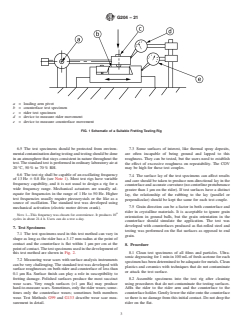
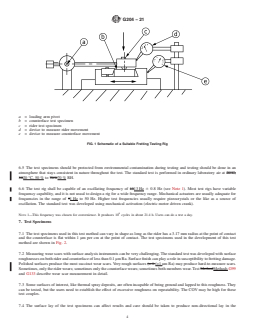
6.1 Fig. 1 is a schematic of the test apparatus showing
losses of the rider and the flat specimen. necessary features. The schematic shows the counterface
moving laterally with respect to the rider. The rider could
4. Summary of Test Method
reciprocatewithrespecttothecounterfaceaslongasitstillcan
4.1 This test method rubs a spherical or hemispherical solid move in the downward direction to accommodate wear.
rider on a solid flat under prescribed conditions to produce
6.2 The rider or counterface holder can be instrumented to
fretting damage on one or both surfaces. If damage occurs, it is
sense friction force, but the device cannot interfere with
quantified as a wear volume on each member and as system
achieving the required relative motion between the rider and
wear, the sum of the rider and counterface wear.
counterface. Test rigs need instrumentation or a system to
4.2 Friction forces can be measured during the fretting test,
verify that the amplitude of oscillation is the test value of
but these measurements, as well as reporting these data, is
50 µm 6 2 µm at test frequency.
optional.
6.3 The test specimens must be affixed to the test rig in such
a manner that their movement in specimen clamps is less than
5. Significance and Use
1 µm during testing.
5.1 Fretting wear and corrosion are potential serviceability
factors in many machines. They have always been factors in
6.4 Wear in the specified test can be such that vertical
motion of the rider as wear occurs can be hundreds of
3 micrometers.Thus,thetestrigshouldbedesignedsuchthatthe
The last approved version of this historical standard is referenced on
www.astm.org. rider can move into the counterface at least 500 µm 6 20 µm.
G204 − 21
a = loading arm pivot
b = counterface test specimen
c = rider test specimen
d = device to measure rider movement
e = device to measure counterface movement
FIG. 1 Schematic of a Suitable Fretting Testing Rig
6.5 The test specimens should be protected from environ- 7.3 Some surfaces of interest, like thermal spray deposits,
mentalcontaminationduringtestingandtestingshouldbedone are often incapable of being ground and lapped to this
in an atmosphere that stays consistent in nature throughout the roughness. They can be tested, but the users need to establish
test.Thestandardtestisperformedinordinarylaboratoryairat the effect of excessive roughness on repeatability. The COV
20 °C, 50 % to 70 % RH. may be high for these test couples.
6.6 The test rig shall be capable of an oscillating frequency
7.4 The surface lay of the test specimens can affect results
of 13 Hz 6 0.8 Hz (see Note 1). Most test rigs have variable
and care should be taken to produce non-directional lay in the
frequency capability, and it is not usual to design a rig for a
counterface and accurate curvature (no centerline protuberance
wide frequency range. Mechanical actuators are usually ad-
g
...
This document is not an ASTM standard and is intended only to provide the user of an ASTM standard an indication of what changes have been made to the previous version. Because
it may not be technically possible to adequately depict all changes accurately, ASTM recommends that users consult prior editions as appropriate. In all cases only the current version
of the standard as published by ASTM is to be considered the official document.
Designation: G204 − 15 G204 − 21
Standard Test Method for
Damage to Contacting Solid Surfaces under Fretting
Conditions
This standard is issued under the fixed designation G204; the number immediately following the designation indicates the year of
original adoption or, in the case of revision, the year of last revision. A number in parentheses indicates the year of last reapproval. A
superscript epsilon (´) indicates an editorial change since the last revision or reapproval.
INTRODUCTION
Fretting is small amplitude oscillating motion usually in the range of 1010 μm to 300 μm.
Contacting solid surfaces subjected to this type of motion can develop significant damage in the form
of mass loss, pitting, and debris generation, etc. generation. Frequently, pitting damage caused by
fretting creates stress concentrations that contribute to mechanical failures. Most material couples are
susceptible to fretting damage and this This test method is intended to assess a tribocouple’s relative
susceptibility to damage under fretting conditions.
When tribocouples experience oscillating relative motion less than about 10 μm, gross slip (all
points in a contact experience relative slip over a complete cycle) may not occur. The elastic behavior
of the real contacts may accommodate this motion and fretting damage may not occur.The onset of
fretting wear in a given tribocouple depends on factors such as the critical amplitude of slip, frequency
of oscillation, contact pressure, environment, cumulative cycles of oscillation, state of lubrication, and
contact geometry.
When metal couples are subjected to fretting motion, there is a potential for chemical reaction with
the ambient environment to be a component of the damage. In metals rubbing in air, oxidation of
freshly fractured surfaces can occur. When chemical reaction is conjoint with the mechanical damage
produced by fretting, it is called fretting corrosion. When most plastic (polymer) couples are damaged
by fretting motion, the fractured surfaces may not react with the environment and fretting wear occurs
as opposed to fretting corrosion.
1. Scope
1.1 This test method covers the studying or ranking the susceptibility of candidate materials to fretting corrosion or fretting wear
for the purposes of material selection for applications where fretting corrosion or fretting wear can limit serviceability.may be used
for either fundamental or applications-oriented studies of fretting damage. Accordingly, data from these tests may be used to rank
the wear resistance of candidate material couples for certain types of machine components whose service life is limited by fretting.
1.2 This test method uses a tribological bench test apparatus with a mechanism or device that will produce the necessary relative
motion between a contacting hemispherical rider and a flat counterface. The rider is pressed against the flat counterface with a
loading mass. The test method is intended for use in room temperature air, but future editions could include air. Other
configurations or test parameters may be needed to investigate fretting in the presence of lubricants or other environments.
1.3 The purpose of this test method is to rub two solid surfaces together under controlled fretting conditions and to quantify the
damage to both surfaces in units of volume loss for the test method.loss.
This test method is under the jurisdiction of ASTM Committee G02 on Wear and Erosion and is the direct responsibility of Subcommittee G02.40 on Non-Abrasive Wear.
Current edition approved Nov. 15, 2015June 1, 2021. Published December 2015July 2021. Originally approved in 2010. Last previous edition approved in 20102015 as
G204–10. DOI:10.1520/G0204–15.–15. DOI:10.1520/G0204-21.
Copyright © ASTM International, 100 Barr Harbor Drive, PO Box C700, West Conshohocken, PA 19428-2959. United States
G204 − 21
1.4 The values stated in SI units are to be regarded as standard. No other units of measurement are included in this standard.
1.5 This standard does not purport to address all of the safety concerns, if any, associated with its use. It is the responsibility
of the user of this standard to establish appropriate safety safety, health, and healthenvironmental practices and determine the
applicability of regulatory limitations prior to use.
1.6 This international standard was developed in accordance with internationally recognized principles on standardization
established in the Decision on Principles for the Development of International Standards, Guides and Recommendations issued
by the World Trade Organization Technical Barriers to Trade (TBT) Committee.
2. Referenced Documents
2.1 ASTM Standards:
E177 Practice for Use of the Terms Precision and Bias in ASTM Test Methods
E691 Practice for Conducting an Interlaboratory Study to Determine the Precision of a Test Method
G40 Terminology Relating to Wear and Erosion
G99 Test Method for Wear Testing with a Pin-on-Disk Apparatus
G117 Guide for Calculating and Reporting Measures of Precision Using Data from Interlaboratory Wear or Erosion Tests
(Withdrawn 2016)
G133 Test Method for Linearly Reciprocating Ball-on-Flat Sliding Wear
3. Terminology
3.1 Definitions:
3.1.1 fretting, n—in tribology, small amplitude oscillating motion usually tangential between two solid surfaces in contact. G40
3.1.2 fretting corrosion, n—form of fretting wear in which corrosion plays a significant role. G40
3.1.3 fretting wear, n—wear arising as a result of fretting. G40
3.2 Definitions of Terms Specific to This Standard:
3.2.1 coeffıcient of variation (COV), n—test standard deviation divided by the test mean.mean, sometimes expressed as a percent.
3.2.2 counterface, n—flat surface that the rider rubs on in this test.
3.2.3 crater, n—counterface damage in a fretting test from a hemispherical or spherical rider characterized by loss of material in
the form of a surface depression.
3.2.4 fretting amplitude, n—sliding distance between direction reversals (for example, if a dial indicator is used to measure stroke,
the amplitude is the indicator movement on the dial).
3.2.5 rider, n—ball or hemisphere that oscillates on another surface to produce fretting damage.
3.2.6 scar, n—damage to either rider or counterface in a fretting test.
3.2.7 system wear volume, n—the sum of the wear volume losses of the rider and the flat specimen.
4. Summary of Test Method
4.1 This test method rubs a spherical or hemispherical solid rider on a solid flat under prescribed conditions to produce fretting
damage on one or both surfaces. If damage occurs, it is quantified as a wear volume on each member and as system wear, the sum
of the rider and counterface wear.
For referenced ASTM standards, visit the ASTM website, www.astm.org, or contact ASTM Customer Service at service@astm.org. For Annual Book of ASTM Standards
volume information, refer to the standard’sstandard’s Document Summary page on the ASTM website.
The last approved version of this historical standard is referenced on www.astm.org.
G204 − 21
4.2 Friction forces can be measured during the fretting test, but these measurements, as well as reporting these data, is optional.
5. Significance and Use
5.1 Fretting wear and corrosion are potential serviceability factors in many machines. They have always been factors in shipping
finished goods by truck or rail. Packing materials rubbing on a product in transit can make the product unsalable. Beverage cans
and food cans can lose their trade dress and consumers often equate container damage to content damage.
5.2 Clamping surfaces on injection molds are damaged by fretting motions on clamping. This damage is a significant cause for
mold replacement.
5.3 Machines in shipment are subject to fretting damage in the real area of contact of the bearings on the machines.
5.4 Operating vibration and movement of mechanically clamped components, like screwed assemblies, can produce damage on
the clamped faces and other faces that affects machine function or use. Many times fretting damage appears in the form of pits,
which are stress concentrators that can lead to mechanical fractures.
5.5 Electrical contacts in any device that is subject to vibration are susceptible to failure (open circuit) due to fretting damage at
real areas of contact.
5.6 This test method is intended to be used to identify mating couples that may be less prone to fretting damage than others. This
information in turn is used to select materials of construction or surface treatments that are less prone to fretting damage for
applications where fretting conditions are known or perceived to exist.
5.7 When using this test method to screen candidate material pairs for a specific application, the user should ensure that the
prescribed geometry and test conditions described in Sections 6 – 8 adequately simulate the intended end use. The rationale for
any deviations from the prescribed test conditions, if any, shall be explained in the test report and, accordingly, the user shall report
that they used a modified version of the standard.
6. Apparatus
6.1 Fig. 1 is a schematic of the test apparatus showing necessary features. The schematic shows the counterface moving laterally
with respect to the rider. The rider could reciprocate with respect to the counterface as long as it still can move in the downward
direction to accommodate wear.
6.2 The rider or counterface holder can be instrumented to sense friction force, but the device cannot interfere with achieving the
required relative motion between the rider and counterface. Test rigs need instrumentation or a system to verify that the amplitude
of oscillation is the test value of 5050 μm 6 2 μm at test frequency.
6.3 The test specimens must be affixed to the test rig in such a manner that their movement in specimen clamps is less than 1 μm
during testing.
6.4 Wear in the specified test can be such that vertical motion of the rider as wear occurs can be hundreds of micrometers. Thus,
the test rig should be designed such that the rider can move into the counterface at least 500500 μm 6 20 μm.
G204 − 21
a = loading arm pivot
b = counterface test specimen
c = rider test specimen
d = device to measure rider movement
e = device to measure counterface movement
FIG. 1 Schematic of a Suitable Fretting Testing Rig
6.5 The test specimens should be protected from environmental contamination during testing and testing should be done in an
atmosphere that stays consistent in nature throughout the test. The standard test is performed in ordinary laboratory air at 20°C,
5020 °C, 50 % to 70%70 % RH.
6.6 The test rig shall be capable of an oscillating frequency of 1313 Hz 6 0.8 Hz (see Note 1). Most test rigs have variable
frequency capability, and it is not usual to design a rig for a wide frequency range. Mechanical actuators are usually adequate for
frequencies in the range of 11 Hz to 50 Hz. Higher test frequencies usually require piezocrystals o
...