

ASTM D8227-20
(Test Method)Standard Test Method for Determining the Coefficient of Friction of Synchronizer Lubricated by Mechanical Transmission Fluids (MTF) Using a High-Frequency, Linear-Oscillation (SRV) Test Machine
General Information
- Abstract
SIGNIFICANCE AND USE
5.1 This test method can be used to quickly determine the lubricating ability of fully-formulated lubricants used as mechanical transmission fluids (MTF) to display a frictional behavior against materials used in synchronizers of mechanical gears in automotive vehicles. This test method has found to be complementary to bench tests (for example, Test Method D5579 and CEC L-66-99) by using the present test conditions. This test method is a material and application oriented approach based on inputs from field experiences for characterizing the frictional behavior (coefficient of friction (cof)) using random, discrete, and constant parameter combinations as seen in field experiences. Users of this test method should determine whether results correlate with field performance or other applications prior to commercialization.
SCOPE
1.1 This test method covers a procedure for determining the coefficient of friction of lubricants (fluids) tribologically interacting with materials used in synchronizers in mechanical transmission (MT) gears under high-frequency linear-oscillation motion using the SRV test machine. A flat areal contact geometry is applied.
1.2 The values stated in SI units are to be regarded as standard. No other units of measurement are included in this standard.
1.3 This standard does not purport to address all of the safety concerns, if any, associated with its use. It is the responsibility of the user of this standard to establish appropriate safety, health, and environmental practices and determine the applicability of regulatory limitations prior to use.
1.4 This international standard was developed in accordance with internationally recognized principles on standardization established in the Decision on Principles for the Development of International Standards, Guides and Recommendations issued by the World Trade Organization Technical Barriers to Trade (TBT) Committee.
- Status
- Published
- Publication Date
- 30-Nov-2020
- Technical Committee
- D02 - Petroleum Products, Liquid Fuels, and Lubricants
- Drafting Committee
- D02.L0.11 - Tribological Properties of Industrial Fluids and Lubricates
Buy Documents
ASTM D8227-20 - Standard Test Method for Determining the Coefficient of Friction of Synchronizer Lubricated by Mechanical Transmission Fluids (MTF) Using a High-Frequency, Linear-Oscillation (SRV) Test Machine
REDLINE ASTM D8227-20 - Standard Test Method for Determining the Coefficient of Friction of Synchronizer Lubricated by Mechanical Transmission Fluids (MTF) Using a High-Frequency, Linear-Oscillation (SRV) Test Machine
Overview
ASTM D8227-20 is a standard test method developed by ASTM International for determining the coefficient of friction of synchronizers lubricated by mechanical transmission fluids (MTF) using a high-frequency, linear-oscillation (SRV) test machine. This method provides a means to evaluate the lubricating performance of fully-formulated lubricants as they interact with synchronizer materials commonly found in automotive manual transmission gears.
Focusing on real-world tribological interactions, the method utilizes SRV test equipment in a flat-on-flat contact geometry, simulating the operational motions and pressures experienced by synchronizer assemblies. Results from this test method can complement other established procedures, offering a material- and application-oriented perspective for characterizing frictional properties under varying field-relevant conditions.
Key Topics
- Test Objective: Measures the coefficient of friction exhibited by MTF lubricants when interacting with synchronizer materials under controlled temperature, pressure, and oscillation conditions.
- Relevance: Enables rapid screening of lubricants, giving insights into their effectiveness in minimizing friction and wear in manual transmission synchronizer components.
- Apparatus: Utilizes SRV test machines (specifically Models 4 and 5) to apply high-frequency, linear oscillations to test specimens.
- Test Materials: Involves typical synchronizer material pairings such as carburized bearing steels and manganese brass alloys.
- Parameter Variability: Supports customization of parameters (contact pressure, temperature, stroke, and frequency) to better simulate particular field scenarios.
- Data Collection: Continuously records frictional data, providing detailed evaluation over the entire test duration.
Applications
- Automotive Lubricant Development: Essential for researchers and manufacturers evaluating new or existing MTF formulations intended for use in manual transmissions.
- Quality Control: Provides a standardized procedure to verify the frictional characteristics of lubricants against synchronizer materials before mass production or market release.
- Bench Test Complement: Offers an alternative or supplementary assessment to other laboratory methods, such as ASTM D5579 or CEC L-66-99, refining the understanding of lubricant–synchronizer interactions.
- Field Performance Correlation: The approach allows users to assess whether laboratory results are indicative of real-world synchronizer function and durability, supporting informed product validation and selection.
Related Standards
- ASTM D235: Specification for mineral spirits, relevant for cleaning procedures.
- ASTM D4175: Terminology related to petroleum products, liquid fuels, and lubricants.
- ASTM D5579: Thermal stability testing method for manual transmission lubricants.
- ASTM D5706 & D7421: Methods for determining extreme pressure properties of lubricating greases and oils using SRV test units.
- CEC L-66-99: Evaluation of synchronizer loading parameters.
- DIN Standards (51631, EN ISO 13565-2, EN 17022-3): Referenced for test material specifications and surface texture measurement.
- GB/T 3077-2015 & YS/T 669-2013: Material standards for steel and copper alloy synchronizer rings.
Practical Value
Adherence to ASTM D8227-20 ensures a consistent, internationally recognized approach for assessing the frictional performance of mechanical transmission fluids in automotive applications. This standardized test enables:
- Enhanced product reliability by helping manufacturers select MTFs with optimal synchronizer lubrication characteristics.
- Reduced wear and improved durability of synchronizer components, contributing to smoother gear shifting and prolonged gearbox service life.
- Support for regulatory compliance and global market acceptance through conformity with internationally harmonized testing principles.
By incorporating ASTM D8227-20 into product development, quality assurance, and specification protocols, organizations can more efficiently evaluate lubricant suitability for critical manual transmission applications, directly impacting end-user satisfaction and reducing the risk of field failures.
Relations
- Effective Date
- 01-Dec-2023
- Effective Date
- 01-Nov-2023
- Effective Date
- 01-Dec-2019
- Effective Date
- 15-Nov-2016
- Effective Date
- 01-Oct-2016
- Effective Date
- 01-Apr-2016
- Effective Date
- 01-Nov-2015
- Effective Date
- 01-Apr-2015
- Effective Date
- 01-May-2014
- Effective Date
- 01-Oct-2013
- Effective Date
- 01-Jun-2013
- Effective Date
- 01-Dec-2012
- Effective Date
- 01-May-2012
- Effective Date
- 15-Apr-2012
- Effective Date
- 01-Dec-2011
Buy Documents
ASTM D8227-20 - Standard Test Method for Determining the Coefficient of Friction of Synchronizer Lubricated by Mechanical Transmission Fluids (MTF) Using a High-Frequency, Linear-Oscillation (SRV) Test Machine
REDLINE ASTM D8227-20 - Standard Test Method for Determining the Coefficient of Friction of Synchronizer Lubricated by Mechanical Transmission Fluids (MTF) Using a High-Frequency, Linear-Oscillation (SRV) Test Machine
Frequently Asked Questions
ASTM D8227-20 is a standard published by ASTM International. Its full title is "Standard Test Method for Determining the Coefficient of Friction of Synchronizer Lubricated by Mechanical Transmission Fluids (MTF) Using a High-Frequency, Linear-Oscillation (SRV) Test Machine". This standard covers: SIGNIFICANCE AND USE 5.1 This test method can be used to quickly determine the lubricating ability of fully-formulated lubricants used as mechanical transmission fluids (MTF) to display a frictional behavior against materials used in synchronizers of mechanical gears in automotive vehicles. This test method has found to be complementary to bench tests (for example, Test Method D5579 and CEC L-66-99) by using the present test conditions. This test method is a material and application oriented approach based on inputs from field experiences for characterizing the frictional behavior (coefficient of friction (cof)) using random, discrete, and constant parameter combinations as seen in field experiences. Users of this test method should determine whether results correlate with field performance or other applications prior to commercialization. SCOPE 1.1 This test method covers a procedure for determining the coefficient of friction of lubricants (fluids) tribologically interacting with materials used in synchronizers in mechanical transmission (MT) gears under high-frequency linear-oscillation motion using the SRV test machine. A flat areal contact geometry is applied. 1.2 The values stated in SI units are to be regarded as standard. No other units of measurement are included in this standard. 1.3 This standard does not purport to address all of the safety concerns, if any, associated with its use. It is the responsibility of the user of this standard to establish appropriate safety, health, and environmental practices and determine the applicability of regulatory limitations prior to use. 1.4 This international standard was developed in accordance with internationally recognized principles on standardization established in the Decision on Principles for the Development of International Standards, Guides and Recommendations issued by the World Trade Organization Technical Barriers to Trade (TBT) Committee.
SIGNIFICANCE AND USE 5.1 This test method can be used to quickly determine the lubricating ability of fully-formulated lubricants used as mechanical transmission fluids (MTF) to display a frictional behavior against materials used in synchronizers of mechanical gears in automotive vehicles. This test method has found to be complementary to bench tests (for example, Test Method D5579 and CEC L-66-99) by using the present test conditions. This test method is a material and application oriented approach based on inputs from field experiences for characterizing the frictional behavior (coefficient of friction (cof)) using random, discrete, and constant parameter combinations as seen in field experiences. Users of this test method should determine whether results correlate with field performance or other applications prior to commercialization. SCOPE 1.1 This test method covers a procedure for determining the coefficient of friction of lubricants (fluids) tribologically interacting with materials used in synchronizers in mechanical transmission (MT) gears under high-frequency linear-oscillation motion using the SRV test machine. A flat areal contact geometry is applied. 1.2 The values stated in SI units are to be regarded as standard. No other units of measurement are included in this standard. 1.3 This standard does not purport to address all of the safety concerns, if any, associated with its use. It is the responsibility of the user of this standard to establish appropriate safety, health, and environmental practices and determine the applicability of regulatory limitations prior to use. 1.4 This international standard was developed in accordance with internationally recognized principles on standardization established in the Decision on Principles for the Development of International Standards, Guides and Recommendations issued by the World Trade Organization Technical Barriers to Trade (TBT) Committee.
ASTM D8227-20 is classified under the following ICS (International Classification for Standards) categories: 21.260 - Lubrication systems. The ICS classification helps identify the subject area and facilitates finding related standards.
ASTM D8227-20 has the following relationships with other standards: It is inter standard links to ASTM D5706-23, ASTM D7421-23, ASTM D7421-19, ASTM D5706-16, ASTM D7421-16, ASTM D5579-16, ASTM G40-15, ASTM D5579-15, ASTM D5579-14, ASTM D5579-13, ASTM G40-13, ASTM D5579-12a, ASTM G40-12, ASTM D5579-12, ASTM D7421-11. Understanding these relationships helps ensure you are using the most current and applicable version of the standard.
ASTM D8227-20 is available in PDF format for immediate download after purchase. The document can be added to your cart and obtained through the secure checkout process. Digital delivery ensures instant access to the complete standard document.
Standards Content (Sample)
This international standard was developed in accordance with internationally recognized principles on standardization established in the Decision on Principles for the
Development of International Standards, Guides and Recommendations issued by the World Trade Organization Technical Barriers to Trade (TBT) Committee.
Designation: D8227 − 20
Standard Test Method for
Determining the Coefficient of Friction of Synchronizer
Lubricated by Mechanical Transmission Fluids (MTF) Using
a High-Frequency, Linear-Oscillation (SRV) Test Machine
This standard is issued under the fixed designation D8227; the number immediately following the designation indicates the year of
original adoption or, in the case of revision, the year of last revision. A number in parentheses indicates the year of last reapproval. A
superscript epsilon (´) indicates an editorial change since the last revision or reapproval.
1. Scope* D5706 Test Method for Determining Extreme Pressure
Properties of Lubricating Greases Using a High-
1.1 This test method covers a procedure for determining the
Frequency, Linear-Oscillation (SRV) Test Machine
coefficient of friction of lubricants (fluids) tribologically inter-
D7421 Test Method for Determining Extreme Pressure
acting with materials used in synchronizers in mechanical
Properties of Lubricating Oils Using High-Frequency,
transmission (MT) gears under high-frequency linear-
Linear-Oscillation (SRV) Test Machine
oscillation motion using the SRV test machine. A flat areal
G40 Terminology Relating to Wear and Erosion
contact geometry is applied.
2.2 Other Standards:
1.2 The values stated in SI units are to be regarded as
DIN 51631 Special-boiling-point spirits—Requirements and
standard. No other units of measurement are included in this
testing
standard.
DIN EN ISO 13565-2 Geometrical Product Specifications
1.3 This standard does not purport to address all of the (GPS)—Surface texture: Profile method—Surfaces hav-
safety concerns, if any, associated with its use. It is the
ing stratified functional properties—Part 2: Height char-
responsibility of the user of this standard to establish appro- acterization using linear material ratio curve
priate safety, health, and environmental practices and deter-
DIN EN 17022–3 Heat treatment of ferrous materials; heat
mine the applicability of regulatory limitations prior to use. treatment methods; case hardening
1.4 This international standard was developed in accor-
CEC L-66-99 Evaluation of synchronizer loading param-
dance with internationally recognized principles on standard- eters and their ability to predict failure
ization established in the Decision on Principles for the
GB/T 3077-2015 Alloy structural steel
Development of International Standards, Guides and Recom-
YS/T 669-2013 Copper alloy tube of extruded product for
mendations issued by the World Trade Organization Technical synchronizer rings
Barriers to Trade (TBT) Committee.
TL-VW084 (1993) Kupfer-Zink-Legierungen – Werkstoffan
forderungen (Copper-Zinc alloys—Material require-
2. Referenced Documents ments)
2.1 ASTM Standards:
D235 Specification for Mineral Spirits (Petroleum Spirits)
3. Terminology
(Hydrocarbon Dry Cleaning Solvent)
3.1 Definitions:
D5579 Test Method for Evaluating the Thermal Stability of
3.1.1 break-in, n—in tribology, an initial transition process
Manual Transmission Lubricants in a Cyclic Durability
occurring in newly established wearing contacts, often accom-
Test
panied by transients in coefficient of friction or wear rate, or
Available from Beuth Verlag GmbH (DIN Deutsches Institut für Normung
This test method is under the jurisdiction of ASTM Committee D02 on e.V.), Burggrafenstrasse 6, 10787 Berlin, Germany, http://www.en.din.de
Petroleum Products, Liquid Fuels, and Lubricants and is the direct responsibility of Available from Coordinating European Council (CEC), Services provided by
Subcommittee D02.L0.11 on Tribological Properties of Industrial Fluids and Kellen Europe, Avenue Jules Bordet 142 - 1140, Brussels, Belgium, http://
Lubricates. www.cectests.org.
Current edition approved Dec. 1, 2020. Published December 2020. Originally Available from Standardization Administration of China, No. 9 Madian
approved in 2018. Last previous edition approved in 2018 as D8227 – 18. DOI: Donglu, Haidian District, Beijing 100088, P.R. China.
10.1520/D8227-20. Available as a standard of nonferrous industry from Standardization Adminis-
For referenced ASTM standards, visit the ASTM website, www.astm.org, or tration of China, No. 9 Madian Donglu, Haidian District, Beijing 100088, P.R.
contact ASTM Customer Service at service@astm.org. For Annual Book of ASTM China.
Standards volume information, refer to the standard’s Document Summary page on Available from Volkswagen AG, corporate IP, post stop 1770, D-38346
the ASTM website. Wolfsburg, Germany, www.vwgroupsupply.com.
*A Summary of Changes section appears at the end of this standard
Copyright © ASTM International, 100 Barr Harbor Drive, PO Box C700, West Conshohocken, PA 19428-2959. United States
D8227 − 20
NOTE 1—Synchronizer rings operate typically under geometric contact
both, which are uncharacteristic of the given tribological
pressures from 2 MPa to 6 MPa.
system’s long-term behavior. G40
NOTE 2—Test frequency, stroke length, temperature, and materials
3.1.2 carburization, n—carburizing is not defined in the
and/or coatings used as/on disk and flat material can be varied to simulate
field conditions.
ASTM Dictionary of Engineering Science and Technology, but
NOTE 3—This test runs in the SRV Models 4 and 5 models horizontally
is defined in DIN EN 17022-3 “Heat treatment of ferrous
and untilted. SRV Models 4 and 5 can be equipped with a maximum test
materials; heat treatment methods; case hardening”.
load unit of 2500 N.
3.1.3 coeffıcient of friction, μ or ƒ, n—in tribology, the
5. Significance and Use
dimensionless ratio of the friction force (F) between two
bodies to the normal force (N) pressing these bodies together.
5.1 This test method can be used to quickly determine the
G40
lubricating ability of fully-formulated lubricants used as me-
chanical transmission fluids (MTF) to display a frictional
3.1.4 lubricant, n—any material interposed between two
behavior against materials used in synchronizers of mechanical
surfaces that reduces the friction or wear, or both, between
gears in automotive vehicles. This test method has found to be
them.
complementary to bench tests (for example, Test Method
3.1.5 Ra (C.L.A.), n—in measuring surface finish, the arith-
D5579 and CEC L-66-99) by using the present test conditions.
metic average of the absolute distances of all profile points
8 This test method is a material and application oriented ap-
from the mean line for a given distance.
proach based on inputs from field experiences for characteriz-
3.1.6 Rpk, n—reduced peak height according to DIN EN
ing the frictional behavior (coefficient of friction (cof)) using
ISO 13565-2; Rpk is the mean height of the peak sticking out
random, discrete, and constant parameter combinations as seen
above the core profile section.
in field experiences. Users of this test method should determine
3.1.7 Rvk, n—reduced valley height according to DIN EN
whether results correlate with field performance or other
ISO 13565-2; Rvk is the mean depth of the valley reaching into
applications prior to commercialization.
the material below the core profile section.
6. Apparatus
3.1.8 Rz (DIN), n—in measuring surface finish, the average
of all Ry values (peak to valley heights) in the assessment 6.1 SRV Test Machine, illustrated in Figs. 1 and 2.
length.
7. Reagents and Materials
3.2 Definitions of Terms Specific to This Standard:
7.1 Flat ring disk in carburized 20CrMnTi (similar to
3.2.1 metal specimen, n—represented by the lower speci-
~20MnCr5 and ~SAE 5120) bearing steel in =200.05 mm outer
men disk in manganese brass alloys, but also friction layers in
diameter oil quenched from 800 °C 6 10 °C and tempered at
thermally sprayed molybdenum coatings, sinter iron, paper and
180 °C 6 10 °C during 8 h followed by air cooling to 60 6
carbon fiber tapes are in use.
2 HRC. The contact face has an inner cavity with a diameter of
3.2.2 seizure, n—localized fusion of metal between the
17 mm 6 0.05 mm with a depth of 1.5 mm 6 0.10 mm (see
rubbing surfaces of the test pieces. D5706
Fig. 3 and Fig. X1.1). The contact face has two straight slits at
3.2.2.1 Discussion—In this test method, seizure is indicated
180° opposite to each other with a width of 1 mm with a depth
by a sharp rise in the coefficient of friction, over steady state,
of 1.5 mm 6 0.10 mm. Functional surfaces shall be free from
of greater than 0.3 for over 20 s. In severe cases, a stoppage in
scratches and any surface damages. The topography of the disk
the motor will occur (for example, see Test Methods D5706
will be determined by four values:
and D7421).
0.200 μm < Rz (DIN) < 0.350 μm
3.3 Acronyms:
0.040 μm < Ra (C.L.A.) < 0.060 μm
3.3.1 SRV, n—Schwingung, Reibung, Verschleiß (German);
0.150 μm < R < 0.300 μm
pk
oscillating, friction, wear (English translation).
0.200 μm < R < 0.350 μm
vk
3.3.2 UNS, n—the Unified Numbering System (UNS) is an
7.2 Lower Test Disk—Extruded manganese brass HMn64-8-
accepted alloy designation system in North America.
5-1.5 according to YS/T 669-2013, homologue to TL-VW084,
with HBW2.5/62.5210-260 hardness or 28025 HV0.2, the
4. Summary of Test Method
surfaces of the disk being lapped and polished. α/ß-phase ratio
4.1 This test method is performed on SRV test machine
is 50/50. Test disks have an outer diameter of 24 mm 6
using an areal flat-on-flat geometry oscillating at 50 Hz against
0.5 mm diameter with a height of 7.8 mm 6 0.1 mm.
a steel test disk with lubricant (grease) between them. Test load
(spherodization at 450 °C to 590 °C during 2 h to 6 h in air.)
is fixed to 260 N (corresponding to a geometrical contact
The topography of the disk will be determined by four values:
pressure of 3.1 MPa) using a test temperature of 60 °C and a
0.500 μm < Rz (DIN) < 0.700 μm
stroke of 1.0 mm during a test time of 2 h. This test is limited
0.040 μm < Ra (C.L.A.) < 0.060 μm
to SRV Models 4 and 5.
The sole source of supply of the apparatus known to the committee at this time
Amstutz, Hu, “Surface Texture: The Parameters,” Bulletin MI-TP-003-0785, is Optimol Instruments GmbH, Flößergasse 3, D-81369 Munich, Germany. If you
Sheffield Measurement Division, Warner and Swasey, 1985, p. 21. are aware of alternative suppliers, please provide this information to ASTM
Amstutz, Hu, “Surface Texture: The Parameters,” Bulletin MI-TP-003-0785, International Headquarters. Your comments will
...
This document is not an ASTM standard and is intended only to provide the user of an ASTM standard an indication of what changes have been made to the previous version. Because
it may not be technically possible to adequately depict all changes accurately, ASTM recommends that users consult prior editions as appropriate. In all cases only the current version
of the standard as published by ASTM is to be considered the official document.
Designation: D8227 − 18 D8227 − 20
Standard Test Method for
Determining the Coefficient of Friction of Synchronizer
Lubricated by Mechanical Transmission Fluids (MTF) Using
a High-Frequency, Linear-Oscillation (SRV) Test Machine
This standard is issued under the fixed designation D8227; the number immediately following the designation indicates the year of
original adoption or, in the case of revision, the year of last revision. A number in parentheses indicates the year of last reapproval. A
superscript epsilon (´) indicates an editorial change since the last revision or reapproval.
1. Scope Scope*
1.1 This test method covers a procedure for determining the coefficient of friction of lubricants (fluids) tribologically interacting
with materials used in synchronizers in mechanical transmission (MT) gears under high-frequency linear-oscillation motion using
the SRV test machine. A flat areal contact geometry is applied.
1.2 The values stated in SI units are to be regarded as standard. No other units of measurement are included in this standard.
1.3 This standard does not purport to address all of the safety concerns, if any, associated with its use. It is the responsibility
of the user of this standard to establish appropriate safety, health, and environmental practices and determine the applicability of
regulatory limitations prior to use.
1.4 This international standard was developed in accordance with internationally recognized principles on standardization
established in the Decision on Principles for the Development of International Standards, Guides and Recommendations issued
by the World Trade Organization Technical Barriers to Trade (TBT) Committee.
2. Referenced Documents
2.1 ASTM Standards:
D235 Specification for Mineral Spirits (Petroleum Spirits) (Hydrocarbon Dry Cleaning Solvent)
D4175 Terminology Relating to Petroleum Products, Liquid Fuels, and Lubricants
D5579 Test Method for Evaluating the Thermal Stability of Manual Transmission Lubricants in a Cyclic Durability Test
D5706 Test Method for Determining Extreme Pressure Properties of Lubricating Greases Using a High-Frequency, Linear-
Oscillation (SRV) Test Machine
D7421 Test Method for Determining Extreme Pressure Properties of Lubricating Oils Using High-Frequency, Linear-Oscillation
(SRV) Test Machine
G40 Terminology Relating to Wear and Erosion
2.2 Other Standards:
DIN 51631 Special-boiling-point spirits—Requirements and testing
DIN EN ISO 13565-2 Geometrical Product Specifications (GPS)—Surface texture: Profile method—Surfaces having stratified
functional properties—Part 2: Height characterization using linear material ratio curve
This test method is under the jurisdiction of ASTM Committee D02 on Petroleum Products, Liquid Fuels, and Lubricants and is the direct responsibility of Subcommittee
D02.L0.07 on Engineering Sciences of High Performance Fluids and Solids (Formally D02.1100).
Current edition approved Oct. 1, 2018Dec. 1, 2020. Published November 2018December 2020. Originally approved in 2018. Last previous edition approved in 2018 as
D8227 – 18. DOI: 10.1520/D8227-18.10.1520/D8227-20.
For referenced ASTM standards, visit the ASTM website, www.astm.org, or contact ASTM Customer Service at service@astm.org. For Annual Book of ASTM Standards
volume information, refer to the standard’s Document Summary page on the ASTM website.
Available from Beuth Verlag GmbH (DIN Deutsches Institut für Normung e.V.), Burggrafenstrasse 6, 10787 Berlin, Germany, http://www.en.din.de
*A Summary of Changes section appears at the end of this standard
Copyright © ASTM International, 100 Barr Harbor Drive, PO Box C700, West Conshohocken, PA 19428-2959. United States
D8227 − 20
DIN EN 17022–3 Heat treatment of ferrous materials; heat treatment methods; case hardening
CEC L-66-99 Evaluation of synchronizer loading parameters and their ability to predict failure
GB/T 3077-2015 Alloy structural steel
YS/T 669-2013 Copper alloy tube of extruded product for synchronizer rings
TL-VW084 (1993) Kupfer-Zink-Legierungen – Werkstoffan forderungen (Copper-Zinc alloys—Material requirements)
3. Terminology
3.1 Definitions:
3.1.1 break-in, n—in tribology, an initial transition process occurring in newly established wearing contacts, often accompanied
by transients in coefficient of friction or wear rate, or both, which are uncharacteristic of the given tribological system’s long-term
behavior. G40
3.1.2 carburization, n—carburizing is not defined in the ASTM Dictionary of Engineering Science and Technology, but is defined
in DIN EN 17022-3 “Heat treatment of ferrous materials; heat treatment methods; case hardening”.
3.1.3 coeffıcient of friction, μ or ƒ, n—in tribology, the dimensionless ratio of the friction force (F) between two bodies to the
normal force (N) pressing these bodies together. G40
3.1.4 lubricant, n—any material interposed between two surfaces that reduces the friction or wear wear, or both, between them.
D4175
3.1.4 carburization, n—carburizing is not defined in the ASTM Dictionary of Engineering Science and Technology, but is defined
in DIN EN 17022-3 “Heat treatment of ferrous materials; heat treatment methods; case hardening”.
3.1.5 Ra (C.L.A.), n—in measuring surface finish, the arithmetic average of the absolute distances of all profile points from the
mean line for a given distance.
3.1.6 Rpk, n—reduced peak height according to DIN EN ISO 13565-2; Rpk is the mean height of the peak sticking out above the
core profile section.
3.1.7 Rvk, n—reduced valley height according to DIN EN ISO 13565-2; Rvk is the mean depth of the valley reaching into the
material below the core profile section.
3.1.8 Rz (DIN), n—in measuring surface finish, the average of all Ry values (peak to valley heights) in the assessment length.
3.2 Definitions of Terms Specific to This Standard:
3.2.1 metal specimen, n—represented by the lower specimen disk in manganese brass alloys, but also friction layers in thermally
sprayed molybdenum coatings, sinter iron, paper and carbon fiber tapes are in use.
3.2.2 seizure, n—localized fusion of metal between the rubbing surfaces of the test pieces. D5706
3.2.2.1 Discussion—
In this test method, seizure is indicated by a sharp rise in the coefficient of friction, over steady state, of greater than 0.3 for over
20 s. In severe cases, a stoppage in the motor will occur (for example, see Test Methods D5706 and D7421).
3.3 Acronyms:
3.3.1 SRV, n—Schwingung, Reibung, Verschleiß (German); oscillating, friction, wear (English translation).
Available from Coordinating European Council (CEC), Services provided by Kellen Europe, Avenue Jules Bordet 142 - 1140, Brussels, Belgium, http://www.cectests.org.
Available from Standardization Administration of China, No. 9 Madian Donglu, Haidian District, Beijing 100088, P.R. China.
Available as a standard of nonferrous industry from Standardization Administration of China, No. 9 Madian Donglu, Haidian District, Beijing 100088, P.R. China.
Available from Volkswagen AG, corporate IP, post stop 1770, D-38346 Wolfsburg, Germany, www.vwgroupsupply.com.
Amstutz, Hu, “Surface Texture: The Parameters,” Bulletin MI-TP-003-0785, Sheffield Measurement Division, Warner and Swasey, 1985, p. 21.
Amstutz, Hu, “Surface Texture: The Parameters,” Bulletin MI-TP-003-0785, Sheffield Measurement Division, Warner and Swasey, 1985, pp. 29-31.
D8227 − 20
3.3.2 UNS, n—the Unified Numbering System (UNS) is an accepted alloy designation system in North America.
4. Summary of Test Method
4.1 This test method is performed on SRV test machine using aan areal flat-on-flat geometry oscillating at 50 Hz against a steel
test disk with lubricant (grease) between them. Test load is fixed to 260 N (corresponding to a geometrical contact pressure of
3.1 MPa) using a test temperature of 60 °C and a stroke of 1.0 mm during a test time of 2 h. This test is limited to SRV Models
4 and 5.
NOTE 1—Synchronizer rings operate typically under geometric contact pressures from 2 MPa to 6 MPa.
NOTE 2—Test frequency, stroke length, temperature, and materials and/or coatings used as/on disk and flat material can be varied to simulate field
conditions.
NOTE 3—This test runs in the SRV Models 4 and 5 models horizontally and untilted. SRV Models 4 and 5 can be equipped with a maximum test load
unit of 2500 N.
5. Significance and Use
5.1 This test method can be used to quickly determine the lubricating ability of fully-formulated lubricants used as mechanical
transmission fluids (MTF) to display a frictional behavior against materials used in synchronizers of mechanical gears in
automotive vehicles. This test method has found to be complementary to bench tests (for example, Test Method D5579 and CEC
L-66-99) by using the present test conditions. This test method is a material and application oriented approach based on inputs from
field experiences for characterizing the frictional behavior (coefficient of friction (cof)) using random, discrete, and constant
parameter combinations as seen in field experiences. Users of this test method should determine whether results correlate with field
performance or other applications prior to commercialization.
6. Apparatus
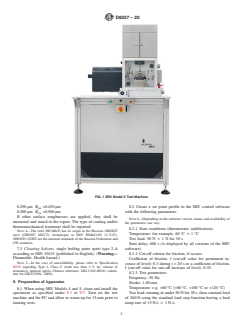
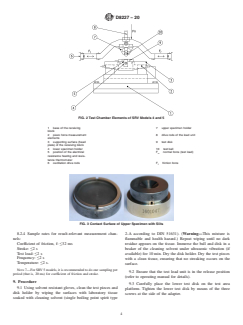
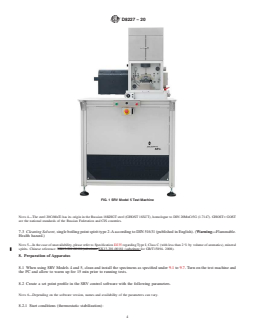
6.1 SRV Test Machine, illustrated in Figs. 1 and 2.
7. Reagents and Materials
7.1 Flat ring disk in carburized 20CrMnTi (similar to ~20MnCr5 and ~SAE 5120) bearing steel in =200.05 mm outer diameter
oil quenched from 800 °C 6 10 °C and tempered at 180 °C 6 10 °C during 8 h followed by air cooling to 60 6 2 HRC. The
contact face has an inner cavity with a diameter of 17 mm 6 0.05 mm with a depth of 1.5 mm 6 0.10 mm (see Fig. 3 and Fig.
X1.1). The contact face has two straight slits at 180° opposite to each other with a width of 1 mm with a depth of 1.5 mm 6
0.10 mm. Functional surfaces shall be free from scratches and any surface damages. The topography of the disk will be determined
by four values:
0.200 μm < Rz (DIN) < 0.350 μm
0.040 μm < Ra (C.L.A.) < 0.060 μm
0.150 μm < R < 0.300 μm
pk
0.200 μm < R < 0.350 μm
vk
7.2 Lower Test Disk—Extruded manganese brass HMn64-8- 5-1.5 according to YS/T 669-2013, homologue to TL-VW084, with
HBW2.5/62.5210-260 hardness or 28025 HV0.2, the surfaces of the disk being lapped and polished. α/ß-phase ratio is 50/50.
Test disks have an outer diameter of 24 mm 6 0.5 mm diameter with a height of 7.8 mm 6 0.1 mm. (spherodization at 450 °C
to 590 °C during 2 h to 6 h in air.) The topography of the disk will be determined by four values:
0.500 μm < Rz (DIN) < 0.700 μm
0.040 μm < Ra (C.L.A.) < 0.060 μm
...