

ASTM A986/A986M-01(2021)
(Specification)Standard Specification for Magnetic Particle Examination of Continuous Grain Flow Crankshaft Forgings
General Information
- Abstract
ABSTRACT
This test method covers the procedures for the standard practice of performing magnetic particle examination of continuous grain flow crankshaft forgings intended for medium speed diesel engines. Crankshafts shall be divided into four zones of decreasing operational stress, each of which have been designated its own set of acceptance criteria. Zone 1, which consists of the major critical areas, includes the crankpin journals, main bearing journals, and oil holes. Zone 2, which consists of the minor critical areas, includes the balance of the fillet radii of the crankpin and main bearing journals not included in Zone 1. Zone 3, which comprises the journal running surfaces, includes the remainder of the crankpin and main bearing journal surfaces not covered by Zones 1 and 2. Finally, Zone 4 comprises all other remaining areas, including the crankpin web surfaces, and flange faces and periphery. Dimpling technique may be used to remove unwanted visual or magnetic particle indications.
SCOPE
1.1 This specification covers the magnetic particle examination of forged continuous grain flow (CGF) crankshafts intended for medium speed diesel engines.
1.2 For the purpose of magnetic particle indication assessment, the crankshaft is divided into four zones of decreasing operational stress. Acceptance criteria have been set for each zone.
1.3 The engines to which these crankshafts are fitted are commonly used for diesel electric locomotives, marine propulsion, and power generation. Engines fueled by natural gas also fall into this medium speed category.
1.4 Specification A983/A983M is a product specification that covers the manufacture of CGF crankshafts.
1.5 The values stated in either inch-pound units or SI units are to be regarded separately as standard. Within the text, the SI units are shown in brackets. The values stated in each system are not necessarily exact equivalents; therefore, to ensure conformance with the standard, each system shall be used independently of the other, and values from the two systems shall not be combined.
1.6 This international standard was developed in accordance with internationally recognized principles on standardization established in the Decision on Principles for the Development of International Standards, Guides and Recommendations issued by the World Trade Organization Technical Barriers to Trade (TBT) Committee.
- Status
- Published
- Publication Date
- 28-Feb-2021
- Technical Committee
- A01 - Steel, Stainless Steel and Related Alloys
- Drafting Committee
- A01.06 - Steel Forgings and Billets


Overview
ASTM A986/A986M-01(2021) is a key international standard developed by ASTM for the magnetic particle examination of continuous grain flow (CGF) crankshaft forgings. These procedures ensure the high integrity and performance of crankshafts intended for medium speed diesel and natural gas engines, which are critical components in diesel-electric locomotives, marine propulsion systems, and power generation applications. The standard outlines methods for examining and classifying magnetic particle indications on crankshafts, assigning regions of the forging to four operational stress zones, each with tailored acceptance criteria to optimize reliability and safety.
Key Topics
- Magnetic Particle Examination Procedures: Defines how forged CGF crankshafts must be tested using wet fluorescent magnetic particle methods in accordance with recognized practices.
- Zone Classification: The crankshaft is segmented into four operational stress zones:
- Zone 1: Major critical areas (e.g., crankpin journals, main bearing journals, oil holes) with the strictest acceptance criteria.
- Zone 2: Minor critical areas, such as the remainder of fillet radii and welded counterweight zones.
- Zone 3: Journal running surfaces not covered in Zones 1 and 2.
- Zone 4: All other areas, including web surfaces and flange faces.
- Assessment of Indications: Surface magnetic particle indications are classified as open or non-open and are subject to specific evaluation and remedial actions, such as blending, grinding, or dimpling.
- Acceptance Criteria: Prescribes limits for length, depth, and total area of indications for each zone to minimize the risk of fatigue failure.
- Dimpling Technique: Guidelines for removing unwanted magnetic indications while maintaining surface integrity and avoiding excessive material removal.
- Dual Units System: Provides specifications in both inch-pound and SI units, ensuring global applicability.
- Procedural Responsibility: Outlines the purchaser’s role in specifying any required changes to zone allocations and examination requirements.
Applications
- Diesel and Natural Gas Engine Crankshafts: Ensuring safety and longevity in engines for locomotives, marine propulsion, and power generation.
- Quality Assurance in Manufacturing: Supporting manufacturers in meeting global market requirements for defect-free CGF crankshaft forgings.
- Maintenance and Inspection: Providing a standard examination protocol for ongoing reliability assessments during crankshaft overhauls or refurbishments.
- Weld Quality Control: Establishing inspection requirements for welded counterweight areas and ensuring welding repairs meet strict acceptance criteria.
- International Trade Compliance: Supporting conformance with trade and safety regulations for mechanical forgings through standardized inspection methodologies.
Related Standards
- ASTM A983/A983M: Specification for the manufacture of continuous grain flow forged carbon and alloy steel crankshafts for medium speed diesel engines, which references ASTM A986/A986M for the examination process.
- ASTM A966/A966M: Practice for magnetic particle examination of steel forgings using alternating current; provides the detailed testing procedures referenced in ASTM A986/A986M.
- ASTM A788/A788M: General requirements for steel forgings, including inspection, rejection, and certification provisions relevant to CGF crankshafts.
ASTM A986/A986M-01(2021) delivers a robust framework for magnetic particle examination of crankshaft forgings, ensuring high safety, durability, and compliance in demanding engine applications across the transportation and energy sectors. By adhering to these well-established procedures and acceptance criteria, manufacturers and purchasers can manage risk and maintain the highest quality standards in crankshaft production and maintenance.
Relations
- Effective Date
- 01-Mar-2020
- Effective Date
- 01-May-2019
- Effective Date
- 01-Nov-2018
- Effective Date
- 01-Sep-2018
- Effective Date
- 01-Mar-2018
- Effective Date
- 01-Nov-2017
- Effective Date
- 01-May-2017
- Effective Date
- 01-Dec-2016
- Effective Date
- 01-May-2015
- Effective Date
- 01-May-2015
- Effective Date
- 01-Oct-2014
- Effective Date
- 15-May-2014
- Effective Date
- 01-Nov-2013
- Effective Date
- 01-May-2012
- Effective Date
- 01-Oct-2011
Get Certified
Connect with accredited certification bodies for this standard

Element Materials Technology
Materials testing and product certification.

Inštitut za kovinske materiale in tehnologije
Institute of Metals and Technology. Materials testing, metallurgical analysis, NDT.
Sponsored listings
Frequently Asked Questions
ASTM A986/A986M-01(2021) is a technical specification published by ASTM International. Its full title is "Standard Specification for Magnetic Particle Examination of Continuous Grain Flow Crankshaft Forgings". This standard covers: ABSTRACT This test method covers the procedures for the standard practice of performing magnetic particle examination of continuous grain flow crankshaft forgings intended for medium speed diesel engines. Crankshafts shall be divided into four zones of decreasing operational stress, each of which have been designated its own set of acceptance criteria. Zone 1, which consists of the major critical areas, includes the crankpin journals, main bearing journals, and oil holes. Zone 2, which consists of the minor critical areas, includes the balance of the fillet radii of the crankpin and main bearing journals not included in Zone 1. Zone 3, which comprises the journal running surfaces, includes the remainder of the crankpin and main bearing journal surfaces not covered by Zones 1 and 2. Finally, Zone 4 comprises all other remaining areas, including the crankpin web surfaces, and flange faces and periphery. Dimpling technique may be used to remove unwanted visual or magnetic particle indications. SCOPE 1.1 This specification covers the magnetic particle examination of forged continuous grain flow (CGF) crankshafts intended for medium speed diesel engines. 1.2 For the purpose of magnetic particle indication assessment, the crankshaft is divided into four zones of decreasing operational stress. Acceptance criteria have been set for each zone. 1.3 The engines to which these crankshafts are fitted are commonly used for diesel electric locomotives, marine propulsion, and power generation. Engines fueled by natural gas also fall into this medium speed category. 1.4 Specification A983/A983M is a product specification that covers the manufacture of CGF crankshafts. 1.5 The values stated in either inch-pound units or SI units are to be regarded separately as standard. Within the text, the SI units are shown in brackets. The values stated in each system are not necessarily exact equivalents; therefore, to ensure conformance with the standard, each system shall be used independently of the other, and values from the two systems shall not be combined. 1.6 This international standard was developed in accordance with internationally recognized principles on standardization established in the Decision on Principles for the Development of International Standards, Guides and Recommendations issued by the World Trade Organization Technical Barriers to Trade (TBT) Committee.
ABSTRACT This test method covers the procedures for the standard practice of performing magnetic particle examination of continuous grain flow crankshaft forgings intended for medium speed diesel engines. Crankshafts shall be divided into four zones of decreasing operational stress, each of which have been designated its own set of acceptance criteria. Zone 1, which consists of the major critical areas, includes the crankpin journals, main bearing journals, and oil holes. Zone 2, which consists of the minor critical areas, includes the balance of the fillet radii of the crankpin and main bearing journals not included in Zone 1. Zone 3, which comprises the journal running surfaces, includes the remainder of the crankpin and main bearing journal surfaces not covered by Zones 1 and 2. Finally, Zone 4 comprises all other remaining areas, including the crankpin web surfaces, and flange faces and periphery. Dimpling technique may be used to remove unwanted visual or magnetic particle indications. SCOPE 1.1 This specification covers the magnetic particle examination of forged continuous grain flow (CGF) crankshafts intended for medium speed diesel engines. 1.2 For the purpose of magnetic particle indication assessment, the crankshaft is divided into four zones of decreasing operational stress. Acceptance criteria have been set for each zone. 1.3 The engines to which these crankshafts are fitted are commonly used for diesel electric locomotives, marine propulsion, and power generation. Engines fueled by natural gas also fall into this medium speed category. 1.4 Specification A983/A983M is a product specification that covers the manufacture of CGF crankshafts. 1.5 The values stated in either inch-pound units or SI units are to be regarded separately as standard. Within the text, the SI units are shown in brackets. The values stated in each system are not necessarily exact equivalents; therefore, to ensure conformance with the standard, each system shall be used independently of the other, and values from the two systems shall not be combined. 1.6 This international standard was developed in accordance with internationally recognized principles on standardization established in the Decision on Principles for the Development of International Standards, Guides and Recommendations issued by the World Trade Organization Technical Barriers to Trade (TBT) Committee.
ASTM A986/A986M-01(2021) is classified under the following ICS (International Classification for Standards) categories: 77.140.85 - Iron and steel forgings. The ICS classification helps identify the subject area and facilitates finding related standards.
ASTM A986/A986M-01(2021) has the following relationships with other standards: It is inter standard links to ASTM A966/A966M-15(2020), ASTM A788/A788M-19, ASTM A788/A788M-18b, ASTM A788/A788M-18a, ASTM A788/A788M-18, ASTM A788/A788M-17a, ASTM A788/A788M-17, ASTM A788/A788M-16a, ASTM A788/A788M-15, ASTM A966/A966M-15, ASTM A788/A788M-14a, ASTM A788/A788M-14, ASTM A788/A788M-13, ASTM A966/A966M-08(2012), ASTM A788/A788M-11. Understanding these relationships helps ensure you are using the most current and applicable version of the standard.
ASTM A986/A986M-01(2021) is available in PDF format for immediate download after purchase. The document can be added to your cart and obtained through the secure checkout process. Digital delivery ensures instant access to the complete standard document.
Standards Content (Sample)
This international standard was developed in accordance with internationally recognized principles on standardization established in the Decision on Principles for the
Development of International Standards, Guides and Recommendations issued by the World Trade Organization Technical Barriers to Trade (TBT) Committee.
Designation: A986/A986M −01 (Reapproved 2021)
Standard Specification for
Magnetic Particle Examination of Continuous Grain Flow
Crankshaft Forgings
This standard is issued under the fixed designationA986/A986M; the number immediately following the designation indicates the year
of original adoption or, in the case of revision, the year of last revision. A number in parentheses indicates the year of last reapproval.
A superscript epsilon (´) indicates an editorial change since the last revision or reapproval.
1. Scope A966/A966M Practice for Magnetic Particle Examination of
Steel Forgings Using Alternating Current
1.1 This specification covers the magnetic particle exami-
A983/A983M Specification for Continuous Grain Flow
nation of forged continuous grain flow (CGF) crankshafts
Forged Carbon and Alloy Steel Crankshafts for Medium
intended for medium speed diesel engines.
Speed Diesel Engines
1.2 For the purpose of magnetic particle indication
assessment, the crankshaft is divided into four zones of
3. Ordering Information
decreasing operational stress.Acceptance criteria have been set
3.1 Specification A983/A983M requires that crankshafts
for each zone.
made to that specification be examined in accordance with
1.3 The engines to which these crankshafts are fitted are
Specification A986/A986M for magnetic particle examination.
commonly used for diesel electric locomotives, marine
It is the responsibility of the purchaser to specify any changes
propulsion, and power generation. Engines fueled by natural
to the zone allocations for the crankshaft surfaces.
gas also fall into this medium speed category.
4. Procedure
1.4 Specification A983/A983M is a product specification
that covers the manufacture of CGF crankshafts. 4.1 Magnetic particle examination shall be conducted in
accordance with Practice A966/A966M. The use of prod type
1.5 The values stated in either inch-pound units or SI units
contacts is not permitted on finished crankshaft surfaces.
are to be regarded separately as standard. Within the text, the
Magnetic leeches may be used only on flat noncritical surfaces,
SI units are shown in brackets. The values stated in each
and within the limitations specified in Practice A966/A966M.
system are not necessarily exact equivalents; therefore, to
4.2 The magnetic particle examination shall be conducted
ensure conformance with the standard, each system shall be
used independently of the other, and values from the two using the wet fluorescent method described in Practice A966/
systems shall not be combined. A966M.
1.6 This international standard was developed in accor-
5. Areas of Examination
dance with internationally recognized principles on standard-
5.1 Zone 1—Major Critical Areas:
ization established in the Decision on Principles for the
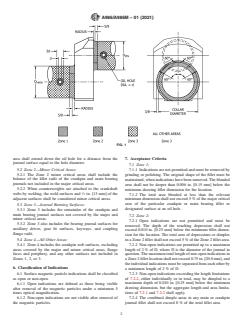
Development of International Standards, Guides and Recom- 5.1.1 Crankpin Journals—The major critical area of each
crankpin journal shall include that area 660 from the 6 o’clock
mendations issued by the World Trade Organization Technical
position of the crankpin and extend ⁄8 in. [10 mm] above the
Barriers to Trade (TBT) Committee.
fillet collar and ⁄8 in. [15 mm] along the crankpin surface as
2. Referenced Documents
measured from the blend of the fillet radius and the journal
2.1 ASTM Standards:
surface. These positions are shown in Fig. 1.
A788/A788M Specification for Steel Forgings, General Re- 5.1.2 Main Bearing Journals—The major critical areas of
quirements
any main bearing journal shall include that area 660 from the
12 o’clock position on top of the journal and extend ⁄8 in.
1 5
This specification is under the jurisdiction of ASTM Committee A01 on Steel,
[10 mm] above the fillet collar and ⁄8 in. [15 mm] along the
Stainless Steel and Related Alloys and is the direct responsibility of Subcommittee
journal as measured from the blend of the fillet radius and the
A01.06 on Steel Forgings and Billets.
journal surface. These positions are shown in Fig. 1.
Current edition approved March 1, 2021. Published March 2021. Originally
5.1.3 Oil Holes—The major critical areas in also shall
approved in 1998. Last previous edition approved in 2016 as A986/A986M – 01
(2016). DOI: 10.1520/A0986_A0986M-01R21.
include the surfaces surrounding the journal oil holes. The
For referenced ASTM standards, visit the ASTM website, www.astm.org, or
diameter of this critical area shall be 3d, where d is the oil hole
contact ASTM Customer Service at service@astm.org. For Annual Book of ASTM
diameter before the radius. The critical area shall be centered
Standards volume information, refer to the standard’s Document Summary page on
the ASTM website. on the centerline of the oil hole. In addition, the Zone 1 critical
Copyright © ASTM International, 100 Barr Harbor Drive, PO Box C700, West Conshohocken, PA 19428-2959. United States
A986/A986M − 01 (2021)
FIG. 1
area shall extend down the oil hole for a distance from the 7. Acceptance Criteria
journal surface equal to the hole diameter.
7.1 Zone 1:
5.2 Zone 2—Minor Critical Areas:
7.1.1 Indications are not permitted and must be removed by
5.2.1 The Zone 2 minor critical areas shall include the
grinding or polishing. The original shape of the fillet must be
balance of the fillet radii of the crankpin and main bearing
maintained, when indications have been removed.The blended
journals not included in the major critical areas.
area shall not be deeper than 0.006 in. [0.15 mm] below the
5.2.2 When counterweights are attached to the crankshaft
minimum drawing fillet dimension for the location.
webs by welding, the weld surfaces and ⁄2 in. [13 mm] of the
7.1.2 The total area blended at less than the relevant
adjacent surfaces shall be considered minor critical areas.
minimum dimension shall not exceed 5 % of the major critical
area of the particular crankpin or main bearing fillet or
5.3 Zone 3—Journal Running Surfaces:
designated surface at an oil hole.
5.3.1 Zone 3 includes the remainder of the crankpin and
main bearing journal surfaces not covered by the major and
7.2 Zone 2:
minor critical areas.
7.2.1 Open indications are not permitted and must be
5.3.2 Zone 3 also includes the bearing journal surfaces for
removed. The depth of the resulting depression shall not
auxiliary drives, gear fit surfaces, keyways, and coupling
exceed 0.010 in. [0.25 mm] below the minimum fillet dimen-
flange radii.
sion for the location. The total area of depressions or dimples
5.4 Zone 4—All Other Areas: in a Zone 2 fillet shall not exceed 5 % of the Zone 2 fillet area.
5.4.1 Zone 4 includes the crankpin web surfaces, excluding 7.2.2 Non-open indications are permitted up to a maximu
...