

ASTM A105/A105M-24
(Specification)Standard Specification for Carbon Steel Forgings for Piping Applications
General Information
- Abstract
ABSTRACT
This specification covers standards for forged carbon steel piping components, that is, flanges, fittings, valves, and similar parts, for use in pressure systems at ambient and higher-temperature service conditions. Materials shall be subjected to heat treatment (annealing, normalizing, tempering, or quenching). Material shall conform to carbon, manganese, phosphorus, sulfur, silicon, copper, nickel, chromium, molybdenum and vanadium contents. The forgings shall be subjected to tension, hardness and hydrostatic tests, with the latter applicable when required. Material shall adhere to tensile strength, yield strength, elongation, reduction of area, and hardness requirements. Guidelines for retreatment, repair by welding, and product marking are given.
SCOPE
1.1 This specification2 covers forged carbon steel piping components for ambient- and higher-temperature service in pressure systems. Included are flanges, fittings, valves, and similar parts ordered either to dimensions specified by the purchaser or to dimensional standards such as the MSS, ASME, and API specifications referenced in Section 2. Forgings made to this specification are limited to a maximum weight of 10 000 lb [4540 kg]. Larger forgings may be ordered to Specification A266/A266M. Tubesheets and hollow cylindrical forgings for pressure vessel shells are not included within the scope of this specification. Although this specification covers some piping components machined from rolled bar and seamless tubular products (see 5.2), it does not cover raw material produced in these product forms.
1.2 Supplementary requirements are provided for use when additional testing or inspection is desired. These shall apply only when specified individually by the purchaser in the order.
1.3 Specification A266/A266M covers other steel forgings and Specifications A675/A675M and A696 cover other steel bars.
1.4 This specification is expressed in both inch-pound units and SI units. However, unless the order specifies the applicable “M” specification designation (SI units), the material shall be furnished to inch-pound units. The values stated in either SI units or inch-pound units are to be regarded separately as standard. Within the text, the SI units are shown in brackets. The values stated in each system may not be exact equivalents; therefore, each system shall be used independently of the other. Combining values from the two systems may result in non-conformance with the standard.
Note 1: The dimensionless designator NPS (nominal pipe size) has been substituted in this standard for such traditional terms as “nominal diameter,” “size,” and “nominal size.”
1.5 This international standard was developed in accordance with internationally recognized principles on standardization established in the Decision on Principles for the Development of International Standards, Guides and Recommendations issued by the World Trade Organization Technical Barriers to Trade (TBT) Committee.
- Status
- Published
- Publication Date
- 14-Apr-2024
- Technical Committee
- A01 - Steel, Stainless Steel and Related Alloys
Buy Documents
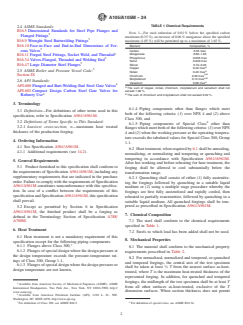
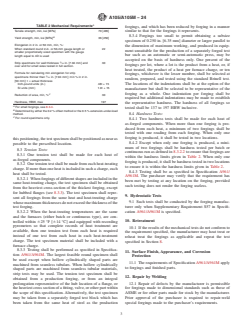
ASTM A105/A105M-24 - Standard Specification for Carbon Steel Forgings for Piping Applications
REDLINE ASTM A105/A105M-24 - Standard Specification for Carbon Steel Forgings for Piping Applications
Overview
ASTM A105/A105M-24 is an international standard developed by ASTM International that specifies the requirements for forged carbon steel piping components, including flanges, fittings, valves, and similar parts intended for use in pressure systems at both ambient and elevated temperatures. This standard ensures the quality, safety, and performance of carbon steel forgings used in critical piping applications across numerous industries by setting stringent criteria for chemical composition, mechanical properties, and manufacturing processes.
ASTM A105/A105M is widely recognized in the fields of mechanical engineering, oil and gas, refinery, chemical processing, and power generation. It is referenced in the ASME Boiler and Pressure Vessel Code and endorsed by key industry organizations.
Key Topics
Scope and Applicability
- Covers forged carbon steel piping components such as flanges, fittings, valves, and related parts up to a maximum weight of 10,000 lb [4540 kg].
- Excludes tubesheets, hollow cylindrical forgings for pressure vessel shells, and raw material produced as rolled bar or seamless tubes.
Material and Heat Treatment
- Forgings may require heat treatments such as annealing, normalizing, tempering, or quenching to meet performance criteria.
- Specific requirements for heat treatment apply to components based on class and size, especially for high-pressure and high-temperature service.
Chemical and Mechanical Requirements
- Prescribes strict limits for elements like carbon, manganese, phosphorus, sulfur, silicon, copper, nickel, chromium, molybdenum, and vanadium.
- Mechanical properties required include minimum tensile strength (70 ksi [485 MPa]), yield strength (36 ksi [250 MPa]), elongation, reduction of area, and Brinell hardness (137–197 HBW).
Testing and Inspection
- Mandatory tension and hardness tests for each production lot.
- Hydrostatic testing is conducted when specified by the purchaser.
- Supplementary requirements are available for enhanced inspections or additional testing.
Certification and Marking
- Components must be properly marked to indicate compliance, heat treatment, and repair history.
- Certificate and test report generation is required, detailing chemical composition, mechanical properties, and heat treatment type.
Applications
ASTM A105/A105M-24 carbon steel forgings are essential for safe and reliable operation in:
- Oil & Gas Industry: Employed in pipelines, refining, and petrochemical processing for pressure-containing flanges, valves, and fittings.
- Power Generation: Used in high-pressure steam and cooling water systems.
- Chemical Processing Plants: Ensures corrosion resistance and mechanical strength in varied temperature and pressure conditions.
- Water Treatment and Distribution: Utilized for critical piping in water infrastructure requiring robust mechanical properties.
- General Industrial Piping: Suitable for any application demanding high-strength carbon steel forgings that meet recognized international standards.
This standard is integral to maintaining safety and reliability in pressure systems by ensuring every forging meets consistent quality benchmarks.
Related Standards
For comprehensive compliance and specification matching, the following standards are frequently referenced alongside ASTM A105/A105M-24:
- ASTM A266/A266M: Carbon Steel Forgings for Pressure Vessel Components (for larger forgings above 10,000 lb/4540 kg).
- ASTM A675/A675M: Steel Bars, Carbon, Hot-Wrought, Special Quality, Mechanical Properties.
- ASTM A696: Steel Bars, Carbon, Special Quality, for Pressure Piping Components.
- ASTM A788/A788M: General Requirements for Steel Forgings.
- ASTM A961/A961M: Common Requirements for Steel Flanges, Forged Fittings, Valves, and Parts for Piping Applications.
- ASME Standards: Including ASME B16.5 (Pipe Flanges and Flanged Fittings), B16.9 (Wrought Steel Buttwelding Fittings), B16.11 (Forged Steel Fittings), and B16.34 (Valves).
- API Standards: API 600 (Steel Gate Valves), API 602 (Compact Design Carbon Steel Gate Valves).
- MSS SP-44: Steel Pipe Line Flanges.
By adhering to ASTM A105/A105M-24 and the related standards, manufacturers and end-users ensure that carbon steel forged piping components provide dependable service in stringent industrial environments, supporting both safety and operational efficiency.
Keywords: ASTM A105, carbon steel forgings, piping applications, flanges, fittings, valves, pressure systems, oil and gas, mechanical properties, international standard, high-temperature service.
Relations
- Replaces
ASTM A105/A105M-23 - Standard Specification for Carbon Steel Forgings for Piping Applications - Effective Date
- 15-Apr-2024
- Referred By
ASTM F1565-00(2019) - Standard Specification for Pressure-Reducing Valves for Steam Service - Effective Date
- 15-Apr-2024
- Effective Date
- 15-Apr-2024
- Referred By
ASTM F1155-10(2019) - Standard Practice for Selection and Application of Piping System Materials - Effective Date
- 15-Apr-2024
- Effective Date
- 15-Apr-2024
- Effective Date
- 15-Apr-2024
- Effective Date
- 15-Apr-2024
- Effective Date
- 15-Apr-2024
- Effective Date
- 15-Apr-2024
- Effective Date
- 15-Apr-2024
Buy Documents
ASTM A105/A105M-24 - Standard Specification for Carbon Steel Forgings for Piping Applications
REDLINE ASTM A105/A105M-24 - Standard Specification for Carbon Steel Forgings for Piping Applications
Get Certified
Connect with accredited certification bodies for this standard

Element Materials Technology
Materials testing and product certification.

Inštitut za kovinske materiale in tehnologije
Institute of Metals and Technology. Materials testing, metallurgical analysis, NDT.
Sponsored listings
Frequently Asked Questions
ASTM A105/A105M-24 is a technical specification published by ASTM International. Its full title is "Standard Specification for Carbon Steel Forgings for Piping Applications". This standard covers: ABSTRACT This specification covers standards for forged carbon steel piping components, that is, flanges, fittings, valves, and similar parts, for use in pressure systems at ambient and higher-temperature service conditions. Materials shall be subjected to heat treatment (annealing, normalizing, tempering, or quenching). Material shall conform to carbon, manganese, phosphorus, sulfur, silicon, copper, nickel, chromium, molybdenum and vanadium contents. The forgings shall be subjected to tension, hardness and hydrostatic tests, with the latter applicable when required. Material shall adhere to tensile strength, yield strength, elongation, reduction of area, and hardness requirements. Guidelines for retreatment, repair by welding, and product marking are given. SCOPE 1.1 This specification2 covers forged carbon steel piping components for ambient- and higher-temperature service in pressure systems. Included are flanges, fittings, valves, and similar parts ordered either to dimensions specified by the purchaser or to dimensional standards such as the MSS, ASME, and API specifications referenced in Section 2. Forgings made to this specification are limited to a maximum weight of 10 000 lb [4540 kg]. Larger forgings may be ordered to Specification A266/A266M. Tubesheets and hollow cylindrical forgings for pressure vessel shells are not included within the scope of this specification. Although this specification covers some piping components machined from rolled bar and seamless tubular products (see 5.2), it does not cover raw material produced in these product forms. 1.2 Supplementary requirements are provided for use when additional testing or inspection is desired. These shall apply only when specified individually by the purchaser in the order. 1.3 Specification A266/A266M covers other steel forgings and Specifications A675/A675M and A696 cover other steel bars. 1.4 This specification is expressed in both inch-pound units and SI units. However, unless the order specifies the applicable “M” specification designation (SI units), the material shall be furnished to inch-pound units. The values stated in either SI units or inch-pound units are to be regarded separately as standard. Within the text, the SI units are shown in brackets. The values stated in each system may not be exact equivalents; therefore, each system shall be used independently of the other. Combining values from the two systems may result in non-conformance with the standard. Note 1: The dimensionless designator NPS (nominal pipe size) has been substituted in this standard for such traditional terms as “nominal diameter,” “size,” and “nominal size.” 1.5 This international standard was developed in accordance with internationally recognized principles on standardization established in the Decision on Principles for the Development of International Standards, Guides and Recommendations issued by the World Trade Organization Technical Barriers to Trade (TBT) Committee.
ABSTRACT This specification covers standards for forged carbon steel piping components, that is, flanges, fittings, valves, and similar parts, for use in pressure systems at ambient and higher-temperature service conditions. Materials shall be subjected to heat treatment (annealing, normalizing, tempering, or quenching). Material shall conform to carbon, manganese, phosphorus, sulfur, silicon, copper, nickel, chromium, molybdenum and vanadium contents. The forgings shall be subjected to tension, hardness and hydrostatic tests, with the latter applicable when required. Material shall adhere to tensile strength, yield strength, elongation, reduction of area, and hardness requirements. Guidelines for retreatment, repair by welding, and product marking are given. SCOPE 1.1 This specification2 covers forged carbon steel piping components for ambient- and higher-temperature service in pressure systems. Included are flanges, fittings, valves, and similar parts ordered either to dimensions specified by the purchaser or to dimensional standards such as the MSS, ASME, and API specifications referenced in Section 2. Forgings made to this specification are limited to a maximum weight of 10 000 lb [4540 kg]. Larger forgings may be ordered to Specification A266/A266M. Tubesheets and hollow cylindrical forgings for pressure vessel shells are not included within the scope of this specification. Although this specification covers some piping components machined from rolled bar and seamless tubular products (see 5.2), it does not cover raw material produced in these product forms. 1.2 Supplementary requirements are provided for use when additional testing or inspection is desired. These shall apply only when specified individually by the purchaser in the order. 1.3 Specification A266/A266M covers other steel forgings and Specifications A675/A675M and A696 cover other steel bars. 1.4 This specification is expressed in both inch-pound units and SI units. However, unless the order specifies the applicable “M” specification designation (SI units), the material shall be furnished to inch-pound units. The values stated in either SI units or inch-pound units are to be regarded separately as standard. Within the text, the SI units are shown in brackets. The values stated in each system may not be exact equivalents; therefore, each system shall be used independently of the other. Combining values from the two systems may result in non-conformance with the standard. Note 1: The dimensionless designator NPS (nominal pipe size) has been substituted in this standard for such traditional terms as “nominal diameter,” “size,” and “nominal size.” 1.5 This international standard was developed in accordance with internationally recognized principles on standardization established in the Decision on Principles for the Development of International Standards, Guides and Recommendations issued by the World Trade Organization Technical Barriers to Trade (TBT) Committee.
ASTM A105/A105M-24 is classified under the following ICS (International Classification for Standards) categories: 77.140.85 - Iron and steel forgings. The ICS classification helps identify the subject area and facilitates finding related standards.
ASTM A105/A105M-24 has the following relationships with other standards: It is inter standard links to ASTM A105/A105M-23, ASTM F1565-00(2019), ASTM C1617-19, ASTM F1155-10(2019), ASTM C1847-21, ASTM F1508-96(2021), ASTM A961/A961M-23, ASTM F1545-15a(2021), ASTM F721-18(2022), ASTM A234/A234M-23a. Understanding these relationships helps ensure you are using the most current and applicable version of the standard.
ASTM A105/A105M-24 is available in PDF format for immediate download after purchase. The document can be added to your cart and obtained through the secure checkout process. Digital delivery ensures instant access to the complete standard document.
Standards Content (Sample)
This international standard was developed in accordance with internationally recognized principles on standardization established in the Decision on Principles for the
Development of International Standards, Guides and Recommendations issued by the World Trade Organization Technical Barriers to Trade (TBT) Committee.
Designation: A105/A105M − 24 Endorsed by
Manufacturers Standardization Society
of the Valve and Fittings Industry
Used in USDOE-NE Standards
Standard Specification for
Carbon Steel Forgings for Piping Applications
This standard is issued under the fixed designation A105/A105M; the number immediately following the designation indicates the year
of original adoption or, in the case of revision, the year of last revision. A number in parentheses indicates the year of last reapproval.
A superscript epsilon (´) indicates an editorial change since the last revision or reapproval.
This standard has been approved for use by agencies of the U.S. Department of Defense.
1. Scope* Combining values from the two systems may result in non-
2 conformance with the standard.
1.1 This specification covers forged carbon steel piping
NOTE 1—The dimensionless designator NPS (nominal pipe size) has
components for ambient- and higher-temperature service in
been substituted in this standard for such traditional terms as “nominal
pressure systems. Included are flanges, fittings, valves, and
diameter,” “size,” and “nominal size.”
similar parts ordered either to dimensions specified by the
1.5 This international standard was developed in accor-
purchaser or to dimensional standards such as the MSS,
dance with internationally recognized principles on standard-
ASME, and API specifications referenced in Section 2. Forg-
ization established in the Decision on Principles for the
ings made to this specification are limited to a maximum
Development of International Standards, Guides and Recom-
weight of 10 000 lb [4540 kg]. Larger forgings may be ordered
mendations issued by the World Trade Organization Technical
to Specification A266/A266M. Tubesheets and hollow cylin-
Barriers to Trade (TBT) Committee.
drical forgings for pressure vessel shells are not included
within the scope of this specification. Although this specifica-
2. Referenced Documents
tion covers some piping components machined from rolled bar
2.1 In addition to those reference documents listed in
and seamless tubular products (see 5.2), it does not cover raw
Specification A961/A961M, the following list of standards
material produced in these product forms.
apply to this specification:
1.2 Supplementary requirements are provided for use when
2.2 ASTM Standards:
additional testing or inspection is desired. These shall apply
A266/A266M Specification for Carbon Steel Forgings for
only when specified individually by the purchaser in the order.
Pressure Vessel Components
1.3 Specification A266/A266M covers other steel forgings
A675/A675M Specification for Steel Bars, Carbon, Hot-
and Specifications A675/A675M and A696 cover other steel
Wrought, Special Quality, Mechanical Properties
bars.
A696 Specification for Steel Bars, Carbon, Hot-Wrought or
Cold-Finished, Special Quality, for Pressure Piping Com-
1.4 This specification is expressed in both inch-pound units
ponents
and SI units. However, unless the order specifies the applicable
A788/A788M Specification for Steel Forgings, General Re-
“M” specification designation (SI units), the material shall be
quirements
furnished to inch-pound units. The values stated in either SI
A961/A961M Specification for Common Requirements for
units or inch-pound units are to be regarded separately as
Steel Flanges, Forged Fittings, Valves, and Parts for
standard. Within the text, the SI units are shown in brackets.
Piping Applications
The values stated in each system may not be exact equivalents;
therefore, each system shall be used independently of the other.
2.3 MSS Standards:
SP 44 Standard for Steel Pipe Line Flanges
This specification is under the jurisdiction of ASTM Committee A01 on Steel,
Stainless Steel and Related Alloys and is the direct responsibility of Subcommittee
A01.22 on Steel Forgings and Wrought Fittings for Piping Applications and Bolting For referenced ASTM standards, visit the ASTM website, www.astm.org, or
Materials for Piping and Special Purpose Applications. contact ASTM Customer Service at service@astm.org. For Annual Book of ASTM
Current edition approved April 15, 2024. Published April 2024. Originally Standards volume information, refer to the standard’s Document Summary page on
approved in 1926. Last previous edition approved in 2023 as A105/A105M – 23. the ASTM website.
DOI: 10.1520/A0105_A0105M-24. Available from Manufacturers Standardization Society of the Valve and Fittings
For ASME Boiler and Pressure Vessel Code applications see related Specifi- Industry (MSS), 127 Park St., NE, Vienna, VA 22180-4602, http://www.mss-
cation SA-105 in Section II of that Code. hq.com.
*A Summary of Changes section appears at the end of this standard
Copyright © ASTM International, 100 Barr Harbor Drive, PO Box C700, West Conshohocken, PA 19428-2959. United States
A105/A105M − 24
TABLE 1 Chemical Requirements
2.4 ASME Standards:
B16.5 Dimensional Standards for Steel Pipe Flanges and
NOTE 1—For each reduction of 0.01 % below the specified carbon
Flanged Fittings
maximum (0.35 %), an increase of 0.06 % manganese above the specified
maximum (1.05 %) will be permitted up to a maximum of 1.65 %.
B16.9 Wrought Steel Buttwelding Fittings
B16.10 Face-to-Face and End-to-End Dimensions of Fer- Element Composition, %
rous Valves Carbon 0.35 max
Manganese 0.60–1.05
B16.11 Forged Steel Fittings, Socket Weld, and Threaded
Phosphorus 0.035 max
B16.34 Valves-Flanged, Threaded and Welding End
Sulfur 0.040 max
B16.47 Large Diameter Steel Flanges Silicon 0.10–0.35
A
Copper 0.40 max
2.5 ASME Boiler and Pressure Vessel Code: A
Nickel 0.40 max
A,B
Section IX
Chromium 0.30 max
A,B
Molybdenum 0.12 max
2.6 API Standards:
A
Vanadium 0.08 max
API-600 Flanged and Butt-Welding-End Steel Gate Valves
A
The sum of copper, nickel, chromium, molybdenum and vanadium shall not
API-602 Compact Design Carbon Steel Gate Valves for
exceed 1.00 %.
B
Refinery Use The sum of chromium and molybdenum shall not exceed 0.32 %.
3. Terminology
6.1.4 Piping components other than flanges which meet
3.1 Definitions—For definitions of other terms used in this
both of the following criteria: (1) over NPS 4 and (2) above
specification, refer to Specification A961/A961M.
Class 300, and
3.2 Definitions of Terms Specific to This Standard: 8
6.1.5 Piping components of Special Class other than
3.2.1 heaviest cross-section, n—maximum heat treated
flanges which meet both of the following criteria: (1) over NPS
thickness of the production forging.
4 and (2) when the working pressure at the operating tempera-
ture exceeds the tabulated values for Special Class 300, Group
4. Ordering Information
1.1.
4.1 See Specification A961/A961M.
6.2 Heat treatment, when required by 6.1 shall be annealing,
4.1.1 Additional requirements (see 14.2).
normalizing, or normalizing and tempering or quenching and
tempering in accordance with Specification A961/A961M.
5. General Requirements
After hot working and before reheating for heat treatment, the
5.1 Product furnished to this specification shall conform to
forging shall be allowed to cool substantially below the
the requirements of Specification A961/A961M, including any
transformation range.
supplementary requirements that are indicated in the purchase
6.2.1 Quenching shall consist of either (1) fully austenitiz-
order. Failure to comply with the requirements of Specification
ing the forgings followed by quenching in a suitable liquid
A961/A961M constitutes nonconformance with this specifica-
medium or (2) using a multiple stage procedure whereby the
tion. In case of a conflict between the requirements of this
forgings are first fully austenitized and rapidly cooled, then
specification and Specification A961/A961M, this specification
reheated to partially reaustenitize, followed by quenching in a
shall prevail.
suitable liquid medium. All quenched forgings shall be tem-
pered as prescribed in Specification A961/A961M.
5.2 Except as permitted by Section 6 in Specification
A961/A961M, the finished product shall be a forging as
7. Chemical Composition
defined in the Terminology Section of Specification A788/
7.1 The steel shall conform to the chemical requirements
A788M.
specified in Table 1.
6. Heat Treatment
7.2 Steels to which lead has been added shall not be used.
6.1 Heat treatment is not a mandatory requirement of this
8. Mechanical Properties
specification except for the following piping components:
6.1.1 Flanges above Class 300,
8.1 The material shall conform to the mechanical property
6.1.2 Flanges of special design where the design pressure at
requirements prescribed in Table 2.
the design temperature exceeds the pressure-temperature rat-
8.2 For normalized, normalized and tempered, or quenched
ings of Class 300, Group 1.1,
and tempered forgings, the central axis of the test specimen
6.1.3 Flanges of special design where the design pressure or
shall be taken at least ⁄4 T from the nearest surface as-heat-
design temperature are not known,
treated, where T is the maximum heat-treated thickness of the
represented forging. In addition, for quenched and tempered
forgings, the midlength of the test specimen shall be at least T
Available from American Society of Mechanical Engineers (ASME), ASME
from all other surfaces as-heat-treated, exclusive of the T
International Headquarters, Two Park Ave., New York, NY 10016-5990, http://
www.asme.org. dimension surfaces. When section thickness does not permit
Available from American Petroleum Institute (API), 1220 L. St., NW,
Washington, DC 20005-4070, http://www.api.org.
7 8
For definition of Class 300, see ASME B16.5. For definition of special class, see ASME B16.34.
A105/A105M − 24
A
TABLE 2 Mechanical Requirements
forgings, and which has been reduced by forging in a manner
Tensile strength, min, ksi [MPa] 70 [485]
similar to that for the forgings it represents.
8.3.4 Forgings too small to permit obtaining a subsize
B
Yield strength, min, ksi [MPa] 36 [250]
specimen of 0.250 in. [6.35 mm] diameter or larger parallel to
Elongation in 2 in. or 50 mm, min, %:
the dimension of maximum working, and produced in equip-
When standard round 2-in. or 50-mm gauge length or 22
ment unsuitable for the production of a separately forged test
smaller proportionally sized specimen with the gauge
bar such as an automatic or semi-automatic press, may be
length equal to 4D is used
accepted on the basis of hardness only. One percent of the
Strip specimens for wall thickness ⁄16 in. [7.94 mm] and 30
forgings per lot, where a lot is the product from a heat, or, if
over and for small sizes tested in full section.
heat treated, the product of a heat per furnace charge, or ten
Formula for calculating min elongation for strip
forgings, whichever is the lesser number, shall be selected at
specimens thinner than ⁄16 in. [7.94 mm]; min % in 2 in.
random, prepared, and tested using the standard Brinell test.
[50 mm]: t = actual thickness
Inch-pound units (in.) 48t + 15 The locations of the indentations shall be at the option of the
SI units (mm) 1.9t + 15
manufacturer but shall be selected to be representative of the
C forging as a whole. One indentation per forging shall be
Reduction of area, min, % 30
required but additional indentations may be made to establish
Hardness, HBW, max 197
the representative hardness. The hardness of all forgings so
A
For small forgings, see 8.3.4.
tested sh
...
This document is not an ASTM standard and is intended only to provide the user of an ASTM standard an indication of what changes have been made to the previous version. Because
it may not be technically possible to adequately depict all changes accurately, ASTM recommends that users consult prior editions as appropriate. In all cases only the current version
of the standard as published by ASTM is to be considered the official document.
Designation: A105/A105M − 23 A105/A105M − 24 Endorsed by
Manufacturers Standardization Society
of the Valve and Fittings Industry
Used in USDOE-NE Standards
Standard Specification for
Carbon Steel Forgings for Piping Applications
This standard is issued under the fixed designation A105/A105M; the number immediately following the designation indicates the year
of original adoption or, in the case of revision, the year of last revision. A number in parentheses indicates the year of last reapproval.
A superscript epsilon (´) indicates an editorial change since the last revision or reapproval.
This standard has been approved for use by agencies of the U.S. Department of Defense.
1. Scope*
1.1 This specification covers forged carbon steel piping components for ambient- and higher-temperature service in pressure
systems. Included are flanges, fittings, valves, and similar parts ordered either to dimensions specified by the purchaser or to
dimensional standards such as the MSS, ASME, and API specifications referenced in Section 2. Forgings made to this specification
are limited to a maximum weight of 10 000 lb [4540 kg]. Larger forgings may be ordered to Specification A266/A266M.
Tubesheets and hollow cylindrical forgings for pressure vessel shells are not included within the scope of this specification.
Although this specification covers some piping components machined from rolled bar and seamless tubular products (see 5.2), it
does not cover raw material produced in these product forms.
1.2 Supplementary requirements are provided for use when additional testing or inspection is desired. These shall apply only when
specified individually by the purchaser in the order.
1.3 Specification A266/A266M covers other steel forgings and Specifications A675/A675M and A696 cover other steel bars.
1.4 This specification is expressed in both inch-pound units and SI units. However, unless the order specifies the applicable “M”
specification designation (SI units), the material shall be furnished to inch-pound units. The values stated in either SI units or
inch-pound units are to be regarded separately as standard. Within the text, the SI units are shown in brackets. The values stated
in each system may not be exact equivalents; therefore, each system shall be used independently of the other. Combining values
from the two systems may result in non-conformance with the standard.
NOTE 1—The dimensionless designator NPS (nominal pipe size) has been substituted in this standard for such traditional terms as “nominal diameter,”
“size,” and “nominal size.”
1.5 This international standard was developed in accordance with internationally recognized principles on standardization
established in the Decision on Principles for the Development of International Standards, Guides and Recommendations issued
by the World Trade Organization Technical Barriers to Trade (TBT) Committee.
2. Referenced Documents
2.1 In addition to those reference documents listed in Specification A961/A961M, the following list of standards apply to this
specification:
This specification is under the jurisdiction of ASTM Committee A01 on Steel, Stainless Steel and Related Alloys and is the direct responsibility of Subcommittee A01.22
on Steel Forgings and Wrought Fittings for Piping Applications and Bolting Materials for Piping and Special Purpose Applications.
Current edition approved May 1, 2023April 15, 2024. Published May 2023April 2024. Originally approved in 1926. Last previous edition approved in 20212023 as
A105/A105M – 21.A105/A105M – 23. DOI: 10.1520/A0105_A0105M-23.10.1520/A0105_A0105M-24.
For ASME Boiler and Pressure Vessel Code applications see related Specification SA-105 in Section II of that Code.
*A Summary of Changes section appears at the end of this standard
Copyright © ASTM International, 100 Barr Harbor Drive, PO Box C700, West Conshohocken, PA 19428-2959. United States
A105/A105M − 24
2.2 ASTM Standards:
A266/A266M Specification for Carbon Steel Forgings for Pressure Vessel Components
A675/A675M Specification for Steel Bars, Carbon, Hot-Wrought, Special Quality, Mechanical Properties
A696 Specification for Steel Bars, Carbon, Hot-Wrought or Cold-Finished, Special Quality, for Pressure Piping Components
A788/A788M Specification for Steel Forgings, General Requirements
A961/A961M Specification for Common Requirements for Steel Flanges, Forged Fittings, Valves, and Parts for Piping
Applications
2.3 MSS Standards:
SP 44 Standard for Steel Pipe Line Flanges
2.4 ASME Standards:
B16.5 Dimensional Standards for Steel Pipe Flanges and Flanged Fittings
B16.9 Wrought Steel Buttwelding Fittings
B16.10 Face-to-Face and End-to-End Dimensions of Ferrous Valves
B16.11 Forged Steel Fittings, Socket Weld, and Threaded
B16.34 Valves-Flanged, Threaded and Welding End
B16.47 Large Diameter Steel Flanges
2.5 ASME Boiler and Pressure Vessel Code:
Section IX
2.6 API Standards:
API-600 Flanged and Butt-Welding-End Steel Gate Valves
API-602 Compact Design Carbon Steel Gate Valves for Refinery Use
3. Terminology
3.1 Definitions—For definitions of other terms used in this specification, refer to Specification A961/A961M.
3.2 Definitions of Terms Specific to This Standard:
3.2.1 heaviest cross-section, n—maximum heat treated thickness of the production forging.
4. Ordering Information
4.1 See Specification A961/A961M.
4.1.1 Additional requirements (see 14.2).
5. General Requirements
5.1 Product furnished to this specification shall conform to the requirements of Specification A961/A961M, including any
supplementary requirements that are indicated in the purchase order. Failure to comply with the requirements of Specification
A961/A961M constitutes nonconformance with this specification. In case of a conflict between the requirements of this
specification and Specification A961/A961M, this specification shall prevail.
5.2 Except as permitted by Section 6 in Specification A961/A961M, the finished product shall be a forging as defined in the
Terminology Section of Specification A788/A788M.
6. Heat Treatment
6.1 Heat treatment is not a mandatory requirement of this specification except for the following piping components:
For referenced ASTM standards, visit the ASTM website, www.astm.org, or contact ASTM Customer Service at service@astm.org. For Annual Book of ASTM Standards
volume information, refer to the standard’s Document Summary page on the ASTM website.
Available from Manufacturers Standardization Society of the Valve and Fittings Industry (MSS), 127 Park St., NE, Vienna, VA 22180-4602, http://www.mss-hq.com.
Available from American Society of Mechanical Engineers (ASME), ASME International Headquarters, Two Park Ave., New York, NY 10016-5990, http://
www.asme.org.
Available from American Petroleum Institute (API), 1220 L. St., NW, Washington, DC 20005-4070, http://www.api.org.
A105/A105M − 24
6.1.1 Flanges above Class 300,
6.1.2 Flanges of special design where the design pressure at the design temperature exceeds the pressure-temperature ratings of
Class 300, Group 1.1,
6.1.3 Flanges of special design where the design pressure or design temperature are not known,
6.1.4 Piping components other than flanges which meet both of the following criteria: (1) over NPS 4 and (2) above Class 300,
and
6.1.5 Piping components of Special Class other than flanges which meet both of the following criteria: (1) over NPS 4 and (2)
when the working pressure at the operating temperature exceeds the tabulated values for Special Class 300, Group 1.1.
6.2 Heat treatment, when required by 6.1 shall be annealing, normalizing, or normalizing and tempering or quenching and
tempering in accordance with Specification A961/A961M. After hot working and before reheating for heat treatment, the forging
shall be allowed to cool substantially below the transformation range.
6.2.1 Quenching shall consist of either (1) fully austenitizing the forgings followed by quenching in a suitable liquid medium or
(2) using a multiple stage procedure whereby the forgings are first fully austenitized and rapidly cooled, then reheated to partially
reaustenitize, followed by quenching in a suitable liquid medium. All quenched forgings shall be tempered as prescribed in
Specification A961/A961M.
7. Chemical Composition
7.1 The steel shall conform to the chemical requirements specified in Table 1.
7.2 Steels to which lead has been added shall not be used.
8. Mechanical Properties
8.1 The material shall conform to the mechanical property requirements prescribed in Table 2 and Table 3.
8.2 For normalized, normalized and tempered, or quenched and tempered forgings, the central axis of the test specimen shall be
taken at least ⁄4 T from the nearest surface as-heat-treated, where T is the maximum heat-treated thickness of the represented
forging. In addition, for quenched and tempered forgings, the midlength of the test specimen shall be at least T from all other
TABLE 1 Chemical Requirements
NOTE 1—For each reduction of 0.01 % below the specified carbon
maximum (0.35 %), an increase of 0.06 % manganese above the specified
maximum (1.05 %) will be permitted up to a maximum of 1.65 %.
Element Composition, %
Carbon 0.35 max
Manganese 0.60–1.05
Phosphorus 0.035 max
Sulfur 0.040 max
Silicon 0.10–0.35
A
Copper 0.40 max
A
Nickel 0.40 max
A,B
Chromium 0.30 max
A,B
Molybdenum 0.12 max
A
Vanadium 0.08 max
A
The sum of copper, nickel, chromium, molybdenum and vanadium shall not
exceed 1.00 %.
B
The sum of chromium and molybdenum shall not exceed 0.32 %.
For definition of Class 300, see ASME B16.5.
For definition of special class, see ASME B16.34.
A105/A105M − 24
A
TABLE 2 Mechanical Requirements
Tensile strength, min, ksi [MPa] 70 [485]
B
Yield strength, min, ksi [MPa] 36 [250]
Elongation in 2 in. or 50 mm, min, %:
Basic minimum elongation for walls ⁄16 in. [7.9 mm] 30
and over in thickness, strip tests.
When standard round 2-in. or 50-mm gauge length or 22
smaller proportionally sized specimen with the gauge
length equal to 4D is used
When standard round 2-in. or 50-mm gauge length or 22
smaller proportionally sized specimen with the gauge
length equal to 4D is used
C
For strip tests, a deduction for each ⁄32 -in. [0.8-mm] 1.50
decrease in wall thickness below ⁄16 in. [7.9 mm]
from the basic minimum elongation
of the percentage points of Table 3
Strip specimens for 30
wall thickness ⁄16 in. [7.94 mm]
and over and for small
sizes tested in full section.
Formula for calculating min elongation for strip
specimens thinner than ⁄16 in. [7.94 mm]; min % in 2 in.
[50 mm]: t = actual thickness
Inch-pound units (in.) 48t + 15
SI units (mm) 1.9t + 15
D
Reduction of area, min, % 30
C
Reduction of area, min, % 30
Hardness, HBW, max 197
A
For small forgings, see 8.3.4.
B
Determined by either the 0.2 % offset method or the 0.5 % extension-under-load
method.
C
See Table 3 for computed minimum values.
C
For round specimens only.
surfaces as-heat-treated, exclusive of the T dimension surfaces. When section thickness does not permit this positioning, the test
specimen shall be positioned as near as possible to the prescribed location.
8.3 Tension Tests:
8.3.1 One tension test shall be made for each heat of as-forged components.
8.3.2 One tension test shall be made from each heat-treating charge. If more than one heat is included in such a charge, each heat
shall be tested.
8.3.2.1 When forgings of different shapes are included in the same heat-treating charge, the test specimen shall be obtained from
the heaviest cross-section of the thickest forging, except for hubbed flanges (see 8.3.3). The test specimen shall represent all
forgings from the same heat and heat-treating charge whose maximum thicknesses do not exceed the thickness of the test forging.
8.3.2.2 When the heat-treating temperatures are the same and the furnaces (either batch or continuous type), are controlled within
625 °F [614 °C] and equipped with recording pyrometers so that complete records of heat treatment are availabl
...