

ASTM A234/A234M-23a
(Specification)Standard Specification for Piping Fittings of Wrought Carbon Steel and Alloy Steel for Moderate and High Temperature Service
General Information
- Abstract
ABSTRACT
This specification covers wrought carbon steel and alloy steel fittings of seamless and welded construction. These fittings are for use in pressure piping and in pressure vessel fabrication for service at moderate and elevated temperatures. The material for fittings shall consist of killed steel, forgings, bars, plates, seamless or fusion-welded tubular products with filler metal added. Forging or shaping operations may be performed by hammering, pressing, piercing, extruding, upsetting, rolling, bending, fusion welding, machining, or by a combination of two or more of these operations. The forming procedure shall be so applied that it will not produce injurious imperfections in the fittings. Fittings, after forming at an elevated temperature, shall be cooled to a temperature below the critical range under suitable conditions to prevent injurious defects caused by too rapid cooling, but in no case more rapidly than the cooling rate in still air. The fittings shall be subjected to tension test, hardness test, and hydrostatic test.
SCOPE
1.1 This specification2 covers wrought carbon steel and alloy steel fittings of seamless and welded construction covered by the latest revision of ASME B16.9, B16.11, MSS-SP-79, MSS-SP-83, MSS-SP-95, and MSS-SP-97. These fittings are for use in pressure piping and in pressure vessel fabrication for service at moderate and elevated temperatures. Fittings differing from these ASME and MSS standards shall be furnished in accordance with Supplementary Requirement S58 of Specification A960/A960M.
1.2 Optional supplementary requirements are provided for fittings where a greater degree of examination is desired. When desired, one or more of these supplementary requirements may be specified in the order.
1.3 This specification does not cover cast welding fittings or fittings machined from castings. Cast steel welding fittings are governed by Specifications A216/A216M and A217/A217M.
1.4 This specification is expressed in both inch-pound units and in SI units. However, unless the order specifies the applicable “M” specification designation (SI units), the material shall be furnished to inch-pound units.
1.5 The values stated in either SI units or inch-pound units are to be regarded separately as standard. Within the text, the SI units are shown in brackets. The values stated in each system may not be exact equivalents; therefore, each system shall be used independently of the other. Combining values from the two systems may result in non-conformance with the standard.
1.6 This international standard was developed in accordance with internationally recognized principles on standardization established in the Decision on Principles for the Development of International Standards, Guides and Recommendations issued by the World Trade Organization Technical Barriers to Trade (TBT) Committee.
- Status
- Published
- Publication Date
- 30-Apr-2023
- Technical Committee
- A01 - Steel, Stainless Steel and Related Alloys
Buy Documents
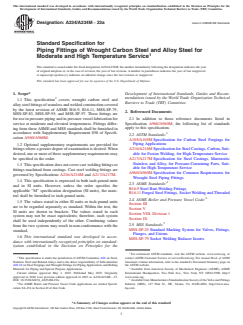
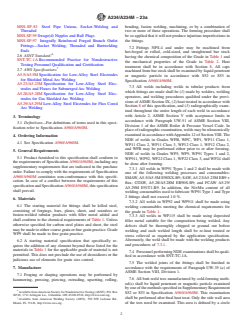
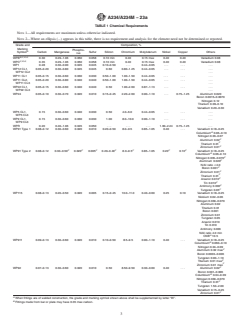
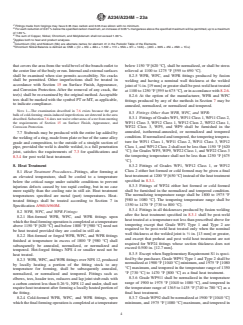
ASTM A234/A234M-23a - Standard Specification for Piping Fittings of Wrought Carbon Steel and Alloy Steel for Moderate and High Temperature Service
REDLINE ASTM A234/A234M-23a - Standard Specification for Piping Fittings of Wrought Carbon Steel and Alloy Steel for Moderate and High Temperature Service
Overview
ASTM A234/A234M-23a is the internationally recognized standard specification for piping fittings of wrought carbon steel and alloy steel intended for moderate and high temperature service. Developed and maintained by ASTM International, this standard covers both seamless and welded fittings used in pressure piping systems and pressure vessel fabrication. Key applications include industries such as power generation, oil & gas, chemical processing, and other sectors requiring robust performance at elevated temperatures. ASTM A234/A234M ensures that fittings meet critical performance and quality requirements for safety and reliability in demanding environments.
Key Topics
Scope and Coverage
- Applies to wrought carbon steel and alloy steel fittings of seamless and welded construction.
- Intended for use in pressure piping and pressure vessel applications under moderate to elevated temperatures.
- Covers fittings conforming to ASME B16.9, B16.11, and MSS specifications.
Material Requirements
- Fittings must be produced from "killed" steel, which ensures uniform chemistry and soundness.
- Approved primary forms include forgings, bars, plates, and seamless or fusion-welded tubular products.
Manufacturing Process
- Permitted shaping operations include forging, pressing, rolling, bending, fusion welding, and machining, alone or in combination.
- Forming methods must avoid the introduction of injurious defects or imperfections.
Mechanical and Nondestructive Testing
- Mandatory testing includes tensile strength, hardness, and, where applicable, hydrostatic testing to verify material performance.
- Additional NDE options such as radiography, ultrasonic, liquid penetrant, or magnetic particle examinations are available when required.
Heat Treatment
- Fittings formed at elevated temperatures must be properly cooled to prevent adverse effects such as cracking.
- Detailed heat treatment requirements are specified by material grade, covering processes like normalizing, annealing, or tempering.
Dimensions and Markings
- Must adhere to ASME and MSS dimensional tolerances and marking conventions, including grade/type and construction method (seamless or welded).
- Bar-coding and supplementary marking methods are permitted for identification.
Supplementary Requirements
- Optional, purchaser-specified requirements allow for enhanced testing, inspection, or stricter material controls.
Applications
ASTM A234/A234M-23a-compliant wrought steel fittings are used in:
- Power Generation: Boiler and furnace piping systems, steam lines, and heat exchangers.
- Oil & Gas: Transmission and distribution piping, refineries, petrochemical plant installations.
- Chemical Processing: Process piping for handling high temperature fluids and gases.
- Pressure Vessel Construction: Fabrication and repair of vessels for high pressure and temperature storage or processing.
- Water Treatment: High pressure water distribution systems in municipal or industrial facilities.
The standard assures users that fittings will perform reliably under varying service temperatures, maintain leak-tight connections, and meet mechanical strength requirements.
Related Standards
- ASTM A960/A960M: General requirements for wrought steel piping fittings.
- ASTM A105/A105M: Carbon steel forgings for piping.
- ASTM A216/A216M & A217/A217M: Steel castings for pressure-containing parts.
- ASME B16.9 & B16.11: Steel butt-welding and forged fittings standards.
- MSS-SP-79, MSS-SP-83, MSS-SP-95, MSS-SP-97: Standards for steel pipe unions, reducer inserts, and branch outlet fittings.
Practical Value
Compliance with ASTM A234/A234M-23a ensures:
- Interchangeability and Global Acceptance: Confidence in product compatibility across a wide range of industries and international markets.
- Safety and Performance: Rigorous requirements for material properties, heat treatment, dimensional control, and testing yield fittings that ensure system integrity under pressure and temperature extremes.
- Traceability: Robust certification and marking requirements aid in quality control, material traceability, and compliance documentation.
Manufacturers, engineers, and procurement professionals can trust ASTM A234/A234M-23a to provide reliable guidance for the selection and use of wrought steel pipe fittings in high-demand applications.
Relations
- Effective Date
- 15-Apr-2024
- Effective Date
- 01-Nov-2019
- Effective Date
- 01-Mar-2019
- Effective Date
- 01-Dec-2016
- Effective Date
- 01-Jun-2016
- Effective Date
- 01-Mar-2016
- Effective Date
- 01-Nov-2015
- Effective Date
- 01-Nov-2014
- Effective Date
- 01-May-2014
- Effective Date
- 01-May-2014
- Effective Date
- 01-May-2014
- Effective Date
- 01-May-2014
- Effective Date
- 01-Oct-2013
- Effective Date
- 01-May-2013
- Effective Date
- 01-Nov-2012
Buy Documents
ASTM A234/A234M-23a - Standard Specification for Piping Fittings of Wrought Carbon Steel and Alloy Steel for Moderate and High Temperature Service
REDLINE ASTM A234/A234M-23a - Standard Specification for Piping Fittings of Wrought Carbon Steel and Alloy Steel for Moderate and High Temperature Service
Get Certified
Connect with accredited certification bodies for this standard

Institut za varilstvo d.o.o. (Welding Institute)
Slovenia's leading welding institute since 1952. ISO 3834, EN 1090, pressure equipment certification, NDT personnel, welder qualification. Only IIW Au
Sponsored listings
Frequently Asked Questions
ASTM A234/A234M-23a is a technical specification published by ASTM International. Its full title is "Standard Specification for Piping Fittings of Wrought Carbon Steel and Alloy Steel for Moderate and High Temperature Service". This standard covers: ABSTRACT This specification covers wrought carbon steel and alloy steel fittings of seamless and welded construction. These fittings are for use in pressure piping and in pressure vessel fabrication for service at moderate and elevated temperatures. The material for fittings shall consist of killed steel, forgings, bars, plates, seamless or fusion-welded tubular products with filler metal added. Forging or shaping operations may be performed by hammering, pressing, piercing, extruding, upsetting, rolling, bending, fusion welding, machining, or by a combination of two or more of these operations. The forming procedure shall be so applied that it will not produce injurious imperfections in the fittings. Fittings, after forming at an elevated temperature, shall be cooled to a temperature below the critical range under suitable conditions to prevent injurious defects caused by too rapid cooling, but in no case more rapidly than the cooling rate in still air. The fittings shall be subjected to tension test, hardness test, and hydrostatic test. SCOPE 1.1 This specification2 covers wrought carbon steel and alloy steel fittings of seamless and welded construction covered by the latest revision of ASME B16.9, B16.11, MSS-SP-79, MSS-SP-83, MSS-SP-95, and MSS-SP-97. These fittings are for use in pressure piping and in pressure vessel fabrication for service at moderate and elevated temperatures. Fittings differing from these ASME and MSS standards shall be furnished in accordance with Supplementary Requirement S58 of Specification A960/A960M. 1.2 Optional supplementary requirements are provided for fittings where a greater degree of examination is desired. When desired, one or more of these supplementary requirements may be specified in the order. 1.3 This specification does not cover cast welding fittings or fittings machined from castings. Cast steel welding fittings are governed by Specifications A216/A216M and A217/A217M. 1.4 This specification is expressed in both inch-pound units and in SI units. However, unless the order specifies the applicable “M” specification designation (SI units), the material shall be furnished to inch-pound units. 1.5 The values stated in either SI units or inch-pound units are to be regarded separately as standard. Within the text, the SI units are shown in brackets. The values stated in each system may not be exact equivalents; therefore, each system shall be used independently of the other. Combining values from the two systems may result in non-conformance with the standard. 1.6 This international standard was developed in accordance with internationally recognized principles on standardization established in the Decision on Principles for the Development of International Standards, Guides and Recommendations issued by the World Trade Organization Technical Barriers to Trade (TBT) Committee.
ABSTRACT This specification covers wrought carbon steel and alloy steel fittings of seamless and welded construction. These fittings are for use in pressure piping and in pressure vessel fabrication for service at moderate and elevated temperatures. The material for fittings shall consist of killed steel, forgings, bars, plates, seamless or fusion-welded tubular products with filler metal added. Forging or shaping operations may be performed by hammering, pressing, piercing, extruding, upsetting, rolling, bending, fusion welding, machining, or by a combination of two or more of these operations. The forming procedure shall be so applied that it will not produce injurious imperfections in the fittings. Fittings, after forming at an elevated temperature, shall be cooled to a temperature below the critical range under suitable conditions to prevent injurious defects caused by too rapid cooling, but in no case more rapidly than the cooling rate in still air. The fittings shall be subjected to tension test, hardness test, and hydrostatic test. SCOPE 1.1 This specification2 covers wrought carbon steel and alloy steel fittings of seamless and welded construction covered by the latest revision of ASME B16.9, B16.11, MSS-SP-79, MSS-SP-83, MSS-SP-95, and MSS-SP-97. These fittings are for use in pressure piping and in pressure vessel fabrication for service at moderate and elevated temperatures. Fittings differing from these ASME and MSS standards shall be furnished in accordance with Supplementary Requirement S58 of Specification A960/A960M. 1.2 Optional supplementary requirements are provided for fittings where a greater degree of examination is desired. When desired, one or more of these supplementary requirements may be specified in the order. 1.3 This specification does not cover cast welding fittings or fittings machined from castings. Cast steel welding fittings are governed by Specifications A216/A216M and A217/A217M. 1.4 This specification is expressed in both inch-pound units and in SI units. However, unless the order specifies the applicable “M” specification designation (SI units), the material shall be furnished to inch-pound units. 1.5 The values stated in either SI units or inch-pound units are to be regarded separately as standard. Within the text, the SI units are shown in brackets. The values stated in each system may not be exact equivalents; therefore, each system shall be used independently of the other. Combining values from the two systems may result in non-conformance with the standard. 1.6 This international standard was developed in accordance with internationally recognized principles on standardization established in the Decision on Principles for the Development of International Standards, Guides and Recommendations issued by the World Trade Organization Technical Barriers to Trade (TBT) Committee.
ASTM A234/A234M-23a is classified under the following ICS (International Classification for Standards) categories: 23.040.40 - Metal fittings. The ICS classification helps identify the subject area and facilitates finding related standards.
ASTM A234/A234M-23a has the following relationships with other standards: It is inter standard links to ASTM A105/A105M-24, ASTM A960/A960M-19a, ASTM A960/A960M-19, ASTM A960/A960M-16a, ASTM A960/A960M-16, ASTM A216/A216M-16, ASTM A960/A960M-15, ASTM A960/A960M-14a, ASTM A960/A960M-14, ASTM A216/A216M-14, ASTM A216/A216M-14e1, ASTM A217/A217M-14, ASTM A105/A105M-13, ASTM A960/A960M-13, ASTM A216/A216M-12. Understanding these relationships helps ensure you are using the most current and applicable version of the standard.
ASTM A234/A234M-23a is available in PDF format for immediate download after purchase. The document can be added to your cart and obtained through the secure checkout process. Digital delivery ensures instant access to the complete standard document.
Standards Content (Sample)
This international standard was developed in accordance with internationally recognized principles on standardization established in the Decision on Principles for the
Development of International Standards, Guides and Recommendations issued by the World Trade Organization Technical Barriers to Trade (TBT) Committee.
Designation: A234/A234M − 23a Used in USDOE-NE Standards
Standard Specification for
Piping Fittings of Wrought Carbon Steel and Alloy Steel for
Moderate and High Temperature Service
This standard is issued under the fixed designation A234/A234M; the number immediately following the designation indicates the year
of original adoption or, in the case of revision, the year of last revision. A number in parentheses indicates the year of last reapproval.
A superscript epsilon (´) indicates an editorial change since the last revision or reapproval.
This standard has been approved for use by agencies of the U.S. Department of Defense.
1. Scope* Development of International Standards, Guides and Recom-
2 mendations issued by the World Trade Organization Technical
1.1 This specification covers wrought carbon steel and
Barriers to Trade (TBT) Committee.
alloy steel fittings of seamless and welded construction covered
by the latest revision of ASME B16.9, B16.11, MSS-SP-79,
2. Referenced Documents
MSS-SP-83, MSS-SP-95, and MSS-SP-97. These fittings are
for use in pressure piping and in pressure vessel fabrication for 2.1 In addition to those reference documents listed in
Specification A960/A960M, the following list of standards
service at moderate and elevated temperatures. Fittings differ-
ing from these ASME and MSS standards shall be furnished in apply to this specification.
accordance with Supplementary Requirement S58 of Specifi-
2.2 ASTM Standards:
cation A960/A960M.
A105/A105M Specification for Carbon Steel Forgings for
Piping Applications
1.2 Optional supplementary requirements are provided for
fittings where a greater degree of examination is desired. When A216/A216M Specification for Steel Castings, Carbon, Suit-
able for Fusion Welding, for High-Temperature Service
desired, one or more of these supplementary requirements may
be specified in the order. A217/A217M Specification for Steel Castings, Martensitic
Stainless and Alloy, for Pressure-Containing Parts, Suit-
1.3 This specification does not cover cast welding fittings or
able for High-Temperature Service
fittings machined from castings. Cast steel welding fittings are
A960/A960M Specification for Common Requirements for
governed by Specifications A216/A216M and A217/A217M.
Wrought Steel Piping Fittings
1.4 This specification is expressed in both inch-pound units
2.3 ASME Standards:
and in SI units. However, unless the order specifies the
B16.9 Steel Butt-Welding Fittings
applicable “M” specification designation (SI units), the mate-
B16.11 Forged Steel Fittings, Socket Welding and Threaded
rial shall be furnished to inch-pound units.
2.4 ASME Boiler and Pressure Vessel Code:
1.5 The values stated in either SI units or inch-pound units
Section III
are to be regarded separately as standard. Within the text, the
Section V
SI units are shown in brackets. The values stated in each
Section VIII, Division 1
system may not be exact equivalents; therefore, each system
Section IX
shall be used independently of the other. Combining values
2.5 MSS Standards:
from the two systems may result in non-conformance with the
MSS-SP-25 Standard Marking System for Valves, Fittings,
standard.
Flanges, and Unions
1.6 This international standard was developed in accor-
MSS-SP-79 Socket Welding Reducer Inserts
dance with internationally recognized principles on standard-
ization established in the Decision on Principles for the
For referenced ASTM standards, visit the ASTM website, www.astm.org, or
This specification is under the jurisdiction of ASTM Committee A01 on Steel, contact ASTM Customer Service at service@astm.org. For Annual Book of ASTM
Stainless Steel and Related Alloys and is the direct responsibility of Subcommittee Standards volume information, refer to the standard’s Document Summary page on
A01.22 on Steel Forgings and Wrought Fittings for Piping Applications and Bolting the ASTM website.
Materials for Piping and Special Purpose Applications. Available from American Society of Mechanical Engineers (ASME), ASME
Current edition approved May 1, 2023. Published May 2023. Originally International Headquarters, Two Park Ave., New York, NY 10016-5990, http://
approved in 1940. Last previous edition approved in 2023 as A234/A234M – 23. www.asme.org.
DOI: 10.1520/A0234_A0234M-23A. Available from Manufacturers Standardization Society of the Valve and Fittings
For ASME Boiler and Pressure Vessel Code applications see related Specifi- Industry (MSS), 127 Park St., NE, Vienna, VA 22180-4602, http://www.mss-
cation SA-234 in Section II of that Code. hq.com.
*A Summary of Changes section appears at the end of this standard
Copyright © ASTM International, 100 Barr Harbor Drive, PO Box C700, West Conshohocken, PA 19428-2959. United States
A234/A234M − 23a
MSS-SP-83 Steel Pipe Unions, Socket-Welding and bending, fusion welding, machining, or by a combination of
Threaded two or more of these operations. The forming procedure shall
MSS-SP-95 Swage(d) Nipples and Bull Plugs be so applied that it will not produce injurious imperfections in
MSS-SP-97 Integrally Reinforced Forged Branch Outlet the fittings.
Fittings—Socket Welding, Threaded and Buttwelding
7.2 Fittings NPS-4 and under may be machined from
Ends
hot-forged or rolled, cold-sized, and straightened bar stock
2.6 ASNT Standard:
having the chemical composition of the Grade in Table 1 and
SNT-TC-1A Recommended Practice for Nondestructive
the mechanical properties of the Grade in Table 2. Heat
Testing Personnel Qualification and Certification
treatment shall be in accordance with Section 8. All caps
2.7 AWS Specifications
machined from bar stock shall be examined by liquid penetrant
A5.5/A5.5M Specification for Low-Alloy Steel Electrodes
or magnetic particle in accordance with S52 or S53 in
for Shielded Metal Arc Welding
Specification A960/A960M.
A5.23/A5.23M Specification for Low-Alloy Steel Elec-
7.3 All welds including welds in tubular products from
trodes and Fluxes for Submerged Arc Welding
which fittings are made shall be (1) made by welders, welding
A5.28/A5.28M Specification for Low-Alloy Steel Elec-
operators, and welding procedures qualified under the provi-
trodes for Gas Shielded Arc Welding
sions of ASME Section IX, (2) heat treated in accordance with
A5.29/A5.29M Low-Alloy Steel Electrodes for Flux Cored
Section 8 of this specification, and (3) radiographically exam-
Arc Welding
ined throughout the entire length of each weld in accordance
with Article 2, ASME Section V with acceptance limits in
3. Terminology
accordance with Paragraph UW-51 of ASME Section VIII,
3.1 Definitions—For definitions of terms used in this speci-
Division 1 of the ASME Boiler & Pressure Vessel Code. In
fication refer to Specification A960/A960M.
place of radiographic examination, welds may be ultrasonically
examined in accordance with Appendix 12 of Section VIII. The
4. Ordering Information
NDE of welds in Grades WPB, WPC, WP1, WP11 Class 1,
4.1 See Specification A960/A960M.
WP11 Class 2, WP11 Class 3, WP12 Class 1, WP12 Class 2,
and WPR may be performed either prior to or after forming.
5. General Requirements
NDE of welds in Grades WP5, WP9, WP91 Types 1 and 2,
5.1 Product furnished to this specification shall conform to
WP911, WP92, WP22 Class 1, WP22 Class 3, and WP24 shall
the requirements of Specification A960/A960M, including any
be done after forming.
supplementary requirements that are indicated in the purchase
7.3.1 All welds in WP91 Types 1 and 2 shall be made with
order. Failure to comply with the requirements of Specification
one of the following welding processes and consumables:
A960/A960M constitutes non-conformance with this specifi-
SMAW, A5.5/A5.5M E90XX-B9; SAW, A5.23/A5.23M EB9 +
cation. In case of a conflict between the requirements of this
flux; GTAW, A5.28/A5.28M ER90S-B9; and FCAW A5.29/
specification and Specification A960/A960M, this specification
A5.29M E91T1-B9. In addition, the Ni+Mn content of all
shall prevail.
welding consumables used to fabricate WP91 Type 1 and Type
2 fittings shall not exceed 1.0 %.
6. Materials
7.3.2 All welds in WP92 and WP911 shall be made using
6.1 The starting material for fittings shall be killed steel,
welding consumables meeting the chemical requirements for
consisting of forgings, bars, plates, sheet, and seamless or
the grade in Table 1.
fusion-welded tubular products with filler metal added and
7.3.3 All welds in WP115 shall be made using deposited
shall conform to the chemical requirements of Table 1. Unless
filler metal suitable for the composition being welded. Any
otherwise specified for carbon steel plates and sheet, the steel
defects shall be thoroughly chipped or ground out before
may be made to either coarse grain or fine grain practice. Grade
welding and each welded length shall be re-heat treated or
WP9 shall be made to fine grain practice.
stress relieved as required by the application specification.
Alternately, the weld shall be made with the welding products
6.2 A starting material specification that specifically re-
and procedures of 7.3.1.
quires the addition of any element beyond those listed for the
materials in Table 1 for the applicable grade of material is not
7.4 Personnel performing NDE examinations shall be quali-
permitted. This does not preclude the use of deoxidizers or the
fied in accordance with SNT-TC-1A.
judicious use of elements for grain size control.
7.5 The welded joints of the fittings shall be finished in
accordance with the requirements of Paragraph UW-35 (a) of
7. Manufacture
ASME Section VIII, Division 1.
7.1 Forging or shaping operations may be performed by
7.6 All butt-weld tees manufactured by cold-forming meth-
hammering, pressing, piercing, extruding, upsetting, rolling,
od(s) shall be liquid penetrant or magnetic particle examined
by one of the methods specified in Supplementary Requirement
Available from American Society for Nondestructive Testing (ASNT), P.O. Box
S52 or S53 in Specification A960/A960M. This examination
28518, 1711 Arlingate Ln., Columbus, OH 43228-0518, http://www.asnt.org.
shall be performed after final heat treat. Only the side wall area
Available from American Welding Society (AWS), 550 NW LeJeune Rd.,
Miami, FL 33126, http://www.aws.org. of the tees need be examined. This area is defined by a circle
A234/A234M − 23a
TABLE 1 Chemical Requirements
NOTE 1—All requirements are maximum unless otherwise indicated.
NOTE 2—Where an ellipsis (.) appears in this table, there is no requirement and analysis for the element need not be determined or reported.
Grade and Composition, %
Marking
Phospho-
A
Carbon Manganese Sulfur Silicon Chromium Molybdenum Nickel Copper Others
Symbol
rus
B,C,D,E,
WPB 0.30 0.29–1.06 0.050 0.058 0.10 min 0.40 0.15 max 0.40 0.40 Vanadium 0.08
C,D,E,
WPC 0.35 0.29–1.06 0.050 0.058 0.10 min 0.40 0.15 max 0.40 0.40 Vanadium 0.08
WP1 0.28 0.30–0.90 0.045 0.045 0.10–0.50 . . . 0.44–0.65 . . . . . . . . .
WP12 CL1, 0.05–0.20 0.30–0.80 0.045 0.045 0.60 0.80–1.25 0.44–0.65 . . . . . . . . .
WP12 CL2 . . .
WP11 CL1 0.05–0.15 0.30–0.60 0.030 0.030 0.50–1.00 1.00–1.50 0.44–0.65 . . . . . . . . .
WP11 CL2, 0.05–0.20 0.30–0.80 0.040 0.040 0.50–1.00 1.00–1.50 0.44–0.65 . . . . . . . . .
WP11 CL3 . . .
WP22 CL1, 0.05–0.15 0.30–0.60 0.040 0.040 0.50 1.90–2.60 0.87–1.13 . . . . . . . . .
WP22 CL3 . . .
WP24 0.05–0.10 0.30–0.70 0.020 0.010 0.15–0.45 2.20–2.60 0.90–1.10 . . . 0.75–1.25 Aluminum 0.020
Boron 0.0015–0.0070
Nitrogen 0.12
Titanium 0.06–0.10
Vanadium 0.20–0.30
WP5 CL1, 0.15 0.30–0.60 0.040 0.030 0.50 4.0–6.0 0.44–0.65 . . . . . . . . .
WP5 CL3 . . .
WP9 CL1, 0.15 0.30–0.60 0.030 0.030 1.00 8.0–10.0 0.90–1.10 . . . . . . . . .
WP9 CL3
WPR 0.20 0.40–1.06 0.045 0.050 . . . . . . . . . 1.60–2.24 0.75–1.25 . . .
WP91 Type 1 0.08–0.12 0.30–0.60 0.020 0.010 0.20–0.50 8.0–9.5 0.85–1.05 0.40 . . . Vanadium 0.18–0.25
G
Columbium 0.06–0.10
Nitrogen 0.03–0.07
F
Aluminum 0.02
F
Titanium 0.01
F
Zirconium 0.01
F F F F F F F
WP91 Type 2 0.08–0.12 0.30–0.50 0.020 0.005 0.20–0.40 8.0–9.5 0.85–1.05 0.20 0.10 Vanadium 0.18–0.25
G
Columbium 0.06–0.10
F
Nitrogen 0.035–0.070
F
Aluminum 0.020
N/Al ratio $4.0
F
Boron 0.001
F
Zirconium 0.01
F
Titanium 0.01
F
Arsenic 0.010
F
Tin 0.010
F
Antimony 0.003
F
Tungsten 0.05
WP115 0.08–0.13 0.20–0.50 0.020 0.005 0.15–0.45 10.0–11.0 0.40–0.60 0.25 0.10 Vanadium 0.18–0.25
Niobium 0.02–0.06
Nitrogen 0.030–0.070
Aluminum 0.02
Titanium 0.01
Boron 0.001
Zirconium 0.01
Tungsten 0.05
Arsenic 0.010
Tin 0.010
Antimony 0.003
N/Al ratio 4.0 min
H
CNB 10.5
WP911 0.09–0.13 0.30–0.60 0.020 0.010 0.10–0.50 8.5–9.5 0.90–1.10 0.40 . . . Vanadium 0.18–0.25
G
Columbium 0.060–0.10
Nitrogen 0.04–0.09
F
Aluminum 0.02 max
Boron 0.0003–0.006
Tungsten 0.90–1.10
F
Titanium 0.01 max
F
Zirconium 0.01 max
F
WP92 0.07–0.13 0.30–0.60 0.020 0.010 0.50 8.50–9.50 0.30–0.60 0.40 . . . Aluminum 0.02
Boron 0.001–0.006
G
Columbium 0.04–0.09
Nitrogen 0.030–0.070
F
Titanium 0.01
Tungsten 1.50–2.00
Vanadium 0.15–0.25
F
Zirconium 0.01
A
When fittings are of welded construction, the grade and marking symbol shown above shall be supplemented by letter “W”.
B
Fittings made from bar or plate may have 0.35 max carbon.
A234/A234M − 23a
C
Fittings made from forgings may have 0.35 max carbon and 0.35 max silicon with no minimum.
D
For each reduction of 0.01 % below the specified carbon maximum, an increase of 0.06 % manganese above the specified maximum will be permitted, up to a maximum
of 1.65 %.
E
The sum of Copper, Nickel, Chromium, and Molybdenum shall not exceed 1.00 %.
F
Applies both to heat and product analyses.
G
Columbium (Cb) and Niobium (Nb) are alternate names for element 41 in the Periodic Table of the Elements.
H
Chromium Nickel Balance is defined as CNB = (Cr + 6Si + 4Mo + 1.5W + 11V + 5Nb + 9Ti + 12Al) – (40C + 30N + 4Ni + 2Mn + 1Cu)
that covers the area from the weld bevel of the branch outlet to below 1150 °F [620 °C], shall be normalized, or shall be stress
the center line of the body or run. Internal and external surfaces relieved at 1100 to 1275 °F [595 to 690 °C].
shall be examined when size permits accessibility. No cracks
8.2.5 WPB, WPC, and WPR fittings produced by fusion
shall be permitted. Other imperfections shall be treated in
welding and having a nominal wall thickness at the welded
accordance with Section 15 on Surface Finish, Appearance,
joint of ⁄4 in. [19 mm] or greater shall be post-weld heat treated
and Corrosion Protection. After the removal of any crack, the
at 1100 to 1250 °F [595 to 675 °C], or in accordance with 8.2.6.
tee(s) shall be re-examined by the original method. Acceptable
8.2.6 At the option of the manufacturer, WPB and WPC
tees shall be marked with the symbol PT or MT, as applicable,
fittings produced by any of the methods in Section 7 may be
to indicate compliance.
annealed, normalized, or normalized and tempered.
NOTE 1—The examination described in 7.6 exists because the great
8.3 Fittings Other than WPB, WPC, and WPR:
bulk of cold-forming strain-induced imperfections are detected in the area
8.3.1 Fittings of Grades WP1, WP11 Class 1, WP11 Class 2,
described. Subsection 7.6 does not waive other areas of a tee from meeting
WP11 Class 3, WP12 Class 1, WP12 Class 2, WP22 Class 1,
the requirements of Section 15 on Surface Finish, Appearance, and
Corrosion Protection.
WP22 Class 3, WP5, and WP9 shall be furnished in the
annealed, isothermal-annealed, or normalized and tempered
7.7 Stubends may be produced with the entire lap added by
condition. If normalized and tempered, the tempering tempera-
the welding of a ring, made from plate or bar of the same alloy
ture for WP11 Class 1, WP11 Class 2, WP11 Class 3, WP12
grade and composition, to the outside of a straight section of
Class 1, and WP12 Class 2 shall not be less than 1150 °F [620
pipe, provided the weld is double welded, is a full penetration
°C]; for Grades WP5, WP9, WP22 Class 1, and WP22 Class 3
joint, satisfies the requirements of 7.3 for qualifications and
the tempering temperature shall not be less than 1250 °F [675
8.3.4 for post weld heat treatment.
°C].
8. Heat Treatment
8.3.2 Fittings of Grades WP1, WP12 Class 1, or WP12
Class 2 either hot formed or cold formed may be given a final
8.1 Heat Treatment Procedures—Fittings, after forming at
heat treatment at 1200 °F [650 °C] instead of the heat treatment
an elevated temperature, shall be cooled to a temperature
specified in 8.3.1.
below the critical range under suitable conditions to prevent
8.3.3 Fittings of WP24 either hot formed or cold formed
injurious defects caused by too rapid cooling, but in no case
shall be furnished in the normalized and tempered condition.
more rapidly than the cooling rate in still air. Heat treatment
The normalizing temperature range shall be 1800 to 1975 °F
temperatures specified are metal (part) temperatures. Heat-
[980 to 1080 °C]. The tempering temperature range shall be
treated fittings shall be treated according to Section 7 in
1350 to 1470 °F [730 to 800 °C].
Specification A960/A960M.
8.3.4 Fittings in all thicknesses produced by fusion welding
8.2 WPB, WPC, and WPR Fittings:
after the heat treatment specified in 8.3.1 shall be post-weld
8.2.1 Hot-formed WPB, WPC, and WPR fittings upon
heat treated at a temperature not less than prescribed above for
which the final forming operation is completed at a temperature
tempering except that Grade WP1 Type 1 and Type 2 are
above 1150 °F [620 °C] and below 1800 °F [980 °C] need not
required to be post-weld heat treated only when the nominal
be heat treated provided they are cooled in still air.
wall thickness at the welded joint is ⁄2 in. [13 mm] or greater,
8.2.2 Hot-formed or forged WPB, WPC, and WPR fittings
and except that preheat and post weld heat treatment are not
finished at temperature in excess of 1800 °F [980 °C] shall
required for WP24 fittings whose section thickness does not
subsequently be annealed, normalized, or normalized and
exceed 0.500 in. [12.7 mm].
tempered. Hot-forged fittings NPS 4 or smaller need not be
8.3.5 Except when Supplementary Requirement S1 is speci-
heat treated.
fied by the purchaser, Grade WP91 Type 1 and Type 2 shall be
8.2.3 WPB, WPC, and WPR fittings over NPS 12, produced
normalized at 1900 °F [1040 °C] minimum, and 1975 °F [1080
by locally heating a portion of the fitting stock to any
°C] maximum, and tempered in the temperature range of 1350
temperature for forming, shall be subsequently annealed,
°F [730 °C] to 1470 °F [800 °C] as a final heat treatment.
normalized, or normalized and tempered. Fittings such as
8.3.6 Grade WP911 shall be normalized in the temperature
elbows, tees, header tees, reducers and lap joint stub ends with
range of 1900 to 1975 °F [1040 to 1080 °C], and tempered in
a carbon content less than 0.26 %, NPS 12 and under, shall not
the temperature range of 1365 to 1435 °F [740 to 780 °C] as a
require heat treatment after forming a locally heated portion of
final heat treatment.
the fitting.
8.2.4 Cold-formed WPB, WPC, and WPR fittings, upon 8.3.7 Grade WP92 shall be normalized at 1900 °F [1040 °C]
which the final forming operation is completed at a temperature minimum, and 1975 °F [1080 °C] maximum, and tempered in
A234/A234M − 23a
TABLE 2 Tensile Requirements
NOTE 1—Where an ellipsis (.) appears in this table, there is no requirement.
WPC, WP11 CL1, WP11 CL3,
WP11 CL2, WP22 CL1, WP22 CL3 WP91 WP92
Grade and Marking Symbol WPB WP1 WPR WP24 WP115 WP12 CL1
WP12 CL2 WP5 CL1 WP5 CL3 Types 1 and 2 WP911
WP9 CL1 WP9 CL3
Tensile strength, minimum unless 60 [415] 70 [485] 55–80 60 [415] 63–88 75 [520] 85 [585] 90 [620] 90–120 90 [620] 60 [415]
a range is given ksi [MPa] [380–550] [435–605] [620–840]
Yield strength, min, ksi [MPa] 35 [240] 40 [275] 30 [205] 30 [205] 46 [315] 45 [310] 60 [415] 60 [415] 64 [440] 65 [450] 32 [220]
(0.2 % offset or 0.5 %
extension-
under-load)
Elongation Requirements
Grades
WP91 Types 1 and 2
All Grades except WPR,
WP92
WP91 Type 1 and Type 2, WP115 WPR and WP24
WP115
and WP911
WP911
Longi- Trans- Longi- Trans-
...
This document is not an ASTM standard and is intended only to provide the user of an ASTM standard an indication of what changes have been made to the previous version. Because
it may not be technically possible to adequately depict all changes accurately, ASTM recommends that users consult prior editions as appropriate. In all cases only the current version
of the standard as published by ASTM is to be considered the official document.
Designation: A234/A234M − 23 A234/A234M − 23a Used in USDOE-NE Standards
Standard Specification for
Piping Fittings of Wrought Carbon Steel and Alloy Steel for
Moderate and High Temperature Service
This standard is issued under the fixed designation A234/A234M; the number immediately following the designation indicates the year
of original adoption or, in the case of revision, the year of last revision. A number in parentheses indicates the year of last reapproval.
A superscript epsilon (´) indicates an editorial change since the last revision or reapproval.
This standard has been approved for use by agencies of the U.S. Department of Defense.
1. Scope*
1.1 This specification covers wrought carbon steel and alloy steel fittings of seamless and welded construction covered by the
latest revision of ASME B16.9, B16.11, MSS-SP-79, MSS-SP-83, MSS-SP-95, and MSS-SP-97. These fittings are for use in
pressure piping and in pressure vessel fabrication for service at moderate and elevated temperatures. Fittings differing from these
ASME and MSS standards shall be furnished in accordance with Supplementary Requirement S58 of Specification A960/A960M.
1.2 Optional supplementary requirements are provided for fittings where a greater degree of examination is desired. When desired,
one or more of these supplementary requirements may be specified in the order.
1.3 This specification does not cover cast welding fittings or fittings machined from castings. Cast steel welding fittings are
governed by Specifications A216/A216M and A217/A217M.
1.4 This specification is expressed in both inch-pound units and in SI units. However, unless the order specifies the applicable “M”
specification designation (SI units), the material shall be furnished to inch-pound units.
1.5 The values stated in either SI units or inch-pound units are to be regarded separately as standard. Within the text, the SI units
are shown in brackets. The values stated in each system may not be exact equivalents; therefore, each system shall be used
independently of the other. Combining values from the two systems may result in non-conformance with the standard.
1.6 This international standard was developed in accordance with internationally recognized principles on standardization
established in the Decision on Principles for the Development of International Standards, Guides and Recommendations issued
by the World Trade Organization Technical Barriers to Trade (TBT) Committee.
2. Referenced Documents
2.1 In addition to those reference documents listed in Specification A960/A960M, the following list of standards apply to this
specification.
This specification is under the jurisdiction of ASTM Committee A01 on Steel, Stainless Steel and Related Alloys and is the direct responsibility of Subcommittee A01.22
on Steel Forgings and Wrought Fittings for Piping Applications and Bolting Materials for Piping and Special Purpose Applications.
Current edition approved March 1, 2023May 1, 2023. Published March 2023May 2023. Originally approved in 1940. Last previous edition approved in 20222023 as
A234/A234M – 22.A234/A234M – 23. DOI: 10.1520/A0234_A0234M-23.10.1520/A0234_A0234M-23A.
For ASME Boiler and Pressure Vessel Code applications see related Specification SA-234 in Section II of that Code.
*A Summary of Changes section appears at the end of this standard
Copyright © ASTM International, 100 Barr Harbor Drive, PO Box C700, West Conshohocken, PA 19428-2959. United States
A234/A234M − 23a
2.2 ASTM Standards:
A105/A105M Specification for Carbon Steel Forgings for Piping Applications
A216/A216M Specification for Steel Castings, Carbon, Suitable for Fusion Welding, for High-Temperature Service
A217/A217M Specification for Steel Castings, Martensitic Stainless and Alloy, for Pressure-Containing Parts, Suitable for
High-Temperature Service
A960/A960M Specification for Common Requirements for Wrought Steel Piping Fittings
2.3 ASME Standards:
B16.9 Steel Butt-Welding Fittings
B16.11 Forged Steel Fittings, Socket Welding and Threaded
2.4 ASME Boiler and Pressure Vessel Code:
Section III
Section V
Section VIII, Division 1
Section IX
2.5 MSS Standards:
MSS-SP-25 Standard Marking System for Valves, Fittings, Flanges, and Unions
MSS-SP-79 Socket Welding Reducer Inserts
MSS-SP-83 Steel Pipe Unions, Socket-Welding and Threaded
MSS-SP-95 Swage(d) Nipples and Bull Plugs
MSS-SP-97 Integrally Reinforced Forged Branch Outlet Fittings—Socket Welding, Threaded and Buttwelding Ends
2.6 ASNT Standard:
SNT-TC-1A Recommended Practice for Nondestructive Testing Personnel Qualification and Certification
2.7 AWS Specifications
A5.5/A5.5M Specification for Low-Alloy Steel Electrodes for Shielded Metal Arc Welding
A5.23/A5.23M Specification for Low-Alloy Steel Electrodes and Fluxes for Submerged Arc Welding
A5.28/A5.28M Specification for Low-Alloy Steel Electrodes for Gas Shielded Arc Welding
A5.29/A5.29M Low-Alloy Steel Electrodes for Flux Cored Arc Welding
3. Terminology
3.1 Definitions—For definitions of terms used in this specification refer to Specification A960/A960M.
4. Ordering Information
4.1 See Specification A960/A960M.
5. General Requirements
5.1 Product furnished to this specification shall conform to the requirements of Specification A960/A960M, including any
supplementary requirements that are indicated in the purchase order. Failure to comply with the requirements of Specification
A960/A960M constitutes non-conformance with this specification. In case of a conflict between the requirements of this
specification and Specification A960/A960M, this specification shall prevail.
6. Materials
6.1 The starting material for fittings shall be killed steel, consisting of forgings, bars, plates, sheet, and seamless or fusion-welded
tubular products with filler metal added and shall conform to the chemical requirements of Table 1. Unless otherwise specified for
carbon steel plates and sheet, the steel may be made to either coarse grain or fine grain practice. Grade WP9 shall be made to fine
grain practice.
For referenced ASTM standards, visit the ASTM website, www.astm.org, or contact ASTM Customer Service at service@astm.org. For Annual Book of ASTM Standards
volume information, refer to the standard’s Document Summary page on the ASTM website.
Available from American Society of Mechanical Engineers (ASME), ASME International Headquarters, Two Park Ave., New York, NY 10016-5990, http://
www.asme.org.
Available from Manufacturers Standardization Society of the Valve and Fittings Industry (MSS), 127 Park St., NE, Vienna, VA 22180-4602, http://www.mss-hq.com.
Available from American Society for Nondestructive Testing (ASNT), P.O. Box 28518, 1711 Arlingate Ln., Columbus, OH 43228-0518, http://www.asnt.org.
Available from American Welding Society (AWS), 550 NW LeJeune Rd., Miami, FL 33126, http://www.aws.org.
A234/A234M − 23a
TABLE 1 Chemical Requirements
NOTE 1—All requirements are maximum unless otherwise indicated.
NOTE 2—Where an ellipsis (.) appears in this table, there is no requirement and analysis for the element need not be determined or reported.
Grade and Composition, %
Marking
Phospho-
A
Carbon Manganese Sulfur Silicon Chromium Molybdenum Nickel Copper Others
Symbol
rus
B,C,D,E,
WPB 0.30 0.29–1.06 0.050 0.058 0.10 min 0.40 0.15 max 0.40 0.40 Vanadium 0.08
C,D,E,
WPC 0.35 0.29–1.06 0.050 0.058 0.10 min 0.40 0.15 max 0.40 0.40 Vanadium 0.08
WP1 0.28 0.30–0.90 0.045 0.045 0.10–0.50 . . . 0.44–0.65 . . . . . . . . .
WP12 CL1, 0.05–0.20 0.30–0.80 0.045 0.045 0.60 0.80–1.25 0.44–0.65 . . . . . . . . .
WP12 CL2 . . .
WP11 CL1 0.05–0.15 0.30–0.60 0.030 0.030 0.50–1.00 1.00–1.50 0.44–0.65 . . . . . . . . .
WP11 CL2, 0.05–0.20 0.30–0.80 0.040 0.040 0.50–1.00 1.00–1.50 0.44–0.65 . . . . . . . . .
WP11 CL3 . . .
WP22 CL1, 0.05–0.15 0.30–0.60 0.040 0.040 0.50 1.90–2.60 0.87–1.13 . . . . . . . . .
WP22 CL3 . . .
WP24 0.05–0.10 0.30–0.70 0.020 0.010 0.15–0.45 2.20–2.60 0.90–1.10 . . . 0.75–1.25 Aluminum 0.020
Boron 0.0015–0.0070
Nitrogen 0.12
Titanium 0.06–0.10
Vanadium 0.20–0.30
WP5 CL1, 0.15 0.30–0.60 0.040 0.030 0.50 4.0–6.0 0.44–0.65 . . . . . . . . .
WP5 CL3 . . .
WP9 CL1, 0.15 0.30–0.60 0.030 0.030 1.00 8.0–10.0 0.90–1.10 . . . . . . . . .
WP9 CL3
WPR 0.20 0.40–1.06 0.045 0.050 . . . . . . . . . 1.60–2.24 0.75–1.25 . . .
WP91 Type 1 0.08–0.12 0.30–0.60 0.020 0.010 0.20–0.50 8.0–9.5 0.85–1.05 0.40 . . . Vanadium 0.18–0.25
G
Columbium 0.06–0.10
Nitrogen 0.03–0.07
F
Aluminum 0.02
F
Titanium 0.01
F
Zirconium 0.01
F F F F F F F
WP91 Type 2 0.08–0.12 0.30–0.50 0.020 0.005 0.20–0.40 8.0–9.5 0.85–1.05 0.20 0.10 Vanadium 0.18–0.25
G
Columbium 0.06–0.10
F
Nitrogen 0.035–0.070
F
Aluminum 0.020
N/Al ratio $4.0
F
Boron 0.001
F
Zirconium 0.01
F
Titanium 0.01
F
Arsenic 0.010
F
Tin 0.010
F
Antimony 0.003
F
Tungsten 0.05
WP115 0.08–0.13 0.20–0.50 0.020 0.005 0.15–0.45 10.0–11.0 0.40–0.60 0.25 0.10 Vanadium 0.18–0.25
Niobium 0.02–0.06
Nitrogen 0.030–0.070
Aluminum 0.02
Titanium 0.01
Boron 0.001
Zirconium 0.01
Tungsten 0.05
Arsenic 0.010
Tin 0.010
Antimony 0.003
N/Al ratio 4.0 min
H
CNB 10.5
WP911 0.09–0.13 0.30–0.60 0.020 0.010 0.10–0.50 8.5–9.5 0.90–1.10 0.40 . . . Vanadium 0.18–0.25
G
Columbium 0.060–0.10
Nitrogen 0.04–0.09
F
Aluminum 0.02 max
Boron 0.0003–0.006
Tungsten 0.90–1.10
F
Titanium 0.01 max
F
Zirconium 0.01 max
F
WP92 0.07–0.13 0.30–0.60 0.020 0.010 0.50 8.50–9.50 0.30–0.60 0.40 . . . Aluminum 0.02
Boron 0.001–0.006
G
Columbium 0.04–0.09
Nitrogen 0.030–0.070
F
Titanium 0.01
Tungsten 1.50–2.00
Vanadium 0.15–0.25
F
Zirconium 0.01
A
When fittings are of welded construction, the grade and marking symbol shown above shall be supplemented by letter “W”.
B
Fittings made from bar or plate may have 0.35 max carbon.
A234/A234M − 23a
C
Fittings made from forgings may have 0.35 max carbon and 0.35 max silicon with no minimum.
D
For each reduction of 0.01 % below the specified carbon maximum, an increase of 0.06 % manganese above the specified maximum will be permitted, up to a maximum
of 1.65 %.
E
The sum of Copper, Nickel, Chromium, and Molybdenum shall not exceed 1.00 %.
F
Applies both to heat and product analyses.
G
Columbium (Cb) and Niobium (Nb) are alternate names for element 41 in the Periodic Table of the Elements.
H
Chromium Nickel Balance is defined as CNB = (Cr + 6Si + 4Mo + 1.5W + 11V + 5Nb + 9Ti + 12Al) – (40C + 30N + 4Ni + 2Mn + 1Cu)
6.2 A starting material specification that specifically requires the addition of any element beyond those listed for the materials in
Table 1 for the applicable grade of material is not permitted. This does not preclude the use of deoxidizers or the judicious use
of elements for grain size control.
7. Manufacture
7.1 Forging or shaping operations may be performed by hammering, pressing, piercing, extruding, upsetting, rolling, bending,
fusion welding, machining, or by a combination of two or more of these operations. The forming procedure shall be so applied
that it will not produce injurious imperfections in the fittings.
7.2 Fittings NPS-4 and under may be machined from hot-forged or rolled, cold-sized, and straightened bar stock having the
chemical composition of the Grade in Table 1 and the mechanical properties of the Grade in Table 2. Heat treatment shall be in
accordance with Section 8. All caps machined from bar stock shall be examined by liquid penetrant or magnetic particle in
accordance with S52 or S53 in Specification A960/A960M.
7.3 All welds including welds in tubular products from which fittings are made shall be (1) made by welders, welding operators,
and welding procedures qualified under the provisions of ASME Section IX, (2) heat treated in accordance with Section 8 of this
specification, and (3) radiographically examined throughout the entire length of each weld in accordance with Article 2, ASME
Section V with acceptance limits in accordance with Paragraph UW-51 of ASME Section VIII, Division 1 of the ASME Boiler
& Pressure Vessel Code. In place of radiographic examination, welds may be ultrasonically examined in accordance with Appendix
12 of Section VIII. The NDE of welds in Grades WPB, WPC, WP1, WP11 Class 1, WP11 Class 2, WP11 Class 3, WP12 Class
1, WP12 Class 2, and WPR may be performed either prior to or after forming. NDE of welds in Grades WP5, WP9, WP91 Types
1 and 2, WP911, WP92, WP22 Class 1, WP22 Class 3, and WP24 shall be done after forming.
7.3.1 All welds in WP91 Types 1 and 2 shall be made with one of the following welding processes and consumables: SMAW,
A5.5/A5.5M E90XX-B9; SAW, A5.23/A5.23M EB9 + flux; GTAW, A5.28/A5.28M ER90S-B9; and FCAW A5.29/A5.29M
E91T1-B9. In addition, the Ni+Mn content of all welding consumables used to fabricate WP91 Type 1 and Type 2 fittings shall
not exceed 1.0 %.
7.3.2 All welds in WP92 and WP911 shall be made using welding consumables meeting the chemical requirements for the grade
in Table 1.
7.3.3 All welds in WP115 shall be made using deposited filler metal suitable for the composition being welded. Any defects shall
be thoroughly chipped or ground out before welding and each welded length shall be re-heat treated or stress relieved as required
by the application specification. Alternately, the weld shall be made with the welding products and procedures of 7.3.1.
7.4 Personnel performing NDE examinations shall be qualified in accordance with SNT-TC-1A.
7.5 The welded joints of the fittings shall be finished in accordance with the requirements of Paragraph UW-35 (a) of ASME
Section VIII, Division 1.
7.6 All butt-weld tees manufactured by cold-forming method(s) shall be liquid penetrant or magnetic particle examined by one
of the methods specified in Supplementary Requirement S52 or S53 in Specification A960/A960M. This examination shall be
performed after final heat treat. Only the side wall area of the tees need be examined. This area is defined by a circle that covers
the area from the weld bevel of the branch outlet to the center line of the body or run. Internal and external surfaces shall be
examined when size permits accessibility. No cracks shall be permitted. Other imperfections shall be treated in accordance with
Section 15 on Surface Finish, Appearance, and Corrosion Protection. After the removal of any crack, the tee(s) shall be
re-examined by the original method. Acceptable tees shall be marked with the symbol PT or MT, as applicable, to indicate
compliance.
A234/A234M − 23a
TABLE 2 Tensile Requirements
NOTE 1—Where an ellipsis (.) appears in this table, there is no requirement.
WPC, WP11 CL1, WP11 CL3,
WP11 CL2, WP22 CL1, WP22 CL3 WP91 WP92
Grade and Marking Symbol WPB WP1 WPR WP24 WP115 WP12 CL1
WP12 CL2 WP5 CL1 WP5 CL3 Types 1 and 2 WP911
WP9 CL1 WP9 CL3
Tensile strength, minimum unless 60 [415] 70 [485] 55–80 60 [415] 63–88 75 [520] 85 [585] 90 [620] 90–120 90 [620] 60 [415]
a range is given ksi [MPa] [380–550] [435–605] [620–840]
Yield strength, min, ksi [MPa] 35 [240] 40 [275] 30 [205] 30 [205] 46 [315] 45 [310] 60 [415] 60 [415] 64 [440] 65 [450] 32 [220]
(0.2 % offset or 0.5 %
extension-
under-load)
Elongation Requirements
Grades
WP91 Types 1 and 2
All Grades except WPR,
WP92
WP91 Type 1 and Type 2, WP115 WPR and WP24
WP115
and WP911
WP911
Longi- Trans- Longi- Trans- Longi- Trans-
tudinal verse tudinal verse tudinal verse
Elongation:
Standard round specimen, or small proportional specimen, min % in 4 D 22 14 20 . . . 20 13
A
Rectangular specimen for wall thickness ⁄16 in. [7.94 mm] and over, 30 20 28 . . . . . . . . .
and for all small sizes tested in full section; min % in 2 in. [50 mm]
B B B
Rectangular specimen for wall thickness less than ⁄16 in. [7.94 mm]; . . . . . . . . .
min % in 2 in. [50 mm] ( ⁄2-in. [12.7-mm] wide specimen)
A
WPB and WPC fittings manufactured from plate shall have a minimum elongation of 17 %.
B
1 5
For each ⁄32 in. [0.79 mm] decrease in wall thickness below ⁄16 in. [7.94 mm], a deduction of 1.5 % for longitudinal and 1.0 % for transverse from the values shown above is permitted. The following table gives the
minimum value for various wall thicknesses.
Grades
WP91 Types 1 and 2,
Wall Thickness All Grades except WPR, WP91 Type 1 and Type 2, WP115,
WPR WP92, WP115, and
and WP911
WP911
in. [mm] Longitudinal Transverse Longitudinal Longitudinal
⁄16 (0.312) 7.94 30.0 20.0 28.0 20
⁄32 (0.281) 7.14 28.5 19.0 26.5 19
⁄4 (0.250) 6.35 27.0 18.0 25.0 18
⁄32 (0.219) 5.56 25.5 . . . 23.5 17
⁄16 (0.188) 4.76 24.0 . . . 22.0 16
⁄32 (0.156) 3.97 22.5 . . . 20.5 15
⁄8 (0.125) 3.17 21.0 . . . 19.0 14
⁄32 (0.094) 2.38 19.5 . . . 17.5 13
⁄16 (0.062) 1.59 18.0 . . . 16.0 12
Note—This table gives the computed minimum % elongation value for each ⁄32 in. [0.79 mm] decrease in wall thickness. Where the wall thickness lies between two values above, the minimum elongation value is
determined by the following equations:
Direction of Test Equation
Longitudinal E = 48t + 15.00
Transverse E = 32t + 10.00
A234/A234M − 23a
where:
E = elongation in 2 in. or [50 mm], %, and
t = actual thickness of specimen, in. [mm].
A234/A234M − 23a
NOTE 1—The examination described in 7.6 exists because the great bulk of cold-forming strain-induced imperfections are detected in the area described.
Subsection 7.6 does not waive other areas of a tee from meeting the requirements of Section 15 on Surface Finish, Appearance, and Corrosion Protection.
7.7 Stubends may be produced with the entire lap added by the welding of a ring, made from plate or bar of the same alloy grade
and composition, to the outside of a straight section of pipe, provided the weld is double welded, is a full penetration joint, satisfies
the requirements of 7.3 for qualifications and 8.3.4 for post weld heat treatment.
8. Heat Treatment
8.1 Heat Treatment Procedures—Fittings, after forming at an elevated temperature, shall be cooled to a temperature below the
critical range under suitable conditions to prevent injurious defects caused by too rapid cooling, but in no case more rapidly than
the cooling rate in still air. Heat treatment temperatures specified are metal (part) temperatures. Heat-treated fittings shall be treated
according to Section 7 in Specification A960/A960M.
8.2 WPB, WPC, and WPR Fittings:
8.2.1 Hot-formed WPB, WPC, and WPR fittings upon which the final forming operation is completed at a temperature above 1150
°F [620 °C] and below 1800 °F [980 °C] need not be heat treated provided they are cooled in still air.
8.2.2 Hot-formed or forged WPB, WPC, and WPR fittings finished at temperature in excess of 1800 °F [980 °C] shall subsequently
be annealed, normalized, or normalized and tempered. Hot-forged fittings NPS 4 or smaller need not be heat treated.
8.2.3 WPB, WPC, and WPR fittings over NPS 12, produced by locally heating a portion of the fitting stock to any temperature
for forming, shall be subsequently annealed, normalized, or normalized and tempered. Fittings such as elbows, tees, header tees,
reducers and lap joint stub ends with a carbon content less than 0.26 %, NPS 12 and under, shall not require heat treatment after
forming a locally heated portion of the fitting.
8.2.4 Cold-formed WPB, WPC, and WPR fittings, upon which the final forming operation is completed at a temperature below
1150 °F [620 °C], shall be normalized, or shall be stress relieved at 1100 to 1275 °F [595 to 690 °C].
8.2.5 WPB, WPC, and WPR fittings produced by fusion welding and having a nominal wall thickness at the welded joint of ⁄4
in. [19 mm] or greater shall be post-weld heat treated at 1100 to 1250 °F [595 to 675 °C], or in accordance with 8.2.6.
8.2.6 At the option of the manufacturer, WPB and WPC fittings produced by any of the methods in Section 7 may be annealed,
normalized, or normalized and tempered.
8.3 Fittings Other than WPB, WPC, and WPR:
8.3.1 Fittings of Grades WP1, WP11 Class 1, WP11 Class 2, WP11 Class 3, WP12 Class 1, WP12 Class 2, WP22 Class 1, WP22
Class 3, WP5, and WP9 shall be furnished in the annealed, isothermal-annealed, or normalized and tempered condition. If
normalized and tempered, the tempering temperature for WP11 Class 1, WP11 Class 2, WP11 Class 3, WP12 Class 1, and WP12
Class 2 sha
...