

ASTM A403/A403M-22b
(Specification)Standard Specification for Wrought Austenitic Stainless Steel Piping Fittings
General Information
- Abstract
ABSTRACT
This specification covers the standard for wrought austenitic stainless steel fittings for pressure piping applications. The material for fittings shall consist of forgings, bars, plates, or seamless or welded tubular products. Forging or shaping operations shall be performed by hammering, pressing, piercing, extruding, upsetting, rolling, bending, fusion welding, machining, or by a combination of two or more of these operations. All fittings shall undergo heat-treatment. Chemical and product analyses shall be performed and shall conform to the required chemical composition in carbon, manganese, phosphorus, sulfur, silicon, chromium, molybdenum, and titanium. Tension test shall be done on the fitting material to determine the tensile properties such as yield strength and tensile strength. Fittings supplied under this specification shall be examined visually for surface discontinuities, surface checks, and mechanical marks.
SCOPE
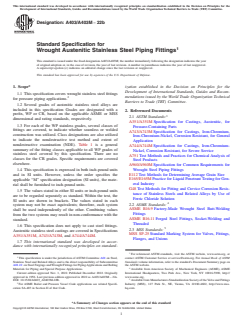
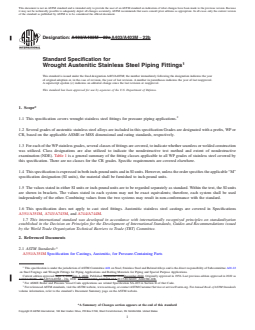
1.1 This specification covers wrought stainless steel fittings for pressure piping applications.2
1.2 Several grades of austenitic stainless steel alloys are included in this specification Grades are designated with a prefix, WP or CR, based on the applicable ASME or MSS dimensional and rating standards, respectively.
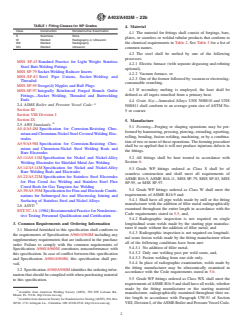
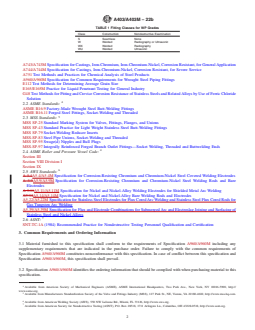
1.3 For each of the WP stainless grades, several classes of fittings are covered, to indicate whether seamless or welded construction was utilized. Class designations are also utilized to indicate the nondestructive test method and extent of nondestructive examination (NDE). Table 1 is a general summary of the fitting classes applicable to all WP grades of stainless steel covered by this specification. There are no classes for the CR grades. Specific requirements are covered elsewhere.
1.4 This specification is expressed in both inch-pound units and in SI units. However, unless the order specifies the applicable “M” specification designation (SI units), the material shall be furnished to inch-pound units.
1.5 The values stated in either SI units or inch-pound units are to be regarded separately as standard. Within the text, the SI units are shown in brackets. The values stated in each system may not be exact equivalents; therefore, each system shall be used independently of the other. Combining values from the two systems may result in non-conformance with the standard.
1.6 This specification does not apply to cast steel fittings. Austenitic stainless steel castings are covered in Specifications A351/A351M, A743/A743M, and A744/A744M.
1.7 This international standard was developed in accordance with internationally recognized principles on standardization established in the Decision on Principles for the Development of International Standards, Guides and Recommendations issued by the World Trade Organization Technical Barriers to Trade (TBT) Committee.
- Status
- Published
- Publication Date
- 31-Oct-2022
- Technical Committee
- A01 - Steel, Stainless Steel and Related Alloys
Buy Documents
ASTM A403/A403M-22b - Standard Specification for Wrought Austenitic Stainless Steel Piping Fittings
REDLINE ASTM A403/A403M-22b - Standard Specification for Wrought Austenitic Stainless Steel Piping Fittings
Overview
ASTM A403/A403M-22b: Standard Specification for Wrought Austenitic Stainless Steel Piping Fittings defines the requirements for wrought austenitic stainless steel fittings used in pressure piping applications. Developed and published by ASTM International, this standard covers fittings made from forgings, bars, plates, or seamless and welded tubular products. It specifies the manufacturing processes, material compositions, mechanical property requirements, heat treatments, and appropriate test methods to ensure the quality and performance of stainless steel piping fittings in high-pressure environments.
Key Topics
Scope and Applicability
- Covers wrought austenitic stainless steel fittings for pressure piping, not cast fittings.
- Includes seamless and welded construction, with multiple grades and classes for various applications.
- Expressed in both inch-pound and SI units.
Material and Manufacturing
- Fittings are to be manufactured from high-quality forgings, bars, plates, or tubular products.
- Forming can be achieved by hammering, pressing, rolling, welding, machining, or combinations thereof.
- All fittings must undergo solution annealing heat treatment to achieve proper corrosion resistance and mechanical properties.
Grades and Classes
- Stainless steel alloys are designated as WP (ASME standards) or CR (MSS standards) grades.
- Classes indicate manufacturing processes (seamless or welded) and type/extent of nondestructive examination (radiographic or ultrasonic).
Testing and Inspection
- Heat-treated fittings undergo rigorous chemical analysis to confirm composition requirements (carbon, chromium, nickel, etc.).
- Mechanical testing includes tension tests for properties such as yield strength and tensile strength.
- Visual examinations are required to detect surface discontinuities, with further examination and repairs as needed.
Dimensional and Quality Control
- Fittings must adhere to the dimensional standards specified in referenced ASME or MSS standards.
- Surface finish criteria are defined to ensure durability and corrosion protection.
- Hydrostatic testing is not mandatory but fittings must be capable of withstanding pressures required by their matching pipes.
Applications
ASTM A403/A403M-22b plays a critical role in industries where corrosion resistance and high mechanical strength are required for piping systems. Its main applications include:
- Chemical and Petrochemical Plants: Ensuring safe transport of corrosive fluids under pressure.
- Oil and Gas Industry: Used extensively in pipelines, refineries, and offshore platforms.
- Power Generation: Boiler, heat exchanger, and condenser piping systems.
- Pharmaceutical and Food Processing: Applications demanding high hygiene and corrosion resistance.
- Marine and Water Treatment: Piping for seawater and high-purity water systems.
By specifying the requirements for material selection, processing, and product integrity, ASTM A403/A403M-22b ensures reliable performance and safety in challenging operational environments.
Related Standards
Stakeholders often reference ASTM A403/A403M-22b alongside the following standards for comprehensive compliance:
- ASME B16.9, B16.11 - Factory-made wrought steel and forged fittings.
- ASTM A351/A351M, A743/A743M, A744/A744M - Specifications for austenitic stainless steel and iron-chromium-nickel castings.
- ASTM A960/A960M - Common requirements for wrought steel piping fittings.
- MSS SP-43, SP-79, SP-83, SP-95, SP-97 - Manufacturer’s standardization society fitting practices.
- ASME Boiler and Pressure Vessel Code (Sections III, VIII, IX) - Requirements for pressure vessel construction and welding procedures.
- AWS A5 Series - Specifications for welding consumables.
- ASTM E112, E165/E165M - Methods for grain size measurement and liquid penetrant inspection.
- ASTM A751 - Test methods for chemical analysis of steel.
Conclusion
ASTM A403/A403M-22b provides a comprehensive framework for manufacturing, testing, and certifying austenitic stainless steel piping fittings. Adherence to this standard ensures compatibility with global engineering practices, reliability under pressure, and the corrosion resistance necessary for modern industrial piping systems. For project engineers, procurement specialists, and fabricators, referencing ASTM A403/A403M-22b is essential when specifying or evaluating stainless steel fittings for critical piping applications.
Relations
- Effective Date
- 01-Nov-2019
- Effective Date
- 01-Mar-2019
- Effective Date
- 01-May-2018
- Effective Date
- 01-Nov-2017
- Effective Date
- 01-Dec-2016
- Effective Date
- 01-Jun-2016
- Refers
ASTM A351/A351M-16 - Standard Specification for Castings, Austenitic, for Pressure-Containing Parts - Effective Date
- 01-May-2016
- Effective Date
- 01-Nov-2015
- Refers
ASTM A351/A351M-15 - Standard Specification for Castings, Austenitic, for Pressure-Containing Parts - Effective Date
- 01-Sep-2015
- Effective Date
- 01-Nov-2014
- Effective Date
- 01-May-2014
- Refers
ASTM A351/A351M-14 - Standard Specification for Castings, Austenitic, for Pressure-Containing Parts - Effective Date
- 01-May-2014
- Effective Date
- 01-Mar-2014
- Effective Date
- 15-May-2013
- Refers
ASTM A351/A351M-13a - Standard Specification for Castings, Austenitic, for Pressure-Containing Parts - Effective Date
- 15-May-2013
Buy Documents
ASTM A403/A403M-22b - Standard Specification for Wrought Austenitic Stainless Steel Piping Fittings
REDLINE ASTM A403/A403M-22b - Standard Specification for Wrought Austenitic Stainless Steel Piping Fittings
Get Certified
Connect with accredited certification bodies for this standard

Institut za varilstvo d.o.o. (Welding Institute)
Slovenia's leading welding institute since 1952. ISO 3834, EN 1090, pressure equipment certification, NDT personnel, welder qualification. Only IIW Au
Sponsored listings
Frequently Asked Questions
ASTM A403/A403M-22b is a technical specification published by ASTM International. Its full title is "Standard Specification for Wrought Austenitic Stainless Steel Piping Fittings". This standard covers: ABSTRACT This specification covers the standard for wrought austenitic stainless steel fittings for pressure piping applications. The material for fittings shall consist of forgings, bars, plates, or seamless or welded tubular products. Forging or shaping operations shall be performed by hammering, pressing, piercing, extruding, upsetting, rolling, bending, fusion welding, machining, or by a combination of two or more of these operations. All fittings shall undergo heat-treatment. Chemical and product analyses shall be performed and shall conform to the required chemical composition in carbon, manganese, phosphorus, sulfur, silicon, chromium, molybdenum, and titanium. Tension test shall be done on the fitting material to determine the tensile properties such as yield strength and tensile strength. Fittings supplied under this specification shall be examined visually for surface discontinuities, surface checks, and mechanical marks. SCOPE 1.1 This specification covers wrought stainless steel fittings for pressure piping applications.2 1.2 Several grades of austenitic stainless steel alloys are included in this specification Grades are designated with a prefix, WP or CR, based on the applicable ASME or MSS dimensional and rating standards, respectively. 1.3 For each of the WP stainless grades, several classes of fittings are covered, to indicate whether seamless or welded construction was utilized. Class designations are also utilized to indicate the nondestructive test method and extent of nondestructive examination (NDE). Table 1 is a general summary of the fitting classes applicable to all WP grades of stainless steel covered by this specification. There are no classes for the CR grades. Specific requirements are covered elsewhere. 1.4 This specification is expressed in both inch-pound units and in SI units. However, unless the order specifies the applicable “M” specification designation (SI units), the material shall be furnished to inch-pound units. 1.5 The values stated in either SI units or inch-pound units are to be regarded separately as standard. Within the text, the SI units are shown in brackets. The values stated in each system may not be exact equivalents; therefore, each system shall be used independently of the other. Combining values from the two systems may result in non-conformance with the standard. 1.6 This specification does not apply to cast steel fittings. Austenitic stainless steel castings are covered in Specifications A351/A351M, A743/A743M, and A744/A744M. 1.7 This international standard was developed in accordance with internationally recognized principles on standardization established in the Decision on Principles for the Development of International Standards, Guides and Recommendations issued by the World Trade Organization Technical Barriers to Trade (TBT) Committee.
ABSTRACT This specification covers the standard for wrought austenitic stainless steel fittings for pressure piping applications. The material for fittings shall consist of forgings, bars, plates, or seamless or welded tubular products. Forging or shaping operations shall be performed by hammering, pressing, piercing, extruding, upsetting, rolling, bending, fusion welding, machining, or by a combination of two or more of these operations. All fittings shall undergo heat-treatment. Chemical and product analyses shall be performed and shall conform to the required chemical composition in carbon, manganese, phosphorus, sulfur, silicon, chromium, molybdenum, and titanium. Tension test shall be done on the fitting material to determine the tensile properties such as yield strength and tensile strength. Fittings supplied under this specification shall be examined visually for surface discontinuities, surface checks, and mechanical marks. SCOPE 1.1 This specification covers wrought stainless steel fittings for pressure piping applications.2 1.2 Several grades of austenitic stainless steel alloys are included in this specification Grades are designated with a prefix, WP or CR, based on the applicable ASME or MSS dimensional and rating standards, respectively. 1.3 For each of the WP stainless grades, several classes of fittings are covered, to indicate whether seamless or welded construction was utilized. Class designations are also utilized to indicate the nondestructive test method and extent of nondestructive examination (NDE). Table 1 is a general summary of the fitting classes applicable to all WP grades of stainless steel covered by this specification. There are no classes for the CR grades. Specific requirements are covered elsewhere. 1.4 This specification is expressed in both inch-pound units and in SI units. However, unless the order specifies the applicable “M” specification designation (SI units), the material shall be furnished to inch-pound units. 1.5 The values stated in either SI units or inch-pound units are to be regarded separately as standard. Within the text, the SI units are shown in brackets. The values stated in each system may not be exact equivalents; therefore, each system shall be used independently of the other. Combining values from the two systems may result in non-conformance with the standard. 1.6 This specification does not apply to cast steel fittings. Austenitic stainless steel castings are covered in Specifications A351/A351M, A743/A743M, and A744/A744M. 1.7 This international standard was developed in accordance with internationally recognized principles on standardization established in the Decision on Principles for the Development of International Standards, Guides and Recommendations issued by the World Trade Organization Technical Barriers to Trade (TBT) Committee.
ASTM A403/A403M-22b is classified under the following ICS (International Classification for Standards) categories: 23.040.40 - Metal fittings. The ICS classification helps identify the subject area and facilitates finding related standards.
ASTM A403/A403M-22b has the following relationships with other standards: It is inter standard links to ASTM A960/A960M-19a, ASTM A960/A960M-19, ASTM A351/A351M-18e1, ASTM A743/A743M-17, ASTM A960/A960M-16a, ASTM A960/A960M-16, ASTM A351/A351M-16, ASTM A960/A960M-15, ASTM A351/A351M-15, ASTM A960/A960M-14a, ASTM A960/A960M-14, ASTM A351/A351M-14, ASTM A751-14, ASTM A743/A743M-13a, ASTM A351/A351M-13a. Understanding these relationships helps ensure you are using the most current and applicable version of the standard.
ASTM A403/A403M-22b is available in PDF format for immediate download after purchase. The document can be added to your cart and obtained through the secure checkout process. Digital delivery ensures instant access to the complete standard document.
Standards Content (Sample)
This international standard was developed in accordance with internationally recognized principles on standardization established in the Decision on Principles for the
Development of International Standards, Guides and Recommendations issued by the World Trade Organization Technical Barriers to Trade (TBT) Committee.
Designation:A403/A403M −22b
Standard Specification for
Wrought Austenitic Stainless Steel Piping Fittings
This standard is issued under the fixed designationA403/A403M; the number immediately following the designation indicates the year
of original adoption or, in the case of revision, the year of last revision. A number in parentheses indicates the year of last reapproval.
A superscript epsilon (´) indicates an editorial change since the last revision or reapproval.
This standard has been approved for use by agencies of the U.S. Department of Defense.
1. Scope* ization established in the Decision on Principles for the
Development of International Standards, Guides and Recom-
1.1 This specification covers wrought stainless steel fittings
2 mendations issued by the World Trade Organization Technical
for pressure piping applications.
Barriers to Trade (TBT) Committee.
1.2 Several grades of austenitic stainless steel alloys are
included in this specification Grades are designated with a
2. Referenced Documents
prefix, WP or CR, based on the applicable ASME or MSS
2.1 ASTM Standards:
dimensional and rating standards, respectively.
A351/A351M Specification for Castings, Austenitic, for
1.3 For each of the WP stainless grades, several classes of
Pressure-Containing Parts
fittings are covered, to indicate whether seamless or welded
A743/A743M Specification for Castings, Iron-Chromium,
construction was utilized. Class designations are also utilized
Iron-Chromium-Nickel, Corrosion Resistant, for General
to indicate the nondestructive test method and extent of
Application
nondestructive examination (NDE). Table 1 is a general
A744/A744M Specification for Castings, Iron-Chromium-
summary of the fitting classes applicable to all WP grades of
Nickel, Corrosion Resistant, for Severe Service
stainless steel covered by this specification. There are no
A751 Test Methods and Practices for Chemical Analysis of
classes for the CR grades. Specific requirements are covered
Steel Products
elsewhere.
A960/A960M Specification for Common Requirements for
Wrought Steel Piping Fittings
1.4 This specification is expressed in both inch-pound units
E112 Test Methods for Determining Average Grain Size
and in SI units. However, unless the order specifies the
E165/E165M Practice for Liquid Penetrant Testing for Gen-
applicable “M” specification designation (SI units), the mate-
eral Industry
rial shall be furnished to inch-pound units.
G48 Test Methods for Pitting and Crevice Corrosion Resis-
1.5 The values stated in either SI units or inch-pound units
tance of Stainless Steels and Related Alloys by Use of
are to be regarded separately as standard. Within the text, the
Ferric Chloride Solution
SI units are shown in brackets. The values stated in each
2.2 ASME Standards:
system may not be exact equivalents; therefore, each system
ASME B16.9 Factory-Made Wrought Steel Butt-Welding
shall be used independently of the other. Combining values
Fittings
from the two systems may result in non-conformance with the
ASME B16.11 Forged Steel Fittings, Socket-Welding and
standard.
Threaded
1.6 This specification does not apply to cast steel fittings.
2.3 MSS Standards:
Austenitic stainless steel castings are covered in Specifications
MSS SP-25 Standard Marking System for Valves, Fittings,
A351/A351M, A743/A743M, and A744/A744M.
Flanges, and Unions
1.7 This international standard was developed in accor-
dance with internationally recognized principles on standard-
For referenced ASTM standards, visit the ASTM website, www.astm.org, or
This specification is under the jurisdiction of ASTM Committee A01 on Steel, contact ASTM Customer Service at service@astm.org. For Annual Book of ASTM
Stainless Steel and Related Alloys and is the direct responsibility of Subcommittee Standards volume information, refer to the standard’s Document Summary page on
A01.22 on SteelForgingsandWroughtFittingsforPipingApplicationsandBolting the ASTM website.
Materials for Piping and Special Purpose Applications. Available from American Society of Mechanical Engineers (ASME), ASME
Current edition approved Nov. 1, 2022. Published December 2022. Originally International Headquarters, Two Park Ave., New York, NY 10016-5990, http://
approved in 1956. Last previous edition approved in 2022 as A403/A403M – 22a. www.asme.org.
DOI: 10.1520/A0403_A0403M-22B. AvailablefromManufacturersStandardizationSocietyoftheValveandFittings
For ASME Boiler and Pressure Vessel Code applications see related Specifi- Industry (MSS), 127 Park St., NE, Vienna, VA 22180-4602, http://www.mss-
cation SA-403 in Section II of that Code. hq.com.
*A Summary of Changes section appears at the end of this standard
Copyright © ASTM International, 100 Barr Harbor Drive, PO Box C700, West Conshohocken, PA 19428-2959. United States
A403/A403M−22b
TABLE 1 Fitting Classes for WP Grades
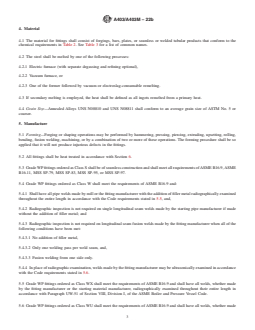
4. Material
Class Construction Nondestructive Examination
4.1 The material for fittings shall consist of forgings, bars,
S Seamless None
plates, or seamless or welded tubular products that conform to
W Welded Radiography or Ultrasonic
the chemical requirements in Table 2. See Table 3 for a list of
WX Welded Radiography
WU Welded Ultrasonic
common names.
4.2 The steel shall be melted by one of the following
processes:
MSS SP-43 Standard Practice for Light Weight Stainless
4.2.1 Electric furnace (with separate degassing and refining
Steel Butt-Welding Fittings
optional),
MSS SP-79 Socket-Welding Reducer Inserts
4.2.2 Vacuum furnace, or
MSS-SP-83 Steel Pipe Unions, Socket-Welding and
4.2.3 One of the former followed by vacuum or electroslag-
Threaded
consumable remelting.
MSS SP-95 Swage(d) Nipples and Bull Plugs
4.3 If secondary melting is employed, the heat shall be
MSS-SP-97 Integrally Reinforced Forged Branch Outlet
defined as all ingots remelted from a primary heat.
Fittings—Socket Welding, Threaded and Buttwelding
Ends
4.4 Grain Size—Annealed Alloys UNS N08810 and UNS
2.4 ASME Boiler and Pressure Vessel Code:
N08811 shall conform to an average grain size of ASTM No.
Section III
5 or coarser.
Section VIII Division I
Section IX
5. Manufacture
2.5 AWS Standards:
5.1 Forming—Forging or shaping operations may be per-
A5.4/A5.4M Specification for Corrosion-Resisting Chro-
formedbyhammering,pressing,piercing,extruding,upsetting,
miumandChromium-NickelSteelCoveredWeldingElec-
rolling, bending, fusion welding, machining, or by a combina-
trodes
tionoftwoormoreoftheseoperations.Theformingprocedure
A5.9/A5.9M Specification for Corrosion-Resisting Chro-
shall be so applied that it will not produce injurious defects in
mium and Chromium-Nickel Steel Welding Rods and
the fittings.
Bare Electrodes
5.2 All fittings shall be heat treated in accordance with
A5.11/A5.11M Specification for Nickel and Nickel-Alloy
Section 6.
Welding Electrodes for Shielded Metal Arc Welding
A5.14/A5.14M Specification for Nickel and Nickel-Alloy
5.3 Grade WP fittings ordered as Class S shall be of
Bare Welding Rods and Electrodes
seamless construction and shall meet all requirements of
A5.22/A5.22M Specification for Stainless Steel Electrodes
ASME B16.9, ASME B16.11, MSS SP-79, MSS SP-83, MSS
for Flux Cored Arc Welding and Stainless Steel Flux
SP-95, or MSS SP-97.
Cored Rods for Gas Tungsten Arc Welding
5.4 Grade WP fittings ordered as Class W shall meet the
A5.39/A5.39M Specification for Flux and Electrode Combi-
requirements of ASME B16.9 and:
nations for Submerged Arc and Electroslag Joining and
5.4.1 Shall have all pipe welds made by mill or the fitting
Surfacing of Stainless Steel and Nickel Alloys
manufacturer with the addition of filler metal radiographically
2.6 ASNT:
examined throughout the entire length in accordance with the
SNT-TC-1A (1984) Recommended Practice for Nondestruc-
Code requirements stated in 5.5, and,
tive Testing Personnel Qualification and Certification
5.4.2 Radiographic inspection is not required on single
3. Common Requirements and Ordering Information longitudinal seam welds made by the starting pipe manufac-
turer if made without the addition of filler metal; and
3.1 Material furnished to this specification shall conform to
5.4.3 Radiographic inspection is not required on longitudi-
the requirements of Specification A960/A960M including any
nal seam fusion welds made by the fitting manufacturer when
supplementary requirements that are indicated in the purchase
all of the following conditions have been met:
order. Failure to comply with the common requirements of
5.4.3.1 No addition of filler metal,
Specification A960/A960M constitutes nonconformance with
5.4.3.2 Only one welding pass per weld seam, and,
this specification. In case of conflict between this specification
5.4.3.3 Fusion welding from one side only.
and Specification A960/A960M, this specification shall pre-
5.4.4 In place of radiographic examination, welds made by
vail.
the fitting manufacturer may be ultrasonically examined in
3.2 SpecificationA960/A960Midentifiestheorderinginfor-
accordance with the Code requirements stated in 5.6.
mation that should be complied with when purchasing material
5.5 Grade WP fittings ordered as Class WX shall meet the
to this specification.
requirementsofASMEB16.9andshallhaveallwelds,whether
made by the fitting manufacturer or the starting material
Available from American Welding Society (AWS), 550 NW LeJeune Rd.,
manufacturer, radiographically examined throughout their en-
Miami, FL 33126, http://www.aws.org.
tire length in accordance with Paragraph UW-51 of Section
AvailablefromAmericanSocietyforNondestructiveTesting(ASNT),P.O.Box
28518, 1711 Arlingate Ln., Columbus, OH 43228-0518, http://www.asnt.org. VIII,DivisionI,oftheASMEBoilerandPressureVesselCode.
A403/A403M−22b
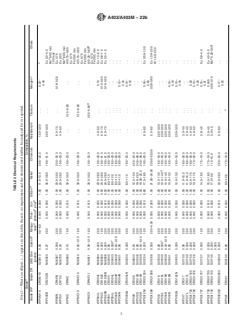
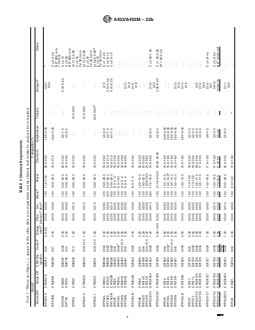
TABLE 2 Chemical Requirements
NOTE 1—Where an ellipsis (.) appears in this table, there is no requirement and the element need neither be analyzed for or reported.
A
Grade Composition, %
B B C
Grade WP Grade CR UNS Des- Carbon Manga- Phos- Sul- Silicon Nickel Chromium Molybdenum Titanium Nitrogen Others
B B B
ignation nese phorous phur
E
WPXM-19 CRXM-19 S20910 0.06 4.0–6.0 0.045 0.030 1.00 11.5–13.5 20.5–23.5 1.50–3.00 . . . 0.20–
0.40
WP20CB CR20CB N08020 0.07 2.00 0.045 0.035 1.00 32.0–38.0 19.0–21.0 2.00–3.00 . . . Cu 3.0–4.0
D
Nb 8XC min,
1.00 max
WP6XN CR6XN N08367 0.030 2.00 0.040 0.030 1.00 23.5–25.5 20.0–22.0 6.0–7.0 . . . 0.18–0.25 Cu 0.75
WP700 CR700 N08700 0.04 2.00 0.040 0.030 1.00 24.0–26.0 19.0–23.0 4.3–5.0 Cu 0.50
D
Nb 8XC min
WPNIC CRNIC N08800 0.10 1.50 0.045 0.015 1.00 30.0–35.0 19.0–23.0 . . . 0.15–0.60 . . . Al 0.15–0.60
Cu 0.75
Fe 39.5 min
WPNIC10 CRNIC10 N08810 0.05–0.10 1.50 0.045 0.015 1.00 30.0–35.0 19.0–23.0 . . . 0.15–0.60 . . . Al 0.15–0.60
Cu 0.75
Fe 39.5 min
M M
WPNIC11 CRNIC11 N08811 0.06–0.10 1.50 0.040 0.015 1.00 30.0–35.0 19.0–23.0 . . . 0.25–0.60 . . . Al 0.25–0.60
Cu 0.75
Fe 39.5 min
WP904L CR904L N08904 0.020 2.00 0.045 0.035 1.00 23.0–28.0 19.0–23.0 4.0–5.0 . . . 0.10 Cu 1.0–2.0
WP1925 CR1925 N08925 0.020 1.00 0.045 0.030 0.50 24.0–26.0 19.0–21.0 6.0–7.0 0.10–0.20 Cu 0.8–1.5
WP1925N CR1925N N08926 0.020 2.00 0.030 0.010 0.50 24.0–26.0 19.0–21.0 6.0–7.0 . . . 0.15–0.25 Cu 0.5–1.5
WP304 CR304 S30400 0.08 2.00 0.045 0.030 1.00 8.0–11.0 18.0–20.0 . . . . . . . . . . . .
F
WP304L CR304L S30403 0.030 2.00 0.045 0.030 1.00 8.0–12.0 18.0–20.0 . . . . . . . . . . . .
WP304H CR304H S30409 0.04–0.10 2.00 0.045 0.030 1.00 8.0–11.0 18.0–20.0 . . . . . . . . . . . .
WP304N CR304N S30451 0.08 2.00 0.045 0.030 1.00 8.0–11.0 18.0–20.0 . . . . . . 0.10– .
0.16
WP304LN CR304LN S30453 0.030 2.00 0.045 0.030 1.00 8.0–11.0 18.0–20.0 . . . . . . 0.10– .
0.16
WP309 CR309 S30900 0.20 2.00 0.045 0.030 1.00 12.0–15.0 22.0–24.0 . . . . . . . . . . . .
WP310S CR310S S31008 0.08 2.00 0.045 0.030 1.00 19.0–22.0 24.0–26.0 . . . . . . . . . . . .
WP310H CR310H S31009 0.04–0.10 2.00 0.045 0.030 1.00 19.00–22.0 24.0–26.0 . . . . . . . . . . . .
WPS31254 CRS31254 S31254 0.020 1.00 0.030 0.010 0.80 17.5–18.5 19.5–20.5 6.0–6.5 . . . 0.18– Cu 0.50–1.00
0.25
WPS31266 CRS31266 S31266 0.030 2.00–4.00 0.035 0.020 1.00 21.00–24.00 23.00–25.00 5.2–6.2 . . . 0.35–0.60 Cu 1.00–2.50
W 1.50–2.50
WP316 CR316 S31600 0.08 2.00 0.045 0.030 1.00 10.0–14.0 16.0–18.0 2.00–3.00 . . . . . . . . .
F G
WP316L CR316L S31603 0.030 2.00 0.045 0.030 1.00 10.0–14.0 16.0–18.0 2.00–3.00 . . . . . . . . .
WP316H CR316H S31609 0.04–0.10 2.00 0.045 0.030 1.00 10.0–14.0 16.0–18.0 2.00–3.00 . . . . . . . . .
WP316N CR316N S31651 0.08 2.00 0.045 0.030 1.00 10.0–13.0 16.0–18.0 2.00–3.00 . . . 0.10– .
0.16
WP316LN CR316LN S31653 0.030 2.00 0.045 0.030 1.00 10.0–13.0 16.0–18.0 2.00–3.00 . . . 0.10– .
0.16
WP317 CR317 S31700 0.08 2.00 0.045 0.030 1.00 11.0–15.0 18.0–20.0 3.0–4.0 . . . . . . . . .
WP317L CR317L S31703 0.030 2.00 0.045 0.030 1.00 11.0–15.0 18.0–20.0 3.0–4.0 . . . . . . . . .
WPS31725 CRS31725 S31725 0.030 2.00 0.045 0.030 1.00 13.5–17.5 18.0–20.0 4.0–5.0 . . . 0.20 . . .
WPS31726 CRS31726 S31726 0.030 2.00 0.045 0.030 1.00 13.5–17.5 17.0–20.0 4.0–5.0 . . . 0.10– .
0.20
WPS31727 CRS31727 S31727 0.030 1.00 0.030 0.030 1.00 14.5–16.5 17.5–19.0 3.8–4.5 . . . 0.15– Cu 2.8–4.0
0.21
WPS31730 CRS31730 S31730 0.030 2.00 0.040 0.010 1.00 15.0–16.5 17.0–19.0 3.0–4.0 . . . 0.045 Cu 4.0–5.0
D L
WPS31740 CRS31740 S31740 0.005- 2.00 0.045 0.030 1.00 17.0-19.0 11.0-15.0 3.0-4.5 . . . 0.06-0.15 Nb 0.20-0.50
0.020
WPS32053 CRS32053 S32053 0.030 1.00 0.030 0.010 1.00 24.0–26.0 22.0–24.0 5.0–6.0 . . . 0.17– .
0.22
H
WP321 CR321 S32100 0.08 2.00 0.045 0.030 1.00 9.0–12.0 17.0–19.0 . . . . .
A403/A403M−22b
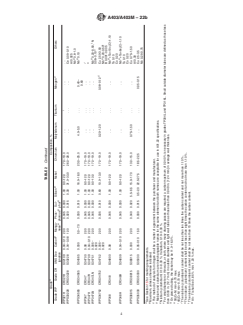
TABLE2 Continued
A
Grade Composition, %
B B C
Grade WP Grade CR UNS Des- Carbon Manga- Phos- Sul- Silicon Nickel Chromium Molybdenum Titanium Nitrogen Others
B B B
ignation nese phorous phur
I
WP321H CR321H S32109 0.04–0.10 2.00 0.045 0.030 1.00 9.0–12.0 17.0–19.0 . . . . .
WPS33228 CRS33228 S33228 0.04–0.08 1.00 0.020 0.015 0.30 31.0–33.0 26.0–28.0 . . . . . . . . . Ce 0.05–0.10
Al 0.025
D
Nb 0.6–1.0
D
WPS34565 CRS34565 S34565 0.030 5.0–7.0 0.030 0.010 1.00 16.0–18.0 23.0–25.0 4.0–5.0 . . . 0.40– Nb 0.10
0.60
J
WP347 CR347 S34700 0.08 2.00 0.045 0.030 1.00 9.0–12.0 17.0–19.0 . . . . . . . . .
K
WP347H CR347H S34709 0.04–0.10 2.00 0.045 0.030 1.00 9.0–12.0 17.0–19.0 . . . . . . . . .
D L
WP347LN CR347LN S34751 0.005– 2.00 0.045 0.030 1.00 9.0–13.0 17.0–19.0 . . . . . . . . . Nb 0.20–0.50, N
C
0.06–0.10
0.020
C
WPS34752 CRS34752 S34752 0.005– 2.00 0.035 0.010 0.60 10.0–13.0 17.0–19.0 0.20–1.20 . . . 0.06–0.12 Cu 2.50-3.50
D L
0.020 Nb 0.20-0.50
B 0.001-0.005
D
WP348 CR348 S34800 0.08 2.00 0.045 0.030 1.00 9.0–12.0 17.0–19.0 . . . . . . . . . Nb +Ta=10×(C)−1.10
Ta 0.10
Co 0.20
D
WP348H CR348H S34809 0.04–0.10 2.00 0.045 0.030 1.00 9.0–12.0 17.0–19.0 . . . . . . . . . Nb +Ta=8×(C)−1.10
Ta 0.10
Co 0.20
WPS38815 CRS38815 S38815 0.030 2.00 0.040 0.020 5.5–6.5 15.0–17.0 13.0–15.0 0.75–1.50 . . . . . . Cu 0.75–1.50
Al 0.30
WPS35030 CRS35030 S35030 0.05-0.10 1.50 0.030 0.015 0.5-2.0 22.5-27.5 18.5-22.5 . . . . . . 0.05-0.15 Cu 2.5-3.5
Nb 0.25-0.75
A
See Section 15 for marking requirements.
B
Maximum, unless otherwise indicated.
C
The method of analysis for nitrogen shall be a matter of agreement between the purchaser and manufacturer.
D
Niobium and columbium are interchangeable names for the same element and both names are acceptable for use in A01.22 specifications.
E
Niobium (columbium) 0.10–0.30 %; Vanadium, 0.10–0.30 %.
F
For small diameter or thin walls, or both, where many drawing passes are required, a carbon maximum of 0.040 % is necessary in grades TP304L and TP316L. Small outside diameter tubes are defined as those less
than 0.500 in. [12.7 mm] in outside diameter and light wall tubes as those less than 0.049 in. [1.24 mm] in average wall thickness.
G
On pierced tubing, the nickel may be 11.0–16.0 %.
H
5X(C+N) min–0.70 max.
I
4X(C+N) min–0.70 max.
J
The niobium (columbium) content shall be not less than ten times the carbon content and not more than 1.10 %.
K
The niobium (columbium) content shall be not less than eight times the carbon content and not more than 1.10 %.
L
The niobium (columbium) content shall be not less than 15 times the carbon content.
M
Al + Ti shall be 0.85 % min: 1.20 % max.
A403/A403M−22b
TABLE 3 Common Names
Section IX of the ASME Boiler and Pressure Vessel Code
A A B
Grade WP Grade CR UNS Designation Type except that starting pipe welds made without the addition of
C
WPXM-19 CRXM-19 S20910 XM-19 filler metal do not require such qualification.
WP20CB CR20CB N08020 . . .
WP6XN CR6XN N08367 . . . 5.11 All joints welded with filler metal shall be finished in
WP700 CR700 N08700 . . .
accordance with the requirements of Paragraph UW-35 (a) of
C
WPNIC CRNIC N08800 800
C Section VIII, Division I, of the ASME Boiler and Pressure
WPNIC10 CRNIC10 N08810 800H
Vessel Code.
WPNIC11 CRNIC11 N08811 . . .
C
WP904L CR904L N08904 904L
5.12 Fittings machined from bar shall be restricted to NPS 4
WP1925 CR1925 N08925 . . .
WP1925N CR1925N N08926 . . .
or smaller. Elbows, return bends, tees, and header tees shall not
WP304 CR304 S30400 304
be machined directly from bar stock.
WP304L CR304L S30403 304L
WP304H CR304H S30409 304H
5.12.1 All caps machined from bar shall be examined by
WP304N CR304N S30451 304N
liquid penetrant in accordance with Supplementary Require-
WP304LN CR304LN S30453 304LN
ment S52 in Specification A960/A960M.
WP309 CR309 S30900 309
WP310S CR310S S31008 310S
5.13 Weld buildup is permitted to dimensionally correct
WP310H CR310H S31009 310H
WPS31254 CRS31254 S31254 . . .
unfilled areas produced during forming of stub ends. Radio-
WPS31266 CRS31266 S31266 . . .
graphic examination of the weld buildup shall not be required
WP316 CR316 S31600 316
provided that all the following steps are adhered to:
WP316L CR316L S31603 316L
WP316H CR316H S31609 316H
5.13.1 The weld procedure and welders or welding opera-
WP316N CR316N S31651 316N
tors meet the requirements of 5.10.
WP316LN CR316LN S31653 316LN
WP317 CR317 S31700 317
5.13.2 Annealing is performed after welding and prior to
WP317L CR317L S31703 317L
machining.
C
WPS31725 CRS31725 S31725 317LM
C
5.13.3 All weld surfaces are liquid penetrant examined in
WPS31726 CRS31726 S31726 317LMN
WPS31727 CRS31727 S31727 . . .
accordance withAppendix 8 of Section VIII, Division 1 of the
WPS31730 CRS31730 S31730 . . .
ASME Boiler and Pressure Vessel Code.
WPS31740 CRS31740 S31740 317LNCb
WPS32053 CRS32053 S32053 . . .
5.13.4 Repair of areas in the weld is permitted, but 5.13.1,
WP321 CR321 S32100 321
5.13.2, and 5.13.3 must be repeated.
WP321H CR321H S32109 321H
WPS33228 CRS33228 S33228 . . .
5.14 Stubendsmaybeproducedwiththeentirelapaddedas
WPS34565 CRS34565 S34565 . . .
weld metal to a straight pipe section provided the welding
WP347 CR347 S34700 347
WP347H CR347H S34709 347H satisfies the requirements of 5.10 for qualifications and Section
WP347LN CR347LN S34751 347LN
6 for post weld heat treatment.
WPS34752 CRS34752 S34752 . . .
WP348 CR348 S34800 348 5.14.1 Grade WP Class W—Radiographic inspection of the
WP348H CR348H S34809 348H
weld is required. See 5.4.
WPS38815 CRS38815 S38815 . . .
5.14.2 GradeWPClassWX—Radiographicinspectionofall
WPS35030 CRS35030 S35030 . . .
welds is required. See 5.5.
A
Naming system developed and applied by ASTM International.
B
Unless otherwise indicated, a grade designation originally assigned by the
5.14.3 Grade WP Class WU—Ultrasonic inspection of all
American Iron and Steel Institute (AISI).
welds is required. See 5.6.
C
Common name, not a trademark widely used, not associated with any one
producer. 5.14.4 Grade CR—Nondestructive examination is not re-
quired. See 5.12.1.
5.15 Stub ends may be produced with the entire lap added
by the welding of a ring, made from plate or bar of the same
5.6 Grade WP fittings ordered as Class WU shall meet the
alloygradeandcomposition,totheoutsideofastraightsection
requirementsofASMEB16.9andshallhaveallwelds,whether
of pipe, provided the weld is double welded, is a full
made by the fitting manufacturer or the starting material
penetration joint, satisfies the requirements of 5.10 for quali-
manufacturer, ultrasonically examined throughout their entire
fications and Section 6 for post weld heat treatment.
length in accordance with Appendix 12 of Section VIII,
Division 1 of ASME Boiler and Pressure Vessel Code. 5.15.1 Grade WP Class W—Radiographic inspection of the
welds, made with the addition of filler metal, is required (see
5.7 The radiography or ultrasonic examination of welds for
5.4).
this class of fittings may be done at the option of the
5.15.2 GradeWPClassWX—Radiographicinspectionofall
manufacturer, either prior to or after forming.
welds, made with or without the addition of filler metal, is
5.8 Personnel performing NDE examinations shall be quali-
required (see 5.5).
fied in accordance with SNT-TC-1A.
5.15.3 Grade WP Class WU—Ultrasonic inspection of all
5.9 Grade CR fittings shall meet the requirements of MSS
welds, made with or without the addition of filler metal, is
SP-43 and do not require nondestructive examination.
required (see 5.6).
5.10 All fittings shall have the welders, welding operators, 5.15.4 GradeCRnondestructiveexaminationisnotrequired
and welding procedures qualified under the provisions of (see 5.9).
A403/A403M−22b
5.16 After final heat treatment, all “H-Grade” steel fittings required for solution annealing; in-process heat treatments are
shall have a grain size of 7 or coarser in accordance with Test not permitted as a substitute for the separate solution annealing
Methods E112. treatments. The heat-treat procedure, except for those grades
listed in 6.2, shall consist of solution annealing the fittings at
6. Heat Treatment
the temperatures listed for each grade in Table 4 until the
6.1 All fittings shall be furnished in the heat-treated condi- chromium carbides go into solution, and then cooling at a
tion. For H grades, separate solution heat treatments are sufficient rate to prevent reprecipitation.
TABLE 4 Heat Treatment
Grade Grade UNS Designation Solution Anneal Quench Media
A A B
WP CR Temperature, min °F [°C]
WPXM-19 CRXM-19 S20910 1900 [1040] water or other rapid cool
WP20CB CR20CB N08020 1700–1850 water or other rapid cool
[927–1010]
WP6XN CR6XN N08367 2025 [1107] water or other rapid cool
WP700 CR700 N08700 2025–2100 water or other rapid cool
[1107–1150]
WPNIC CRNIC N08800 1800–1900 water or other rapid cool
C
[983–1038]
WPNIC10 CRNIC10 N08810 2100–2150 water or other rapid cool
C
[1147–1177]
WPNIC11 CRNIC11 N08811 2100–2150 water or other rapid cool
C
[1147–1177]
WP904L CR904L N08904 1985–2100 water or other rapid cool
[1085–1150]
WP1925 CR1925 N08925 1800–1900 water or other rapid cool
[983–1038]
WP1925N CR1925N N08926 2150 [1177] water or other rapid cool
WP304 CR304 S30400
...
This document is not an ASTM standard and is intended only to provide the user of an ASTM standard an indication of what changes have been made to the previous version. Because
it may not be technically possible to adequately depict all changes accurately, ASTM recommends that users consult prior editions as appropriate. In all cases only the current version
of the standard as published by ASTM is to be considered the official document.
Designation: A403/A403M − 22a A403/A403M − 22b
Standard Specification for
Wrought Austenitic Stainless Steel Piping Fittings
This standard is issued under the fixed designation A403/A403M; the number immediately following the designation indicates the year
of original adoption or, in the case of revision, the year of last revision. A number in parentheses indicates the year of last reapproval.
A superscript epsilon (´) indicates an editorial change since the last revision or reapproval.
This standard has been approved for use by agencies of the U.S. Department of Defense.
1. Scope*
1.1 This specification covers wrought stainless steel fittings for pressure piping applications.
1.2 Several grades of austenitic stainless steel alloys are included in this specification Grades are designated with a prefix, WP or
CR, based on the applicable ASME or MSS dimensional and rating standards, respectively.
1.3 For each of the WP stainless grades, several classes of fittings are covered, to indicate whether seamless or welded construction
was utilized. Class designations are also utilized to indicate the nondestructive test method and extent of nondestructive
examination (NDE). Table 1 is a general summary of the fitting classes applicable to all WP grades of stainless steel covered by
this specification. There are no classes for the CR grades. Specific requirements are covered elsewhere.
1.4 This specification is expressed in both inch-pound units and in SI units. However, unless the order specifies the applicable “M”
specification designation (SI units), the material shall be furnished to inch-pound units.
1.5 The values stated in either SI units or inch-pound units are to be regarded separately as standard. Within the text, the SI units
are shown in brackets. The values stated in each system may not be exact equivalents; therefore, each system shall be used
independently of the other. Combining values from the two systems may result in non-conformance with the standard.
1.6 This specification does not apply to cast steel fittings. Austenitic stainless steel castings are covered in Specifications
A351/A351M, A743/A743M, and A744/A744M.
1.7 This international standard was developed in accordance with internationally recognized principles on standardization
established in the Decision on Principles for the Development of International Standards, Guides and Recommendations issued
by the World Trade Organization Technical Barriers to Trade (TBT) Committee.
2. Referenced Documents
2.1 ASTM Standards:
A351/A351M Specification for Castings, Austenitic, for Pressure-Containing Parts
This specification is under the jurisdiction of ASTM Committee A01 on Steel, Stainless Steel and Related Alloys and is the direct responsibility of Subcommittee A01.22
on Steel Forgings and Wrought Fittings for Piping Applications and Bolting Materials for Piping and Special Purpose Applications.
Current edition approved Sept. 1, 2022Nov. 1, 2022. Published September 2022December 2022. Originally approved in 1956. Last previous edition approved in 2022 as
A403/A403M – 22.A403/A403M – 22a. DOI: 10.1520/A0403_A0403M-22A.10.1520/A0403_A0403M-22B.
For ASME Boiler and Pressure Vessel Code applications see related Specification SA-403 in Section II of that Code.
For referenced ASTM standards, visit the ASTM website, www.astm.org, or contact ASTM Customer Service at service@astm.org. For Annual Book of ASTM Standards
volume information, refer to the standard’s Document Summary page on the ASTM website.
*A Summary of Changes section appears at the end of this standard
Copyright © ASTM International, 100 Barr Harbor Drive, PO Box C700, West Conshohocken, PA 19428-2959. United States
A403/A403M − 22b
TABLE 1 Fitting Classes for WP Grades
Class Construction Nondestructive Examination
S Seamless None
W Welded Radiography or Ultrasonic
WX Welded Radiography
WU Welded Ultrasonic
A743/A743M Specification for Castings, Iron-Chromium, Iron-Chromium-Nickel, Corrosion Resistant, for General Application
A744/A744M Specification for Castings, Iron-Chromium-Nickel, Corrosion Resistant, for Severe Service
A751 Test Methods and Practices for Chemical Analysis of Steel Products
A960/A960M Specification for Common Requirements for Wrought Steel Piping Fittings
E112 Test Methods for Determining Average Grain Size
E165/E165M Practice for Liquid Penetrant Testing for General Industry
G48 Test Methods for Pitting and Crevice Corrosion Resistance of Stainless Steels and Related Alloys by Use of Ferric Chloride
Solution
2.2 ASME Standards:
ASME B16.9 Factory-Made Wrought Steel Butt-Welding Fittings
ASME B16.11 Forged Steel Fittings, Socket-Welding and Threaded
2.3 MSS Standards:
MSS SP-25 Standard Marking System for Valves, Fittings, Flanges, and Unions
MSS SP-43 Standard Practice for Light Weight Stainless Steel Butt-Welding Fittings
MSS SP-79 Socket-Welding Reducer Inserts
MSS-SP-83 Steel Pipe Unions, Socket-Welding and Threaded
MSS SP-95 Swage(d) Nipples and Bull Plugs
MSS-SP-97 Integrally Reinforced Forged Branch Outlet Fittings—Socket Welding, Threaded and Buttwelding Ends
2.4 ASME Boiler and Pressure Vessel Code:
Section III
Section VIII Division I
Section IX
2.5 AWS Standards:
A 5.4A5.4/A5.4M Specification for Corrosion-Resisting Chromium and Chromium-Nickel Steel Covered Welding Electrodes
A 5.9A5.9/A5.9M Specification for Corrosion-Resisting Chromium and Chromium-Nickel Steel Welding Rods and Bare
Electrodes
A 5.11A5.11/A5.11M Specification for Nickel and Nickel-Alloy Welding Electrodes for Shielded Metal Arc Welding
A5.14A5.14/A5.14M Specification for Nickel and Nickel-Alloy Bare Welding Rods and Electrodes
A5.22/A5.22M Specification for Stainless Steel Electrodes for Flux Cored Arc Welding and Stainless Steel Flux Cored Rods for
Gas Tungsten Arc Welding
A5.39/A5.39M Specification for Flux and Electrode Combinations for Submerged Arc and Electroslag Joining and Surfacing of
Stainless Steel and Nickel Alloys
2.6 ASNT:
SNT-TC-1A (1984) Recommended Practice for Nondestructive Testing Personnel Qualification and Certification
3. Common Requirements and Ordering Information
3.1 Material furnished to this specification shall conform to the requirements of Specification A960/A960M including any
supplementary requirements that are indicated in the purchase order. Failure to comply with the common requirements of
Specification A960/A960M constitutes nonconformance with this specification. In case of conflict between this specification and
Specification A960/A960M, this specification shall prevail.
3.2 Specification A960/A960M identifies the ordering information that should be complied with when purchasing material to this
specification.
Available from American Society of Mechanical Engineers (ASME), ASME International Headquarters, Two Park Ave., New York, NY 10016-5990, http://
www.asme.org.
Available from Manufacturers Standardization Society of the Valve and Fittings Industry (MSS), 127 Park St., NE, Vienna, VA 22180-4602, http://www.mss-hq.com.
Available from American Welding Society (AWS), 550 NW LeJeune Rd., Miami, FL 33126, http://www.aws.org.
Available from American Society for Nondestructive Testing (ASNT), P.O. Box 28518, 1711 Arlingate Ln., Columbus, OH 43228-0518, http://www.asnt.org.
A403/A403M − 22b
4. Material
4.1 The material for fittings shall consist of forgings, bars, plates, or seamless or welded tubular products that conform to the
chemical requirements in Table 2. See Table 3 for a list of common names.
4.2 The steel shall be melted by one of the following processes:
4.2.1 Electric furnace (with separate degassing and refining optional),
4.2.2 Vacuum furnace, or
4.2.3 One of the former followed by vacuum or electroslag-consumable remelting.
4.3 If secondary melting is employed, the heat shall be defined as all ingots remelted from a primary heat.
4.4 Grain Size—Annealed Alloys UNS N08810 and UNS N08811 shall conform to an average grain size of ASTM No. 5 or
coarser.
5. Manufacture
5.1 Forming—Forging or shaping operations may be performed by hammering, pressing, piercing, extruding, upsetting, rolling,
bending, fusion welding, machining, or by a combination of two or more of these operations. The forming procedure shall be so
applied that it will not produce injurious defects in the fittings.
5.2 All fittings shall be heat treated in accordance with Section 6.
5.3 Grade WP fittings ordered as Class S shall be of seamless construction and shall meet all requirements of ASME B16.9, ASME
B16.11, MSS SP-79, MSS SP-83, MSS SP-95, or MSS SP-97.
5.4 Grade WP fittings ordered as Class W shall meet the requirements of ASME B16.9 and:
5.4.1 Shall have all pipe welds made by mill or the fitting manufacturer with the addition of filler metal radiographically examined
throughout the entire length in accordance with the Code requirements stated in 5.5, and,
5.4.2 Radiographic inspection is not required on single longitudinal seam welds made by the starting pipe manufacturer if made
without the addition of filler metal; and
5.4.3 Radiographic inspection is not required on longitudinal seam fusion welds made by the fitting manufacturer when all of the
following conditions have been met:
5.4.3.1 No addition of filler metal,
5.4.3.2 Only one welding pass per weld seam, and,
5.4.3.3 Fusion welding from one side only.
5.4.4 In place of radiographic examination, welds made by the fitting manufacturer may be ultrasonically examined in accordance
with the Code requirements stated in 5.6.
5.5 Grade WP fittings ordered as Class WX shall meet the requirements of ASME B16.9 and shall have all welds, whether made
by the fitting manufacturer or the starting material manufacturer, radiographically examined throughout their entire length in
accordance with Paragraph UW-51 of Section VIII, Division I, of the ASME Boiler and Pressure Vessel Code.
5.6 Grade WP fittings ordered as Class WU shall meet the requirements of ASME B16.9 and shall have all welds, whether made
A403/A403M − 22b
TABLE 2 Chemical Requirements
NOTE 1—Where an ellipsis (.) appears in this table, there is no requirement and the element need neither be analyzed for or reported.
A
Grade Composition, %
B B C
Grade WP Grade CR UNS Des- Carbon Manga- Phos- Sul- Silicon Nickel Chromium Molybdenum Titanium Nitrogen Others
B B B
ignation nese phorous phur
E
WPXM-19 CRXM-19 S20910 0.06 4.0–6.0 0.045 0.030 1.00 11.5–13.5 20.5–23.5 1.50–3.00 . . . 0.20–
0.40
WP20CB CR20CB N08020 0.07 2.00 0.045 0.035 1.00 32.0–38.0 19.0–21.0 2.00–3.00 . . . Cu 3.0–4.0
D
Nb 8XC min,
1.00 max
WP6XN CR6XN N08367 0.030 2.00 0.040 0.030 1.00 23.5–25.5 20.0–22.0 6.0–7.0 . . . 0.18–0.25 Cu 0.75
WP700 CR700 N08700 0.04 2.00 0.040 0.030 1.00 24.0–26.0 19.0–23.0 4.3–5.0 Cu 0.50
D
Nb 8XC min
WPNIC CRNIC N08800 0.10 1.50 0.045 0.015 1.00 30.0–35.0 19.0–23.0 . . . 0.15–0.60 . . . Al 0.15–0.60
Cu 0.75
Fe 39.5 min
WPNIC10 CRNIC10 N08810 0.05–0.10 1.50 0.045 0.015 1.00 30.0–35.0 19.0–23.0 . . . 0.15–0.60 . . . Al 0.15–0.60
Cu 0.75
Fe 39.5 min
M M
WPNIC11 CRNIC11 N08811 0.06–0.10 1.50 0.040 0.015 1.00 30.0–35.0 19.0–23.0 . . . 0.25–0.60 . . . Al 0.25–0.60
Cu 0.75
Fe 39.5 min
WP904L CR904L N08904 0.020 2.00 0.045 0.035 1.00 23.0–28.0 19.0–23.0 4.0–5.0 . . . 0.10 Cu 1.0–2.0
WP1925 CR1925 N08925 0.020 1.00 0.045 0.030 0.50 24.0–26.0 19.0–21.0 6.0–7.0 0.10–0.20 Cu 0.8–1.5
WP1925N CR1925N N08926 0.020 2.00 0.030 0.010 0.50 24.0–26.0 19.0–21.0 6.0–7.0 . . . 0.15–0.25 Cu 0.5–1.5
WP304 CR304 S30400 0.08 2.00 0.045 0.030 1.00 8.0–11.0 18.0–20.0 . . . . . . . . . . . .
F
WP304L CR304L S30403 0.030 2.00 0.045 0.030 1.00 8.0–12.0 18.0–20.0 . . . . . . . . . . . .
WP304H CR304H S30409 0.04–0.10 2.00 0.045 0.030 1.00 8.0–11.0 18.0–20.0 . . . . . . . . . . . .
WP304N CR304N S30451 0.08 2.00 0.045 0.030 1.00 8.0–11.0 18.0–20.0 . . . . . . 0.10– . . .
0.16
WP304LN CR304LN S30453 0.030 2.00 0.045 0.030 1.00 8.0–11.0 18.0–20.0 . . . . . . 0.10– . . .
0.16
WP309 CR309 S30900 0.20 2.00 0.045 0.030 1.00 12.0–15.0 22.0–24.0 . . . . . . . . . . . .
WP310S CR310S S31008 0.08 2.00 0.045 0.030 1.00 19.0–22.0 24.0–26.0 . . . . . . . . . . . .
WP310H CR310H S31009 0.04–0.10 2.00 0.045 0.030 1.00 19.00–22.0 24.0–26.0 . . . . . . . . . . . .
WPS31254 CRS31254 S31254 0.020 1.00 0.030 0.010 0.80 17.5–18.5 19.5–20.5 6.0–6.5 . . . 0.18– Cu 0.50–1.00
0.25
WPS31266 CRS31266 S31266 0.030 2.00–4.00 0.035 0.020 1.00 21.00–24.00 23.00–25.00 5.2–6.2 . . . 0.35–0.60 Cu 1.00–2.50
W 1.50–2.50
WP316 CR316 S31600 0.08 2.00 0.045 0.030 1.00 10.0–14.0 16.0–18.0 2.00–3.00 . . . . . . . . .
F G
WP316L CR316L S31603 0.030 2.00 0.045 0.030 1.00 10.0–14.0 16.0–18.0 2.00–3.00 . . . . . . . . .
WP316H CR316H S31609 0.04–0.10 2.00 0.045 0.030 1.00 10.0–14.0 16.0–18.0 2.00–3.00 . . . . . . . . .
WP316N CR316N S31651 0.08 2.00 0.045 0.030 1.00 10.0–13.0 16.0–18.0 2.00–3.00 . . . 0.10– . . .
0.16
WP316LN CR316LN S31653 0.030 2.00 0.045 0.030 1.00 10.0–13.0 16.0–18.0 2.00–3.00 . . . 0.10– . . .
0.16
WP317 CR317 S31700 0.08 2.00 0.045 0.030 1.00 11.0–15.0 18.0–20.0 3.0–4.0 . . . . . . . . .
WP317L CR317L S31703 0.030 2.00 0.045 0.030 1.00 11.0–15.0 18.0–20.0 3.0–4.0 . . . . . . . . .
WPS31725 CRS31725 S31725 0.030 2.00 0.045 0.030 1.00 13.5–17.5 18.0–20.0 4.0–5.0 . . . 0.20 . . .
WPS31726 CRS31726 S31726 0.030 2.00 0.045 0.030 1.00 13.5–17.5 17.0–20.0 4.0–5.0 . . . 0.10– . . .
0.20
WPS31727 CRS31727 S31727 0.030 1.00 0.030 0.030 1.00 14.5–16.5 17.5–19.0 3.8–4.5 . . . 0.15– Cu 2.8–4.0
0.21
WPS31730 CRS31730 S31730 0.030 2.00 0.040 0.010 1.00 15.0–16.5 17.0–19.0 3.0–4.0 . . . 0.045 Cu 4.0–5.0
D L
WPS31740 CRS31740 S31740 0.005- 2.00 0.045 0.030 1.00 17.0-19.0 11.0-15.0 3.0-4.5 . . . 0.06-0.15 Nb 0.20-0.50
0.020
WPS32053 CRS32053 S32053 0.030 1.00 0.030 0.010 1.00 24.0–26.0 22.0–24.0 5.0–6.0 . . . 0.17– . . .
0.22
H
WP321 CR321 S32100 0.08 2.00 0.045 0.030 1.00 9.0–12.0 17.0–19.0 . . . . . . . . .
A403/A403M − 22b
TABLE 2 Continued
A
Grade Composition, %
B B C
Grade WP Grade CR UNS Des- Carbon Manga- Phos- Sul- Silicon Nickel Chromium Molybdenum Titanium Nitrogen Others
B B B
ignation nese phorous phur
I
WP321H CR321H S32109 0.04–0.10 2.00 0.045 0.030 1.00 9.0–12.0 17.0–19.0 . . . . . . . . .
WPS33228 CRS33228 S33228 0.04–0.08 1.00 0.020 0.015 0.30 31.0–33.0 26.0–28.0 . . . . . . . . . Ce 0.05–0.10
Al 0.025
D
Nb 0.6–1.0
D
WPS34565 CRS34565 S34565 0.030 5.0–7.0 0.030 0.010 1.00 16.0–18.0 23.0–25.0 4.0–5.0 . . . 0.40– Nb 0.10
0.60
J
WP347 CR347 S34700 0.08 2.00 0.045 0.030 1.00 9.0–12.0 17.0–19.0 . . . . . . . . .
K
WP347H CR347H S34709 0.04–0.10 2.00 0.045 0.030 1.00 9.0–12.0 17.0–19.0 . . . . . . . . .
D L
WP347LN CR347LN S34751 0.005– 2.00 0.045 0.030 1.00 9.0–13.0 17.0–19.0 . . . . . . . . . Nb 0.20–0.50, N
C
0.06–0.10
0.020
C
WPS34752 CRS34752 S34752 0.005– 2.00 0.035 0.010 0.60 10.0–13.0 17.0–19.0 0.20–1.20 . . . 0.06–0.12 Cu 2.50-3.50
D L
0.020 Nb 0.20-0.50
B 0.001-0.005
D
WP348 CR348 S34800 0.08 2.00 0.045 0.030 1.00 9.0–12.0 17.0–19.0 . . . . . . . . . Nb +Ta=10×(C)−1.10
Ta 0.10
Co 0.20
D
WP348H CR348H S34809 0.04–0.10 2.00 0.045 0.030 1.00 9.0–12.0 17.0–19.0 . . . . . . . . . Nb +Ta=8×(C)−1.10
Ta 0.10
Co 0.20
WPS38815 CRS38815 S38815 0.030 2.00 0.040 0.020 5.5–6.5 15.0–17.0 13.0–15.0 0.75–1.50 . . . . . . Cu 0.75–1.50
Al 0.30
WPS35030 CRS35030 S35030 0.05-0.10 1.50 0.030 0.015 0.5-2.0 22.5-27.5 18.5-22.5 . . . . . . 0.05-0.15 Cu 2.5-3.5
Nb 0.25-0.75
A
See Section 15 for marking requirements.
B
Maximum, unless otherwise indicated.
C
The method of analysis for nitrogen shall be a matter of agreement between the purchaser and manufacturer.
D
Niobium and columbium are interchangeable names for the same element and both names are acceptable for use in A01.22 specifications.
E
Niobium (columbium) 0.10–0.30 %; Vanadium, 0.10–0.30 %.
F
For small diameter or thin walls, or both, where many drawing passes are required, a carbon maximum of 0.040 % is necessary in grades TP304L and TP316L. Small outside diameter tubes are defined as those less
than 0.500 in. [12.7 mm] in outside diameter and light wall tubes as those less than 0.049 in. [1.24 mm] in average wall thickness.
G
On pierced tubing, the nickel may be 11.0–16.0 %.
H
5X(C+N) min–0.70 max.
I
4X(C+N) min–0.70 max.
J
The niobium (columbium) content shall be not less than ten times the carbon content and not more than 1.10 %.
K
The niobium (columbium) content shall be not less than eight times the carbon content and not more than 1.10 %.
L
The niobium (columbium) content shall be not less than 15 times the carbon content.
M
Al + Ti shall be 0.85 % min: 1.20 % max.
A403/A403M − 22b
TABLE 3 Common Names
A A B
Grade WP Grade CR UNS Designation Type
C
WPXM-19 CRXM-19 S20910 XM-19
WP20CB CR20CB N08020 . . .
WP6XN CR6XN N08367 . . .
WP700 CR700 N08700 . . .
C
WPNIC CRNIC N08800 800
C
WPNIC10 CRNIC10 N08810 800H
WPNIC11 CRNIC11 N08811 . . .
C
WP904L CR904L N08904 904L
WP1925 CR1925 N08925 . . .
WP1925N CR1925N N08926 . . .
WP304 CR304 S30400 304
WP304L CR304L S30403 304L
WP304H CR304H S30409 304H
WP304N CR304N S30451 304N
WP304LN CR304LN S30453 304LN
WP309 CR309 S30900 309
WP310S CR310S S31008 310S
WP310H CR310H S31009 310H
WPS31254 CRS31254 S31254 . . .
WPS31266 CRS31266 S31266 . . .
WP316 CR316 S31600 316
WP316L CR316L S31603 316L
WP316H CR316H S31609 316H
WP316N CR316N S31651 316N
WP316LN CR316LN S31653 316LN
WP317 CR317 S31700 317
WP317L CR317L S31703 317L
C
WPS31725 CRS31725 S31725 317LM
C
WPS31726 CRS31726 S31726 317LMN
WPS31727 CRS31727 S31727 . . .
WPS31730 CRS31730 S31730 . . .
WPS31740 CRS31740 S31740 317LNCb
WPS32053 CRS32053 S32053 . . .
WP321 CR321 S32100 321
WP321H CR321H S32109 321H
WPS33228 CRS33228 S33228 . . .
WPS34565 CRS34565 S34565 . . .
WP347 CR347 S34700 347
WP347H CR347H S34709 347H
WP347LN CR347LN S34751 347LN
WPS34752 CRS34752 S34752 . . .
WP348 CR348 S34800 348
WP348H CR348H S34809 348H
WPS38815 CRS38815 S38815 . . .
WPS35030 CRS35030 S35030 . . .
A
Naming system developed and applied by ASTM International.
B
Unless otherwise indicated, a grade designation originally assigned by the
American Iron and Steel Institute (AISI).
C
Common name, not a trademark widely used, not associated with any one
producer.
by the fitting manufacturer or the starting material manufacturer, ultrasonically examined throughout their entire length in
accordance with Appendix 12 of Section VIII, Division 1 of ASME Boiler and Pressure Vessel Code.
5.7 The radiography or ultrasonic examination of welds for this class of fittings may be done at the option of the manufacturer,
either prior to or after forming.
5.8 Personnel performing NDE examinations shall be qualified in accordance with SNT-TC-1A.
5.9 Grade CR fittings shall meet the requirements of MSS SP-43 and do not require nondestructive examination.
5.10 All fittings shall have the welders, welding operators, and welding procedures qualified under the provisions of Section IX
of the ASME Boiler and Pressure Vessel Code except that starting pipe welds made without the addition of filler metal do not
require such qualification.
A403/A403M − 22b
5.11 All joints welded with filler metal shall be finished in accordance with the requirements of Paragraph UW-35 (a) of Section
VIII, Division I, of the ASME Boiler and Pressure Vessel Code.
5.12 Fittings machined from bar shall be restricted to NPS 4 or smaller. Elbows, return bends, tees, and header tees shall not be
machined directly from bar stock.
5.12.1 All caps machined from bar shall be examined by liquid penetrant in accordance with Supplementary Requirement S52 in
Specification A960/A960M.
5.13 Weld buildup is permitted to dimensionally correct unfilled areas produced during forming of stub ends. Radiographic
examination of the weld buildup shall not be required provided that all the following steps are adhered to:
5.13.1 The weld procedure and welders or welding operators meet the requirements of 5.10.
5.13.2 Annealing is performed after welding and prior to machining.
5.13.3 All weld surfaces are liquid penetrant examined in accordance with Appendix 8 of Section VIII, Division 1 of the ASME
Boiler and Pressure Vessel Code.
5.13.4 Repair of areas in the weld is permitted, but 5.13.1, 5.13.2, and 5.13.3 must be repeated.
5.14 Stub ends may be produced with the entire lap added as weld metal to a straight pipe section provided the welding satisfies
the requirements of 5.10 for qualifications and Section 6 for post weld heat treatment.
5.14.1 Grade WP Class W—Radiographic inspection of the weld is required. See 5.4.
5.14.2 Grade WP Class WX—Radiographic inspection of all welds is required. See 5.5.
5.14.3 Grade WP Class WU—Ultrasonic inspection of all welds is required. See 5.6.
5.14.4 Grade CR—Nondestructive examination is not required. See 5.12.1.
5.15 Stub ends may be produced with the entire lap added by the welding of a ring, made from plate or bar of the same alloy grade
and composition, to the outside of a straight section of pipe, provided the weld is double welded, is a full penetration joint, satisfies
the requirements of 5.10 for qualifications and Section 6 for post weld heat treatment.
5.15.1 Grade WP Class W—Radiographic inspection of the welds, made with the addition of filler metal, is required (see 5.4).
5.15.2 Grade WP Class WX—Radiographic inspection of all welds, made with or without the addition of filler metal, is required
(see 5.5).
5.15.3 Grade WP Class WU—Ultrasonic inspection of all welds, made with or without the addition of filler metal, is required (see
5.6).
5.15.4 Grade CR nondestructive examination is not required (see 5.9).
5.16 After final heat treatment, all “H-Grade” steel fittings shall have a grain size of 7 or coarser in accordance with Test Methods
E112.
6. Heat Treatment
6.1 All fittings shall be furnished in the heat-treated condition. For H grades, separate solution heat treatments are required for
solution annealing; in-process heat treatments are not permitted as a substitute for the separate solution annealing treatments. The
A403/A403M − 22b
heat-treat procedure, except for those grades listed in 6.2, shall consist of solution annealing the fittings at the temperatures listed
for each grade in Table 4 until the chromium carbides go into solution, and then cooling at a sufficient rate to prevent
reprecipitation.
6.2 A solution annealing temperature above 1950 °F [1065 °C] may impair the resistance to intergranular corrosion after
subsequent exposure to sensitizing conditions in 321, 321H, 347, and 347H. When specified by the purchaser a lower temperature
stabilizing treatment or a second solution anneal shall be used subsequent to the initial high-temperature solution anneal (see
Supplementary Requirement S2).
TABLE 4 Heat Treatment
Grade Grade UNS Designation Solution Anneal Quench Media
A A B
WP CR Temperature, min °F [°C]
WPXM-19 CRXM-19 S20910 1900 [1040] water or other rapid cool
WP20CB CR20CB N08020 1700–1850 water or other rapid cool
[927–1010]
WP6XN CR6XN N08367 2025 [1107] water or other rapid cool
WP700 CR700 N08700 2025–2100 water or other rapid cool
[1107–1150]
WPNIC CRNIC N08800 1800–1900 water or other rapid cool
C
[983–1038]
WPNIC10 CRNIC10 N08810 2100–2150 water or other rapid cool
C
[1147–1177]
WPNIC11 CRNIC11 N08811 2100–2150 water or other rapid cool
C
[1147–1177]
WP904L CR904L N08904 1985–2100 water or other rapid cool
[1085–1150]
WP1925 CR1925 N08925 1800–1900 water or other rapid cool
[983–1038]
WP1925N CR1925N N08926 2150 [1177] water or other rapid cool
WP304 CR304 S30400 1900 [1040] water or other rapid cool
WP304L CR304L S30403 1900 [1040] water or other rapid cool
WP304H CR304H S30409 1900 [1040] water or other rapid cool
WP304N CR304N S30451 1900 [1040] water or other rapid cool
WP304LN CR304LN S30453 1900 [1040] water or other rapid cool
WP309 CR309 S30900 1900 [1040] water or other rapid cool
WP310S CR310S S31008 1900 [1040] water or other rapid cool
WP310H CR310H S31009 1900 [1040] water or other rapid cool
WPS31254 CR31254 S31254 2100 [1150] water or other rapid cool
WPS31266 CRS31266 S31266 2100 [1150] water or other rapid cool
WP316 CR316 S31600 1900 [1040] water or other rapid cool
WP316L CR316L S31603 1900 [1040] water or other rapid cool
WP316H CR316H S31609 1900 [10
...