

ASTM A473-23a
(Specification)Standard Specification for Stainless Steel Forgings
General Information
- Abstract
ABSTRACT
This specification covers austenitic, austenitic-ferritic, ferritic, and martensitic stainless steel forgings for general use, and for low- or high-temperature service. The different solution heat treatment and annealing treatment received by the steel material are presented in details. The steel shall conform to the specified chemical composition and room temperature mechanical requirements. The forgings shall be produced with prolongations for testing, unless otherwise specified. The number of and procedure for tension test for forgings depending on their weight are presented. The tension test specimens shall be taken from the test prolongations or from the forgings.
SCOPE
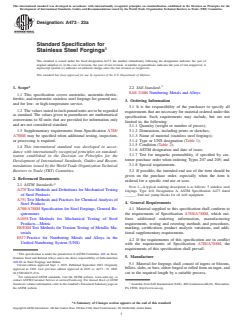
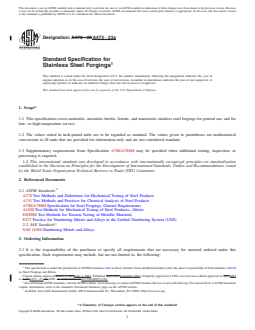
1.1 This specification covers austenitic, austenitic-ferritic, ferritic, and martensitic stainless steel forgings for general use, and for low- or high-temperature service.
1.2 The values stated in inch-pound units are to be regarded as standard. The values given in parentheses are mathematical conversions to SI units that are provided for information only and are not considered standard.
1.3 Supplementary requirements from Specification A788/A788M may be specified when additional testing, inspection, or processing is required.
1.4 This international standard was developed in accordance with internationally recognized principles on standardization established in the Decision on Principles for the Development of International Standards, Guides and Recommendations issued by the World Trade Organization Technical Barriers to Trade (TBT) Committee.
- Status
- Published
- Publication Date
- 31-Aug-2023
- Technical Committee
- A01 - Steel, Stainless Steel and Related Alloys
- Drafting Committee
- A01.06 - Steel Forgings and Billets
Overview
ASTM A473-23a is the standard specification developed by ASTM International for stainless steel forgings. This document details requirements for austenitic, austenitic-ferritic (duplex), ferritic, and martensitic stainless steel forgings intended for general applications, including both low- and high-temperature service. Covering heat treatment processes, chemical composition, mechanical properties, and testing protocols, the standard ensures consistent quality and performance of stainless steel forgings across industries. ASTM A473-23a is widely recognized for its applicability in critical environments demanding reliable, corrosion-resistant forged components.
Key Topics
- Material Types
- Austenitic, austenitic-ferritic, ferritic, and martensitic stainless steels
- Scope and Applications
- Forgings for general, low-temperature, and high-temperature applications
- Heat Treatment Protocols
- Solution heat treatment and annealing for various grades
- Requirements for stabilization and tempering depending on the steel type
- Chemical Composition
- Conformance to specified chemical elements per grade
- Reference to ASTM A751 for chemical analysis methods
- Mechanical Properties
- Room temperature requirements for tensile strength, yield strength, elongation, and hardness
- Use of tension tests and alternative hardness tests for ferritic and martensitic grades
- Testing and Sampling
- Guidelines for the number of tests based on forging weight
- Selection and location of test specimens
- Provisions for retesting if initial requirements are not met
- Supplementary Requirements
- Options for additional testing or inspection per ASTM A788/A788M
- Magnetic permeability testing for certain grades when specified by purchase order
Applications
ASTM A473-23a stainless steel forgings are essential in industries requiring reliable, high-quality forged parts capable of withstanding demanding service conditions. Practical applications include:
- Petrochemical and Oil & Gas
Used for components like pump blocks, valves, and pressure-containing parts that require excellent corrosion resistance and mechanical integrity. - Power Generation
Suitable for high-temperature components in turbines, boilers, and heat exchangers. - Chemical Processing
Utilized in reactors, flanges, and fittings exposed to corrosive chemicals and environments. - Automotive and Transport
Employed in structural and safety-critical components. - General Engineering and Industrial Equipment
Used wherever robust, durable, and precise forged stainless steel parts are required.
The comprehensive requirements in ASTM A473-23a help manufacturers, purchasers, and end-users specify forgings suited to specific demands, ensuring operational reliability and safety.
Related Standards
- ASTM A370 - Test Methods and Definitions for Mechanical Testing of Steel Products
- ASTM A751 - Test Methods and Practices for Chemical Analysis of Steel Products
- ASTM A788/A788M - Specification for Steel Forgings, General Requirements
- ASTM A1058 - Test Methods for Mechanical Testing of Steel Products – Metric
- ASTM E8/E8M - Test Methods for Tension Testing of Metallic Materials
- ASTM E527 - Practice for Numbering Metals and Alloys in the Unified Numbering System (UNS)
- SAE J1086 - Numbering Metals and Alloys
Adherence to these referenced standards supports effective ordering, testing, and certification processes for stainless steel forgings.
Keywords: ASTM A473, stainless steel forgings, austenitic stainless steel, ferritic stainless steel, martensitic stainless steel, duplex stainless steel, mechanical properties, heat treatment, chemical composition, industrial forgings.
Relations
- Effective Date
- 01-Mar-2024
- Effective Date
- 01-Jan-2024
- Effective Date
- 01-Jul-2019
- Effective Date
- 01-May-2019
- Effective Date
- 01-Nov-2018
- Effective Date
- 01-Sep-2018
- Effective Date
- 01-Mar-2018
- Refers
ASTM A370-17a - Standard Test Methods and Definitions for Mechanical Testing of Steel Products - Effective Date
- 15-Nov-2017
- Effective Date
- 01-Nov-2017
- Effective Date
- 01-May-2017
- Effective Date
- 01-Jan-2017
- Effective Date
- 01-Dec-2016
- Effective Date
- 15-Jul-2016
- Effective Date
- 01-Nov-2015
- Effective Date
- 01-May-2015
Get Certified
Connect with accredited certification bodies for this standard

Element Materials Technology
Materials testing and product certification.

Inštitut za kovinske materiale in tehnologije
Institute of Metals and Technology. Materials testing, metallurgical analysis, NDT.
Sponsored listings
Frequently Asked Questions
ASTM A473-23a is a technical specification published by ASTM International. Its full title is "Standard Specification for Stainless Steel Forgings". This standard covers: ABSTRACT This specification covers austenitic, austenitic-ferritic, ferritic, and martensitic stainless steel forgings for general use, and for low- or high-temperature service. The different solution heat treatment and annealing treatment received by the steel material are presented in details. The steel shall conform to the specified chemical composition and room temperature mechanical requirements. The forgings shall be produced with prolongations for testing, unless otherwise specified. The number of and procedure for tension test for forgings depending on their weight are presented. The tension test specimens shall be taken from the test prolongations or from the forgings. SCOPE 1.1 This specification covers austenitic, austenitic-ferritic, ferritic, and martensitic stainless steel forgings for general use, and for low- or high-temperature service. 1.2 The values stated in inch-pound units are to be regarded as standard. The values given in parentheses are mathematical conversions to SI units that are provided for information only and are not considered standard. 1.3 Supplementary requirements from Specification A788/A788M may be specified when additional testing, inspection, or processing is required. 1.4 This international standard was developed in accordance with internationally recognized principles on standardization established in the Decision on Principles for the Development of International Standards, Guides and Recommendations issued by the World Trade Organization Technical Barriers to Trade (TBT) Committee.
ABSTRACT This specification covers austenitic, austenitic-ferritic, ferritic, and martensitic stainless steel forgings for general use, and for low- or high-temperature service. The different solution heat treatment and annealing treatment received by the steel material are presented in details. The steel shall conform to the specified chemical composition and room temperature mechanical requirements. The forgings shall be produced with prolongations for testing, unless otherwise specified. The number of and procedure for tension test for forgings depending on their weight are presented. The tension test specimens shall be taken from the test prolongations or from the forgings. SCOPE 1.1 This specification covers austenitic, austenitic-ferritic, ferritic, and martensitic stainless steel forgings for general use, and for low- or high-temperature service. 1.2 The values stated in inch-pound units are to be regarded as standard. The values given in parentheses are mathematical conversions to SI units that are provided for information only and are not considered standard. 1.3 Supplementary requirements from Specification A788/A788M may be specified when additional testing, inspection, or processing is required. 1.4 This international standard was developed in accordance with internationally recognized principles on standardization established in the Decision on Principles for the Development of International Standards, Guides and Recommendations issued by the World Trade Organization Technical Barriers to Trade (TBT) Committee.
ASTM A473-23a is classified under the following ICS (International Classification for Standards) categories: 77.140.85 - Iron and steel forgings. The ICS classification helps identify the subject area and facilitates finding related standards.
ASTM A473-23a has the following relationships with other standards: It is inter standard links to ASTM A370-24, ASTM E8/E8M-24, ASTM A370-19, ASTM A788/A788M-19, ASTM A788/A788M-18b, ASTM A788/A788M-18a, ASTM A788/A788M-18, ASTM A370-17a, ASTM A788/A788M-17a, ASTM A788/A788M-17, ASTM A370-17, ASTM A788/A788M-16a, ASTM E8/E8M-16, ASTM A370-15, ASTM A788/A788M-15. Understanding these relationships helps ensure you are using the most current and applicable version of the standard.
ASTM A473-23a is available in PDF format for immediate download after purchase. The document can be added to your cart and obtained through the secure checkout process. Digital delivery ensures instant access to the complete standard document.
Standards Content (Sample)
This international standard was developed in accordance with internationally recognized principles on standardization established in the Decision on Principles for the
Development of International Standards, Guides and Recommendations issued by the World Trade Organization Technical Barriers to Trade (TBT) Committee.
Designation: A473 − 23a
Standard Specification for
Stainless Steel Forgings
This standard is issued under the fixed designation A473; the number immediately following the designation indicates the year of
original adoption or, in the case of revision, the year of last revision. A number in parentheses indicates the year of last reapproval. A
superscript epsilon (´) indicates an editorial change since the last revision or reapproval.
This standard has been approved for use by agencies of the U.S. Department of Defense.
1. Scope* 2.2 SAE Standard:
SAE J1086 Numbering Metals and Alloys
1.1 This specification covers austenitic, austenitic-ferritic,
ferritic, and martensitic stainless steel forgings for general use,
3. Ordering Information
and for low- or high-temperature service.
3.1 It is the responsibility of the purchaser to specify all
1.2 The values stated in inch-pound units are to be regarded
requirements that are necessary for material ordered under this
as standard. The values given in parentheses are mathematical
specification. Such requirements may include, but are not
conversions to SI units that are provided for information only
limited to, the following:
and are not considered standard.
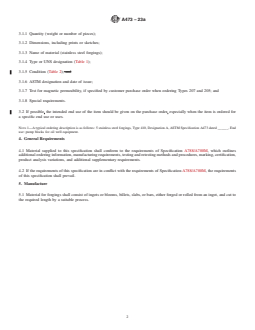
3.1.1 Quantity (weight or number of pieces);
3.1.2 Dimensions, including prints or sketches;
1.3 Supplementary requirements from Specification A788/
A788M may be specified when additional testing, inspection, 3.1.3 Name of material (stainless steel forgings);
3.1.4 Type or UNS designation (Table 1);
or processing is required.
3.1.5 Condition (Table 2);
1.4 This international standard was developed in accor-
3.1.6 ASTM designation and date of issue;
dance with internationally recognized principles on standard-
3.1.7 Test for magnetic permeability, if specified by cus-
ization established in the Decision on Principles for the
tomer purchase order when ordering Types 207 and 205; and
Development of International Standards, Guides and Recom-
3.1.8 Special requirements.
mendations issued by the World Trade Organization Technical
Barriers to Trade (TBT) Committee.
3.2 If possible, the intended end use of the item should be
given on the purchase order, especially when the item is
2. Referenced Documents
ordered for a specific end use or uses.
2.1 ASTM Standards:
NOTE 1—A typical ordering description is as follows: 5 stainless steel
A370 Test Methods and Definitions for Mechanical Testing
forgings, Type 410, Designation A, ASTM Specification A473 dated
of Steel Products
______. End use: pump blocks for oil well equipment.
A751 Test Methods and Practices for Chemical Analysis of
4. General Requirements
Steel Products
A788/A788M Specification for Steel Forgings, General Re- 4.1 Material supplied to this specification shall conform to
quirements the requirements of Specification A788/A788M, which out-
A1058 Test Methods for Mechanical Testing of Steel lines additional ordering information, manufacturing
Products—Metric
requirements, testing and retesting methods and procedures,
E8/E8M Test Methods for Tension Testing of Metallic Ma- marking, certification, product analysis variations, and addi-
terials
tional supplementary requirements.
E527 Practice for Numbering Metals and Alloys in the
4.2 If the requirements of this specification are in conflict
Unified Numbering System (UNS)
with the requirements of Specification A788/A788M, the
requirements of this specification shall prevail.
This specification is under the jurisdiction of ASTM Committee A01 on Steel,
5. Manufacture
Stainless Steel and Related Alloys and is the direct responsibility of Subcommittee
A01.06 on Steel Forgings and Billets.
5.1 Material for forgings shall consist of ingots or blooms,
Current edition approved Sept. 1, 2023. Published September 2023. Originally
billets, slabs, or bars, either forged or rolled from an ingot, and
approved in 1962. Last previous edition approved in 2023 as A473 – 23. DOI:
10.1520/A0473-23A.
cut to the required length by a suitable process.
For referenced ASTM standards, visit the ASTM website, www.astm.org, or
contact ASTM Customer Service at service@astm.org. For Annual Book of ASTM
Standards volume information, refer to the standard’s Document Summary page on Available from SAE International (SAE), 400 Commonwealth Dr., Warrendale,
the ASTM website. PA 15096, http://www.sae.org.
*A Summary of Changes section appears at the end of this standard
Copyright © ASTM International, 100 Barr Harbor Drive, PO Box C700, West Conshohocken, PA 19428-2959. United States
A473 − 23a
A
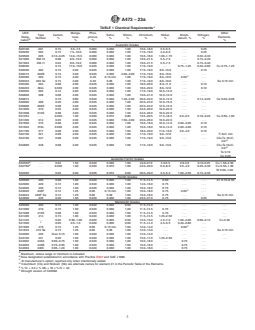
TABLE 1 Chemical Requirements
UNS Manga- Phos- Other
Type Carbon, Sulfur, Silicon, Chromium, Nickel, Molyb- Nitrogen,
Desig- nese, phorus, Elements,
Number % % % % % denum, % %
B
nation % % %
Austenitic Grades
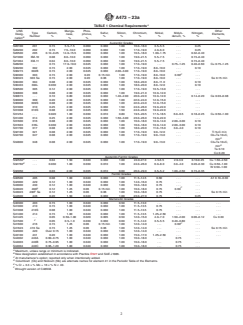
S20100 201 0.15 5.5–7.5 0.060 0.030 1.00 16.0–18.0 3.5–5.5 . . . 0.25
S20200 202 0.15 7.5–10.0 0.060 0.030 1.00 17.0–19.0 4.0–6.0 . . . 0.25
S20500 205 0.12–0.25 14.0–15.5 0.060 0.030 1.00 16.5–18.0 1.00–1.75 . . . 0.32–0.40
S21900 XM-10 0.08 8.0–10.0 0.060 0.030 1.00 19.0–21.5 5.5–7.5 . . . 0.15–0.40
S21904 XM-11 0.04 8.0–10.0 0.060 0.030 1.00 19.0–21.5 5.5–7.5 . . . 0.15–0.40
S28200 . . . 0.15 17.0–19.0 0.045 0.030 1.00 17.0–19.0 . . . 0.75–1.25 0.40–0.60 Cu 0.75–1.25
S30200 302 0.15 2.00 0.045 0.030 1.00 17.0–19.0 8.0–10.0 . . . 0.10
S30215 302B 0.15 2.00 0.045 0.030 2.00–3.00 17.0–19.0 8.0–10.0 . . . . . .
C
S30300 303 0.15 2.00 0.20 0.15 min 1.00 17.0–19.0 8.0–10.0 0.60 . . .
S30323 303 Se 0.15 2.00 0.20 0.06 1.00 17.0–19.0 8.0–10.0 . . . . . . Se 0.15 min
S30400 304 0.08 2.00 0.045 0.030 1.00 18.0–20.0 8.0–11.0 . . . 0.10
S30403 304L 0.030 2.00 0.045 0.030 1.00 18.0–20.0 8.0–12.0 . . . 0.10
S30500 305 0.12 2.00 0.045 0.030 1.00 17.0–19.0 10.5–13.0 . . . . . .
S30800 308 0.08 2.00 0.045 0.030 1.00 19.0–21.0 10.0–12.0 . . . . . .
S30815 . . . 0.10 0.80 0.040 0.030 1.40–2.00 20.0–22.0 10.0–12.0 . . . 0.14–0.20 Ce 0.03–0.08
S30900 309 0.20 2.00 0.045 0.030 1.00 22.0–24.0 12.0–15.0 . . . . . .
S30908 309S 0.08 2.00 0.045 0.030 1.00 22.0–24.0 12.0–15.0 . . . . . .
S31000 310 0.25 2.00 0.045 0.030 1.50 24.0–26.0 19.0–22.0 . . . . . .
S31008 310S 0.08 2.00 0.045 0.030 1.50 24.0–26.0 19.0–22.0 . . . . . .
S31254 . . . 0.020 1.00 0.030 0.010 0.80 19.5–20.5 17.5–18.5 6.0–6.5 0.18–0.25 Cu 0.50–1.00
S31400 314 0.25 2.00 0.045 0.030 1.50–3.00 23.0–26.0 19.0–22.0 . . . . . .
S31600 316 0.08 2.00 0.045 0.030 1.00 16.0–18.0 10.0–14.0 2.00–3.00 0.10
S31603 316L 0.030 2.00 0.045 0.030 1.00 16.0–18.0 10.0–14.0 2.00–3.00 0.10
S31700 317 0.08 2.00 0.045 0.030 1.00 18.0–20.0 11.0–15.0 3.0–4.0 0.10
S32100 321 0.08 2.00 0.045 0.030 1.00 17.0–19.0 9.0–12.0 . . . . . . Ti 5×C min
S34700 347 0.08 2.00 0.045 0.030 1.00 17.0–19.0 9.0–13.0 . . . . . . Cb+Ta 10×C,
D
min
S34800 348 0.08 2.00 0.045 0.030 1.00 17.0–19.0 9.0–13.0 . . . . . . Cb+Ta 10×C,
D
min
Ta 0.10
Co 0.20
Austenitic-Ferritic Grades
E
S32550 . . . 0.04 1.50 0.040 0.030 1.00 24.0-27.0 4.5-6.5 2.9-3.9 0.10-0.25 Cu 1.50–2.50
E
S32760 . . . 0.030 1.00 0.030 0.010 1.00 24.0–26.0 6.0–8.0 3.0–4.0 0.20–0.30 Cu 0.50–1.00
W 0.50–1.00
S32950 . . . 0.03 2.00 0.035 0.010 0.60 26.0–29.0 3.5–5.2 1.00–2.50 0.15–0.35
Ferritic Grades
S40500 405 0.08 1.00 0.040 0.030 1.00 11.5–14.5 0.60 . . . . . . A1 0.10–0.30
S42900 429 0.12 1.00 0.040 0.030 1.00 14.0–16.0 0.75 . . . . . .
S43000 430 0.12 1.00 0.040 0.030 1.00 16.0–18.0 0.75 . . . . . .
C
S43020 430F 0.12 1.25 0.06 0.15 min 1.00 16.0–18.0 0.75 0.60 . . .
S43023 430F Se 0.12 1.25 0.06 0.06 1.00 16.0–18.0 0.75 . . . . . . Se 0.15 min
S44600 446 0.20 1.50 0.040 0.030 1.00 23.0–27.0 0.75 . . . 0.25
Martensitic Grades
S40300 403 0.15 1.00 0.040 0.030 0.50 11.5–13.0 . . . . . . . . . . . .
S41000 410 0.15 1.00 0.040 0.030 1.00 11.5–13.5 0.75 . . . . . . . . .
S41008 410S 0.08 1.00 0.040 0.030 1.00 11.5–13.5 0.75 . . . . . . . . .
S41400 414 0.15 1.00 0.040 0.030 1.00 11.5–13.5 1.25–2.50 . . . . . . . . .
S41425 . . . 0.05 0.50–1.00 0.020 0.005 0.50 12.0–15.0 4.0–7.0 1.50–2.00 0.06–0.12 Cu 0.30
F
S41500 0.05 0.5–1.0 0.030 0.030 0.60 11.5–14.0 3.5–5.5 0.40–0.80 . . .
C
S41600 416 0.15 1.25 0.06 0.15 min 1.00 12.0–14.0 . . . 0.60 . . .
S41623 416 Se 0.15 1.25 0.06 0.06 1.00 12.0–14.0 . . . . . . . . . Se 0.15 min
S42000 420 Over 0.15 1.00 0.040 0.030 1.00 12.0–14.0 . . . . . . . . . . . .
S43100 431 0.20 1.00 0.040 0.030 1.00 15.0–17.0 1.25–2.50 . . . . . . . . .
S44002 440A 0.60–0.75 1.00 0.040 0.030 1.00 16.0–18.0 . . . 0.75 . . .
S44003 440B 0.75–0.95 1.00 0.040 0.030 1.00 16.0–18.0 . . . 0.75 . . .
S44004 440C 0.95–1.20 1.00 0.040 0.030 1.00 16.0–18.0 . . . 0.75 . . .
A
Maximum, unless range or minimum is indicated.
B
New designation established in accordance with Practice E527 and SAE J1086.
C
At manufacturer’s option; reported only when intentionally added.
D
Columbium (Cb) and Niobium (Nb) are alternate names for element 41 in the Periodic Table of the Elements.
E
% Cr + 3.3 × % Mo + 16 × % N $ 40.
F
Wrought version of CA6NM.
A473 − 23a
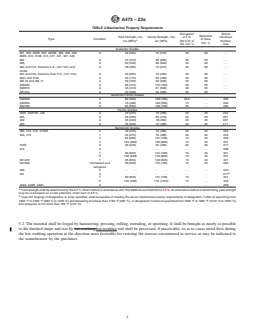
TABLE 2 Mechanical Property Requirements
Elongation Brinell
Reduction
Yield Strength, min, Tensile Strength, min, in 2 in. Hardness
Type Condition of Area,
A
ksi (MPa) ksi (MPa) (50 mm) or Number,
min, %
4D, min % max
Austenitic Grades
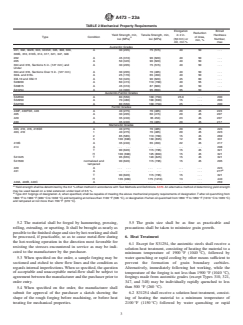
201, 302, 302B, 303, 303SE, 305, 308, 309, A 30 (205) 75 (515) 40 50 . . .
309S, 310, 310S, 314, 317, 321, 347, 348
202 A 45 (310) 90 (620) 40 50 . . .
205 A 50 (345) 90 (620) 40 50 . . .
304 and 316, Sections 5 in. (127 mm) and A 30 (205) 75 (515) 40 50 . . .
Under
304 and 316, Sections Over 5 in. (127 mm) A 30 (205) 70 (485) 40 50 . . .
304L and 316L A 25 (170) 65 (450) 40 50 . . .
XM-10 and XM-11 A 50 (345) 90 (620) 45 60 . . .
S28200 A 60 (415) 110 (760) 40 55 . . .
S30815 A 45 (310) 87 (600) 40 50 . . .
S31254 A 44 (300) 95 (650) 35 50 . . .
Austenitic-Ferritic Grades
S32550 A 80 (550) 109 (750) 25.0 . . . 290
S32950 A 70 (480) 100 (690) 15 . . . 293
S32760 A 80 (550) 109 (750) 25 . . . 290
Ferritic Grades
430F, 430FSE, 446 A 40 (275) 70 (485) 20 45 223
405 A 30 (205) 60 (415) 20 45 207
429 A 35 (240) 65 450) 23 45 207
430 A 35 (240) 70 (485) 20 45 217
Martensitic Grades
403, 410, 416, 416SE A 40 (275) 70 (485) 20 45 223
403, 410 1 40 (275) 70 (485) 20 45 223
2 85 (585) 110 (760) 15 45 269
3 100 (690) 130 (895) 12 35 331
410S A 35 (240) 65 (450) 22 45 217
414 A . . . . . . . . . . . . . . . . . . 298
T 90 (620) 115 (795) 15 45 321
H 100 (690) 125 (860) 15 45 321
S41425 T 95 (655) 120 (825) 15 45 321
S41500 normalized and 90 (620) 115 (795) 15 45 295
tempered
420 A . . . . . . . . . . . . . . . . . . 223
B
431 A . . . . . . . . . . . . . . . . . . 277
T 90 (620) 115 (795) 15 . . . 321
H 135 (930) 175 (1210) 13 . . . 440
440A, 440B, 440C A . . . . . . . . . . . . . . . . . . 269
A
Yield strength shall be determined by the 0.2 % offset method in accordance with Test Methods and Definitions A370. An alternative method of determining yield strength
may be used based on a total extension under load of 0.5 %.
B
Type 431 forgings of designation A, when specified, shall be capable of meeting the above mechanical property requirements of designation T after oil quenching from
1800 °F to 1900 °F (980 °C to 1038 °C) and tempering at not less than 1100 °F (595 °C), or designation H when oil quenched from 1850 °F to 1950 °F (1010 °C to 1065 °C)
and tempered at not more than 700 °F (370 °C).
5.2 The material shall be forged by hammering, pressing, 5.5 The grain size shall be as fine as practicable and
rolling, extruding, or upsetting. It shall be brought as nearly as precautions shall be taken to minimize grain growth.
possible to the finished shape and size by hot-working and shall
be processed, if practicable, so as to cause metal-flow during 6. Heat Treatment
the hot-working operation in the direction most favorable for
6.1 Except for S31254, the austenitic steels shall receive a
...
This document is not an ASTM standard and is intended only to provide the user of an ASTM standard an indication of what changes have been made to the previous version. Because
it may not be technically possible to adequately depict all changes accurately, ASTM recommends that users consult prior editions as appropriate. In all cases only the current version
of the standard as published by ASTM is to be considered the official document.
Designation: A473 − 23 A473 − 23a
Standard Specification for
Stainless Steel Forgings
This standard is issued under the fixed designation A473; the number immediately following the designation indicates the year of
original adoption or, in the case of revision, the year of last revision. A number in parentheses indicates the year of last reapproval. A
superscript epsilon (´) indicates an editorial change since the last revision or reapproval.
This standard has been approved for use by agencies of the U.S. Department of Defense.
1. Scope*
1.1 This specification covers austenitic, austenitic-ferritic, ferritic, and martensitic stainless steel forgings for general use, and for
low- or high-temperature service.
1.2 The values stated in inch-pound units are to be regarded as standard. The values given in parentheses are mathematical
conversions to SI units that are provided for information only and are not considered standard.
1.3 Supplementary requirements from Specification A788/A788M may be specified when additional testing, inspection, or
processing is required.
1.4 This international standard was developed in accordance with internationally recognized principles on standardization
established in the Decision on Principles for the Development of International Standards, Guides and Recommendations issued
by the World Trade Organization Technical Barriers to Trade (TBT) Committee.
2. Referenced Documents
2.1 ASTM Standards:
A370 Test Methods and Definitions for Mechanical Testing of Steel Products
A751 Test Methods and Practices for Chemical Analysis of Steel Products
A788/A788M Specification for Steel Forgings, General Requirements
A1058 Test Methods for Mechanical Testing of Steel Products—Metric
E8/E8M Test Methods for Tension Testing of Metallic Materials
E527 Practice for Numbering Metals and Alloys in the Unified Numbering System (UNS)
2.2 SAE Standard:
SAE J1086 Numbering Metals and Alloys
3. Ordering Information
3.1 It is the responsibility of the purchaser to specify all requirements that are necessary for material ordered under this
specification. Such requirements may include, but are not limited to, the following:
This specification is under the jurisdiction of ASTM Committee A01 on Steel, Stainless Steel and Related Alloys and is the direct responsibility of Subcommittee A01.06
on Steel Forgings and Billets.
Current edition approved March 1, 2023Sept. 1, 2023. Published April 2023September 2023. Originally approved in 1962. Last previous edition approved in 20212023
as A473A473 – 23.-21. DOI: 10.1520/A0473-23.10.1520/A0473-23A.
For referenced ASTM standards, visit the ASTM website, www.astm.org, or contact ASTM Customer Service at service@astm.org. For Annual Book of ASTM Standards
volume information, refer to the standard’s Document Summary page on the ASTM website.
Available from SAE International (SAE), 400 Commonwealth Dr., Warrendale, PA 15096, http://www.sae.org.
*A Summary of Changes section appears at the end of this standard
Copyright © ASTM International, 100 Barr Harbor Drive, PO Box C700, West Conshohocken, PA 19428-2959. United States
A473 − 23a
3.1.1 Quantity (weight or number of pieces);
3.1.2 Dimensions, including prints or sketches;
3.1.3 Name of material (stainless steel forgings);
3.1.4 Type or UNS designation (Table 1);
3.1.5 Condition (Table 2); and
3.1.6 ASTM designation and date of issue;
3.1.7 Test for magnetic permeability, if specified by customer purchase order when ordering Types 207 and 205; and
3.1.8 Special requirements.
3.2 If possible, the intended end use of the item should be given on the purchase order, especially when the item is ordered for
a specific end use or uses.
NOTE 1—A typical ordering description is as follows: 5 stainless steel forgings, Type 410, Designation A, ASTM Specification A473 dated ______. End
use: pump blocks for oil well equipment.
4. General Requirements
4.1 Material supplied to this specification shall conform to the requirements of Specification A788/A788M, which outlines
additional ordering information, manufacturing requirements, testing and retesting methods and procedures, marking, certification,
product analysis variations, and additional supplementary requirements.
4.2 If the requirements of this specification are in conflict with the requirements of Specification A788/A788M, the requirements
of this specification shall prevail.
5. Manufacture
5.1 Material for forgings shall consist of ingots or blooms, billets, slabs, or bars, either forged or rolled from an ingot, and cut to
the required length by a suitable process.
A473 − 23a
A
TABLE 1 Chemical Requirements
UNS Manga- Phos- Other
Type Carbon, Sulfur, Silicon, Chromium, Nickel, Molyb- Nitrogen,
Desig- nese, phorus, Elements,
Number % % % % % denum, % %
B
nation % % %
Austenitic Grades
S20100 201 0.15 5.5–7.5 0.060 0.030 1.00 16.0–18.0 3.5–5.5 . . . 0.25
S20200 202 0.15 7.5–10.0 0.060 0.030 1.00 17.0–19.0 4.0–6.0 . . . 0.25
S20500 205 0.12–0.25 14.0–15.5 0.060 0.030 1.00 16.5–18.0 1.00–1.75 . . . 0.32–0.40
S21900 XM-10 0.08 8.0–10.0 0.060 0.030 1.00 19.0–21.5 5.5–7.5 . . . 0.15–0.40
S21904 XM-11 0.04 8.0–10.0 0.060 0.030 1.00 19.0–21.5 5.5–7.5 . . . 0.15–0.40
S28200 . . . 0.15 17.0–19.0 0.045 0.030 1.00 17.0–19.0 . . . 0.75–1.25 0.40–0.60 Cu 0.75–1.25
S30200 302 0.15 2.00 0.045 0.030 1.00 17.0–19.0 8.0–10.0 . . . 0.10
S30215 302B 0.15 2.00 0.045 0.030 2.00–3.00 17.0–19.0 8.0–10.0 . . . . . .
C
S30300 303 0.15 2.00 0.20 0.15 min 1.00 17.0–19.0 8.0–10.0 0.60 . . .
S30323 303 Se 0.15 2.00 0.20 0.06 1.00 17.0–19.0 8.0–10.0 . . . . . . Se 0.15 min
S30400 304 0.08 2.00 0.045 0.030 1.00 18.0–20.0 8.0–11.0 . . . 0.10
S30403 304L 0.030 2.00 0.045 0.030 1.00 18.0–20.0 8.0–12.0 . . . 0.10
S30500 305 0.12 2.00 0.045 0.030 1.00 17.0–19.0 10.5–13.0 . . . . . .
S30800 308 0.08 2.00 0.045 0.030 1.00 19.0–21.0 10.0–12.0 . . . . . .
S30815 . . . 0.10 0.80 0.040 0.030 1.40–2.00 20.0–22.0 10.0–12.0 . . . 0.14–0.20 Ce 0.03–0.08
S30900 309 0.20 2.00 0.045 0.030 1.00 22.0–24.0 12.0–15.0 . . . . . .
S30908 309S 0.08 2.00 0.045 0.030 1.00 22.0–24.0 12.0–15.0 . . . . . .
S31000 310 0.25 2.00 0.045 0.030 1.50 24.0–26.0 19.0–22.0 . . . . . .
S31008 310S 0.08 2.00 0.045 0.030 1.50 24.0–26.0 19.0–22.0 . . . . . .
S31254 . . . 0.020 1.00 0.030 0.010 0.80 19.5–20.5 17.5–18.5 6.0–6.5 0.18–0.25 Cu 0.50–1.00
S31400 314 0.25 2.00 0.045 0.030 1.50–3.00 23.0–26.0 19.0–22.0 . . . . . .
S31600 316 0.08 2.00 0.045 0.030 1.00 16.0–18.0 10.0–14.0 2.00–3.00 0.10
S31603 316L 0.030 2.00 0.045 0.030 1.00 16.0–18.0 10.0–14.0 2.00–3.00 0.10
S31700 317 0.08 2.00 0.045 0.030 1.00 18.0–20.0 11.0–15.0 3.0–4.0 0.10
S32100 321 0.08 2.00 0.045 0.030 1.00 17.0–19.0 9.0–12.0 . . . . . . Ti 5×C min
S34700 347 0.08 2.00 0.045 0.030 1.00 17.0–19.0 9.0–13.0 . . . . . . Cb+Ta 10×C,
D
min
S34800 348 0.08 2.00 0.045 0.030 1.00 17.0–19.0 9.0–13.0 . . . . . . Cb+Ta 10×C,
D
min
Ta 0.10
Co 0.20
Austenitic-Ferritic Grades
E
S32550 . . . 0.04 1.50 0.040 0.030 1.00 24.0-27.0 4.5-6.5 2.9-3.9 0.10-0.25 Cu 1.50–2.50
E
S32760 . . . 0.030 1.00 0.030 0.010 1.00 24.0–26.0 6.0–8.0 3.0–4.0 0.20–0.30 Cu 0.50–1.00
W 0.50–1.00
S32950 . . . 0.03 2.00 0.035 0.010 0.60 26.0–29.0 3.5–5.2 1.00–2.50 0.15–0.35
Ferritic Grades
S40500 405 0.08 1.00 0.040 0.030 1.00 11.5–14.5 0.60 . . . . . . A1 0.10–0.30
S42900 429 0.12 1.00 0.040 0.030 1.00 14.0–16.0 0.75 . . . . . .
S43000 430 0.12 1.00 0.040 0.030 1.00 16.0–18.0 0.75 . . . . . .
C
S43020 430F 0.12 1.25 0.06 0.15 min 1.00 16.0–18.0 0.75 0.60 . . .
S43023 430F Se 0.12 1.25 0.06 0.06 1.00 16.0–18.0 0.75 . . . . . . Se 0.15 min
S44600 446 0.20 1.50 0.040 0.030 1.00 23.0–27.0 0.75 . . . 0.25
Martensitic Grades
S40300 403 0.15 1.00 0.040 0.030 0.50 11.5–13.0 . . . . . . . . . . . .
S41000 410 0.15 1.00 0.040 0.030 1.00 11.5–13.5 0.75 . . . . . . . . .
S41008 410S 0.08 1.00 0.040 0.030 1.00 11.5–13.5 0.75 . . . . . . . . .
S41400 414 0.15 1.00 0.040 0.030 1.00 11.5–13.5 1.25–2.50 . . . . . . . . .
S41425 . . . 0.05 0.50–1.00 0.020 0.005 0.50 12.0–15.0 4.0–7.0 1.50–2.00 0.06–0.12 Cu 0.30
F
S41500 0.05 0.5–1.0 0.030 0.030 0.60 11.5–14.0 3.5–5.5 0.40–0.80 . . .
C
S41600 416 0.15 1.25 0.06 0.15 min 1.00 12.0–14.0 . . . 0.60 . . .
S41623 416 Se 0.15 1.25 0.06 0.06 1.00 12.0–14.0 . . . . . . . . . Se 0.15 min
S42000 420 Over 0.15 1.00 0.040 0.030 1.00 12.0–14.0 . . . . . . . . . . . .
S43100 431 0.20 1.00 0.040 0.030 1.00 15.0–17.0 1.25–2.50 . . . . . . . . .
S44002 440A 0.60–0.75 1.00 0.040 0.030 1.00 16.0–18.0 . . . 0.75 . . .
S44003 440B 0.75–0.95 1.00 0.040 0.030 1.00 16.0–18.0 . . . 0.75 . . .
S44004 440C 0.95–1.20 1.00 0.040 0.030 1.00 16.0–18.0 . . . 0.75 . . .
A
Maximum, unless range or minimum is indicated.
B
New designation established in accordance with Practice E527 and SAE J1086.
C
At manufacturer’s option; reported only when intentionally added.
D
Columbium (Cb) and Niobium (Nb) are alternate names for element 41 in the Periodic Table of the Elements.
E
% Cr + 3.3 × % Mo + 16 × % N $ 40.
F
Wrought version of CA6NM.
A473 − 23a
TABLE 2 Mechanical Property Requirements
Elongation Brinell
Reduction
Yield Strength, min, Tensile Strength, min, in 2 in. Hardness
Type Condition of Area,
A
ksi (MPa) ksi (MPa) (50 mm) or Number,
min, %
4D, min % max
Austenitic Grades
201, 302, 302B, 303, 303SE, 305, 308, 309, A 30 (205) 75 (515) 40 50 . . .
309S, 310, 310S, 314, 317, 321, 347, 348
202 A 45 (310) 90 (620) 40 50 . . .
205 A 50 (345) 90 (620) 40 50 . . .
304 and 316, Sections 5 in. (127 mm) and A 30 (205) 75 (515) 40 50 . . .
Under
304 and 316, Sections Over 5 in. (127 mm) A 30 (205) 70 (485) 40 50 . . .
304L and 316L A 25 (170) 65 (450) 40 50 . . .
XM-10 and XM-11 A 50 (345) 90 (620) 45 60 . . .
S28200 A 60 (415) 110 (760) 40 55 . . .
S30815 A 45 (310) 87 (600) 40 50 . . .
S31254 A 44 (300) 95 (650) 35 50 . . .
Austenitic-Ferritic Grades
S32550 A 80 (550) 109 (750) 25.0 . . . 290
S32950 A 70 (480) 100 (690) 15 . . . 293
S32760 A 80 (550) 109 (750) 25 . . . 290
Ferritic Grades
430F, 430FSE, 446 A 40 (275) 70 (485) 20 45 223
405 A 30 (205) 60 (415) 20 45 207
429 A 35 (240) 65 450) 23 45 207
430 A 35 (240) 70 (485) 20 45 217
Martensitic Grades
403, 410, 416, 416SE A 40 (275) 70 (485) 20 45 223
403, 410 1 40 (275) 70 (485) 20 45 223
2 85 (585) 110 (760) 15 45 269
3 100 (690) 130 (895) 12 35 331
410S A 35 (240) 65 (450) 22 45 217
414 A . . . . . . . . . . . . . . . . . . 298
T 90 (620) 115 (795) 15 45 321
H 100 (690) 125 (860) 15 45 321
S41425 T 95 (655) 120 (825) 15 45 321
S41500 normalized and 90 (620) 115 (795) 15 45 295
tempered
420 A . . . . . . . . . . . . . . . . . . 223
B
431 A . . . . . . . . . . . . . . . . . . 277
T 90 (620) 115 (795) 15 . . . 321
H 135 (930) 175 (1210) 13 . . . 440
440A, 440B, 440C A . . . . . . . . . . . . . . . . . . 269
A
Yield strength shall be determined by the 0.2 % offset method in accordance with Test Methods and Definitions A370. An alternative method of determining yield strength
may be used based on a total extension under load of 0.5 %.
B
Type 431 forgings of designation A, when specified, shall be capable of meeting the above mechanical property requirements of designation T after oil quenching from
1800 °F to 1900 °F (980 °C to 1038 °C) and tempering at not less than 1100 °F (595 °C), or designation H when oil quenched from 1850 °F to 1950 °F (1010 °C to 1065 °C)
and tempered at not more than 700 °F (370 °C).
5.2 The material shall be forged by hammering, pressing, rolling, extruding, or upsetting. It shall be brought as nearly as possible
to the finished shape and size by hot-working;hot-working and shall be processed, if practicable, so as to cause metal-flow during
the hot-working operation in the direction most favorable for resisting the stresses encountered in service as may be indicated to
the manufacturer by the purchaser.
A473 − 23a
5.3 When specified on the order, a sample forging may be sectioned and etched to show flow lines and the condition as regards
internal imperfections. When so spe
...