

ASTM F2337-22
(Test Method)Standard Test Method for Treestand Fall Arrest System
General Information
- Abstract
SIGNIFICANCE AND USE
4.1 This test method is intended to measure the maximum arrest force and dynamic strength on treestand FAS and components or subsystems. This test is intended for program quality assurance and production quality control purposes. It is not intended to be an independent material or product acceptance test.
SCOPE
1.1 This test method covers the determination of the load capacities for treestand fall arrest systems (FAS) and components or subsystems.
1.2 This test method addresses equipment used in hunting situations requiring personal protection against falls from heights and applies to the manufacturers, distributors, purchasers, and users of such equipment.
1.3 The values stated in inch-pound units are to be regarded as standard. The values given in parentheses are mathematical conversions to SI units that are provided for information only and are not considered standard.
1.4 This standard does not purport to address all of the safety concerns, if any, associated with its use. It is the responsibility of the user of this standard to establish appropriate safety, health, and environmental practices and determine the applicability of regulatory limitations prior to use.
1.5 This international standard was developed in accordance with internationally recognized principles on standardization established in the Decision on Principles for the Development of International Standards, Guides and Recommendations issued by the World Trade Organization Technical Barriers to Trade (TBT) Committee.
- Status
- Published
- Publication Date
- 31-Oct-2022
- Technical Committee
- F08 - Sports Equipment, Playing Surfaces, and Facilities
- Drafting Committee
- F08.18 - Treestands
Overview
ASTM F2337-22 is the internationally recognized standard test method for determining the load capacities and dynamic characteristics of treestand fall arrest systems (FAS), including their components and subsystems. Developed by ASTM International, this standard is specifically tailored for equipment used in hunting and outdoor activities where personal protection from falls is essential. The document sets out procedures to assess the maximum arrest force (MAF) and overall system performance, targeting manufacturers, distributors, purchasers, and users.
The standard is fundamental for quality assurance and production quality control but is not intended as a standalone product acceptance test. It also emphasizes the need for adherence to safety, health, and environmental practices by all stakeholders involved in the application of treestand fall arrest systems.
Key Topics
Maximum Arrest Force (MAF) Measurement:
Procedures for evaluating the peak dynamic force a treestand FAS exerts on a user during a simulated fall, ensuring the system’s capacity to arrest a fall within established safety thresholds.Dynamic Strength and Load Capacity Testing:
Methods to confirm that treestand FAS, including full body harnesses, connectors, deceleration devices, and other critical components, can withstand both dynamic falls and static loads as per set requirements.Climbing Belt and Suspension Relief Device Tests:
Includes test procedures for climbing belts integral to the FAS, as well as suspension relief devices designed to alleviate suspension trauma after fall arrest.Labeling and Safety Requirements:
Outlines clear criteria for product safety labels-including mandatory warnings, manufacturing dates, rated capacity, and other essential information-to enhance user safety and compliance.Quality Assurance in Manufacturing:
Requires manufacturers to provide material certification compliance statements, ensuring components meet designated specifications even when involving subcontractors.
Applications
The ASTM F2337-22 standard is vital for:
Product Development and Manufacturing Control:
Assists treestand FAS manufacturers in implementing robust production quality control and quality assurance programs to mitigate fall risks for end users.Third-party Testing and Evaluation:
Used by independent test laboratories and regulatory agencies to verify that fall arrest equipment meets recognized safety benchmarks.Purchaser and User Confidence:
Enables distributors, purchasers, and end users-especially hunters and tree stand installers-to select equipment verified to perform reliably under fall arrest conditions.Training and Instruction:
Guides trainers and end users in proper donning, use, and inspection of fall arrest systems, supporting best practices in outdoor safety.Compliance with International Safety Frameworks:
Supports organizations in meeting international trade and safety requirements, adhering to World Trade Organization (WTO) guidelines for technical barriers to trade.
Related Standards
For comprehensive fall protection and safety, consider these related ASTM and international standards:
- ASTM F2123: Standard Test Method for Treestand Static Stability
- ASTM F2196: Standard Test Method for Treestand Harness System Testing
- ANSI/ASSE Z359 Series: American National Standards for Fall Protection and Fall Restraint
- ISO 10333 Series: Personal Fall Arrest Systems
Keywords:
treestand, fall arrest system, ASTM F2337-22, maximum arrest force, dynamic strength, climbing belt, hunting safety, quality assurance, personal protection, safety harness.
By following ASTM F2337-22, stakeholders in the hunting and outdoor industry can significantly improve safety, reduce injury risk, and build confidence in fall protection equipment performance.
Get Certified
Connect with accredited certification bodies for this standard

Control Union Certifications
Global certification for agriculture and sustainability.

ECOCERT
Organic and sustainability certification.

FSC International
Forest Stewardship Council certification.
Sponsored listings
Frequently Asked Questions
ASTM F2337-22 is a standard published by ASTM International. Its full title is "Standard Test Method for Treestand Fall Arrest System". This standard covers: SIGNIFICANCE AND USE 4.1 This test method is intended to measure the maximum arrest force and dynamic strength on treestand FAS and components or subsystems. This test is intended for program quality assurance and production quality control purposes. It is not intended to be an independent material or product acceptance test. SCOPE 1.1 This test method covers the determination of the load capacities for treestand fall arrest systems (FAS) and components or subsystems. 1.2 This test method addresses equipment used in hunting situations requiring personal protection against falls from heights and applies to the manufacturers, distributors, purchasers, and users of such equipment. 1.3 The values stated in inch-pound units are to be regarded as standard. The values given in parentheses are mathematical conversions to SI units that are provided for information only and are not considered standard. 1.4 This standard does not purport to address all of the safety concerns, if any, associated with its use. It is the responsibility of the user of this standard to establish appropriate safety, health, and environmental practices and determine the applicability of regulatory limitations prior to use. 1.5 This international standard was developed in accordance with internationally recognized principles on standardization established in the Decision on Principles for the Development of International Standards, Guides and Recommendations issued by the World Trade Organization Technical Barriers to Trade (TBT) Committee.
SIGNIFICANCE AND USE 4.1 This test method is intended to measure the maximum arrest force and dynamic strength on treestand FAS and components or subsystems. This test is intended for program quality assurance and production quality control purposes. It is not intended to be an independent material or product acceptance test. SCOPE 1.1 This test method covers the determination of the load capacities for treestand fall arrest systems (FAS) and components or subsystems. 1.2 This test method addresses equipment used in hunting situations requiring personal protection against falls from heights and applies to the manufacturers, distributors, purchasers, and users of such equipment. 1.3 The values stated in inch-pound units are to be regarded as standard. The values given in parentheses are mathematical conversions to SI units that are provided for information only and are not considered standard. 1.4 This standard does not purport to address all of the safety concerns, if any, associated with its use. It is the responsibility of the user of this standard to establish appropriate safety, health, and environmental practices and determine the applicability of regulatory limitations prior to use. 1.5 This international standard was developed in accordance with internationally recognized principles on standardization established in the Decision on Principles for the Development of International Standards, Guides and Recommendations issued by the World Trade Organization Technical Barriers to Trade (TBT) Committee.
ASTM F2337-22 is classified under the following ICS (International Classification for Standards) categories: 65.145 - Hunting. The ICS classification helps identify the subject area and facilitates finding related standards.
ASTM F2337-22 is available in PDF format for immediate download after purchase. The document can be added to your cart and obtained through the secure checkout process. Digital delivery ensures instant access to the complete standard document.
Standards Content (Sample)
This international standard was developed in accordance with internationally recognized principles on standardization established in the Decision on Principles for the
Development of International Standards, Guides and Recommendations issued by the World Trade Organization Technical Barriers to Trade (TBT) Committee.
Designation: F2337 − 22 An American National Standard
Standard Test Method for
Treestand Fall Arrest System
This standard is issued under the fixed designation F2337; the number immediately following the designation indicates the year of
original adoption or, in the case of revision, the year of last revision.Anumber in parentheses indicates the year of last reapproval.A
superscript epsilon (´) indicates an editorial change since the last revision or reapproval.
1. Scope 2.2.2.1 Discussion—AFBHmaybeconstructedtoaddition-
ally serve this function.
1.1 This test method covers the determination of the load
capacities for treestand fall arrest systems (FAS) and compo- 2.2.3 connecting hardware, n—any locking hardware that
nents or subsystems. connects the FAS components in series, thus creating a linear
linkage along which the maximum arrest force (MAF) acts.
1.2 This test method addresses equipment used in hunting
2.2.3.1 Discussion—Includes snap hooks, carabiners, links,
situations requiring personal protection against falls from
anchorage hardware, and buckles.
heights and applies to the manufacturers, distributors,
purchasers, and users of such equipment. 2.2.4 connector, n—a device that is used to connect compo-
nents of a full body harness, fall restraint.
1.3 The values stated in inch-pound units are to be regarded
2.2.4.1 Discussion—Connectors include but are not limited
as standard. The values given in parentheses are mathematical
totethers,lockingsnaphooks,carabiners,decelerationdevices,
conversions to SI units that are provided for information only
and specialty systems such as self-retracting treestand safety
and are not considered standard.
ropes, ladder climbing systems, vertical treestand safety ropes
1.4 This standard does not purport to address all of the
and rope grab.
safety concerns, if any, associated with its use. It is the
2.2.5 deceleration device, n—any mechanism, such as a
responsibility of the user of this standard to establish appro-
rope grab, rip stitch tether, specially woven tether, tearing or
priate safety, health, and environmental practices and deter-
deforming tether, automatic self-retracting treestand safety
mine the applicability of regulatory limitations prior to use.
ropes,etc.whichservestodissipateenergyduringfallarrestor
1.5 This international standard was developed in accor-
otherwise limit the maximum arrest force (MAF) on a user
dance with internationally recognized principles on standard-
during a fall arrest.
ization established in the Decision on Principles for the
Development of International Standards, Guides and Recom-
2.2.6 deceleration distance, n—the additional vertical dis-
mendations issued by the World Trade Organization Technical
tance a falling user travels, excluding treestand safety rope
Barriers to Trade (TBT) Committee.
elongation and free-fall distance before stopping, from the
point at which the deceleration device begins to operate.
2. Terminology
2.2.7 engineered products, n—strategically designed prod-
2.1 The terminology and definitions in the referenced docu-
ucts by a professional to meet a specific need.
ments are applicable to this practice.
2.2.8 equivalent, a, n—alternative designs, methods or ma-
2.2 Definitions:
terials used to protect against a hazard which the manufacturer
2.2.1 anchorage, n—a component or structure, or both, to
can demonstrate will provide an equal or greater degree of
which a full body harness (FBH) is attached to the tree trunk.
safety for the user than the methods, materials or designs
specified in the standard.
2.2.2 climbing belt, n—a strap/belt (or system of straps)
whichisfastenedaboutthepersoninamannersoastocontain
2.2.9 fall arrest system (FAS), n—the complete collection of
the torso and stabilize the users horizontal load while either
equipment and components that is designed to stop a fall in
working from a vertical position to attach treestands, climbing
progress.
devices,andsoforth,orduringascent/descentoftreeorladder.
2.2.10 free fall, v—the act of falling before a fall arrest
system (FAS) begins to apply force to arrest the fall.
2.2.11 flexible stretch tether, n—a full body harness tether
This test method is under the jurisdiction ofASTM Committee F08 on Sports
that expands and contracts following the user’s movement.
Equipment, Playing Surfaces, and Facilities and is the direct responsibility of
Subcommittee F08.18 on Treestands.
2.2.12 full body harness (FBH), n—a component with a
Current edition approved Nov. 1, 2022. Published November 2022. Originally
designofstrapswhichisfastenedaboutthepersoninamanner
approved in 2003. Last previous edition approved in 2021 as F2337–21. DOI:
10.1520/F2337-22. so as to contain the torso and distribute the fall arrest forces
Copyright © ASTM International, 100 Barr Harbor Drive, PO Box C700, West Conshohocken, PA 19428-2959. United States
F2337 − 22
over at least the upper thighs, pelvis, chest, and shoulders with 3.3 One system test shall consist of testing one individual
means for attaching it to other components or subsystems. fall arrest system unit for dynamic strength in accordance with
the procedures in Section 7.
2.2.13 maximum arrest force (MAF), n—the peak dynamic
force exerted on the body during fall arrest.
3.4 One climbing belt test shall consist of testing one
2.2.14 product safety sign or label, n—sign, label, hang tag
individual climbing belt (for use only if FAS includes integral
or decal affixed to a product that provides safety information climbing belt) in accordance with the procedures in Section 8.
about that product.
3.5 For each test a test weight torso having the physical
2.2.15 rope grab, n—adevicewhichtravelsonaconnecting
properties described in 5.4 or 5.5 shall be dropped from an
treestand safety rope and automatically, by friction, engages
adequate elevation to simulate a free-fall motion from a
the treestand safety rope and locks so as to arrest the fall of a
treestand platform.
user.
3.6 One static load test shall consist of testing one (1)
2.2.15.1 Discussion—Arope grab usually employs the prin-
individual Suspension Relief Device in accordance with the
cipal of inertial locking, cam/level locking, or both (that is,
procedures in Section 9 of this standard.
Prusik, Klemheist, or Autoblock knots).
3.6.1 A Suspension Relief Device shall be provided with
2.2.16 safety symbols, n—a graphic representation intended
eachFAS/FBHcompletewithinstructions.Thisdeviceshallbe
to convey a safety message without the use of words.
capable of allowing the user to relieve the load on the user’s
2.2.17 self-recovery point, n—the maximum distance a user
lower extremities if suspended in a harness to help maintain
can fall to minimize the risk of the user not having the ability
circulation in the legs and help prevent suspension trauma
to recover so that they are no longer suspended in a harness
(blood pooling). The capacity rating of the Suspension Relief
after a fall has been arrested.
Device shall be equal to the FAS rated capacity.
2.2.18 suspension relief device, n—a device to allow relief
of a person’s weight on the lower extremities if suspended in a
4. Significance and Use
harness, or allow the user to descend to the ground.
4.1 This test method is intended to measure the maximum
2.2.18.1 Discussion—The device is to help maintain circu-
arrest force and dynamic strength on treestand FAS and
lation in the legs and help prevent suspension trauma (blood
components or subsystems. This test is intended for program
pooling).
quality assurance and production quality control purposes. It is
2.2.19 tether, n—a component of a treestand full body
not intended to be an independent material or product accep-
harness consisting of a flexible strap which is attached to the
tance test.
dorsal area of the harness for the purpose of securing the FBH
directly or indirectly to an anchorage to the tree trunk.
5. Apparatus
2.2.20 thigh/leg straps, n—the straps, which are integrated
5.1 A vertical, rigid, round wood pole shall be used to
with the buttock strap (optional) and are routed from back to
mount the test weight torso and fall arrest system (FAS) such
front across the groin area or loop around the upper part of the
that pole deflection is minimized during testing.
thigh.
2.2.21 total fall distance, n—the maximum vertical distance
5.2 The mounting pole diameter shall be 10 6 1 in. and
between a full body harness anchorage and the lowest extrem-
shallhaveaminimumheightnecessaryforfreefalltomeetthe
ity of the body before and after the fall is arrested including
provisions of 6.1.4, 6.2.4, 7.1.3 – 7.1.6, and 8.1.3.
tether extension or drop distance, or both (refer to Fig. 1 for
5.3 Themountingpoleshallhaveawooddowel/stopaffixed
clarification of total fall distance calculation).
horizontally on the backside of the pole at the point just below
2.2.22 treestand, n—adevicedesignedtobeaffixedtoatree
where the anchorage is attached. The purpose of this stop is to
so as to permit an individual to sit or stand thereon for the
prevent any vertical slippage of the anchorage during testing.
purpose of attaining an elevated position from which to
This wood dowel/stop shall be 3 6 0.25 in. in diameter,
observe, photograph, or hunt.
smooth, cylindrical in shape and at least 1.5 in. in length.
2.2.23 treestand safety rope, n—component consisting of a
5.4 The test weight torso used during the performance test
flexible line for connection to a tree trunk at one end to hang
shallweigh220 62lb.Thetestweighttorsoshallbeasshown
vertically and which serves as a means for connecting other
in Fig. 2.
components of a fall arrest system.
5.5 The test weight torso used during the dynamic strength
3. Summary of Test Method
test shall weigh 300 6 3 lb or the rated capacity of the harness
63 lb as specified on the label attached to unit to be tested.
3.1 One system test shall consist of the testing of one
individual fall arrest system unit for maximum arrest force
5.6 The test weight torso and test operator shall be raised to
(MAF) in accordance with the procedures in 6.1.
therequiredelevationbymeansofamanlift,forklift/basket,or
3.2 One system test shall consist of the testing of one other device capable of providing means to ascend to the
individualfallarrestsystemunitforperformanceinaccordance proper elevation and provide a stable and safe working
with the procedures in 6.2. environment.
F2337 − 22
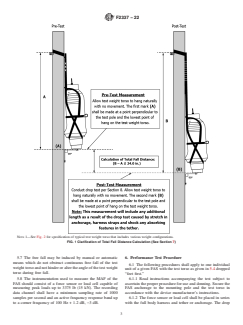
NOTE 1—See Fig. 2 for specification of typical test weight torso that includes various weight configurations.
FIG. 1 Clarification of Total Fall Distance Calculation (See Section 7)
5.7 The free fall may be induced by manual or automatic 6. Performance Test Procedure
means which do not obstruct continuous free fall of the test
6.1 The following procedures shall apply to one individual
weighttorsoandnothinderoraltertheangleofthetestweight
unit of a given FAS with the test torso as given in 5.4 dropped
torso during free fall.
“feet first.”
5.8 The instrumentation used to measure the MAF of the 6.1.1 Read instructions accompanying the test subject to
FAS should consist of a force sensor or load cell capable of ascertain the proper procedure for use and donning. Secure the
measuring peak loads up to 3375 lb (15 kN). The recording FAS anchorage to the mounting pole and the test torso in
data channel shall have a minimum sampling rate of 1000 accordance with the device manufacturer’s instructions.
samples per second and an active frequency response band up 6.1.2 The force sensor or load cell shall be placed in series
to a corner frequency of 100 Hz + 1.2 dB, −3 dB. with the full body harness and tether or anchorage. The drop
F2337 − 22
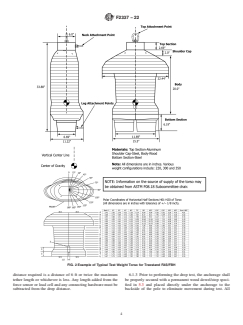
FIG. 2 Example of Typical Test Weight Torso for Treestand FAS/FBH
distance required is a distance of 6 ft or twice the maximum 6.1.3 Prior to performing the drop test, the anchorage shall
tether length or whichever is less. Any length added from the be properly secured with a permanent wood dowel/stop speci-
force sensor or load cell and any connecting hardware must be fied in 5.3 and placed directly under the anchorage to the
subtracted from the drop distance. backside of the pole to eliminate movement during test. All
F2337 − 22
surfaces shall be free of burs or sharp edges to reduce the 6.2 The following procedures shall apply to one individual
possibility of damage to the anchorage which would invalidate unit of a given FAS with the test weight torso as given in 5.4
the test. dropped “face first” (see Fig. 3 for clarification).
6.1.4 Attach the release mechanism to the test weight torso 6.2.1 Read instructions accompanying the test subject to
ascertain the proper procedure for use and donning. Secure the
at a point located at the top (see Fig. 2 for clarification). The
test weight torso specified in 5.4 shall be suspended from a FAS anchorage to the mounting pole and the test weight torso
in accordance with the device manufacturer’s instructions.
single attachment point at the top facing away from the test
pole with the center of gravity on the test pole (see Fig. 1 for
6.2.2 Thedropdistancerequiredisadistanceof6ftortwice
clarification). The test weight torso shall be raised to an
the maximum tether length, or whichever is less. Any added
elevation such that its free fall begins at the point above the
length from any connecting hardware must be subtracted from
anchorage equal to the maximum length of the tether (if the drop distance.
adjustable) or a distance which allows 6 ft of free fall,
6.2.3 Prior to performing the drop test, the anchorage shall
whichever is less. The test weight torso shall be located as
be properly secured with a permanent wood dowel/stop as
close to the pole as practical or not greater than 1 ft with no
specified in 5.3 and placed directly under the anchorage to the
tension in the tether prior to release. In such a manner, the
backside of the pole to eliminate movement during test.
free-fall distance will equal twice the maximum available
6.2.4 Attach the quick release mechanism to the test weight
length or 6 ft, whichever is less.
torso at three (3) poi
...
This document is not an ASTM standard and is intended only to provide the user of an ASTM standard an indication of what changes have been made to the previous version. Because
it may not be technically possible to adequately depict all changes accurately, ASTM recommends that users consult prior editions as appropriate. In all cases only the current version
of the standard as published by ASTM is to be considered the official document.
Designation: F2337 − 21 F2337 − 22 An American National Standard
Standard Test Method for
Treestand Fall Arrest System
This standard is issued under the fixed designation F2337; the number immediately following the designation indicates the year of
original adoption or, in the case of revision, the year of last revision. A number in parentheses indicates the year of last reapproval. A
superscript epsilon (´) indicates an editorial change since the last revision or reapproval.
1. Scope
1.1 This test method covers the determination of the load capacities for treestand fall arrest systems (FAS) and components or
subsystems.
1.2 This test method addresses equipment used in hunting situations requiring personal protection against falls from heights and
applies to the manufacturers, distributors, purchasers, and users of such equipment.
1.3 The values stated in inch-pound units are to be regarded as standard. The values given in parentheses are mathematical
conversions to SI units that are provided for information only and are not considered standard.
1.4 This standard does not purport to address all of the safety concerns, if any, associated with its use. It is the responsibility
of the user of this standard to establish appropriate safety, health, and environmental practices and determine the applicability of
regulatory limitations prior to use.
1.5 This international standard was developed in accordance with internationally recognized principles on standardization
established in the Decision on Principles for the Development of International Standards, Guides and Recommendations issued
by the World Trade Organization Technical Barriers to Trade (TBT) Committee.
2. Terminology
2.1 The terminology and definitions in the referenced documents are applicable to this practice.
2.2 Definitions:
2.2.1 anchorage, n—a component or structure, or both, to which a full body harness (FBH) is attached to the tree trunk.
2.2.2 climbing belt, n—a strap/belt (or system of straps) which is fastened about the person in a manner so as to contain the torso
and stabilize the users horizontal load while either working from a vertical position to attach treestands, climbing devices, and so
forth, or during ascent/descent of tree or ladder.
2.2.2.1 Discussion—
A FBH may be constructed to additionally serve this function.
2.2.3 connecting hardware, n—any locking hardware that connects the FAS components in series, thus creating a linear linkage
along which the maximum arrest force (MAF) acts.
This test method is under the jurisdiction of ASTM Committee F08 on Sports Equipment, Playing Surfaces, and Facilities and is the direct responsibility of Subcommittee
F08.18 on Treestands.
Current edition approved Dec. 1, 2021Nov. 1, 2022. Published December 2021November 2022. Originally approved in 2003. Last previous edition approved in 20202021
as F2337 – 20.F2337 – 21. DOI: 10.1520/F2337-21.10.1520/F2337-22.
Copyright © ASTM International, 100 Barr Harbor Drive, PO Box C700, West Conshohocken, PA 19428-2959. United States
F2337 − 22
2.2.3.1 Discussion—
Includes snap hooks, carabiners, links, anchorage hardware, and buckles.
2.2.4 connector, n—a device that is used to connect components of a full body harness, fall restraint.
2.2.4.1 Discussion—
Connectors include but are not limited to tethers, locking snap hooks, carabiners, deceleration devices, and specialty systems such
as self-retracting treestand safety ropes, ladder climbing systems, vertical treestand safety ropes and rope grab.
2.2.5 deceleration device, n—any mechanism, such as a rope grab, rip stitch tether, specially woven tether, tearing or deforming
tether, automatic self-retracting treestand safety ropes, etc. which serves to dissipate energy during fall arrest or otherwise limit
the maximum arrest force (MAF) on a user during a fall arrest.
2.2.6 deceleration distance, n—the additional vertical distance a falling user travels, excluding treestand safety rope elongation
and free-fall distance before stopping, from the point at which the deceleration device begins to operate.
2.2.7 engineered products, n—strategically designed products by a professional to meet a specific need.
2.2.8 equivalent, a, n—alternative designs, methods or materials used to protect against a hazard which the manufacturer can
demonstrate will provide an equal or greater degree of safety for the user than the methods, materials or designs specified in the
standard.
2.2.9 fall arrest system (FAS), n—the complete collection of equipment and components that is designed to stop a fall in progress.
2.2.10 free fall, v—the act of falling before a fall arrest system (FAS) begins to apply force to arrest the fall.
2.2.11 flexible stretch tether, n—a full body harness tether that expands and contracts following the user’s movement.
2.2.12 full body harness (FBH), n—a component with a design of straps which is fastened about the person in a manner so as to
contain the torso and distribute the fall arrest forces over at least the upper thighs, pelvis, chest, and shoulders with means for
attaching it to other components or subsystems.
2.2.13 maximum arrest force (MAF), n—the peak dynamic force exerted on the body during fall arrest.
2.2.14 product safety sign or label, n—sign, label, hang tag or decal affixed to a product that provides safety information about
that product.
2.2.15 rope grab, n—a device which travels on a connecting treestand safety rope and automatically, by friction, engages the
treestand safety rope and locks so as to arrest the fall of a user.
2.2.15.1 Discussion—
A rope grab usually employs the principal of inertial locking, cam/level locking, or both (that is, Prusik, Klemheist, or Autoblock
knots).
2.2.16 safety symbols, n—a graphic representation intended to convey a safety message without the use of words.
2.2.17 self-recovery point, n—the maximum distance a user can fall to minimize the risk of the user not having the ability to
recover so that they are no longer suspended in a harness after a fall has been arrested.
2.2.18 suspension relief device, n—a device to allow relief of a person’s weight on the lower extremities if suspended in a harness,
or allow the user to descend to the ground.
2.2.18.1 Discussion—
The device is to help maintain circulation in the legs and help prevent suspension trauma (blood pooling).
2.2.19 tether, n—a component of a treestand full body harness consisting of a flexible strap which is attached to the dorsal area
of the harness for the purpose of securing the FBH directly or indirectly to an anchorage to the tree trunk.
F2337 − 22
2.2.20 thigh/leg straps, n—the straps, which are integrated with the buttock strap (optional) and are routed from back to front
across the groin area or loop around the upper part of the thigh.
2.2.21 total fall distance, n—the maximum vertical distance between a full body harness anchorage and the lowest extremity of
the body before and after the fall is arrested including tether extension or drop distance, or both (refer to Fig. 1 for clarification
of total fall distance calculation).
2.2.22 treestand, n—a device designed to be affixed to a tree so as to permit an individual to sit or stand thereon for the purpose
of attaining an elevated position from which to observe, photograph, or hunt.
NOTE 1—See Fig. 2 for specification of typical test weight torso that includes various weight configurations.
FIG. 1 Clarification of Total Fall Distance Calculation (See Section 7)
F2337 − 22
2.2.23 treestand safety rope, n—component consisting of a flexible line for connection to a tree trunk at one end to hang vertically
and which serves as a means for connecting other components of a fall arrest system.
3. Summary of Test Method
3.1 One system test shall consist of the testing of one individual fall arrest system unit for maximum arrest force (MAF) in
accordance with the procedures in 6.1.
3.2 One system test shall consist of the testing of one individual fall arrest system unit for performance in accordance with the
procedures in 6.2.
3.3 One system test shall consist of testing one individual fall arrest system unit for dynamic strength in accordance with the
procedures in Section 7.
3.4 One climbing belt test shall consist of testing one individual climbing belt (for use only if FAS includes integral climbing belt)
in accordance with the procedures in Section 8.
3.5 For each test a test weight torso having the physical properties described in 5.4 or 5.5 shall be dropped from an adequate
elevation to simulate a free-fall motion from a treestand platform.
3.6 One static load test shall consist of testing one (1) individual Suspension Relief Device in accordance with the procedures in
Section 9 of this standard.
3.6.1 A Suspension Relief Device shall be provided with each FAS/FBH complete with instructions. This device shall be capable
of allowing the user to relieve the load on the user’s lower extremities if suspended in a harness to help maintain circulation in
the legs and help prevent suspension trauma (blood pooling). The capacity rating of the Suspension Relief Device shall be equal
to the FAS rated capacity.
4. Significance and Use
4.1 This test method is intended to measure the maximum arrest force and dynamic strength on treestand FAS and components
or subsystems. This test is intended for program quality assurance and production quality control purposes. It is not intended to
be an independent material or product acceptance test.
5. Apparatus
5.1 A vertical, rigid, round wood pole shall be used to mount the test weight torso and fall arrest system (FAS) such that pole
deflection is minimized during testing.
5.2 The mounting pole diameter shall be 10 6 1 in. and shall have a minimum height necessary for free fall to meet the provisions
of 6.1.4, 6.2.4, 7.1.3 – 7.1.6, and 8.1.3.
5.3 The mounting pole shall have a wood dowel/stop affixed horizontally on the backside of the pole at the point just below where
the anchorage is attached. The purpose of this stop is to prevent any vertical slippage of the anchorage during testing. This wood
dowel/stop shall be 3 6 0.25 in. in diameter, smooth, cylindrical in shape and at least 1.5 in. in length.
5.4 The test weight torso used during the performance test shall weigh 220 6 2 lb. The test weight torso shall be as shown in Fig.
2.
5.5 The test weight torso used during the dynamic strength test shall weigh 300 6 3 lb or the rated capacity of the harness 63
lb as specified on the label attached to unit to be tested.
5.6 The test weight torso and test operator shall be raised to the required elevation by means of a man lift, forklift/basket, or other
device capable of providing means to ascend to the proper elevation and provide a stable and safe working environment.
F2337 − 22
FIG. 2 Example of Typical Test Weight Torso for Treestand FAS/FBH
5.7 The free fall may be induced by manual or automatic means which do not obstruct continuous free fall of the test weight torso
and not hinder or alter the angle of the test weight torso during free fall.
5.8 The instrumentation used to measure the MAF of the FAS should consist of a force sensor or load cell capable of measuring
F2337 − 22
peak loads up to 3375 lb (15 kN). The recording data channel shall have a minimum sampling rate of 1000 samples per second
and an active frequency response band up to a corner frequency of 100 Hz + 1.2 dB, −3 dB.
6. Performance Test Procedure
6.1 The following procedures shall apply to one individual unit of a given FAS with the test torso as given in 5.4 dropped “feet
first.”
6.1.1 Read instructions accompanying the test subject to ascertain the proper procedure for use and donning. Secure the FAS
anchorage to the mounting pole and the test torso in accordance with the device manufacturer’s instructions.
6.1.2 The force sensor or load cell shall be placed in series with the full body harness and tether or anchorage. The drop distance
required is a distance of 6 ft or twice the maximum tether length or whichever is less. Any length added from the force sensor or
load cell and any connecting hardware must be subtracted from the drop distance.
6.1.3 Prior to performing the drop test, the anchorage shall be properly secured with a permanent wood dowel/stop specified in
5.3 and placed directly under the anchorage to the backside of the pole to eliminate movement during test. All surfaces shall be
free of burs or sharp edges to reduce the possibility of damage to the anchorage which would invalidate the test.
6.1.4 Attach the release mechanism to the test weight torso at a point located at the top (see Fig. 2 for clarification). The test weight
torso specified in 5.4 shall be suspended from a single attachment point at the top facing away from the test pole with the center
of gravity on the test pole (see Fig. 1 for clarification). The test weight torso shall be raised to an elevation such that its free fall
begins at the point above the anchorage equal to the maximum length of the tether (if adjustable) or a distance which allows 6 ft
of free fall, whichever is less. The test weight torso shall be located as close to the pole as practical or not greater than 1 ft with
no tension in the tether prior to release. In such a manner, the free-fall distance will equal twice the maximum available length
or 6 ft, whichever is less.
6.1.5 The test weight torso shall be dropped “feet first” or otherwise released as if to simulate a free-fall from a treestand platform.
The fall should be essentially vertical with minimal “swinging” of the test subject. The fall shall be closely observed for any
unusual or unsafe action. Measure and record the maximum arrest force (MAF), and whether or not any test weight torso detaches
from the harness. After the drop, the test weight torso is to remain suspended by the FAS for a period of 2 min.
6.1.6 After the FAS has been engaged, the test weight torso shall be lowered to the ground and the FAS inspected for damage.
Compare test results to the requirements set forth in 11.1 – 11.4.
6.2 The following procedures shall apply to one individual unit of a given FAS with the test weight torso as given in 5.4 dropped
“face first” (see Fig. 3 for clarification).
6.2.1 Read instru
...