

ASTM F2275-21
(Practice)Standard Practice for Treestand Manufacturer Quality Assurance Program
General Information
- Abstract
SIGNIFICANCE AND USE
3.1 The purpose of this practice is to provide the minimum requirements necessary for the establishment of a written quality assurance program for treestands and elevated hunting equipment.
SCOPE
1.1 This practice provides minimum requirements for a quality assurance program.
1.2 This standard does not purport to address all of the safety concerns, if any, associated with its use. It is the responsibility of the user of this standard to establish appropriate safety, health, and environmental practices and determine the applicability of regulatory limitations prior to use.
1.3 This international standard was developed in accordance with internationally recognized principles on standardization established in the Decision on Principles for the Development of International Standards, Guides and Recommendations issued by the World Trade Organization Technical Barriers to Trade (TBT) Committee.
- Status
- Published
- Publication Date
- 30-Apr-2021
- Technical Committee
- F08 - Sports Equipment, Playing Surfaces, and Facilities
- Drafting Committee
- F08.18 - Treestands




Overview
ASTM F2275-21: Standard Practice for Treestand Manufacturer Quality Assurance Program establishes the baseline requirements for implementing a written quality assurance (QA) program for the manufacture of treestands and elevated hunting equipment. Developed by ASTM International, this standard provides a foundational framework to help manufacturers ensure product quality, consistency, and compliance with applicable safety and performance standards through well-documented processes.
ASTM F2275-21 is internationally recognized and aligns with principles established by the World Trade Organization Technical Barriers to Trade (TBT) Committee, making it relevant for manufacturers seeking global market access.
Key Topics
ASTM F2275-21 specifies a series of essential procedures designed to strengthen manufacturing and product oversight, including:
- Drawing and Document Control: Requirements for maintaining and retaining engineering drawings, revisions, and related manufacturing documents to support traceability and ongoing product quality.
- Material Control: Procedures to ensure all materials, components, and processes meet the defined engineering specifications, from procurement to inventory identification and certification documentation.
- Date Coding: Mandatory permanent date coding on final assemblies to provide traceability of production batches, including clear identification of manufacture year and month (or week).
- Inspection Protocols: Steps for inspecting parts, subassemblies, purchased components, and finished units to verify conformance with specifications before delivery.
- Nonconformance Handling: Guidance on managing, evaluating, and documenting nonconforming components, including appropriate re-inspection, modification, or disposal actions.
- Testing and Compliance: Requirements to ensure products are tested and comply with the most current ASTM test methods, and practices applicable to treestands and related equipment.
- Document Retention: Retention of records and test results for the life of the product plus an additional five years after distribution ends.
- Product Modifications: Procedures for maintaining compliance when significant changes occur in product design, material, or manufacturing processes.
Applications
ASTM F2275-21 is principally intended for manufacturers of treestands and elevated hunting equipment, but is also valuable for testing laboratories, certifying bodies, and regulatory authorities. Key applications include:
- Quality Assurance Implementation: Establishing and maintaining a robust written QA program for ongoing product quality and regulatory compliance.
- Certification Preparation: As part of a broader certification process, this standard outlines essential criteria for product audit and certification readiness.
- Supply Chain Management: Supporting procurement, inspection, and traceability throughout the supply chain by formalizing procedures for material and process control.
- Safety and Reliability: Enhancing the safety and reliability of treestands for end-users by minimizing risks related to materials, manufacturing errors, and nonconformances.
- Market Access: Meeting the minimum international quality assurance requirements facilitates entry into both domestic and international markets.
Related Standards
To ensure comprehensive compliance and product performance, ASTM F2275-21 references several other key standards:
- ASTM F2123: Practice for Treestand Instructions
- ASTM F2125: Test Method for Treestand Static Stability and Adherence
- ASTM F2126: Test Method for Treestand Static Load Capacity
- ASTM F2128: Test Method for Treestand Repetitive Loading Capability
- ASTM F2337: Test Method for Treestand Fall Arrest System
- ASTM F2531: Test Method for Load Capacity of Treestand Seats
- ASTM F3249: Specification for Treestands, Climbing Sticks, and Tripod or Tower Stands
Manufacturers seeking full certification must meet all applicable requirements from these and other referenced standards to ensure comprehensive quality and safety assurance within their products.
Keywords: treestand quality assurance, ASTM F2275-21, hunting equipment standards, treestand compliance, elevated platform safety, manufacturing QA program, product certification, material control, inspection procedures, international standard.
Relations
- Refers
ASTM F3249-24 - Standard Specification for Treestands, Climbing Sticks, and Tripod or Tower Stands - Effective Date
- 01-Feb-2024
- Effective Date
- 01-Nov-2023
- Refers
ASTM F3249-20 - Standard Specification for Treestands, Climbing Sticks, and Tripod or Tower Stands - Effective Date
- 01-Apr-2020
- Effective Date
- 01-Dec-2019
- Effective Date
- 01-Jan-2019
- Effective Date
- 01-Jun-2018
- Refers
ASTM F3249-17 - Standard Specification for Treestands, Climbing Sticks, and Tripod or Tower Stands - Effective Date
- 15-Jun-2017
- Effective Date
- 01-Oct-2016
- Effective Date
- 01-May-2013
- Effective Date
- 01-Jun-2011
- Effective Date
- 01-Aug-2010
- Effective Date
- 01-May-2010
- Effective Date
- 01-Sep-2009
- Effective Date
- 01-Sep-2009
- Effective Date
- 01-Sep-2009
Get Certified
Connect with accredited certification bodies for this standard

Control Union Certifications
Global certification for agriculture and sustainability.

ECOCERT
Organic and sustainability certification.

FSC International
Forest Stewardship Council certification.
Sponsored listings
Frequently Asked Questions
ASTM F2275-21 is a standard published by ASTM International. Its full title is "Standard Practice for Treestand Manufacturer Quality Assurance Program". This standard covers: SIGNIFICANCE AND USE 3.1 The purpose of this practice is to provide the minimum requirements necessary for the establishment of a written quality assurance program for treestands and elevated hunting equipment. SCOPE 1.1 This practice provides minimum requirements for a quality assurance program. 1.2 This standard does not purport to address all of the safety concerns, if any, associated with its use. It is the responsibility of the user of this standard to establish appropriate safety, health, and environmental practices and determine the applicability of regulatory limitations prior to use. 1.3 This international standard was developed in accordance with internationally recognized principles on standardization established in the Decision on Principles for the Development of International Standards, Guides and Recommendations issued by the World Trade Organization Technical Barriers to Trade (TBT) Committee.
SIGNIFICANCE AND USE 3.1 The purpose of this practice is to provide the minimum requirements necessary for the establishment of a written quality assurance program for treestands and elevated hunting equipment. SCOPE 1.1 This practice provides minimum requirements for a quality assurance program. 1.2 This standard does not purport to address all of the safety concerns, if any, associated with its use. It is the responsibility of the user of this standard to establish appropriate safety, health, and environmental practices and determine the applicability of regulatory limitations prior to use. 1.3 This international standard was developed in accordance with internationally recognized principles on standardization established in the Decision on Principles for the Development of International Standards, Guides and Recommendations issued by the World Trade Organization Technical Barriers to Trade (TBT) Committee.
ASTM F2275-21 is classified under the following ICS (International Classification for Standards) categories: 65.145 - Hunting. The ICS classification helps identify the subject area and facilitates finding related standards.
ASTM F2275-21 has the following relationships with other standards: It is inter standard links to ASTM F3249-24, ASTM F2123-23, ASTM F3249-20, ASTM F2337-19a, ASTM F2337-19, ASTM F2337-18, ASTM F3249-17, ASTM F2337-16, ASTM F2123-13, ASTM F2337-11, ASTM F2337-10, ASTM F2126-06(2010), ASTM F2125-09, ASTM F2128-09, ASTM F2531-05(2009). Understanding these relationships helps ensure you are using the most current and applicable version of the standard.
ASTM F2275-21 is available in PDF format for immediate download after purchase. The document can be added to your cart and obtained through the secure checkout process. Digital delivery ensures instant access to the complete standard document.
Standards Content (Sample)
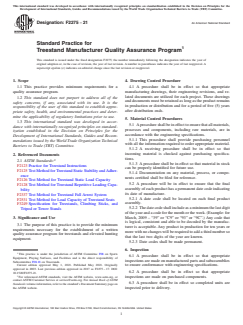
This international standard was developed in accordance with internationally recognized principles on standardization established in the Decision on Principles for the
Development of International Standards, Guides and Recommendations issued by the World Trade Organization Technical Barriers to Trade (TBT) Committee.
Designation: F2275 − 21 An American National Standard
Standard Practice for
Treestand Manufacturer Quality Assurance Program
This standard is issued under the fixed designation F2275; the number immediately following the designation indicates the year of
original adoption or, in the case of revision, the year of last revision. A number in parentheses indicates the year of last reapproval. A
superscript epsilon (´) indicates an editorial change since the last revision or reapproval.
1. Scope 4. Drawing Control Procedure
1.1 This practice provides minimum requirements for a 4.1 A procedure shall be in effect so that appropriate
quality assurance program. manufacturing drawings, their engineering revisions, and re-
lated documents are utilized for each project. These drawings
1.2 This standard does not purport to address all of the
and documents must be retained as long as the product remains
safety concerns, if any, associated with its use. It is the
in production or distribution and for a period of five (5) years
responsibility of the user of this standard to establish appro-
after distribution ends.
priate safety, health, and environmental practices and deter-
mine the applicability of regulatory limitations prior to use.
5. Material Control Procedures
1.3 This international standard was developed in accor-
5.1 Aprocedureshallbeineffecttoensurethatallmaterials,
dance with internationally recognized principles on standard-
processes and components, including raw materials, are in
ization established in the Decision on Principles for the
accordance with the engineering specifications.
Development of International Standards, Guides and Recom-
5.1.1 This procedure shall provide purchasing personnel
mendations issued by the World Trade Organization Technical
with all the information required to order appropriate material.
Barriers to Trade (TBT) Committee.
5.1.2 A receiving procedure shall be in effect so that
incoming material is checked against purchasing specifica-
2. Referenced Documents
tions.
2.1 ASTM Standards:
5.1.3 Aprocedure shall be in effect so that material in stock
F2123 Practice for Treestand Instructions
can be properly identified for future use.
F2125 Test Method for Treestand Static Stability andAdher-
5.1.4 Documentation on any material, process, or compo-
ence
nents certified shall be filed for reference.
F2126 Test Method for Treestand Static Load Capacity
5.2 A procedure will be in effect to ensure that the final
F2128 Test Method for Treestand Repetitive Loading Capa-
assembly of each product has a permanent date code indicating
bility
its date of manufacture.
F2337 Test Method for Treestand Fall Arrest System
5.2.1 A date code shall be located on each final product
F2531 Test Method for Load Capacity of Treestand Seats
assembly.
F3249 Specification for Treestands, Climbing Sticks, and
5.2.2 Thedatecodeshallincludeasaminimumthelastdigit
Tripod or Tower Stands
of the year and a code for the month or the week. (Example: for
March, 2009 – “39” or “C9” or “93” or “9C”.) Any code that
3. Significance and Use
is logical, consistent and able to be decoded by the manufac-
3.1 The purpose of this practice is to provide the minimum
turer is acceptable. Any product in production for ten years or
requirements necessary for the establishment of a written
more with no changes will be required to add a third number so
quality assurance program for treestands and elevated hunting
that the last two digits of the year are known.
equipment.
5.2.3 Date codes shall be made permanent.
6. Inspection
This practice is under the jurisdiction of ASTM Committee F08 on Sports
6.1 A procedure shall be in effect so that appropriate
Equipment, Playing Surfaces, and Facilities and is the direct responsibility of
inspections are made on manufactured parts and subassemblies
Subcommittee F08.18 on Treestands.
Current edition approved May 1, 2021. Published May 2021. Originally to ensure conformance with engineering specifications.
approved in 2003. Last previous edition approved in 2017 as F2275 – 17. DOI:
6.2 A procedure shall be in effect so that appropriat
...
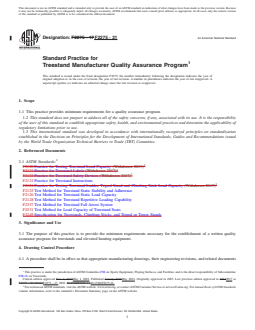
This document is not an ASTM standard and is intended only to provide the user of an ASTM standard an indication of what changes have been made to the previous version. Because
it may not be technically possible to adequately depict all changes accurately, ASTM recommends that users consult prior editions as appropriate. In all cases only the current version
of the standard as published by ASTM is to be considered the official document.
Designation: F2275 − 17 F2275 − 21 An American National Standard
Standard Practice for
Treestand Manufacturer Quality Assurance Program
This standard is issued under the fixed designation F2275; the number immediately following the designation indicates the year of
original adoption or, in the case of revision, the year of last revision. A number in parentheses indicates the year of last reapproval. A
superscript epsilon (´) indicates an editorial change since the last revision or reapproval.
1. Scope
1.1 This practice provides minimum requirements for a quality assurance program.
1.2 This standard does not purport to address all of the safety concerns, if any, associated with its use. It is the responsibility
of the user of this standard to establish appropriate safety, health, and environmental practices and determine the applicability of
regulatory limitations prior to use.
1.3 This international standard was developed in accordance with internationally recognized principles on standardization
established in the Decision on Principles for the Development of International Standards, Guides and Recommendations issued
by the World Trade Organization Technical Barriers to Trade (TBT) Committee.
2. Referenced Documents
2.1 ASTM Standards:
F2120 Practice for Testing Treestand Load Capacity (Withdrawn 2019)
F2121 Practice for Treestand Labels (Withdrawn 2017)
F2122 Practice for Treestand Safety Devices (Withdrawn 2017)
F2123 Practice for Treestand Instructions
F2124 Practice for Testing Treestand Ladder, Tripod Stand and Climbing Stick Load Capacity (Withdrawn 2017)
F2125 Test Method for Treestand Static Stability and Adherence
F2126 Test Method for Treestand Static Load Capacity
F2128 Test Method for Treestand Repetitive Loading Capability
F2337 Test Method for Treestand Fall Arrest System
F2531 Test Method for Load Capacity of Treestand Seats
F3249 Specification for Treestands, Climbing Sticks, and Tripod or Tower Stands
3. Significance and Use
3.1 The purpose of this practice is to provide the minimum requirements necessary for the establishment of a written quality
assurance program for treestands and elevated hunting equipment.
4. Drawing Control Procedure
4.1 A procedure shall be in effect so that appropriate manufacturing drawings, their engineering revisions, and related documents
This practice is under the jurisdiction of ASTM Committee F08 on Sports Equipment, Playing Surfaces, and Facilities and is the direct responsibility of Subcommittee
F08.18 on Treestands.
Current edition approved Dec. 1, 2017May 1, 2021. Published January 2018May 2021. Originally approved in 2003. Last previous edition approved in 20142017 as
F2275 – 10 (2014).F2275 – 17. DOI: 10.1520/F2275-17.10.1520/F2275-21.
For referenced ASTM standards, visit the ASTM website, www.astm.org, or contact ASTM Customer Service at service@astm.org. For Annual Book of ASTM Standards
volume information, refer to the standard’s Document Summary page on the ASTM website.
Copyright © ASTM International, 100 Barr Harbor Drive, PO Box C700, West Conshohocken, PA 19428-2959. United States
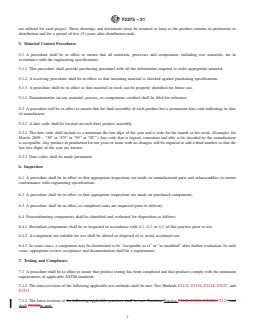
F2275 − 21
are utilized for each project. These drawings and documents must be retained as long as the product remains in production or
distribution and for a period of five (5) years after distribution ends.
5. Material Control Procedures
5.1 A procedure shall be in effect to ensure that all materials, processes and components, including raw materials, are in
accordance with the engineering specifications.
5.1.1 This procedure shall provide purchasing personnel with all the information required to order appropriate material.
5.1.2 A receiving procedure shall be in effect so that incoming material is checked against purchasing specifications.
5.1.3 A procedure shall be in effect so that material in stock can be properly identified for future use.
5.1.4 Documentation on any material, process, or components certified shall be filed for reference.
5.2 A procedure will be in effect to ensure that the final assembly of each product has a permanent date code indicating its date
of manufacture.
5.2.1 A date code shall be located on each final product assembly.
5.2.2 The date code shall include as a minimum the last digit of the year and a code for the month or the week. (Example: for
March, 200
...