

ASTM F3544-21
(Test Method)Standard Test Method for Hunting Saddle Static Load Capacity
General Information
- Abstract
SIGNIFICANCE AND USE
5.1 This test method is intended for quality assurance and production control purposes.
SCOPE
1.1 This test method covers the determination of the static load capacity of hunting saddles and bridge in terms of a factor of safety relative to the manufacturer’s rated capacity.
1.2 The values shared are in inch-pound units and are to be regarded as the standard. No other units of measurement are included in this standard.
1.3 This standard does not purport to address all of the safety concerns, if any, associated with its use. It is the responsibility of the user of this standard to establish appropriate safety, health, and environmental practices and determine the applicability of regulatory limitations prior to use.
1.4 This international standard was developed in accordance with internationally recognized principles on standardization established in the Decision on Principles for the Development of International Standards, Guides and Recommendations issued by the World Trade Organization Technical Barriers to Trade (TBT) Committee.
- Status
- Published
- Publication Date
- 30-Nov-2021
- Technical Committee
- F08 - Sports Equipment, Playing Surfaces, and Facilities
- Drafting Committee
- F08.18 - Treestands


Overview
ASTM F3544-21: Standard Test Method for Hunting Saddle Static Load Capacity provides an internationally recognized procedure for determining the static load capacity of hunting saddles and bridges. Developed by ASTM International, this standard is essential for evaluating safety in accordance with the manufacturer’s rated capacity, ensuring consistent quality during quality assurance and production control. This test method exclusively uses inch-pound units and aligns with World Trade Organization Technical Barriers to Trade (TBT) Committee principles.
Key Topics
- Purpose: The primary goal is to assess the ability of hunting saddles to withstand static loads in relation to the stated rated capacity by the manufacturer.
- Quality Control: Designed for use in both quality assurance and production settings, making it a critical reference for manufacturers and third-party testing organizations.
- Test Setup:
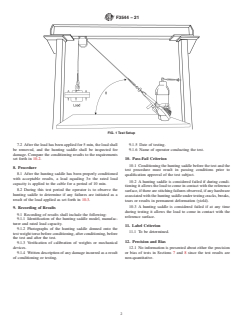
- Hunting saddle is donned on a rigidly mounted test weight torso.
- A cable is attached to the saddle’s bridge and subjected to forces via calibrated weights or mechanical devices.
- The orientation and alignment of the pulley, cable, and test weight torso are controlled for repeatability.
- Conditioning and Testing:
- Saddles undergo a conditioning phase with the rated load applied for 5 minutes, followed by inspection for visible damage.
- After successful conditioning, a static load three times the rated capacity is applied for 10 minutes to evaluate structural integrity.
- Pass/Fail Criteria: Includes loss of saddle support, stitching or hardware failures, cracking, breakage, tearing, or permanent deformation as causes for failure.
Applications
- Manufacturers: Use this standard to verify the static load rating of hunting saddles prior to release or mass production, promoting user safety and regulatory compliance.
- Third-party Testing Labs: Employ the method as an authoritative benchmark in certifying hunting saddles, supporting regulatory submissions and retailer requirements.
- Product Development: Engineering teams can reference ASTM F3544-21 during design and prototyping to test various materials and constructions for durability under stress.
- Quality Control: In production environments, periodic sampling and testing as outlined ensure batch-to-batch consistency, helping prevent field failures and recalls.
- Consumer Confidence: Products tested according to ASTM F3544-21 provide end users with assurance of robust performance standards and greater safety.
Related Standards
- ASTM F2337: Test Method for Treestand Fall Arrest System - referenced for mounting the test weight torso, connecting fall protection methodologies.
- ASTM F3543: Terminology Relating to Hunting Saddles - provides essential definitions and consistent terminology to support this and allied standards.
By adhering to ASTM F3544-21, organizations ensure hunting saddles are rigorously evaluated for static load capacity, bolstering product safety and reliability. This standard is integral for manufacturers, test labs, and regulatory authorities committed to maintaining high-quality and trustworthy hunting equipment on the market.
Relations
- Effective Date
- 01-Dec-2019
- Effective Date
- 01-Jan-2019
- Effective Date
- 01-Jun-2018
- Effective Date
- 01-Oct-2016
- Effective Date
- 01-Jun-2011
- Effective Date
- 01-Aug-2010
- Effective Date
- 01-Apr-2008
- Effective Date
- 01-Nov-2003
Get Certified
Connect with accredited certification bodies for this standard

Control Union Certifications
Global certification for agriculture and sustainability.

ECOCERT
Organic and sustainability certification.

FSC International
Forest Stewardship Council certification.
Sponsored listings
Frequently Asked Questions
ASTM F3544-21 is a standard published by ASTM International. Its full title is "Standard Test Method for Hunting Saddle Static Load Capacity". This standard covers: SIGNIFICANCE AND USE 5.1 This test method is intended for quality assurance and production control purposes. SCOPE 1.1 This test method covers the determination of the static load capacity of hunting saddles and bridge in terms of a factor of safety relative to the manufacturer’s rated capacity. 1.2 The values shared are in inch-pound units and are to be regarded as the standard. No other units of measurement are included in this standard. 1.3 This standard does not purport to address all of the safety concerns, if any, associated with its use. It is the responsibility of the user of this standard to establish appropriate safety, health, and environmental practices and determine the applicability of regulatory limitations prior to use. 1.4 This international standard was developed in accordance with internationally recognized principles on standardization established in the Decision on Principles for the Development of International Standards, Guides and Recommendations issued by the World Trade Organization Technical Barriers to Trade (TBT) Committee.
SIGNIFICANCE AND USE 5.1 This test method is intended for quality assurance and production control purposes. SCOPE 1.1 This test method covers the determination of the static load capacity of hunting saddles and bridge in terms of a factor of safety relative to the manufacturer’s rated capacity. 1.2 The values shared are in inch-pound units and are to be regarded as the standard. No other units of measurement are included in this standard. 1.3 This standard does not purport to address all of the safety concerns, if any, associated with its use. It is the responsibility of the user of this standard to establish appropriate safety, health, and environmental practices and determine the applicability of regulatory limitations prior to use. 1.4 This international standard was developed in accordance with internationally recognized principles on standardization established in the Decision on Principles for the Development of International Standards, Guides and Recommendations issued by the World Trade Organization Technical Barriers to Trade (TBT) Committee.
ASTM F3544-21 is classified under the following ICS (International Classification for Standards) categories: 65.145 - Hunting. The ICS classification helps identify the subject area and facilitates finding related standards.
ASTM F3544-21 has the following relationships with other standards: It is inter standard links to ASTM F2337-19a, ASTM F2337-19, ASTM F2337-18, ASTM F2337-16, ASTM F2337-11, ASTM F2337-10, ASTM F2337-08, ASTM F2337-03. Understanding these relationships helps ensure you are using the most current and applicable version of the standard.
ASTM F3544-21 is available in PDF format for immediate download after purchase. The document can be added to your cart and obtained through the secure checkout process. Digital delivery ensures instant access to the complete standard document.
Standards Content (Sample)
This international standard was developed in accordance with internationally recognized principles on standardization established in the Decision on Principles for the
Development of International Standards, Guides and Recommendations issued by the World Trade Organization Technical Barriers to Trade (TBT) Committee.
Designation: F3544 − 21
Standard Test Method for
Hunting Saddle Static Load Capacity
This standard is issued under the fixed designation F3544; the number immediately following the designation indicates the year of
original adoption or, in the case of revision, the year of last revision. A number in parentheses indicates the year of last reapproval. A
superscript epsilon (´) indicates an editorial change since the last revision or reapproval.
1. Scope 5. Significance and Use
1.1 This test method covers the determination of the static
5.1 This test method is intended for quality assurance and
loadcapacityofhuntingsaddlesandbridgeintermsofafactor
production control purposes.
of safety relative to the manufacturer’s rated capacity.
6. Apparatus
1.2 The values shared are in inch-pound units and are to be
regarded as the standard. No other units of measurement are
6.1 Referring to Fig. 1, a hunting saddle test specimen is
included in this standard.
donned on the test weight torso as specified in Test Method
1.3 This standard does not purport to address all of the
F2337.
safety concerns, if any, associated with its use. It is the
6.2 The said test weight torso is rigidly mounted to a
responsibility of the user of this standard to establish appro-
referencesurface.Thetestweighttorsomaybesupportedfrom
priate safety, health, and environmental practices and deter-
a vertical and horizontal position to ensure no movement
mine the applicability of regulatory limitations prior to use.
occurs during the test execution.
1.4 This international standard was developed in accor-
dance with internationally recognized principles on standard- 6.3 A cable is attached to a minimum 3000 lb rated
connectorwithadiameterof ⁄8in.Theconnectorisattachedto
ization established in the Decision on Principles for the
Development of International Standards, Guides and Recom- thebridgeofthehuntingsaddle.Careshouldbetakentoensure
the connector is centered on the bridge.
mendations issued by the World Trade Organization Technical
Barriers to Trade (TBT) Committee.
6.4 Apulley is rigidly mounted above the reference surface
locating the test weight torso. Care should be taken to ensure
2. Referenced Documents
the pully is aligned with the center of the test weight torso.
2.1 ASTM Standards:
6.5 The cable is positioned over the pulley. The angle ɵ
F2337 Test Method for Treestand Fall Arrest System
equaling45°ismeasuredbetweenthereferencesurfaceandthe
F3543 Terminology Relating to Hunting Saddles
cabletoensureproperloadonthebridgeofthehuntingsaddle.
3. Terminology
6.6 The rated load equaling the rated load printed on the
3.1 Terminology and definitions applicable to this test
product label or in the manufacturer’s instructions shall be
method are referenced in Terminology F3543.
applied to the cable using calibrated weights or a mechanical
deviceinconjunctionwithacalibratedloadcell.Theloadshall
4. Summary of Test Method
beappliedaminimumof1ftabovethereferencesurfacewhen
4.1 A hunting saddle is donned on a rigidly mounted test
the load is fully engaged. Caution should be exercised for
weight torso. A cable is attached to the bridge of the hunting
operator protection with the use of weights in the case of
saddle.Thecableispositionedoverapulleyatadefinedangle.
slippage or premature failure.
A defined weight is suspended from the cable during a
6.7 The use of a mechanical device such as a tensile test
conditioning break-in period and during the static load evalu-
machine or hydraulic load device requires the use of a
ation period.
calibrated load cell to ensure the proper load is applied.
This test method is under the jurisdiction of ASTM Committee F08 on Sports
Equipment, Playing Surfaces, and Facilities and is the direct responsibility of 7. Conditioning
Subcommittee F08.18 on Treestands.
7.1 Referring to Fig. 1, a load equal to the rated load
Current edition approved Dec. 1, 2021. Published F
...