

ASTM D4092-21
(Terminology)Standard Terminology for Plastics: Dynamic Mechanical Properties
General Information
- Abstract
SCOPE
1.1 This terminology is a compilation of definitions and descriptions of technical terms used in dynamic mechanical property measurements on polymeric materials, including solutions, melts, and solids. Terms that are generally understood or defined adequately in other readily available sources are either not included or sources identified.
1.2 A definition is a single sentence with additional information included in notes. It is reviewed every five years and the year of the last review or revision is appended.
1.3 Definitions identical to those published by another standards organization or ASTM committee are identified with the abbreviation of the name of the organization or the ASTM committee.
1.4 Descriptions of terms specific to dynamic mechanical measurements are identified with an italicized introductory phrase.
Note 1: This terminology standard is similar to ISO 6721–1 however, the ISO document cites fewer terms.
1.5 This international standard was developed in accordance with internationally recognized principles on standardization established in the Decision on Principles for the Development of International Standards, Guides and Recommendations issued by the World Trade Organization Technical Barriers to Trade (TBT) Committee.
- Status
- Published
- Publication Date
- 30-Sep-2021
- Technical Committee
- D20 - Plastics
- Drafting Committee
- D20.10 - Mechanical Properties

Overview
ASTM D4092-21: Standard Terminology for Plastics: Dynamic Mechanical Properties provides a comprehensive set of definitions and descriptions for key terms used in dynamic mechanical property measurements of polymeric materials, including solutions, melts, and solids. Developed by ASTM International, this standard ensures consistent use of terminology in testing, research, and industry applications involving plastics’ dynamic mechanical properties. The document supports polymer scientists, engineers, and quality control professionals by clarifying language around test methods, results, and reporting in the field.
Key Topics
ASTM D4092-21 covers terminology central to dynamic mechanical analysis (DMA) in plastics, aiding accurate communication and data comparison across laboratories and industries. Key terminology areas include:
- Dynamic Mechanical Measurement: Definitions for techniques involving modulus and damping measurements under oscillatory load or displacement as functions of temperature, frequency, or time.
- Complex Modulus (E, G, K*)**: Clarification of different modulus types-tension, compression, flexure, and shear-vital for interpreting DMA results.
- Damping and Energy Loss: Terms like damping, damping ratio, and energy loss explain how polymers dissipate energy as heat when cyclically deformed.
- Glass Transition and Related Parameters: Includes “glass transition,” “glass transition temperature (Tg),” and how these affect mechanical behavior and analyses.
- Phase Angle and Loss Factor (tan δ): Critical concepts for describing the relationship between applied stress and resulting strain, and for quantifying viscoelastic properties.
- Shear, Strain, and Stress: Standardized definitions for measurement and reporting of key mechanical properties.
- Hysteresis and Damping Peaks: Alpha (α), beta (β), and gamma (γ) loss peaks, as well as the hysteresis loop, are included for comprehensive loss and modulus profiling.
- Storage and Loss Modulus: Clear distinction between stored energy and energy dissipated during loading cycles.
- Measurement Techniques: Descriptions of resonant and nonresonant forced vibration techniques used in dynamic mechanical property evaluation.
Applications
The standardized terminology in ASTM D4092-21 offers widespread practical value:
- Enhancing Data Comparability: Ensures consistent language in technical reports, research papers, and certificates of analysis, facilitating data comparison across labs and organizations.
- Supporting Quality Control: Assists professionals in quality assurance roles to interpret DMA data accurately for compliance with product specifications.
- Enabling Research and Development: Streamlines communication in R&D across polymer formulation, product design, and structural analysis where dynamic mechanical properties are critical.
- References in Product Standards: Useful as a reference for specifying test methods and property requirements in product standards and regulatory filings.
- Training and Education: Serves as a foundational terminology resource for training new scientists, engineers, and technical staff in the plastics and materials industries.
Related Standards
ASTM D4092-21 aligns with and references several other essential standards, providing a harmonized foundation for dynamic mechanical property measurement:
- ASTM D883: Terminology Relating to Plastics
- ASTM D653: Terminology Relating to Soil, Rock, and Contained Fluids
- ASTM E6: Terminology Relating to Methods of Mechanical Testing
- ISO 472: Plastics – Vocabulary
- ISO 6721-1: Plastics – Determination of Dynamic Mechanical Properties, Part 1: General Principles
By referencing these documents, ASTM D4092-21 maintains synergy within the broader landscape of material standards, promoting global compatibility and best practices in plastics testing.
For professionals in plastics research, product development, and quality assurance, adherence to ASTM D4092-21 assures the highest clarity and reliability in dynamic mechanical property measurement and reporting.
Relations
- Effective Date
- 01-Feb-2024
- Effective Date
- 01-Nov-2023
- Effective Date
- 01-Jan-2020
- Effective Date
- 01-Aug-2019
- Effective Date
- 15-Apr-2019
- Effective Date
- 01-Feb-2019
- Effective Date
- 01-Dec-2018
- Effective Date
- 01-Nov-2018
- Effective Date
- 15-Aug-2017
- Effective Date
- 01-Aug-2014
- Effective Date
- 15-Nov-2012
- Effective Date
- 01-Sep-2011
- Effective Date
- 15-May-2011
- Effective Date
- 15-May-2009
- Effective Date
- 15-May-2009
Get Certified
Connect with accredited certification bodies for this standard

DIN CERTCO
DIN Group product certification.

Smithers Quality Assessments
US management systems and product certification.
Sponsored listings
Frequently Asked Questions
ASTM D4092-21 is a standard published by ASTM International. Its full title is "Standard Terminology for Plastics: Dynamic Mechanical Properties". This standard covers: SCOPE 1.1 This terminology is a compilation of definitions and descriptions of technical terms used in dynamic mechanical property measurements on polymeric materials, including solutions, melts, and solids. Terms that are generally understood or defined adequately in other readily available sources are either not included or sources identified. 1.2 A definition is a single sentence with additional information included in notes. It is reviewed every five years and the year of the last review or revision is appended. 1.3 Definitions identical to those published by another standards organization or ASTM committee are identified with the abbreviation of the name of the organization or the ASTM committee. 1.4 Descriptions of terms specific to dynamic mechanical measurements are identified with an italicized introductory phrase. Note 1: This terminology standard is similar to ISO 6721–1 however, the ISO document cites fewer terms. 1.5 This international standard was developed in accordance with internationally recognized principles on standardization established in the Decision on Principles for the Development of International Standards, Guides and Recommendations issued by the World Trade Organization Technical Barriers to Trade (TBT) Committee.
SCOPE 1.1 This terminology is a compilation of definitions and descriptions of technical terms used in dynamic mechanical property measurements on polymeric materials, including solutions, melts, and solids. Terms that are generally understood or defined adequately in other readily available sources are either not included or sources identified. 1.2 A definition is a single sentence with additional information included in notes. It is reviewed every five years and the year of the last review or revision is appended. 1.3 Definitions identical to those published by another standards organization or ASTM committee are identified with the abbreviation of the name of the organization or the ASTM committee. 1.4 Descriptions of terms specific to dynamic mechanical measurements are identified with an italicized introductory phrase. Note 1: This terminology standard is similar to ISO 6721–1 however, the ISO document cites fewer terms. 1.5 This international standard was developed in accordance with internationally recognized principles on standardization established in the Decision on Principles for the Development of International Standards, Guides and Recommendations issued by the World Trade Organization Technical Barriers to Trade (TBT) Committee.
ASTM D4092-21 is classified under the following ICS (International Classification for Standards) categories: 01.040.83 - Rubber and plastics industries (Vocabularies); 83.080.01 - Plastics in general. The ICS classification helps identify the subject area and facilitates finding related standards.
ASTM D4092-21 has the following relationships with other standards: It is inter standard links to ASTM D883-24, ASTM D883-23, ASTM D883-20, ASTM D883-19c, ASTM D883-19a, ASTM D883-19, ASTM D883-18a, ASTM D883-18, ASTM D883-17, ASTM D653-14, ASTM D883-12e1, ASTM D653-11, ASTM D883-11, ASTM E6-09b, ASTM E6-09be1. Understanding these relationships helps ensure you are using the most current and applicable version of the standard.
ASTM D4092-21 is available in PDF format for immediate download after purchase. The document can be added to your cart and obtained through the secure checkout process. Digital delivery ensures instant access to the complete standard document.
Standards Content (Sample)
This international standard was developed in accordance with internationally recognized principles on standardization established in the Decision on Principles for the
Development of International Standards, Guides and Recommendations issued by the World Trade Organization Technical Barriers to Trade (TBT) Committee.
Designation: D4092 − 21
Standard Terminology for
Plastics: Dynamic Mechanical Properties
This standard is issued under the fixed designation D4092; the number immediately following the designation indicates the year of
original adoption or, in the case of revision, the year of last revision.Anumber in parentheses indicates the year of last reapproval.A
superscript epsilon (´) indicates an editorial change since the last revision or reapproval.
This standard has been approved for use by agencies of the U.S. Department of Defense.
1. Scope* D2231Practice for Rubber Properties in Forced Vibration
(Withdrawn 1998)
1.1 This terminology is a compilation of definitions and
E6Terminology Relating to Methods of Mechanical Testing
descriptions of technical terms used in dynamic mechanical
2.2 ISO Standards:
property measurements on polymeric materials, including
ISO 472:1988 (E/F) Definitions
solutions, melts, and solids. Terms that are generally under-
ISO 6721–11994 (E) Plastics-Determination of Dynamic
stood or defined adequately in other readily available sources
Mechanical Properties, Part 1, General Principles
are either not included or sources identified.
1.2 A definition is a single sentence with additional infor-
3. Terminology Definitions and Descriptions
mation included in notes. It is reviewed every five years and
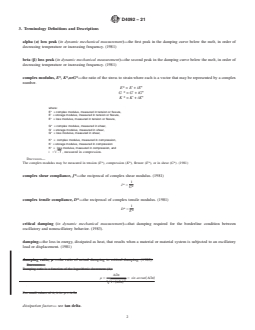
alpha (α) loss peak (in dynamic mechanical measurement)—
the year of the last review or revision is appended.
the first peak in the damping curve below the melt, in order
1.3 Definitions identical to those published by another
of decreasing temperature or increasing frequency. (1981)
standards organization orASTM committee are identified with
the abbreviation of the name of the organization or theASTM
beta (β) loss peak (indynamicmechanicalmeasurement)—the
committee.
second peak in the damping curve below the melt, in order
of decreasing temperature or increasing frequency. (1981)
1.4 Descriptions of terms specific to dynamic mechanical
measurements are identified with an italicized introductory
complex modulus, E*, K*, or G*—the ratio of the stress to
phrase.
strain where each is a vector that may be represented by a
complex number.
NOTE 1—This terminology standard is similar to ISO 6721–1 however,
the ISO document cites fewer terms. E*=E'+iE"
G*=G'+iG"
1.5 This international standard was developed in accor-
K*=K'+iK"
dance with internationally recognized principles on standard-
ization established in the Decision on Principles for the where:
E* = complex modulus, measured in tension or flexure,
Development of International Standards, Guides and Recom-
E' = storage modulus, measured in tension or flexure,
mendations issued by the World Trade Organization Technical
E9 = loss modulus, measured in tension or flexure,
Barriers to Trade (TBT) Committee.
G* = complex modulus, measured in shear,
G' = storage modulus, measured in shear,
2. Referenced Documents
G9 = loss modulus, measured in shear,
2.1 ASTM Standards:
K* = complex modulus, measured in compression,
D653Terminology Relating to Soil, Rock, and Contained K' = storage modulus, measured in compression
K9 = loss modulus, measured in compression, and
Fluids
i 5 21 , measured in compression.
œ
D883Terminology Relating to Plastics
DISCUSSION—The complex modulus may be measured in tension
(E*), compression (K*), flexure (E*), or in shear (G*). (1981)
1 complex shear compliance, J*—the reciprocal of complex
ThisterminologyisunderthejurisdictionofASTMCommitteeD20onPlastics
and is the direct responsibility of Subcommittee D20.10 on Mechanical Properties.
shear modulus. (1981)
Current edition approved Oct. 1, 2021. Published October 2021. Originally
approved in 1982. Last previous edition approved in 2013 as D4092-07(2013).
DOI: 10.1520/D4092-21.
2 3
For referenced ASTM standards, visit the ASTM website, www.astm.org, or The last approved version of this historical standard is referenced on
contact ASTM Customer Service at service@astm.org. For Annual Book of ASTM www.astm.org.
Standards volume information, refer to the standard’s Document Summary page on Available fromAmerican National Standards Institute (ANSI), 25 W. 43rd St.,
the ASTM website. 4th Floor, New York, NY 10036, http://www.ansi.org.
*A Summary of Changes section appears at the end of this standard
Copyright © ASTM International, 100 Barr Harbor Drive, PO Box C700, West Conshohocken, PA 19428-2959. United States
D4092 − 21
takes place in a specific electrical, mechanical, or other physical
J* 5
property. Moreover, the observed temperature can vary significantly,
G*
depending on the specific property chosen for observation and on
complex tensile compliance, D*—the reciprocal of complex details of the experimental technique (for example, rate of heating,
frequency). Therefore, the observed T should be considered only an
tensile modulus. (1981)
g
estimate. The most reliable estimates are normally obtained from the
loss peak observed in dynamic mechanical tests or from dilatometric
D* 5
E*
data. (D20) (1981)
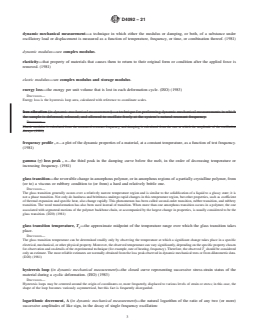
critical damping (indynamicmechanicalmeasurement)—that
hysteresis loop (in dynamic mechanical measurement)—the
damping required for the borderline condition between
closed curve representing successive stress-strain status of
oscillatory and nonoscillatory behavior. (1983).
the material during a cyclic deformation. (ISO) (1983)
DISCUSSION—Hysteresis loops may be centered around the origin of
damping—the loss in energy, dissipated as heat, that results
coordinates or, more frequently, displaced to various levels of strain or
when a material or material system is subjected to an
stress; in this case, the shape of the loop becomes variously
oscillatory load or displacement. (1981)
asymmetrical, but this fact is frequently disregarded.
dissipation factor— see tan delta.
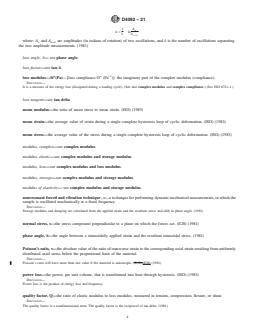
logarithmic decrement, ∆ (in dynamic mechanical
dynamic mechanical measurement—a technique in which
measurement)—the natural logarithm of the ratio of any two
eitherthemodulusordamping,orboth,ofasubstanceunder
(or more) successive amplitudes of like sign, in the decay of
oscillatoryloadordisplacementismeasuredasafunctionof
single frequency oscillation:
temperature, frequency, or time, or combination thereof.
1 A
n
(1981)
∆ 5 ln
k A
n1k
dynamic modulus—see complex modulus.
where: A and A are amplitudes (in radians of rotation)
n n+k
elasticity—thatpropertyofmaterialsthatcausesthemtoreturn
of two oscillations, and k is the number of oscillations sepa-
to their original form or condition after the applied force is
rating the two amplitude measurements. (1981)
removed. (1981)
loss angle, δ— see phase angle.
elastic modulus—see complex modulus and storage modu-
loss factor—see tan δ.
lus.
−1
loss modulus—M"(Pa)—[loss compliance O" (Pa )]: the
energy loss—the energy per unit volume that is lost in each
imaginary part of the complex modulus (compliance).
deformation cycle. (ISO) (1983)
DISCUSSION—It is a measure of the energy lost (dissipated during a
DISCUSSION—Energy loss is the hysteresis loop area, calculated with
loadingcycle).(Seealso complex modulusand complex compliance.)
reference to coordinate scales.
(See ISO 6721–1.)
frequency profile , n—a plot of the dynamic properties of a
loss tangent—see tan delta.
material, at a constant temperature, as a function of test
mean modulus—theratioofmeanstresstomeanstrain.(ISO)
frequency. (1981)
(1983)
gamma (γ) loss peak , n—the third peak in the damping curve
below the melt, in the order of decreasing temperature or mean strain—the average value of strain during a single
increasing frequency. (1981)
completehysteresisloopofcyclicdeformation.(ISO)(1983)
glass transition—the reversible change in amorphous
mean stress—the average value of the stress during a single
polymer, or in amorphous regions of a partially crystalline
completehysteresisloopofcyclicdeformation.(ISO)(1983)
polymer, from (or to) a viscous or rubbery condition to (or
modulus, complex—see complex modulus.
from) a hard and relatively brittle one.
DISCUSSION—The glass transition generally occurs over a relatively modulus, elastic—see complex modulus and storage modu-
narrowtemperatureregionandissimilartothesolidificationofaliquid
lus.
to a glassy state; it is not a phase transition. Not only do hardness a
...
This document is not an ASTM standard and is intended only to provide the user of an ASTM standard an indication of what changes have been made to the previous version. Because
it may not be technically possible to adequately depict all changes accurately, ASTM recommends that users consult prior editions as appropriate. In all cases only the current version
of the standard as published by ASTM is to be considered the official document.
Designation: D4092 − 07 (Reapproved 2013) D4092 − 21
Standard Terminology for
Plastics: Dynamic Mechanical Properties
This standard is issued under the fixed designation D4092; the number immediately following the designation indicates the year of
original adoption or, in the case of revision, the year of last revision. A number in parentheses indicates the year of last reapproval. A
superscript epsilon (´) indicates an editorial change since the last revision or reapproval.
This standard has been approved for use by agencies of the U.S. Department of Defense.
1. Scope Scope*
1.1 This terminology is a compilation of definitions and descriptions of technical terms used in dynamic mechanical property
measurements on polymeric materials, including solutions, melts, and solids. Terms that are generally understood or defined
adequately in other readily available sources are either not included or sources identified.
1.2 A definition is a single sentence with additional information included in notes. It is reviewed every five years and the year of
the last review or revision is appended.
1.3 Definitions identical to those published by another standards organization or ASTM committee are identified with the
abbreviation of the name of the organization or the ASTM committee.
1.4 Descriptions of terms specific to dynamic mechanical measurements are identified with an italicized introductory phrase.
NOTE 1—This terminology standard is similar to ISO 6721–1 however, the ISO document cites fewer terms.
1.5 This international standard was developed in accordance with internationally recognized principles on standardization
established in the Decision on Principles for the Development of International Standards, Guides and Recommendations issued
by the World Trade Organization Technical Barriers to Trade (TBT) Committee.
2. Referenced Documents
2.1 ASTM Standards:
D653 Terminology Relating to Soil, Rock, and Contained Fluids
D883 Terminology Relating to Plastics
D2231 Practice for Rubber Properties in Forced Vibration (Withdrawn 1998)
E6 Terminology Relating to Methods of Mechanical Testing
2.2 ISO Standards:
ISO 472: 1988 (E/F) Definitions
ISO 6721–1 1994 (E) Plastics-Determination of Dynamic Mechanical Properties, Part 1, General Principles
This terminology is under the jurisdiction of ASTM Committee D20 on Plastics and is the direct responsibility of Subcommittee D20.10 on Mechanical Properties.
Current edition approved May 1, 2013Oct. 1, 2021. Published May 2013October 2021. Originally approved in 1982. Last previous edition approved in 20072013 as
D4092 - 07.D4092 - 07(2013). DOI: 10.1520/D4092-07R13.10.1520/D4092-21.
For referenced ASTM standards, visit the ASTM website, www.astm.org, or contact ASTM Customer Service at service@astm.org. For Annual Book of ASTM Standards
volume information, refer to the standard’s Document Summary page on the ASTM website.
The last approved version of this historical standard is referenced on www.astm.org.
Available from American National Standards Institute (ANSI), 25 W. 43rd St., 4th Floor, New York, NY 10036, http://www.ansi.org.
*A Summary of Changes section appears at the end of this standard
Copyright © ASTM International, 100 Barr Harbor Drive, PO Box C700, West Conshohocken, PA 19428-2959. United States
D4092 − 21
3. Terminology Definitions and Descriptions
alpha (α) loss peak (in dynamic mechanical measurement)—the first peak in the damping curve below the melt, in order of
decreasing temperature or increasing frequency. (1981)
beta (β) loss peak (in dynamic mechanical measurement)—the second peak in the damping curve below the melt, in order of
decreasing temperature or increasing frequency. (1981)
complex modulus, E*, K*,orG*—the ratio of the stress to strain where each is a vector that may be represented by a complex
number.
E* = E' + iE"
G * = G' + iG"
K * = K' + iK"
where:
E* = complex modulus, measured in tension or flexure,
E' = storage modulus, measured in tension or flexure,
E9 = loss modulus, measured in tension or flexure,
G* = complex modulus, measured in shear,
G' = storage modulus, measured in shear,
G9 = loss modulus, measured in shear,
K* = complex modulus, measured in compression,
K' = storage modulus, measured in compression
K9 = loss modulus, measured in compression, and
i 5 21 , measured in compression.
œ
DISCUSSION—
The complex modulus may be measured in tension (E*), compression (K*), flexure (E*), or in shear (G*). (1981)
complex shear compliance, J*—the reciprocal of complex shear modulus. (1981)
J*5
G*
complex tensile compliance, D*—the reciprocal of complex tensile modulus. (1981)
D*5
E*
critical damping (in dynamic mechanical measurement)—that damping required for the borderline condition between
oscillatory and nonoscillatory behavior. (1983).
damping—the loss in energy, dissipated as heat, that results when a material or material system is subjected to an oscillatory
load or displacement. (1981)
damping ratio, μ —the ratio of actual damping to critical damping. (1983).
DISCUSSION—
Damping ratio is a function of the logarithmic decrement (Δ):
Δ/2π
μ 5 5 sin arctan~Δ/2π!
=11~Δ/2π!
For small values of Δ, it is: μ = Δ ⁄2π
dissipation factor— see tan delta.
D4092 − 21
dynamic mechanical measurement—a technique in which either the modulus or damping, or both, of a substance under
oscillatory load or displacement is measured as a function of temperature, frequency, or time, or combination thereof. (1981)
dynamic modulus—see complex modulus.
elasticity—that property of materials that causes them to return to their original form or condition after the applied force is
removed. (1981)
elastic modulus—see complex modulus and storage modulus.
energy loss—the energy per unit volume that is lost in each deformation cycle. (ISO) (1983)
DISCUSSION—
Energy loss is the hysteresis loop area, calculated with reference to coordinate scales.
free vibration (in dynamic mechanical measurement)—a technique for performing dynamic mechanical measurements in which
the sample is deformed, released, and allowed to oscillate freely at the system’s natural resonant frequency.
DISCUSSION—
Elastic modulus is calculated from the measured resonant frequency, and damping is calculated from the rate at which the amplitude of the oscillation
decays. (1981)
frequency profile , n—a plot of the dynamic properties of a material, at a constant temperature, as a function of test frequency.
(1981)
gamma (γ) loss peak , n—the third peak in the damping curve below the melt, in the order of decreasing temperature or
increasing frequency. (1981)
glass transition—the reversible change in amorphous polymer, or in amorphous regions of a partially crystalline polymer, from
(or to) a viscous or rubbery condition to (or from) a hard and relatively brittle one.
DISCUSSION—
The glass transition generally occurs over a relatively narrow temperature region and is similar to the solidification of a liquid to a glassy state; it is
not a phase transition. Not only do hardness and brittleness undergo rapid changes in this temperature region, but other properties, such as coefficient
of thermal expansion and specific heat, also change rapidly. This phenomenon has been called second-order transition, rubber transition, and rubbery
transition. The word transformation has also been used instead of transition. When more than one amorphous transition occurs in a polymer, the one
associated with segmental motions of the polymer backbone chain, or accompanied by the largest change in properties, is usually considered to be the
glass transition. (D20) (1981)
glass transition temperature, T —the approximate midpoint of the temperature range over which the glass transition takes
g
place.
DISCUSSION—
The glass transition temperature can be determined readily only by observing the temperature at which a significant change takes place in a specific
electrical, mechanical, or other physical property. Moreover, the observed temperature can vary significantly, depending on the specific property chosen
for observation and on details of the experimental technique (for example, rate of heating, frequency). Therefore, the observed T should be considered
g
only an estimate. The most reliable estimates are normally obtained from the loss peak observed in dynamic mechanical tests or from dilatometric data.
(D20) (1981)
hysteresis loop (in dynamic mechanical measurement)—the closed curve representing successive stress-strain status of the
material during a cyclic deformation. (ISO) (1983)
DISCUSSION—
Hysteresis loops may be centered around the origin of coordinates or, more frequently, displaced to various levels of strain or stress; in this case, the
shape of the loop becomes variously asymmetrical, but this fact is frequently disregarded.
logarithmic decrement, Δ (i
...