

ASTM A265-12(2019)
(Specification)Standard Specification for Nickel and Nickel-Base Alloy-Clad Steel Plate
General Information
- Abstract
ABSTRACT
This specification covers the standard for plate of a carbon steel or low-alloy steel base to which is integrally and continuously bonded on one or both sides a layer of nickel or nickel-base alloy. The steel shall be made by the open-hearth, electric furnace (with separate degassing and refining optional), or basic-oxygen processes, or by secondary processes whereby steel made from these primary processes is remelted using, but not limited to electroslag remelting or vacuum arc remelting processes. The nickel or nickel-base alloy cladding metal shall conform to prescribed chemical composition. The base metal shall be carbon steel or low-alloy steel conforming to the specifications for steels for either pressure vessels or for general structural applications. The composite plate shall undergo shear strength test, bond strength test, and tension test and shall conform to the required tensile strength and yield strength. Product and chemical analyses shall be performed on the cladding alloy and be accomplished by wet chemical or instrumental procedures.
SCOPE
1.1 This specification2 covers plate of a carbon steel or low-alloy steel base to which is integrally and continuously bonded on one or both sides a layer of nickel or nickel-base alloy. The material is generally intended for pressure vessel use but may be used in other structural applications where corrosion resistance of the alloy is of prime importance.
1.2 The values stated in inch-pound units are to be regarded as standard. The values given in parentheses are mathematical conversions to SI units that are provided for information only and are not considered standard.
1.3 This international standard was developed in accordance with internationally recognized principles on standardization established in the Decision on Principles for the Development of International Standards, Guides and Recommendations issued by the World Trade Organization Technical Barriers to Trade (TBT) Committee.
- Status
- Published
- Publication Date
- 28-Feb-2019
- Technical Committee
- A01 - Steel, Stainless Steel and Related Alloys
- Drafting Committee
- A01.11 - Steel Plates for Boilers and Pressure Vessels
Overview
ASTM A265-12(2019) is the standard specification developed by ASTM International for nickel and nickel-base alloy-clad steel plate. This standard defines requirements for flat plate products in which a layer of nickel or a nickel-based alloy is integrally and continuously bonded to a base of carbon steel or low-alloy steel. Cladding can be applied to one or both sides of the steel plate to improve corrosion resistance and mechanical properties, making it suitable for demanding environments, particularly in pressure vessel and structural applications where corrosion protection is a priority.
Key Topics
- Material Composition:
- The base metal must be carbon steel or low-alloy steel, produced by open-hearth, electric furnace, or basic-oxygen processes, including secondary remelting processes like electroslag and vacuum arc remelting.
- The cladding layer must conform to recognized chemical composition requirements for nickel or nickel-base alloys as specified in referenced ASTM standards (such as B127, B162, B168, etc.).
- Bonding Methods:
- The standard covers metallurgical bonding processes, ensuring that the nickel or nickel-base alloy is bonded integrally and continuously across the plate, which may include methods like explosive bonding where applicable.
- Testing and Quality Assurance:
- Plates must undergo mechanical testing such as tension, shear strength, and bond strength tests.
- Non-destructive examinations (e.g., ultrasonic inspection), impact testing, and simulated post-weld heat treatments may be specified according to end-use requirements.
- Product Analysis:
- Chemical analysis of the clad material and, where required, the base metal is mandated to ensure conformity.
- Product marking and certification are required to verify compliance with the standard.
Applications
- Pressure Vessels:
- Primary use is in the manufacture of pressure vessels where a combination of mechanical strength (from the steel) and corrosion resistance (from the nickel alloy cladding) is needed.
- Chemical and Petrochemical Processing:
- Used in equipment and vessels exposed to aggressive process media, maximizing durability and minimizing maintenance.
- Structural Applications:
- Appropriate for structures subjected to harsh atmospheric or process conditions where enhanced corrosion protection is essential.
- Other Industrial Uses:
- Utilized in power generation, marine, and oil & gas infrastructure, wherever a cost-effective solution to corrosion and mechanical fatigue is required.
Related Standards
ASTM A265 references several other important standards for both the cladding and base metals, as well as associated test procedures:
- Cladding Metal Standards:
- ASTM B127 (Nickel-Copper Alloy Plate),
- ASTM B162 (Nickel Plate),
- ASTM B168 (Nickel-Chromium-Iron Alloy Plate)
- ASTM B333, B409, B424, B443, B463, B575, B582, B625 (various nickel-base alloy plates).
- Base Metal and General Requirements:
- ASTM A6/A6M (General requirements for rolled structural steel),
- ASTM A20/A20M (Requirements for pressure vessel steel plates).
- Testing Methods:
- ASTM A370 (Mechanical testing of steel products),
- ASTM A578/A578M (Ultrasonic examination for steel plates).
- Code Integration:
- ASME Boiler and Pressure Vessel Code, Section IX (for welding procedures and qualifications).
Manufacturers and purchasers must specify relevant supplementary requirements as needed to ensure suitability for intended applications. Adherence to ASTM A265 ensures the quality, safety, and performance of nickel- and nickel-base alloy-clad steel plates in critical industrial uses.
Keywords: ASTM A265, nickel-clad steel plate, nickel-base alloy, corrosion resistance, pressure vessel, ASTM standards, mechanical testing, industrial steel plates.
Relations
- Effective Date
- 01-Mar-2024
- Effective Date
- 01-Mar-2024
- Effective Date
- 01-Nov-2023
- Effective Date
- 01-Nov-2023
- Effective Date
- 01-Nov-2019
- Effective Date
- 01-Nov-2019
- Effective Date
- 01-Nov-2019
- Effective Date
- 01-Jul-2019
- Effective Date
- 01-Apr-2019
- Effective Date
- 01-Nov-2018
- Refers
ASTM B333-03(2018) - Standard Specification for Nickel-Molybdenum Alloy Plate, Sheet, and Strip - Effective Date
- 01-Nov-2018
- Effective Date
- 01-Nov-2018
- Effective Date
- 01-Mar-2018
- Effective Date
- 15-Nov-2017
- Refers
ASTM A370-17a - Standard Test Methods and Definitions for Mechanical Testing of Steel Products - Effective Date
- 15-Nov-2017
Get Certified
Connect with accredited certification bodies for this standard

Element Materials Technology
Materials testing and product certification.

Inštitut za kovinske materiale in tehnologije
Institute of Metals and Technology. Materials testing, metallurgical analysis, NDT.
Sponsored listings
Frequently Asked Questions
ASTM A265-12(2019) is a technical specification published by ASTM International. Its full title is "Standard Specification for Nickel and Nickel-Base Alloy-Clad Steel Plate". This standard covers: ABSTRACT This specification covers the standard for plate of a carbon steel or low-alloy steel base to which is integrally and continuously bonded on one or both sides a layer of nickel or nickel-base alloy. The steel shall be made by the open-hearth, electric furnace (with separate degassing and refining optional), or basic-oxygen processes, or by secondary processes whereby steel made from these primary processes is remelted using, but not limited to electroslag remelting or vacuum arc remelting processes. The nickel or nickel-base alloy cladding metal shall conform to prescribed chemical composition. The base metal shall be carbon steel or low-alloy steel conforming to the specifications for steels for either pressure vessels or for general structural applications. The composite plate shall undergo shear strength test, bond strength test, and tension test and shall conform to the required tensile strength and yield strength. Product and chemical analyses shall be performed on the cladding alloy and be accomplished by wet chemical or instrumental procedures. SCOPE 1.1 This specification2 covers plate of a carbon steel or low-alloy steel base to which is integrally and continuously bonded on one or both sides a layer of nickel or nickel-base alloy. The material is generally intended for pressure vessel use but may be used in other structural applications where corrosion resistance of the alloy is of prime importance. 1.2 The values stated in inch-pound units are to be regarded as standard. The values given in parentheses are mathematical conversions to SI units that are provided for information only and are not considered standard. 1.3 This international standard was developed in accordance with internationally recognized principles on standardization established in the Decision on Principles for the Development of International Standards, Guides and Recommendations issued by the World Trade Organization Technical Barriers to Trade (TBT) Committee.
ABSTRACT This specification covers the standard for plate of a carbon steel or low-alloy steel base to which is integrally and continuously bonded on one or both sides a layer of nickel or nickel-base alloy. The steel shall be made by the open-hearth, electric furnace (with separate degassing and refining optional), or basic-oxygen processes, or by secondary processes whereby steel made from these primary processes is remelted using, but not limited to electroslag remelting or vacuum arc remelting processes. The nickel or nickel-base alloy cladding metal shall conform to prescribed chemical composition. The base metal shall be carbon steel or low-alloy steel conforming to the specifications for steels for either pressure vessels or for general structural applications. The composite plate shall undergo shear strength test, bond strength test, and tension test and shall conform to the required tensile strength and yield strength. Product and chemical analyses shall be performed on the cladding alloy and be accomplished by wet chemical or instrumental procedures. SCOPE 1.1 This specification2 covers plate of a carbon steel or low-alloy steel base to which is integrally and continuously bonded on one or both sides a layer of nickel or nickel-base alloy. The material is generally intended for pressure vessel use but may be used in other structural applications where corrosion resistance of the alloy is of prime importance. 1.2 The values stated in inch-pound units are to be regarded as standard. The values given in parentheses are mathematical conversions to SI units that are provided for information only and are not considered standard. 1.3 This international standard was developed in accordance with internationally recognized principles on standardization established in the Decision on Principles for the Development of International Standards, Guides and Recommendations issued by the World Trade Organization Technical Barriers to Trade (TBT) Committee.
ASTM A265-12(2019) is classified under the following ICS (International Classification for Standards) categories: 77.140.50 - Flat steel products and semi-products. The ICS classification helps identify the subject area and facilitates finding related standards.
ASTM A265-12(2019) has the following relationships with other standards: It is inter standard links to ASTM A6/A6M-24, ASTM A370-24, ASTM A6/A6M-23, ASTM A578/A578M-17(2023), ASTM B424-19, ASTM B127-19, ASTM B443-19, ASTM A370-19, ASTM B162-99(2019), ASTM B582-07(2018), ASTM B333-03(2018), ASTM B168-18, ASTM A20/A20M-18, ASTM A20/A20M-17, ASTM A370-17a. Understanding these relationships helps ensure you are using the most current and applicable version of the standard.
ASTM A265-12(2019) is available in PDF format for immediate download after purchase. The document can be added to your cart and obtained through the secure checkout process. Digital delivery ensures instant access to the complete standard document.
Standards Content (Sample)
This international standard was developed in accordance with internationally recognized principles on standardization established in the Decision on Principles for the
Development of International Standards, Guides and Recommendations issued by the World Trade Organization Technical Barriers to Trade (TBT) Committee.
Designation:A265 −12 (Reapproved 2019)
Standard Specification for
Nickel and Nickel-Base Alloy-Clad Steel Plate
This standard is issued under the fixed designation A265; the number immediately following the designation indicates the year of
original adoption or, in the case of revision, the year of last revision. A number in parentheses indicates the year of last reapproval. A
superscript epsilon (´) indicates an editorial change since the last revision or reapproval.
This standard has been approved for use by agencies of the U.S. Department of Defense.
1. Scope A751 Test Methods, Practices, and Terminology for Chemi-
2 cal Analysis of Steel Products
1.1 This specification covers plate of a carbon steel or
B127 Specification for Nickel-CopperAlloy (UNS N04400)
low-alloy steel base to which is integrally and continuously
Plate, Sheet, and Strip
bonded on one or both sides a layer of nickel or nickel-base
B162 Specification for Nickel Plate, Sheet, and Strip
alloy.Thematerialisgenerallyintendedforpressurevesseluse
B168 Specification for Nickel-Chromium-AluminumAlloys
but may be used in other structural applications where corro-
(UNS N06699), Nickel-Chromium-Iron Alloys (UNS
sion resistance of the alloy is of prime importance.
N06600, N06601, N06603, N06690, N06693, N06025,
1.2 The values stated in inch-pound units are to be regarded
N06045, and N06696), Nickel-Chromium-Cobalt-
as standard. The values given in parentheses are mathematical
Molybdenum Alloy (UNS N06617), Nickel-Iron-
conversions to SI units that are provided for information only
Chromium-Tungsten Alloy (UNS N06674), Pla
and are not considered standard.
B333 Specification for Nickel-Molybdenum Alloy Plate,
1.3 This international standard was developed in accor-
Sheet, and Strip
dance with internationally recognized principles on standard- B409 Specification for Nickel-Iron-Chromium Alloy Plate,
ization established in the Decision on Principles for the
Sheet, and Strip
Development of International Standards, Guides and Recom- B424 Specification for Ni-Fe-Cr-Mo-Cu Alloy (UNS
mendations issued by the World Trade Organization Technical
N08825, UNS N08221, and UNS N06845) Plate, Sheet,
Barriers to Trade (TBT) Committee. and Strip
B443 Specification for Nickel-Chromium-Molybdenum-
2. Referenced Documents
Columbium Alloy(UNS N06625) and Nickel-Chromium-
2.1 ASTM Standards: Molybdenum-SiliconAlloy (UNS N06219) Plate, Sheet,
A6/A6M Specification for General Requirements for Rolled and Strip
Structural Steel Bars, Plates, Shapes, and Sheet Piling B463 Specification for UNS N08020Alloy Plate, Sheet, and
A20/A20M SpecificationforGeneralRequirementsforSteel Strip
Plates for Pressure Vessels B575 Specification for Low-Carbon Nickel-Chromium-
A370 Test Methods and Definitions for Mechanical Testing Molybdenum, Low-Carbon Nickel-Chromium-
of Steel Products Molybdenum-Copper, Low-Carbon Nickel-Chromium-
A578/A578M Specification for Straight-Beam Ultrasonic Molybdenum-Tantalum, Low-Carbon Nickel-Chromium-
Examination of Rolled Steel Plates for Special Applica- Molybdenum-Tungsten, and Low-Carbon Nickel-
tions Molybdenum-Chromium Alloy Plate, Sheet, and Strip
B582 Specification for Nickel-Chromium-Iron-
Molybdenum-Copper Alloy Plate, Sheet, and Strip
This specification is under the jurisdiction ofASTM Committee A01 on Steel,
B625 Specification for UNS N08925, UNS N08031, UNS
Stainless Steel and Related Alloys and is the direct responsibility of Subcommittee
A01.11 on Steel Plates for Boilers and Pressure Vessels.
N08034, UNS N08932, UNS N08926, UNS N08354,
Current edition approved March 1, 2019. Published April 2019. Originally
UNS N08830, and UNS R20033 Plate, Sheet, and Strip
approved in 1943. Last previous edition approved in 2012 as A265 – 12. DOI:
2.2 Other Standards:
10.1520/A0265-12R19.
For ASME Boiler and Pressure Vessel Code applications see related Specifi- ASME Boiler and Pressure Vessel Code, Section IX
cation SA-265 in Section II of that Code.
For referenced ASTM standards, visit the ASTM website, www.astm.org, or
contact ASTM Customer Service at service@astm.org. For Annual Book of ASTM Available from American Society of Mechanical Engineers (ASME), ASME
Standards volume information, refer to the standard’s Document Summary page on International Headquarters, Two Park Ave., New York, NY 10016-5990, http://
the ASTM website. www.asme.org.
Copyright © ASTM International, 100 Barr Harbor Drive, PO Box C700, West Conshohocken, PA 19428-2959. United States
A265−12 (2019)
3. Terminology 4.2.1 Nondestructive examination,
4.2.2 Impact testing, and
3.1 Definitions of Terms Specific to This Standard:
4.2.3 Simulated Post-Weld Heat Treatment of Mechanical
3.1.1 This material is considered as single-clad or double-
Test Coupons (SPWHT).
clad nickel or nickel-base alloy clad steel plate, depending on
whether one or both sides are covered. 4.3 If the requirements of this specification are in conflict
3.1.2 The term plate as used in this specification applies to with the requirements of SpecificationA20/A20M, the require-
ments of this specification shall prevail.
material ⁄16 in. (2.73 mm) and over in thickness, and over 10
in. (254 mm) in width.
4.4 Special tests.
3.1.3 alloy cladding, n—the nickel or nickel-base alloy
component of the composite plate.
5. Materials and Manufacture
3.1.4 base metal (backing steel), n—component to which
5.1 Process:
the alloy cladding is applied, usually the greater percentage of
5.1.1 The steel shall be made by the open-hearth, electric-
the composite plate and usually consisting of carbon or
furnace (with separate degassing and refining optional), or
low-alloy steel.
basic-oxygen processes, or by secondary processes whereby
3.1.5 integrally and continuously bonded, n—the process by
steel made from these primary processes is remelted using, but
whichthealloycladdingandbasemetalarebroughttogetherto
not limited to electroslag remelting or vacuum arc remelting
form a metallurgical bond at essentially the entire interface of
processes.
the two metals by means other than those processes that do not
5.1.2 The cladding metal may be metallurgically bonded to
produce a homogeneous composite plate.
thebasemetalbyanymethodthatwillproduceacladsteelthat
will conform to the requirements of this specification.
4. Ordering Information
5.1.3 For explosively bonded products, the alloy cladding
4.1 It is the responsibility of the purchaser to specify all metal may be comprised of two or more separate alloy plates
or sheets completely welded together to form a single fabri-
requirements that are necessary for material ordered under this
specification. Such requirements may include, but are not cated component.
limited to the following:
5.2 Heat Treatment—Unless a specific heat treatment is
4.1.1 Quantity (weight or number of pieces).
required by the cladding material or base steel specification, or
4.1.2 Heat treatment, if required (see Section 5).
unless otherwise agreed upon by the purchaser and
4.1.3 Dimensions, including the thickness of the cladding
manufacturer, the clad plate shall be furnished in a condition
alloy and the backing steel, or of the total composite plate and
that is appropriate for the cladding alloy, base metal, or both.
if more or less restrictive thickness tolerances apply.
6. Chemical Composition
4.1.4 Cladding alloy specification (see Section 6).
4.1.5 Base metal specification (see Section 6).
6.1 The composite plate may conform to any desired com-
4.1.6 Product analysis, if required. Specify whether appli-
bination cladding metal and base metal as described in 6.2 and
cable to the cladding alloy, backing steel, or both (see Section
6.3, and as agreed upon between the purchaser and the
10).
manufacturer.
4.1.7 Mechanical Properties (see Sections 7, 13, and 14).
6.2 Cladding Metal—The nickel or nickel-base alloy clad-
4.1.8 Restrictions, if required, on repair by welding (see
ding metal specified shall conform to the requirements as to
Section 14).
chemical composition prescribed for the respective metal in
4.1.9 Additions to the specification or special requirements
Specifications B127, B162, B168, B333, B409, B424, B443,
such as applicable construction code rules.
B463, B575, B582, and B625, or other nickel-base alloy as
4.1.10 Corrosions tests, if required.
agreed upon by the purchaser and manufacturer.
4.1.11 Notification when the cladding alloy is to be used for
6.3 Base Metal—The base metal shall be carbon steel or
inclusion in the design strength calculations for an applicable
low-alloy steel conforming to the ASTM specifications for
construction code.
steels for either pressure vessels or general structural
NOTE 1—Construction codes may dictate certain fabrication require-
applications, or other, as agreed upon by the purchaser and
ments when the cladding is used in the design calculations that may be
manufacturer. The base metal shall conform to the chemical
different than if the cladding is used for corrosion resistance only. This
requirements of the specification to which it is ordered.
may be particularly important when the alloy cladding involves the use of
welded components in the explosion bonded clad manufacturing process.
It is incumbent on the purchaser to make the clad manufacturer aware of
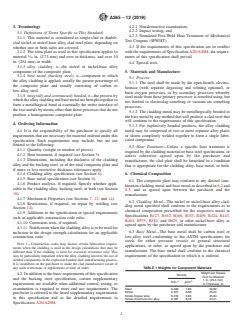
TABLE 1 Weights for Component Materials
any such restrictions or applications at time of order.
Weight per Square
4.2 Inadditiontothebasicrequirementsofthisspecification
Density
Foot for Material
and the backing steel specification, certain supplementary
1 in. (25.4 mm)
3 3
lb/in. g/cm
requirements are available when additional control, testing, or in Thickness, lb
examination is required to meet end use requirements. The Steel 0.283 7.83 40.80
Nickel 0.321 8.88 46.22
purchaser is referred to the listed supplementary requirements
Nickel-copper alloy 0.319 8.83 45.94
in this specification and to the detailed requirements in
Nickel-chromium-iron alloy 0.307 8.49 44.21
Specification A20/A20M.
A265−12 (2019)
7. Mechanical Properties
7.1 Tensile Requirements:
7.1.1 The tensile properties shall be determined by a tension
test of the composite plate for clad plates that meet all of the
following conditions.
(1) Thenominalcompositegageislessthanorequalto1 ⁄2
in (38 mm).
(2) The specified minimum tensile strength of the base
steel is less than or equal to 70 000 psi (485 MPa).
(3) The specified minimum yield strength of the base steel
is less than or equal to 40 000 psi (275 MPa).
(4) The tensile properties thus determined shall not be less
than the minimum and not more than 5000 psi (35 MPa) over
the maximum prescribed in the specification for the base steel
used.All other tensile test requirements of the specification for
Metric Equivalents
the base steel shall be met.
in. mm in. mm
0.005 0.127 1 25.4
7.1.2 The tensile properties shall be determined by a
1 1
⁄8 3.17 2 ⁄2 64.5
tension test of the base steel only for clad plates that meet one
⁄4 19.1 3 76.2
of the following conditions. The properties thus determined
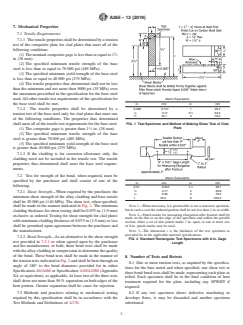
shall meet all of the tensile test requirements for the base steel. FIG. 1 Test Specimen and Method of Making Shear Test of Clad
Plate
(1) The composite gage is greater than 1 ⁄2 in. (38 mm).
(2) The specified minimum tensile strength of the base
steel is greater than 70 000 psi (485 MPa).
(3) The specified minimum yield strength of the base steel
is greater than 40 000 psi (275 MPa).
7.1.3 If the cladding is for corrosion allowance only, the
cladding need not be included in the tensile test. The tensile
properties thus determined shall meet the base steel require-
ments.
7.2 Test for strength of the bond, when required, must be
Metric Equivalents
specified by the purchaser and shall consist of one of the
in. mm in. mm
following.
0.01 0.254 1 ⁄2 38.1
⁄8 3.17 2 50.8
7.2.1 Shear Strength—When required by the purchaser, the
⁄4 6.35 3 76.2
minimum shear strength of the alloy cladding and base metals
1 25.4 8 203.2
shall be 20 000 psi (140 MPa). The shear test, when specified,
shall be made in the manner indicated in Fig. 1. The minimum NOTE 1—When necessary, it is permissible to use a narrower specimen,
but in such a case the reduced portion shall be not less than 1 in. in width.
cladding thickness for shear testing shall be 0.075 in. (1.9 mm)
NOTE 2—Punch marks for measuring elongation after fracture shall be
exclusive as ordered. Testing for shear strength for clad plates
made on the flat or on the edge of the specimen and within the parallel
with minimum cladding thickness of 0.075 in (1.9 mm) or less
section; either a set of nine punch marks 1 in. apart, or one or more sets
shall be permitted upon agreement between the purchaser and of 8-in. punch marks may be used.
the manufacturer. NOTE 3—The dimension t is the thickness of the test specimen as
provided for in the applicable material specifications.
7.2.2 Bond Strength—As an alternative to the shear strength
FIG. 2 Standard Rectangular Test Specimens with 8-in. Gage
test provided in 7.2.1 or when agreed upon by the purchaser
Length
and the manufacturer, or both, three bend tests shall be made
withthealloycladdingincompressiontodeterminethequality
of the bond. These bend tests shall be made in the manner of
8. Number of Test
...