

ASTM B333-03(2018)
(Specification)Standard Specification for Nickel-Molybdenum Alloy Plate, Sheet, and Strip
General Information
- Abstract
ABSTRACT
This specification covers plate, sheet, and strip of nickel-molybdenum alloys covering UNS N10001, N10665, N10675, N10629, and N10624 for use in general corrosive service. Product analysis shall be performed on the alloy and shall conform to the chemical composition requirement in nickel, molybdenum, iron, chromium, carbon, silicon, cobalt, manganese, phosphorus, sulfur, vanadium, nickel, molybdenum, aluminum, columbium, copper, tantalum, titanium, tungsten, zirconium, and magnesium. Sheet and strip shall undergo hot or cold rolling, solution annealing, and descaling unless solution annealed in atmosphere. Plates shall undergo hot or cold rolling, solution annealing, and descaling. The material shall conform to the required tensile properties such as tensile strength, yield strength, elongation, and Rockwell hardness. Sheet and strip shall conform to the specified grain size requirement
SCOPE
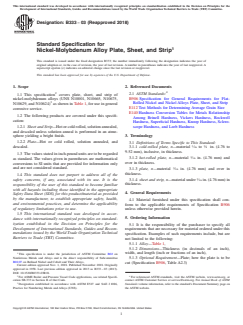
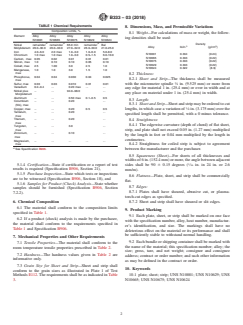
1.1 This specification2 covers plate, sheet, and strip of nickel-molybdenum alloys (UNS N10001, N10665, N10675, N10629, and N10624)3 as shown in Table 1, for use in general corrosive service.
1.2 The following products are covered under this specification:
1.2.1 Sheet and Strip—Hot or cold rolled, solution annealed, and descaled unless solution anneal is performed in an atmosphere yielding a bright finish.
1.2.2 Plate—Hot or cold rolled, solution annealed, and descaled.
1.3 The values stated in inch-pound units are to be regarded as standard. The values given in parentheses are mathematical conversions to SI units that are provided for information only and are not considered standard.
1.4 This standard does not purport to address all of the safety concerns, if any, associated with its use. It is the responsibility of the user of this standard to become familiar with all hazards including those identified in the appropriate Safety Data Sheet (SDS) for this product/material as provided by the manufacturer, to establish appropriate safety, health, and environmental practices, and determine the applicability of regulatory limitations prior to use.
1.5 This international standard was developed in accordance with internationally recognized principles on standardization established in the Decision on Principles for the Development of International Standards, Guides and Recommendations issued by the World Trade Organization Technical Barriers to Trade (TBT) Committee.
- Status
- Published
- Publication Date
- 31-Oct-2018
- Technical Committee
- B02 - Nonferrous Metals and Alloys
- Drafting Committee
- B02.07 - Refined Nickel and Cobalt and Their Alloys


Overview
ASTM B333-03(2018) is the ASTM International standard specification for nickel-molybdenum alloy plate, sheet, and strip. This widely recognized standard sets requirements for the manufacture and quality control of flat-rolled nickel-molybdenum alloys designated as UNS N10001, N10665, N10675, N10629, and N10624, used primarily in general corrosive service. The standard outlines the necessary chemical compositions, mechanical properties, dimensional tolerances, and product marking, ensuring consistent product performance and compliance within critical industrial applications.
Key Topics
Scope and Covered Products
- Applies to plate, sheet, and strip of nickel-molybdenum alloys
- Includes both hot-rolled and cold-rolled material
- Solution annealing and descaling are required for optimal quality, unless a bright finish is achieved by annealing in a controlled atmosphere
Chemical Composition
- Specifies limits for nickel, molybdenum, iron, chromium, carbon, silicon, cobalt, manganese, phosphorus, sulfur, and additional trace elements
- Ensures alloy consistency and corrosion resistance
Mechanical Properties
- Sets minimum requirements for tensile strength, yield strength, elongation, and hardness
- Includes references to ASTM standards for measurement and conversion (such as ASTM E112 for grain size and ASTM E140 for hardness conversions)
Dimensional and Physical Properties
- Defines acceptable density values for weight calculations
- Strict tolerances for thickness, length, flatness, squareness, and edge quality
Product Marking and Certification
- Plates, sheets, or strips must be clearly marked with all essential details (specification, alloy, size, manufacturer)
- Certification and product analysis support traceability and quality assurance
Applications
Nickel-molybdenum alloys covered by ASTM B333-03(2018) are used in environments demanding high corrosion resistance, particularly where exposure to strong acids or other aggressive chemicals occurs. Common applications include:
- Chemical processing plants and equipment
- Pharmaceutical manufacturing
- Food processing units
- Power generation facilities, especially where acid handling is required
- Marine and offshore engineering
- Components for pressure vessels and heat exchangers
These alloys' excellent resistance to pitting, stress-corrosion cracking, and general corrosion make them a preferred material choice for demanding industrial applications.
Related Standards
ASTM B333 is closely linked to several other standards to ensure quality and compatibility throughout the supply chain:
- ASTM B906: General requirements for flat-rolled nickel and nickel alloys plate, sheet, and strip
- ASTM E112: Test methods for determining average grain size
- ASTM E140: Hardness conversion tables for metals relationships
- ASME SB-333: Referenced for boiler and pressure vessel code applications
These related standards support comprehensive testing, dimensional accuracy, and mechanical performance validation, providing a consistent framework for producers and end-users.
Keywords: ASTM B333, nickel-molybdenum alloys, plate, sheet, strip, UNS N10001, N10665, N10675, N10629, N10624, corrosion resistance, chemical processing, flat-rolled alloys, mechanical properties, ASTM standards.
Relations
- Replaces
ASTM B333-03(2013) - Standard Specification for Nickel-Molybdenum Alloy Plate, Sheet, and Strip - Effective Date
- 01-Nov-2018
- Effective Date
- 01-Nov-2017
- Effective Date
- 15-Nov-2012
- Effective Date
- 01-May-2012
- Effective Date
- 01-Nov-2010
- Effective Date
- 01-Dec-2006
- Effective Date
- 23-Oct-2006
- Effective Date
- 01-Apr-2005
- Effective Date
- 01-Apr-2005
- Effective Date
- 01-Nov-2004
- Effective Date
- 01-Nov-2004
- Effective Date
- 10-Oct-2002
- Effective Date
- 10-Jan-2002
- Effective Date
- 10-Jan-2002
- Effective Date
- 10-Jan-2002
Get Certified
Connect with accredited certification bodies for this standard

Element Materials Technology
Materials testing and product certification.

Inštitut za kovinske materiale in tehnologije
Institute of Metals and Technology. Materials testing, metallurgical analysis, NDT.
Sponsored listings
Frequently Asked Questions
ASTM B333-03(2018) is a technical specification published by ASTM International. Its full title is "Standard Specification for Nickel-Molybdenum Alloy Plate, Sheet, and Strip". This standard covers: ABSTRACT This specification covers plate, sheet, and strip of nickel-molybdenum alloys covering UNS N10001, N10665, N10675, N10629, and N10624 for use in general corrosive service. Product analysis shall be performed on the alloy and shall conform to the chemical composition requirement in nickel, molybdenum, iron, chromium, carbon, silicon, cobalt, manganese, phosphorus, sulfur, vanadium, nickel, molybdenum, aluminum, columbium, copper, tantalum, titanium, tungsten, zirconium, and magnesium. Sheet and strip shall undergo hot or cold rolling, solution annealing, and descaling unless solution annealed in atmosphere. Plates shall undergo hot or cold rolling, solution annealing, and descaling. The material shall conform to the required tensile properties such as tensile strength, yield strength, elongation, and Rockwell hardness. Sheet and strip shall conform to the specified grain size requirement SCOPE 1.1 This specification2 covers plate, sheet, and strip of nickel-molybdenum alloys (UNS N10001, N10665, N10675, N10629, and N10624)3 as shown in Table 1, for use in general corrosive service. 1.2 The following products are covered under this specification: 1.2.1 Sheet and Strip—Hot or cold rolled, solution annealed, and descaled unless solution anneal is performed in an atmosphere yielding a bright finish. 1.2.2 Plate—Hot or cold rolled, solution annealed, and descaled. 1.3 The values stated in inch-pound units are to be regarded as standard. The values given in parentheses are mathematical conversions to SI units that are provided for information only and are not considered standard. 1.4 This standard does not purport to address all of the safety concerns, if any, associated with its use. It is the responsibility of the user of this standard to become familiar with all hazards including those identified in the appropriate Safety Data Sheet (SDS) for this product/material as provided by the manufacturer, to establish appropriate safety, health, and environmental practices, and determine the applicability of regulatory limitations prior to use. 1.5 This international standard was developed in accordance with internationally recognized principles on standardization established in the Decision on Principles for the Development of International Standards, Guides and Recommendations issued by the World Trade Organization Technical Barriers to Trade (TBT) Committee.
ABSTRACT This specification covers plate, sheet, and strip of nickel-molybdenum alloys covering UNS N10001, N10665, N10675, N10629, and N10624 for use in general corrosive service. Product analysis shall be performed on the alloy and shall conform to the chemical composition requirement in nickel, molybdenum, iron, chromium, carbon, silicon, cobalt, manganese, phosphorus, sulfur, vanadium, nickel, molybdenum, aluminum, columbium, copper, tantalum, titanium, tungsten, zirconium, and magnesium. Sheet and strip shall undergo hot or cold rolling, solution annealing, and descaling unless solution annealed in atmosphere. Plates shall undergo hot or cold rolling, solution annealing, and descaling. The material shall conform to the required tensile properties such as tensile strength, yield strength, elongation, and Rockwell hardness. Sheet and strip shall conform to the specified grain size requirement SCOPE 1.1 This specification2 covers plate, sheet, and strip of nickel-molybdenum alloys (UNS N10001, N10665, N10675, N10629, and N10624)3 as shown in Table 1, for use in general corrosive service. 1.2 The following products are covered under this specification: 1.2.1 Sheet and Strip—Hot or cold rolled, solution annealed, and descaled unless solution anneal is performed in an atmosphere yielding a bright finish. 1.2.2 Plate—Hot or cold rolled, solution annealed, and descaled. 1.3 The values stated in inch-pound units are to be regarded as standard. The values given in parentheses are mathematical conversions to SI units that are provided for information only and are not considered standard. 1.4 This standard does not purport to address all of the safety concerns, if any, associated with its use. It is the responsibility of the user of this standard to become familiar with all hazards including those identified in the appropriate Safety Data Sheet (SDS) for this product/material as provided by the manufacturer, to establish appropriate safety, health, and environmental practices, and determine the applicability of regulatory limitations prior to use. 1.5 This international standard was developed in accordance with internationally recognized principles on standardization established in the Decision on Principles for the Development of International Standards, Guides and Recommendations issued by the World Trade Organization Technical Barriers to Trade (TBT) Committee.
ASTM B333-03(2018) is classified under the following ICS (International Classification for Standards) categories: 77.150.40 - Nickel and chromium products. The ICS classification helps identify the subject area and facilitates finding related standards.
ASTM B333-03(2018) has the following relationships with other standards: It is inter standard links to ASTM B333-03(2013), ASTM B906-02(2017), ASTM E112-12, ASTM B906-02(2012), ASTM E112-10, ASTM B906-02(2006), ASTM E112-96(2004)e2, ASTM E140-05, ASTM E140-05e1, ASTM E112-96(2004)e1, ASTM E112-96(2004), ASTM B906-02, ASTM E140-02e1, ASTM E140-97e2, ASTM E140-02. Understanding these relationships helps ensure you are using the most current and applicable version of the standard.
ASTM B333-03(2018) is available in PDF format for immediate download after purchase. The document can be added to your cart and obtained through the secure checkout process. Digital delivery ensures instant access to the complete standard document.
Standards Content (Sample)
This international standard was developed in accordance with internationally recognized principles on standardization established in the Decision on Principles for the
Development of International Standards, Guides and Recommendations issued by the World Trade Organization Technical Barriers to Trade (TBT) Committee.
Designation:B333 −03 (Reapproved 2018)
Standard Specification for
Nickel-Molybdenum Alloy Plate, Sheet, and Strip
This standard is issued under the fixed designation B333; the number immediately following the designation indicates the year of
original adoption or, in the case of revision, the year of last revision. A number in parentheses indicates the year of last reapproval. A
superscript epsilon (´) indicates an editorial change since the last revision or reapproval.
This standard has been approved for use by agencies of the U.S. Department of Defense.
1. Scope 2. Referenced Documents
2.1 ASTM Standards:
1.1 This specification covers plate, sheet, and strip of
B906 Specification for General Requirements for Flat-
nickel-molybdenum alloys (UNS N10001, N10665, N10675,
Rolled Nickel and Nickel Alloys Plate, Sheet, and Strip
N10629, and N10624) as shown in Table 1, for use in general
E112 Test Methods for Determining Average Grain Size
corrosive service.
E140 Hardness Conversion Tables for Metals Relationship
1.2 The following products are covered under this specifi-
Among Brinell Hardness, Vickers Hardness, Rockwell
cation:
Hardness, Superficial Hardness, Knoop Hardness, Sclero-
1.2.1 Sheet and Strip—Hotorcoldrolled,solutionannealed,
scope Hardness, and Leeb Hardness
and descaled unless solution anneal is performed in an atmo-
3. Terminology
sphere yielding a bright finish.
1.2.2 Plate—Hot or cold rolled, solution annealed, and
3.1 Definitions of Terms Specific to This Standard:
3 3
descaled.
3.1.1 cold-rolled plate, n—material ⁄16 to ⁄8 in. (4.76 to
9.52 mm), inclusive, in thickness.
1.3 The values stated in inch-pound units are to be regarded
3.1.2 hot-rolled plate, n—material ⁄16 in. (4.76 mm) and
as standard. The values given in parentheses are mathematical
over in thickness.
conversions to SI units that are provided for information only
and are not considered standard.
3.1.3 plate, n—material ⁄16 in. (4.76 mm) and over in
thickness.
1.4 This standard does not purport to address all of the
3.1.4 sheet and strip, n—material under ⁄16 in. (4.76 mm) in
safety concerns, if any, associated with its use. It is the
thickness.
responsibility of the user of this standard to become familiar
with all hazards including those identified in the appropriate
4. General Requirements
Safety Data Sheet (SDS) for this product/material as provided
by the manufacturer, to establish appropriate safety, health,
4.1 Material furnished under this specification shall con-
and environmental practices, and determine the applicability
form to the applicable requirements of Specification B906
of regulatory limitations prior to use.
unless otherwise provided herein.
1.5 This international standard was developed in accor-
5. Ordering Information
dance with internationally recognized principles on standard-
ization established in the Decision on Principles for the
5.1 It is the responsibility of the purchaser to specify all
Development of International Standards, Guides and Recom-
requirements that are necessary for material ordered under this
mendations issued by the World Trade Organization Technical
specification. Examples of such requirements include, but are
Barriers to Trade (TBT) Committee.
not limited to the following:
5.1.1 Alloy—Table 1,
5.1.2 Dimensions—Thickness (in decimals of an inch),
1 width, and length (inch or fractions of an inch),
This specification is under the jurisdiction of ASTM Committee B02 on
Nonferrous Metals and Alloys and is the direct responsibility of Subcommittee
5.1.3 Optional Requirement—Plate; how the plate is to be
B02.07 on Refined Nickel and Cobalt and Their Alloys.
cut (Specification B906, Table A2.3)
Current edition approved Nov. 1, 2018. Published November 2018. Originally
approved in 1958. Last previous edition approved in 2013 as B333 – 03 (2013).
DOI: 10.1520/B0333-03R18.
2 4
For ASME Boiler and Pressure Vessel Code applications, see related Specifi- For referenced ASTM standards, visit the ASTM website, www.astm.org, or
cation SB-333 in Section II of that Code. contact ASTM Customer Service at service@astm.org. For Annual Book of ASTM
Designation established in accordance with ASTM E527 and SAE J 1086, Standards volume information, refer to the standard’s Document Summary page on
Practice for Numbering Metals and Alloys (UNS). the ASTM website.
Copyright © ASTM International, 100 Barr Harbor Drive, PO Box C700, West Conshohocken, PA 19428-2959. United States
B333−03 (2018)
TABLE 1 Chemical Requirements
8. Dimensions, Mass, and Permissible Variations
Composition Limits, %
8.1 Weight—For calculations of mass or weight, the follow-
Element
Alloy Alloy Alloy Alloy Alloy
ing densities shall be used:
N10001 N10665 N10675 N10629 N10624
A A A Density
Nickel remainder remainder 65.0 min remainder Bal
3 3
Alloy lb/in. (g/cm )
Molybdenum 26.0–30.0 26.0–30.0 27.0–32.0 26.0–30.0 21.0-25.0
Iron 4.0–6.0 2.0 max 1.0–3.0 1.0–6.0 5.0-8.0
N10001 0.334 (9.24)
Chromium 1.0 max 1.0 max 1.0–3.0 0.5–1.5 6.0-10.0
N10665 0.333 (9.22)
Carbon, max 0.05 0.02 0.01 0.01 0.01
N10675 0.333 (9.22)
Silicon, max 1.0 0.10 0.10 0.05 0.10
N10629 0.333 (9.22)
Cobalt, max 2.5 1.00 3.0 2.5 1.0
N10624 0.322 (8.9)
Manganese, 1.0 1.0 3.0 1.5 1.0
max
8.2 Thickness:
Phosphorus, 0.04 0.04 0.030 0.04 0.025
8.2.1 Sheet and Strip—The thickness shall be measured
max
Sulfur, max 0.03 0.03 0.010 0.01 0.01 with the micrometer spindle ⁄8 in. (9.525 mm) or more from
Vanadium 0.2–0.4 . 0.20 max . .
any edge for material 1 in. (25.4 mm) or over in width and at
Nickel plus . . 94.0–98.0 .
any place on material under 1 in. (25.4 mm) in width.
Molybdenum
Aluminum . . 0.50 max 0.1–0.5 0.5
8.3 Length:
Columbium . . 0.20 .
8.3.1 Sheet and Strip—Sheet and str
...