

ASTM E1868-10(2021)
(Test Method)Standard Test Methods for Loss-On-Drying by Thermogravimetry
General Information
- Abstract
SIGNIFICANCE AND USE
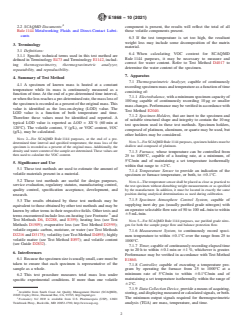
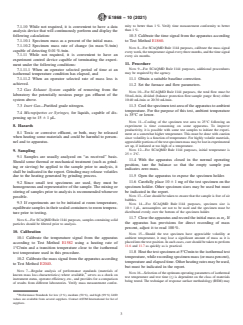
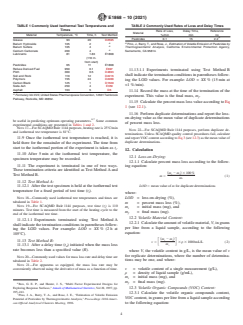
5.1 These test methods are used to estimate the amount of volatile materials present in a material.
5.2 These test methods are useful for design purposes, service evaluation, regulatory statutes, manufacturing control, quality control, specification acceptance, development, and research.
5.3 The results obtained by these test methods may be equivalent to those obtained by other test methods and may be known by other terms in their respective fields. Other tests and terms encountered include loss-on-heating (see Footnote 5 and Test Methods D6, D2288, and E359); heating loss (see Test Methods D1509); evaporative loss (see Test Method D2595); volatile organic carbon, moisture, or water (see Test Methods D2216 and D3175); volatility (see Test Method D4893); highly volatile matter (see Test Method E897); and volatile content (see Guide D2832).
SCOPE
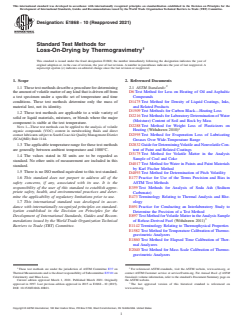
1.1 These test methods describe a procedure for determining the amount of volatile matter of any kind that is driven off from a test specimen under a specific set of temperature and time conditions. These test methods determine only the mass of material lost, not its identity.
1.2 These test methods are applicable to a wide variety of solid or liquid materials, mixtures, or blends where the major component is stable at the test temperature.
Note 1: These test methods can be applied to the analysis of volatile organic compounds (VOC) content in metalworking fluids and direct contact lubricants subject to South Coast Air Quality Management District (SCAQMD) Rule 1144.
1.3 The applicable temperature range for these test methods are generally between ambient temperature and 1000°C.
1.4 The values stated in SI units are to be regarded as standard. No other units of measurement are included in this standard.
1.5 There is no ISO method equivalent to this test standard.
1.6 This standard does not purport to address all of the safety concerns, if any, associated with its use. It is the responsibility of the user of this standard to establish appropriate safety, health, and environmental practices and determine the applicability of regulatory limitations prior to use.
1.7 This international standard was developed in accordance with internationally recognized principles on standardization established in the Decision on Principles for the Development of International Standards, Guides and Recommendations issued by the World Trade Organization Technical Barriers to Trade (TBT) Committee.
- Status
- Published
- Publication Date
- 28-Feb-2021
- Technical Committee
- E37 - Thermal Measurements
- Drafting Committee
- E37.01 - Calorimetry and Mass Loss
Overview
ASTM E1868-10(2021), Standard Test Methods for Loss-On-Drying by Thermogravimetry establishes procedures for determining the amount of volatile matter released from a test specimen under controlled temperature and time conditions. This standard enables users to measure the total mass loss of volatile materials - not their specific identities - using thermogravimetric analysis (TGA). The methodology is widely applicable for assessing both solid and liquid samples, including mixtures and blends where the main component remains stable at test temperatures.
The standard supports a temperature range from ambient up to 1000°C and is designed to provide reliable, repeatable results in a variety of laboratory and industrial settings. It is utilized globally for regulatory compliance, design validation, quality assurance, and research and development applications. There is no direct ISO equivalent to this ASTM method.
Key Topics
- Loss-On-Drying (LOD) by Thermogravimetry: Measures mass lost from a specimen when subjected to specified thermal conditions, reflecting the presence of volatile content.
- Versatility: Suitable for diverse materials, including oils, lubricants, metalworking fluids, soils, rocks, polymers, and more.
- Parameters: Only the total mass loss is measured; further analysis may be required to identify the nature of volatiles (e.g., water, organic compounds).
- Apparatus and Setup: Describes instrumentation such as thermogravimetric analyzers, balances, specimen holders (including materials like platinum, aluminum, or quartz), inert gas supply (commonly purified nitrogen), and data collection systems.
- Calculation Methods: Procedures for calculating percent mass loss (LOD), volatile material content (g/L), and volatile organic compound (VOC) content.
- Test Conditions: Emphasizes the importance of reporting test temperature, time, and specimen size, as well as performing duplicate determinations for accuracy.
- Precision and Repeatability: Includes robust information about interlaboratory reproducibility and repeatability, supporting confidence in results across different facilities.
Applications
- Quality Control: Routinely applied in manufacturing to monitor moisture and volatile content in raw materials, intermediates, and finished products.
- Regulatory Compliance: Useful for industries subject to air quality standards and regulations (e.g., VOC limits in metalworking fluids in accordance with SCAQMD Rule 1144).
- Product Development & Research: Essential in R&D for evaluating formulation changes, studying material degradation, and assessing stability under heat.
- Design and Service Evaluation: Assists engineers and designers in selecting materials based on volatility characteristics, and in verifying materials' performance over their lifecycle.
- Industry Sectors: Key sectors include chemicals, petrochemicals, paints and coatings, environmental testing, materials science, pharmaceuticals, and lubricants.
Related Standards
The ASTM E1868 standard interacts with and references several related ASTM standards to ensure comprehensive analysis:
- ASTM D6 - Test Method for Loss on Heating of Oil and Asphaltic Compounds
- ASTM D1509 - Carbon Black-Heating Loss
- ASTM D2216 - Laboratory Determination of Water Content of Soil and Rock by Mass
- ASTM D2595 - Evaporation Loss of Lubricating Greases Over Wide-Temperature Range
- ASTM D3175 - Volatile Matter in the Analysis Sample of Coal and Coke
- ASTM D4893 - Determination of Pitch Volatility
- ASTM E359 - Analysis of Soda Ash (Sodium Carbonate)
- ASTM E691 - Interlaboratory Study Procedures (Precision)
- ASTM E2040 - Mass Scale Calibration of Thermogravimetric Analyzers
Implementing ASTM E1868-10(2021) assures reliable, traceable measurements of volatile content, supporting operational efficiency, regulatory adherence, and overall material quality across industries.
Keywords: loss on drying, thermogravimetry, thermogravimetric analysis, volatile matter, mass loss, quality control, volatility testing, ASTM E1868, VOC determination, industrial standards.
Relations
- Effective Date
- 01-Oct-2023
- Effective Date
- 01-Oct-2023
- Effective Date
- 01-Jun-2020
- Refers
ASTM D3175-20 - Standard Test Method for Volatile Matter in the Analysis Sample of Coal and Coke - Effective Date
- 01-Feb-2020
- Refers
ASTM E2040-19 - Standard Test Method for Mass Scale Calibration of Thermogravimetric Analyzers - Effective Date
- 01-Dec-2019
- Effective Date
- 01-Mar-2019
- Refers
ASTM D3175-18 - Standard Test Method for Volatile Matter in the Analysis Sample of Coal and Coke - Effective Date
- 01-Dec-2018
- Effective Date
- 15-Jun-2017
- Refers
ASTM D3175-17 - Standard Test Method for Volatile Matter in the Analysis Sample of Coal and Coke - Effective Date
- 01-Feb-2017
- Effective Date
- 01-Apr-2016
- Effective Date
- 01-Nov-2015
- Effective Date
- 01-May-2015
- Effective Date
- 01-Apr-2015
- Effective Date
- 15-Aug-2014
- Effective Date
- 15-Aug-2014
Get Certified
Connect with accredited certification bodies for this standard

ECOCERT
Organic and sustainability certification.

Eurofins Food Testing Global
Global leader in food, environment, and pharmaceutical product testing.

Intertek Bangladesh
Intertek certification and testing services in Bangladesh.
Sponsored listings
Frequently Asked Questions
ASTM E1868-10(2021) is a standard published by ASTM International. Its full title is "Standard Test Methods for Loss-On-Drying by Thermogravimetry". This standard covers: SIGNIFICANCE AND USE 5.1 These test methods are used to estimate the amount of volatile materials present in a material. 5.2 These test methods are useful for design purposes, service evaluation, regulatory statutes, manufacturing control, quality control, specification acceptance, development, and research. 5.3 The results obtained by these test methods may be equivalent to those obtained by other test methods and may be known by other terms in their respective fields. Other tests and terms encountered include loss-on-heating (see Footnote 5 and Test Methods D6, D2288, and E359); heating loss (see Test Methods D1509); evaporative loss (see Test Method D2595); volatile organic carbon, moisture, or water (see Test Methods D2216 and D3175); volatility (see Test Method D4893); highly volatile matter (see Test Method E897); and volatile content (see Guide D2832). SCOPE 1.1 These test methods describe a procedure for determining the amount of volatile matter of any kind that is driven off from a test specimen under a specific set of temperature and time conditions. These test methods determine only the mass of material lost, not its identity. 1.2 These test methods are applicable to a wide variety of solid or liquid materials, mixtures, or blends where the major component is stable at the test temperature. Note 1: These test methods can be applied to the analysis of volatile organic compounds (VOC) content in metalworking fluids and direct contact lubricants subject to South Coast Air Quality Management District (SCAQMD) Rule 1144. 1.3 The applicable temperature range for these test methods are generally between ambient temperature and 1000°C. 1.4 The values stated in SI units are to be regarded as standard. No other units of measurement are included in this standard. 1.5 There is no ISO method equivalent to this test standard. 1.6 This standard does not purport to address all of the safety concerns, if any, associated with its use. It is the responsibility of the user of this standard to establish appropriate safety, health, and environmental practices and determine the applicability of regulatory limitations prior to use. 1.7 This international standard was developed in accordance with internationally recognized principles on standardization established in the Decision on Principles for the Development of International Standards, Guides and Recommendations issued by the World Trade Organization Technical Barriers to Trade (TBT) Committee.
SIGNIFICANCE AND USE 5.1 These test methods are used to estimate the amount of volatile materials present in a material. 5.2 These test methods are useful for design purposes, service evaluation, regulatory statutes, manufacturing control, quality control, specification acceptance, development, and research. 5.3 The results obtained by these test methods may be equivalent to those obtained by other test methods and may be known by other terms in their respective fields. Other tests and terms encountered include loss-on-heating (see Footnote 5 and Test Methods D6, D2288, and E359); heating loss (see Test Methods D1509); evaporative loss (see Test Method D2595); volatile organic carbon, moisture, or water (see Test Methods D2216 and D3175); volatility (see Test Method D4893); highly volatile matter (see Test Method E897); and volatile content (see Guide D2832). SCOPE 1.1 These test methods describe a procedure for determining the amount of volatile matter of any kind that is driven off from a test specimen under a specific set of temperature and time conditions. These test methods determine only the mass of material lost, not its identity. 1.2 These test methods are applicable to a wide variety of solid or liquid materials, mixtures, or blends where the major component is stable at the test temperature. Note 1: These test methods can be applied to the analysis of volatile organic compounds (VOC) content in metalworking fluids and direct contact lubricants subject to South Coast Air Quality Management District (SCAQMD) Rule 1144. 1.3 The applicable temperature range for these test methods are generally between ambient temperature and 1000°C. 1.4 The values stated in SI units are to be regarded as standard. No other units of measurement are included in this standard. 1.5 There is no ISO method equivalent to this test standard. 1.6 This standard does not purport to address all of the safety concerns, if any, associated with its use. It is the responsibility of the user of this standard to establish appropriate safety, health, and environmental practices and determine the applicability of regulatory limitations prior to use. 1.7 This international standard was developed in accordance with internationally recognized principles on standardization established in the Decision on Principles for the Development of International Standards, Guides and Recommendations issued by the World Trade Organization Technical Barriers to Trade (TBT) Committee.
ASTM E1868-10(2021) is classified under the following ICS (International Classification for Standards) categories: 71.040.40 - Chemical analysis. The ICS classification helps identify the subject area and facilitates finding related standards.
ASTM E1868-10(2021) has the following relationships with other standards: It is inter standard links to ASTM E473-23b, ASTM E1142-23b, ASTM D4893-20, ASTM D3175-20, ASTM E2040-19, ASTM D2216-19, ASTM D3175-18, ASTM E359-17, ASTM D3175-17, ASTM D2832-92(2016), ASTM D1509-15, ASTM E1142-15, ASTM D4893-94(2015)e1, ASTM E1142-14b, ASTM E473-14. Understanding these relationships helps ensure you are using the most current and applicable version of the standard.
ASTM E1868-10(2021) is available in PDF format for immediate download after purchase. The document can be added to your cart and obtained through the secure checkout process. Digital delivery ensures instant access to the complete standard document.
Standards Content (Sample)
This international standard was developed in accordance with internationally recognized principles on standardization established in the Decision on Principles for the
Development of International Standards, Guides and Recommendations issued by the World Trade Organization Technical Barriers to Trade (TBT) Committee.
Designation: E1868 − 10 (Reapproved 2021)
Standard Test Methods for
Loss-On-Drying by Thermogravimetry
This standard is issued under the fixed designation E1868; the number immediately following the designation indicates the year of
original adoption or, in the case of revision, the year of last revision. A number in parentheses indicates the year of last reapproval. A
superscript epsilon (´) indicates an editorial change since the last revision or reapproval.
1. Scope 2. Referenced Documents
1.1 Thesetestmethodsdescribeaprocedurefordetermining 2.1 ASTM Standards:
theamountofvolatilematterofanykindthatisdrivenofffrom D6 Test Method for Loss on Heating of Oil and Asphaltic
a test specimen under a specific set of temperature and time Compounds
conditions. These test methods determine only the mass of D1475 Test Method for Density of Liquid Coatings, Inks,
material lost, not its identity. and Related Products
D1509 Test Methods for Carbon Black—Heating Loss
1.2 These test methods are applicable to a wide variety of
D2216 Test Methods for Laboratory Determination of Water
solid or liquid materials, mixtures, or blends where the major
(Moisture) Content of Soil and Rock by Mass
component is stable at the test temperature.
D2288 Test Method for Weight Loss of Plasticizers on
NOTE 1—These test methods can be applied to the analysis of volatile
Heating (Withdrawn 2010)
organic compounds (VOC) content in metalworking fluids and direct
contactlubricantssubjecttoSouthCoastAirQualityManagementDistrict
D2595 Test Method for Evaporation Loss of Lubricating
(SCAQMD) Rule 1144.
Greases Over Wide-Temperature Range
1.3 The applicable temperature range for these test methods D2832 GuideforDeterminingVolatileandNonvolatileCon-
are generally between ambient temperature and 1000°C. tent of Paint and Related Coatings
D3175 Test Method for Volatile Matter in the Analysis
1.4 The values stated in SI units are to be regarded as
Sample of Coal and Coke
standard. No other units of measurement are included in this
D4017 Test Method for Water in Paints and Paint Materials
standard.
by Karl Fischer Method
1.5 There is no ISO method equivalent to this test standard.
D4893 Test Method for Determination of Pitch Volatility
1.6 This standard does not purport to address all of the
E177 Practice for Use of the Terms Precision and Bias in
safety concerns, if any, associated with its use. It is the ASTM Test Methods
responsibility of the user of this standard to establish appro- E359 Test Methods for Analysis of Soda Ash (Sodium
priate safety, health, and environmental practices and deter-
Carbonate)
mine the applicability of regulatory limitations prior to use. E473 Terminology Relating to Thermal Analysis and Rhe-
1.7 This international standard was developed in accor-
ology
dance with internationally recognized principles on standard- E691 Practice for Conducting an Interlaboratory Study to
ization established in the Decision on Principles for the
Determine the Precision of a Test Method
Development of International Standards, Guides and Recom- E897 TestMethodforVolatileMatterintheAnalysisSample
mendations issued by the World Trade Organization Technical
of Refuse-Derived Fuel (Withdrawn 2011)
Barriers to Trade (TBT) Committee. E1142 Terminology Relating to Thermophysical Properties
E1582 Test Method for Temperature Calibration of Thermo-
gravimetric Analyzers
E1860 Test Method for Elapsed Time Calibration of Ther-
mal Analyzers
E2040 Test Method for Mass Scale Calibration of Thermo-
gravimetric Analyzers
1 2
These test methods are under the jurisdiction of ASTM Committee E37 on For referenced ASTM standards, visit the ASTM website, www.astm.org, or
Thermal Measurements and is the direct responsibility of Subcommittee E37.01 on contact ASTM Customer service at service@astm.org. For Annual Book of ASTM
Calorimetry and Mass Loss. Standards volume information, refer to the standard’s Document Summary page on
Current edition approved March 1, 2021. Published March 2021. Originally the ASTM website.
approved in 1997. Last previous edition approved in 2015 as E1868 – 10 (2015). The last approved version of this historical standard is referenced on
DOI: 10.1520/E1868-10R21. www.astm.org.
Copyright © ASTM International, 100 Barr Harbor Drive, PO Box C700, West Conshohocken, PA 19428-2959. United States
E1868 − 10 (2021)
2.2 SCAQMD Documents: component is present, the results will reflect the total of all
Rule 1144 Metalworking Fluids and Direct-Contact Lubri- those volatile components present.
cants
6.3 If the test temperature is set too high, the resultant
weight loss may include some decomposition of the matrix
3. Terminology
material.
3.1 Definitions:
6.4 When calculating VOC content for SCAQMD
3.1.1 Specific technical terms used in this test method are
Rule 1144 purposes, it may be necessary to measure and
defined in Terminology E473 and Terminology E1142, includ-
correct for water content. Refer to Test Method D4017 to
ing thermogravimetry, thermogravimetric analyzer,
determine the water content of the specimen.
repeatability, and reproducibility.
7. Apparatus
4. Summary of Test Method
7.1 Thermogravimetric Analyzer, capable of continuously
4.1 A specimen of known mass is heated at a constant
recording specimen mass and temperature as a function of time
temperature while its mass is continuously measured as a
consisting of:
function of time.At the end of a pre-determined time interval,
7.1.1 Electrobalance,withaminimumspecimencapacityof
orwhenthelossreachesapre-determinedrate,themasslossof
100 mg capable of continuously recording 10 µg or smaller
the specimen is recorded as a percent of the original mass.This
masschanges.Performancemaybeverifiedinaccordancewith
value is identified as the loss-on-drying (LOD) value. The
Test Method E2040.
LOD value is a function of both temperature and time.
7.1.2 Specimen Holders, that are inert to the specimen and
Therefore these values must be identified and reported. A
of suitable structural shape and integrity to contain the 10 mg
typical LOD value is reported as LOD=XX% (60 min at
test specimen used in these test methods. Specimen holders,
120°C). The volatile content, V (g/L), or VOC content, VOC
composed of platinum, aluminum, or quartz may be used, but
(g/L), may be calculated.
other holders may be considered.
NOTE 2—For SCAQMD Rule 1144 purposes, at the end of a pre-
NOTE3—ForSCAQMDRule 1144purposes,specimenholdersmustbe
determined time interval and specified temperature, the mass loss of the
shallow and composed of platinum.
specimen is recorded as a percent of the original mass. Additionally, the
density and water content of the sample are determined. These values are
7.1.3 Furnace, whose temperature can be controlled from
then used to calculate the VOC content.
25 to 1000°C, capable of a heating rate, at a minimum, of
5°C/min and of maintaining a set temperature isothermally
5. Significance and Use
within that range to 62°C.
5.1 These test methods are used to estimate the amount of
7.1.4 Temperature Sensor to provide an indication of the
volatile materials present in a material.
specimen or furnace temperature, or both, to 60.1°C.
5.2 These test methods are useful for design purposes,
NOTE 4—The temperature sensor shall be placed as close as practical to
service evaluation, regulatory statutes, manufacturing control,
the test specimen without disturbing weight measurements or as specified
quality control, specification acceptance, development, and by the manufacturer. In addition, it must be located in exactly the same
position during analytical determinations as used during calibration.
research.
7.1.5 Specimen Atmosphere Control System, capable of
5.3 The results obtained by these test methods may be
supplying inert dry gas (usually purified grade nitrogen) with
equivalent to those obtained by other test methods and may be
an operator selectable flow rate of 50 to 100 mL⁄min to within
known by other terms in their respective fields. Other tests and
65 mL⁄min.
terms encountered include loss-on-heating (see Footnote and
Test Methods D6, D2288, and E359); heating loss (see Test
NOTE 5—For SCAQMD Rule 1144 purposes, use purified grade nitro-
Methods D1509); evaporative loss (see Test Method D2595);
gen for both the sample purge flow and balance protection flow.
volatile organic carbon, moisture, or water (see Test Methods
7.1.6 Measurement System, to continuously record speci-
D2216andD3175);volatility(seeTestMethodD4893);highly
men temperature to within 60.1°C over the range from 25 to
volatile matter (see Test Method E897); and volatile content
1000°C.
(see Guide D2832).
7.1.7 Timer, capable of continuously recording elapsed time
up to 20 h to within 60.1 min or 61 %, whichever is greater.
6. Interferences
Performance may be verified in accordance with Test Method
6.1 Becausethespecimensizeisusuallysmall,caremustbe
E1860.
taken to ensure that each specimen is representative of the
7.1.8 Controller, capable of executing a temperature pro-
sample as a whole.
gram by operating the furnace from 25 to 1000°C at a
minimum rate of 5°C/min to within 60.1°C/min and of
6.2 This test procedure measures total mass loss under
maintaining a set temperature isothermally within the range of
specific experimental conditions. If more than one volatile
62°C.
7.1.9 Data Collection Device,provideameansofacquiring,
Available from South Coast Air Quality Management District (SCAQMD),
storing, and displaying measured or calculated signals, or both.
21865 Copley Drive, Diamond Bar, CA, 91765, http://aqmd.gov.
The minimum output signals required for thermogravimetric
Formulary Vol XVII is available from U.S. Pharmacopeia (USP), 12601
Twinbrook Pkwy., Rockville, MD 20852-1790, http://www.usp.org. analysis (TGA) are mass, temperature, and time.
E1868 − 10 (2021)
mity to better than 1 %. Verify time measurement conformity to better
7.1.10 While not required, it is convenient to have a data
than 1 %.
analysis device that will continuously perform and display the
following calculation: 10.3 Calibrate the time signal from the apparatus according
7.1.10.1 Specimen mass as a percent of the initial mass. to Test Method E1860.
7.1.10.2 Specimen mass rate of change (in mass %⁄min)
NOTE 8—For SCAQMD Rule 1144 purposes, calibrate the mass signal
capable of detecting 0.01 %⁄min.
everyweek,thetemperaturesignaleverythreemonths,andthetimesignal
7.1.11 While not required, it is convenient to have an
every six months.
experiment control device capable of terminating the experi-
11. Procedure
ment under the following conditions:
NOTE 9—For SCAQMD Rule 1144 purposes, additional proceedures
7.1.11.1 When an operator selected period of time at an
may be required by the agency.
isothermal temperature condition has elapsed, and
11.1 Obtain a suitable baseline correction.
7.1.11.2 When an operator selected rate of mass loss is
achieved.
11.2 Set the furnace and flow parameters.
7.2 Gas Exhaust System capable of removing from the
NOTE 10—For SCAQMD Rule 1144 purposes, the total flow must be
laboratory the potentially noxious purge gas effluent of the
50 mL⁄min, divided (balance protection flow:sample purge flow) either
system above. 10:40 mL/min or 20:30 mL/min.
11.3 Cool the specimen test area of the apparatus to ambient
7.3 Inert Gas—Purified grade nitrogen.
temperature. For the purpose of this test, ambient temperature
7.4 Micropipettes or Syringes, for liquids, capable of dis-
is 35°C or lower.
pensing up to 15 6 1 µL.
NOTE 11—Cooling of the specimen test area to 25°C following an
8. Hazards experiment is time consuming on some apparatus. To improve
productivity, it is possible with some test samples to initiate the experi-
8.1 Toxic or corrosive effluent, or both, may be released
ment at a somewhat higher temperature. This must be done with caution
when heating some materials and could be harmful to person-
since volatility is a function of temperature. For highly volatile materials,
nel and to apparatus. appreciableportionsofthetestspecimenmassmaybelostinexperimental
set up, if initiated at too high of a temperature.
NOTE 12—For SCAQMD Rule 1144 purposes, initial temperature is
9. Sampling
25 6 2°C.
9.1 Samples are usually analyzed on “as received” basis.
11.4 With the apparatus closed in the normal operating
Should some thermal or mechanical treatment (such as grind-
position, tare the balance so that the empty sample pan
ing or sieving) be applied to the sample prior to analysis, it
indicates zero mass.
shall be indicated in the report. Grinding may release volatiles
11.5 Open the apparatus to expose the specimen holder.
due to the heating generated by grinding process.
11.6 Carefully place 10 6 1 mg of the test specimen on the
9.2 Since small test specimens are used, they must be
specimen holder. Other specimen sizes may be used but must
homogeneous and representative of the sample. The mixing or
be indicated in the report.
stirring of samples prior to analysis is recommended whenever
NOTE 13—Care should be taken to ensure that the sample is free of air
possible.
bubbles.
9.3 If experiments are to be initiated at room temperature,
NOTE 14—For SCAQMD Rule 1144 purposes, specimen size is
10 6 1 µL, autosamplers are not to be used and the specimen must be
equilibrate samples in their sealed containers to room tempera-
distributed evenly over the bottom of the specimen holder.
ture prior to testing.
11.7 Close the apparatus and record the initial mass as m.If
i
NOTE 6—For SCAQMD Rule 1144 purposes, samples containing solid
the apparatus has provisions for direct recording of mass
particles should be filtered prior to analysis.
percent, adjust it to read 100 %.
10. Calibration
NOTE 15—Should the test specimen have appreciable volatility at
10.1 Calibrate the temperature signal from the apparatus ambient temperature, it may lose a significant amount of mass as it is
placedintothetestposition.Insuchcases,careshouldbetakentoperform
according to Test Method E1582 using a heating rate of
11.6 and 11.7 as quickly as is practical.
1°C/min and a transition temperature close to the isothermal
11.8 Heatthetestspecimenat5°C/mintotheisothermaltest
test temperature used in this procedure.
temperature,whilerecordingspecimenma
...