

ASTM D4893-20
(Test Method)Standard Test Method for Determination of Pitch Volatility
General Information
- Abstract
SIGNIFICANCE AND USE
4.1 This test is useful in evaluating and characterizing pitch physical properties in comparing the consistency of shipments and sources of supply.
SCOPE
1.1 This test method covers the determination of the percent of pitch volatility.
1.2 Since this test method is empirical, strict adherence to the procedure is necessary.
1.3 The values stated in SI units are to be regarded as the standard. The values in parentheses are given for information only.
1.3.1 Exceptions—The diameter of a special aluminum block is measured in inches.
1.4 This standard does not purport to address all of the safety concerns, if any, associated with its use. It is the responsibility of the user of this standard to establish appropriate safety, health, and environmental practices and determine the applicability of regulatory limitations prior to use.
1.5 This international standard was developed in accordance with internationally recognized principles on standardization established in the Decision on Principles for the Development of International Standards, Guides and Recommendations issued by the World Trade Organization Technical Barriers to Trade (TBT) Committee.
- Status
- Published
- Publication Date
- 31-May-2020
- Technical Committee
- D02 - Petroleum Products, Liquid Fuels, and Lubricants
- Drafting Committee
- D02.05 - Properties of Fuels, Petroleum Coke and Carbon Material
Overview
ASTM D4893-20:Standard Test Method for Determination of Pitch Volatility is an internationally recognized standard published by ASTM International. This test method provides a procedure for the empirical determination of the percentage of volatility in pitch-a key property related to its physical and chemical characteristics. The standard is frequently used throughout the petrochemical, metallurgical, and energy sectors to compare quality and consistency between shipments and sources of pitch supply.
With rigorous procedures and specified apparatus, ASTM D4893 ensures repeatable and reproducible measurement of mass loss as pitch samples are subjected to controlled heating and a nitrogen atmosphere. Percent volatility determined by this test method is critical for quality control in industrial processes that utilize coal tar pitch, petroleum pitch, and related materials.
Key Topics
Test Method Scope
- Covers determination of the percent volatility in pitch samples.
- Employs an empirical process requiring strict adherence to the method for accuracy.
- Standard values are expressed in SI units (supplemented by inch-based values where specified).
Significance and Use
- Useful for evaluating and characterizing pitch properties.
- Enables the comparison of consistency between different shipments and sources.
- Supports verification of supplier quality and production uniformity for manufacturers and end users.
Apparatus Requirements
- Utilizes a specially designed aluminum block with heating and nitrogen-purging features.
- Involves equipment such as aluminum weighing dishes, flowmeters for nitrogen, and U.S. standard sieves.
Sample Handling
- Includes specific procedures for dehydration and preparation of both hard and soft pitch samples.
- Samples are heated at 350°C with nitrogen flow to purge volatile compounds, with mass loss calculated as percent volatility.
Precision and Results
- Defined criteria for repeatability (≤0.2%) and reproducibility (≤0.3%) ensure reliable inter- and intra-laboratory results.
- Emphasizes the importance of sample preparation, temperature control, and apparatus cleaning.
Applications
ASTM D4893-20 is widely employed in industries where pitch volatility impacts final product performance or process safety, including:
- Metallurgical Production
- Ensuring the quality of binder pitch in aluminum anodes and graphite electrodes.
- Petrochemical Processing
- Monitoring product consistency for coal tar or petroleum pitch.
- Materials Testing and Research
- Quality assurance for supply chain management and supplier evaluation.
- Regulatory Compliance
- Providing documentation to demonstrate conformity with global trade and quality standards.
By following ASTM D4893, laboratories and manufacturing facilities can demonstrate compliance with internationally recognized best practices for volatility measurement, thereby supporting product reliability and customer confidence.
Related Standards
- ASTM E11: Specification for Woven Wire Test Sieve Cloth and Test Sieves – referenced for the preparation of pitch samples.
- ASTM D02 Series: Broadly encompasses standards for petroleum products, liquid fuels, and carbon materials.
- ISO/TC 138: International technical committee relevant to methods involving thermal analysis and material properties.
By adhering to ASTM D4893-20 alongside these related standards, stakeholders ensure robust, comparable, and trusted measurement of pitch volatility across industrial applications worldwide.
Relations
- Effective Date
- 01-Jun-2020
- Effective Date
- 01-Oct-2013
- Effective Date
- 01-May-2009
- Effective Date
- 01-May-2004
- Effective Date
- 10-May-2001
- Effective Date
- 10-May-2001
- Effective Date
- 01-Jun-2020
Get Certified
Connect with accredited certification bodies for this standard

Element Materials Technology
Materials testing and product certification.

ABS Group Brazil
ABS Group certification services in Brazil.

ABS Quality Evaluations Inc.
American Bureau of Shipping quality certification.
Sponsored listings
Frequently Asked Questions
ASTM D4893-20 is a standard published by ASTM International. Its full title is "Standard Test Method for Determination of Pitch Volatility". This standard covers: SIGNIFICANCE AND USE 4.1 This test is useful in evaluating and characterizing pitch physical properties in comparing the consistency of shipments and sources of supply. SCOPE 1.1 This test method covers the determination of the percent of pitch volatility. 1.2 Since this test method is empirical, strict adherence to the procedure is necessary. 1.3 The values stated in SI units are to be regarded as the standard. The values in parentheses are given for information only. 1.3.1 Exceptions—The diameter of a special aluminum block is measured in inches. 1.4 This standard does not purport to address all of the safety concerns, if any, associated with its use. It is the responsibility of the user of this standard to establish appropriate safety, health, and environmental practices and determine the applicability of regulatory limitations prior to use. 1.5 This international standard was developed in accordance with internationally recognized principles on standardization established in the Decision on Principles for the Development of International Standards, Guides and Recommendations issued by the World Trade Organization Technical Barriers to Trade (TBT) Committee.
SIGNIFICANCE AND USE 4.1 This test is useful in evaluating and characterizing pitch physical properties in comparing the consistency of shipments and sources of supply. SCOPE 1.1 This test method covers the determination of the percent of pitch volatility. 1.2 Since this test method is empirical, strict adherence to the procedure is necessary. 1.3 The values stated in SI units are to be regarded as the standard. The values in parentheses are given for information only. 1.3.1 Exceptions—The diameter of a special aluminum block is measured in inches. 1.4 This standard does not purport to address all of the safety concerns, if any, associated with its use. It is the responsibility of the user of this standard to establish appropriate safety, health, and environmental practices and determine the applicability of regulatory limitations prior to use. 1.5 This international standard was developed in accordance with internationally recognized principles on standardization established in the Decision on Principles for the Development of International Standards, Guides and Recommendations issued by the World Trade Organization Technical Barriers to Trade (TBT) Committee.
ASTM D4893-20 is classified under the following ICS (International Classification for Standards) categories: 75.140 - Waxes, bituminous materials and other petroleum products. The ICS classification helps identify the subject area and facilitates finding related standards.
ASTM D4893-20 has the following relationships with other standards: It is inter standard links to ASTM D4893-94(2015)e1, ASTM E11-13, ASTM E11-09e1, ASTM E11-04, ASTM E11-95, ASTM E11-01, ASTM E1868-10(2021). Understanding these relationships helps ensure you are using the most current and applicable version of the standard.
ASTM D4893-20 is available in PDF format for immediate download after purchase. The document can be added to your cart and obtained through the secure checkout process. Digital delivery ensures instant access to the complete standard document.
Standards Content (Sample)
This international standard was developed in accordance with internationally recognized principles on standardization established in the Decision on Principles for the
Development of International Standards, Guides and Recommendations issued by the World Trade Organization Technical Barriers to Trade (TBT) Committee.
Designation: D4893 − 20
Standard Test Method for
Determination of Pitch Volatility
This standard is issued under the fixed designation D4893; the number immediately following the designation indicates the year of
original adoption or, in the case of revision, the year of last revision. A number in parentheses indicates the year of last reapproval. A
superscript epsilon (´) indicates an editorial change since the last revision or reapproval.
1. Scope* allowed to cool down in the desiccator. The pitch volatility is
determined by the sample weight loss and reported as percent
1.1 This test method covers the determination of the percent
weight loss.
of pitch volatility.
1.2 Since this test method is empirical, strict adherence to
4. Significance and Use
the procedure is necessary.
4.1 This test is useful in evaluating and characterizing pitch
1.3 The values stated in SI units are to be regarded as the
physical properties in comparing the consistency of shipments
standard. The values in parentheses are given for information
and sources of supply.
only.
1.3.1 Exceptions—The diameter of a special aluminum
5. Apparatus
block is measured in inches.
5.1 Aluminum Block, 4 ⁄2 in. outside diameter, composed of
1.4 This standard does not purport to address all of the
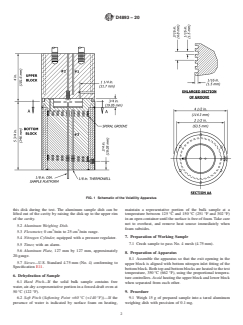
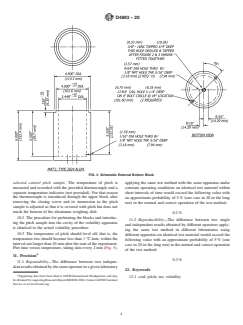
two sections (Figs. 1-4).
safety concerns, if any, associated with its use. It is the
5.1.1 The top block is maintained at a chosen constant
responsibility of the user of this standard to establish appro-
temperature according to the signal from the thermocouple
priate safety, health, and environmental practices and deter-
inserted into the thermowell No. 1 near the center of the block.
mine the applicability of regulatory limitations prior to use.
A proportional temperature controller regulates the heat input.
1.5 This international standard was developed in accor-
Two insulated handles are attached to this part for easy
dance with internationally recognized principles on standard-
handling.An additional thermowell No. 2, located in the center
ization established in the Decision on Principles for the
of the block, accommodates another thermocouple used only
Development of International Standards, Guides and Recom-
for the determination of the rate of temperature rise of the
mendations issued by the World Trade Organization Technical
pitch. When the screw at the bottom of the No. 2 well is taken
Barriers to Trade (TBT) Committee.
out, the thermocouple can then be pushed down and inserted in
2. Referenced Documents pitch.
5.1.2 The bottom block has a cavity for the aluminum
2.1 ASTM Standards:
weighingdish.Aspiralchannelcutaroundtheperipheryofthis
E11 Specification for Woven Wire Test Sieve Cloth and Test
part serves for preheating the nitrogen introduced at the
Sieves
measured rate (10 cm /min) into the block for purging vola-
tiles.
3. Summary of Test Method
5.1.3 The test temperature, the same as that in the top block,
3.1 An aluminum weighing dish with about 15 g of speci-
is maintained by the second proportional temperature control-
men is introduced into the cavity of a metal block heated and
ler according to the signals of a thermocouple inserted in a
maintained at 350 °C (662 °F). After 30 min 6 10 s during
thermowell No. 3 of the bottom block. There is a hole in the
which the volatiles are swept away from the surface of the
center of the bottom cylinder to accommodate the sample
liquid pitch by preheated nitrogen, the sample is taken out and
platform, a rod with a stainless steel disk welded to its top.The
aluminum sample dish containing the sample rests on top of
This test method is under the jurisdiction of ASTM Committee D02 on
Petroleum Products, Liquid Fuels, and Lubricants and is the direct responsibility of
SubcommitteeD02.05onPropertiesofFuels,PetroleumCokeandCarbonMaterial.
Current edition approved June 1, 2020. Published June 2020. Originally An aluminum block that may be obtained on special order from Koppers
ɛ1
approved in 1989. Last previous edition approved in 2015 as D4893 – 94 (2015) . Company, Inc., 1005 Wm. Pitt Way, Pittsburgh, PA 15238, has been found
DOI: 10.1520/D4893-20. satisfactory for this purpose; or drawings of block will be furnished by Koppers
For referenced ASTM standards, visit the ASTM website, www.astm.org, or upon request. If you are aware of alternative suppliers, please provide this
contact ASTM Customer Service at service@astm.org. For Annual Book of ASTM information to ASTM International Headquarters. Your comments will receive
Standards volume information, refer to the standard’s Document Summary page on careful consideration at a meeting of the responsible technical committee, which
the ASTM website. you may attend.
*A Summary of Changes section appears at the end of this standard
Copyright © ASTM International, 100 Barr Harbor Drive, PO Box C700, West Conshohocken, PA 19428-2959. United States
D4893 − 20
FIG. 1 Schematic of the Volatility Apparatus
this disk during the test. The aluminum sample dish can be maintain a representative portion of the bulk sample at a
lifted out of the cavity by raising the disk up to the upper rim temperature between 125 °C and 150 °C (251 °F and 302 °F)
of the cavity. in an open container until the surface is free of foam.Take care
not to overheat, and remove heat source immediately when
5.2 Aluminum Weighing Dish.
foam subsides.
3 3
5.3 Flowmeter,0cm /min to 25 cm /min range.
7. Preparation of Working Sample
5.4 Nitrogen Cylinder, equipped with a pressure regulator.
7.1 Crush sample to pass No. 4 mesh (4.75 mm).
5.5 Timer, with an alarm.
5.6 Aluminum Plate, 127 mm by 127 mm, approximately
8. Preparation of Apparatus
20-gauge.
8.1 Assemble the apparatus so that the exit opening in the
5.7 Sieves—U.S. Standard 4.75 mm (No. 4) conforming to
upper block is aligned with bottom nitrogen inlet fitting of the
Specification E11.
bottomblock.Bothtopandbottomblocksareheatedtothetest
temperature, 350 °C (662 °F), using the proportional tempera-
6. Dehydration of Sample
ture controllers.Avoid heating the upper block and lower block
6.1 Hard Pitch—If the solid bulk sample contains free
when separated from each other.
water, air-dry a representativ
...
This document is not an ASTM standard and is intended only to provide the user of an ASTM standard an indication of what changes have been made to the previous version. Because
it may not be technically possible to adequately depict all changes accurately, ASTM recommends that users consult prior editions as appropriate. In all cases only the current version
of the standard as published by ASTM is to be considered the official document.
´1
Designation: D4893 − 94 (Reapproved 2015) D4893 − 20
Standard Test Method for
Determination of Pitch Volatility
This standard is issued under the fixed designation D4893; the number immediately following the designation indicates the year of
original adoption or, in the case of revision, the year of last revision. A number in parentheses indicates the year of last reapproval. A
superscript epsilon (´) indicates an editorial change since the last revision or reapproval.
ε NOTE—SI units formatting was corrected editorially in May 2015.
1. Scope Scope*
1.1 This test method covers the determination of the percent of pitch volatility.
1.2 Since this test method is empirical, strict adherence to the procedure is necessary.
1.3 The values stated in SI units are to be regarded as the standard. The values in parentheses are given for information only.
1.3.1 Exceptions—The diameter of a special aluminum block is measured in inches.
1.4 This standard does not purport to address all of the safety concerns, if any, associated with its use. It is the responsibility
of the user of this standard to establish appropriate safety safety, health, and healthenvironmental practices and determine the
applicability of regulatory limitations prior to use.
1.5 This international standard was developed in accordance with internationally recognized principles on standardization
established in the Decision on Principles for the Development of International Standards, Guides and Recommendations issued
by the World Trade Organization Technical Barriers to Trade (TBT) Committee.
2. Referenced Documents
2.1 ASTM Standards:
E11 Specification for Woven Wire Test Sieve Cloth and Test Sieves
3. Summary of Test Method
3.1 An aluminum weighing dish with about 15 g of specimen is introduced into the cavity of a metal block heated and
maintained at 350 °C (662 °F). After 30 min 6 10 s during which the volatiles are swept away from the surface of the liquid pitch
by preheated nitrogen, the sample is taken out and allowed to cool down in the desiccator. The pitch volatility is determined by
the sample weight loss and reported as percent weight loss.
4. Significance and Use
4.1 This test is useful in evaluating and characterizing pitch physical properties in comparing the consistency of shipments and
sources of supply.
5. Apparatus
5.1 Aluminum Block, 4 ⁄2 in. outside diameter, composed of two sections (Figs. 1-4).
5.1.1 The top block is maintained at a chosen constant temperature according to the signal from the thermocouple inserted into
the thermowell No. 1 near the center of the block. A proportional temperature controller regulates the heat input. Two insulated
handles are attached to this part for easy handling. An additional thermowell No. 2, located in the center of the block,
accommodates another thermocouple used only for the determination of the rate of temperature rise of the pitch. When the screw
at the bottom of the No. 2 well is taken out, the thermocouple can then be pushed down and inserted in pitch.
This test method is under the jurisdiction of ASTM Committee D02 on Petroleum Products, Liquid Fuels, and Lubricants and is the direct responsibility of Subcommittee
D02.05 on Properties of Fuels, Petroleum Coke and Carbon Material.
Current edition approved April 1, 2015June 1, 2020. Published May 2015June 2020. Originally approved in 1989. Last previous edition approved in 20092015 as
ɛ1
D4893 – 94 (2009).(2015) . DOI: 10.1520/D4893-94R15E01.10.1520/D4893-20.
For referenced ASTM standards, visit the ASTM website, www.astm.org, or contact ASTM Customer Service at service@astm.org. For Annual Book of ASTM Standards
volume information, refer to the standard’s Document Summary page on the ASTM website.
An aluminum block that may be obtained on special order from Koppers Company, Inc., 1005 Wm. Pitt Way, Pittsburgh, PA 15238, has been found satisfactory for this
purpose; or drawings of block will be furnished by Koppers upon request. If you are aware of alternative suppliers, please provide this information to ASTM International
Headquarters. Your comments will receive careful consideration at a meeting of the responsible technical committee, which you may attend.
*A Summary of Changes section appears at the end of this standard
Copyright © ASTM International, 100 Barr Harbor Drive, PO Box C700, West Conshohocken, PA 19428-2959. United States
D4893 − 20
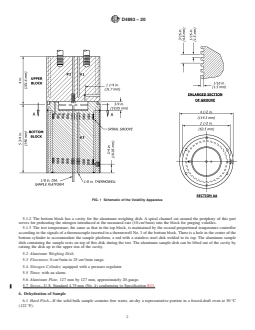
FIG. 1 Schematic of the Volatility Apparatus
5.1.2 The bottom block has a cavity for the aluminum weighing dish. A spiral channel cut around the periphery of this part
serves for preheating the nitrogen introduced at the measured rate (10 cm /min) into the block for purging volatiles.
5.1.3 The test temperature, the same as that in the top block, is maintained by the second proportional temperature controller
according to the signals of a thermocouple inserted in a thermowell No. 3 of the bottom block. There is a hole in the center of the
bottom cylinder to accommodate the sample platform, a rod with a stainless steel disk welded to its top. The aluminum sample
dish containing the sample rests on top of this disk during the test. The aluminum sample dish can be lifted out of the cavity by
raising the disk up to the upper rim of the cavity.
5.2 Aluminum Weighing Dish.
3 3
5.3 Flowmeter, 0 cm /min to 25 cm /min range.
5.4 Nitrogen Cylinder, equipped with a pressure regulator.
5.5 Timer, with an alarm.
5.6 Aluminum Plate, 127 mm by 127 mm, approximately 20-gauge.
5.7 Sieves—U.S. Standard 4.75 mm (No. 4) conforming to Specification E11.
6. Dehydration of Sample
6.1 Hard Pitch—If the solid bulk sample contains free water, air-dry a representative portion in a forced-draft oven at 50 °C
(122 °F).
D4893 − 20
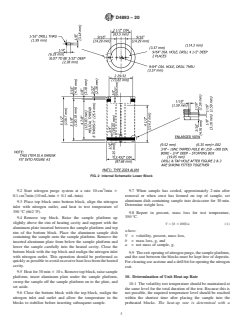
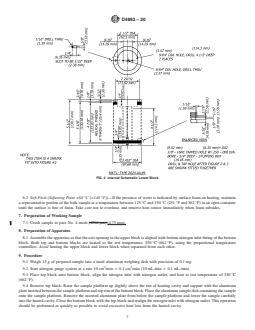
FIG. 2 Internal Schematic Lower Block
6.2 Soft Pitch (Softening Point <60 °C (<140 °F))—If the presence of water is indicated by surface foam on heating, maintain
a representative portion of the bulk sample at a temperature between 125 °C and 150 °C (251 °F and 302 °F) in an open container
until the surface is free of foam. Take care not to overheat, and remove heat source immediately when foam subsides.
7. Preparation of Working Sample
7.1 Crush sample to pass No. 4 mesh (4760 μm).(4.75 mm).
8. Preparation of Apparatus
8.1 Assemble the apparatus so that the exit opening in the upper block is aligned w
...