

ASTM D1321-23
(Test Method)Standard Test Method for Needle Penetration of Petroleum Waxes
General Information
- Abstract
SIGNIFICANCE AND USE
5.1 Petroleum waxes differ in hardness. Needle penetration is a measurement of hardness. Hardness may have a significant effect upon other physical properties.
SCOPE
1.1 This test method covers the empirical estimation of the consistency of waxes derived from petroleum by measurement of the extent of penetration of a standard needle. This test method is applicable to waxes having a penetration of not greater than 250.
Note 1: This test method is similar to the needle method for determining the penetration of bituminous material, Test Method D5. Cone methods applicable to greases and to petrolatum are described in Test Methods D217 and Test Method D937, respectively.
1.2 WARNING—Mercury has been designated by many regulatory agencies as a hazardous substance that can cause serious medical issues. Mercury, or its vapor, has been demonstrated to be hazardous to health and corrosive to materials. Use caution when handling mercury and mercury-containing products. See the applicable product Safety Data Sheet (SDS) for additional information. The potential exists that selling mercury or mercury-containing products, or both, is prohibited by local or national law. Users must determine legality of sales in their location.
1.3 The values stated in SI units are to be regarded as the standard.
1.3.1 Exception—The values given in parentheses are for information only.
1.4 This standard does not purport to address all of the safety concerns, if any, associated with its use. It is the responsibility of the user of this standard to establish appropriate safety, health, and environmental practices and determine the applicability of regulatory limitations prior to use.
1.5 This international standard was developed in accordance with internationally recognized principles on standardization established in the Decision on Principles for the Development of International Standards, Guides and Recommendations issued by the World Trade Organization Technical Barriers to Trade (TBT) Committee.
- Status
- Published
- Publication Date
- 30-Nov-2023
- Technical Committee
- D02 - Petroleum Products, Liquid Fuels, and Lubricants
Overview
ASTM D1321-23, Standard Test Method for Needle Penetration of Petroleum Waxes, is a widely recognized international standard developed by ASTM International. This test method provides a reliable procedure for empirically determining the consistency or hardness of petroleum-derived waxes by measuring the depth to which a standard needle penetrates the wax under specific conditions. The result, known as needle penetration, is a critical indicator of wax hardness, which significantly affects other physical properties and end-use performance.
Applicable to waxes with a needle penetration value not greater than 250, ASTM D1321-23 offers a benchmark for quality control in the production and processing of petroleum waxes. Accurate hardness measurement is crucial in the formulation and assessment of wax-based products across various industries.
Key Topics
- Needle Penetration as Hardness Measurement: The test measures the depth (in tenths of a millimeter) a standard needle penetrates into a wax sample. This value directly reflects the hardness, providing an empirical comparison between different wax samples.
- Applicability and Test Range: Suitable for petroleum waxes with needle penetration up to 250, but not intended for greases or petrolatum, for which separate ASTM methods exist (D217, D937).
- Equipment and Procedure: Utilizes a standard penetrometer and needle, with tests conducted under controlled temperature and sample preparation conditions to ensure repeatable, accurate results.
- Safety Considerations: Emphasizes caution in handling hazardous materials, particularly mercury, due to its health and environmental risks. Users must consult product Safety Data Sheets (SDS) and comply with local regulations.
- International Standardization: Developed based on recognized WTO technical barriers to trade principles, ensuring global relevance and compatibility.
Applications
The ASTM D1321-23 standard is essential for:
- Quality Control in Manufacturing: Ensuring consistent hardness of petroleum wax products such as paraffin and microcrystalline waxes used in packaging, coatings, adhesives, and candles.
- Product Development: Guiding formulation adjustments for desired physical properties in wax blends or products where hardness or consistency impacts utility, stability, or appearance.
- Regulatory Compliance: Providing a standardized measurement method recognized by government and industry bodies, including the U.S. Department of Defense, for product certification and specification fulfillment.
- Comparative Analysis: Enabling benchmarking between different lots or suppliers, critical for procurement and quality assurance in industries relying on wax raw materials.
- Research and Development: Supporting innovation in wax applications by providing an objective parameter for evaluating experimental modifications or alternative sources.
Related Standards
When working with petroleum waxes or assessing related physical properties, consider these additional ASTM standards:
- ASTM D5: Test Method for Penetration of Bituminous Materials - similar needle penetration method for bituminous substances.
- ASTM D87: Test Method for Melting Point of Petroleum Wax (Cooling Curve) - determines wax melting behavior.
- ASTM D217: Test Methods for Cone Penetration of Lubricating Grease - evaluates the consistency of grease products.
- ASTM D937: Test Method for Cone Penetration of Petrolatum - measures the hardness of petrolatum.
- ASTM D938: Test Method for Congealing Point of Petroleum Waxes - assesses temperature at which wax becomes rigid.
- ASTM D4175: Terminology Relating to Petroleum Products, Liquid Fuels, and Lubricants - for relevant definitions.
By adhering to ASTM D1321-23, organizations can ensure accurate, reproducible, and internationally recognized assessments of petroleum wax hardness, supporting product reliability and compliance across global markets.
Relations
- Effective Date
- 01-Dec-2023
- Refers
ASTM D4175-23a - Standard Terminology Relating to Petroleum Products, Liquid Fuels, and Lubricants - Effective Date
- 15-Dec-2023
- Refers
ASTM D4175-23e1 - Standard Terminology Relating to Petroleum Products, Liquid Fuels, and Lubricants - Effective Date
- 01-Jul-2023
- Effective Date
- 01-Dec-2023
- Referred By
ASTM F3401-19 - Standard Test Method for Wax Binder Removal from Equestrian Synthetic Track Surfaces - Effective Date
- 01-Dec-2023
- Effective Date
- 01-Dec-2023
- Effective Date
- 01-Dec-2023
Get Certified
Connect with accredited certification bodies for this standard

Element Materials Technology
Materials testing and product certification.

ABS Group Brazil
ABS Group certification services in Brazil.

ABS Quality Evaluations Inc.
American Bureau of Shipping quality certification.
Sponsored listings
Frequently Asked Questions
ASTM D1321-23 is a standard published by ASTM International. Its full title is "Standard Test Method for Needle Penetration of Petroleum Waxes". This standard covers: SIGNIFICANCE AND USE 5.1 Petroleum waxes differ in hardness. Needle penetration is a measurement of hardness. Hardness may have a significant effect upon other physical properties. SCOPE 1.1 This test method covers the empirical estimation of the consistency of waxes derived from petroleum by measurement of the extent of penetration of a standard needle. This test method is applicable to waxes having a penetration of not greater than 250. Note 1: This test method is similar to the needle method for determining the penetration of bituminous material, Test Method D5. Cone methods applicable to greases and to petrolatum are described in Test Methods D217 and Test Method D937, respectively. 1.2 WARNING—Mercury has been designated by many regulatory agencies as a hazardous substance that can cause serious medical issues. Mercury, or its vapor, has been demonstrated to be hazardous to health and corrosive to materials. Use caution when handling mercury and mercury-containing products. See the applicable product Safety Data Sheet (SDS) for additional information. The potential exists that selling mercury or mercury-containing products, or both, is prohibited by local or national law. Users must determine legality of sales in their location. 1.3 The values stated in SI units are to be regarded as the standard. 1.3.1 Exception—The values given in parentheses are for information only. 1.4 This standard does not purport to address all of the safety concerns, if any, associated with its use. It is the responsibility of the user of this standard to establish appropriate safety, health, and environmental practices and determine the applicability of regulatory limitations prior to use. 1.5 This international standard was developed in accordance with internationally recognized principles on standardization established in the Decision on Principles for the Development of International Standards, Guides and Recommendations issued by the World Trade Organization Technical Barriers to Trade (TBT) Committee.
SIGNIFICANCE AND USE 5.1 Petroleum waxes differ in hardness. Needle penetration is a measurement of hardness. Hardness may have a significant effect upon other physical properties. SCOPE 1.1 This test method covers the empirical estimation of the consistency of waxes derived from petroleum by measurement of the extent of penetration of a standard needle. This test method is applicable to waxes having a penetration of not greater than 250. Note 1: This test method is similar to the needle method for determining the penetration of bituminous material, Test Method D5. Cone methods applicable to greases and to petrolatum are described in Test Methods D217 and Test Method D937, respectively. 1.2 WARNING—Mercury has been designated by many regulatory agencies as a hazardous substance that can cause serious medical issues. Mercury, or its vapor, has been demonstrated to be hazardous to health and corrosive to materials. Use caution when handling mercury and mercury-containing products. See the applicable product Safety Data Sheet (SDS) for additional information. The potential exists that selling mercury or mercury-containing products, or both, is prohibited by local or national law. Users must determine legality of sales in their location. 1.3 The values stated in SI units are to be regarded as the standard. 1.3.1 Exception—The values given in parentheses are for information only. 1.4 This standard does not purport to address all of the safety concerns, if any, associated with its use. It is the responsibility of the user of this standard to establish appropriate safety, health, and environmental practices and determine the applicability of regulatory limitations prior to use. 1.5 This international standard was developed in accordance with internationally recognized principles on standardization established in the Decision on Principles for the Development of International Standards, Guides and Recommendations issued by the World Trade Organization Technical Barriers to Trade (TBT) Committee.
ASTM D1321-23 is classified under the following ICS (International Classification for Standards) categories: 75.140 - Waxes, bituminous materials and other petroleum products. The ICS classification helps identify the subject area and facilitates finding related standards.
ASTM D1321-23 has the following relationships with other standards: It is inter standard links to ASTM D1321-16a, ASTM D4175-23a, ASTM D4175-23e1, ASTM D4730-13(2020), ASTM F3401-19, ASTM C782-13(2023), ASTM D4872-14(2020). Understanding these relationships helps ensure you are using the most current and applicable version of the standard.
ASTM D1321-23 is available in PDF format for immediate download after purchase. The document can be added to your cart and obtained through the secure checkout process. Digital delivery ensures instant access to the complete standard document.
Standards Content (Sample)
This international standard was developed in accordance with internationally recognized principles on standardization established in the Decision on Principles for the
Development of International Standards, Guides and Recommendations issued by the World Trade Organization Technical Barriers to Trade (TBT) Committee.
Designation: D1321 − 23
Standard Test Method for
Needle Penetration of Petroleum Waxes
This standard is issued under the fixed designation D1321; the number immediately following the designation indicates the year of
original adoption or, in the case of revision, the year of last revision. A number in parentheses indicates the year of last reapproval. A
superscript epsilon (´) indicates an editorial change since the last revision or reapproval.
This standard has been approved for use by agencies of the U.S. Department of Defense.
1. Scope* 2. Referenced Documents
1.1 This test method covers the empirical estimation of the 2.1 ASTM Standards:
consistency of waxes derived from petroleum by measurement D5 Test Method for Penetration of Bituminous Materials
of the extent of penetration of a standard needle. This test D87 Test Method for Melting Point of Petroleum Wax
method is applicable to waxes having a penetration of not (Cooling Curve)
greater than 250. D217 Test Methods for Cone Penetration of Lubricating
Grease
NOTE 1—This test method is similar to the needle method for
D937 Test Method for Cone Penetration of Petrolatum
determining the penetration of bituminous material, Test Method D5.
D938 Test Method for Congealing Point of Petroleum
Cone methods applicable to greases and to petrolatum are described in
Test Methods D217 and Test Method D937, respectively.
Waxes, Including Petrolatum
D4175 Terminology Relating to Petroleum Products, Liquid
1.2 WARNING—Mercury has been designated by many
Fuels, and Lubricants
regulatory agencies as a hazardous substance that can cause
E1 Specification for ASTM Liquid-in-Glass Thermometers
serious medical issues. Mercury, or its vapor, has been dem-
E2251 Specification for Liquid-in-Glass ASTM Thermom-
onstrated to be hazardous to health and corrosive to materials.
eters with Low-Hazard Precision Liquids
Use caution when handling mercury and mercury-containing
products. See the applicable product Safety Data Sheet (SDS)
3. Terminology
for additional information. The potential exists that selling
3.1 Definitions:
mercury or mercury-containing products, or both, is prohibited
3.1.1 For definitions of terms used in this test method, refer
by local or national law. Users must determine legality of sales
to Terminology D4175.
in their location.
3.1.2 penetration, n—of petroleum wax, the depth in tenths
1.3 The values stated in SI units are to be regarded as the
of a millimetre to which a standard needle penetrates into the
standard.
wax under defined conditions.
1.3.1 Exception—The values given in parentheses are for
3.1.2.1 Discussion—As an example, a penetration reading
information only.
of 85 from the indicator scale corresponds to a penetration
1.4 This standard does not purport to address all of the
depth of 8.5 mm.
safety concerns, if any, associated with its use. It is the
3.1.3 penetrometer, n—an instrument that measures the
responsibility of the user of this standard to establish appro-
consistency or hardness of semiliquid to semisolid materials by
priate safety, health, and environmental practices and deter-
measuring the depth to which a specified cone or needle under
mine the applicability of regulatory limitations prior to use.
a given force falls into the material.
1.5 This international standard was developed in accor-
3.1.3.1 Discussion—In this test method, a standard pen-
dance with internationally recognized principles on standard-
etrometer needle (6.3) is used to determine the hardness of
ization established in the Decision on Principles for the
petroleum wax. The penetration force is determined by the
Development of International Standards, Guides and Recom-
total mass (100 g) of the needle, plunger, and 50 g weight.
mendations issued by the World Trade Organization Technical
Barriers to Trade (TBT) Committee.
4. Summary of Test Method
4.1 The sample is heated to at least 17 °C (30 °F) above its
This test method is under the jurisdiction of ASTM Committee D02 on
expected congealing point or melting point, poured into a
Petroleum Products, Liquid Fuels, and Lubricants and is the direct responsibility of
Subcommittee D02.10 on Properties of Petroleum Waxes and Alternative Wax-like
Materials. For referenced ASTM standards, visit the ASTM website, www.astm.org, or
Current edition approved Dec. 1, 2023. Published December 2023. Originally contact ASTM Customer Service at service@astm.org. For Annual Book of ASTM
approved in 1954. Last previous edition approved in 2016 as D1321 – 16a. DOI: Standards volume information, refer to the standard’s Document Summary page on
10.1520/D1321-23. the ASTM website.
*A Summary of Changes section appears at the end of this standard
Copyright © ASTM International, 100 Barr Harbor Drive, PO Box C700, West Conshohocken, PA 19428-2959. United States
D1321 − 23
container, and then air cooled under controlled conditions. The 6.3 Needle and Plunger—The needle shall be approximately
sample then is conditioned at test temperature in a water bath. 83 mm in length and conform to the dimensions shown in Fig.
Penetration is measured with a penetrometer, which applies a 2. It shall be symmetrically tapered at one end to a cone whose
standard needle to the sample for 5 s under a load of 100 g. angle shall be within the range from 8°, 55 min to 9°, 25 min
over the entire length of the cone. The axis of the cone shall be
5. Significance and Use
coincident with the shaft axis within 0.13 mm (0.005 in.)
maximum runout (total indicator reading). The tapered section
5.1 Petroleum waxes differ in hardness. Needle penetration
of the needle shall be made from fully hardened and tempered
is a measurement of hardness. Hardness may have a significant
stainless steel, Grade 440-C or equal, Rockwell hardness C57
effect upon other physical properties.
to 60. After tapering, the point shall be ground off to a
truncated cone, the smaller base of which shall be from
6. Apparatus
0.14 mm to 0.16 mm in diameter. The truncation shall be
6.1 Penetrometer, for applying the standard needle to the
square with the needle axis within 2°, and the edge shall be
surface of the sample specimen and for measuring the extent of
sharp and free from burrs. The conical surface and the
penetration at the conclusion of the test. The penetrometer shall
truncation shall be finished to a smoothness of 0.2 μm (8 μin.)
be constructed in such a manner that the accurate placement of
(rms). The final weight of the needle shall be 2.5 g 6 0.05 g.
the tip of the needle at the level surface of the specimen may
The total weight of the plunger shall be 47.5 g 6 0.05 g; a
be made while maintaining a “zero” reading on the indicator.
weight of 50 g 6 0.05 g is required for mounting on the
The apparatus shown in Fig. 1 represents a composite drawing
plunger.
illustrating the two available types of instrument, one with an
NOTE 2—The National Institute of Standards and Technology will
adjustable table and the other with an adjustable needle
measure and certify the accuracy of penetration needles in accordance
assembly; the use of either type of instrument is permissible.
with these permissible variations.
The loaded needle must fall, when released, without appre-
6.4 Test Specimen Container, consisting of a brass cylinder
ciable friction. The instrument shall be provided with leveling
open at both ends, having a 25.4 mm 6 1.6 mm (1 in. 6
screws and a spirit level to maintain the plunger shaft in a true
1 1 1
⁄16 in.) inside diameter, 31.8 mm 6 1.6 mm (1 ⁄4 in. 6 ⁄16 in.)
vertical position. The indicator scale shall be calibrated in
1 1
height, and 3.2 mm 6 1.6 mm ( ⁄8 in. 6 ⁄16 in.) wall thickness.
tenths of a millimetre division and shall have a range of at least
To prevent slippage of very hard wax, a few screw threads or
250 tenths of millimetres.
grooves shall be cut into the center part of the inside wall of the
6.2 Timing Device—An automatic timing release mecha-
cylinder. The cylinder shall be placed on a base plate of brass,
nism attached to the penetrometer may be used. Alternatively,
wetted with an equal volume mixture of glycerin and water,
a stop watch graduated in 0.1 s intervals may be used.
when casting a test specimen.
6.5 Test Room or Cabinet, capable of being maintained at
23.9 °C 6 2.2 °C (75 °F 6 4 °F).
6.6 Water Bath, of at least 10 L capacity, capable of being
maintained at the test temperature within 60.1 °C (60.2 °F)
(Note 5). The water bath should be made of glass or other
suitable transparent material, or have a window to permit a
horizontal view of the specimen. It shall be possible to
immerse the test specimen in the bath to a depth of not less than
102 mm (4 in.) and to support it on a perforated conditioning
shelf not less than 51 mm (2 in.) from the bottom of the bath.
The bath also shall be equipped with a rigid perforated test
shelf about 51 mm below the water level to support the
specimen during the penetration by the needle.
6.7 Thermometer
...
This document is not an ASTM standard and is intended only to provide the user of an ASTM standard an indication of what changes have been made to the previous version. Because
it may not be technically possible to adequately depict all changes accurately, ASTM recommends that users consult prior editions as appropriate. In all cases only the current version
of the standard as published by ASTM is to be considered the official document.
Designation: D1321 − 16a D1321 − 23
Standard Test Method for
Needle Penetration of Petroleum Waxes
This standard is issued under the fixed designation D1321; the number immediately following the designation indicates the year of
original adoption or, in the case of revision, the year of last revision. A number in parentheses indicates the year of last reapproval. A
superscript epsilon (´) indicates an editorial change since the last revision or reapproval.
This standard has been approved for use by agencies of the U.S. Department of Defense.
1. Scope*
1.1 This test method covers the empirical estimation of the consistency of waxes derived from petroleum by measurement of the
extent of penetration of a standard needle. This test method is applicable to waxes having a penetration of not greater than 250.
NOTE 1—This test method is similar to the needle method for determining the penetration of bituminous material, Test Method D5. Cone methods
applicable to greases and to petrolatum are described in Test Methods D217 and Test Method D937, respectively.
1.2 WARNING—Mercury has been designated by many regulatory agencies as a hazardous materialsubstance that can cause
central nervous system, kidney and liver damage. serious medical issues. Mercury, or its vapor, may has been demonstrated to be
hazardous to health and corrosive to materials. Caution should be taken Use caution when handling mercury and mercury
containing mercury-containing products. See the applicable product Material Safety Data Sheet (MSDS) for details and EPA’s
website—http://www.epa.gov/mercury/faq.htm—for additional information. Users should be aware (SDS) for additional informa-
tion. The potential exists that selling mercury and/or mercury containing products into your state or country may be prohibited by
law.or mercury-containing products, or both, is prohibited by local or national law. Users must determine legality of sales in their
location.
1.3 The values stated in SI units are to be regarded as the standard.
1.3.1 Exception—The values given in parentheses are for information only.
1.4 This standard does not purport to address all of the safety concerns, if any, associated with its use. It is the responsibility
of the user of this standard to establish appropriate safety, health, and environmental practices and determine the applicability of
regulatory limitations prior to use.
1.5 This international standard was developed in accordance with internationally recognized principles on standardization
established in the Decision on Principles for the Development of International Standards, Guides and Recommendations issued
by the World Trade Organization Technical Barriers to Trade (TBT) Committee.
2. Referenced Documents
2.1 ASTM Standards:
D5 Test Method for Penetration of Bituminous Materials
This test method is under the jurisdiction of ASTM Committee D02 on Petroleum Products, Liquid Fuels, and Lubricants and is the direct responsibility of Subcommittee
D02.10 on Properties of Petroleum Waxes and Alternative Wax-like Materials.
Current edition approved July 1, 2016Dec. 1, 2023. Published July 2016December 2023. Originally approved in 1954. Last previous edition approved in 2016 as
D1321 – 16.D1321 – 16a. DOI: 10.1520/D1321-16A. 10.1520/D1321-23.
For referenced ASTM standards, visit the ASTM website, www.astm.org, or contact ASTM Customer Service at service@astm.org. For Annual Book of ASTM Standards
volume information, refer to the standard’s Document Summary page on the ASTM website.
*A Summary of Changes section appears at the end of this standard
Copyright © ASTM International, 100 Barr Harbor Drive, PO Box C700, West Conshohocken, PA 19428-2959. United States
D1321 − 23
D87 Test Method for Melting Point of Petroleum Wax (Cooling Curve)
D217 Test Methods for Cone Penetration of Lubricating Grease
D937 Test Method for Cone Penetration of Petrolatum
D938 Test Method for Congealing Point of Petroleum Waxes, Including Petrolatum
D4175 Terminology Relating to Petroleum Products, Liquid Fuels, and Lubricants
E1 Specification for ASTM Liquid-in-Glass Thermometers
E2251 Specification for Liquid-in-Glass ASTM Thermometers with Low-Hazard Precision Liquids
3. Terminology
3.1 Definitions:
3.1.1 For definitions of terms used in this test method, refer to Terminology D4175.
3.1.2 penetration, n—of petroleum wax, the depth in tenths of a millimetre to which a standard needle penetrates into the wax
under defined conditions.
3.1.2.1 Discussion—
As an example, a penetration reading of 85 from the indicator scale corresponds to a penetration depth of 8.5 mm.
3.1.3 penetrometer, n—an instrument that measures the consistency or hardness of semiliquid to semisolid materials by measuring
the depth to which a specified cone or needle under a given force falls into the material.
3.1.3.1 Discussion—
In this test method, a standard penetrometer needle (6.3) is used to determine the hardness of petroleum wax. The penetration force
is determined by the total mass (100 g) of the needle, plunger, and 50 g weight.
4. Summary of Test Method
4.1 The sample is heated to at least 17 °C (30 °F) above its expected congealing point or melting point, poured into a container,
and then air cooled under controlled conditions. The sample then is conditioned at test temperature in a water bath. Penetration
is measured with a penetrometer, which applies a standard needle to the sample for 5 s under a load of 100 g.
5. Significance and Use
5.1 Petroleum waxes differ in hardness. Needle penetration is a measurement of hardness. Hardness may have a significant effect
upon other physical properties.
6. Apparatus
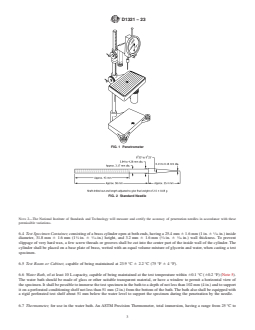
6.1 Penetrometer, for applying the standard needle to the surface of the sample specimen and for measuring the extent of
penetration at the conclusion of the test. The penetrometer shall be constructed in such a manner that the accurate placement of
the tip of the needle at the level surface of the specimen may be made while maintaining a “zero” reading on the indicator. The
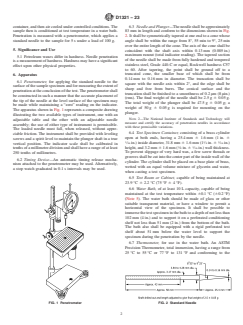
apparatus shown in Fig. 1 represents a composite drawing illustrating the two available types of instrument, one with an adjustable
table and the other with an adjustable needle assembly; the use of either type of instrument is permissible. The loaded needle must
fall, when released, without appreciable friction. The instrument shall be provided with leveling screws and a spirit level to
maintain the plunger shaft in a true vertical position. The indicator scale shall be calibrated in tenths of a millimetre division and
shall have a range of at least 250 tenths of millimetres.
6.2 Timing Device—An automatic timing release mechanism attached to the penetrometer may be used. Alternatively, a stop watch
graduated in 0.1 s intervals may be used.
6.3 Needle and Plunger—The needle shall be approximately 83 mm in length and conform to the dimensions shown in Fig. 2. It
shall be symmetrically tapered at one end to a cone whose angle shall be within the range from 8°, 55 min to 9°, 25 min over the
entire length of the cone. The axis of the cone shall be coincident with the shaft axis within 0.13 mm (0.005 in.) maximum runout
(total indicator reading). The tapered section of the needle shall be made from fully hardened and tempered stainless steel, Grade
440-C or equal, Rockwell hardness C57 to 60. After tapering, the point shall be ground off to a truncated cone, the smaller base
of which shall be from 0.14 mm to 0.16 mm in diameter. The truncation shall be square with the needle axis within 2°, and the
edge shall be sharp and free from burrs. The conical surface and the truncation shall be finished to a smoothness of 0.2 μm (8 μin.)
(rms). The final weight of the needle shall be 2.5 g 6 0.05 g. The total weight of the plunger shall be 47.5 g 6 0.05 g; a weight
of 50 g 6 0.05 g is required for mounting on the plunger.
D1321 − 23
FIG. 1 Penetrometer
FIG. 2 Standard Needle
NOTE 2—The National Institute of Standards and Technology will measure and certify the accuracy of penetration needles in accordance with these
permissible variations.
6.4 Test Specimen Container, consisting of a brass cylinder open at both ends, having a 25.4 mm 6 1.6 mm (1 in. 6 ⁄16 in.) inside
1 1 1 1
diameter, 31.8 mm 6 1.6 mm (1 ⁄4 in. 6 ⁄16 in.) height, and 3.2 mm 6 1.6 mm ( ⁄8 in. 6 ⁄16 in.) wall thickness. To prevent
slippage of very hard wax, a few screw threads or grooves shall be cut into the center part of the inside wall of the cylinder. The
cylinder shall be placed on a base plate of brass, wetted with an equal volume mixture of glycerin and water, when casting a test
specimen.
6.5 Test Room or Cabinet, capable of being maintained at 23.9 °C 6 2.2 °C (75 °F 6 4 °F).
6.6 Water Bath, of at least 10 L capacity, capable of being maintained at the test temperature within 60.1 °C (60.2 °F) (Note 5).
The water bath should be made of glass or other suitable transparent material, or have a window to permit a horizontal view of
the specimen. It shall be possible to immerse the test specimen in the bath to a depth of not less than 102 mm (4 in.) and to support
it on a perforated conditioning shelf not less than 51 mm (2 in.) from the bottom of the bath. The bath also shall be equipped with
a rigid perforated test shelf about 51 mm below the water level to support the specimen during the pen
...