

ASTM D5018-23
(Test Method)Standard Test Method for Shear Viscosity of Coal-Tar and Petroleum Pitches
General Information
- Abstract
SIGNIFICANCE AND USE
5.1 This test method is useful as one element in establishing the uniformity of shipments.
5.2 Viscosity is also valuable for rheological characterization of binder pitches. Binder pitch imparts consistency to carbonaceous mixes and affects their resistance to deformation. Binder pitch viscosity is important for assessing mix consistency and for evaluating the ease of mix extrusion or molding into artifacts.
SCOPE
1.1 This test method covers the determination of the apparent shear viscosity of coal-tar and petroleum-based pitches having a Mettler softening point (SP) range of approximately 95 °C to 120 °C (see Test Method D3104).
1.2 This test method is applicable only for rotational viscometers.
1.3 Since this test method is based on theoretical grounds, strict adherence to details of the procedure is necessary to comply with the theoretical requirements.
1.4 The values stated in SI units are to be regarded as standard.
1.4.1 Exception—The values stated in conventional units (centipoise) are to be regarded as the standard for viscosity measurement only. The SI unit is the pascal second (Pa·s) and one millipascal second (mPa·s) = one centipoise (cP); centipoise is in cgs units.
1.5 This standard does not purport to address all of the safety concerns, if any, associated with its use. It is the responsibility of the user of this standard to establish appropriate safety, health, and environmental practices and determine the applicability of regulatory limitations prior to use. Specific hazard statements are given in Section 8.
1.6 This international standard was developed in accordance with internationally recognized principles on standardization established in the Decision on Principles for the Development of International Standards, Guides and Recommendations issued by the World Trade Organization Technical Barriers to Trade (TBT) Committee.
- Status
- Published
- Publication Date
- 30-Sep-2023
- Technical Committee
- D02 - Petroleum Products, Liquid Fuels, and Lubricants
- Drafting Committee
- D02.05 - Properties of Fuels, Petroleum Coke and Carbon Material
Overview
ASTM D5018-23: Standard Test Method for Shear Viscosity of Coal-Tar and Petroleum Pitches provides a reliable procedure for measuring the apparent shear viscosity of coal-tar and petroleum-based pitches. This method applies to materials with a Mettler softening point in the range of approximately 95 °C to 120 °C and is performed using rotational viscometers. Shear viscosity is a crucial property for binder pitches, affecting the consistency and processability of carbonaceous mixtures in various industrial applications.
The standard ensures consistency and quality control in shipments, supports rheological characterization, and guides safe and effective laboratory practices. It is developed according to internationally recognized standardization principles.
Key Topics
Scope and Applicability
- Measures apparent shear viscosity of coal-tar and petroleum pitches.
- Targets pitches with Mettler softening points approximately 95 °C to 120 °C.
- Applicable only to rotational viscometer methods.
Measurement Principles
- Viscosity is determined by unidirectional steady shear using a concentrically configured cylinder viscometer.
- Accurate temperature control and strict procedural adherence are required for reliable results.
Units of Measurement
- SI unit: Pascal second (Pa·s)
- Centipoise (cP/mPa·s) for viscosity reporting, per cgs unit conventions.
Significance
- Viscosity assesses binder pitch uniformity and suitability for use.
- Provides rheological data for evaluating extrusion and molding processes.
Safety and Handling
- Addresses handling of hot pitch and toxic solvents.
- Requires appropriate ventilation and avoidance of ignition sources.
- Users must comply with health, safety, and environmental regulations.
Applications
Accurate measurement of shear viscosity supports diverse industrial and quality control applications within coal-tar and petroleum industries, especially where pitch uniformity and rheology critically influence product performance. Common uses of this ASTM pitch viscosity test method include:
- Quality Assurance: Monitoring batch-to-batch uniformity prior to shipment or processing.
- Process Control: Adjusting carbonaceous mixture consistency for easier extrusion or molding into desired artifacts.
- Product Development: Tailoring pitch properties to specific product requirements in refractory, carbon electrode, or anode production.
- Material Evaluation: Comparing different pitches to select suitable materials for targeted industrial processes.
This method helps ensure that binder pitch delivers the necessary consistency, workability, and resistance to deformation during manufacturing.
Related Standards
Several ASTM standards complement or are referenced by ASTM D5018-23, enabling unified terminology and methods across the petroleum and pitch industry. Key related standards include:
- ASTM D3104: Test Method for Softening Point of Pitches (Mettler Softening Point Method)
- ASTM D4175: Terminology Relating to Petroleum Products, Liquid Fuels, and Lubricants
- ASTM D4296: Practice for Sampling Pitch
- ASTM E691: Practice for Conducting an Interlaboratory Study to Determine Precision of a Test Method
- ASTM E1953: Practice for Description of Thermal Analysis and Rheology Apparatus
- ASTM E2975: Test Method for Calibration or Calibration Verification of Concentric Cylinder Rotational Viscometers
Adhering to these standards ensures accurate, repeatable results and effective communication within the industry.
Keywords: ASTM D5018, shear viscosity, coal-tar pitch, petroleum pitch, binder pitch, rotational viscometer, viscosity testing, rheological characterization, quality control, pitch softening point
Relations
- Effective Date
- 01-Oct-2023
- Effective Date
- 01-Mar-2024
- Refers
ASTM D4175-23a - Standard Terminology Relating to Petroleum Products, Liquid Fuels, and Lubricants - Effective Date
- 15-Dec-2023
- Refers
ASTM D4175-23e1 - Standard Terminology Relating to Petroleum Products, Liquid Fuels, and Lubricants - Effective Date
- 01-Jul-2023
- Refers
ASTM D4175-23 - Standard Terminology Relating to Petroleum Products, Liquid Fuels, and Lubricants - Effective Date
- 01-Jul-2023
- Effective Date
- 01-Dec-2018
Get Certified
Connect with accredited certification bodies for this standard

Element Materials Technology
Materials testing and product certification.

ABS Group Brazil
ABS Group certification services in Brazil.

ABS Quality Evaluations Inc.
American Bureau of Shipping quality certification.
Sponsored listings
Frequently Asked Questions
ASTM D5018-23 is a standard published by ASTM International. Its full title is "Standard Test Method for Shear Viscosity of Coal-Tar and Petroleum Pitches". This standard covers: SIGNIFICANCE AND USE 5.1 This test method is useful as one element in establishing the uniformity of shipments. 5.2 Viscosity is also valuable for rheological characterization of binder pitches. Binder pitch imparts consistency to carbonaceous mixes and affects their resistance to deformation. Binder pitch viscosity is important for assessing mix consistency and for evaluating the ease of mix extrusion or molding into artifacts. SCOPE 1.1 This test method covers the determination of the apparent shear viscosity of coal-tar and petroleum-based pitches having a Mettler softening point (SP) range of approximately 95 °C to 120 °C (see Test Method D3104). 1.2 This test method is applicable only for rotational viscometers. 1.3 Since this test method is based on theoretical grounds, strict adherence to details of the procedure is necessary to comply with the theoretical requirements. 1.4 The values stated in SI units are to be regarded as standard. 1.4.1 Exception—The values stated in conventional units (centipoise) are to be regarded as the standard for viscosity measurement only. The SI unit is the pascal second (Pa·s) and one millipascal second (mPa·s) = one centipoise (cP); centipoise is in cgs units. 1.5 This standard does not purport to address all of the safety concerns, if any, associated with its use. It is the responsibility of the user of this standard to establish appropriate safety, health, and environmental practices and determine the applicability of regulatory limitations prior to use. Specific hazard statements are given in Section 8. 1.6 This international standard was developed in accordance with internationally recognized principles on standardization established in the Decision on Principles for the Development of International Standards, Guides and Recommendations issued by the World Trade Organization Technical Barriers to Trade (TBT) Committee.
SIGNIFICANCE AND USE 5.1 This test method is useful as one element in establishing the uniformity of shipments. 5.2 Viscosity is also valuable for rheological characterization of binder pitches. Binder pitch imparts consistency to carbonaceous mixes and affects their resistance to deformation. Binder pitch viscosity is important for assessing mix consistency and for evaluating the ease of mix extrusion or molding into artifacts. SCOPE 1.1 This test method covers the determination of the apparent shear viscosity of coal-tar and petroleum-based pitches having a Mettler softening point (SP) range of approximately 95 °C to 120 °C (see Test Method D3104). 1.2 This test method is applicable only for rotational viscometers. 1.3 Since this test method is based on theoretical grounds, strict adherence to details of the procedure is necessary to comply with the theoretical requirements. 1.4 The values stated in SI units are to be regarded as standard. 1.4.1 Exception—The values stated in conventional units (centipoise) are to be regarded as the standard for viscosity measurement only. The SI unit is the pascal second (Pa·s) and one millipascal second (mPa·s) = one centipoise (cP); centipoise is in cgs units. 1.5 This standard does not purport to address all of the safety concerns, if any, associated with its use. It is the responsibility of the user of this standard to establish appropriate safety, health, and environmental practices and determine the applicability of regulatory limitations prior to use. Specific hazard statements are given in Section 8. 1.6 This international standard was developed in accordance with internationally recognized principles on standardization established in the Decision on Principles for the Development of International Standards, Guides and Recommendations issued by the World Trade Organization Technical Barriers to Trade (TBT) Committee.
ASTM D5018-23 is classified under the following ICS (International Classification for Standards) categories: 75.140 - Waxes, bituminous materials and other petroleum products. The ICS classification helps identify the subject area and facilitates finding related standards.
ASTM D5018-23 has the following relationships with other standards: It is inter standard links to ASTM D5018-18, ASTM D4296-24, ASTM D4175-23a, ASTM D4175-23e1, ASTM D4175-23, ASTM D4296-18. Understanding these relationships helps ensure you are using the most current and applicable version of the standard.
ASTM D5018-23 is available in PDF format for immediate download after purchase. The document can be added to your cart and obtained through the secure checkout process. Digital delivery ensures instant access to the complete standard document.
Standards Content (Sample)
This international standard was developed in accordance with internationally recognized principles on standardization established in the Decision on Principles for the
Development of International Standards, Guides and Recommendations issued by the World Trade Organization Technical Barriers to Trade (TBT) Committee.
Designation: D5018 − 23
Standard Test Method for
Shear Viscosity of Coal-Tar and Petroleum Pitches
This standard is issued under the fixed designation D5018; the number immediately following the designation indicates the year of
original adoption or, in the case of revision, the year of last revision. A number in parentheses indicates the year of last reapproval. A
superscript epsilon (´) indicates an editorial change since the last revision or reapproval.
1. Scope* D3104 Test Method for Softening Point of Pitches (Mettler
Softening Point Method)
1.1 This test method covers the determination of the appar-
D4175 Terminology Relating to Petroleum Products, Liquid
ent shear viscosity of coal-tar and petroleum-based pitches
Fuels, and Lubricants
having a Mettler softening point (SP) range of approximately
D4296 Practice for Sampling Pitch
95 °C to 120 °C (see Test Method D3104).
E691 Practice for Conducting an Interlaboratory Study to
1.2 This test method is applicable only for rotational vis-
Determine the Precision of a Test Method
cometers.
E1953 Practice for Description of Thermal Analysis and
1.3 Since this test method is based on theoretical grounds, Rheology Apparatus
E2975 Test Method for Calibration or Calibration Verifica-
strict adherence to details of the procedure is necessary to
comply with the theoretical requirements. tion of Concentric Cylinder Rotational Viscometers
1.4 The values stated in SI units are to be regarded as
3. Terminology
standard.
1.4.1 Exception—The values stated in conventional units 3.1 Definitions:
(centipoise) are to be regarded as the standard for viscosity
3.1.1 For definitions of terms used in this test method, refer
measurement only. The SI unit is the pascal second (Pa·s) and
to Terminology D4175.
one millipascal second (mPa·s) = one centipoise (cP); cen-
tipoise is in cgs units.
4. Summary of Test Method
1.5 This standard does not purport to address all of the
4.1 The viscosity of a pitch, over the temperature range of
safety concerns, if any, associated with its use. It is the
about 40 °C to 100 °C above the SP of the material, is
responsibility of the user of this standard to establish appro-
determined using a rotational viscometer.
priate safety, health, and environmental practices and deter-
4.2 The recommended specifications herein are for measur-
mine the applicability of regulatory limitations prior to use.
ing the apparent shear viscosity of binder pitches via a
Specific hazard statements are given in Section 8.
concentric cylinder viscometer. Apparent shear viscosity is the
1.6 This international standard was developed in accor-
ratio of shear stress to shear rate in a unidirectional simple
dance with internationally recognized principles on standard-
shear flow field at steady state conditions. A concentric
ization established in the Decision on Principles for the
cylinder viscometer is useful for measuring the apparent shear
Development of International Standards, Guides and Recom-
viscosity, provided the sample temperature is adequately
mendations issued by the World Trade Organization Technical
controlled, the “end-effects” are negligible, and the gap be-
Barriers to Trade (TBT) Committee.
tween rotor/cup is small and remains constant during the test.
The extrapolated value of apparent shear viscosity at “zero”
2. Referenced Documents
shear rate is called shear viscosity.
2.1 ASTM Standards:
5. Significance and Use
5.1 This test method is useful as one element in establishing
This test method is under the jurisdiction of ASTM Committee D02 on
the uniformity of shipments.
Petroleum Products, Liquid Fuels, and Lubricantsand is the direct responsibility of
Subcommittee D02.05 on Properties of Fuels, Petroleum Coke and Carbon Material.
5.2 Viscosity is also valuable for rheological characteriza-
Current edition approved Oct. 1, 2023. Published October 2023. Originally
tion of binder pitches. Binder pitch imparts consistency to
approved in 1989. Last previous edition approved in 2018 as D5018 – 18. DOI:
10.1520/D5018-23.
carbonaceous mixes and affects their resistance to deformation.
For referenced ASTM standards, visit the ASTM website, www.astm.org, or
Binder pitch viscosity is important for assessing mix consis-
contact ASTM Customer Service at service@astm.org. For Annual Book of ASTM
tency and for evaluating the ease of mix extrusion or molding
Standards volume information, refer to the standard’s Document Summary page on
the ASTM website. into artifacts.
*A Summary of Changes section appears at the end of this standard
Copyright © ASTM International, 100 Barr Harbor Drive, PO Box C700, West Conshohocken, PA 19428-2959. United States
D5018 − 23
6. Apparatus
6.1 Viscometer—A rotational viscometer capable of measur-
ing viscosity in the range of about 5 mPa·s (cP) to
15 000 mPa·s (cP); the viscometer should be equipped with the
appropriate accessories to allow measurements up to about
230 °C. The essential instrumentation required providing the
minimum rotational viscometer analytical capabilities include
(see Practice E1953):
6.1.1 Drive motor, to apply a unidirectional rotational dis-
placement to the specimen of 0.3 r ⁄min to 60 r ⁄min constant to
61 %.
6.1.2 Force sensor, to measure the torque developed by the
specimen to within 61 %.
6.1.3 Coupling shaft, or other means to transmit the dis-
placement from the motor to the specimen.
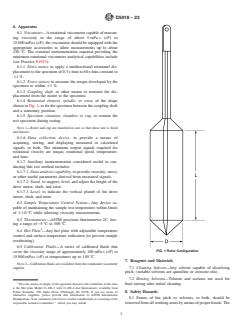
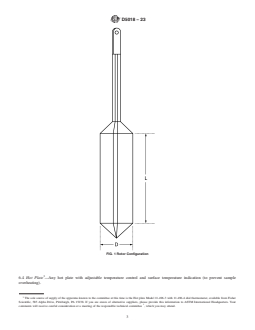
6.1.4 Rotational element, spindle, or rotor, of the shape
shown in Fig. 1, to fix the specimen between the coupling shaft
and a stationary position.
6.1.5 Specimen container, chamber, or cup, to contain the
test specimen during testing.
NOTE 1—Rotor and cup are matched in size so that shear rate is fixed
and known.
6.1.6 Data collection device, to provide a means of
acquiring, storing, and displaying measured or calculated
signals, or both. The minimum output signals required for
rotational visocity are torque, rotational speed, temperature,
and time.
6.1.7 Auxiliary instrumentation considered useful in con-
ducting this test method includes:
6.1.7.1 Data analysis capability, to provide viscosity, stress,
or other useful parameters derived from measured signals.
6.1.7.2 Stand, to support, level, and adjust the height of the
drive motor, shaft, and rotor.
6.1.7.3 Level, to indicate the vertical plumb of the drive
motor, shaft, and rotor.
6.2 Sample Temperature Control System—Any device ca-
pable of maintaining the sample test temperature within limits
of 61.0 °C while allowing viscosity measurements.
6.3 Thermometer—ASTM precision thermometer 2C, hav-
ing a range of −5 °C to 300 °C.
6.4 Hot Plate —Any hot plate with adjustable temperature
control and surface temperature indication (to prevent sample
overheating).
6.5 Calibration Fluids—A series of calibrated fluids that
FIG. 1 Rotor Configuration
cover the viscosity range of approximately 100 mPa·s (cP) to
15 000 mPa·s (cP) at temperatures up to 150 °C.
7. Reagents and Materials
NOTE 2—Calibration fluids are available from the rotational viscometer
supplier. 7.1 Cleaning Solvent—Any solvent capable of dissolving
pitch, (suitable solvents are quinoline or creosote oils).
7.2 Rinsing Solvents—Toluene and acetone are used for
final rinsing after initial cleaning.
The sole source of supply of the apparatus known to the committee at this time
is the Hot plate Model 11-496-3 with 11-496-4 dial thermometer, available from
Fisher Scientific, 585 Alpha Drive, Pittsburgh, PA 15238. If you are aware of 8. Safety Hazards
alternative suppliers, please provide this information to ASTM International
8.1 Fumes of hot pitch or solvents, or both, should be
Headquarters. Your comments will receive careful consideration at a meeting of the
responsible technical committee , which you may attend. removed from all working areas by means of proper hoods. The
D5018 − 23
working area should be kept free of sparks and flames. 13.1.4 Prevent viscous heating (due to prolonged rotation of
Quinoline fumes should not be inhaled, and prolonged contact rotor at high revolutions per minute).
with skin should be avoided. Toluene is toxic and flammable.
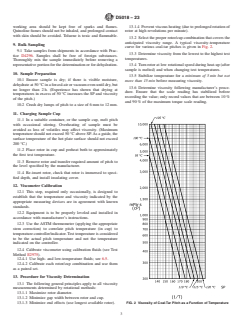
13.2 Select the proper rotor/cup combination that covers the
anticipated viscosity range. A typical viscosity-temperature
9. Bulk Sampling
curve for various coal-tar pitches is given in Fig. 2.
9.1 Take samples from shipments in accordance with Prac-
13.3 Determine viscosity from the lowest to the highest test
tice D4296. Samples shall be free of foreign substan
...
This document is not an ASTM standard and is intended only to provide the user of an ASTM standard an indication of what changes have been made to the previous version. Because
it may not be technically possible to adequately depict all changes accurately, ASTM recommends that users consult prior editions as appropriate. In all cases only the current version
of the standard as published by ASTM is to be considered the official document.
Designation: D5018 − 18 D5018 − 23
Standard Test Method for
Shear Viscosity of Coal-Tar and Petroleum Pitches
This standard is issued under the fixed designation D5018; the number immediately following the designation indicates the year of
original adoption or, in the case of revision, the year of last revision. A number in parentheses indicates the year of last reapproval. A
superscript epsilon (´) indicates an editorial change since the last revision or reapproval.
1. Scope*
1.1 This test method covers the determination of the apparent shear viscosity of coal-tar and petroleum-based pitches having a
Mettler softening point (SP) range of approximately 95 °C to 120 °C (see Test Method D3104).
1.2 This test method is applicable only for rotational viscometers.
1.3 Since this test method is based on theoretical grounds, strict adherence to details of the procedure is necessary to comply with
the theoretical requirements.
1.4 The values stated in SI units are to be regarded as standard.
1.4.1 Exception—The values stated in conventional units (centipoise) are to be regarded as the standard for viscosity measurement
only. The SI unit is the pascal second (Pa·s) and one millipascal second (mPa·s) = one centipoise (cP); centipoise is in cgs units.
1.5 This standard does not purport to address all of the safety concerns, if any, associated with its use. It is the responsibility
of the user of this standard to establish appropriate safety, health, and environmental practices and determine the applicability of
regulatory limitations prior to use. Specific hazard statements are given in Section 78.
1.6 This international standard was developed in accordance with internationally recognized principles on standardization
established in the Decision on Principles for the Development of International Standards, Guides and Recommendations issued
by the World Trade Organization Technical Barriers to Trade (TBT) Committee.
2. Referenced Documents
2.1 ASTM Standards:
D3104 Test Method for Softening Point of Pitches (Mettler Softening Point Method)
D4175 Terminology Relating to Petroleum Products, Liquid Fuels, and Lubricants
D4296 Practice for Sampling Pitch
E691 Practice for Conducting an Interlaboratory Study to Determine the Precision of a Test Method
E1953 Practice for Description of Thermal Analysis and Rheology Apparatus
E2975 Test Method for Calibration or Calibration Verification of Concentric Cylinder Rotational Viscometers
3. Terminology
3.1 Definitions:
This test method is under the jurisdiction of ASTM Committee D02 on Petroleum Products, Liquid Fuels, and Lubricantsand is the direct responsibility of Subcommittee
D02.05 on Properties of Fuels, Petroleum Coke and Carbon Material.
Current edition approved June 1, 2018Oct. 1, 2023. Published July 2018October 2023. Originally approved in 1989. Last previous edition approved in 20152018 as
ɛ1
D5018 – 89 (2015)D5018 – 18. . DOI: 10.1520/D5018-18.10.1520/D5018-23.
For referenced ASTM standards, visit the ASTM website, www.astm.org, or contact ASTM Customer Service at service@astm.org. For Annual Book of ASTM Standards
volume information, refer to the standard’s Document Summary page on the ASTM website.
*A Summary of Changes section appears at the end of this standard
Copyright © ASTM International, 100 Barr Harbor Drive, PO Box C700, West Conshohocken, PA 19428-2959. United States
D5018 − 23
3.1.1 For definitions of terms used in this test method, refer to Terminology D4175.
4. Summary of Test Method
4.1 The viscosity of a pitch, over the temperature range of about 40 °C to 100 °C above the SP of the material, is determined using
a rotational viscometer.
4.2 The recommended specifications herein are for measuring the apparent shear viscosity of binder pitches via a concentric
cylinder viscometer. Apparent shear viscosity is the ratio of shear stress to shear rate in a unidirectional simple shear flow field
at steady state conditions. A concentric cylinder viscometer is useful for measuring the apparent shear viscosity, provided the
sample temperature is adequately controlled, the “end-effects” are negligible, and the gap between rotor/cup is small and remains
constant during the test. The extrapolated value of apparent shear viscosity at “zero” shear rate is called shear viscosity.
5. Significance and Use
5.1 This test method is useful as one element in establishing the uniformity of shipments.
5.2 Viscosity is also valuable for rheological characterization of binder pitches. Binder pitch imparts consistency to carbonaceous
mixes and affects their resistance to deformation. Binder pitch viscosity is important for assessing mix consistency and for
evaluating the ease of mix extrusion or molding into artifacts.
6. Apparatus
6.1 Viscometer—A rotational viscometer capable of measuring viscosity in the range of about 5 mPa·s (cP) to 15 000 mPa·s (cP);
the viscometer should be equipped with the appropriate accessories to allow measurements up to about 230 °C. The essential
instrumentation required providing the minimum rotational viscometer analytical capabilities include (see Practice E1953):
6.1.1 Drive motor, to apply a unidirectional rotational displacement to the specimen of 0.3 r ⁄min to 60 r ⁄min constant to 61 %.
6.1.2 Force sensor, to measure the torque developed by the specimen to within 61 %.
6.1.3 Coupling shaft, or other means to transmit the displacement from the motor to the specimen.
6.1.4 Rotational element, spindle, or rotor, of the shape shown in Fig. 1, to fix the specimen between the coupling shaft and a
stationary position.
6.1.5 Specimen container, chamber, or cup, to contain the test specimen during testing.
NOTE 1—Rotor and cup are matched in size so that shear rate is fixed and known.
6.1.6 Data collection device, to provide a means of acquiring, storing, and displaying measured or calculated signals, or both. The
minimum output signals required for rotational visocity are torque, rotational speed, temperature, and time.
6.1.7 Auxiliary instrumentation considered useful in conducting this test method includes:
6.1.7.1 Data analysis capability, to provide viscosity, stress, or other useful parameters derived from measured signals.
6.1.7.2 Stand, to support, level, and adjust the height of the drive motor, shaft, and rotor.
6.1.7.3 Level, to indicate the vertical plumb of the drive motor, shaft, and rotor.
6.2 Sample Temperature Control System—Any device capable of maintaining the sample test temperature within limits of 61.0 °C
while allowing viscosity measurements.
6.3 Thermometer—ASTM precision thermometer 2C, having a range of −5 °C to 300 °C.
D5018 − 23
FIG. 1 Rotor Configuration
6.4 Hot Plate —Any hot plate with adjustable temperature control and surface temperature indication (to prevent sample
overheating).
The sole source of supply of the apparatus known to the committee at this time is the Hot plate Model 11-496-3 with 11-496-4 dial thermometer, available from Fisher
Scientific, 585 Alpha Drive, Pittsburgh, PA 15238. If you are aware of alternative suppliers, please provide this information to ASTM International Headquarters. Your
comments will receive careful consideration at a meeting of the responsible technical committee , which you may attend.
D5018 − 23
6.5 Calibration Fluids—A series of calibrated fluids that cover the viscosity range of approximately 100 mPa·s (cP) to
15 000 mPa·s (cP) at temperatures up to 150 °C.
NOTE 2—Calibration fluids are available from the rotational viscometer supplier.
7. Reagents and Materials
7.1 Cleaning Solvent—Any solvent capable of dissolving pitch, (suitable solvents are quinoline or creosote oils).
7.2 Rinsing Solvents—Toluene and acetone are used for final rinsing after initial cleaning.
8. Safety Hazards
8.1 Fumes of hot pitch or solvents, or both, should be removed from all working areas by means of proper hoods. The working
area should be kept free of sparks and flames. Quinoline fumes should not be inhaled, and prolonged contact with skin should be
avoided. Toluene is toxic and flammable.
9. Bulk Sampling
9.1 Take samples from shipments in accordance with Practice D4296. Samples shall be free of foreign substances. Thoroughly mix
the sample immediately before removing a representative portion for the determination or for dehydration.
10. Sample Preparation
10.1 Ensure sample is dry; if there is visible moisture, dehydrate at 50 °C in a forced-air or vacuum oven until dry, but no longer
than 2 h. (Experience has shown that drying at temperatures in excess of 50 °C increases the SP and viscosity of the pitch.)
10.2 Crush dry lumps of pitch to a size of 6 mm to 12 mm.
11. Charging Sample Cup
11.1 In a suitable container, or the sample cup, melt pitch with occasional stirring. Overheating of sample must be avoided as loss
of volatiles may affect viscosity. (Maximum tempe
...