

ASTM F3401-19
(Test Method)Standard Test Method for Wax Binder Removal from Equestrian Synthetic Track Surfaces
General Information
- Abstract
SIGNIFICANCE AND USE
5.1 Wax binders are critical for synthetic equestrian surfaces to stay together at consistencies desired. Surfaces are designed to prevent injuries and the wax binders are critical to ensure that this happens. Soxhlet extraction of wax binder is an efficient method to determine the amount of wax binder present in a synthetic equestrian surface.
SCOPE
1.1 Equine surfaces containing wax-oil based coatings/binders must be treated and cleaned prior to the subsequent material tests described for sand and fiber surfaces. Note: skip this test for surfaces that are not wax coated.
1.2 The procedures described for wax separation employ Soxhlet extraction to remove wax content from the surface and to calculate crude wax percentage in the surface. Procedures are based upon the Soxhlet extraction method, which has been modified for use on equestrian surfaces by Lab/Cor Materials, Seattle, Washington, USA.2
1.3 If synthetic fibers are present, then fiber solubility will need to be considered prior to Soxhlet extraction to ensure that the Soxhlet procedure will not damage fiber integrity.
1.4 This standard does not purport to address all of the safety concerns, if any, associated with its use. It is the responsibility of the user of this standard to establish appropriate safety, health, and environmental practices and determine the applicability of regulatory limitations prior to use.
1.5 This international standard was developed in accordance with internationally recognized principles on standardization established in the Decision on Principles for the Development of International Standards, Guides and Recommendations issued by the World Trade Organization Technical Barriers to Trade (TBT) Committee.
- Status
- Published
- Publication Date
- 30-Sep-2019
- Technical Committee
- F08 - Sports Equipment, Playing Surfaces, and Facilities
- Drafting Committee
- F08.28 - Equestrian Surfaces
Overview
ASTM F3401-19, the "Standard Test Method for Wax Binder Removal from Equestrian Synthetic Track Surfaces," is an internationally recognized guideline developed by ASTM International. This standard outlines approved methods for determining the wax binder content in equestrian synthetic track surfaces using Soxhlet extraction. Wax binders are crucial in maintaining track surface consistency and integrity, which helps reduce the risk of injuries to horses and riders. The procedure described under ASTM F3401-19 serves material manufacturers, testing laboratories, surface installers, and maintenance teams who need to analyze, benchmark, or monitor the wax binder content in synthetic equestrian surfaces.
Key Topics
- Wax Binder Function: Wax binders contribute significantly to the mechanical performance and safety of synthetic equestrian surfaces. They enhance the cohesion, elasticity, and hydrophobicity of sand fillers, ultimately impacting compaction, porosity, and permeability.
- Soxhlet Extraction Method: This standard employs the Soxhlet extraction technique, an efficient laboratory method modified specifically for equestrian surfaces, to remove and quantify wax binder content.
- Sample Preparation: Surfaces with wax-oil based coatings must be dry and cleaned before testing. Special attention is required for samples containing synthetic fibers to ensure fiber integrity during extraction.
- Testing Consistency: To ensure reliable and reproducible results, the extraction must be conducted on at least two samples, with results agreeing within 0.5-1%. A third extraction is required if discrepancies exceed this range.
- Safety and Compliance: Users must follow all relevant safety, health, and environmental regulations when applying this standard.
Applications
ASTM F3401-19 is highly relevant for the following applications:
- Quality Control: Surface manufacturers use this test method to verify the correct wax content in newly produced synthetic equestrian tracks, ensuring product consistency and compliance with performance specifications.
- Surface Performance Assessment: Maintenance teams and facility managers use the standard to assess existing track surfaces, helping to determine if surfaces need replenishing or replacing to maintain safety and performance.
- R&D for Track Materials: The method assists material scientists and product developers in benchmarking current materials against industry standards or when developing new surface technologies to enhance safety and durability.
- Regulatory and Certification Testing: Third-party laboratories and certifying bodies may employ ASTM F3401-19 as part of the approval, certification, or diagnostic processes for equestrian sports surfaces.
- Sustainability Initiatives: Sampling and assessment of recycled fibers and rubber chips in synthetic soils can be monitored for wax compatibility and environmental standards.
Related Standards
ASTM F3401-19 works within a broader framework of standards for synthetic soils, sports surfaces, and binder testing. Key referenced and related standards include:
- ASTM D938: Test Method for Congealing Point of Petroleum Waxes, Including Petrolatum
- ASTM D1321: Test Method for Needle Penetration of Petroleum Waxes
- ASTM D445: Test Method for Kinematic Viscosity of Transparent and Opaque Liquids
- ASTM D6045: Test Method for Color of Petroleum Products by the Automatic Tristimulus Method
Additional standards for the assessment of fiber-reinforced sand, polymer binders, and recycled material use may also complement ASTM F3401-19 in quality assurance programs.
Keywords: ASTM F3401-19, wax binder removal, equestrian synthetic track, Soxhlet extraction, surface integrity, wax content, synthetic soils, wax-oil coatings, track performance, materials testing
Relations
- Effective Date
- 01-Apr-2024
- Effective Date
- 01-Dec-2023
- Effective Date
- 01-Nov-2023
- Effective Date
- 15-Dec-2016
- Effective Date
- 01-Jun-2016
- Effective Date
- 01-Jul-2014
- Effective Date
- 01-Jul-2014
- Effective Date
- 15-Apr-2012
- Effective Date
- 15-May-2006
- Refers
ASTM D938-05 - Standard Test Method for Congealing Point of Petroleum Waxes, Including Petrolatum - Effective Date
- 01-Nov-2005
- Effective Date
- 01-Nov-2004
- Effective Date
- 01-Nov-2004
- Effective Date
- 01-Nov-2004
- Effective Date
- 01-Nov-2004
- Effective Date
- 01-May-2004
Get Certified
Connect with accredited certification bodies for this standard

DVS-ZERT GmbH
German welding certification society.
CARES (UK Certification Authority for Reinforcing Steels)
UK certification for reinforcing steels and construction.
EWF/IIW (European/International Welding Federation)
International welding personnel certification.
Sponsored listings
Frequently Asked Questions
ASTM F3401-19 is a standard published by ASTM International. Its full title is "Standard Test Method for Wax Binder Removal from Equestrian Synthetic Track Surfaces". This standard covers: SIGNIFICANCE AND USE 5.1 Wax binders are critical for synthetic equestrian surfaces to stay together at consistencies desired. Surfaces are designed to prevent injuries and the wax binders are critical to ensure that this happens. Soxhlet extraction of wax binder is an efficient method to determine the amount of wax binder present in a synthetic equestrian surface. SCOPE 1.1 Equine surfaces containing wax-oil based coatings/binders must be treated and cleaned prior to the subsequent material tests described for sand and fiber surfaces. Note: skip this test for surfaces that are not wax coated. 1.2 The procedures described for wax separation employ Soxhlet extraction to remove wax content from the surface and to calculate crude wax percentage in the surface. Procedures are based upon the Soxhlet extraction method, which has been modified for use on equestrian surfaces by Lab/Cor Materials, Seattle, Washington, USA.2 1.3 If synthetic fibers are present, then fiber solubility will need to be considered prior to Soxhlet extraction to ensure that the Soxhlet procedure will not damage fiber integrity. 1.4 This standard does not purport to address all of the safety concerns, if any, associated with its use. It is the responsibility of the user of this standard to establish appropriate safety, health, and environmental practices and determine the applicability of regulatory limitations prior to use. 1.5 This international standard was developed in accordance with internationally recognized principles on standardization established in the Decision on Principles for the Development of International Standards, Guides and Recommendations issued by the World Trade Organization Technical Barriers to Trade (TBT) Committee.
SIGNIFICANCE AND USE 5.1 Wax binders are critical for synthetic equestrian surfaces to stay together at consistencies desired. Surfaces are designed to prevent injuries and the wax binders are critical to ensure that this happens. Soxhlet extraction of wax binder is an efficient method to determine the amount of wax binder present in a synthetic equestrian surface. SCOPE 1.1 Equine surfaces containing wax-oil based coatings/binders must be treated and cleaned prior to the subsequent material tests described for sand and fiber surfaces. Note: skip this test for surfaces that are not wax coated. 1.2 The procedures described for wax separation employ Soxhlet extraction to remove wax content from the surface and to calculate crude wax percentage in the surface. Procedures are based upon the Soxhlet extraction method, which has been modified for use on equestrian surfaces by Lab/Cor Materials, Seattle, Washington, USA.2 1.3 If synthetic fibers are present, then fiber solubility will need to be considered prior to Soxhlet extraction to ensure that the Soxhlet procedure will not damage fiber integrity. 1.4 This standard does not purport to address all of the safety concerns, if any, associated with its use. It is the responsibility of the user of this standard to establish appropriate safety, health, and environmental practices and determine the applicability of regulatory limitations prior to use. 1.5 This international standard was developed in accordance with internationally recognized principles on standardization established in the Decision on Principles for the Development of International Standards, Guides and Recommendations issued by the World Trade Organization Technical Barriers to Trade (TBT) Committee.
ASTM F3401-19 is classified under the following ICS (International Classification for Standards) categories: 25.220.10 - Surface preparation. The ICS classification helps identify the subject area and facilitates finding related standards.
ASTM F3401-19 has the following relationships with other standards: It is inter standard links to ASTM D445-24, ASTM D1321-23, ASTM D445-23, ASTM D445-16, ASTM D1321-16, ASTM D445-14e1, ASTM D445-14, ASTM D445-12, ASTM D445-06, ASTM D938-05, ASTM D6045-04, ASTM D445-04e2, ASTM D1321-04, ASTM D445-04e1, ASTM D445-04. Understanding these relationships helps ensure you are using the most current and applicable version of the standard.
ASTM F3401-19 is available in PDF format for immediate download after purchase. The document can be added to your cart and obtained through the secure checkout process. Digital delivery ensures instant access to the complete standard document.
Standards Content (Sample)
This international standard was developed in accordance with internationally recognized principles on standardization established in the Decision on Principles for the
Development of International Standards, Guides and Recommendations issued by the World Trade Organization Technical Barriers to Trade (TBT) Committee.
Designation: F3401 − 19 An American National Standard
Standard Test Method for
Wax Binder Removal from Equestrian Synthetic Track
Surfaces
This standard is issued under the fixed designation F3401; the number immediately following the designation indicates the year of
original adoption or, in the case of revision, the year of last revision.Anumber in parentheses indicates the year of last reapproval.A
superscript epsilon (´) indicates an editorial change since the last revision or reapproval.
1. Scope D938Test Method for Congealing Point of Petroleum
Waxes, Including Petrolatum
1.1 Equine surfaces containing wax-oil based coatings/
D1321Test Method for Needle Penetration of Petroleum
binders must be treated and cleaned prior to the subsequent
Waxes
material tests described for sand and fiber surfaces. Note: skip
D6045Test Method for Color of Petroleum Products by the
this test for surfaces that are not wax coated.
Automatic Tristimulus Method
1.2 The procedures described for wax separation employ
Soxhletextractiontoremovewaxcontentfromthesurfaceand
3. Terminology
to calculate crude wax percentage in the surface. Procedures
3.1 Definitions:
are based upon the Soxhlet extraction method, which has been
3.1.1 binder, n—The binder contributes to improving both
modified for use on equestrian surfaces by Lab/Cor Materials,
the mechanical and hydraulic properties of sand filler. The
Seattle, Washington, USA.
binder is either melted or emulsified in order to coat sand
1.3 If synthetic fibers are present, then fiber solubility will
particles with a thin layer as thick as a few micrometers.After
needtobeconsideredpriortoSoxhletextractiontoensurethat
having been applied, the binder coating enhances adherence
the Soxhlet procedure will not damage fiber integrity.
between sand particles, which leads to a better control of the
1.4 This standard does not purport to address all of the packingdensity,andaffectselasticityandcohesion.Thebinder
safety concerns, if any, associated with its use. It is the coating also repels water from sand grains, making those
hydrophobic, and therefore influences compaction, porosity
responsibility of the user of this standard to establish appro-
priate safety, health, and environmental practices and deter- and permeability of the sand filler. Surfaces manufacturers use
three major types of binder, that is, wax, polymers, and
mine the applicability of regulatory limitations prior to use.
1.5 This international standard was developed in accor- polymer enhanced petroleum products. The differences be-
dance with internationally recognized principles on standard- tween these binder types can be detected by the difference in
ization established in the Decision on Principles for the the color of these tracks.
Development of International Standards, Guides and Recom-
3.1.2 fibers and rubber chips, n—The other constituents of
mendations issued by the World Trade Organization Technical
synthetic soils, besides sand filler and binder, are fibers and
Barriers to Trade (TBT) Committee.
rubber chips. Synthetic soils use different types of fibers
depending on the manufacturers. Fibers are usually made of
2. Referenced Documents
synthetic materials, have a length of 1.5 to 2.5 cm and a
2.1 ASTM Standards:
diameter of 0.01 to 0.4 mm. Fibers originate from recycled
D445Test Method for Kinematic Viscosity of Transparent
carpets, shredded tires, or fibers used in fiber-reinforced
and Opaque Liquids (and Calculation of DynamicViscos-
concrete. Experimental results collected over the last 20 years
ity)
indicate that short fibers mixed into soils have a noticeable
reinforcement effect (for example, Gray and Ohashi; Micha-
lowski ).Thefibersincreasethecohesionandshearstrengthof
This test method is under the jurisdiction ofASTM Committee F08 on Sports
sand fillers, and have also been shown to influence the
Equipment, Playing Surfaces, and Facilities and is the direct responsibility of
optimum water content in compaction tests. Rubber chips
Subcommittee F08.28 on Equestrian Surfaces.
Current edition approved Oct. 1, 2019. Published November 2019. DOI: usually originate from shredded tires. In most synthetic soils,
10.1520/F3401-19.
Suits, L. D. et al., “Soxhlet Extraction Determination of Composition of
Synthetic Soils,” Geotechnical Testing Journal, Vol. 34, No. 3, 2011, p. 102751.
3 4
For referenced ASTM standards, visit the ASTM website, www.astm.org, or Gray, D.H. and Ohashi, H, “Mechanics of Fiber Reinforcement in Sand,”
contact ASTM Customer Service at service@astm.org. For Annual Book of ASTM Journal of Geotechnical Engineering, Vol. 109, No. 3, 1983.
Standards volume information, refer to the standard’s Document Summary page on Michalowski, R., “Triaxial Compression of Sand Reinforced with Fibers,”
the ASTM website. Journal of Geotechnical and Geoenvironmental Engineering,Vol.129,No.2,2003.
Copyright © ASTM International, 100 Barr Harbor Drive, PO Box C700, West Conshohocken, PA 19428-2959. United States
F3401 − 19
the chips have sizes ranging from approximately 1.3 cm down 4. Summary of Test Method
to the size of sand grains.
4.1 The procedures described for wax separation employ
Soxhletextractiontoremovewaxcontentfromthesurfaceand
3.1.3 polymers and polymer-enhanced asphaltic products,
to calculate crude wax percentage in the surface.
n—Polymers and polymer-enhanced petroleum products are
thenewesttypesofbinderusedbymanufacturers.Atthistime,
5. Significance and Use
there are only two manufacturers that have explored their
5.1 Waxbindersarecriticalforsyntheticequestriansurfaces
application. The track record of these binders is, however, too
to stay together at consistencies desired. Surfaces are designed
recent to conclude on their superiority over other types of
to prevent injuries and the wax binders are critical to ensure
binders. In the absence of detailed chemical analysis of these
that this happens. Soxhlet extraction of wax binder is an
products, the manufacture process of which is proprietary, it is
efficientmethodtodeterminetheamountofwaxbinderpresent
reasonable to assume that these products present some simi-
in a synthetic equestrian surface.
laritieswithdustsuppressants.Thesedustsuppressantsinclude
polymer-enhanced resins, which belong to the class of petro-
6. Interferences
leum products.
6.1 The procedure must be carried out twice (2 × 100 g) to
3.1.4 sand filler, n—Sand, which constitutes the largest
ensurethatresultsarewithin0.5to1%ofoneanother.Athird
fraction of synthetic soils, is referred to as filler. Fillers are
sample must undergo wax extraction if differences between
usually made of silica sand. By nature, silica sand is
sample 1 and 2 are greater than this range.
hydrophilic, that is, tends to retain water on its grain surfaces.
6.2 If using a filter paper bag, care must be taken to ensure
Water drops are immediately absorbed by compacted sand
that the bag is folded so that none of the surface sample can
surfaces, leaving only the imprints where water drops pen-
escape when it is immersed in hot solvent.
etrated the surfaces. The hydrophilicity of sand particles
6.3 The Soxhlet apparatus works automatically and should
depends on sand mineralogy. When it rains, layers of hydro-
be left to run for 6 to8hor when the solvent runs clear.
philic sand may retain a large amount of water. The grain size
Excessive reflux cycles may result in fiber degradation and
distribution of sand filler found in most synthetic soils corre-
should be avoided. The apparatus should be checked every
spondstomediumfinesandswithnegligiblesiltcontents.Silts
hour.Theheatingmantlemaybeturnedoffwhenthesolventin
are avoided because they have often unknown and uncontrol-
theSoxhletchamberisclear,indicatingthatithasdissolvedall
lable characteristics strongly dependent on geographic loca-
wax from the sample.
tions.
3.1.5 wax binders, n—Wax traditionally refers to a sub-
7. Apparatus
stance that bees secrete (beeswax) to construct their honey-
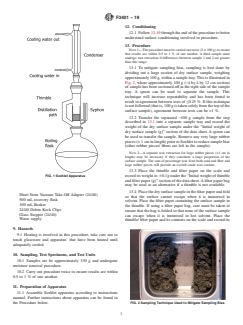
7.1 Fig.1belowfigureshowsadiagramofatypicalSoxhlet
combs. Wax may be natural or artificial substance with
Apparatus.
properties similar to beeswax, namely it is plastic (malleable)
at normal ambient temperatures, has a melting point above
8. Reagents and Materials
approximately 45°C (113°F), has a relatively low viscosity
8.1 Dry Surface Sample—Approximately 330 g. Sample
when melted, is insoluble in water, and is hydrophobic.
must have undergone moisture removal procedure.
Microcrystalline waxes are a type of wax produced by refining
8.2 Heating Mantle—Greater than 200 W needed.
petroleum. They are generally darker, more viscous, denser,
tackierandmoreelasticthanparaffinwaxes,andhaveahigher 8.3 Convective Oven—Any type.
molecular weight and melting point. Microcrystalline waxes
8.4 Isooctane Solvent 99+ 2,2,4-Trimethylpentane (isooc-
are typically produced to meet a number of ASTM test
tane) CAS# 540-84-1.
methods. These include congeal point [Test Method D938-05
8.5 Balance/Scale—Any style; must be accurate to 0.1 g.
(2005)], needle penetration [Test Method D1321-10 (2010)],
8.6 Glassware/Soxhlet Apparatus—Includes the following
color [Test Method D6045-09(2009)], and viscosity [Test
below:
MethodD445-10(2010)].Thecongealingpointisthetempera-
1000 mL Round Bottom Flask (24/40)
ture at which a wax begins to harden into a solid form. The
Soxhlet Extractor (55/50 size on Condenser side)
congealing point is a few degrees below the melting point.
Soxhlet Condenser (55/50)
Harder waxes have a higher melting and congealing point than
30 cm Condenser Arm (24/40)
soft waxes, which makes them more appropriate for the hot
3-way Distillation Adapter (24/40)
temperatures of racing surfaces in California. Harder waxes
tend to be more expensive, more hydrophobic, less adhesive,
and more difficult to process than soft waxes. Wax blends are
The sole source of supply of the solvent (ACS 99+% 4L SKU:31787) known
mixture of a soft main wax and a hard secondary wax. They
to the committee at this time isAlfaAesar, 2 Radcliff Rd., Tewksbury, MA01876,
https://www.alfa.com/en/. If you are aware of alternative suppliers, please provide
enhance the desired qualities of both constituent waxes. Wax
this information toASTM International Headquarters. Your comments will receive
blends
...