

ASTM E2551-20
(Test Method)Standard Test Methods for Humidity Calibration (or Conformation) of Humidity Generators for Use with Thermogravimetric Analyzers
General Information
- Abstract
SIGNIFICANCE AND USE
5.1 These test methods calibrate or demonstrate conformity of the humidity level in a purge gas generated by a humidity generator at a fixed temperature. Such calibration or demonstration of conformity may be required by quality initiatives.
5.2 Conformance demonstrates that the humidified purge gas is within some established limits.
5.3 Calibration provides an offset and or slope value that may be used for establishing the relative humidity scale of the apparatus.
SCOPE
1.1 These test methods describe the humidity calibration (or conformance) of humidity generators for use with thermogravimetric analyzers and other thermal analysis apparatus. The humidity range covered is 5 % relative humidity (% RH) to 95 % RH and the temperature range is 0 °C to 80 °C.
1.2 The values stated in SI units are to be regarded as standard. No other units of measurement are included in this standard.
1.3 This standard does not purport to address all of the safety concerns, if any, associated with its use. It is the responsibility of the user of this standard to establish appropriate safety, health, and environmental practices and determine the applicability of regulatory limitations prior to use.
1.4 This international standard was developed in accordance with internationally recognized principles on standardization established in the Decision on Principles for the Development of International Standards, Guides and Recommendations issued by the World Trade Organization Technical Barriers to Trade (TBT) Committee.
- Status
- Published
- Publication Date
- 14-Mar-2020
- Technical Committee
- E37 - Thermal Measurements
- Drafting Committee
- E37.10 - Fundamental, Statistical and Mechanical Properties
Buy Documents
ASTM E2551-20 - Standard Test Methods for Humidity Calibration (or Conformation) of Humidity Generators for Use with Thermogravimetric Analyzers

REDLINE ASTM E2551-20 - Standard Test Methods for Humidity Calibration (or Conformation) of Humidity Generators for Use with Thermogravimetric Analyzers
Overview
ASTM E2551-20 sets forth standard test methods for the calibration and conformance of humidity generators used in conjunction with thermogravimetric analyzers (TGAs) and other thermal analysis equipment. The standard provides a reliable approach for verifying and adjusting the humidity levels in purge gases, ensuring measurement accuracy in environments where precise control of relative humidity is essential. This standard addresses the calibration of humidity generators across a wide humidity range of 5% to 95% relative humidity (% RH) and temperature range from 0°C to 80°C. It supports compliance with quality initiatives by ensuring humidified purge gases meet strict tolerances.
Key Topics
Purpose of Calibration and Conformance:
- Calibration establishes correction factors (offset/slope) for the relative humidity scale of equipment, improving measurement accuracy.
- Conformance verifies that the humidified purge gas remains within established quality limits.
Test Methods:
- Detailed procedures using reference materials to measure the response of a TGA under controlled humidity conditions.
- Methods assess the onset of material deliquescence or the rate of mass change at specific humidity points.
- Supports analysis of both constant humidity (isohume) and dynamic humidity profiles.
Required Equipment and Conditions:
- Use of precise temperature and humidity sensors, controllers, and flow meters.
- Humidity generator requirements include accurate delivery across the defined RH and temperature ranges.
- Necessity for careful solution and apparatus preparation, using high-purity reagents and water.
Precision and Bias:
- Repeatability and reproducibility limits provided for various reference salts, aiding in the evaluation of laboratory performance.
- Guidelines for statistical analysis and quality reporting support laboratory accreditation and audit readiness.
Applications
Thermal Analysis Quality Control:
Laboratories use ASTM E2551-20 to calibrate and validate humidity generators attached to thermogravimetric analyzers to ensure accurate moisture analysis and decomposition studies. This is critical for pharmaceuticals, polymers, chemicals, and materials research.Instrument Validation:
Regular calibration supports regulatory compliance and data integrity in R&D and production environments, especially where trace moisture influences product stability.Method Development:
Establishes a validated humidity baseline for method development and optimization in thermal analysis, supporting product development and comparative studies.Industrial and Academic Research:
Enables reproducible results and interlaboratory comparisons by standardizing humidity calibration techniques, fostering consistency across studies and facilities.
Related Standards
ASTM D1193 - Specification for Reagent Water:
Specifies water quality requirements for reagent preparation.ASTM E177 - Precision and Bias in ASTM Test Methods:
Guides on the application of precision and bias statements.ASTM E473 & E1142 - Terminology Standards:
Provide consistent definitions related to thermal analysis and thermophysical properties.ASTM E691 - Conducting Interlaboratory Studies:
Outlines design and analysis for reproducibility studies.ASTM E1582 - Temperature Calibration of Thermogravimetric Analyzers:
Prescribes temperature calibration procedures for TGAs.
By adhering to ASTM E2551-20, laboratories and researchers enhance the reliability of humidity measurements in thermal analysis, supporting quality assurance, instrument validation, and compliance with international standards. The document’s methods facilitate precise calibration of humidity generators, which is fundamental for accurate thermogravimetric performance in both industrial and academic settings.
Relations
- Effective Date
- 15-Mar-2020
- Effective Date
- 01-Oct-2023
- Effective Date
- 01-Oct-2023
- Effective Date
- 01-May-2015
- Effective Date
- 15-Aug-2014
- Effective Date
- 15-Aug-2014
- Effective Date
- 01-May-2014
- Effective Date
- 01-Apr-2014
- Effective Date
- 15-Feb-2014
- Effective Date
- 01-May-2013
- Effective Date
- 01-May-2013
- Effective Date
- 01-Sep-2012
- Effective Date
- 01-Nov-2011
- Effective Date
- 01-Aug-2011
- Effective Date
- 15-Jun-2011
Buy Documents
ASTM E2551-20 - Standard Test Methods for Humidity Calibration (or Conformation) of Humidity Generators for Use with Thermogravimetric Analyzers
REDLINE ASTM E2551-20 - Standard Test Methods for Humidity Calibration (or Conformation) of Humidity Generators for Use with Thermogravimetric Analyzers
Get Certified
Connect with accredited certification bodies for this standard

ECOCERT
Organic and sustainability certification.

Eurofins Food Testing Global
Global leader in food, environment, and pharmaceutical product testing.

Intertek Bangladesh
Intertek certification and testing services in Bangladesh.
Sponsored listings
Frequently Asked Questions
ASTM E2551-20 is a standard published by ASTM International. Its full title is "Standard Test Methods for Humidity Calibration (or Conformation) of Humidity Generators for Use with Thermogravimetric Analyzers". This standard covers: SIGNIFICANCE AND USE 5.1 These test methods calibrate or demonstrate conformity of the humidity level in a purge gas generated by a humidity generator at a fixed temperature. Such calibration or demonstration of conformity may be required by quality initiatives. 5.2 Conformance demonstrates that the humidified purge gas is within some established limits. 5.3 Calibration provides an offset and or slope value that may be used for establishing the relative humidity scale of the apparatus. SCOPE 1.1 These test methods describe the humidity calibration (or conformance) of humidity generators for use with thermogravimetric analyzers and other thermal analysis apparatus. The humidity range covered is 5 % relative humidity (% RH) to 95 % RH and the temperature range is 0 °C to 80 °C. 1.2 The values stated in SI units are to be regarded as standard. No other units of measurement are included in this standard. 1.3 This standard does not purport to address all of the safety concerns, if any, associated with its use. It is the responsibility of the user of this standard to establish appropriate safety, health, and environmental practices and determine the applicability of regulatory limitations prior to use. 1.4 This international standard was developed in accordance with internationally recognized principles on standardization established in the Decision on Principles for the Development of International Standards, Guides and Recommendations issued by the World Trade Organization Technical Barriers to Trade (TBT) Committee.
SIGNIFICANCE AND USE 5.1 These test methods calibrate or demonstrate conformity of the humidity level in a purge gas generated by a humidity generator at a fixed temperature. Such calibration or demonstration of conformity may be required by quality initiatives. 5.2 Conformance demonstrates that the humidified purge gas is within some established limits. 5.3 Calibration provides an offset and or slope value that may be used for establishing the relative humidity scale of the apparatus. SCOPE 1.1 These test methods describe the humidity calibration (or conformance) of humidity generators for use with thermogravimetric analyzers and other thermal analysis apparatus. The humidity range covered is 5 % relative humidity (% RH) to 95 % RH and the temperature range is 0 °C to 80 °C. 1.2 The values stated in SI units are to be regarded as standard. No other units of measurement are included in this standard. 1.3 This standard does not purport to address all of the safety concerns, if any, associated with its use. It is the responsibility of the user of this standard to establish appropriate safety, health, and environmental practices and determine the applicability of regulatory limitations prior to use. 1.4 This international standard was developed in accordance with internationally recognized principles on standardization established in the Decision on Principles for the Development of International Standards, Guides and Recommendations issued by the World Trade Organization Technical Barriers to Trade (TBT) Committee.
ASTM E2551-20 is classified under the following ICS (International Classification for Standards) categories: 71.040.40 - Chemical analysis. The ICS classification helps identify the subject area and facilitates finding related standards.
ASTM E2551-20 has the following relationships with other standards: It is inter standard links to ASTM E2551-18, ASTM E1142-23b, ASTM E473-23b, ASTM E1142-15, ASTM E473-14, ASTM E1142-14b, ASTM E177-14, ASTM E1142-14a, ASTM E1142-14, ASTM E691-13, ASTM E177-13, ASTM E1142-12, ASTM E691-11, ASTM E1142-11b, ASTM E1142-11a. Understanding these relationships helps ensure you are using the most current and applicable version of the standard.
ASTM E2551-20 is available in PDF format for immediate download after purchase. The document can be added to your cart and obtained through the secure checkout process. Digital delivery ensures instant access to the complete standard document.
Standards Content (Sample)
This international standard was developed in accordance with internationally recognized principles on standardization established in the Decision on Principles for the
Development of International Standards, Guides and Recommendations issued by the World Trade Organization Technical Barriers to Trade (TBT) Committee.
Designation: E2551 − 20
Standard Test Methods for
Humidity Calibration (or Conformation) of Humidity
Generators for Use with Thermogravimetric Analyzers
This standard is issued under the fixed designation E2551; the number immediately following the designation indicates the year of
original adoption or, in the case of revision, the year of last revision. A number in parentheses indicates the year of last reapproval. A
superscript epsilon (´) indicates an editorial change since the last revision or reapproval.
1. Scope* E1582 Test Method for Temperature Calibration of Thermo-
gravimetric Analyzers
1.1 These test methods describe the humidity calibration (or
conformance) of humidity generators for use with thermogra-
3. Terminology
vimetric analyzers and other thermal analysis apparatus. The
3.1 Specifictechnicaltermsusedinthisstandardaredefined
humidity range covered is 5 % relative humidity (% RH) to
in Terminologies E473 and E1142. These terms include first-
95 % RH and the temperature range is 0 °C to 80 °C.
deviation-from-baseline, isohume, relative humidity, thermal
1.2 The values stated in SI units are to be regarded as
curve, and thermogravimetric analysis.
standard. No other units of measurement are included in this
standard.
4. Summary of Test Method
1.3 This standard does not purport to address all of the
4.1 Humidity generators are devices aimed at producing a
safety concerns, if any, associated with its use. It is the
specific level of humidity in the purge gas used by thermogra-
responsibility of the user of this standard to establish appro-
vimetric analyzers or other thermal analysis apparatus. The
priate safety, health, and environmental practices and deter-
requested humidity levels may be held constant (isohume) or
mine the applicability of regulatory limitations prior to use.
increased or decreased in a continuous or stepped fashion.
1.4 This international standard was developed in accor-
4.2 The humidified purge gas is submitted to a thermogra-
dance with internationally recognized principles on standard-
vimetric analyzer in which the weight of a hygroscopic
ization established in the Decision on Principles for the
material is observed. The relative humidity (or activity) of the
Development of International Standards, Guides and Recom-
moisture in the purge gas is stepped or scanned through a
mendations issued by the World Trade Organization Technical
humidity range. At a fixed humidity of the purge gas, the test
Barriers to Trade (TBT) Committee.
specimen deliquesces and gains weight. In Test MethodA, the
2. Referenced Documents
humidity of the onset of this weight gain is taken as the
humidity calibration point. In Test Methods B and C, the rate
2.1 ASTM Standards:
of weight change is zero at the humidity calibration point.
D1193 Specification for Reagent Water
E177 Practice for Use of the Terms Precision and Bias in
5. Significance and Use
ASTM Test Methods
E473 Terminology Relating to Thermal Analysis and Rhe- 5.1 These test methods calibrate or demonstrate conformity
ology of the humidity level in a purge gas generated by a humidity
E691 Practice for Conducting an Interlaboratory Study to generator at a fixed temperature. Such calibration or demon-
Determine the Precision of a Test Method stration of conformity may be required by quality initiatives.
E1142 Terminology Relating to Thermophysical Properties
5.2 Conformance demonstrates that the humidified purge
gas is within some established limits.
5.3 Calibration provides an offset and or slope value that
1 may be used for establishing the relative humidity scale of the
These test methods are under the jurisdiction of ASTM Committee E37 on
ThermalMeasurementsandarethedirectresponsibilityofSubcommitteeE37.10on
apparatus.
Fundamental, Statistical and Mechanical Properties.
Current edition approved March 15, 2020. Published April 2020. Originally
6. Interferences
approved in 2007. Last previous edition approved in 2018 as E2551 – 18. DOI:
10.1520/E2551-20.
6.1 Temperature regulation of any solution-head space en-
For referenced ASTM standards, visit the ASTM website, www.astm.org, or
vironment to within 60.1 °C is essential for realizing gener-
contact ASTM Customer Service at service@astm.org. For Annual Book of ASTM
ated relative humidity values stable to within 61% RH
Standards volume information, refer to the standard’s Document Summary page on
the ASTM website. (expected).
*A Summary of Changes section appears at the end of this standard
Copyright © ASTM International, 100 Barr Harbor Drive, PO Box C700, West Conshohocken, PA 19428-2959. United States
E2551 − 20
7. Apparatus 7.3.2 A temperature sensor to provide an indication of the
specimen or furnace temperature to within 60.1 °C.
7.1 The humidity generator that is the focus of this standard
7.3.3 A continuously recording balance to measure the
may be an accessory providing a humidified purge gas to some
specimen weight with a minimum capacity of 100 mg and
otherthermalanalysisapparatus(typicallyathermogravimetric
sensitivity of 610 µg.
analyzer) or it may be part of a self-contained instrument that
7.3.4 Ameans of maintaining the specimen/container under
includes both the humidity generator and the thermal analysis
atmospheric control at a purge rate of 10 mL/min to 200
apparatus. In the former case, some of the components de-
mL/min 6 10 mL/min or 1 %, whichever is greater.
scribed below may be redundant.
7.3.5 A temperature controller capable of executing a spe-
7.2 Humidity Generator—The essential instrumentation re-
cific temperature program by operating the furnace between
quired to provide the minimum humidity generator capability
selected temperature limits at a rate of temperature change of
for these test methods includes:
0.5 °C/min constant to within 60.1 °C/min or to an isothermal
7.2.1 Temperature Sensor, to provide an indication of the
temperature that is maintained constant to within 60.1 °C for
purge gas temperature readable to within 60.1 °C.
a minimum of 100 h.
7.2.2 Temperature Controller, capable of executing a spe-
7.3.6 Containers (pans, crucibles, etc.) that are inert to the
cific temperature program by operating heaters or coolers
specimen and that will remain gravimetrically stable within the
between selected temperature limits at a rate of temperature
temperature limits of this method.
change of 0.5 °C/min constant to 60.1 °C/min or at an
7.3.7 Data storage capable of storage of the weight and
isothermal temperature constant to within 60.1 °C.
relative humidity signals.
7.2.3 Humidity Sensor,capableofindicatingthehumidityof
NOTE 1—A data acquisition rate of 1 point per second has been found
the purge gas over the range of5%RHto95%RH readable
adequate. At rates may be used.
to within 60.1 % RH.
7.3.8 A display capable of plotting a thermal curve with
7.2.4 Humidity Controller, capable of executing a specific
weight on the ordinate (Y-axis) and relative humidity (or
humidity program by operating purge gas humidifiers between
activity) on the abscissa (X-axis) with a sensitivity of 10 µg for
selected humidity limits at a rate of humidity change of 0.5 %
weight and 0.1 % RH, respectively.
RH/min constant to within 60.1 % RH or at an isohume
relative humidity to within 60.1 % RH.
8. Reagents and Materials
7.2.5 Purge Gas Flow Sensor, capable of measuring purge
8.1 One or more inorganic salts taken from Table 1 selected
gas flow readable to within 60.1 mL/min.
to provide the humidity range of interest.
7.2.6 Purge Gas Flow Controller, capable of controlling
purge gas flow readable to within 60.1 mL/min.
8.2 Purity of Reagents—Reagentgradechemicals(orbetter)
7.2.7 Humidifier Element,capableofgeneratingpurgegases
shall be used for preparation of all standard solutions.
with relative humidity continuously over the range of5%RH
8.3 Purity of Water—Reagent water produced by distillation
to 95 % RH.
or by ion exchange, or reverse osmosis followed by distillation
7.3 Thermogravimetric Analyzer (TGA)—The essential in-
shall be used (see Specification D1193).
strumentation required to provide the minimum thermogravi-
9. Hazards
metric analytical capability for this method includes:
7.3.1 A furnace to provide uniform controlled heating or
9.1 Salt solutions are extremely corrosive to apparatus if
coolingofaspecimentoaconstanttemperatureorataconstant spilled. Care shall be taken in their preparation and handling to
rate within the applicable temperature range of this method. prevent contact with apparatus.
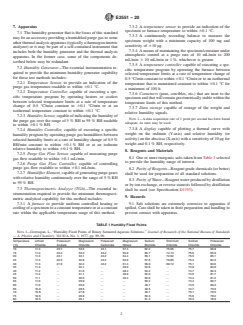
TABLE 1 Humidity Fixed Points
NOTE 1—Greenspan, L., “Humidity Fixed Points of Binary Saturated Aqueous Solutions,” Journal of Research of the National Bureau of Standards
— A. Physics and Chemistry, Vol 81A, No. 1, 1977, pp. 89–96.
Temperature Lithium Potassium Magnesium Potassium Magnesium Sodium Strontium Sodium Potassium
(°C) Chloride Acetate Chloride Carbonate Nitrate Bromide Chloride Chloride Chloride
10 11.3 23.7 33.5 43.1 57.4 62.2 75.66 75.7 86.8
15 11.3 23.4 33.3 43.2 55.9 60.7 74.13 75.6 85.9
20 11.3 23.1 33.1 43.2 54.4 59.1 72.52 75.5 85.1
25 11.3 22.5 32.8 43.2 52.9 57.6 70.85 75.3 84.3
30 11.3 21.6 32.4 43.2 51.4 56.0 69.12 75.1 83.6
35 11.3 . 32.1 . 49.9 54.6 . 74.9 83.0
40 11.2 . 31.6 . 48.4 53.2 . 74.7 82.3
45 11.2 . 31.1 . 46.9 52.0 . 74.5 81.7
50 11.1 . 30.5 . 45.4 50.9 . 74.4 81.2
55 11.0 . 29.9 . . 50.2 . 74.4 80.7
60 11.0 . 29.3 . . 49.7 . 74.5 80.3
65 10.9 . 28.5 . . 49.5 . 74.7 79.9
70 10.8 . 27.8 . . 49.7 . 75.1 79.5
75 10.6 . 26.9 . . 50.3 . 75.6 79.2
80 10.5 . 26.1 . . 51.4 . 76.3 78.9
E2551 − 20
10. Preparation of Apparatus 12.4 Test Method A:
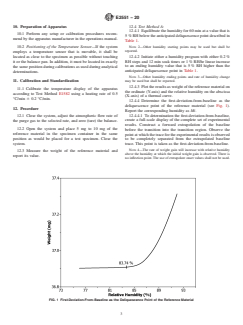
12.4.1 Equilibrate the humidity for 60 min at a value that is
10.1 Perform any setup or calibration procedures recom-
5 %RHbelowtheanticipateddeliquescencepointdescribedin
mend by the apparatus manufacturer in the operations manual.
Table 1.
10.2 Positioning of the Temperature Sensor—If the system
NOTE 2—Other humidity starting points may be used but shall be
reported.
employs a temperature sensor that is movable, it shall be
located as close to the specimen as possible without touching
12.4.2 Initiate either a humidity program with either 0.2 %
it or the balance pan. In addition, it must be loca
...
This document is not an ASTM standard and is intended only to provide the user of an ASTM standard an indication of what changes have been made to the previous version. Because
it may not be technically possible to adequately depict all changes accurately, ASTM recommends that users consult prior editions as appropriate. In all cases only the current version
of the standard as published by ASTM is to be considered the official document.
Designation: E2551 − 18 E2551 − 20
Standard Test Methods for
Humidity Calibration (or Conformation) of Humidity
Generators for Use with Thermogravimetric Analyzers
This standard is issued under the fixed designation E2551; the number immediately following the designation indicates the year of
original adoption or, in the case of revision, the year of last revision. A number in parentheses indicates the year of last reapproval. A
superscript epsilon (´) indicates an editorial change since the last revision or reapproval.
1. Scope Scope*
1.1 These test methods describe the humidity calibration (or conformance) of humidity generators for use with thermogravi-
metric analyzers and other thermal analysis apparatus. The humidity range covered is 5 % relative humidity (% RH) to 95 % RH
and the temperature range is 0 °C to 80 °C.
1.2 The values stated in SI units are to be regarded as standard. No other units of measurement are included in this standard.
1.3 This standard does not purport to address all of the safety concerns, if any, associated with its use. It is the responsibility
of the user of this standard to establish appropriate safety, health, and environmental practices and determine the applicability of
regulatory limitations prior to use.
1.4 This international standard was developed in accordance with internationally recognized principles on standardization
established in the Decision on Principles for the Development of International Standards, Guides and Recommendations issued
by the World Trade Organization Technical Barriers to Trade (TBT) Committee.
2. Referenced Documents
2.1 ASTM Standards:
D1193 Specification for Reagent Water
E177 Practice for Use of the Terms Precision and Bias in ASTM Test Methods
E473 Terminology Relating to Thermal Analysis and Rheology
E691 Practice for Conducting an Interlaboratory Study to Determine the Precision of a Test Method
E1142 Terminology Relating to Thermophysical Properties
These test methods are under the jurisdiction of ASTM Committee E37 on Thermal Measurements and are the direct responsibility of Subcommittee E37.10 on
Fundamental, Statistical and Mechanical Properties.
Current edition approved Oct. 1, 2018March 15, 2020. Published October 2018April 2020. Originally approved in 2007. Last previous edition approved in 20132018 as
E2551 – 13.18. DOI: 10.1520/E2551-18.10.1520/E2551-20.
For referenced ASTM standards, visit the ASTM website, www.astm.org, or contact ASTM Customer Service at service@astm.org. For Annual Book of ASTM Standards
volume information, refer to the standard’s Document Summary page on the ASTM website.
*A Summary of Changes section appears at the end of this standard
Copyright © ASTM International, 100 Barr Harbor Drive, PO Box C700, West Conshohocken, PA 19428-2959. United States
E2551 − 20
E1582 Test Method for Temperature Calibration of Thermogravimetric Analyzers
3. Terminology
3.1 Specific technical terms used in this standard are defined in Terminologies E473 and E1142. These terms include
first-deviation-from-baseline, isohume, relative humidity, thermal curve, and thermogravimetric analysis.
3.2 Definitions of Terms Specific to This Standard:
3.2.1 water activity, n—the ratio of actual partial pressure of water to the saturated water vapor pressure at the same temperature,
expressed as a decimal fraction.
3.2.1.1 Discussion—
Water activity is also known as relative pressure in some applications areas.
4. Summary of Test Method
4.1 Humidity generators are devices aimed at producing a specific level of humidity in the purge gas used by thermogravimetric
analyzers or other thermal analysis apparatus. The requested humidity levels may be held constant (isohume) or increased or
decreased in a continuous or stepped fashion.
4.2 The humidified purge gas is submitted to a thermogravimetric analyzer in which the weight of a hygroscopic material is
observed. The relative humidity (or activity) of the moisture in the purge gas is stepped or scanned through a humidity range. At
a fixed humidity of the purge gas, the test specimen deliquesces and gains weight. In Test Method A, the humidity of the onset
of this weight gain is taken as the humidity calibration point. In Test Methods B and C, the rate of weight change is zero at the
humidity calibration point.
5. Significance and Use
5.1 These test methods calibrate or demonstrate conformity of the humidity level in a purge gas generated by a humidity
generator at a fixed temperature. Such calibration or demonstration of conformity may be required by quality initiatives.
5.2 Conformance demonstrates that the humidified purge gas is within some established limits.
5.3 Calibration provides an offset and or slope value that may be used for establishing the relative humidity scale of the
apparatus.
6. Interferences
6.1 Temperature regulation of any solution-head space environment to within 60.1 °C is essential for realizing generated
relative humidity values stable to within 61 % RH (expected).
7. Apparatus
7.1 The humidity generator that is the focus of this standard may be an accessory providing a humidified purge gas to some other
thermal analysis apparatus (typically a thermogravimetric analyzer) or it may be part of a self-contained instrument that includes
both the humidity generator and the thermal analysis apparatus. In the former case, some of the components described below may
be redundant.
7.2 Humidity Generator—The essential instrumentation required to provide the minimum humidity generator capability for
these test methods includes:
7.2.1 Temperature Sensor, to provide an indication of the purge gas temperature readable to within 60.1 °C.
7.2.2 Temperature Controller, capable of executing a specific temperature program by operating heaters or coolers between
selected temperature limits at a rate of temperature change of 0.5 °C/min constant to 60.1 °C/min or at an isothermal temperature
constant to within 60.1 °C.
7.2.3 Humidity Sensor, capable of indicating the humidity of the purge gas over the range of 5 % RH to 95 % RH readable to
within 60.1 % RH.
7.2.4 Humidity Controller, capable of executing a specific humidity program by operating purge gas humidifiers between
selected humidity limits at a rate of humidity change of 0.5 % RH/min constant to within 60.1 % RH or at an isohume relative
humidity to within 60.1 % RH.
7.2.5 Purge Gas Flow Sensor, capable of measuring purge gas flow readable to within 60.1 mL/min.
7.2.6 Purge Gas Flow Controller, capable of controlling purge gas flow readable to within 60.1 mL/min.
7.2.7 Humidifier Element, capable of generating purge gases with relative humidity continuously over the range of 5 % RH to
95 % RH.
7.3 Thermogravimetric Analyzer (TGA)—The essential instrumentation required to provide the minimum thermogravimetric
analytical capability for this method includes:
E2551 − 20
7.3.1 A furnace to provide uniform controlled heating or cooling of a specimen to a constant temperature or at a constant rate
within the applicable temperature range of this method.
7.3.2 A temperature sensor to provide an indication of the specimen or furnace temperature to within 60.1 °C.
7.3.3 A continuously recording balance to measure the specimen weight with a minimum capacity of 100 mg and sensitivity
of 610 μg.
7.3.4 A means of maintaining the specimen/container under atmospheric control at a purge rate of 10 mL/min to 200 mL/min
6 10 mL/min or 1 %, whichever is greater.
7.3.5 A temperature controller capable of executing a specific temperature program by operating the furnace between selected
temperature limits at a rate of temperature change of 0.5 °C/min constant to within 60.1 °C/min or to an isothermal temperature
that is maintained constant to within 60.1 °C for a minimum of 100 h.
7.3.6 Containers (pans, crucibles, etc.) that are inert to the specimen and that will remain gravimetrically stable within the
temperature limits of this method.
7.3.7 Data storage capable of storage of the weight and relative humidity signals.
NOTE 1—A data acquisition rate of 1 point per second has been found adequate. At rates may be used.
7.3.8 A display capable of plotting a thermal curve with weight on the ordinate (Y-axis) and relative humidity (or activity) on
the abscissa (X-axis) with a sensitivity of 10 μg for weight and 0.1 % RH, respectively.
8. Reagents and Materials
8.1 One or more inorganic salts taken from Table 1 selected to provide the humidity range of interest.
8.2 Purity of Reagents—Reagent grade chemicals (or better) shall be used for preparation of all standard solutions.
8.3 Purity of Water—Reagent water produced by distillation or by ion exchange, or reverse osmosis followed by distillation
shall be used (see Specification D1193).
9. Hazards
9.1 Salt solutions are extremely corrosive to apparatus if spilled. Care shall be taken in their preparation and handling to prevent
contact with apparatus.
10. Preparation of Apparatus
10.1 Perform any setup or calibration procedures recommend by the apparatus manufacturer in the operations manual.
10.2 Positioning of the Temperature Sensor—If the system employs a temperature sensor that is movable, it shall be located as
close to the specimen as possible without touching it or the balance pan. In addition, it must be located in exactly the same position
during calibrations as used during analytical determinations.
11. Calibration and Standardization
11.1 Calibrate the temperature display of the apparatus according to Test Method E1582 using a heating rate of 0.5 °C/min 6
0.2 °C/min.
TABLE 1 Humidity Fixed Points
NOTE 1—Greenspan, L., “Humidity Fixed Points of Binary Saturated Aqueous Solutions,” Journal of Research of the National Bureau of Standards
— A. Physics and Chemistry, Vol 81A, No. 1, 1977, pp. 89–96.
Temperature Lithium Potassium Magnesium Potassium Magnesium Sodium Strontium Sodium Potassium
(°C) Chloride Acetate Chloride Carbonate Nitrate Bromide Chloride Chloride Chloride
10 11.3 23.7 33.5 43.1 57.4 62.2 75.66 75.7 86.8
15 11.3 23.4 33.3 43.2 55.9 60.7 74.13 75.6 85.9
20 11.3 23.1 33.1 43.2 54.4 59.1 72.52 75.5 85.1
25 11.3 22.5 32.8 43.2 52.9 57.6 70.85 75.3 84.3
30 11.3 21.6 32.4 43.2 51.4 56.0 69.12 75.1 83.6
35 11.3 . 32.1 . 49.9 54.6 . 74.9 83.0
40 11.2 . 31.6 . 48.4 53.2 . 74.7 82.3
45 11.2 . 31.1 . 46.9 52.0 . 74.5 81.7
50 11.1 . 30.5 . 45.4 50.9 . 74.4 81.2
55 11.0 . 29.9 . . 50.2 . 74.4 80.7
60 11.0 . 29.3 . . 49.7 . 74.5 80.3
65 10.9 . 28.5 . . 49.5 . 74.7 79.9
70 10.8 . 27.8 . . 49.7 . 75.1
...