

ASTM D3175-20
(Test Method)Standard Test Method for Volatile Matter in the Analysis Sample of Coal and Coke
General Information
- Abstract
SIGNIFICANCE AND USE
5.1 Volatile matter, when determined as herein described, can be used to establish the rank of coals, to indicate coke yield on carbonization process, to provide the basis for purchasing and selling, or to establish burning characteristics.
SCOPE
1.1 This test method covers the determination of the gaseous products, exclusive of moisture vapor, as volatile matter in the analysis sample of coal or coke from coal.
1.2 The test method for the determination of volatile matter is empirical.
1.3 Units—The values stated in SI units are to be regarded as standard. The values given in parentheses after SI units are provided for information only and are not considered standard.
1.4 This standard does not purport to address all of the safety concerns, if any, associated with its use. It is the responsibility of the user of this standard to establish appropriate safety, health, and environmental practices and determine the applicability of regulatory limitations prior to use.
1.5 This international standard was developed in accordance with internationally recognized principles on standardization established in the Decision on Principles for the Development of International Standards, Guides and Recommendations issued by the World Trade Organization Technical Barriers to Trade (TBT) Committee.
- Status
- Published
- Publication Date
- 31-Jan-2020
- Technical Committee
- D05 - Coal and Coke
- Drafting Committee
- D05.21 - Methods of Analysis
Buy Documents
ASTM D3175-20 - Standard Test Method for Volatile Matter in the Analysis Sample of Coal and Coke
REDLINE ASTM D3175-20 - Standard Test Method for Volatile Matter in the Analysis Sample of Coal and Coke
Overview
ASTM D3175-20 is the internationally recognized standard test method for determining volatile matter in coal and coke samples. Developed by ASTM, this method is widely utilized across energy, metallurgical, and chemical industries for coal and coke characterization. The primary focus of ASTM D3175 is to quantify the amount of volatile matter-excluding moisture vapor-released from a sample under controlled heating conditions. Results from this test provide essential data for classifying coal rank, estimating coke yields, supporting commercial transactions, and understanding combustion behavior.
Key Topics
- Volatile Matter Determination: The standard describes an empirical procedure for quantifying volatile matter content. It specifies the apparatus, such as platinum crucibles or alternate materials, and precise temperature controls.
- Controlled Testing Conditions: Sample preparation, heating to 950°C ± 20°C in a regulated vertical electric tube furnace, and the use of suitable crucibles ensure reliable, reproducible results.
- Moisture Correction: The volatile matter value is corrected by subtracting the sample’s moisture content, determined using referenced moisture analysis methods.
- Precision and Bias: ASTM D3175 details repeatability and reproducibility guidelines for different coal ranks and apparatus types, ensuring consistent and accurate laboratory performance.
- Relative Bias - Crucible Materials: When alternate crucible materials such as nickel-chromium are used, the standard includes procedures for determining and correcting relative bias compared to platinum crucibles.
Applications
The ASTM D3175-20 standard is highly practical for:
- Coal Rank Classification: Differentiating between anthracite, bituminous, subbituminous, and lignite coals based on volatile matter content.
- Coke Production Forecasting: Assessing expected yields based on the amount of volatile matter lost during carbonization processes.
- Fuel Combustion Assessment: Determining burning characteristics, ignition behavior, and suitability for various industrial applications.
- Commercial Transactions: Providing a standardized way to verify coal and coke properties in purchasing and selling agreements.
- Quality Control and Research: Ensuring consistent sample analysis in routine laboratory quality assessments and research studies.
The method's reproducibility and precision make it indispensable for laboratories performing coal analysis and supporting regulatory compliance in the energy supply chain.
Related Standards
ASTM D3175-20 references and is used in conjunction with several other ASTM standards for coal and coke analysis, including:
- ASTM D121: Terminology of Coal and Coke
- ASTM D346: Collection and Preparation of Coke Samples for Laboratory Analysis
- ASTM D388: Classification of Coals by Rank
- ASTM D2013: Preparing Coal Samples for Analysis
- ASTM D3173/D3173M: Test Method for Moisture in Coal and Coke
- ASTM D3180: Calculating Coal and Coke Analyses From As-Determined to Different Bases
- ASTM D6374: Test Method for Volatile Matter in Green Petroleum Coke
- ASTM D7582: Proximate Analysis of Coal and Coke by Macro Thermogravimetric Analysis
- ASTM E691: Practice for Conducting Interlaboratory Study to Determine Precision of a Test Method
Each of these related standards enhances laboratory procedures, enabling comprehensive evaluation of coal and coke for energy, metallurgical, and commercial applications.
Keywords: ASTM D3175-20, volatile matter, coal analysis, coke testing, proximate analysis, coal classification, furnace method, moisture correction, laboratory precision, energy industry standards.
Relations
- Replaces
ASTM D3175-18 - Standard Test Method for Volatile Matter in the Analysis Sample of Coal and Coke - Effective Date
- 01-Feb-2020
- Effective Date
- 01-Apr-2024
- Effective Date
- 01-Mar-2024
- Effective Date
- 01-Dec-2023
- Effective Date
- 01-Dec-2023
- Effective Date
- 01-Jun-2019
- Effective Date
- 01-Nov-2018
- Effective Date
- 01-Feb-2018
- Effective Date
- 01-Nov-2017
- Effective Date
- 01-Jul-2017
- Refers
ASTM D3173/D3173M-17 - Standard Test Method for Moisture in the Analysis Sample of Coal and Coke - Effective Date
- 01-Feb-2017
- Effective Date
- 01-Sep-2015
- Effective Date
- 15-May-2015
- Effective Date
- 01-Jan-2015
- Effective Date
- 01-May-2013
Buy Documents
ASTM D3175-20 - Standard Test Method for Volatile Matter in the Analysis Sample of Coal and Coke
REDLINE ASTM D3175-20 - Standard Test Method for Volatile Matter in the Analysis Sample of Coal and Coke
Get Certified
Connect with accredited certification bodies for this standard

Element Materials Technology
Materials testing and product certification.

ABS Group Brazil
ABS Group certification services in Brazil.

ABS Quality Evaluations Inc.
American Bureau of Shipping quality certification.
Sponsored listings
Frequently Asked Questions
ASTM D3175-20 is a standard published by ASTM International. Its full title is "Standard Test Method for Volatile Matter in the Analysis Sample of Coal and Coke". This standard covers: SIGNIFICANCE AND USE 5.1 Volatile matter, when determined as herein described, can be used to establish the rank of coals, to indicate coke yield on carbonization process, to provide the basis for purchasing and selling, or to establish burning characteristics. SCOPE 1.1 This test method covers the determination of the gaseous products, exclusive of moisture vapor, as volatile matter in the analysis sample of coal or coke from coal. 1.2 The test method for the determination of volatile matter is empirical. 1.3 Units—The values stated in SI units are to be regarded as standard. The values given in parentheses after SI units are provided for information only and are not considered standard. 1.4 This standard does not purport to address all of the safety concerns, if any, associated with its use. It is the responsibility of the user of this standard to establish appropriate safety, health, and environmental practices and determine the applicability of regulatory limitations prior to use. 1.5 This international standard was developed in accordance with internationally recognized principles on standardization established in the Decision on Principles for the Development of International Standards, Guides and Recommendations issued by the World Trade Organization Technical Barriers to Trade (TBT) Committee.
SIGNIFICANCE AND USE 5.1 Volatile matter, when determined as herein described, can be used to establish the rank of coals, to indicate coke yield on carbonization process, to provide the basis for purchasing and selling, or to establish burning characteristics. SCOPE 1.1 This test method covers the determination of the gaseous products, exclusive of moisture vapor, as volatile matter in the analysis sample of coal or coke from coal. 1.2 The test method for the determination of volatile matter is empirical. 1.3 Units—The values stated in SI units are to be regarded as standard. The values given in parentheses after SI units are provided for information only and are not considered standard. 1.4 This standard does not purport to address all of the safety concerns, if any, associated with its use. It is the responsibility of the user of this standard to establish appropriate safety, health, and environmental practices and determine the applicability of regulatory limitations prior to use. 1.5 This international standard was developed in accordance with internationally recognized principles on standardization established in the Decision on Principles for the Development of International Standards, Guides and Recommendations issued by the World Trade Organization Technical Barriers to Trade (TBT) Committee.
ASTM D3175-20 is classified under the following ICS (International Classification for Standards) categories: 75.160.10 - Solid fuels. The ICS classification helps identify the subject area and facilitates finding related standards.
ASTM D3175-20 has the following relationships with other standards: It is inter standard links to ASTM D3175-18, ASTM D7582-24, ASTM D121-15(2024), ASTM D3180-15(2023), ASTM D7582-15(2023), ASTM D388-19, ASTM D388-18a, ASTM D388-18, ASTM D388-17a, ASTM D388-17, ASTM D3173/D3173M-17, ASTM D121-15, ASTM D388-15, ASTM D3180-15, ASTM E691-13. Understanding these relationships helps ensure you are using the most current and applicable version of the standard.
ASTM D3175-20 is available in PDF format for immediate download after purchase. The document can be added to your cart and obtained through the secure checkout process. Digital delivery ensures instant access to the complete standard document.
Standards Content (Sample)
This international standard was developed in accordance with internationally recognized principles on standardization established in the Decision on Principles for the
Development of International Standards, Guides and Recommendations issued by the World Trade Organization Technical Barriers to Trade (TBT) Committee.
Designation: D3175 − 20
Standard Test Method for
Volatile Matter in the Analysis Sample of Coal and Coke
This standard is issued under the fixed designation D3175; the number immediately following the designation indicates the year of
original adoption or, in the case of revision, the year of last revision. A number in parentheses indicates the year of last reapproval. A
superscript epsilon (´) indicates an editorial change since the last revision or reapproval.
This standard has been approved for use by agencies of the U.S. Department of Defense.
1. Scope* D5142 Test Methods for ProximateAnalysis of theAnalysis
Sample of Coal and Coke by Instrumental Procedures
1.1 This test method covers the determination of the gas-
(Withdrawn 2010)
eous products, exclusive of moisture vapor, as volatile matter
D6374 Test Method for Volatile Matter in Green Petroleum
in the analysis sample of coal or coke from coal.
Coke Quartz Crucible Procedure
1.2 The test method for the determination of volatile matter
D7582 Test Methods for Proximate Analysis of Coal and
is empirical.
Coke by Macro Thermogravimetric Analysis
E691 Practice for Conducting an Interlaboratory Study to
1.3 Units—The values stated in SI units are to be regarded
as standard. The values given in parentheses after SI units are Determine the Precision of a Test Method
provided for information only and are not considered standard.
3. Terminology
1.4 This standard does not purport to address all of the
3.1 Definitions:
safety concerns, if any, associated with its use. It is the
3.1.1 popping, n—unseating of the crucible cover due to
responsibility of the user of this standard to establish appro-
swelling of the test sample resulting in mechanical loss of the
priate safety, health, and environmental practices and deter-
test material.
mine the applicability of regulatory limitations prior to use.
1.5 This international standard was developed in accor-
3.1.1.1 Discussion—This phenomenon is normally associ-
dance with internationally recognized principles on standard-
ated with strongly swelling coals.
ization established in the Decision on Principles for the
3.1.2 sparking, n—the evolution of gaseous products at a
Development of International Standards, Guides and Recom-
rate sufficient to mechanically carry solid particles out of the
mendations issued by the World Trade Organization Technical
crucible; those particles escaping at higher temperatures be-
Barriers to Trade (TBT) Committee.
come incandescent when they are emitted, creating sparks.
3.1.2.1 Discussion—This phenomenon is normally associ-
2. Referenced Documents
ated with non-swelling coals but can also be associated with
2.1 ASTM Standards:
swelling coals as well as cokes.
D121 Terminology of Coal and Coke
3.1.3 swelling, n—the change in volume which takes place
D346 Practice for Collection and Preparation of Coke
when coal is heated under conditions allowing the softened
Samples for Laboratory Analysis
coal to expand freely in a direction normal to the plane of
D388 Classification of Coals by Rank
heating.
D2013 Practice for Preparing Coal Samples for Analysis
3.2 Refer toTerminology D121 for additional definitions of
D3173/D3173M Test Method for Moisture in the Analysis
terms used in this test method.
Sample of Coal and Coke
D3180 Practice for Calculating Coal and Coke Analyses
4. Summary of Test Method
from As-Determined to Different Bases
4.1 Volatile matter is determined by establishing the mass
loss resulting from heating a coal or coke under rigidly
This test method is under the jurisdiction of ASTM Committee D05 on Coal
controlled conditions. The measured mass loss, corrected for
and Coke and is the direct responsibility of Subcommittee D05.21 on Methods of
moisture as determined in Test Methods D3173/D3173M or
Analysis.
D7582 establishes the volatile matter content. Two procedures
Current edition approved Feb. 1, 2020. Published March 2020. Originally
approved in 1973. Last previous edition approved in 2018 as D3175 – 18. DOI: are described to permit conformity with differences in sample
10.1520/D3175-20.
behavior.
For referenced ASTM standards, visit the ASTM website, www.astm.org, or
contact ASTM Customer Service at service@astm.org. For Annual Book of ASTM
Standards volume information, refer to the standard’s Document Summary page on The last approved version of this historical standard is referenced on
the ASTM website. www.astm.org.
*A Summary of Changes section appears at the end of this standard
Copyright © ASTM International, 100 Barr Harbor Drive, PO Box C700, West Conshohocken, PA 19428-2959. United States
D3175 − 20
4.2 In this empirical test method, the use of platinum 7. Reagents and Materials
crucibles shall be considered the standard reference method for
7.1 Desiccants—Use freshly regenerated self-indicating
volatile matter. Platinum crucibles shall be used in determining
desiccants. Suitable materials are listed as follows.
the volatile matter determined for classification of coals by
7.1.1 Anhydrous Calcium Sulfate
rank.Volatilematterdeterminationsbysomelaboratoriesusing
7.1.2 Silica Gel
alternate nickel-chromium alloy crucibles having the physical
dimensions specified in 6.1 have been shown to differ from
8. Procedure
those obtained using platinum crucibles.Alaboratory utilizing
8.1 The sample shall be the material pulverized to 250 µm
nickel-chromium crucibles shall first determine if a relative
(No. 60) sieve in accordance with Practice D2013 or Practice
bias exists between the use of nickel-chromium and platinum
D346.
crucibles on the coals being tested using the test method set
8.1.1 Carry out a moisture determination in accordance
forth in AnnexA1. Where a relative bias is shown to exist, the
with Test Method D3173/D3173M or Test Methods D7582 on
volatile matter determined using nickel-chromium crucibles
a separate portion of the analysis sample, preferably on the
shall be corrected by a factor determined through comparison
same day but not more than 24 h apart from the volatile matter
of volatile matter results from both crucible types on coals
determination so that reliable corrections to other bases can be
being tested or analysis of samples of known proximate
made.
analysis.
8.2 Procedure for Nonsparking Coals and Cokes:
5. Significance and Use 8.2.1 Refer to 4.2 and Section 6 for the type of crucible to
use. Record the mass of the crucible and cover to the nearest
5.1 Volatile matter, when determined as herein described,
0.0001 g. Place 1 g of the analysis sample in the crucible.
canbeusedtoestablishtherankofcoals,toindicatecokeyield
Record the mass of the crucible, test specimen, and cover.
on carbonization process, to provide the basis for purchasing
8.2.2 Close with a cover which fits closely enough so that
and selling, or to establish burning characteristics.
the carbon deposit from bituminous, subbituminous, and lig-
nite coals does not burn away from the underside. Record the
6. Apparatus
total mass of the crucible, sample, and cover to the nearest
0.0001 g. Place the crucible on platinum or nickel-chromium
6.1 Platinum Crucible, with closely fitting cover, for coal.
wire supports and insert directly into the furnace chamber,
The crucible shall be of not less than 10 mL or more than
which shall be maintained at a temperature of 950 °C 6 20 °C,
20 mL capacity, not less than 25 mm or more than 35 mm in
and lower immediately to the 950 °C zone. Regulation of the
diameter, and not less than 30 mm or more than 35 mm in
temperature to within the prescribed limits is critical.After the
height.
more rapid discharge of volatile matter has subsided, as shown
6.2 Platinum Crucible, with closely fitting cover, for coke.
by the disappearance of the luminous flame, or in the case of
The crucible shall be of 10 mL capacity, with capsule cover
coke, after 2 min or 3 min, inspect the crucible (see Note 1)to
having thin flexible sides fitting down into crucible. Or the
verifythatthelidisstillproperlysealed.Ifnecessary,reseatthe
double-crucible method can be used, in which the sample is
lid to guard against the admission of air into the crucible. Do
placed in 10 mLplatinum crucible, which is then covered with
this as rapidly as possible by raising the crucible to the top of
anothercrucibleofsuchasizethatitwillfitcloselytothesides
the furnace chamber, reposition the lid to more perfectly seal
of the outer crucible and its bottom will rest 8.5 mm to
the crucible, then lower the crucible immediately back to the
1 1
12.7 mm ( ⁄3 in. to ⁄2 in.) above the bottom of the outer
950 °C zone.After heating for a total of exactly 7 min, remove
crucible.
the crucible from the furnace and without disturbing the cover;
allow it to cool. Coke should be cooled in a desiccator. Weigh
6.3 Alternate Crucible Materials, nickel-chromium cru-
as soon as cold. Refer to Section 9 for the calculations
cible with closely fitting cover. The crucible shall not be less
necessary to calculate the volatile matter in the analysis
than 10 mL or more than 20 mL capacity, not less than 25 mm
sample.
or more than 35 mm in diameter, and not less than 30 mm or
more than 35 mm in height. Nickel-chromium crucibles shall
NOTE 1—Inspection of the crucible can be aided by the use of a mirror
be heat-treated for4hat500°C to ensure that they are held above the furnace well.
completely oxidized prior to use.
8.2.3 With some strongly caking low-volatile and medium-
6.3.1 Quartz crucible with closely fitting cover for coke volatile bituminous coals, the coke button can be broken with
samples. The crucible shall be the same type as specified for
explosive violence due to the liberation of volatile matter
use with Test Method D6374. within the button. This is usually designated as popping. Such
popping can blow the lid off the crucible and cause mechanical
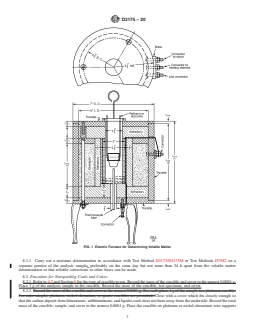
6.4 Vertical Electric Tube Furnace, for coal or coke. The
losses of the coked material. When such popping is observed,
electric furnace shall be a vertical tube furnace. The furnace
the determination shall be rejected and the test repeated until
can be of the form shown in Fig. 1. It shall be regulated to
popping does not occur.
maintain a temperature of 950 °C 6 20 °C in the crucible, as
8.2.4 Fuels that do not cake or cake weakly when volatile
measured by a thermocouple positioned in the furnace.
matter is determined shall be watched closely for sparking
6.5 Balance, sensitive to 0.1 mg. during the heating period. At the end of the test, the crucible
D3175 − 20
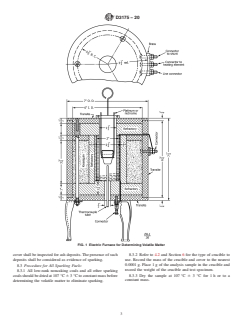
FIG. 1 Electric Furnace for Determining Volatile Matter
cover shall be inspected for ash deposits. The presence of such 8.3.2 Refer to 4.2 and Section 6 for the type of crucible to
deposits shall be considered as evidence of sparking. use. Record the mass of the crucible and cover to the nearest
0.0001 g. Place 1 g of the analysis sample in the crucible and
8.3 Procedure for All Sparking Fuels:
record the weight of the crucible and test specimen.
8.3.1 All low-rank noncaking coals and all other sparking
coals should be dried at 107 °C 6 3 °C to constant mass before 8.3.3 Dry the sample at 107 °C 6 3 °C for 1 h or to a
determining the volatile matter to eliminate sparking. constant mass.
D3175 − 20
TABLE 1 Limits for Repeatability and Reproducibility of Volatile
8.3.3.1 Drying the sparking coals can also be accomplished
Matter in Coal
by determining the moisture content following the conditions
Rank Repeatability Reproducibility
outlined in Test Method D3173/D3173M.
Limit, Limit,
8.3.4 After drying of the sample is complete, determine the
r R
volatile matter in the test specimens following the procedure
Anthracite 0.3 0.6
Semianthracite, bituminous, 0.5 1.0
described in 8.2.2.
Subbituminous 0.7 1.4
Lignite 1.0 2.0
9. Calculations
9.1 For nonsparking coals and cokes, calculate the percent
mass loss, D, on heating as follows:
ability and Reproducibility limits for this test method were
D 5 100x@~B 2 C!⁄~B 2 A!# (1) determined using only platinum crucibles. Coal Repeatability
and Reproducibility limits for nickel-chromium crucibles have
where:
not been determined.
A = mass of crucible and cover, g,
11.1.1 Repeatability Limit (r)—The value below which the
B = mass of crucible, cover, and contents before heating, g,
absolute difference between two test results of separate and
C = mass of crucible, cover, and contents after heating, g,
consecutive test determinations, carried out on the same
and
sample, in the same laboratory, by the same operator, using the
D = mass loss, %.
same apparatus on samples taken at random from a single
9.2 For nonsparking coals and cokes, calculate the volatile
quantity of homogeneous material, can be expected to occur
matter mass fraction, w , in %, in the analysis samples as
VM
with a probability of approximately 95 %.
follows:
11.1.2 Reproducibility Limit (R)—The value below which
w 5 D 2 E (2) the absolute difference between two test results carried out in
VM
different laboratories, using samples taken at random from a
where:
single quantity of material that is as homogeneous as possible,
E = moisture in the analysis sample, %, as determined by
can be expected to occur with a probability of approximately
Test Methods D3173/D3173M or D7582.
95 %.
9.3 Sparking Coals Calculations:
11.2 The precision of this test method for the determination
9.3.1 If the procedure for sparking coals (8.3) is used and
of Volatile Matter in Coke is shown in Table 2. The precision
the determination of volatile matter is made on the test
characterizedbyrepeatability(S , r)andreproducibility(S , R)
r R
specimen as weighed and dried (8.3.3 and 8.3.4), calculate the
is described in Table A2.1 in Annex A2.
as-determined volatile matter using Eq 1 and Eq 2 in 9.1 and
11.2.1 The inter-laboratory proficiency test data employed
9.2.
to derive the r and R values for cokes include 48 samples
9.3.2 If the determination of volatile matter is made on a
covering a period of 11 years. Some of the samples were
predried sample, such as that from the determination of
distributed as many as three separate times. All crucible types
moisture (Test Method D3173/D3173M), and the dried coal is
were included for the derivation of the precision statement for
weighed in the crucible (8.3.3), calculate the as-determined
coke offered in this test method.There are a number of reasons
volatile matter using Eq 1 in 9.1. In this case, the percent
for this. Of the 20 to 22 participants taking part in the
as-determined volatile matter is the % mass loss.
proficiency testing program, only 10 to 12 reported volatile
9.4 The calculated volatile matter in the analysis sample is
matter by Test Method D3175. The remaining participants
the as-determined volatile matter.
employed Test Methods D5142 or other standard test methods.
Of the 10 to 12 employingTest Method D3175, the majority (6
10. Report
to 7) employed quartz crucibles. The number of labs employ-
10.1 Report the volatile matter in the analysis sample along
ing platinum crucibles varied from 2 to 4. The remaining
with the sample moisture from 8.1.1.
employed nickel or nickel-chromium crucibles. Practice E691
10.2 Report the procedure employed for the determination
recommends at least 8 laboratories take part in an ILS. The
of volatile matter. Report as the D3175 Procedure for Nonspar- reason for this is that the r and R estimates can exhibit a
king Fuels or the D3175 Procedure for Sparking Fuels.
variance of as much as 25 % for 8 laboratories and that
increases to as much as 30 % for 6 laboratories. Thus, it was
10.3 The volatile matter result can be reported in any of a
necessary to include all crucible types in the derivation of the
number of bases differing in the manner in which the moisture
precision statement for coke. This has an additional effect of
is treated. Procedures for converting the test result obtained on
an analysis sample to other bases are described in Practice
TABLE 2 Concentration Range and Limits for Repeatability and
D3180.
Reproducibility of Volatile Matter in Coke
10.4 Use Classification D388 for reporting volatile matter
Range Repeatability Reproducibility
on a dry mineral matter free basis.
Limit, Limit,
r R
11. Precision and Bias A
Coke 0.49 to 2.50 % 0.20
0.2710.27 ¯x
A
11.1 The precision of this test method for the determination
Where x¯ is the average of two single test results.
of Volatile Matter in Coal is shown in Table 1. Coal Repeat-
D3175 − 20
not having to include the same relative bias requirement in an 11.3.1 No information can be presented on the bias of the
Annex for alternate crucibles as is required for coal. procedure in this test method for determining the volatile
matter in the analysis sample of cokes because this is an
11.3 Bias—Since this is an empirical test method when
empirical test method and no material having an accepted
utilizing platinum crucibles to analyze coal, the degree of
reference value is available.
absolute bias can not be determined. Bias between the use of
platinumandnickel-chromiumcruciblesshallbedeterminedin
the laboratory on coal being tested using the test method set
forth in Annex A1.
ANNEXES
(Mandatory Information)
A1. METHOD FOR DETERMINING RELATIVE BIAS BETWEEN PLATINUM AND NICKEL-CHROMIUM ALLOY CRU-
CIBLES
A1.1 Scope A1.3.2.3 All values determined in any experiment upon
members of the study group shall be used in the statistical
A1.1.1 This method describes the procedure for determin-
analysis (unless there is undeniable evidence that the data to be
ing the component of relative bias between platinum and
rejected is technically invalid).
alternate nickel-chromium alloy crucibles.
A1.3.2.4 All materials within the study group shall be
analyzed the same number of times.
A1.2 Apparatus
A1.3.2.5 Confirmatory analyses for each study group (re-
A1.2.1 All Apparatus and equipment shall conform to the
determination of relative bias) shall be conducted at least once
apparatus and equipment specifications given in the “Appara-
per year to ascertain that normal wear of equipment (crucibles,
tus” Section of Test Method D3175 with the additional
thermocouples, furnace, etc.) does not result in changes to the
requirementthattemperaturesshallbemeasuredwithaTypeK
conclusions of the experiment. See Table A1.2 as an example.
or N thermocouple with a standard tolerance of 62.2 °C.
A1.4 Assessment and Uses of Relative Bias Test Results
A1.3 Procedure
A1.4.1 Compute the differences between the matched pairs,
subtracting the result obtained with the platinum crucible from
A1.3.1 Apply one of the two alternate methods given in the
the result obtained with the nickel-chromium alloy crucible
“Procedure” section of Test Method D3175 to a minimum of
results. Calculate the mean and the standard deviation of the
20 pairs of the materials being tested, one member of each pair
differences. Multiply the standard deviation of the differences
consisting of a 1 g analysis sample in a platinum crucible, and
bythevalueof γcorrespondingtothenumberofpairs(0.85for
the other member of each pair consisting of a 1 g analysis
20 pairs) from TableA1.1. This is the limit of bias at the 95 %
sample of the same material in a nickel-chromium alloy
confidence level that could accidentally pass undetected by
crucible.
reason of statistical error. If this limit exceeds ⁄2 the repeat-
A1.3.2 The following additional limitations apply:
ability limits in Table 1, do not use nickel-chromium alloy
A1.3.2.1 The materials in the study group shall all be of the crucibles for volatile determinations. If this limit is less than ⁄2
same groupings listed in Table 1: the repeatability limits in Table 1, nickel-chromium alloy
crucibles can be used provided the results obtained with
1. Anthracite,
2. Semianthracite, Bituminous, nickel-chromium alloy crucibles are corrected by subtracting
algebraically the test mean of the differences from nickel-
3. Subbituminous, and
4. Lignite. chromium crucible results. Subtracting a negative value alge-
braically corresponds to adding the absolute value.
A1.3.2.2 The range of volatile matter contents within the
study group shall not exceed 10 % absolute. If the range of A1.4.2 Once the relative bias testing is concluded and
volatile matter routinely analyzed and within the same Table 1
acceptable results obtained, if the corrected volatile value
grouping exceeds 10 % absolute, analyze multiple groups to obtained on any subsequent test specimen falls outside the
accommodate the expected range of volatile matter. Apply the
range of values determined on the samples used in conducting
appropriate relative bias to samples within the same volatile the relative bias test (the range of values being that determined
matter range. The relative bias shall be applicable only to
with Pt crucibles), because the value is outside of the method
analyses performed in the laboratory in which it is originally validation range, discard the results and perform the determi-
determined. nation with a platinum crucible.
D3175 − 20
TABLE A1.1 Factors for Maximum Difference That Could Escape TABLE A1.2 Example of Data for a Relative Bias Experiment
A
Undetected 5 % of the Time
Sample ID VM-NiCr VM-Pt NiCr-Pt
n γ 1 37.66 37.14 0.52
10 1.29
2 41.98 41.83 0.15
11 1.22 3 39.50 38.89 0.61
12 1.15
4 40.35 39.93 0.42
13 1.10
5 40.35 40.09 0.26
14 1.05 6 39.77 39.30 0.47
15 1.01
7 33.90 33.43 0.47
16 0.97 8 36.18 35.74 0.44
17 0.94
9 33.81 33.65 0.16
18 0.91 10 36.36 36.09 0.27
19 0.88
11 38.19 37.41 0.78
20 0.85
12 41.06 40.68 0.38
21 0.83 13 42.29 41.70 0.59
22 0.81
14 34.73 34.34 0.39
23 0.79 15 42.03 41.87 0.16
24 0.77
16 38.01 37.47 0.54
25 0.76 17 40.55 39.76 0.79
26 0.74
18 37.51 37.15 0.36
27 0.72 19 38.09 37.83 0.26
28 0.71
20 40.78 40.68 0.10
29 0.70
21 41.84 41.84 0.00
30 0.68 22 38.44 38.14 0.30
31 0.67
23 41.69 41.53 0.16
32 0.66
33 0.65
MEAN 0.37
34 0.64 SD 0.21
35 0.63
SD*0.79 0.16
36 0.62
MINIMUM 33.43
37 0.61 MAXIMUM 41.87
38 0.60
39 0.59 From Table A1.1, with n = 23, γ = 0.79 and from Table A1.2, the standard
40 0.59
deviation of the differences (SD) of the 23 sets is 0.21. The limit of bias is the
product of these two values, SD * γ = 0.21 % * 0.79 = 0.16 %. The limit of the
A
Multiply standard deviation of the Differences by γ for Number of Differences.
bias cannot exceed ⁄2 of the repeatability value given in TableA1.1 for the rank
of coal being considered. The example category is “Semianthracite, Bitumi-
nous” for which the repeatability limit, r, is 0.5 % (absolute) and, therefore, for
which ⁄2 r = 0.25%. The determined limit of bias for the data set in Table A1.2
is0.16 %,andthisvalueislessthan ⁄2 r=(0.25 %).Thissetofdatapassesthe
relative bias experiment and nickel-chromium crucibles may be used in testing
A1.4.3 Forclientandauditpurposes,maintainrecordsofall
these types of materials (with volatile matter values in the range from 33.43 %
relative bias studies and volatile matter tests in such a manner
through 41.87 %).
that it can be ascertained how the values were corrected.
D3175 − 20
A2. PRECISION STATISTICS FOR COKE SAMPLES
A2.1 The precision of this test method, characterized by
repeatability (S , r) and reproducibility (S , R) has been
r R
determined for the following cokes as listed in Table A2.1.
Information for coke was calculated per Practice E691 using 48 sets of data for
24 coke samples from a commercially available inter-laboratory proficiency test
program. The cokes used in this study included furnace coke, foundry coke, and
coke breeze. Details and supporting information are given in Research Report
RR:D05-1039.
TABLE A2.1 Repeatability (S , r) and Reproducibility (S , R)
r R
Parameters used for Calculation of Precision Statement for Coke
Material Average S S rR
r R
CK980108 - Furnace 0.95 0.07 0.21 0.20 0.58
CK980312 - Furnace 0.81 0.05 0.22 0.15 0.63
CK980716 - Foundry 0.69 0.08 0.19 0.21 0.52
CKReference2 - Furnace 0.49 0.06 0.15 0.17 0.44
CKNIST01 - Foundry 1.36 0.06 0.27 0.17 0.76
CKNIST02 - Furnace 1.02 0.03 0.15 0.10 0.43
CK0303 - Foundry 1.25 0.07 0.29 0.19 0.81
CK9903 - Foundry 0.97 0.06 0.14 0.17 0.40
CK9904 - Furnace 1.25 0.08 0.30 0.23 0.85
CK0001 - Furnace 1.26 0.07 0.19 0.20 0.53
CK0401 - Furnace 1.30 0.07 0.16 0.20 0.46
CK0002 - Breeze 3.02 0.06 0.22 0.17 0.61
CK0302 - Breeze 3.13 0.05 0.25 0.13 0.72
CK0003 - Foundry 0.69 0.03 0.17 0.09 0.48
CK0101 - Furnace 0.74 0.06 0.16 0.18 0.46
CK0504 - Furnace 0.84 0.04 0.27 0.10 0.76
CK0701 - Furnace 0.80 0.05 0.12 0.14 0.34
CK0102 - Furnace 0.93 0.06 0.15 0.16 0.41
CK0301 - Furnace 0.96 0.09 0.19 0.26 0.53
CK0404 - Furnace 1.01 0.08 0.14 0.22 0.40
CK0103 - Furnace 1.72 0.06 0.56 0.17 1.57
CK0304 - Furnace 1.67 0.08 0.19 0.24 0.53
CK0601 - Furnace 1.75 0.06 0.23 0.17 0.66
CK0903 - Furnace 1.70 0.04 0.14 0.12 0.39
CK0104 - Furnace 0.71 0.06 0.08 0.18 0.22
CK0503 - Furnnace 0.83 0.05 0.20 0.13 0.57
CK0201 - Furnace 0.95 0.06 0.24 0.17 0.67
CK0501 - Furnace 1.07 0.04 0.13 0.11 0.37
CK0802 - Furnace 1.19 0.06 0.21 0.18 0.59
CK0904 - Furnace 1.03 0.06 0.08 0.17 0.22
CK0202 - Furnace 0.80 0.03 0.11 0.08 0.32
CK0502 - Furnace 0.87 0.07 0.18 0.20 0.51
CK0603 - Furnace 1.06 0.05 0.20 0.13 0.56
CK0203 - Furnace 0.71 0.08 0.10 0.23 0.28
CK0403 - Furnace 0.62 0.06 0.16 0.17 0.46
CK0604 - Furnace 0.62 0.04 0.17 0.13 0.48
CK0801 - Furnace 0.66 0.04 0.21 0.10 0.59
CK0204 - Breeze 2.42 0.06 0.29 0.16 0.82
CK0402 - Breeze 2.44 0.09 0.22 0.24 0.63
CK0602 - Breeze 2.54 0.08 0.36 0.24 1.01
CK0704 - Breeze 2.57 0.05 0.44 0.13 1.24
CK0702 - Furnace 1.53 0.06 0.27 0.17 0.76
CK0902 - Furnace 1.54 0.06 0.20 0.16 0.57
CK0703 - Coke 2.04 0.06 0.27 0.17 0.77
CK0803 - Furnace 1.32 0.07 0.19 0.18 0.53
CK0804 - Furnace 1.26 0.05 0.22 0.13 0.62
CK0901 - Coke 0.72 0.03 0.10 0.09 0.27
CK1001 - Furnace 0.85 0.05 0.17 0.15 0.49
D3175 − 20
A3. INVESTIGATION OF VOLATILE MATTER PRECISION FOR COAL SAMPLES
A3.1 An evaluation of the precision of results for the case of CANSPEX, a group of 7 laboratories known to use the
determination of volatile matter in coal from laboratories
ASTM final soak temperature of 950 °C, a common source of
indicating they are employing Test Method D3175 was con- quartz crucibles, a furnace capable of recovering to the final
ducted
...
This document is not an ASTM standard and is intended only to provide the user of an ASTM standard an indication of what changes have been made to the previous version. Because
it may not be technically possible to adequately depict all changes accurately, ASTM recommends that users consult prior editions as appropriate. In all cases only the current version
of the standard as published by ASTM is to be considered the official document.
Designation: D3175 − 18 D3175 − 20
Standard Test Method for
Volatile Matter in the Analysis Sample of Coal and Coke
This standard is issued under the fixed designation D3175; the number immediately following the designation indicates the year of
original adoption or, in the case of revision, the year of last revision. A number in parentheses indicates the year of last reapproval. A
superscript epsilon (´) indicates an editorial change since the last revision or reapproval.
This standard has been approved for use by agencies of the U.S. Department of Defense.
1. Scope*
1.1 This test method covers the determination of the gaseous products, exclusive of moisture vapor, as volatile matter in the
analysis sample of coal or coke from coal.
1.2 The test method for the determination of volatile matter is empirical.
1.3 Units—The values stated in SI units are to be regarded as standard. The values given in parentheses after SI units are
provided for information only and are not considered standard.
1.4 This standard does not purport to address all of the safety concerns, if any, associated with its use. It is the responsibility
of the user of this standard to establish appropriate safety, health, and environmental practices and determine the applicability of
regulatory limitations prior to use.
1.5 This international standard was developed in accordance with internationally recognized principles on standardization
established in the Decision on Principles for the Development of International Standards, Guides and Recommendations issued
by the World Trade Organization Technical Barriers to Trade (TBT) Committee.
2. Referenced Documents
2.1 ASTM Standards:
D121 Terminology of Coal and Coke
D346 Practice for Collection and Preparation of Coke Samples for Laboratory Analysis
D388 Classification of Coals by Rank
D2013 Practice for Preparing Coal Samples for Analysis
D3173/D3173M Test Method for Moisture in the Analysis Sample of Coal and Coke
D3180 Practice for Calculating Coal and Coke Analyses from As-Determined to Different Bases
D5142 Test Methods for Proximate Analysis of the Analysis Sample of Coal and Coke by Instrumental Procedures (Withdrawn
2010)
D6374 Test Method for Volatile Matter in Green Petroleum Coke Quartz Crucible Procedure
D7582 Test Methods for Proximate Analysis of Coal and Coke by Macro Thermogravimetric Analysis
E691 Practice for Conducting an Interlaboratory Study to Determine the Precision of a Test Method
3. Terminology
3.1 Definitions:
3.1.1 popping—popping, n—unseating of the crucible cover due to swelling of the test sample resulting in mechanical loss of
the test material.
3.1.1.1 Discussion—
This phenomenon is normally associated with strongly swelling coals.
This test method is under the jurisdiction of ASTM Committee D05 on Coal and Coke and is the direct responsibility of Subcommittee D05.21 on Methods of Analysis.
Current edition approved Dec. 1, 2018Feb. 1, 2020. Published January 2019March 2020. Originally approved in 1973. Last previous edition approved in 20172018 as
D3175 – 17.D3175 – 18. DOI: 10.1520/D3175-18.10.1520/D3175-20.
For referenced ASTM standards, visit the ASTM website, www.astm.org, or contact ASTM Customer Service at service@astm.org. For Annual Book of ASTM Standards
volume information, refer to the standard’s Document Summary page on the ASTM website.
The last approved version of this historical standard is referenced on www.astm.org.
*A Summary of Changes section appears at the end of this standard
Copyright © ASTM International, 100 Barr Harbor Drive, PO Box C700, West Conshohocken, PA 19428-2959. United States
D3175 − 20
3.1.2 sparking—sparking, n—the evolution of gaseous products at a rate sufficient to mechanically carry solid particles out of
the crucible; those particles escaping at higher temperatures become incandescent when they are emitted, creating sparks.
3.1.2.1 Discussion—
This phenomenon is normally associated with non-swelling coals but can also be associated with swelling coals as well as cokes.
3.1.3 swelling—swelling, n—the change in volume which takes place when coal is heated under conditions allowing the
softened coal to expand freely in a direction normal to the plane of heating.
3.2 Refer to Terminology D121 for additional definitions of terms used in this test method.
4. Summary of Test Method
4.1 Volatile matter is determined by establishing the mass loss resulting from heating a coal or coke under rigidly controlled
conditions. The measured mass loss, corrected for moisture as determined in Test MethodMethods D3173/D3173M or Test
Methods D7582 establishes the volatile matter content. Two procedures are described to permit conformity with differences in
sample behavior.
4.2 In this empirical test method, the use of platinum crucibles shall be considered the standard reference method for volatile
matter. Platinum crucibles shall be used in determining the volatile matter determined for classification of coals by rank. Volatile
matter determinations by some laboratories using alternate nickel-chromium alloy crucibles having the physical dimensions
specified in 6.1 have been shown to differ from those obtained using platinum crucibles. A laboratory utilizing nickel-chromium
crucibles shall first determine if a relative bias exists between the use of nickel-chromium and platinum crucibles on the coals being
tested using the test method set forth in Annex A1. Where a relative bias is shown to exist, the volatile matter determined using
nickel-chromium crucibles shall be corrected by a factor determined through comparison of volatile matter results from both
crucible types on coals being tested or analysis of samples of known proximate analysis.
5. Significance and Use
5.1 Volatile matter, when determined as herein described, can be used to establish the rank of coals, to indicate coke yield on
carbonization process, to provide the basis for purchasing and selling, or to establish burning characteristics.
6. Apparatus
6.1 Platinum Crucible, with closely fitting cover, for coal. The crucible shall be of not less than 10 mL or more than 20 mL
capacity, not less than 25 mm or more than 35 mm in diameter, and not less than 30 mm or more than 35 mm in height.
6.2 Platinum Crucible, with closely fitting cover, for coke. The crucible shall be of 10 mL capacity, with capsule cover having
thin flexible sides fitting down into crucible. Or the double-crucible method can be used, in which the sample is placed in 10 mL
platinum crucible, which is then covered with another crucible of such a size that it will fit closely to the sides of the outer crucible
1 1
and its bottom will rest 8.5 mm to 12.7 mm ( ⁄3 in. to ⁄2 in.) above the bottom of the outer crucible.
6.3 Alternate Crucible Materials, nickel-chromium crucible with closely fitting cover. The crucible shall not be less than 10 mL
or more than 20 mL capacity, not less than 25 mm or more than 35 mm in diameter, and not less than 30 mm or more than 35 mm
in height. Nickel-chromium crucibles shall be heat-treated for 4 h at 500 °C to ensure that they are completely oxidized prior to
use.
6.3.1 Quartz crucible with closely fitting cover for coke samples. The crucible shall be the same type as specified for use with
Test Method D6374.
6.4 Vertical Electric Tube Furnace, for coal or coke. The electric furnace shall be a vertical tube furnace. The furnace can be
of the form shown in Fig. 1. It shall be regulated to maintain a temperature of 950 °C 6 20 °C in the crucible, as measured by
a thermocouple positioned in the furnace. The furnace shall accommodate sparking coals and meet the specifications set forth in
8.3.2.
6.5 Balance, sensitive to 0.1 mg.
7. Reagents and Materials
7.1 Desiccants—Use freshly regenerated self-indicating desiccants. Suitable materials are listed as follows.
7.1.1 Anhydrous Calcium Sulfate
7.1.2 Silica Gel
8. Procedure
8.1 The sample shall be the material pulverized to 250 μm (No. 60) sieve in accordance with Practice D2013 or Practice D346.
D3175 − 20
FIG. 1 Electric Furnace for Determining Volatile Matter
8.1.1 Carry out a moisture determination in accordance with Test Method D3173/D3173M or Test Methods D7582 on a
separate portion of the analysis sample, preferably on the same day but not more than 24 h apart from the volatile matter
determination so that reliable corrections to other bases can be made.
8.2 Procedure for Nonsparking Coals and Cokes:
8.2.1 Refer to 4.2 and Section 6 for the type of crucible to use. Record the mass of the crucible and cover to the nearest 0.0001 g.
Place 1 g of the analysis sample in the crucible. Record the mass of the crucible, test specimen, and cover.
8.2.2 Record the mass of the crucible and cover to the nearest 0.0001 g. For coals place 1 g of the sample in a platinum crucible.
For coke samples platinum, nickel-chromium, or quartz crucibles are permitted. Close with a cover which fits closely enough so
that the carbon deposit from bituminous, subbituminous, and lignite coals does not burn away from the underside. Record the total
mass of the crucible, sample, and cover to the nearest 0.0001 g. Place the crucible on platinum or nickel-chromium wire supports
D3175 − 20
and insert directly into the furnace chamber, which shall be maintained at a temperature of 950 °C 6 20 °C, and lower immediately
to the 950 °C zone. Regulation of the temperature to within the prescribed limits is critical. After the more rapid discharge of
volatile matter has subsided, as shown by the disappearance of the luminous flame, or in the case of coke, after 2 min or 3 min,
inspect the crucible (see Note 1) to verify that the lid is still properly sealed. If necessary, reseat the lid to guard against the
admission of air into the crucible. Do this as rapidly as possible by raising the crucible to the top of the furnace chamber, reposition
the lid to more perfectly seal the crucible, then lower the crucible immediately back to the 950 °C zone. After heating for a total
of exactly 7 min, remove the crucible from the furnace and without disturbing the cover,cover; allow it to cool. Coke should be
cooled in a desiccator. Weigh as soon as cold. The percentage loss ofRefer to Section 9 weight minus the percentage moisture
equals the volatile matter. With some strongly caking low-volatile and medium-volatile bituminous coals, the coke button can be
broken with explosive violence due to the liberation of volatile matter within the button. This is usually designated as popping.
Such popping can blow the lid off the crucible and cause mechanical losses of the coked material. When such popping is observed,
the determination shall be rejected and the test repeated until popping does not occur.for the calculations necessary to calculate
the volatile matter in the analysis sample.
NOTE 1—Inspection of the crucible can be aided by the use of a mirror held above the furnace well.
8.2.3 With some strongly caking low-volatile and medium-volatile bituminous coals, the coke button can be broken with
explosive violence due to the liberation of volatile matter within the button. This is usually designated as popping. Such popping
can blow the lid off the crucible and cause mechanical losses of the coked material. When such popping is observed, the
determination shall be rejected and the test repeated until popping does not occur.
8.2.4 Fuels that do not cake or cake weakly when volatile matter is determined shall be watched closely for sparking during
the heating period. At the end of the test, the crucible cover shall be inspected for ash deposits. The presence of such deposits shall
be considered as evidence of sparking.
8.3 Modified Procedure for All Sparking Fuels:
8.3.1 Fuels that do not cake or cake weakly when volatile matter is determined shall be watched closely for sparking during
the heating period (seeAll low-rank noncaking coals and all other sparking coals should be dried at 107 °C 6 3 °C to constant
mass before determining the 8.3.3); also, at the end of the test the crucible cover shall be inspected for ash deposits, and the
presence of such deposits shall be considered as evidence of volatile matter to eliminate sparking.
8.3.2 All fuels that spark when the volatile matter is determined by the methods described in Refer to 8.24.2 shall be treated
as follows: The sample shall be given a preliminary gradual heating such that a temperature of 600 °C 6 50 °C is reached in 6 min
(and Section 8.3.36). After this preliminary heating the sample shall be heated for exactly 6 min at 950 °C 6 20 °C. If sparking
is then observed, the determination shall be rejected and the test repeated until no sparking occurs either during the preliminary
heating or during the 6 min period at 950 °C. Remove the crucible from the furnace, cool on a metal cooling block, and weigh.
To ensure uniformity of results, keep the cooling period constant and do not prolong beyond 15 min. The percentage loss in weight
minus the percent moisture in accordance with Test Method for the type of crucible to use. Record the mass of the crucible and
cover to D3173/D3173M or Test Methods D7582, is the volatile matter. All analyses by this test method shall be so marked when
reported to indicate that the modified procedure was used.the nearest 0.0001 g. Place 1 g of the analysis sample in the crucible and
record the weight of the crucible and test specimen.
8.3.3 Dry the sample at 107 °C 6 3 °C for 1 h or to a constant mass.
8.3.3.1 Drying the sparking coals can also be accomplished by determining the moisture content following the conditions
outlined in Test Method D3173/D3173M.
8.3.4 If a tubular furnace After drying of the Fieldner type (sample Fig. 1) is used for the determination of volatile matter, the
preliminary gradual heating can be accomplished by moving the crucible to predetermined positions in the cooler top zone of the
furnace. Due to variations in the heating characteristics of the furnace, the operator shall predetermine by thermocouple the proper
positions to meet a preliminary heating rate as specified in complete, determine the volatile matter in the test specimens following
the procedure described in 8.3.28.2.2. A mechanical device to lower the crucible into the furnace can be used to facilitate control
of the lowering operation.
9. CalculationCalculations
9.1 Calculate For nonsparking coals and cokes, calculate the percent mass loss, D, on heating as follows:
mass loss %, D 5 100 3 B 2 C ⁄ B 2 A (1)
@~ ! ~ !#
D 5 100x@~B 2 C!⁄~B 2 A!# (1)
where:
A = mass of crucible and cover, g,
B = mass of crucible and cover and contents before heating, g, and
B = mass of crucible, cover, and contents before heating, g,
C = mass of crucible and cover and contents after heating, g.
C = mass of crucible, cover, and contents after heating, g, and
D3175 − 20
D = mass loss, %.
9.2 Calculate the percent volatile matter For nonsparking coals and cokes, calculate the volatile matter mass fraction, w , in
VM
%, in the analysis samples as follows:
Volatile matter in analysis sample,%5 D 2 E (2)
w 5 D 2 E (2)
VM
where:
D = mass loss, %, and
E = moisture in analysis sample, %, as determined by Test Methods D3173/D3173M and D7582.
E = moisture in the analysis sample, %, as determined by Test Methods D3173/D3173M or D7582.
9.3 Sparking Coals Calculations:
9.3.1 If the procedure for sparking coals (8.3) is used and the determination of volatile matter is made on the test specimen as
weighed and dried (8.3.3 and 8.3.4), calculate the as-determined volatile matter using Eq 1 and Eq 2 in 9.1 and 9.2.
9.3.2 If the determination of volatile matter is made on a predried sample, such as that from the determination of moisture (Test
Method D3173/D3173M), and the dried coal is weighed in the crucible (8.3.3), calculate the as-determined volatile matter using
Eq 1 in 9.1. In this case, the percent as-determined volatile matter is the % mass loss.
9.4 The calculated volatile matter in the analysis sample is the as-determined volatile matter.
10. Report
10.1 Report the volatile matter in the analysis sample along with the sample moisture from 8.1.1.
10.2 Report the procedure employed for the determination of volatile matter. Report as the D3175 Procedure for Nonsparking
Fuels or the D3175 Procedure for Sparking Fuels.
10.3 The volatile matter result can be reported in any of a number of bases differing in the manner in which the moisture is
treated. Procedures for converting the test result obtained on an analysis sample to other bases are described in Practice D3180.
10.4 Use Classification D388 for reporting volatile matter on a dry mineral matter free basis.
11. Precision and Bias
11.1 The precision of this test method for the determination of Volatile Matter in Coal is shown in Table 1. Coal Repeatability
and Reproducibility limits for this test method were determined using only platinum crucibles. Coal Repeatability and
Reproducibility limits for nickel-chromium crucibles have not been determined.
11.1.1 Repeatability Limit (r)—The value below which the absolute difference between two test results of separate and
consecutive test determinations, carried out on the same sample, in the same laboratory, by the same operator, using the same
apparatus on samples taken at random from a single quantity of homogeneous material, can be expected to occur with a probability
of approximately 95 %.
11.1.2 Reproducibility Limit (R)—The value below which the absolute difference between two test results carried out in different
laboratories, using samples taken at random from a single quantity of material that is as homogeneous as possible, can be expected
to occur with a probability of approximately 95 %.
11.2 The precision of this test method for the determination of Volatile Matter in Coke is shown in Table 2. The precision
characterized by repeatability (S ,r) and reproducibility (S ,R) is described in Table A2.1 in Annex A2.
r R
11.2.1 The inter-laboratory proficiency test data employed to derive the r and R values for cokes include 48 samples covering
a period of 11 years. Some of the samples were distributed as many as three separate times. All crucible types were included for
the derivation of the precision statement for coke offered in this test method. There are a number of reasons for this. Of the 20
to 22 participants taking part in the proficiency testing program, only 10 to 12 reported volatile matter by Test Method D3175. The
remaining participants employed Test Methods D5142 or other standard test methods. Of the 10 to 12 employing Test Method
D3175, the majority (6 to 7) employed quartz crucibles. The number of labs employing platinum crucibles varied from 2 to 4. The
TABLE 1 Limits for Repeatability and Reproducibility of Volatile
Matter in Coal
Rank Repeatability Reproducibility
Limit, Limit,
r R
Anthracite 0.3 0.6
Semianthracite, bituminous, 0.5 1.0
Subbituminous 0.7 1.4
Lignite 1.0 2.0
D3175 − 20
TABLE 2 Concentration Range and Limits for Repeatability and
Reproducibility of Volatile Matter in Coke
Range Repeatability Reproducibility
Limit, Limit,
r R
A
Coke 0.49 to 2.50 % 0.20
0.2710.27 x¯
A
Where x¯ is the average of two single test results.
remaining employed nickel or nickel-chromium crucibles. Practice E691 recommends at least 8 laboratories take part in an ILS.
The reason for this is that the r and R estimates can exhibit a variance of as much as 25 % for 8 laboratories and that increases
to as much as 30 % for 6 laboratories. Thus, it was necessary to include all crucible types in the derivation of the precision
statement for coke. This has an additional effect of not having to include the same relative bias requirement in an Annex for
alternate crucibles as is required for coal.
11.3 Bias—Since this is an empirical test method when utilizing platinum crucibles to analyze coal, the degree of absolute bias
can not be determined. Bias between the use of platinum and nickel-chromium crucibles shall be determined in the laboratory on
coal being tested using the test method set forth in Annex A1.
11.3.1 No information can be presented on the bias of the procedure in this test method for determining the volatile matter in
the analysis sample of cokes because this is an empirical test method and no material having an accepted reference value is
available.
ANNEXES
(Mandatory Information)
A1. METHOD FOR DETERMINING RELATIVE BIAS BETWEEN PLATINUM AND NICKEL-CHROMIUM ALLOY CRU-
CIBLES
A1.1 Scope
A1.1.1 This method describes the procedure for determining the component of relative bias between platinum and alternate
nickel-chromium alloy crucibles.
A1.2 Apparatus
A1.2.1 All Apparatus and equipment shall conform to the apparatus and equipment specifications given in the “Apparatus” Section
of Test Method D3175 with the additional requirement that temperatures shall be measured with a Type K or N thermocouple with
a standard tolerance of 62.2 °C.
A1.3 Procedure
A1.3.1 Apply one of the two alternate methods given in the “Procedure” section of Test Method D3175 to a minimum of 20 pairs
of the materials being tested, one member of each pair consisting of a 1 g analysis sample in a platinum crucible, and the other
member of each pair consisting of a 1 g analysis sample of the same material in a nickel-chromium alloy crucible.
A1.3.2 The following additional limitations apply:
A1.3.2.1 The materials in the study group shall all be of the same groupings listed in Table 1:
1. Anthracite,
2. Semianthracite, Bituminous,
3. Subbituminous, and
4. Lignite.
A1.3.2.2 The range of volatile matter contents within the study group shall not exceed 10 % absolute. If the range of volatile
D3175 − 20
matter routinely analyzed and within the same Table 1 grouping exceeds 10 % absolute, analyze multiple groups to accommodate
the expected range of volatile matter. Apply the appropriate relative bias to samples within the same volatile matter range. The
relative bias shall be applicable only to analyses performed in the laboratory in which it is originally determined.
A1.3.2.3 All values determined in any experiment upon members of the study group shall be used in the statistical analysis (unless
there is undeniable evidence that the data to be rejected is technically invalid).
A1.3.2.4 All materials within the study group shall be analyzed the same number of times.
A1.3.2.5 Confirmatory analyses for each study group (re-determination of relative bias) shall be conducted at least once per year
to ascertain that normal wear of equipment (crucibles, thermocouples, furnace, etc.) does not result in changes to the conclusions
of the experiment. See Table A1.2 as an example.
A1.4 Assessment and Uses of Relative Bias Test Results
A1.4.1 Compute the differences between the matched pairs, subtracting the result obtained with the platinum crucible from the
result obtained with the nickel-chromium alloy crucible results. Calculate the mean and the standard deviation of the differences.
Multiply the standard deviation of the differences by the value of γ corresponding to the number of pairs (0.85 for 20 pairs) from
Table A1.1. This is the limit of bias at the 95 % confidence level that could accidentally pass undetected by reason of statistical
error. If this limit exceeds ⁄2 the repeatability limits in Table 1, do not use nickel-chromium alloy crucibles for volatile
determinations. If this limit is less than ⁄2 the repeatability limits in Table 1, nickel-chromium alloy crucibles can be used provided
the results obtained with nickel-chromium alloy crucibles are corrected by subtracting algebraically the test mean of the differences
from nickel-chromium crucible results. Subtracting a negative value algebraically corresponds to adding the absolute value.
A1.4.2 Once the relative bias testing is concluded and acceptable results obtained, if the corrected volatile value obtained on any
subsequent test specimen falls outside the range of values determined on the samples used in conducting the relative bias test (the
range of values being that determined with Pt crucibles), because the value is outside of the method validation range, discard the
results and perform the determination with a platinum crucible.
TABLE A1.1 Factors for Maximum Difference That Could Escape
A
Undetected 5 % of the Time
n γ
10 1.29
11 1.22
12 1.15
13 1.10
14 1.05
15 1.01
16 0.97
17 0.94
18 0.91
19 0.88
20 0.85
21 0.83
22 0.81
23 0.79
24 0.77
25 0.76
26 0.74
27 0.72
28 0.71
29 0.70
30 0.68
31 0.67
32 0.66
33 0.65
34 0.64
35 0.63
36 0.62
37 0.61
38 0.60
39 0.59
40 0.59
A
Multiply standard deviation of the Differences by γ for Number of Differences.
D3175 − 20
TABLE A1.2 Example of Data for a Relative Bias Experiment
Sample ID VM-NiCr VM-Pt NiCr-Pt
1 37.66 37.14 0.52
2 41.98 41.83 0.15
3 39.50 38.89 0.61
4 40.35 39.93 0.42
5 40.35 40.09 0.26
6 39.77 39.30 0.47
7 33.90 33.43 0.47
8 36.18 35.74 0.44
9 33.81 33.65 0.16
10 36.36 36.09 0.27
11 38.19 37.41 0.78
12 41.06 40.68 0.38
13 42.29 41.70 0.59
14 34.73 34.34 0.39
15 42.03 41.87 0.16
16 38.01 37.47 0.54
17 40.55 39.76 0.79
18 37.51 37.15 0.36
19 38.09 37.83 0.26
20 40.78 40.68 0.10
21 41.84 41.84 0.00
22 38.44 38.14 0.30
23 41.69 41.53 0.16
MEAN 0.37
SD 0.21
SD*0.79 0.16
MINIMUM 33.43
MAXIMUM 41.87
From Table A1.1, with n = 23, γ = 0.79 and from Table A1.2, the standard
deviation of the differences (SD) of the 23 sets is 0.21. The limit of bias is the
product of these two values, SD * γ = 0.21 % * 0.79 = 0.16 %. The limit of the
bias cannot exceed ⁄2 of the repeatability value given in Table A1.1 for the rank
of coal being considered. The example category is “Semianthracite, Bitumi-
nous” for which the repeatability limit, r, is 0.5 % (absolute) and, therefore, for
which ⁄2r = 0.25%. The determined limit of bias for the data set in Table A1.2 is
0.16 %, and this value is less than ⁄2r = (0.25 %). This set of data passes the
relative bias experiment and nickel-chromium crucibles may be used in testing
these types of materials (with volatile matter values in the range from 33.43 %
through 41.87 %).
A1.4.3 For client and audit purposes, maintain records of all relative bias studies and volatile matter tests in such a manner that
it can be ascertained how the values were corrected.
A2. PRECISION STATISTICS FOR COKE SAMPLES
A2.1 The precision of this test method, characterized by repeatability (S ,r) and reproducibility (S ,R) has been determined for the
r R
following cokes as listed in Table A2.1.
Information for coke was calculated per Practice E691 using 48 sets of data for 24 coke samples from a commercially available inter-laboratory proficiency test program.
The cokes used in this study included furnace coke, foundry coke, and coke breeze. Details and supporting information are given in Research Report RR:D05-1039.
D3175 − 20
TABLE A2.1 Repeatability (S ,r) and Reproducibility (S ,R)
r R
Parameters used for Calculation of Precision Statement for Coke
Material Average S S r R
r R
CK980108 - Furnace 0.95 0.07 0.21 0.20 0.58
CK980312 - Furnace 0.81 0.05 0.22 0.15 0.63
CK980716 - Foundry 0.69 0.08 0.19 0.21 0.52
CKReference2 - Furnace 0.49 0.06 0.15 0.17 0.44
CKNIST01 - Foundry 1.36 0.06 0.27 0.17 0.76
CKNIST02 - Furnace 1.02 0.03 0.15 0.10 0.43
CK0303 - Foundry 1.25 0.07 0.29 0.19 0.81
CK9903 - Foundry 0.97 0.06 0.14 0.17 0.40
CK9904 - Furnace 1.25 0.08 0.30 0.23 0.85
CK0001 - Furnace 1.26 0.07 0.19 0.20 0.53
CK0401 - Furnace 1.30 0.07 0.16 0.20 0.46
CK0002 - Breeze 3.02 0.06 0.22 0.17 0.61
CK0302 - Breeze 3.13 0.05 0.25 0.13 0.72
CK0003 - Foundry 0.69 0.03 0.17 0.09 0.48
CK0101 - Furnace 0.74 0.06 0.16 0.18 0.46
CK0504 - Furnace 0.84 0.04 0.27 0.10 0.76
CK0701 - Furnace 0.80 0.05 0.12 0.14 0.34
CK0102 - Furnace 0.93 0.06 0.15 0.16 0.41
CK0301 - Furnace 0.96 0.09 0.19 0.26 0.53
CK0404 - Furnace 1.01 0.08 0.14 0.22 0.40
CK0103 - Furnace 1.72 0.06 0.56 0.17 1.57
CK0304 - Furnace 1.67 0.08 0.19 0.24 0.53
CK0601 - Furnace 1.75 0.06 0.23 0.17 0.66
CK0903 - Furnace 1.70 0.04 0.14 0.12 0.39
CK0104
...