

ASTM D2832-92(2016)
(Guide)Standard Guide for Determining Volatile and Nonvolatile Content of Paint and Related Coatings
General Information
- Abstract
SIGNIFICANCE AND USE
3.1 The nonvolatile content of paint and related coatings is useful to producers and users and to environmental and health and safety interests in comparing the coverage of competing products and in estimating the volatile organic content.
SCOPE
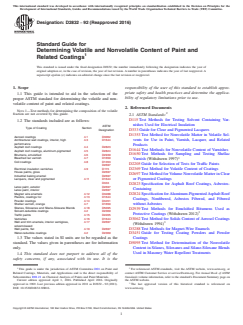
1.1 This guide is intended to aid in the selection of the proper ASTM standard for determining the volatile and nonvolatile content of paint and related coatings.
Note 1: Test methods for determining the composition of the volatile fraction are not covered by this guide.
1.2 The standards included are as follows:
Type of Coating
Section
ASTM
Designation
Aerosol coatings
4.1
D3062
Architectural wall coatings, interior, high
performance
4.3
D1644
Asphalt roof coatings
4.4
D2823
Asphalt roof coatings, aluminum-pigmented
4.5
D2824
Bitumens, emulsified
4.6
D2939
Bleached lac varnish
4.7
D1650
Coil coatings
4.8
D1353
D2697
Electrical insulation varnishes
4.9
D115
House paints, gloss
D2697
Industrial baking enamel
D2697
Lacquers, clear and pigmented
4.11
D1644
D333
Latex paint, exterior
D2697
Latex paint, interior
D2697
Magnet wire enamels
4.12
D3288
Plastics, coatings for
4.13
D1644
Powder coatings
4.14
D3451
Shellac varnish, orange
4.7
D1650
Silanes, Siloxanes and Silane-Siloxane Blends
4.18
D5095
Solvent-reducible coatings
4.2
D2369
Traffic paints
4.15
D2205
Varnishes
4.16
D1644
Wall and trim enamels, interior semigloss, solvent-based
4.17
D2697
Wall paints, flat
4.10
D2697
Water-reducible coatings
4.2
D2369
1.3 The values stated in SI units are to be regarded as the standard. The values given in parentheses are for information only.
1.4 This standard does not purport to address all of the safety concerns, if any, associated with its use. It is the responsibility of the user of this standard to establish appropriate safety and health practices and determine the applicability of regulatory limitations prior to use.
- Status
- Published
- Publication Date
- 31-Mar-2016
- Technical Committee
- D01 - Paint and Related Coatings, Materials, and Applications
- Drafting Committee
- D01.21 - Chemical Analysis of Paints and Paint Materials


Overview
ASTM D2832-92(2016), Standard Guide for Determining Volatile and Nonvolatile Content of Paint and Related Coatings, provides essential guidance for selecting appropriate ASTM standards to determine the volatile and nonvolatile content in a wide variety of paints and coatings. Developed by ASTM International, this standard plays a vital role in ensuring consistency and reliability in measuring the key characteristics of coatings that affect product performance, environmental compliance, and health and safety considerations.
This guide aids users in identifying the best test methods to assess the coverage, quality, and volatile organic content of numerous coating types, without providing procedures for identifying the composition of the volatile fraction.
Key Topics
- Volatile Content Determination: Selection of test methods for measuring the amount of volatile organic compounds released during application/curing.
- Nonvolatile Content Analysis: Guidance on determining the residual solids which constitute the protective and decorative film after application.
- Selection of Methods by Coating Type: Reference to specific ASTM standards appropriate for different coatings, including architectural paints, varnishes, coil coatings, powder coatings, and more.
- Environmental and Safety Considerations: Information for producers and users to assess regulatory compliance and minimize health risks associated with volatile emissions.
Common Coating Types Covered
- Aerosol coatings
- Architectural and wall coatings
- Asphalt and bituminous coatings
- Industrial enamels and lacquers
- Latex paints (interior/exterior)
- Powder coatings
- Electrical insulation varnishes
- Magnet wire enamels
- Traffic paints
- Water-reducible and solvent-based coatings
Applications
ASTM D2832-92(2016) is widely used in industries such as construction, automotive manufacturing, infrastructure maintenance, furniture production, and protective coatings. Its guidance supports:
- Product Comparison: Manufacturers and buyers compare paint and coating products based on nonvolatile content, impacting coverage rates and material performance.
- Regulatory Compliance: Accurate assessment of volatile organic compounds helps meet environmental regulations and health and safety standards.
- Quality Assurance: Consistency in determining solids content ensures product batches meet specification, supporting claims for durability and aesthetic properties.
- Research and Development: Laboratories and developers use appropriate test methods for new coating formulations to analyze performance and environmental impact.
Related Standards
The guide references numerous ASTM standards suitable for specific coating types, ensuring users apply the most relevant and validated methods:
- ASTM D2369: Volatile Content of Coatings (solvent and water-reducible)
- ASTM D1644: Nonvolatile Content of Varnishes, Lacquers, and Coatings
- ASTM D2697: Volume Nonvolatile Matter in Clear or Pigmented Coatings
- ASTM D115: Testing Solvent Containing Varnishes for Electrical Insulation
- ASTM D3062: Solids Content of Aerosol Coatings
- ASTM D2823 / D2824: Asphalt Roof Coatings
- ASTM D2939: Emulsified Bitumens Used as Protective Coatings
- ASTM D3288: Magnet-Wire Enamels
- ASTM D333: Clear and Pigmented Lacquers
- ASTM D3451: Powder Coatings
- ASTM D5095: Nonvolatile Content in Silanes, Siloxanes and Blends
- ASTM D2205: Traffic Paints Selection Tests
For a comprehensive list and details, users are encouraged to consult the full text of ASTM D2832-92(2016) and the referenced standards relevant to their application.
Keywords: volatile content of paints, nonvolatile content of coatings, paint testing standards, ASTM D2832, VOC in coatings, solids content in paints, environmental compliance in paint applications
Relations
- Effective Date
- 01-Apr-2016
- Effective Date
- 01-Mar-2024
- Effective Date
- 01-Feb-2024
- Effective Date
- 01-Nov-2017
- Effective Date
- 01-Jun-2017
- Effective Date
- 01-Dec-2015
- Effective Date
- 01-Jun-2015
- Effective Date
- 01-Nov-2014
- Effective Date
- 01-Jun-2012
- Effective Date
- 01-Jun-2012
- Effective Date
- 01-Apr-2012
- Effective Date
- 01-Jul-2011
- Effective Date
- 01-Dec-2010
- Effective Date
- 01-Jul-2010
- Effective Date
- 01-Jun-2009
Frequently Asked Questions
ASTM D2832-92(2016) is a guide published by ASTM International. Its full title is "Standard Guide for Determining Volatile and Nonvolatile Content of Paint and Related Coatings". This standard covers: SIGNIFICANCE AND USE 3.1 The nonvolatile content of paint and related coatings is useful to producers and users and to environmental and health and safety interests in comparing the coverage of competing products and in estimating the volatile organic content. SCOPE 1.1 This guide is intended to aid in the selection of the proper ASTM standard for determining the volatile and nonvolatile content of paint and related coatings. Note 1: Test methods for determining the composition of the volatile fraction are not covered by this guide. 1.2 The standards included are as follows: Type of Coating Section ASTM Designation Aerosol coatings 4.1 D3062 Architectural wall coatings, interior, high performance 4.3 D1644 Asphalt roof coatings 4.4 D2823 Asphalt roof coatings, aluminum-pigmented 4.5 D2824 Bitumens, emulsified 4.6 D2939 Bleached lac varnish 4.7 D1650 Coil coatings 4.8 D1353 D2697 Electrical insulation varnishes 4.9 D115 House paints, gloss D2697 Industrial baking enamel D2697 Lacquers, clear and pigmented 4.11 D1644 D333 Latex paint, exterior D2697 Latex paint, interior D2697 Magnet wire enamels 4.12 D3288 Plastics, coatings for 4.13 D1644 Powder coatings 4.14 D3451 Shellac varnish, orange 4.7 D1650 Silanes, Siloxanes and Silane-Siloxane Blends 4.18 D5095 Solvent-reducible coatings 4.2 D2369 Traffic paints 4.15 D2205 Varnishes 4.16 D1644 Wall and trim enamels, interior semigloss, solvent-based 4.17 D2697 Wall paints, flat 4.10 D2697 Water-reducible coatings 4.2 D2369 1.3 The values stated in SI units are to be regarded as the standard. The values given in parentheses are for information only. 1.4 This standard does not purport to address all of the safety concerns, if any, associated with its use. It is the responsibility of the user of this standard to establish appropriate safety and health practices and determine the applicability of regulatory limitations prior to use.
SIGNIFICANCE AND USE 3.1 The nonvolatile content of paint and related coatings is useful to producers and users and to environmental and health and safety interests in comparing the coverage of competing products and in estimating the volatile organic content. SCOPE 1.1 This guide is intended to aid in the selection of the proper ASTM standard for determining the volatile and nonvolatile content of paint and related coatings. Note 1: Test methods for determining the composition of the volatile fraction are not covered by this guide. 1.2 The standards included are as follows: Type of Coating Section ASTM Designation Aerosol coatings 4.1 D3062 Architectural wall coatings, interior, high performance 4.3 D1644 Asphalt roof coatings 4.4 D2823 Asphalt roof coatings, aluminum-pigmented 4.5 D2824 Bitumens, emulsified 4.6 D2939 Bleached lac varnish 4.7 D1650 Coil coatings 4.8 D1353 D2697 Electrical insulation varnishes 4.9 D115 House paints, gloss D2697 Industrial baking enamel D2697 Lacquers, clear and pigmented 4.11 D1644 D333 Latex paint, exterior D2697 Latex paint, interior D2697 Magnet wire enamels 4.12 D3288 Plastics, coatings for 4.13 D1644 Powder coatings 4.14 D3451 Shellac varnish, orange 4.7 D1650 Silanes, Siloxanes and Silane-Siloxane Blends 4.18 D5095 Solvent-reducible coatings 4.2 D2369 Traffic paints 4.15 D2205 Varnishes 4.16 D1644 Wall and trim enamels, interior semigloss, solvent-based 4.17 D2697 Wall paints, flat 4.10 D2697 Water-reducible coatings 4.2 D2369 1.3 The values stated in SI units are to be regarded as the standard. The values given in parentheses are for information only. 1.4 This standard does not purport to address all of the safety concerns, if any, associated with its use. It is the responsibility of the user of this standard to establish appropriate safety and health practices and determine the applicability of regulatory limitations prior to use.
ASTM D2832-92(2016) is classified under the following ICS (International Classification for Standards) categories: 87.040 - Paints and varnishes. The ICS classification helps identify the subject area and facilitates finding related standards.
ASTM D2832-92(2016) has the following relationships with other standards: It is inter standard links to ASTM D2832-92(2011), ASTM D115-17(2024), ASTM D2369-24, ASTM D115-17, ASTM D3451-06(2017), ASTM D2205-15, ASTM D2369-10(2015)e1, ASTM D115-14, ASTM D3451-06(2012), ASTM D1644-01(2012), ASTM D115-07(2012), ASTM D2369-10e1, ASTM D2205-85(2010), ASTM D2369-10, ASTM D1353-09. Understanding these relationships helps ensure you are using the most current and applicable version of the standard.
ASTM D2832-92(2016) is available in PDF format for immediate download after purchase. The document can be added to your cart and obtained through the secure checkout process. Digital delivery ensures instant access to the complete standard document.
Standards Content (Sample)
This international standard was developed in accordance with internationally recognized principles on standardization established in the Decision on Principles for the
Development of International Standards, Guides and Recommendations issued by the World Trade Organization Technical Barriers to Trade (TBT) Committee.
Designation: D2832 − 92 (Reapproved 2016)
Standard Guide for
Determining Volatile and Nonvolatile Content of Paint and
Related Coatings
This standard is issued under the fixed designation D2832; the number immediately following the designation indicates the year of
original adoption or, in the case of revision, the year of last revision. A number in parentheses indicates the year of last reapproval. A
superscript epsilon (´) indicates an editorial change since the last revision or reapproval.
1. Scope responsibility of the user of this standard to establish appro-
priate safety and health practices and determine the applica-
1.1 This guide is intended to aid in the selection of the
bility of regulatory limitations prior to use.
proper ASTM standard for determining the volatile and non-
volatile content of paint and related coatings.
2. Referenced Documents
NOTE 1—Test methods for determining the composition of the volatile
fraction are not covered by this guide.
2.1 ASTM Standards:
D115 Test Methods for Testing Solvent Containing Var-
1.2 The standards included are as follows:
nishes Used for Electrical Insulation
ASTM
Type of Coating Section
Designation D333 Guide for Clear and Pigmented Lacquers
D1353 Test Method for Nonvolatile Matter in Volatile Sol-
Aerosol coatings 4.1 D3062
vents for Use in Paint, Varnish, Lacquer, and Related
Architectural wall coatings, interior, high 4.3 D1644
performance
Products
Asphalt roof coatings 4.4 D2823
D1644 Test Methods for Nonvolatile Content of Varnishes
Asphalt roof coatings, aluminum-pigmented 4.5 D2824
D1650 Test Methods for Sampling and Testing Shellac
Bitumens, emulsified 4.6 D2939
Bleached lac varnish 4.7 D1650
Varnish (Withdrawn 1997)
Coil coatings 4.8 D1353
D2205 Guide for Selection of Tests for Traffic Paints
D2697
Electrical insulation varnishes 4.9 D115
D2369 Test Method for Volatile Content of Coatings
House paints, gloss D2697
D2697 Test Method for Volume Nonvolatile Matter in Clear
Industrial baking enamel D2697
Lacquers, clear and pigmented 4.11 D1644 or Pigmented Coatings
D333
D2823 Specification for Asphalt Roof Coatings, Asbestos-
Latex paint, exterior D2697
Containing
Latex paint, interior D2697
Magnet wire enamels 4.12 D3288 D2824 SpecificationforAluminum-PigmentedAsphaltRoof
Plastics, coatings for 4.13 D1644
Coatings, Nonfibered, Asbestos Fibered, and Fibered
Powder coatings 4.14 D3451
without Asbestos
Shellac varnish, orange 4.7 D1650
Silanes, Siloxanes and Silane-Siloxane Blends 4.18 D5095
D2939 Test Methods for Emulsified Bitumens Used as
Solvent-reducible coatings 4.2 D2369
Protective Coatings (Withdrawn 2012)
Traffic paints 4.15 D2205
Varnishes 4.16 D1644 D3062 Test Method for Solids Content of Aerosol Coatings
Wall and trim enamels, interior semigloss, 4.17 D2697
(Withdrawn 1994)
solvent-based
D3288 Test Methods for Magnet-Wire Enamels
Wall paints, flat 4.10 D2697
Water-reducible coatings 4.2 D2369
D3451 Guide for Testing Coating Powders and Powder
1.3 The values stated in SI units are to be regarded as the Coatings
standard. The values given in parentheses are for information D5095 Test Method for Determination of the Nonvolatile
only.
Content in Silanes, Siloxanes and Silane-Siloxane Blends
Used in Masonry Water Repellent Treatments
1.4 This standard does not purport to address all of the
safety concerns, if any, associated with its use. It is the
1 2
This guide is under the jurisdiction of ASTM Committee D01 on Paint and For referenced ASTM standards, visit the ASTM website, www.astm.org, or
Related Coatings, Materials, and Applications and is the direct responsibility of contact ASTM Customer Service at service@astm.org. For Annual Book of ASTM
Subcommittee D01.21 on Chemical Analysis of Paints and Paint Materials. Standards volume information, refer to the standard’s Document Summary page on
Current edition approved April 1, 2016. Published April 2016. Originally the ASTM website.
approved in 1969. Last previous edition approved in 2011 as D2832 – 92 (2011). The last approved version of this historical standard is referenced on
DOI: 10.1520/D2832-92R16. www.astm.org.
Copyright © ASTM International, 100 Barr Harbor Drive, PO Box C700, West Conshohocken, PA 19428-2959. United States
D2832 − 92 (2016)
3. Significance and Use and above in accordance with Test Methods D115 except that
the temperature used shall be 135 6 3°C (275 6 5.5°F) or at
3.1 The nonvolatile content of paint and related coatings is
a temperature agreed upon between the producer and the user.
useful to producers and users and to environmental and health
and safety interests in comparing the coverage of competing
4.10 Volume Nonvolatile Matter in Clear or Pigmented
products and in estimating the volatile organic content.
Coatings (Test Method D2697)—This test method is applicable
to the determination of the volume nonvolatile matter of
4. Procedure
coatings.Agloss enamel, a flat wall paint, a gloss house paint,
an industrial baking enamel, an interior latex paint, and an
4.1 Aerosol Coatings—Test Method D3062 covers the de-
exterior latex paint included in formal collaborative studies of
termination of solids content (weight %) in aerosol coatings.
this test method.
4.2 Volatile Content of Coatings (Test Method D2369)—
4.11 Lacquer Coatings—Determine the nonvolatile content
This test method covers the determination of the volatile
of clear and pigmented lacquers as described in Test Methods
content of coatings. It is considered to be applicable to most
D1644. As an additional requirement, the specimen shall be
solvent-reducible and water-reducible paints.
reheated and reweighed until the weight is constant to within 1
4.3 High Performance Interior Architectural Wall Coatings
mg. Method A of Test Methods D1644 is preferred since
(HIPAC)—D
...