

ASTM G76-18
(Test Method)Standard Test Method for Conducting Erosion Tests by Solid Particle Impingement Using Gas Jets
General Information
- Abstract
SIGNIFICANCE AND USE
5.1 The significance of this test method in any overall measurements program to assess the erosion behavior of materials will depend on many factors concerning the conditions of service applications. The users of this test method should determine the degree of correlation of the results obtained with those from field performance or results using other test systems and methods. This test method may be used to rank the erosion resistance of materials under the specified conditions of testing.
SCOPE
1.1 This test method covers the determination of material loss by gas-entrained solid particle impingement erosion with jetnozzle type erosion equipment. This test method may be used in the laboratory to measure the solid particle erosion of different materials and has been used as a screening test for ranking solid particle erosion rates of materials in simulated service environments (1, 2).2 Actual erosion service involves particle sizes, velocities, attack angles, environments, and so forth, that will vary over a wide range (3-5). Hence, any single laboratory test may not be sufficient to evaluate expected service performance. This test method describes one well characterized procedure for solid particle impingement erosion measurement for which interlaboratory test results are available.
1.2 Units—The values stated in SI units are to be regarded as standard. No other units of measurement are included in this standard (exceptions below).
1.2.1 Exceptions: Table 1 uses HRB hardness. Footnote 7 and 11.2 use abrasive grit designations.
1.3 This standard does not purport to address all of the safety concerns, if any, associated with its use. It is the responsibility of the user of this standard to establish appropriate safety, health, and environmental practices and determine the applicability of regulatory limitations prior to use.
1.4 This international standard was developed in accordance with internationally recognized principles on standardization established in the Decision on Principles for the Development of International Standards, Guides and Recommendations issued by the World Trade Organization Technical Barriers to Trade (TBT) Committee.
- Status
- Published
- Publication Date
- 30-Sep-2018
- Technical Committee
- G02 - Wear and Erosion
- Drafting Committee
- G02.10 - Erosion by Solids and Liquids
Buy Documents
ASTM G76-18 - Standard Test Method for Conducting Erosion Tests by Solid Particle Impingement Using Gas Jets
REDLINE ASTM G76-18 - Standard Test Method for Conducting Erosion Tests by Solid Particle Impingement Using Gas Jets
Overview
ASTM G76-18: Standard Test Method for Conducting Erosion Tests by Solid Particle Impingement Using Gas Jets is an internationally recognized standard from ASTM International. This method is designed to determine the material loss caused by solid particle impingement erosion, utilizing gas-entrained abrasive particles directed at a specimen through a jet nozzle. The procedure provides a controlled and repeatable means to evaluate and compare the erosion resistance of various materials under laboratory conditions. ASTM G76-18 is widely employed as a screening test to rank materials by their relative resistance to solid particle erosion, supporting research, development, and quality assurance efforts for materials intended for erosive service environments.
Key Topics
- Erosion Measurement: The standard describes a systematic process for measuring material loss due to mechanical impact of solid particles, using gas jets as the medium.
- Test Apparatus: Details are provided for a nozzle-type erosion rig capable of delivering a controlled stream of abrasive particles at specified velocities and angles.
- Test Specimen and Abrasive Material: Guidance on selection, preparation, and handling of specimens and abrasive particles, ensuring uniformity and repeatability.
- Standard and Optional Conditions: The method specifies standard test parameters (such as nozzle size, particle size, velocity, impingement angle, and duration), while also permitting deviations for specialized studies, provided all conditions are documented.
- Calibration and Reference Materials: The procedure emphasizes routine calibration using reference materials (such as Type 1020 steel) to assure consistent and comparable results.
- Data Reporting and Analysis: Instructions are given for recording test conditions, measuring mass loss, calculating erosion rates, and reporting normalized values relative to reference specimens for interlaboratory consistency.
- Safety and Compliance: Users are responsible for establishing safety, health, and environmental practices and ensuring compliance with regulatory requirements during testing.
Applications
ASTM G76-18 is widely used in industries where material erosion due to particle impact is a concern, including:
- Aerospace and Turbomachinery: Assessing erosion resistance of engine components, compressor blades, and gas turbine parts exposed to particulate-laden gases.
- Power Generation: Evaluating boiler and piping materials subjected to fly ash or sand particles in fossil-fuel power plants.
- Oil, Gas, and Petrochemical: Testing pipeline, valve, and pump materials for performance in abrasive slurries and sand-bearing gas streams.
- Coatings and Surface Treatments: Screening the effectiveness of protective coatings and surface hardening treatments against erosive environments.
- Materials Research: Supporting the development of new alloys, ceramics, compositional modifications, and composite materials where erosion resistance is a performance requirement.
This standard offers practical value by enabling end-users, manufacturers, and research institutions to estimate service life, compare candidate materials, and validate protective technologies under simulated yet controlled erosive conditions.
Related Standards
- ASTM E122 – Practice for Calculating Sample Size to Estimate, With Specified Precision, the Average for a Characteristic of a Lot or Process
- ASTM G40 – Terminology Relating to Wear and Erosion
- ANSI B74.10 – Grading of Abrasive Microgrits
For comprehensive guidance on wear and erosion testing, as well as methods for material characterization, consult these and other relevant ASTM and ANSI standards.
Keywords: ASTM G76-18, solid particle erosion, gas jet test, wear testing, material loss, erosion resistance, laboratory testing, standard test method, nozzle erosion equipment, abrasive particle impingement
Relations
- Effective Date
- 01-Oct-2018
- Effective Date
- 01-Nov-2015
- Effective Date
- 01-Jun-2013
- Effective Date
- 01-May-2012
- Effective Date
- 01-Aug-2011
- Effective Date
- 01-Dec-2010
- Effective Date
- 01-Jul-2010
- Effective Date
- 01-Jan-2010
- Effective Date
- 15-Nov-2009
- Effective Date
- 01-Aug-2009
- Effective Date
- 01-Oct-2007
- Effective Date
- 01-May-2005
- Effective Date
- 01-Dec-2004
- Effective Date
- 10-Oct-2002
- Effective Date
- 10-Jun-2001
Buy Documents
ASTM G76-18 - Standard Test Method for Conducting Erosion Tests by Solid Particle Impingement Using Gas Jets
REDLINE ASTM G76-18 - Standard Test Method for Conducting Erosion Tests by Solid Particle Impingement Using Gas Jets
Get Certified
Connect with accredited certification bodies for this standard

Element Materials Technology
Materials testing and product certification.

Inštitut za kovinske materiale in tehnologije
Institute of Metals and Technology. Materials testing, metallurgical analysis, NDT.
Sponsored listings
Frequently Asked Questions
ASTM G76-18 is a standard published by ASTM International. Its full title is "Standard Test Method for Conducting Erosion Tests by Solid Particle Impingement Using Gas Jets". This standard covers: SIGNIFICANCE AND USE 5.1 The significance of this test method in any overall measurements program to assess the erosion behavior of materials will depend on many factors concerning the conditions of service applications. The users of this test method should determine the degree of correlation of the results obtained with those from field performance or results using other test systems and methods. This test method may be used to rank the erosion resistance of materials under the specified conditions of testing. SCOPE 1.1 This test method covers the determination of material loss by gas-entrained solid particle impingement erosion with jetnozzle type erosion equipment. This test method may be used in the laboratory to measure the solid particle erosion of different materials and has been used as a screening test for ranking solid particle erosion rates of materials in simulated service environments (1, 2).2 Actual erosion service involves particle sizes, velocities, attack angles, environments, and so forth, that will vary over a wide range (3-5). Hence, any single laboratory test may not be sufficient to evaluate expected service performance. This test method describes one well characterized procedure for solid particle impingement erosion measurement for which interlaboratory test results are available. 1.2 Units—The values stated in SI units are to be regarded as standard. No other units of measurement are included in this standard (exceptions below). 1.2.1 Exceptions: Table 1 uses HRB hardness. Footnote 7 and 11.2 use abrasive grit designations. 1.3 This standard does not purport to address all of the safety concerns, if any, associated with its use. It is the responsibility of the user of this standard to establish appropriate safety, health, and environmental practices and determine the applicability of regulatory limitations prior to use. 1.4 This international standard was developed in accordance with internationally recognized principles on standardization established in the Decision on Principles for the Development of International Standards, Guides and Recommendations issued by the World Trade Organization Technical Barriers to Trade (TBT) Committee.
SIGNIFICANCE AND USE 5.1 The significance of this test method in any overall measurements program to assess the erosion behavior of materials will depend on many factors concerning the conditions of service applications. The users of this test method should determine the degree of correlation of the results obtained with those from field performance or results using other test systems and methods. This test method may be used to rank the erosion resistance of materials under the specified conditions of testing. SCOPE 1.1 This test method covers the determination of material loss by gas-entrained solid particle impingement erosion with jetnozzle type erosion equipment. This test method may be used in the laboratory to measure the solid particle erosion of different materials and has been used as a screening test for ranking solid particle erosion rates of materials in simulated service environments (1, 2).2 Actual erosion service involves particle sizes, velocities, attack angles, environments, and so forth, that will vary over a wide range (3-5). Hence, any single laboratory test may not be sufficient to evaluate expected service performance. This test method describes one well characterized procedure for solid particle impingement erosion measurement for which interlaboratory test results are available. 1.2 Units—The values stated in SI units are to be regarded as standard. No other units of measurement are included in this standard (exceptions below). 1.2.1 Exceptions: Table 1 uses HRB hardness. Footnote 7 and 11.2 use abrasive grit designations. 1.3 This standard does not purport to address all of the safety concerns, if any, associated with its use. It is the responsibility of the user of this standard to establish appropriate safety, health, and environmental practices and determine the applicability of regulatory limitations prior to use. 1.4 This international standard was developed in accordance with internationally recognized principles on standardization established in the Decision on Principles for the Development of International Standards, Guides and Recommendations issued by the World Trade Organization Technical Barriers to Trade (TBT) Committee.
ASTM G76-18 is classified under the following ICS (International Classification for Standards) categories: 77.060 - Corrosion of metals. The ICS classification helps identify the subject area and facilitates finding related standards.
ASTM G76-18 has the following relationships with other standards: It is inter standard links to ASTM G76-13, ASTM G40-15, ASTM G40-13, ASTM G40-12, ASTM E122-09e1, ASTM G40-10b, ASTM G40-10a, ASTM G40-10, ASTM G40-09, ASTM E122-09, ASTM E122-07, ASTM G40-05, ASTM G40-04, ASTM G40-02, ASTM G40-01. Understanding these relationships helps ensure you are using the most current and applicable version of the standard.
ASTM G76-18 is available in PDF format for immediate download after purchase. The document can be added to your cart and obtained through the secure checkout process. Digital delivery ensures instant access to the complete standard document.
Standards Content (Sample)
This international standard was developed in accordance with internationally recognized principles on standardization established in the Decision on Principles for the
Development of International Standards, Guides and Recommendations issued by the World Trade Organization Technical Barriers to Trade (TBT) Committee.
Designation: G76 − 18
Standard Test Method for
Conducting Erosion Tests by Solid Particle Impingement
Using Gas Jets
ThisstandardisissuedunderthefixeddesignationG76;thenumberimmediatelyfollowingthedesignationindicatestheyearoforiginal
adoptionor,inthecaseofrevision,theyearoflastrevision.Anumberinparenthesesindicatestheyearoflastreapproval.Asuperscript
epsilon (´) indicates an editorial change since the last revision or reapproval.
1. Scope 2. Referenced Documents
2.1 ASTM Standards:
1.1 This test method covers the determination of material
E122PracticeforCalculatingSampleSizetoEstimate,With
loss by gas-entrained solid particle impingement erosion with
Specified Precision, the Average for a Characteristic of a
jetnozzle type erosion equipment. This test method may be
Lot or Process
used in the laboratory to measure the solid particle erosion of
G40Terminology Relating to Wear and Erosion
different materials and has been used as a screening test for
2.2 American National Standard:
ranking solid particle erosion rates of materials in simulated
ANSI B74.10Grading of Abrasive Microgrits
service environments (1, 2). Actual erosion service involves
particle sizes, velocities, attack angles, environments, and so
3. Terminology
forth, that will vary over a wide range (3-5). Hence, any single
3.1 Definitions:
laboratory test may not be sufficient to evaluate expected
3.1.1 erosion—progressive loss of original material from a
service performance. This test method describes one well
solid surface due to mechanical interaction between that
characterizedprocedureforsolidparticleimpingementerosion
surfaceandafluid,amulticomponentfluid,orimpingingliquid
measurement for which interlaboratory test results are avail-
or solid particles.
able.
3.1.2 impingement—a process resulting in a continuing
1.2 Units—The values stated in SI units are to be regarded
succession of impacts between (liquid or solid) particles and a
asstandard.Nootherunitsofmeasurementareincludedinthis
solid surface.
standard (exceptions below).
3.2 Definitions of Terms Specific to This Standard:
1.2.1 Exceptions: Table 1 uses HRB hardness. Footnote 7
3.2.1 erosion value—the volume loss of specimen material
and 11.2 use abrasive grit designations.
dividedbythetotalmassofabrasiveparticlesthatimpactedthe
3 −1
1.3 This standard does not purport to address all of the specimen (mm ·g ).
3 −1
safety concerns, if any, associated with its use. It is the
3.2.2 Normalized Erosion Rate—erosionvalue(mm ·g )of
3 −1
responsibility of the user of this standard to establish appro-
specimen material divided by erosion value (mm ·g )of
priate safety, health, and environmental practices and deter-
reference material.
mine the applicability of regulatory limitations prior to use.
4. Summary of Test Method
1.4 This international standard was developed in accor-
dance with internationally recognized principles on standard-
4.1 This test method utilizes a repeated impact erosion
ization established in the Decision on Principles for the approach involving a small nozzle delivering a stream of gas
containing abrasive particles which impacts the surface of a
Development of International Standards, Guides and Recom-
test specimen. A standard set of test conditions is described.
mendations issued by the World Trade Organization Technical
However, deviations from some of the standard conditions are
Barriers to Trade (TBT) Committee.
permitted if described thoroughly. This allows for laboratory
scale erosion measurements under a range of conditions. Test
This test method is under the jurisdiction of ASTM Committee G02 on Wear
and Erosion and is the direct responsibility of Subcommittee G02.10 on Erosion by
Solids and Liquids. For referenced ASTM standards, visit the ASTM website, www.astm.org, or
Current edition approved Oct. 1, 2018. Published November 2018. Originally contact ASTM Customer Service at service@astm.org. For Annual Book of ASTM
approved in 1983. Last previous edition approved in 2013 as G76–13. DOI: Standards volume information, refer to the standard’s Document Summary page on
10.1520/G0076-18. the ASTM website.
2 4
The boldface numbers in parentheses refer to a list of references at the end of Available fromAmerican National Standards Institute (ANSI), 25 W. 43rd St.,
this standard. 4th Floor, New York, NY 10036.
Copyright © ASTM International, 100 Barr Harbor Drive, PO Box C700, West Conshohocken, PA 19428-2959. United States
G76−18
TABLE 1 Characteristics of Type 1020 Steel Reference Material
Annealed 900 s at 760°C, air cooled.
Hardness: HRB = 70 ± 2.
Chemical Composition:
C=0.20±0.01wt%
Mn = 0.45 ± 0.10
S = 0.03 ± 0.01
Si = 0.1± 0.05
P = 0.01 ± 0.01
where:
a = gas jet nozzle,
b = nozzle length,
methodsaredescribedforpreparingthespecimens,conducting
c = mixing chamber,
the erosion exposure, and reporting the results.
d = abrasive hopper,
e = gas source,
5. Significance and Use
f = test specimen,
g = nozzle-to-specimen distance, and
5.1 The significance of this test method in any overall
θ = impingement angle.
measurements program to assess the erosion behavior of
materials will depend on many factors concerning the condi-
FIG. 1 Schematic of Test Rig
tions of service applications. The users of this test method
should determine the degree of correlation of the results
obtained with those from field performance or results using
other test systems and methods. This test method may be used
shall be measured at the location to be occupied by the
to rank the erosion resistance of materials under the specified
specimen and under the conditions of the test.
conditions of testing.
7. Test Materials and Sampling
6. Apparatus
7.1 This test method can be used over a range of specimen
6.1 The apparatus is capable of eroding material from a test
sizes and configurations. One convenient specimen configura-
specimen under well controlled exposure conditions. A sche-
tion is a rectangular strip approximately 10 by 30 by 2 mm
matic drawing of the exit nozzle and the particle-gas supply
thick. Larger specimens and other shapes can be used where
system is shown in Fig. 1. Deviations from this design are
necessary, but must be documented.
permitted; however, adequate system characterization and
7.2 The abrasive material to be used shall be uniform in
controlofcriticalparametersarerequired.Deviationsinnozzle
essential characteristics such as particle size, moisture, chemi-
design and dimensions must be documented. Nozzle length to
cal composition, and so forth.
diameter ratio should be 25:1 or greater in order to achieve an
acceptable particle velocity distribution in the stream. The 7.3 Sampling of material for the purpose of obtaining
recommended nozzle consists of a tube about 1.5 mm inner
representative test specimens shall be done in accordance with
diameter, 50 mm long, manufactured from an erosion resistant acceptablestatisticalpractice.PracticeE122shallbeconsulted.
material such as WC, A1 O , and so forth. Erosion of the
2 3
8. Calibration of Apparatus
nozzle during service shall be monitored and shall not exceed
10% increase in the initial diameter.
8.1 Specimens fabricated fromType 1020 steel (see Table 1
6.2 Necessary features of the apparatus shall include a and Fig. 2) equivalent to that used in the interlaboratory test
series shall be tested periodically using specified (see Section
meansofcontrollingandadjustingtheparticleimpactvelocity,
particleflux,andthespecimenlocationandorientationrelative 9)50µmA1 O particlestoverifythesatisfactoryperformance
2 3
of the apparatus. It is recommended that performance be
to the impinging stream (impingement angle).
verified using this reference material every 50 tests during a
6.3 Various means can be provided for introducing particles
measurement series, and also at the beginning of each new test
into the gas stream, including a vibrator-controlled hopper or a
serieswhenevertheapparatushasbeenidleforsometime.The
screw-feed system. It is required that the system provide a
recommendedcomposition,heattreatment,andhardnessrange
uniform particle feed and that it be adjustable to accommodate
forthissteelarelistedinTable1.Theuseofasteelofdifferent
desired particle flow values.
composition may lead to different erosion results. A photomi-
6.4 A method to measure the particle velocity shall be
crograph of the specified A1 O particles is shown in Fig. 3.
2 3
available for use with the erosion equipment (6-9). Examples
The range of erosion results to be expected for this steel under
of accepted methods are high-speed photography (7), rotating
the standard test conditions specified in Section 9 is shown in
double-disk (6), (8),andlaservelocimeter (9).Particlevelocity
Table 2 and is based on interlaboratory test results.
8.2 Calibration at standard test conditions is recommended
The sole source of supply of the recommended nozzle (tungsten carbide)
even if the apparatus is operated at other test conditions.
known to the committee at this time is Kennametal Inc., 1600TechnologyWay, PO
Box 231, Latrobe, PA15650-0231. If you are aware of alternative suppliers, please
provide this information toASTM International Headquarters.Your comments will
1 6
receive careful consideration at a meeting of the responsible technical committee, Supporting data have been filed atASTM International Headquarters and may
which you may attend. be obtained by requesting Research Report RR:G02-1003.
G76−18
FIG. 4 Example of Erosion Crater Profile for 1020 Steel Eroded
at 70 m/s Particle Velocity Using Standard Conditions Otherwise
9.1.1 The nozzle tube shall be 1.5 mm 6 0.075 mm inner
diameter at least 50 mm long.
9.1.2 The test gas shall be nominally dry air.The test report
shall indicate the amount of water present in the test gas, at
FIG. 2 Microstructure of 1020 Steel Reference Material what pressure, and how the measurement was conducted.
ASTM Grain Size 9
NOTE1—Intheinterlaboratorytesting,onelaboratoryutilizedcylinder-
type compressed air having a water content amount described as “-50°C
dew point” by the manufacturer.Whatever gas source is used in testing, a
comparable level of dryness to that is recommended.
9.1.3 Theabrasiveparticlesshallbenominal50-µmangular
A1 O , equivalent to those used in the interlaboratory test
2 3
series (see Fig. 3). Abrasive shall be used only once.
NOTE 2—Typical size distribution (determined by sedimentation):
100% between 20 to 83 µm, 50% between 42 to 57 µm, 50% coarser
than 48 µm.
−1
9.1.4 The abrasive particle velocity shall be 30 6 2 m·s ,
measuredatthespecimenlocation.Atthisvelocitythegasflow
rate will be approximately 0.13 L/s and the system pressure
will be approximately 140 kPa although the pressure will
depend on the specific system design.
9.1.5 The test time shall be 600 s to achieve steady state
conditions. Longer times are permissible so long as the final
erosion crater is no deeper than 1 mm.
9.1.6 The angle between the nozzle axis and the specimen
surface shall be 90 6 2°.
9.1.7 The test temperature shall be the normal ambient
value (typically between 18°C to 28°C).
9.1.8 The particle feed rate shall be 0.033 6 0.008 g/s.This
corresponds to a particle flux at the specimen surface of about
−2 −1
2 mg·mm ·s under standard conditions. Particle flux deter-
mination requires measurement of the eroded area on the
FIG. 3 Photomicrograph of 50 µm A1 O Particles Used in Inter-
2 3
specimen and is subject to considerable error. A measured
laboratory Testing
width and depth profile of an erosion crater produced using
stated conditions is shown in Fig. 4 and indicates a typical
eroded width/depth relation.
8.3 In any test program the particle velocity and particle
feed rate shall be measured at frequent intervals, typically
every ten tests, to ensure constancy of conditions.
The sole source of supply of the aluminum oxide particles—obtained as grade
240-grit aluminum oxide powder—known to the committee at this time is Norton
9. Standard Test Conditions Co.,1NewBondSt,Worcester,MA01606.Ifyouareawareofalternativesuppliers,
please provide this information to ASTM International Headquarters. Your com-
9.1 This test method defines the following standard condi-
ments will receive careful consideration at a meeting of the responsible technical
tions. committe
...
This document is not an ASTM standard and is intended only to provide the user of an ASTM standard an indication of what changes have been made to the previous version. Because
it may not be technically possible to adequately depict all changes accurately, ASTM recommends that users consult prior editions as appropriate. In all cases only the current version
of the standard as published by ASTM is to be considered the official document.
Designation: G76 − 13 G76 − 18
Standard Test Method for
Conducting Erosion Tests by Solid Particle Impingement
Using Gas Jets
This standard is issued under the fixed designation G76; the number immediately following the designation indicates the year of original
adoption or, in the case of revision, the year of last revision. A number in parentheses indicates the year of last reapproval. A superscript
epsilon (´) indicates an editorial change since the last revision or reapproval.
1. Scope
1.1 This test method covers the determination of material loss by gas-entrained solid particle impingement erosion with
jetnozzle type erosion equipment. This test method may be used in the laboratory to measure the solid particle erosion of different
materials and has been used as a screening test for ranking solid particle erosion rates of materials in simulated service
environments (1, 2). Actual erosion service involves particle sizes, velocities, attack angles, environments, and so forth, that will
vary over a wide range (3-5). Hence, any single laboratory test may not be sufficient to evaluate expected service performance.
This test method describes one well characterized procedure for solid particle impingement erosion measurement for which
interlaboratory test results are available.
1.2 Units—The values stated in SI units are to be regarded as standard. No other units of measurement are included in this
standard (exceptions below).
1.2.1 Exceptions: Table 1 uses HRB hardness. Footnote 7 and 11.2 use abrasive grit designations.
1.3 This standard does not purport to address all of the safety concerns, if any, associated with its use. It is the responsibility
of the user of this standard to establish appropriate safety safety, health, and healthenvironmental practices and determine the
applicability of regulatory limitations prior to use.
1.4 This international standard was developed in accordance with internationally recognized principles on standardization
established in the Decision on Principles for the Development of International Standards, Guides and Recommendations issued
by the World Trade Organization Technical Barriers to Trade (TBT) Committee.
2. Referenced Documents
2.1 ASTM Standards:
E122 Practice for Calculating Sample Size to Estimate, With Specified Precision, the Average for a Characteristic of a Lot or
Process
G40 Terminology Relating to Wear and Erosion
2.2 American National Standard:
ANSI B74.10 Grading of Abrasive Microgrits
This test method is under the jurisdiction of ASTM Committee G02 on Wear and Erosion and is the direct responsibility of Subcommittee G02.10 on Erosion by Solids
and Liquids.
Current edition approved July 1, 2013Oct. 1, 2018. Published July 2013November 2018. Originally approved in 1983. Last previous edition approved in 20072013 as
G76G76 – 13.–07. DOI: 10.1520/G0076-13.10.1520/G0076-18.
The boldface numbers in parentheses refer to a list of references at the end of this standard.
For referenced ASTM standards, visit the ASTM website, www.astm.org, or contact ASTM Customer Service at service@astm.org. For Annual Book of ASTM Standards
volume information, refer to the standard’s Document Summary page on the ASTM website.
Available from American National Standards Institute (ANSI), 25 W. 43rd St., 4th Floor, New York, NY 10036.
TABLE 1 Characteristics of Type 1020 Steel Reference Material
Annealed 900 s at 760°C, air cooled.
Hardness: HRB = 70 ± 2.
Chemical Composition:
C = 0.20 ± 0.01 wt %
Mn = 0.45 ± 0.10
S = 0.03 ± 0.01
Si = 0.1± 0.05
P = 0.01 ± 0.01
Copyright © ASTM International, 100 Barr Harbor Drive, PO Box C700, West Conshohocken, PA 19428-2959. United States
G76 − 18
where:
a = gas jet nozzle,
b = nozzle length,
c = mixing chamber,
d = abrasive hopper,
e = gas source,
f = test specimen,
g = nozzle-to-specimen distance, and
θ = impingement angle.
FIG. 1 Schematic Drawing of Solid Particle Erosion Equipmentof Test Rig
3. Terminology
3.1 Definitions:
3.1.1 erosion—progressive loss of original material from a solid surface due to mechanical interaction between that surface and
a fluid, a multicomponent fluid, or impinging liquid or solid particles.
3.1.2 impingement—a process resulting in a continuing succession of impacts between (liquid or solid) particles and a solid
surface.
3.2 Definitions of Terms Specific to This Standard:
3.2.1 erosion value—the volume loss of specimen material divided by the total mass of abrasive particles that impacted the
3 −1
specimen (mm ·g ).
3 −1 3 −1
3.2.2 Normalized Erosion Rate—erosion value (mm ·g ) of specimen material divided by erosion value (mm ·g ) of reference
material.
4. Summary of Test Method
4.1 This test method utilizes a repeated impact erosion approach involving a small nozzle delivering a stream of gas containing
abrasive particles which impacts the surface of a test specimen. A standard set of test conditions is described. However, deviations
from some of the standard conditions are permitted if described thoroughly. This allows for laboratory scale erosion measurements
under a range of conditions. Test methods are described for preparing the specimens, conducting the erosion exposure, and
reporting the results.
5. Significance and Use
5.1 The significance of this test method in any overall measurements program to assess the erosion behavior of materials will
depend on many factors concerning the conditions of service applications. The users of this test method should determine the
degree of correlation of the results obtained with those from field performance or results using other test systems and methods.
This test method may be used to rank the erosion resistance of materials under the specified conditions of testing.
6. Apparatus
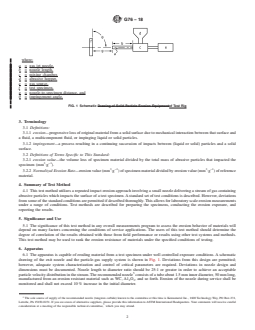
6.1 The apparatus is capable of eroding material from a test specimen under well controlled exposure conditions. A schematic
drawing of the exit nozzle and the particle-gas supply system is shown in Fig. 1. Deviations from this design are permitted;
however, adequate system characterization and control of critical parameters are required. Deviations in nozzle design and
dimensions must be documented. Nozzle length to diameter ratio should be 25:1 or greater in order to achieve an acceptable
particle velocity distribution in the stream. The recommended nozzle consists of a tube about 1.5 mm inner diameter, 50 mm long,
manufactured from an erosion resistant material such as WC, A1 O , and so forth. Erosion of the nozzle during service shall be
2 3
monitored and shall not exceed 10 % increase in the initial diameter.
The sole source of supply of the recommended nozzle (tungsten carbide) known to the committee at this time is Kennametal Inc., 1600 Technology Way, PO Box 231,
Latrobe, PA 15650-0231. If you are aware of alternative suppliers, please provide this information to ASTM International Headquarters. Your comments will receive careful
consideration at a meeting of the responsible technical committee, which you may attend.
G76 − 18
FIG. 2 Microstructure of 1020 Steel Reference Material
ASTM Grain Size 9
6.2 Necessary features of the apparatus shall include a means of controlling and adjusting the particle impact velocity, particle
flux, and the specimen location and orientation relative to the impinging stream.stream (impingement angle).
6.3 Various means can be provided for introducing particles into the gas stream, including a vibrator-controlled hopper or a
screw-feed system. It is required that the system provide a uniform particle feed and that it be adjustable to accommodate desired
particle flow values.
6.4 A method to measure the particle velocity shall be available for use with the erosion equipment (6-9). Examples of accepted
methods are high-speed photography (7), rotating double-disk (6),(8), and laser velocimeter (9). Particle velocity shall be measured
at the location to be occupied by the specimen and under the conditions of the test.
7. Test Materials and Sampling
7.1 This test method can be used over a range of specimen sizes and configurations. One convenient specimen configuration
is a rectangular strip approximately 10 by 30 by 2 mm thick. Larger specimens and other shapes can be used where necessary, but
must be documented.
7.2 The abrasive material to be used shall be uniform in essential characteristics such as particle size, moisture, chemical
composition, and so forth.
7.3 Sampling of material for the purpose of obtaining representative test specimens shall be done in accordance with acceptable
statistical practice. Practice E122 shall be consulted.
8. Calibration of Apparatus
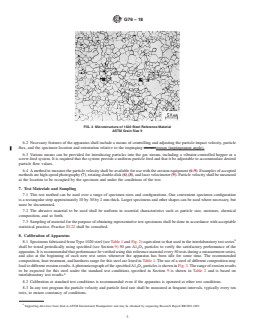
8.1 Specimens fabricated from Type 1020 steel (see Table 1 and Fig. 2) equivalent to that used in the interlaboratory test series
shall be tested periodically using specified (see Section 9) 50 μm A1 O particles to verify the satisfactory performance of the
2 3
apparatus. It is recommended that performance be verified using this reference material every 50 tests during a measurement series,
and also at the beginning of each new test series whenever the apparatus has been idle for some time. The recommended
composition, heat treatment, and hardness range for this steel are listed in Table 1. The use of a steel of different composition may
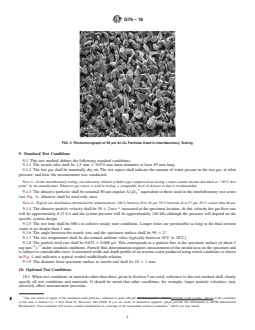
lead to different erosion results. A photomicrograph of the specified A1 O particles is shown in Fig. 3. The range of erosion results
2 3
to be expected for this steel under the standard test conditions specified in Section 9 is shown in Table 2 and is based on
interlaboratory test results.
8.2 Calibration at standard test conditions is recommended even if the apparatus is operated at other test conditions.
8.3 In any test program the particle velocity and particle feed rate shall be measured at frequent intervals, typically every ten
tests, to ensure constancy of conditions.
Supporting data have been filed at ASTM International Headquarters and may be obtained by requesting Research Report RR:G02-1003.
G76 − 18
FIG. 3 Photomicrograph of 50 μm A1 O Particles Used in Interlaboratory Testing
2 3
9. Standard Test Conditions
9.1 This test method defines the following standard conditions.
9.1.1 The nozzle tube shall be 1.5 mm 6 0.075 mm inner diameter at least 50 mm long.
9.1.2 The test gas shall be nominally dry air. The test report shall indicate the amount of water present in the test gas, at what
pressure, and how the measurement was conducted.
NOTE 1—In the interlaboratory testing, one laboratory utilized cylinder-type compressed air having a water content amount described as “-50°C dew
point” by the manufacturer. Whatever gas source is used in testing, a comparable level of dryness to that is recommended.
9.1.3 The abrasive particles shall be nominal 50-μm angular A1 O , equivalent to those used in the interlaboratory test series
2 3
(see Fig. 3). Abrasive shall be used only once.
NOTE 2—Typical size distribution (determined by sedimentation): 100 % between 20 to 83 μm, 50 % between 42 to 57 μm, 50 % coarser than 48 μm.
−1
9.1.4 The abrasive particle velocity shall be 30 6 2 m·s , measured at the specimen location. At this velocity the gas flow rate
will be approximately 0.13 L/s and the system pressure will be approximately 140 kPa although the pressure will depend on the
specific system design.
9.1.5 The test time shall be 600 s to achieve steady state conditions. Longer times are permissible so long as the final erosion
crater is no deeper than 1 mm.
9.1.6 The angle between the nozzle axis and the specimen surface shall be 90 6 2°.
9.1.7 The test temperature shall be the normal ambient value (typically between 18°C to 28°C).
9.1.8 The particle feed rate shall be 0.033 6 0.008 g/s. This corresponds to a particle flux at the specimen surface of about 2
−2 −1
mg·mm ·s under standard conditions. Particle flux determination requires measurement of the eroded area on the specimen and
is subject to considerable error. A measured width and depth profile of an erosion crater produced using stated conditions is shown
in Fig. 4 and indicates a typical eroded width/depth relation.
9.1.9 The distance from specimen surface to nozzle end shall be 10 6 1 mm.
10. Optional Test Conditions
10.1 When test conditions or materials other than those given in Section 9 are used, reference to this test method shall clearly
specify all test conditions and materials. It should be noted that other conditions, for example, larger particle velocities, may
adversely affect measurement precision.
The sole source of supply of the
...