

ASTM E605/E605M-19(2023)
(Test Method)Standard Test Methods for Thickness and Density of Sprayed Fire-Resistive Material (SFRM) Applied to Structural Members
General Information
- Abstract
SIGNIFICANCE AND USE
5.1 Certain properties, namely thickness and density, of SFRM are basic. It is the intent of these test methods to provide procedures to determine these properties.
SCOPE
1.1 These test methods cover procedures for determining thickness and density of sprayed fire-resistive material (SFRM) used in structural assemblies. These include sprayed fiber and cementitious types. The test methods are applicable to both laboratory and field procedures, as indicated in Section 7.
1.2 These test methods require the application of SFRM in accordance with the manufacturers’ published instructions. The apparatus, materials, and procedure used to apply the SFRM for laboratory tests shall be the same as is used for the construction of either of the test assemblies described in Test Methods E119 and E84.
1.3 There is no intent in these test methods to establish levels of performance.
1.4 The values stated in either SI units or inch-pound units are to be regarded separately as standard. The values stated in each system are not necessarily exact equivalents; therefore, to ensure conformance with the standard, each system shall be used independently of the other, and values from the two systems shall not be combined.
1.5 This standard does not purport to address all of the safety concerns, if any, associated with its use. It is the responsibility of the user of this standard to establish appropriate safety, health, and environmental practices and determine the applicability of regulatory limitations prior to use.
1.6 This international standard was developed in accordance with internationally recognized principles on standardization established in the Decision on Principles for the Development of International Standards, Guides and Recommendations issued by the World Trade Organization Technical Barriers to Trade (TBT) Committee.
- Status
- Published
- Publication Date
- 14-May-2023
- Technical Committee
- E06 - Performance of Buildings
- Drafting Committee
- E06.21 - Serviceability
Overview
ASTM E605/E605M-19(2023) is the internationally recognized standard test method for determining the thickness and density of sprayed fire-resistive material (SFRM) applied to structural members. Developed by ASTM International, this standard provides detailed laboratory and field procedures for both fiber and cementitious SFRM types. Compliance with this standard is essential for ensuring that fire-resistive coatings meet intended design and safety requirements in buildings and other structural assemblies.
The proper measurement of thickness and density is crucial to confirm that the applied SFRM delivers the expected fire resistance, as inadequate application can compromise structural integrity during a fire event.
Key Topics
- Measurement Procedures: Outlines standardized methods for measuring SFRM thickness with gauges and density with weighing and volume displacement, ensuring consistent and reproducible results.
- Applicability: Procedures cover both laboratory and field environments, making the standard versatile for new construction, on-site inspections, or laboratory studies.
- Requirements: Specifies necessary apparatus, specimen preparation, measurement techniques, and reporting criteria.
- Deficiency Criteria: Details thresholds for minimum acceptable thickness and density and prescribes steps to remedy or retest deficient applications.
- Reporting: Requires documentation of average, maximum, and minimum values for both thickness and density, along with specimen specifics and any deviations from standard methods.
- Safety and Units: Highlights user responsibility for safe practice and mandates evaluation using either SI or inch-pound units independently.
Applications
ASTM E605/E605M-19(2023) is widely used in construction, building safety assessments, quality control, and regulatory compliance:
- Building Construction: Ensures proper application of fire-resistive materials in commercial, industrial, and residential buildings.
- Structural Steel Protection: Verifies that steel columns, beams, joists, decks, and walls have sufficient SFRM coverage for code-mandated fire ratings.
- Field Inspections: Supports building inspectors and code officials in verifying SFRM application during and after construction.
- Quality Assurance: Provides manufacturers, contractors, and laboratory technicians with a uniform test protocol to assess product performance and compliance.
- Design and Specification Compliance: Assures that SFRM installations align with design documentation and code requirements for fire resistance.
- Remediation: Guides the process of identifying, documenting, and correcting areas with insufficient SFRM coverage or density.
Related Standards
- ASTM E84: Standard Test Method for Surface Burning Characteristics of Building Materials, often referenced for performance criteria related to SFRM.
- ASTM E119: Standard Test Methods for Fire Tests of Building Construction and Materials, important for fire resistance ratings of assemblies.
- ASTM E631: Terminology of Building Constructions, for definitions associated with this and related standards.
Practical Value
Utilizing ASTM E605/E605M-19(2023) ensures that sprayed fire-resistive material is applied correctly and consistently, safeguarding both life and property by promoting effective structural fire protection. The standard supports building code compliance, enhances quality control, and reduces liability for stakeholders involved in building design, construction, and maintenance, making it a vital tool in the fire protection industry.
Keywords: sprayed fire-resistive materials, SFRM, ASTM E605, thickness, density, fire protection, building codes, structural members, fire safety standards, quality assurance.
Relations
- Effective Date
- 01-Dec-2023
- Effective Date
- 01-Sep-2023
- Effective Date
- 01-Oct-2019
- Effective Date
- 01-Jul-2019
- Effective Date
- 15-Apr-2019
- Effective Date
- 01-Mar-2019
- Effective Date
- 01-Nov-2018
- Effective Date
- 01-Nov-2018
- Effective Date
- 01-Oct-2018
- Effective Date
- 01-Sep-2018
- Effective Date
- 01-Jul-2018
- Effective Date
- 01-Jun-2018
- Effective Date
- 01-Mar-2018
- Effective Date
- 01-Mar-2018
- Effective Date
- 01-Nov-2017
Get Certified
Connect with accredited certification bodies for this standard

DIBt (Deutsches Institut für Bautechnik)
German Institute for Building Technology.
DIN CERTCO
DIN Group product certification.

Kiwa BDA Testing
Building and construction product certification.
Sponsored listings
Frequently Asked Questions
ASTM E605/E605M-19(2023) is a standard published by ASTM International. Its full title is "Standard Test Methods for Thickness and Density of Sprayed Fire-Resistive Material (SFRM) Applied to Structural Members". This standard covers: SIGNIFICANCE AND USE 5.1 Certain properties, namely thickness and density, of SFRM are basic. It is the intent of these test methods to provide procedures to determine these properties. SCOPE 1.1 These test methods cover procedures for determining thickness and density of sprayed fire-resistive material (SFRM) used in structural assemblies. These include sprayed fiber and cementitious types. The test methods are applicable to both laboratory and field procedures, as indicated in Section 7. 1.2 These test methods require the application of SFRM in accordance with the manufacturers’ published instructions. The apparatus, materials, and procedure used to apply the SFRM for laboratory tests shall be the same as is used for the construction of either of the test assemblies described in Test Methods E119 and E84. 1.3 There is no intent in these test methods to establish levels of performance. 1.4 The values stated in either SI units or inch-pound units are to be regarded separately as standard. The values stated in each system are not necessarily exact equivalents; therefore, to ensure conformance with the standard, each system shall be used independently of the other, and values from the two systems shall not be combined. 1.5 This standard does not purport to address all of the safety concerns, if any, associated with its use. It is the responsibility of the user of this standard to establish appropriate safety, health, and environmental practices and determine the applicability of regulatory limitations prior to use. 1.6 This international standard was developed in accordance with internationally recognized principles on standardization established in the Decision on Principles for the Development of International Standards, Guides and Recommendations issued by the World Trade Organization Technical Barriers to Trade (TBT) Committee.
SIGNIFICANCE AND USE 5.1 Certain properties, namely thickness and density, of SFRM are basic. It is the intent of these test methods to provide procedures to determine these properties. SCOPE 1.1 These test methods cover procedures for determining thickness and density of sprayed fire-resistive material (SFRM) used in structural assemblies. These include sprayed fiber and cementitious types. The test methods are applicable to both laboratory and field procedures, as indicated in Section 7. 1.2 These test methods require the application of SFRM in accordance with the manufacturers’ published instructions. The apparatus, materials, and procedure used to apply the SFRM for laboratory tests shall be the same as is used for the construction of either of the test assemblies described in Test Methods E119 and E84. 1.3 There is no intent in these test methods to establish levels of performance. 1.4 The values stated in either SI units or inch-pound units are to be regarded separately as standard. The values stated in each system are not necessarily exact equivalents; therefore, to ensure conformance with the standard, each system shall be used independently of the other, and values from the two systems shall not be combined. 1.5 This standard does not purport to address all of the safety concerns, if any, associated with its use. It is the responsibility of the user of this standard to establish appropriate safety, health, and environmental practices and determine the applicability of regulatory limitations prior to use. 1.6 This international standard was developed in accordance with internationally recognized principles on standardization established in the Decision on Principles for the Development of International Standards, Guides and Recommendations issued by the World Trade Organization Technical Barriers to Trade (TBT) Committee.
ASTM E605/E605M-19(2023) is classified under the following ICS (International Classification for Standards) categories: 13.220.50 - Fire-resistance of building materials and elements; 91.100.50 - Binders. Sealing materials. The ICS classification helps identify the subject area and facilitates finding related standards.
ASTM E605/E605M-19(2023) has the following relationships with other standards: It is inter standard links to ASTM E84-23d, ASTM E84-23c, ASTM E119-19, ASTM E84-19b, ASTM E84-19a, ASTM E84-19, ASTM E119-18ce1, ASTM E119-18c, ASTM E84-18b, ASTM E119-18b, ASTM E84-18a, ASTM E119-18a, ASTM E84-18, ASTM E119-18, ASTM E84-17a. Understanding these relationships helps ensure you are using the most current and applicable version of the standard.
ASTM E605/E605M-19(2023) is available in PDF format for immediate download after purchase. The document can be added to your cart and obtained through the secure checkout process. Digital delivery ensures instant access to the complete standard document.
Standards Content (Sample)
This international standard was developed in accordance with internationally recognized principles on standardization established in the Decision on Principles for the
Development of International Standards, Guides and Recommendations issued by the World Trade Organization Technical Barriers to Trade (TBT) Committee.
Designation: E605/E605M − 19 (Reapproved 2023)
Standard Test Methods for
Thickness and Density of Sprayed Fire-Resistive Material
(SFRM) Applied to Structural Members
This standard is issued under the fixed designation E605/E605M; the number immediately following the designation indicates the year
of original adoption or, in the case of revision, the year of last revision. A number in parentheses indicates the year of last reapproval.
A superscript epsilon (´) indicates an editorial change since the last revision or reapproval.
This standard has been approved for use by agencies of the U.S. Department of Defense.
1. Scope 2. Referenced Documents
2.1 ASTM Standards:
1.1 These test methods cover procedures for determining
E84 Test Method for Surface Burning Characteristics of
thickness and density of sprayed fire-resistive material (SFRM)
Building Materials
used in structural assemblies. These include sprayed fiber and
E119 Test Methods for Fire Tests of Building Construction
cementitious types. The test methods are applicable to both
and Materials
laboratory and field procedures, as indicated in Section 7.
E631 Terminology of Building Constructions
1.2 These test methods require the application of SFRM in
accordance with the manufacturers’ published instructions. The
3. Terminology
apparatus, materials, and procedure used to apply the SFRM
3.1 Definitions—For definitions of terms found in these test
for laboratory tests shall be the same as is used for the
methods, refer to Terminology E631.
construction of either of the test assemblies described in Test
3.2 Definitions of Terms Specific to This Standard:
Methods E119 and E84.
3.2.1 density, n—the weight per unit volume of the SFRM.
1.3 There is no intent in these test methods to establish
3.2.2 sprayed fire-resistive materials, n—materials that are
levels of performance.
sprayed onto substrates to provide fire-resistive protection of
the substrates.
1.4 The values stated in either SI units or inch-pound units
3.2.3 thickness, n—the distance measured from the substrate
are to be regarded separately as standard. The values stated in
sprayed with the SFRM, through the SFRM, to the outer
each system are not necessarily exact equivalents; therefore, to
surface of the SFRM.
ensure conformance with the standard, each system shall be
used independently of the other, and values from the two
4. Summary of Test Method
systems shall not be combined.
4.1 The basic properties of density and thickness are deter-
1.5 This standard does not purport to address all of the
mined using a thickness gauge, scales, steel rules, and tem-
safety concerns, if any, associated with its use. It is the
plates.
responsibility of the user of this standard to establish appro-
priate safety, health, and environmental practices and deter-
5. Significance and Use
mine the applicability of regulatory limitations prior to use.
5.1 Certain properties, namely thickness and density, of
1.6 This international standard was developed in accor-
SFRM are basic. It is the intent of these test methods to provide
dance with internationally recognized principles on standard-
procedures to determine these properties.
ization established in the Decision on Principles for the
Development of International Standards, Guides and Recom-
6. Apparatus
mendations issued by the World Trade Organization Technical
Barriers to Trade (TBT) Committee.
6.1 Steel Rule, graduated in at least 1 mm [ ⁄16 in.] intervals.
1 2
These test methods are under the jurisdiction of ASTM Committee E06 on For referenced ASTM standards, visit the ASTM website, www.astm.org, or
Performance of Buildings and is the direct responsibility of Subcommittee E06.21 contact ASTM Customer Service at service@astm.org. For Annual Book of ASTM
on Serviceability. Standards volume information, refer to the standard’s Document Summary page on
Current edition approved May 15, 2023. Published May 2023. Originally the ASTM website.
approved in 1977. Last previous edition approved in 2019 as E605/E605M – 19. Although mass is determined, the term weight is used in these test methods as
DOI: 10.1520/E0605_E0605M–19R23. a field-accepted substitute.
Copyright © ASTM International, 100 Barr Harbor Drive, PO Box C700, West Conshohocken, PA 19428-2959. United States
E605/E605M − 19 (2023)
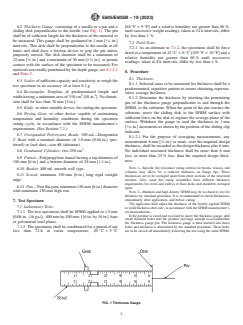
6.2 Thickness Gauge, consisting of a needle or a pin and a [68 °F 6 9 °F] and a relative humidity not greater than 60 %,
sliding disk perpendicular to the needle (see Fig. 1). The pin until successive weight readings, taken at 24 h intervals, differ
shall be of sufficient length for the thickness of the material to by less than 1 %.
be measured. This gauge shall be graduated in 1 mm [ ⁄16 in.]
7.2 Field Tests:
intervals. This disk shall be perpendicular to the needle at all
7.2.1 As an alternate to 7.1.2, the specimens shall be force
times and shall have a friction device to grip the pin unless
dried at a temperature of 43 °C 6 6 °C [109 °F 6 10 °F] and a
purposely moved. The disk diameter shall be a minimum of
relative humidity not greater than 60 % until successive
7 1
22 mm [ ⁄8 in.] and a maximum of 30 mm [1 ⁄8 in.], to permit
readings, taken at 8 h intervals, differ by less than 1 %.
contact with the surface of the specimen to be measured. For
materials not readily penetrated by the depth gauge, see 8.1.2.1
8. Procedure
and Note 2.
8.1 Thickness:
6.3 Scales of sufficient capacity and sensitivity to weigh the
8.1.1 Selected areas to be measured for thickness shall be a
test specimen to an accuracy of at least 0.1 g.
predetermined, repetitive pattern to ensure obtaining represen-
6.4 Rectangular Template of predetermined length and
tative average thickness.
2 2
width having a minimum area of 310 cm [48 in. ]. No dimen-
8.1.2 Determine the thickness by inserting the penetrating
sion shall be less than 76 mm [3 in.].
pin of the thickness gauge perpendicular to and through the
6.5 Knife, or other suitable device, for cutting the specimen. SFRM, to the substrate. When the point of the pin touches the
substrate, move the sliding disk to the SFRM surface with
6.6 Drying Oven, or other device capable of maintaining
sufficient force on the disk to register the average plane of the
temperature and humidity conditions during the specimen
surface. Withdraw the gauge to read the thickness in 1 mm
curing cycle, in accordance with the SFRM manufacturer’s
[ ⁄16 in.] increments as shown by the position of the sliding clip
requirements. (See Section 7.2.)
indicator.
6.7 Unexpanded Polystyrene Beads, 500 mL—Designation
8.1.2.1 For the purpose of averaging measurements, any
C Bead with a nominal diameter of 1.0 mm [0.04 in.] (pre-
measurement 6 mm [ ⁄4 in.] or more, over the required design
ferred) or lead shot—size #8 (alternate).
thickness, shall be recorded as the design thickness plus 6 mm.
6.8 Graduated Cylinders, two 250 cm . No individual measured thickness shall be more than 6 mm
less, or more than 25 % less, than the required design thick-
6.9 Funnel—Polypropylene funnel having a top diameter of
ness.
150 mm [6 in.] and a bottom diameter of 28 mm [1.1 in.].
NOTE 1—Specific fire resistance rating criteria for beams, trusses, and
6.10 Beaker, 400 mL smooth wall type.
columns may allow for a reduced thickness on flange tips. These
6.11 Screed, minimum 150 mm [6 in.] long rigid straight
thicknesses are to be averaged apart from other sections of the structural
member. Also, some fire rating assemblies have different thickness
edge.
requirements for crests and valleys of floor decks and should be averaged
6.12 Pan—Two flat pans minimum 150 mm [6 in.] diameter
apart.
with minimum 150 mm high rim.
NOTE 2—Medium and high density SFRM may be too hard to test for
thickness by standard procedure. It is recommended to check thicknesses
immediately after application, and before curing.
7. Test Specimen
The applicator shall adjust the thickness of the freshly applied SFRM
7.1 Laboratory Tests: to yield thickness after cure, in accordance with the SFRM manufacturer’s
recommendations.
7.1.1 The test specimens shall be SFRM applied to 1.5 mm
If the product is cured and too hard to insert the thickness gauge, drill
[0.06 in. (16 ga.)], 400 mm by 400 mm [16 in. by 16 in.] bare
small diameter holes into the product just large enough to accommodate
or galvanized steel plates.
the thickness gauge pin. The thickness gauge is then inserted into these
7.1.2 The specimens shall be conditioned for a period of not
holes and thickness is determined by the standard procedure. These holes
less than 72 h at room temperature, 20 °C 6 5 °C are to be closed off immediately following the test using the same SFRM.
FIG. 1 Thickness Gauge
E605/E605M − 19 (2023)
8.1.3 Conducting Thickness Testing—One bay per floor or
one bay for each 10 000 ft , whichever provides the greater
number of tests. Thickness determinations for the following
structural elements shall be conducted in each randomly
selected bay: one selected area of metal deck, concrete slab, or
wall section; one column; and one beam (joist or truss).
NOTE 3—The applicable building code governs. Consult the applicable
building code for exact requirements and tolerances.
8.1.4 Tests for the Deck and Wall Section:
8.1.4.1 Flat Decks—In the preselected area, lay out a
300 mm [12 in.] square. Take four random symmetrical mea-
surements within that square and report as an average. (See
Note 1.)
8.1.4.2 Fluted Decks—In the preselected area, lay out a
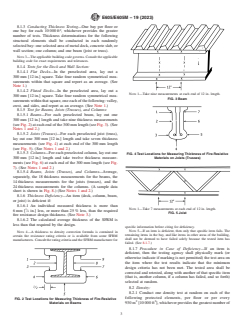
NOTE 1—Take nine measurements at each end of 12 in. length.
300 mm [12 in.] square. Take four random symmetrical mea-
FIG. 3 Beam
surements within that square, one each of the following: valley,
crest, and sides, and report as an average. (See Note 1.)
8.1.5 Test for Beams, Joists (T
...