

ASTM D5629-23
(Test Method)Standard Test Method for Polyurethane Raw Materials: Determination of Acidity in Low-Acidity Aromatic Isocyanates and Polyurethane Prepolymers
General Information
- Abstract
SIGNIFICANCE AND USE
5.1 This test method is suitable for research or for quality control to characterize aromatic isocyanates and low-acidity prepolymers. Acidity correlates with performance in some polyurethane systems.
SCOPE
1.1 This test method measures the acidity, expressed as ppm of hydrochloric acid (HCl), in aromatic isocyanate or polyurethane prepolymer samples of below 100 ppm acidity. The test method is applicable to products derived from toluene diisocyanate and methylene di(phenylisocyanate) (see Note 1). Refer to Test Method D6099 for determination of acidity in moderate- to high-acidity aromatic isocyanates.
1.2 The values stated in SI units are to be regarded as the standard.
1.3 This standard does not purport to address all of the safety concerns, if any, associated with its use. It is the responsibility of the user of this standard to establish appropriate safety, health, and environmental practices and determine the applicability of regulatory limitations prior to use.
Note 1: This standard is equivalent to ISO 14898, Method B.
1.4 This international standard was developed in accordance with internationally recognized principles on standardization established in the Decision on Principles for the Development of International Standards, Guides and Recommendations issued by the World Trade Organization Technical Barriers to Trade (TBT) Committee.
- Status
- Published
- Publication Date
- 28-Feb-2023
- Technical Committee
- D20 - Plastics
- Drafting Committee
- D20.22 - Cellular Materials - Plastics and Elastomers
Buy Documents
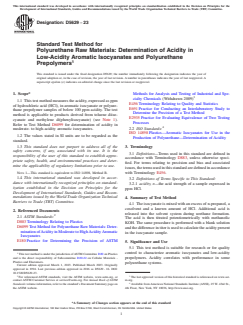
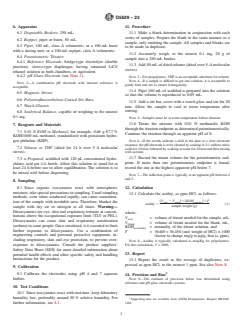


ASTM D5629-23 - Standard Test Method for Polyurethane Raw Materials: Determination of Acidity in Low-Acidity Aromatic Isocyanates and Polyurethane Prepolymers
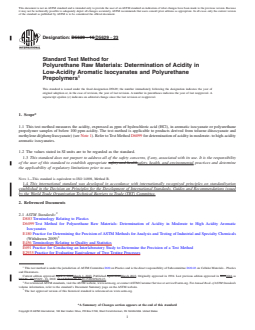
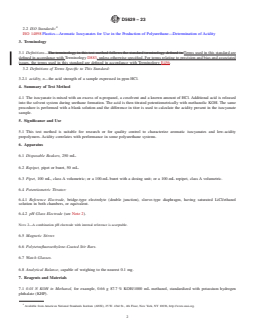
REDLINE ASTM D5629-23 - Standard Test Method for Polyurethane Raw Materials: Determination of Acidity in Low-Acidity Aromatic Isocyanates and Polyurethane Prepolymers
Overview
ASTM D5629-23 is a standard test method published by ASTM International that outlines procedures for determining the acidity of low-acidity aromatic isocyanates and polyurethane prepolymers. This test is essential in both research and quality control environments for characterizing the acidity of raw materials used in producing polyurethane products. Acidity, typically measured as parts per million (ppm) of hydrochloric acid (HCl), can influence the performance and end properties of polyurethane systems. The method is especially relevant for samples derived from toluene diisocyanate (TDI) and methylene di(phenylisocyanate) (MDI) with acidity below 100 ppm.
Key Topics
- Purpose: The test method provides a standardized approach for measuring very low levels of acidity in aromatic isocyanates and prepolymers, typically used in polyurethane manufacturing.
- Scope: Applicable to TDI and MDI-based products with acidity less than 100 ppm. For higher acidity levels, ASTM D6099 should be used.
- Procedure Summary:
- Samples are mixed with acified n-propanol and a cosolvent.
- A potentiometric titration is conducted using methanolic potassium hydroxide (KOH).
- The difference in titrant volume between sample and blank provides the acidity level in ppm HCl.
- Performance Relevance: Acidity determination helps assess the suitability of isocyanates and prepolymers in polyurethane formulations, as acidity correlates with product performance.
- Laboratory Considerations: Strict sample handling to avoid contamination, as isocyanates react quickly with atmospheric moisture. Safety and environmental precautions are emphasized due to the hazardous nature of the chemicals involved.
Applications
The ASTM D5629-23 test method is vital for industries relying on high-performance polyurethane products, where control over raw material purity and quality can affect the end-use characteristics. Key applications include:
- Quality Control: Ensures that aromatic isocyanates and prepolymers meet stringent acidity specifications before being used in production.
- Research and Development: Facilitates the study of raw material impacts on the properties of polyurethane foams, elastomers, adhesives, and coatings.
- Product Qualification: Confirms that materials sourced from different suppliers are consistent in acidity and performance.
- Formulation Adjustments: Allows manufacturers to optimize formulations for better durability, reactivity, and overall product quality by monitoring and controlling acidity levels.
Accurate acidity determination is essential in:
- The production of flexible and rigid foams
- Creation of specialty adhesives and coatings
- Development of elastomeric materials for automotive, construction, and footwear applications
Related Standards
Several standards and resources are relevant to or referenced by ASTM D5629-23:
- ASTM D6099: Test Method for Determination of Acidity in Moderate to High Acidity Aromatic Isocyanates.
- ISO 14898 (Method B): International equivalent procedure for acidity determination in aromatic isocyanates.
- ASTM D883: Terminology Relating to Plastics.
- ASTM E456: Terminology Relating to Quality and Statistics.
- ASTM E691: Practice for Conducting Interlaboratory Studies for Precision of Test Methods.
- ASTM E2935: Practice for Evaluating Equivalence of Two Testing Processes.
In summary, ASTM D5629-23 is an essential standard for the polyurethane industry, ensuring process consistency and material quality through the accurate measurement of acidity in raw materials. Proper application of this standard supports better product performance, regulatory compliance, and customer satisfaction in polyurethane-based products.
Relations
- Effective Date
- 01-Feb-2024
- Effective Date
- 01-Feb-2024
- Effective Date
- 01-Nov-2023
- Effective Date
- 01-Apr-2022
- Effective Date
- 01-Jan-2020
- Effective Date
- 01-Aug-2019
- Effective Date
- 15-Apr-2019
- Effective Date
- 01-Feb-2019
- Effective Date
- 01-Dec-2018
- Effective Date
- 01-Nov-2018
- Effective Date
- 01-Aug-2018
- Effective Date
- 01-Oct-2017
- Refers
ASTM E2935-17 - Standard Practice for Conducting Equivalence Testing in Laboratory Applications - Effective Date
- 01-Oct-2017
- Effective Date
- 01-Oct-2017
- Effective Date
- 15-Aug-2017
Buy Documents
ASTM D5629-23 - Standard Test Method for Polyurethane Raw Materials: Determination of Acidity in Low-Acidity Aromatic Isocyanates and Polyurethane Prepolymers
REDLINE ASTM D5629-23 - Standard Test Method for Polyurethane Raw Materials: Determination of Acidity in Low-Acidity Aromatic Isocyanates and Polyurethane Prepolymers
Get Certified
Connect with accredited certification bodies for this standard

DIN CERTCO
DIN Group product certification.

Smithers Quality Assessments
US management systems and product certification.
Sponsored listings
Frequently Asked Questions
ASTM D5629-23 is a standard published by ASTM International. Its full title is "Standard Test Method for Polyurethane Raw Materials: Determination of Acidity in Low-Acidity Aromatic Isocyanates and Polyurethane Prepolymers". This standard covers: SIGNIFICANCE AND USE 5.1 This test method is suitable for research or for quality control to characterize aromatic isocyanates and low-acidity prepolymers. Acidity correlates with performance in some polyurethane systems. SCOPE 1.1 This test method measures the acidity, expressed as ppm of hydrochloric acid (HCl), in aromatic isocyanate or polyurethane prepolymer samples of below 100 ppm acidity. The test method is applicable to products derived from toluene diisocyanate and methylene di(phenylisocyanate) (see Note 1). Refer to Test Method D6099 for determination of acidity in moderate- to high-acidity aromatic isocyanates. 1.2 The values stated in SI units are to be regarded as the standard. 1.3 This standard does not purport to address all of the safety concerns, if any, associated with its use. It is the responsibility of the user of this standard to establish appropriate safety, health, and environmental practices and determine the applicability of regulatory limitations prior to use. Note 1: This standard is equivalent to ISO 14898, Method B. 1.4 This international standard was developed in accordance with internationally recognized principles on standardization established in the Decision on Principles for the Development of International Standards, Guides and Recommendations issued by the World Trade Organization Technical Barriers to Trade (TBT) Committee.
SIGNIFICANCE AND USE 5.1 This test method is suitable for research or for quality control to characterize aromatic isocyanates and low-acidity prepolymers. Acidity correlates with performance in some polyurethane systems. SCOPE 1.1 This test method measures the acidity, expressed as ppm of hydrochloric acid (HCl), in aromatic isocyanate or polyurethane prepolymer samples of below 100 ppm acidity. The test method is applicable to products derived from toluene diisocyanate and methylene di(phenylisocyanate) (see Note 1). Refer to Test Method D6099 for determination of acidity in moderate- to high-acidity aromatic isocyanates. 1.2 The values stated in SI units are to be regarded as the standard. 1.3 This standard does not purport to address all of the safety concerns, if any, associated with its use. It is the responsibility of the user of this standard to establish appropriate safety, health, and environmental practices and determine the applicability of regulatory limitations prior to use. Note 1: This standard is equivalent to ISO 14898, Method B. 1.4 This international standard was developed in accordance with internationally recognized principles on standardization established in the Decision on Principles for the Development of International Standards, Guides and Recommendations issued by the World Trade Organization Technical Barriers to Trade (TBT) Committee.
ASTM D5629-23 is classified under the following ICS (International Classification for Standards) categories: 83.080.10 - Thermosetting materials. The ICS classification helps identify the subject area and facilitates finding related standards.
ASTM D5629-23 has the following relationships with other standards: It is inter standard links to ASTM D6099-24, ASTM D883-24, ASTM D883-23, ASTM E456-13a(2022)e1, ASTM D883-20, ASTM D883-19c, ASTM D883-19a, ASTM D883-19, ASTM D883-18a, ASTM D883-18, ASTM D6099-18, ASTM E456-13A(2017)e3, ASTM E2935-17, ASTM E456-13A(2017)e1, ASTM D883-17. Understanding these relationships helps ensure you are using the most current and applicable version of the standard.
ASTM D5629-23 is available in PDF format for immediate download after purchase. The document can be added to your cart and obtained through the secure checkout process. Digital delivery ensures instant access to the complete standard document.
Standards Content (Sample)
This international standard was developed in accordance with internationally recognized principles on standardization established in the Decision on Principles for the
Development of International Standards, Guides and Recommendations issued by the World Trade Organization Technical Barriers to Trade (TBT) Committee.
Designation: D5629 − 23
Standard Test Method for
Polyurethane Raw Materials: Determination of Acidity in
Low-Acidity Aromatic Isocyanates and Polyurethane
Prepolymers
This standard is issued under the fixed designation D5629; the number immediately following the designation indicates the year of
original adoption or, in the case of revision, the year of last revision. A number in parentheses indicates the year of last reapproval. A
superscript epsilon (´) indicates an editorial change since the last revision or reapproval.
1. Scope* Methods for Analysis and Testing of Industrial and Spe-
cialty Chemicals (Withdrawn 2009)
1.1 This test method measures the acidity, expressed as ppm
E456 Terminology Relating to Quality and Statistics
of hydrochloric acid (HCl), in aromatic isocyanate or polyure-
E691 Practice for Conducting an Interlaboratory Study to
thane prepolymer samples of below 100 ppm acidity. The test
Determine the Precision of a Test Method
method is applicable to products derived from toluene diiso-
E2935 Practice for Evaluating Equivalence of Two Testing
cyanate and methylene di(phenylisocyanate) (see Note 1).
Processes
Refer to Test Method D6099 for determination of acidity in
2.2 ISO Standards:
moderate- to high-acidity aromatic isocyanates.
ISO 14898 Plastics—Aromatic Isocyanates for Use in the
1.2 The values stated in SI units are to be regarded as the
Production of Polyurethane—Determination of Acidity
standard.
1.3 This standard does not purport to address all of the
3. Terminology
safety concerns, if any, associated with its use. It is the
3.1 Definitions—Terms used in this standard are defined in
responsibility of the user of this standard to establish appro-
accordance with Terminology D883, unless otherwise speci-
priate safety, health, and environmental practices and deter-
fied. For terms relating to precision and bias and associated
mine the applicability of regulatory limitations prior to use.
issues, the terms used in this standard are defined in accordance
NOTE 1—This standard is equivalent to ISO 14898, Method B. with Terminology E456.
1.4 This international standard was developed in accor-
3.2 Definitions of Terms Specific to This Standard:
dance with internationally recognized principles on standard-
3.2.1 acidity, n—the acid strength of a sample expressed in
ization established in the Decision on Principles for the
ppm HCl.
Development of International Standards, Guides and Recom-
mendations issued by the World Trade Organization Technical
4. Summary of Test Method
Barriers to Trade (TBT) Committee.
4.1 The isocyanate is mixed with an excess of n-propanol, a
cosolvent and a known amount of HCl. Additional acid is
2. Referenced Documents
released into the solvent system during urethane formation.
2.1 ASTM Standards:
The acid is then titrated potentiometrically with methanolic
D883 Terminology Relating to Plastics
KOH. The same procedure is performed with a blank solution
D6099 Test Method for Polyurethane Raw Materials: Deter-
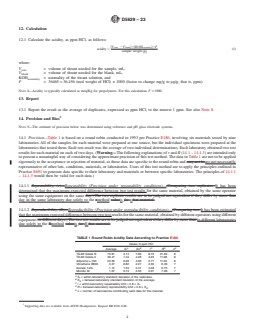
and the difference in titer is used to calculate the acidity present
mination of Acidity in Moderate to High Acidity Aromatic
in the isocyanate sample.
Isocyanates
E180 Practice for Determining the Precision of ASTM
5. Significance and Use
5.1 This test method is suitable for research or for quality
control to characterize aromatic isocyanates and low-acidity
This test method is under the jurisdiction of ASTM Committee D20 on Plastics
and is the direct responsibility of Subcommittee D20.22 on Cellular Materials - prepolymers. Acidity correlates with performance in some
Plastics and Elastomers.
polyurethane systems.
Current edition approved March 1, 2023. Published March 2023. Originally
approved in 1994. Last previous edition approved in 2016 as D5629 - 16. DOI:
10.1520/D5629-23.
2 3
For referenced ASTM standards, visit the ASTM website, www.astm.org, or The last approved version of this historical standard is referenced on www.ast-
contact ASTM Customer Service at service@astm.org. For Annual Book of ASTM m.org.
Standards volume information, refer to the standard’s Document Summary page on Available from American National Standards Institute (ANSI), 25 W. 43rd St.,
the ASTM website. 4th Floor, New York, NY 10036, http://www.ansi.org.
*A Summary of Changes section appears at the end of this standard
Copyright © ASTM International, 100 Barr Harbor Drive, PO Box C700, West Conshohocken, PA 19428-2959. United States
D5629 − 23
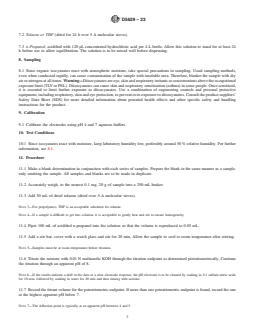
6. Apparatus 11. Procedure
6.1 Disposable Beakers, 250 mL. 11.1 Make a blank determination in conjunction with each
series of samples. Prepare the blank in the same manner as a
6.2 Repipet, pipet or buret, 50 mL.
sample, only omitting the sample. All samples and blanks are
6.3 Pipet, 100 mL, class A volumetric; or a 100-mL buret
to be made in duplicate.
with a dosing unit; or a 100-mL repipet, class A volumetric.
11.2 Accurately weigh, to the nearest 0.1 mg, 20 g of
6.4 Potentiometric Titrator:
sample into a 250-mL beaker.
6.4.1 Reference Electrode, bridge-type electrolyte (double
11.3 Add 50 mL of dried toluene (dried over 5-A molecular
junction), sleeve-type diaphragm, having saturated LiCl/
sieves).
ethanol solution in both chambers, or equivalent.
6.4.2 pH Glass Electrode (see Note 2).
NOTE 3—For prepolymers, THF is an acceptable substitute for toluene.
NOTE 4—If a sample is difficult to get into solution, it is acceptable to
NOTE 2—A combination pH electrode with internal reference is
gently heat and stir to ensure homogeneity.
acceptable.
11.4 Pipet 100 mL of acidified n-propanol into the solution
6.5 Magnetic Stirrer.
so that the volume is reproduced to 0.05 mL.
6.6 Polytetrafluoroethylene-Coated Stir Bars.
11.5 Add a stir bar, cover with a watch glass and stir for 20
6.7 Watch Glasses.
min. Allow the sample to cool to room temperature after
stirring.
6.8 Analytical Balance, capable of weighing to the nearest
0.1 mg.
NOTE 5—Samples must be at room temperature before titration.
11.6 Titrate the mixture with 0.01 N methanolic KOH
7. Reagents and Materials
through the titration endpoint as determined potentiometrically.
7.1 0.01 N KOH in Methanol, for example, 0.66 g 87.7 %
Continue the titration through an apparent pH of 8.
KOH/1000 mL methanol, standardized with potassium hydro-
NOTE 6—If the results indicate a drift in the data or a slow electrode
gen phthalate (KHP).
response, the pH electrode is to be cleaned by soaking in 2:1 sulfuric:nitric
7.2 Toluene or THF (dried for 24 h over 5 A molecular
acids for 10 min, followed by soaking in water for 20 min and then rinsing
sieves). with acetone.
11.7 Record the titrant volume for the potentiometric end-
7.3 n-Propanol, acidified with 120 μL concentrated hydro-
point. If more than one potentiometric endpoint is found,
chloric aci
...
This document is not an ASTM standard and is intended only to provide the user of an ASTM standard an indication of what changes have been made to the previous version. Because
it may not be technically possible to adequately depict all changes accurately, ASTM recommends that users consult prior editions as appropriate. In all cases only the current version
of the standard as published by ASTM is to be considered the official document.
Designation: D5629 − 16 D5629 − 23
Standard Test Method for
Polyurethane Raw Materials: Determination of Acidity in
Low-Acidity Aromatic Isocyanates and Polyurethane
Prepolymers
This standard is issued under the fixed designation D5629; the number immediately following the designation indicates the year of
original adoption or, in the case of revision, the year of last revision. A number in parentheses indicates the year of last reapproval. A
superscript epsilon (´) indicates an editorial change since the last revision or reapproval.
1. Scope*
1.1 This test method measures the acidity, expressed as ppm of hydrochloric acid (HCl), in aromatic isocyanate or polyurethane
prepolymer samples of below 100 ppm acidity. The test method is applicable to products derived from toluene diisocyanate and
methylene di(phenylisocyanate) (see Note 1). Refer to Test Method D6099 for determination of acidity in moderate- to high-acidity
aromatic isocyanates.
1.2 The values stated in SI units are to be regarded as the standard.
1.3 This standard does not purport to address all of the safety concerns, if any, associated with its use. It is the responsibility
of the user of this standard to establish appropriate safety and healthsafety, health, and environmental practices and determine
the applicability of regulatory limitations prior to use.
NOTE 1—This standard is equivalent to ISO 14898, Method B.
1.4 This international standard was developed in accordance with internationally recognized principles on standardization
established in the Decision on Principles for the Development of International Standards, Guides and Recommendations issued
by the World Trade Organization Technical Barriers to Trade (TBT) Committee.
2. Referenced Documents
2.1 ASTM Standards:
D883 Terminology Relating to Plastics
D6099 Test Method for Polyurethane Raw Materials: Determination of Acidity in Moderate to High Acidity Aromatic
Isocyanates
E180 Practice for Determining the Precision of ASTM Methods for Analysis and Testing of Industrial and Specialty Chemicals
(Withdrawn 2009)
E456 Terminology Relating to Quality and Statistics
E691 Practice for Conducting an Interlaboratory Study to Determine the Precision of a Test Method
E2935 Practice for Evaluating Equivalence of Two Testing Processes
This test method is under the jurisdiction of ASTM Committee D20 on Plastics and is the direct responsibility of Subcommittee D20.22 on Cellular Materials - Plastics
and Elastomers.
Current edition approved April 1, 2016March 1, 2023. Published April 2016March 2023. Originally approved in 1994. Last previous edition approved in 20112016 as
D5629 - 11.D5629 - 16. DOI: 10.1520/D5629-16.10.1520/D5629-23.
For referenced ASTM standards, visit the ASTM website, www.astm.org, or contact ASTM Customer Service at service@astm.org. For Annual Book of ASTM Standards
volume information, refer to the standard’s Document Summary page on the ASTM website.
The last approved version of this historical standard is referenced on www.astm.org.
*A Summary of Changes section appears at the end of this standard
Copyright © ASTM International, 100 Barr Harbor Drive, PO Box C700, West Conshohocken, PA 19428-2959. United States
D5629 − 23
2.2 ISO Standards:
ISO 14898 Plastics—Aromatic Isocyanates for Use in the Production of Polyurethane—Determination of Acidity
3. Terminology
3.1 Definitions—The terminology in this test method follows the standard terminology defined in Terms used in this standard are
defined in accordance with Terminology D883, unless otherwise specified. For terms relating to precision and bias and associated
issues, the terms used in this standard are defined in accordance with Terminology E456.
3.2 Definitions of Terms Specific to This Standard:
3.2.1 acidity, n—the acid strength of a sample expressed in ppm HCl.
4. Summary of Test Method
4.1 The isocyanate is mixed with an excess of n-propanol, a cosolvent and a known amount of HCl. Additional acid is released
into the solvent system during urethane formation. The acid is then titrated potentiometrically with methanolic KOH. The same
procedure is performed with a blank solution and the difference in titer is used to calculate the acidity present in the isocyanate
sample.
5. Significance and Use
5.1 This test method is suitable for research or for quality control to characterize aromatic isocyanates and low-acidity
prepolymers. Acidity correlates with performance in some polyurethane systems.
6. Apparatus
6.1 Disposable Beakers, 250 mL.
6.2 Repipet, pipet or buret, 50 mL.
6.3 Pipet, 100 mL, class A volumetric; or a 100-mL buret with a dosing unit; or a 100-mL repipet, class A volumetric.
6.4 Potentiometric Titrator:
6.4.1 Reference Electrode, bridge-type electrolyte (double junction), sleeve-type diaphragm, having saturated LiCl/ethanol
solution in both chambers, or equivalent.
6.4.2 pH Glass Electrode (see Note 2).
NOTE 2—A combination pH electrode with internal reference is acceptable.
6.5 Magnetic Stirrer.
6.6 Polytetrafluoroethylene-Coated Stir Bars.
6.7 Watch Glasses.
6.8 Analytical Balance, capable of weighing to the nearest 0.1 mg.
7. Reagents and Materials
7.1 0.01 N KOH in Methanol, for example, 0.66 g 87.7 % KOH/1000 mL methanol, standardized with potassium hydrogen
phthalate (KHP).
Available from American National Standards Institute (ANSI), 25 W. 43rd St., 4th Floor, New York, NY 10036, http://www.ansi.org.
D5629 − 23
7.2 Toluene or THF (dried for 24 h over 5 A molecular sieves).
7.3 n-Propanol, acidified with 120 μL concentrated hydrochloric acid per 4-L bottle. Allow this solution to stand for at least 24
h before use to allow equilibration. The solution is to be mixed well before dispensing.
8. Sampling
8.1 Since organic isocyanates react with atmospheric moisture, take special precautions in sampling. Usual sampling methods,
even when conducted rapidly, can cause contamination of the sample with insoluble urea. Therefore, blanket the sample with dry
air or nitrogen at all times. Warning—Diisocyanates are eye, skin and respiratory irritants at concentrations above the occupational
exposure limit (TLV or PEL). Diisocyanates can cause skin and respiratory sensitization (asthma) in some people. Once sensitized,
it is essential to limit further exposure to diisocyanates. Use a combination of engineering controls and personal protective
equipment, including respiratory, skin and eye protection, to prevent over-exposure to diisocyanates. Consult the product suppliers’
Safety Data Sheet (SDS) for more detailed information about potential health effects and other specific safety and handling
instructions for the product.
9. Calibration
9.1 Calibrate the electrodes using pH 4 and 7 aqueous buffers.
10. Test Conditions
10.1 Since isocyanates react with moisture, keep laboratory humidity low, preferably around 50 % relative humidity. For further
information, see 8.1.
11. Procedure
11.1 Make a blank determination in conjunction with each series of samples. Prepare the blank in the same manner as a sample,
only omitting the sample. All samples and blanks are to be
...