

ASTM D5991-23
(Practice)Standard Practice for Separation and Identification of Poly(Vinyl Chloride) (PVC) Contamination in Poly(Ethylene Terephthalate) (PET) Flake
General Information
- Abstract
SIGNIFICANCE AND USE
5.1 Presence of even low concentrations of PVC in recycled PET flakes results in equipment corrosion problems during processing. The PVC contamination level shall dictate the market for use of the recycled polymer in secondary products. Procedures presented in this practice are used to identify the PVC contamination in recycled PET flakes.
Note 4: These procedures may also be used to estimate the concentration of PVC contamination.
SCOPE
1.1 This practice covers four procedures for separation and qualitative identification of poly(vinyl chloride) (PVC) contamination in poly(ethylene terephthalate) (PET) flakes.
Note 1: Although not presented as a quantitative method, procedures presented in this practice may be used to provide quantitative results at the discretion of the user. The user assumes the responsibility to verify the reproducibility of quantitative results. Data from an independent source suggest a PVC detection level of 200 ppm (w/w) based on an original sample weight of 454 g.
1.2 Procedure A is based on different fluorescence of PVC and PET when these polymers are exposed to ultraviolet (UV) light.
1.3 Procedure B is an oven test based upon the charring of PVC when it is heated in air at 235°C.
1.4 Procedures C and D are dye tests based on differential staining of PVC and PET.
Note 2: Other polymers (for example, PETG) also absorb the stain or brightener. Such interferences will result in false positive identification of PVC as the contaminant.
1.5 This standard does not purport to address all of the safety concerns, if any, associated with its use. It is the responsibility of the user of this standard to establish appropriate safety, health, and environmental practices and determine the applicability of regulatory limitations prior to use. For specific hazards see Section 8.
Note 3: There is no known ISO equivalent to this standard.
1.6 This international standard was developed in accordance with internationally recognized principles on standardization established in the Decision on Principles for the Development of International Standards, Guides and Recommendations issued by the World Trade Organization Technical Barriers to Trade (TBT) Committee.
- Status
- Published
- Publication Date
- 31-Jan-2023
- Technical Committee
- D20 - Plastics
- Drafting Committee
- D20.95 - Recycled Plastics
Buy Documents
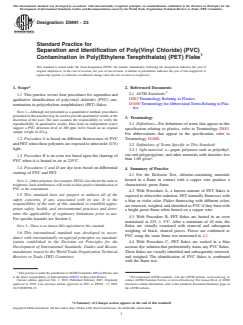
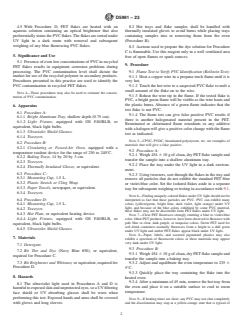
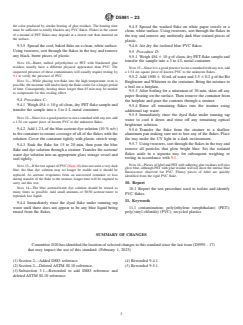

ASTM D5991-23 - Standard Practice for Separation and Identification of Poly(Vinyl Chloride) (PVC) Contamination in Poly(Ethylene Terephthalate) (PET) Flake
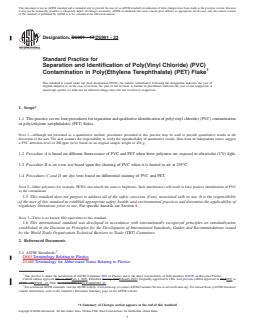
REDLINE ASTM D5991-23 - Standard Practice for Separation and Identification of Poly(Vinyl Chloride) (PVC) Contamination in Poly(Ethylene Terephthalate) (PET) Flake
Overview
ASTM D5991-23: Standard Practice for Separation and Identification of Poly(Vinyl Chloride) (PVC) Contamination in Poly(Ethylene Terephthalate) (PET) Flake is an essential international standard developed by ASTM for the plastics recycling industry. The presence of polyvinyl chloride (PVC) in recycled poly(ethylene terephthalate) (PET) flakes, even at low concentrations, can cause significant equipment corrosion and quality issues in downstream processing, affecting the usability and market value of recycled PET. This standard outlines four robust qualitative methods for the effective separation and identification of PVC contamination in PET flakes, helping to ensure recycled material quality and support sustainable plastic recycling practices.
Key Topics
- Detection of PVC in PET Flake:
The standard presents four practical procedures for determining the presence of PVC in PET flakes:- Ultraviolet (UV) Fluorescence Test: Differentiates PVC and PET based on their fluorescence under UV light.
- Oven Charring Test: Identifies PVC by its tendency to char when heated at 235°C.
- Dye Staining Tests: Two methods leveraging differential staining to visually separate PVC from PET.
- Flame Testing (Beilstein Test):
- Used as a confirmatory method, where a green flame indicates the presence of chlorine-containing polymers like PVC.
- Practical Contamination Thresholds:
Independent data cited in the standard suggests a PVC detection level as low as 200 ppm (w/w) based on a 454 g sample. - Safety Considerations:
The standard emphasizes the importance of appropriate personal protective equipment (PPE) and ventilation due to potential chemical and physical hazards during testing.
Applications
- Quality Assurance for Recycled Plastics:
Ensures reliable detection and removal of PVC contaminants in recycled PET streams, maintaining product quality for food packaging, textiles, and other secondary markets. - Process Optimization:
Reduces the risk of equipment corrosion and processing difficulties in extrusion, molding, and fiber production. - Material Sorting Facilities:
Supports plastics recovery facilities in implementing cost-effective, standardized practices for contaminant identification. - Regulatory Compliance and Market Eligibility:
Assists recyclers and manufacturers to meet stringent quality and compliance standards related to recycled plastics. - Research and Product Development:
Facilitates laboratories and R&D teams in developing and validating new analytical methods or improving existing recycling protocols.
Related Standards
- ASTM D883 - Terminology Relating to Plastics
Provides definitions of standard terms used in polymer testing. - ASTM D1600 - Terminology for Abbreviated Terms Relating to Plastics
Offers guidance on abbreviations commonly used in the plastics industry. - IEEE/ASTM SI 10 - Use of the International System of Units (SI): The Modern Metric System
Establishes requirements for unit usage and reporting in ASTM standards.
Keywords: ASTM D5991-23, PVC contamination in PET, recycled plastics, polyvinyl chloride detection, polyethylene terephthalate, plastics recycling standards, qualitative identification, PET flake quality, plastics sorting, sustainability in plastics recycling.
Relations
- Effective Date
- 01-Feb-2024
- Effective Date
- 01-Nov-2023
- Effective Date
- 01-Jan-2020
- Effective Date
- 01-Aug-2019
- Effective Date
- 15-Apr-2019
- Effective Date
- 01-Feb-2019
- Effective Date
- 01-Dec-2018
- Effective Date
- 01-Nov-2018
- Refers
ASTM D1600-18 - Standard Terminology for Abbreviated Terms Relating to Plastics (Withdrawn 2024) - Effective Date
- 01-Jan-2018
- Effective Date
- 15-Aug-2017
- Effective Date
- 01-Feb-2014
- Effective Date
- 15-Apr-2013
- Effective Date
- 15-Nov-2012
- Effective Date
- 15-May-2011
- Effective Date
- 01-Mar-2008
Buy Documents
ASTM D5991-23 - Standard Practice for Separation and Identification of Poly(Vinyl Chloride) (PVC) Contamination in Poly(Ethylene Terephthalate) (PET) Flake
REDLINE ASTM D5991-23 - Standard Practice for Separation and Identification of Poly(Vinyl Chloride) (PVC) Contamination in Poly(Ethylene Terephthalate) (PET) Flake
Get Certified
Connect with accredited certification bodies for this standard

DIN CERTCO
DIN Group product certification.

Smithers Quality Assessments
US management systems and product certification.
Sponsored listings
Frequently Asked Questions
ASTM D5991-23 is a standard published by ASTM International. Its full title is "Standard Practice for Separation and Identification of Poly(Vinyl Chloride) (PVC) Contamination in Poly(Ethylene Terephthalate) (PET) Flake". This standard covers: SIGNIFICANCE AND USE 5.1 Presence of even low concentrations of PVC in recycled PET flakes results in equipment corrosion problems during processing. The PVC contamination level shall dictate the market for use of the recycled polymer in secondary products. Procedures presented in this practice are used to identify the PVC contamination in recycled PET flakes. Note 4: These procedures may also be used to estimate the concentration of PVC contamination. SCOPE 1.1 This practice covers four procedures for separation and qualitative identification of poly(vinyl chloride) (PVC) contamination in poly(ethylene terephthalate) (PET) flakes. Note 1: Although not presented as a quantitative method, procedures presented in this practice may be used to provide quantitative results at the discretion of the user. The user assumes the responsibility to verify the reproducibility of quantitative results. Data from an independent source suggest a PVC detection level of 200 ppm (w/w) based on an original sample weight of 454 g. 1.2 Procedure A is based on different fluorescence of PVC and PET when these polymers are exposed to ultraviolet (UV) light. 1.3 Procedure B is an oven test based upon the charring of PVC when it is heated in air at 235°C. 1.4 Procedures C and D are dye tests based on differential staining of PVC and PET. Note 2: Other polymers (for example, PETG) also absorb the stain or brightener. Such interferences will result in false positive identification of PVC as the contaminant. 1.5 This standard does not purport to address all of the safety concerns, if any, associated with its use. It is the responsibility of the user of this standard to establish appropriate safety, health, and environmental practices and determine the applicability of regulatory limitations prior to use. For specific hazards see Section 8. Note 3: There is no known ISO equivalent to this standard. 1.6 This international standard was developed in accordance with internationally recognized principles on standardization established in the Decision on Principles for the Development of International Standards, Guides and Recommendations issued by the World Trade Organization Technical Barriers to Trade (TBT) Committee.
SIGNIFICANCE AND USE 5.1 Presence of even low concentrations of PVC in recycled PET flakes results in equipment corrosion problems during processing. The PVC contamination level shall dictate the market for use of the recycled polymer in secondary products. Procedures presented in this practice are used to identify the PVC contamination in recycled PET flakes. Note 4: These procedures may also be used to estimate the concentration of PVC contamination. SCOPE 1.1 This practice covers four procedures for separation and qualitative identification of poly(vinyl chloride) (PVC) contamination in poly(ethylene terephthalate) (PET) flakes. Note 1: Although not presented as a quantitative method, procedures presented in this practice may be used to provide quantitative results at the discretion of the user. The user assumes the responsibility to verify the reproducibility of quantitative results. Data from an independent source suggest a PVC detection level of 200 ppm (w/w) based on an original sample weight of 454 g. 1.2 Procedure A is based on different fluorescence of PVC and PET when these polymers are exposed to ultraviolet (UV) light. 1.3 Procedure B is an oven test based upon the charring of PVC when it is heated in air at 235°C. 1.4 Procedures C and D are dye tests based on differential staining of PVC and PET. Note 2: Other polymers (for example, PETG) also absorb the stain or brightener. Such interferences will result in false positive identification of PVC as the contaminant. 1.5 This standard does not purport to address all of the safety concerns, if any, associated with its use. It is the responsibility of the user of this standard to establish appropriate safety, health, and environmental practices and determine the applicability of regulatory limitations prior to use. For specific hazards see Section 8. Note 3: There is no known ISO equivalent to this standard. 1.6 This international standard was developed in accordance with internationally recognized principles on standardization established in the Decision on Principles for the Development of International Standards, Guides and Recommendations issued by the World Trade Organization Technical Barriers to Trade (TBT) Committee.
ASTM D5991-23 is classified under the following ICS (International Classification for Standards) categories: 83.080.10 - Thermosetting materials. The ICS classification helps identify the subject area and facilitates finding related standards.
ASTM D5991-23 has the following relationships with other standards: It is inter standard links to ASTM D883-24, ASTM D883-23, ASTM D883-20, ASTM D883-19c, ASTM D883-19a, ASTM D883-19, ASTM D883-18a, ASTM D883-18, ASTM D1600-18, ASTM D883-17, ASTM D1600-14, ASTM D1600-13, ASTM D883-12e1, ASTM D883-11, ASTM D883-08. Understanding these relationships helps ensure you are using the most current and applicable version of the standard.
ASTM D5991-23 is available in PDF format for immediate download after purchase. The document can be added to your cart and obtained through the secure checkout process. Digital delivery ensures instant access to the complete standard document.
Standards Content (Sample)
This international standard was developed in accordance with internationally recognized principles on standardization established in the Decision on Principles for the
Development of International Standards, Guides and Recommendations issued by the World Trade Organization Technical Barriers to Trade (TBT) Committee.
Designation: D5991 − 23
Standard Practice for
Separation and Identification of Poly(Vinyl Chloride) (PVC)
Contamination in Poly(Ethylene Terephthalate) (PET) Flake
This standard is issued under the fixed designation D5991; the number immediately following the designation indicates the year of
original adoption or, in the case of revision, the year of last revision. A number in parentheses indicates the year of last reapproval. A
superscript epsilon (´) indicates an editorial change since the last revision or reapproval.
1. Scope* 2. Referenced Documents
2.1 ASTM Standards:
1.1 This practice covers four procedures for separation and
D883 Terminology Relating to Plastics
qualitative identification of poly(vinyl chloride) (PVC) con-
D1600 Terminology for Abbreviated Terms Relating to Plas-
tamination in poly(ethylene terephthalate) (PET) flakes.
tics
NOTE 1—Although not presented as a quantitative method, procedures
presented in this practice may be used to provide quantitative results at the
3. Terminology
discretion of the user. The user assumes the responsibility to verify the
reproducibility of quantitative results. Data from an independent source 3.1 Definitions—For definitions of terms that appear in this
suggest a PVC detection level of 200 ppm (w/w) based on an original
specification relating to plastics, refer to Terminology D883.
sample weight of 454 g.
For abbreviations that appear in the specification, refer to
Terminology D1600.
1.2 Procedure A is based on different fluorescence of PVC
and PET when these polymers are exposed to ultraviolet (UV)
3.2 Definitions of Terms Specific to This Standard:
light.
3.2.1 light material, n—paper, polymers such as polyethyl-
ene and polypropylene, and other materials with densities less
1.3 Procedure B is an oven test based upon the charring of
than 1.00 g/cm .
PVC when it is heated in air at 235°C.
1.4 Procedures C and D are dye tests based on differential
4. Summary of Practice
staining of PVC and PET.
4.1 For the Beilstein Test, chlorine-containing materials
heated in a flame in contact with a copper wire produce a
NOTE 2—Other polymers (for example, PETG) also absorb the stain or
brightener. Such interferences will result in false positive identification of characteristic green flame.
PVC as the contaminant.
4.2 With Procedure A, a known amount of PET flakes is
1.5 This standard does not purport to address all of the
exposed to ultraviolet radiation. PET normally fluoresces with
safety concerns, if any, associated with its use. It is the
a blue or violet color. Flakes fluorescing with different colors
responsibility of the user of this standard to establish appro-
are removed, weighed, and identified as PVC if they burn with
priate safety, health, and environmental practices and deter-
a bright green flame when heated on a copper wire.
mine the applicability of regulatory limitations prior to use.
4.3 With Procedure B, PET flakes are heated in an oven
For specific hazards see Section 8.
maintained at 235 6 5°C. After a minimum of 45 min, the
flakes are visually examined with removal and subsequent
NOTE 3—There is no known ISO equivalent to this standard.
weighing of black, charred pieces. Pieces are confirmed as
1.6 This international standard was developed in accor-
PVC using the same flame test mentioned in 4.1.
dance with internationally recognized principles on standard-
ization established in the Decision on Principles for the 4.4 With Procedure C, PET flakes are soaked in a blue
Development of International Standards, Guides and Recom- acetone dye solution that preferentially stains any PVC flakes.
mendations issued by the World Trade Organization Technical These flakes are visually identified and subsequently removed,
Barriers to Trade (TBT) Committee. and weighed. The identification of PVC flakes is confirmed
with the flame test.
This practice is under the jurisdiction of ASTM Committee D20 on Plastics and
is the direct responsibility of Subcommittee D20.95 on Recycled Plastics. For referenced ASTM standards, visit the ASTM website, www.astm.org, or
Current edition approved Feb. 1, 2023. Published February 2023. Originally contact ASTM Customer Service at service@astm.org. For Annual Book of ASTM
approved in 1996. Last previous edition approved in 2017 as D5991 - 17. DOI: Standards volume information, refer to the standard’s Document Summary page on
10.1520/D5991-23. the ASTM website.
*A Summary of Changes section appears at the end of this standard
Copyright © ASTM International, 100 Barr Harbor Drive, PO Box C700, West Conshohocken, PA 19428-2959. United States
D5991 − 23
4.5 With Procedure D, PET flakes are heated with an 8.2 Hot trays and flake samples shall be handled with
aqueous solution containing an optical brightener that also thermally insulated gloves to avoid burns while placing trays
preferentially stains the PVC flakes. The flakes are sorted under containing samples into or removing them from the oven
UV light in a dark room with removal and subsequent (Procedure B).
weighing of any blue fluorescing PVC flakes.
8.3 Acetone used to prepare the dye solution for Procedure
C is flammable. Use this reagent only in a well ventilated area
5. Significance and Use
free of open flames or spark sources.
5.1 Presence of even low concentrations of PVC in recycled
9. Procedure
PET flakes results in equipment corrosion problems during
processing. The PVC contamination level shall dictate the
9.1 Flame Test to Verify PVC Identification (Beilstein Test):
market for use of the recycled polymer in secondary products. 9.1.1 Heat a copper wire in a propane torch flame until it is
Procedures presented in this practice are used to identify the
very hot.
PVC contamination in recycled PET flakes. 9.1.2 Touch the hot wire to a suspected PVC flake to melt a
small amount of the flake on to the wire.
NOTE 4—These procedures may also be used to estimate the concen-
9.1.3 Reheat the wire tip in the flame. If the tested flake is
tration of PVC contamination.
PVC, a bright green flame will be visible as the wire heats and
the plastic burns. Absence of a green flame indicates that the
6. Apparatus
test flake is not PVC.
6.1 Procedure A:
9.1.4 The flame test can give false positive PVC results if
6.1.1 Bright Aluminum Tray, shallow depth (0.75 cm).
there is another halogenated material present in the PET.
6.1.2 Light Fixture, equipped with GE F40/BLB, or
Brominated or chlorinated flame retardants or any additive
equivalent, black light bulbs.
with a halogen will give a positive color change with the flame
6.1.3 Ultraviolet Shield Glasses.
test as indicated.
6.1.4 Tweezers.
NOTE 5—CPVC, PVDC, brominated polystyrene, etc. are examples of
6.2 Procedure B:
materials that will give a false positive.
6.2.1 Circulating or Forced-Air Oven, equipped with a
9.2 Procedure A:
temperature readout device for the range of 230 to 240°C.
9.2.1 Weigh 454 6 10 g of clean, dry PET flake sample and
6.2.2 Baking Trays, 14 by 20 by 3 cm.
transfer the sample into a shallow aluminum tray.
6.2.3 Tweezers.
9.2.2 Place the tray under the UV light in a dark environ-
6.2.4 Thermally Insulated Gloves, or equivalent.
ment.
6.3 Procedure C:
9.2.3 Using tweezers, sort through the flakes in the tray and
6.3.1 Measuring Cup, 1.5 L.
remove all particles that do not exhibit the standard PET blue
6.3.2 Plastic Stretch or Cling Wrap.
or violet-blue color. Set the isolated flakes aside in a separate
6.3.3 Paper Towels, newspaper, or equivalent.
tray for subsequent weighing or testing in accordance with 9.1.
6.3.4 Tweezers.
NOTE 6—Finding uniquely colored flakes under UV light should not be
6.4 Procedure D: interpreted as fact that these partic
...
This document is not an ASTM standard and is intended only to provide the user of an ASTM standard an indication of what changes have been made to the previous version. Because
it may not be technically possible to adequately depict all changes accurately, ASTM recommends that users consult prior editions as appropriate. In all cases only the current version
of the standard as published by ASTM is to be considered the official document.
Designation: D5991 − 17 D5991 − 23
Standard Practice for
Separation and Identification of Poly(Vinyl Chloride) (PVC)
Contamination in Poly(Ethylene Terephthalate) (PET) Flake
This standard is issued under the fixed designation D5991; the number immediately following the designation indicates the year of
original adoption or, in the case of revision, the year of last revision. A number in parentheses indicates the year of last reapproval. A
superscript epsilon (´) indicates an editorial change since the last revision or reapproval.
1. Scope*
1.1 This practice covers four procedures for separation and qualitative identification of poly(vinyl chloride) (PVC) contamination
in poly(ethylene terephthalate) (PET) flakes.
NOTE 1—Although not presented as a quantitative method, procedures presented in this practice may be used to provide quantitative results at the
discretion of the user. The user assumes the responsibility to verify the reproducibility of quantitative results. Data from an independent source suggest
a PVC detection level of 200 ppm (w/w) based on an original sample weight of 454 g.
1.2 Procedure A is based on different fluorescence of PVC and PET when these polymers are exposed to ultraviolet (UV) light.
1.3 Procedure B is an oven test based upon the charring of PVC when it is heated in air at 235°C.
1.4 Procedures C and D are dye tests based on differential staining of PVC and PET.
NOTE 2—Other polymers (for example, PETG) also absorb the stain or brightener. Such interferences will result in false positive identification of PVC
as the contaminant.
1.5 This standard does not purport to address all of the safety concerns, if any, associated with its use. It is the responsibility
of the user of this standard to establish appropriate safety, health, and environmental practices and determine the applicability of
regulatory limitations prior to use. For specific hazards see Section 8.
NOTE 3—There is no known ISO equivalent to this standard.
1.6 This international standard was developed in accordance with internationally recognized principles on standardization
established in the Decision on Principles for the Development of International Standards, Guides and Recommendations issued
by the World Trade Organization Technical Barriers to Trade (TBT) Committee.
2. Referenced Documents
2.1 ASTM Standards:
D883 Terminology Relating to Plastics
D1600 Terminology for Abbreviated Terms Relating to Plastics
This practice is under the jurisdiction of ASTM Committee D20 on Plastics and is the direct responsibility of Subcommittee D20.95 on Recycled Plastics.
Current edition approved Dec. 1, 2017Feb. 1, 2023. Published January 2018February 2023. Originally approved in 1996. Last previous edition approved in 20152017 as
D5991 - 15.D5991 - 17. DOI: 10.1520/D5991-17.10.1520/D5991-23.
For referenced ASTM standards, visit the ASTM website, www.astm.org, or contact ASTM Customer Service at service@astm.org. For Annual Book of ASTM Standards
volume information, refer to the standard’s Document Summary page on the ASTM website.
*A Summary of Changes section appears at the end of this standard
Copyright © ASTM International, 100 Barr Harbor Drive, PO Box C700, West Conshohocken, PA 19428-2959. United States
D5991 − 23
IEEE/ASTM SI-10 American National Standard for Use of the International System of Units (SI): The Modern Metric System
3. Terminology
3.1 Definitions—The terminology used in this practice is in accordance with For definitions of terms that appear in this
specification relating to plastics, refer to Terminology D1600D883. Units and symbols are in accordance with For abbreviations
that appear in the specification, refer to Terminology IEEE/ASTM SI-10D1600.
3.2 Definitions of Terms Specific to This Standard:
3.2.1 light material, n—paper, polymers such as polyethylene and polypropylene, and other materials with densities less than 1.00
g/cm .
4. Summary of Practice
4.1 For the Beilstein Test, chlorine-containing materials heated in a flame in contact with a copper wire produce a characteristic
green flame.
4.2 With Procedure A, a known amount of PET flakes is exposed to ultraviolet radiation. PET normally fluoresces with a blue or
violet color. Flakes fluorescing with different colors are removed, weighed, and identified as PVC if they burn with a bright green
flame when heated on a copper wire.
4.3 With Procedure B, PET flakes are heated in an oven maintained at 235 6 5°C. After a minimum of 45 min, the flakes are
visually examined with removal and subsequent weighing of black, charred pieces. Pieces are confirmed as PVC using the same
flame test mentioned in 4.1.
4.4 With Procedure C, PET flakes are soaked in a blue acetone dye solution that preferentially stains any PVC flakes. These flakes
are visually identified and subsequently removed, and weighed. The identification of PVC flakes is confirmed with the flame test.
4.5 With Procedure D, PET flakes are heated with an aqueous solution containing an optical brightener that also preferentially
stains the PVC flakes. The flakes are sorted under UV light in a dark room with removal and subsequent weighing of any blue
fluorescing PVC flakes.
5. Significance and Use
5.1 Presence of even low concentrations of PVC in recycled PET flakes results in equipment corrosion problems during
processing. The PVC contamination level shall dictate the market for use of the recycled polymer in secondary products.
Procedures presented in this practice are used to identify the PVC contamination in recycled PET flakes.
NOTE 4—These procedures may also be used to estimate the concentration of PVC contamination.
6. Apparatus
6.1 Procedure A:
6.1.1 Bright Aluminum Tray, shallow depth (0.75 cm).
6.1.2 Light Fixture, equipped with GE F40/BLB, or equivalent, black light bulbs.
6.1.3 Ultraviolet Shield Glasses.
6.1.4 Tweezers.
6.2 Procedure B:
6.2.1 Circulating or Forced-Air Oven, equipped with a temperature readout device for the range of 230 to 240°C.
D5991 − 23
6.2.2 Baking Trays, 14 by 20 by 3 cm.
6.2.3 Tweezers.
6.2.4 Thermally Insulated Gloves, or equivalent.
6.3 Procedure C:
6.3.1 Measuring Cup, 1.5 L.
6.3.2 Plastic Stretch or Cling Wrap.
6.3.3 Paper Towels, newspaper, or equivalent.
6.3.4 Tweezers.
6.4 Procedure D:
6.4.1 Measuring Cup, 1.5 L.
6.4.2 Tweezers.
6.4.3 Hot Plate, or equivalent heating device.
6.4.4 Light Fixture, equipped with GE F40/BLB, or equivalent, black light bulbs.
6.4.5 Ultraviolet Shield Glasses.
7. Materials
7.1 Detergent.
7.2 Rit Tint and Dye (Navy Blue #30), or equivalent, required for Procedure C.
7.3 Rit Brightener and Whitener, or equivalent, required for Procedure D.
8. Hazards
8.1 The ultraviolet light used in Procedures A and D is harmful to exposed skin and unprotected eyes, so a UV filtering face shield
or UV absorbing glasses shall be worn when performing this test. Exposed hands and arms shall be covered with gloves and long
sleeves.
8.2 Hot trays and flake samples shall be handled with thermally insulated gloves to avoid burns while placing trays containing
samples into or removing them from the oven (Procedure B).
8.3 Acetone used to prepare the dye solution for Procedure C is flammable. Use this reagent only in a well ventilated area free
of open flames or spark sources.
9. Procedure
9.1 Flame Test to Verify PVC Identification (Beilstein Test):
9.1.1 Heat a copper wire in a propane torch flame until it is very hot.
9.1.2 Touch the hot wire to a suspected PVC flake to melt a small amount of the flake on to the wire.
D5991 − 23
9.1.3 Reheat the wire tip in the flame. If the tested flake is PVC, a bright green flame will be visible as the wire heats and the plastic
burns. Absence of a green flame indicates that the test flake is not PVC.
9.1.4 The flame test can give false positive PVC results if there is another halogenated material present in the PET. Brominated
or chlorinated flame retardants or any additive with a halogen will
...