

ASTM D4473-08(2021)
(Test Method)Standard Test Method for Plastics: Dynamic Mechanical Properties: Cure Behavior
General Information
- Abstract
SIGNIFICANCE AND USE
5.1 This test method provides a simple means of characterizing the cure behavior of thermosetting resins using very small amounts of material (fewer than 3 to 5 g). The data obtained may be used for quality control, research and development, and establishment of optimum processing conditions.
5.2 Dynamic mechanical testing provides a sensitive method for determining cure characteristics by measuring the elastic and loss moduli as a function of temperature or time, or both. Plots of cure behavior and tan delta of a material versus time provide graphical representation indicative of cure behavior under a specified time-temperature profile.
5.3 This test method can be used to assess the following:
5.3.1 Cure behavior, including rate of cure, gel, and cure time.
5.3.2 Processing behavior, as well as changes as a function of time/temperature.
Note 3: The presence of the substrate prevents an absolute measure, but allows relative measures of flow behavior during cure.
5.3.3 The effects of processing treatment.
5.3.4 Relative resin behavioral properties, including cure behavior and damping.
5.3.5 The effects of substrate types on cure.
Note 4: Due to the rigidity of a supporting braid, the gel time obtained from dynamic mechanical traces will be longer than actual gel time of the unsupported resin measured at the same frequency. This difference will be greater for composites having greater support-to-polymer rigidity ratios.3
5.3.6 Effects of formulation additives that might affect processability or performance.
5.4 For many materials, there may be a specification that requires the use of this test method, but with some procedural modifications that take precedence when adhering to the specification. Therefore, it is advisable to refer to that material specification before using this test method. Table 1 of Classification System D4000 lists the ASTM materials standards that currently exist.
SCOPE
1.1 This test method covers the use of dynamic-mechanical-oscillation instrumentation for gathering and reporting the thermal advancement of cure behavior of thermosetting resin. It may be used for determining the cure properties of both unsupported resins and resins supported on substrates subjected to various oscillatory deformations.
1.2 This test method is intended to provide a means for determining the cure behavior of supported and unsupported thermosetting resins over a range of temperatures by free vibration as well as resonant and nonresonant forced-vibration techniques, in accordance with Practice D4065. Plots of modulus, tan delta, and damping index as a function of time/temperature are indicative of the thermal advancement or cure characteristics of a resin.
1.3 This test method is valid for a wide range of frequencies, typically from 0.01 to 100 Hz. However, it is strongly recommended that low-frequency test conditions, generally below 1.5 Hz, be utilized as they generally will result in more definitive cure-behavior information.
1.4 This test method is intended for resin/substrate composites that have an uncured effective elastic modulus in shear greater than 0.5 MPa.
1.5 Apparent discrepancies may arise in results obtained under differing experimental conditions. These apparent differences from results observed in another study can usually be reconciled, without changing the observed data, by reporting in full (as described in this test method) the conditions under which the data were obtained.
1.6 Due to possible instrumentation compliance, especially in the compressive mode, the data generated may indicate relative and not necessarily absolute property values.
1.7 Test data obtained by this test method are relevant and appropriate for use in engineering design.
1.8 The values stated in SI units are to be regarded as the standard.
1.9 This standard does not purport to address all of the safety concerns, if any, associated with its use....
- Status
- Published
- Publication Date
- 30-Jun-2021
- Technical Committee
- D20 - Plastics
- Drafting Committee
- D20.10 - Mechanical Properties
Overview
ASTM D4473-08(2021), Standard Test Method for Plastics: Dynamic Mechanical Properties: Cure Behavior, provides a recognized methodology for evaluating the cure behavior of thermosetting resins and resin/substrate composites. Utilizing dynamic mechanical oscillation techniques, this standard enables precise measurement and reporting on the thermal advancement of resin cure, including the elastic and loss moduli as functions of temperature and time. The method is especially valuable given it requires only small material samples (typically less than 3–5 grams), making it ideal for quality control, research and development, and optimization of processing conditions for various thermosetting plastics.
Key Topics
- Dynamic Mechanical Testing: Measures elasticity (storage modulus, G'), viscous response (loss modulus, G"), and damping properties across a range of frequencies (0.01–100 Hz), though lower frequencies (below 1.5 Hz) are recommended for definitive cure data.
- Cure Behavior Assessment: Determines critical cure properties, including:
- Rate of cure
- Gel point and cure time
- Processing behavior under varied time/temperature profiles
- Material Versatility: Applies to unsupported liquid resins and substrate-supported composites with an uncured shear modulus greater than 0.5 MPa.
- Graphical Analysis: Plots of modulus, tan delta, and viscosity vs. time/temperature are used for interpreting thermal advancement and material behavior throughout the cure process.
- Relative vs. Absolute Measurements: Recognizes that results, especially for substrate-supported materials, are often relative rather than absolute due to substrate effects and instrument compliance.
- Process Variables: Evaluates how processing treatments and formulation additives affect the thermosetting resin cure, processability, and final performance.
Applications
ASTM D4473 is widely trusted across industries where thermosetting polymers and composites are critical, including aerospace, automotive, electronics, and construction. Practical applications include:
- Quality Control: Rapid identification of cure consistency and performance parameters for manufacturing batches of thermosetting resin preparations.
- Research and Development: Detailed assessment of how variations in formulation, processing, and substrates influence the cure characteristics, ensuring products meet end-use requirements.
- Process Optimization: Determining optimum curing profiles (temperature and time) for various resin and composite systems to maximize efficiency and performance.
- Material Comparisons: Comparing cure properties of different resin systems, substrate types, or additive packages to inform material selection and product development.
- Regulatory and Safety Compliance: Generating standardized, reliable data for engineering design and compliance documentation.
Related Standards
To ensure comprehensive characterization and proper reporting when using this test method, the following ASTM standards are closely associated:
- ASTM D4000 - Classification System for Specifying Plastic Materials: Reference for identifying and categorizing the resin or composite under test.
- ASTM D4065 - Practice for Plastics: Dynamic Mechanical Properties; Determination and Report of Procedures: Provides foundational practices for dynamic mechanical measurements.
- ASTM D4092 - Terminology for Plastics: Dynamic Mechanical Properties: Clarifies terms and definitions used within the context of dynamic mechanical analysis.
- ASTM/IEEE SI-10 - Standard for Use of the International System of Units (SI): Ensures all reported values are in SI units for international compatibility.
Keywords: dynamic mechanical cure testing, thermosetting resin, gel point determination, elastic modulus, loss modulus, tan delta, plastic composites, composite curing, ASTM D4473, viscoelastic properties, quality control in plastics manufacturing.
Adhering to ASTM D4473-08(2021) ensures consistent, precise evaluation of thermosetting resin cure behavior, supporting improved materials development and robust quality assurance processes in plastics and composites industries.
Relations
- Effective Date
- 01-May-2012
- Effective Date
- 01-Apr-2011
- Effective Date
- 01-Jul-2010
- Effective Date
- 01-May-2010
- Effective Date
- 15-Sep-2009
- Effective Date
- 01-Jan-2009
- Effective Date
- 01-Jan-2009
- Effective Date
- 01-Mar-2008
- Effective Date
- 01-Sep-2007
- Effective Date
- 01-Mar-2007
- Effective Date
- 01-Dec-2006
- Effective Date
- 01-Feb-2004
- Effective Date
- 01-Feb-2004
- Effective Date
- 01-Nov-2003
- Effective Date
- 10-Mar-2003
Get Certified
Connect with accredited certification bodies for this standard

DIN CERTCO
DIN Group product certification.

Smithers Quality Assessments
US management systems and product certification.
Sponsored listings
Frequently Asked Questions
ASTM D4473-08(2021) is a standard published by ASTM International. Its full title is "Standard Test Method for Plastics: Dynamic Mechanical Properties: Cure Behavior". This standard covers: SIGNIFICANCE AND USE 5.1 This test method provides a simple means of characterizing the cure behavior of thermosetting resins using very small amounts of material (fewer than 3 to 5 g). The data obtained may be used for quality control, research and development, and establishment of optimum processing conditions. 5.2 Dynamic mechanical testing provides a sensitive method for determining cure characteristics by measuring the elastic and loss moduli as a function of temperature or time, or both. Plots of cure behavior and tan delta of a material versus time provide graphical representation indicative of cure behavior under a specified time-temperature profile. 5.3 This test method can be used to assess the following: 5.3.1 Cure behavior, including rate of cure, gel, and cure time. 5.3.2 Processing behavior, as well as changes as a function of time/temperature. Note 3: The presence of the substrate prevents an absolute measure, but allows relative measures of flow behavior during cure. 5.3.3 The effects of processing treatment. 5.3.4 Relative resin behavioral properties, including cure behavior and damping. 5.3.5 The effects of substrate types on cure. Note 4: Due to the rigidity of a supporting braid, the gel time obtained from dynamic mechanical traces will be longer than actual gel time of the unsupported resin measured at the same frequency. This difference will be greater for composites having greater support-to-polymer rigidity ratios.3 5.3.6 Effects of formulation additives that might affect processability or performance. 5.4 For many materials, there may be a specification that requires the use of this test method, but with some procedural modifications that take precedence when adhering to the specification. Therefore, it is advisable to refer to that material specification before using this test method. Table 1 of Classification System D4000 lists the ASTM materials standards that currently exist. SCOPE 1.1 This test method covers the use of dynamic-mechanical-oscillation instrumentation for gathering and reporting the thermal advancement of cure behavior of thermosetting resin. It may be used for determining the cure properties of both unsupported resins and resins supported on substrates subjected to various oscillatory deformations. 1.2 This test method is intended to provide a means for determining the cure behavior of supported and unsupported thermosetting resins over a range of temperatures by free vibration as well as resonant and nonresonant forced-vibration techniques, in accordance with Practice D4065. Plots of modulus, tan delta, and damping index as a function of time/temperature are indicative of the thermal advancement or cure characteristics of a resin. 1.3 This test method is valid for a wide range of frequencies, typically from 0.01 to 100 Hz. However, it is strongly recommended that low-frequency test conditions, generally below 1.5 Hz, be utilized as they generally will result in more definitive cure-behavior information. 1.4 This test method is intended for resin/substrate composites that have an uncured effective elastic modulus in shear greater than 0.5 MPa. 1.5 Apparent discrepancies may arise in results obtained under differing experimental conditions. These apparent differences from results observed in another study can usually be reconciled, without changing the observed data, by reporting in full (as described in this test method) the conditions under which the data were obtained. 1.6 Due to possible instrumentation compliance, especially in the compressive mode, the data generated may indicate relative and not necessarily absolute property values. 1.7 Test data obtained by this test method are relevant and appropriate for use in engineering design. 1.8 The values stated in SI units are to be regarded as the standard. 1.9 This standard does not purport to address all of the safety concerns, if any, associated with its use....
SIGNIFICANCE AND USE 5.1 This test method provides a simple means of characterizing the cure behavior of thermosetting resins using very small amounts of material (fewer than 3 to 5 g). The data obtained may be used for quality control, research and development, and establishment of optimum processing conditions. 5.2 Dynamic mechanical testing provides a sensitive method for determining cure characteristics by measuring the elastic and loss moduli as a function of temperature or time, or both. Plots of cure behavior and tan delta of a material versus time provide graphical representation indicative of cure behavior under a specified time-temperature profile. 5.3 This test method can be used to assess the following: 5.3.1 Cure behavior, including rate of cure, gel, and cure time. 5.3.2 Processing behavior, as well as changes as a function of time/temperature. Note 3: The presence of the substrate prevents an absolute measure, but allows relative measures of flow behavior during cure. 5.3.3 The effects of processing treatment. 5.3.4 Relative resin behavioral properties, including cure behavior and damping. 5.3.5 The effects of substrate types on cure. Note 4: Due to the rigidity of a supporting braid, the gel time obtained from dynamic mechanical traces will be longer than actual gel time of the unsupported resin measured at the same frequency. This difference will be greater for composites having greater support-to-polymer rigidity ratios.3 5.3.6 Effects of formulation additives that might affect processability or performance. 5.4 For many materials, there may be a specification that requires the use of this test method, but with some procedural modifications that take precedence when adhering to the specification. Therefore, it is advisable to refer to that material specification before using this test method. Table 1 of Classification System D4000 lists the ASTM materials standards that currently exist. SCOPE 1.1 This test method covers the use of dynamic-mechanical-oscillation instrumentation for gathering and reporting the thermal advancement of cure behavior of thermosetting resin. It may be used for determining the cure properties of both unsupported resins and resins supported on substrates subjected to various oscillatory deformations. 1.2 This test method is intended to provide a means for determining the cure behavior of supported and unsupported thermosetting resins over a range of temperatures by free vibration as well as resonant and nonresonant forced-vibration techniques, in accordance with Practice D4065. Plots of modulus, tan delta, and damping index as a function of time/temperature are indicative of the thermal advancement or cure characteristics of a resin. 1.3 This test method is valid for a wide range of frequencies, typically from 0.01 to 100 Hz. However, it is strongly recommended that low-frequency test conditions, generally below 1.5 Hz, be utilized as they generally will result in more definitive cure-behavior information. 1.4 This test method is intended for resin/substrate composites that have an uncured effective elastic modulus in shear greater than 0.5 MPa. 1.5 Apparent discrepancies may arise in results obtained under differing experimental conditions. These apparent differences from results observed in another study can usually be reconciled, without changing the observed data, by reporting in full (as described in this test method) the conditions under which the data were obtained. 1.6 Due to possible instrumentation compliance, especially in the compressive mode, the data generated may indicate relative and not necessarily absolute property values. 1.7 Test data obtained by this test method are relevant and appropriate for use in engineering design. 1.8 The values stated in SI units are to be regarded as the standard. 1.9 This standard does not purport to address all of the safety concerns, if any, associated with its use....
ASTM D4473-08(2021) is classified under the following ICS (International Classification for Standards) categories: 83.080.10 - Thermosetting materials. The ICS classification helps identify the subject area and facilitates finding related standards.
ASTM D4473-08(2021) has the following relationships with other standards: It is inter standard links to ASTM D4000-12, ASTM D4000-11, ASTM D4000-10a, ASTM D4000-10, ASTM D4000-09b, ASTM D4000-09a, ASTM D4000-09, ASTM D4000-08, ASTM D4000-07, ASTM D4092-07, ASTM D4065-06, ASTM D4000-04, ASTM D4000-04e1, ASTM D4000-03a, ASTM D4000-03. Understanding these relationships helps ensure you are using the most current and applicable version of the standard.
ASTM D4473-08(2021) is available in PDF format for immediate download after purchase. The document can be added to your cart and obtained through the secure checkout process. Digital delivery ensures instant access to the complete standard document.
Standards Content (Sample)
This international standard was developed in accordance with internationally recognized principles on standardization established in the Decision on Principles for the
Development of International Standards, Guides and Recommendations issued by the World Trade Organization Technical Barriers to Trade (TBT) Committee.
Designation: D4473 − 08 (Reapproved 2021)
Standard Test Method for
Plastics: Dynamic Mechanical Properties: Cure Behavior
This standard is issued under the fixed designation D4473; the number immediately following the designation indicates the year of
original adoption or, in the case of revision, the year of last revision. A number in parentheses indicates the year of last reapproval. A
superscript epsilon (´) indicates an editorial change since the last revision or reapproval.
This standard has been approved for use by agencies of the U.S. Department of Defense.
1. Scope 1.8 The values stated in SI units are to be regarded as the
standard.
1.1 This test method covers the use of dynamic-mechanical-
1.9 This standard does not purport to address all of the
oscillation instrumentation for gathering and reporting the
safety concerns, if any, associated with its use. It is the
thermal advancement of cure behavior of thermosetting resin.
responsibility of the user of this standard to establish appro-
It may be used for determining the cure properties of both
priate safety, health, and environmental practices and deter-
unsupported resins and resins supported on substrates sub-
mine the applicability of regulatory limitations prior to use.
jected to various oscillatory deformations.
Specific precautionary statements are given in Note 5.
1.2 This test method is intended to provide a means for
determining the cure behavior of supported and unsupported NOTE 1—There is no known ISO equivalent to this standard.
thermosetting resins over a range of temperatures by free
1.10 This international standard was developed in accor-
vibration as well as resonant and nonresonant forced-vibration
dance with internationally recognized principles on standard-
techniques, in accordance with Practice D4065. Plots of
ization established in the Decision on Principles for the
modulus, tan delta, and damping index as a function of
Development of International Standards, Guides and Recom-
time/temperature are indicative of the thermal advancement or
mendations issued by the World Trade Organization Technical
cure characteristics of a resin.
Barriers to Trade (TBT) Committee.
1.3 Thistestmethodisvalidforawiderangeoffrequencies,
2. Referenced Documents
typically from 0.01 to 100 Hz. However, it is strongly
2.1 ASTM Standards:
recommended that low-frequency test conditions, generally
D4000 Classification System for Specifying Plastic Materi-
below 1.5 Hz, be utilized as they generally will result in more
als
definitive cure-behavior information.
D4065 Practice for Plastics: Dynamic Mechanical Proper-
1.4 This test method is intended for resin/substrate compos-
ties: Determination and Report of Procedures
ites that have an uncured effective elastic modulus in shear
D4092 Terminology for Plastics: Dynamic Mechanical
greater than 0.5 MPa.
Properties
1.5 Apparent discrepancies may arise in results obtained
ASTM/IEEE SI–10 Standard for Use of the International
under differing experimental conditions. These apparent differ-
System of Units (SI): The Modern Metric System
ences from results observed in another study can usually be
3. Terminology
reconciled, without changing the observed data, by reporting in
full (as described in this test method) the conditions under
3.1 Definitions—For definitions applicable to this test
which the data were obtained.
method refer to Terminology D4092.
1.6 Due to possible instrumentation compliance, especially
4. Summary of Test Method
in the compressive mode, the data generated may indicate
relative and not necessarily absolute property values. 4.1 A known amount of thermosetting liquid resin or resin-
impregnated substrate is placed in mechanical oscillation at
1.7 Test data obtained by this test method are relevant and
either a fixed or natural resonant frequency or by free vibration
appropriate for use in engineering design.
and at either isothermal conditions, with a linear temperature
increase or using a time-temperature relation simulating a
This test method is under the jurisdiction ofASTM Committee D20 on Plastics
and is the direct responsibility of Subcommittee D20.10 on Mechanical Properties. For referenced ASTM standards, visit the ASTM website, www.astm.org, or
Current edition approved July 1, 2021. Published July 2021. Originally approved contact ASTM Customer Service at service@astm.org. For Annual Book of ASTM
in 1985. Last previous edition approved in 2016 as D4473 - 08(2016). DOI: Standards volume information, refer to the standard’s Document Summary page on
10.1520/D4473-08R21. the ASTM website.
*A Summary of Changes section appears at the end of this standard
Copyright © ASTM International, 100 Barr Harbor Drive, PO Box C700, West Conshohocken, PA 19428-2959. United States
D4473 − 08 (2021)
processing condition. The elastic or loss modulus, or both, of 7. Apparatus
the composite specimen are measured in shear or compression
7.1 The function of the apparatus is to hold a neat (unmodi-
as a function of time. The point in time when tan delta is
fied) resin or uncured supported composite formulation or
maximum, and the elastic modulus levels off after an increase,
coated substrate of known volume and dimensions. The mate-
is calculated as the gel time of the resin under the conditions of
rialactsastheelasticanddissipativeelementinamechanically
the test.
drivenoscillatoryshearordynamiccompressionsystem.These
NOTE 2—The particular method for measuring the elastic and loss dynamic mechanical instruments operate in one or more of the
moduli and tan delta depends upon the individual instrument’s operating
followingmodesformeasuringcurebehaviorintorsionalshear
principles.
or dynamic compression:
7.1.1 Forced, constant amplitude, fixed frequency,
5. Significance and Use
7.1.2 Forced, constant amplitude, resonant oscillation,
5.1 This test method provides a simple means of character-
7.1.3 Freely decaying oscillation.
izingthecurebehaviorofthermosettingresinsusingverysmall
7.2 The apparatus shall consist of the following:
amounts of material (fewer than 3 to 5 g). The data obtained
7.2.1 Test Fixtures, a choice of the following:
maybeusedforqualitycontrol,researchanddevelopment,and
7.2.1.1 Polished Cone and Plate (Having a Known Cone
establishment of optimum processing conditions.
Angle)—Usually a 25 or 50-mm diameter cone and plate or
5.2 Dynamic mechanical testing provides a sensitive
parallel plates are recommended for neat resins. Variations of
method for determining cure characteristics by measuring the
this tooling, such as bottom plates with concentric overflow
elastic and loss moduli as a function of temperature or time, or
rims, may be used as necessary.
both. Plots of cure behavior and tan delta of a material versus
7.2.1.2 Parallel Plates, having either smooth, polished, or
time provide graphical representation indicative of cure behav-
serrated surfaces are recommended for neat resins or prepregs
ior under a specified time-temperature profile.
having less than 6 % volatiles.
5.3 This test method can be used to assess the following:
7.2.1.3 Clamps—Aclamping arrangement that permits grip-
5.3.1 Cure behavior, including rate of cure, gel, and cure
ping of the composite sample.
time.
7.2.2 Oscillatory Deformation (Strain Device)—A device
5.3.2 Processing behavior, as well as changes as a function
for applying a continuous oscillatory deformation (strain) to
of time/temperature.
the specimen. The deformation (strain) may be applied and
then released, as in free-vibration devices, or continuously
NOTE 3—The presence of the substrate prevents an absolute measure,
but allows relative measures of flow behavior during cure.
applied, as in forced-vibration devices (see Table 1 of Practice
D4065).
5.3.3 The effects of processing treatment.
7.2.3 Detectors—A device or devices for determining de-
5.3.4 Relative resin behavioral properties, including cure
pendent and independent experimental parameters, such as
behavior and damping.
force (stress or strain), frequency, and temperature. Tempera-
5.3.5 The effects of substrate types on cure.
ture should be measurable with a precision of 61°C, frequency
NOTE 4—Due to the rigidity of a supporting braid, the gel time obtained
to 61 %, and force to 61%.
from dynamic mechanical traces will be longer than actual gel time of the
7.2.4 Temperature Controller and Oven—A device for con-
unsupported resin measured at the same frequency. This difference will be
trolling the temperature, either by heating (in steps or ramps),
greater for composites having greater support-to-polymer rigidity ratios.
cooling (in steps or ramps), maintaining a constant specimen
5.3.6 Effects of formulation additives that might affect
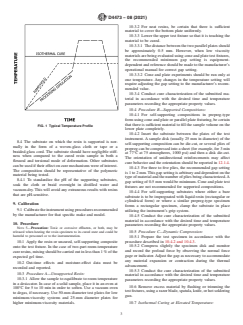
environment,oracombinationthereof.Fig.1illustratestypical
processability or performance.
time-temperature profiles. A temperature controller should be
5.4 For many materials, there may be a specification that
sufficiently stable to permit measurement of sample tempera-
requires the use of this test method, but with some procedural
ture to within 1°C.
modifications that take precedence when adhering to the
7.3 Nitrogen, or other inert gas supply for purging purposes.
specification. Therefore, it is advisable to refer to that material
specification before using this test method. Table 1 of Classi-
8. Test Specimens
fication System D4000 lists theASTM materials standards that
currently exist.
8.1 The neat resin or the self-supporting composition, or
both, should be representative of the polymeric material being
6. Interferences
tested.
6.1 Since small quantities of resin are used, it is essential
8.2 Due to the various geometries that might be used for
that the specimens be representative of the polymeric material
dynamic mechanical curing of thermosetting resins/
being tested.
composites, specimen size is not fixed by this test method.
6.2 The result is a response of the thermal advancement or
Cure rates may be influenced by specimen thickness, so equal
cure behavior of the resin in combination with any substrate
volumes of material should be used for any series of compari-
used to support the resin.
sons.
8.3 For convenience, low-viscosity neat resins can be stud-
Hedvat, S., Polymer Engineering and Science, Vol 21, No. 3, February 1981. ied using a supporting substrate.
D4473 − 08 (2021)
10.3.2 For neat resins, be certain that there is sufficient
material to cover the bottom plate uniformly.
10.3.3 Lower the upper test fixture so that it is touching the
material to be cured.
10.3.3.1 Thedistancebetweenthetwoparallelplatesshould
be approximately 0.5 mm. However, when low viscosity
materials are being evaluated using cone and plate test fixtures,
the recommended minimum gap setting is equipment-
dependent and reference should be made to the manufacturer’s
operational manual for correct gap setting.
10.3.3.2 Cone and plate experiments should be run only at
one temperature. Any changes in the temperature setting will
require adjusting the gap setting to the manufacturer’s recom-
mended value.
10.3.4 Conduct cure characterization of the submitted ma-
terial in accordance with the desired time and temperature
parameters recording the appropriate property values.
10.4 Procedure B—Supported Compositions:
10.4.1 For self-supporting compositions in prepreg-type
form using cone and plate or parallel plate fixturing, be certain
that there is sufficient material to fill the sample volume on the
FIG. 1 Typical Temperature Profile
lower plate completely.
10.4.2 Insert the substrate between the plates of the test
instrument. A sample disk (usually 25 mm in diameter) of th
...