

ASTM D731-22
(Test Method)Standard Test Method for Molding Index of Thermosetting Molding Powder
General Information
- Abstract
SIGNIFICANCE AND USE
5.1 This test method provides a guide for evaluating the moldability of thermosetting molding powders. This test method does not necessarily denote that the molding behavior of different materials will be alike and trials may be necessary to establish the appropriate molding index for each material in question.
5.2 The sensitivity of this test diminishes when the molding pressure is decreased below 5.3 MPa (764 psi), so pressures lower than this are not ordinarily recommended. This is due to the friction of moving parts and the insensitivity of the pressure switch actuating the timer at these low pressures.
SCOPE
1.1 This test method covers the measurement of the molding index (plasticity) of thermosetting plastics ranging in flow from soft to stiff by selection of appropriate molding pressures within the range from 3.7 to 36.5 MPa (530 to 5300 psi).
1.2 The values stated in SI units are to be regarded as the standard. The values given in parentheses are for information only.
1.3 This standard does not purport to address all of the safety concerns, if any, associated with its use. It is the responsibility of the user of this standard to establish appropriate safety, health, and environmental practices and determine the applicability of regulatory limitations prior to use.
1.4 This international standard was developed in accordance with internationally recognized principles on standardization established in the Decision on Principles for the Development of International Standards, Guides and Recommendations issued by the World Trade Organization Technical Barriers to Trade (TBT) Committee.
- Status
- Published
- Publication Date
- 14-Mar-2022
- Technical Committee
- D20 - Plastics
- Drafting Committee
- D20.30 - Thermal Properties

Overview
ASTM D731-22: Standard Test Method for Molding Index of Thermosetting Molding Powder establishes a reliable method for measuring the molding index (plasticity) of thermosetting molding powders. This standard, developed by ASTM International, is a valuable reference for manufacturers, researchers, and quality assurance professionals working with thermosetting plastics. It ensures consistent assessment of moldability, supporting the production of components with predictable performance.
The test measures how easily thermosetting molding powders flow under heat and pressure, providing a means to evaluate and compare different materials. Employing defined molding pressures, this method helps in determining the appropriate processing parameters for various thermosetting powder formulations.
Key Topics
- Scope and Applicability:
- Covers the measurement of molding index for thermosetting plastics with flow characteristics ranging from soft to stiff.
- Utilizes molding pressures between 3.7 and 36.5 MPa (530 to 5300 psi).
- Stipulates that pressures below 5.3 MPa (764 psi) are not recommended due to test insensitivity.
- Procedure Summary:
- A cup mold is installed in a semi-automatic press.
- A controlled sample is placed in the mold, and the force required to produce a cup with specified flash thickness is measured.
- Both the required force and mold closing time are reported as the molding index.
- Significance:
- Provides a standard guide for evaluating moldability and plasticity, essential for quality assurance in plastics processing.
- Offers repeatable and comparable results across different laboratories and production lots.
- Limitations:
- Test method may need adjustment for different thermosetting materials.
- User must ensure proper safety and regulatory compliance.
Applications
The molding index, as determined by ASTM D731-22, is critical in the following areas:
- Material Development and Selection:
- Enables manufacturers to compare the flow behavior of various thermosetting molding powders during formulation and selection.
- Quality Control:
- Ensures batch-to-batch consistency by providing a quantitative index for moldability.
- Process Optimization:
- Helps processors set and validate optimal molding conditions, such as temperature and pressure, for efficient, high-quality production.
- Compliance and Specification:
- Assists in meeting customer requirements and industry specifications by providing standardized data for material properties.
Industries manufacturing electrical components, automotive parts, and consumer goods often rely on this method to qualify and control thermoset plastics.
Related Standards
For a comprehensive approach to thermosetting plastics testing, ASTM D731-22 references and complements several other ASTM standards:
- ASTM D256 - Test Methods for Determining the Izod Pendulum Impact Resistance of Plastics
- ASTM D883 - Terminology Relating to Plastics
- ASTM D957 - Practice for Determining Surface Temperature of Molds for Plastics
- ASTM E691 - Practice for Conducting an Interlaboratory Study to Determine the Precision of a Test Method
These standards help in supporting consistency, terminology, impact testing, and methodological precision when working with thermosetting molding powders.
Keywords: ASTM D731-22, thermosetting molding powder, molding index, plasticity, standard test method, moldability, plastics testing, quality control, thermoset plastics, material selection
Relations
- Effective Date
- 01-Feb-2024
- Effective Date
- 01-Nov-2023
- Effective Date
- 01-Jan-2020
- Effective Date
- 01-Aug-2019
- Effective Date
- 15-Apr-2019
- Effective Date
- 01-Feb-2019
- Effective Date
- 01-Dec-2018
- Effective Date
- 01-Nov-2018
- Effective Date
- 15-Aug-2017
- Effective Date
- 01-May-2013
- Effective Date
- 15-Nov-2012
- Effective Date
- 01-Nov-2011
- Effective Date
- 15-May-2011
- Effective Date
- 01-Oct-2008
- Effective Date
- 01-Mar-2008
Get Certified
Connect with accredited certification bodies for this standard

DIN CERTCO
DIN Group product certification.

Smithers Quality Assessments
US management systems and product certification.
Sponsored listings
Frequently Asked Questions
ASTM D731-22 is a standard published by ASTM International. Its full title is "Standard Test Method for Molding Index of Thermosetting Molding Powder". This standard covers: SIGNIFICANCE AND USE 5.1 This test method provides a guide for evaluating the moldability of thermosetting molding powders. This test method does not necessarily denote that the molding behavior of different materials will be alike and trials may be necessary to establish the appropriate molding index for each material in question. 5.2 The sensitivity of this test diminishes when the molding pressure is decreased below 5.3 MPa (764 psi), so pressures lower than this are not ordinarily recommended. This is due to the friction of moving parts and the insensitivity of the pressure switch actuating the timer at these low pressures. SCOPE 1.1 This test method covers the measurement of the molding index (plasticity) of thermosetting plastics ranging in flow from soft to stiff by selection of appropriate molding pressures within the range from 3.7 to 36.5 MPa (530 to 5300 psi). 1.2 The values stated in SI units are to be regarded as the standard. The values given in parentheses are for information only. 1.3 This standard does not purport to address all of the safety concerns, if any, associated with its use. It is the responsibility of the user of this standard to establish appropriate safety, health, and environmental practices and determine the applicability of regulatory limitations prior to use. 1.4 This international standard was developed in accordance with internationally recognized principles on standardization established in the Decision on Principles for the Development of International Standards, Guides and Recommendations issued by the World Trade Organization Technical Barriers to Trade (TBT) Committee.
SIGNIFICANCE AND USE 5.1 This test method provides a guide for evaluating the moldability of thermosetting molding powders. This test method does not necessarily denote that the molding behavior of different materials will be alike and trials may be necessary to establish the appropriate molding index for each material in question. 5.2 The sensitivity of this test diminishes when the molding pressure is decreased below 5.3 MPa (764 psi), so pressures lower than this are not ordinarily recommended. This is due to the friction of moving parts and the insensitivity of the pressure switch actuating the timer at these low pressures. SCOPE 1.1 This test method covers the measurement of the molding index (plasticity) of thermosetting plastics ranging in flow from soft to stiff by selection of appropriate molding pressures within the range from 3.7 to 36.5 MPa (530 to 5300 psi). 1.2 The values stated in SI units are to be regarded as the standard. The values given in parentheses are for information only. 1.3 This standard does not purport to address all of the safety concerns, if any, associated with its use. It is the responsibility of the user of this standard to establish appropriate safety, health, and environmental practices and determine the applicability of regulatory limitations prior to use. 1.4 This international standard was developed in accordance with internationally recognized principles on standardization established in the Decision on Principles for the Development of International Standards, Guides and Recommendations issued by the World Trade Organization Technical Barriers to Trade (TBT) Committee.
ASTM D731-22 is classified under the following ICS (International Classification for Standards) categories: 83.080.10 - Thermosetting materials. The ICS classification helps identify the subject area and facilitates finding related standards.
ASTM D731-22 has the following relationships with other standards: It is inter standard links to ASTM D883-24, ASTM D883-23, ASTM D883-20, ASTM D883-19c, ASTM D883-19a, ASTM D883-19, ASTM D883-18a, ASTM D883-18, ASTM D883-17, ASTM E691-13, ASTM D883-12e1, ASTM E691-11, ASTM D883-11, ASTM E691-08, ASTM D883-08. Understanding these relationships helps ensure you are using the most current and applicable version of the standard.
ASTM D731-22 is available in PDF format for immediate download after purchase. The document can be added to your cart and obtained through the secure checkout process. Digital delivery ensures instant access to the complete standard document.
Standards Content (Sample)
This international standard was developed in accordance with internationally recognized principles on standardization established in the Decision on Principles for the
Development of International Standards, Guides and Recommendations issued by the World Trade Organization Technical Barriers to Trade (TBT) Committee.
Designation: D731 − 22
Standard Test Method for
Molding Index of Thermosetting Molding Powder
This standard is issued under the fixed designation D731; the number immediately following the designation indicates the year of
original adoption or, in the case of revision, the year of last revision. A number in parentheses indicates the year of last reapproval. A
superscript epsilon (´) indicates an editorial change since the last revision or reapproval.
1. Scope* 3.2 Definitions of Terms Specific to This Standard:
3.3 plasticity, n—a measure of the resistance of a molten
1.1 Thistestmethodcoversthemeasurementofthemolding
thermosetting material to flow under heat and pressure. A
index(plasticity)ofthermosettingplasticsranginginflowfrom
measure of the apparent viscosity of the material.
soft to stiff by selection of appropriate molding pressures
within the range from 3.7 to 36.5 MPa (530 to 5300 psi).
4. Summary of Test Method
1.2 The values stated in SI units are to be regarded as the
4.1 A cup mold is mounted in a semi-automatic type press.
standard. The values given in parentheses are for information
A predetermined quantity of test sample is charged into the
only.
mold, controlled at a temperature dependent upon the test
1.3 This standard does not purport to address all of the
material. The minimum force required to mold a cup having a
safety concerns, if any, associated with its use. It is the
flashorfinthicknesswithinaspecifiedtoleranceisdetermined.
responsibility of the user of this standard to establish appro-
This force along with the mold closing time is reported as
priate safety, health, and environmental practices and deter-
molding index.
mine the applicability of regulatory limitations prior to use.
5. Significance and Use
1.4 This international standard was developed in accor-
dance with internationally recognized principles on standard-
5.1 This test method provides a guide for evaluating the
ization established in the Decision on Principles for the
moldability of thermosetting molding powders. This test
Development of International Standards, Guides and Recom-
method does not necessarily denote that the molding behavior
mendations issued by the World Trade Organization Technical
of different materials will be alike and trials may be necessary
Barriers to Trade (TBT) Committee.
to establish the appropriate molding index for each material in
question.
2. Referenced Documents
5.2 The sensitivity of this test diminishes when the molding
2.1 ASTM Standards:
pressure is decreased below 5.3 MPa (764 psi), so pressures
D256 Test Methods for Determining the Izod Pendulum
lower than this are not ordinarily recommended. This is due to
Impact Resistance of Plastics
thefrictionofmovingpartsandtheinsensitivityofthepressure
D883 Terminology Relating to Plastics
switch actuating the timer at these low pressures.
D957 Practice for Determining Surface Temperature of
Molds for Plastics
6. Apparatus
E691 Practice for Conducting an Interlaboratory Study to
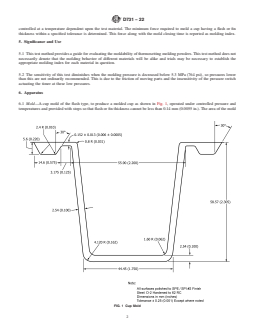
6.1 Mold—A cup mold of the flash type, to produce a
Determine the Precision of a Test Method
molded cup as shown in Fig. 1, operated under controlled
pressure and temperatures and provided with stops so that flash
3. Terminology
or fin thickness cannot be less than 0.14 mm (0.0055 in.). The
3.1 Definitions are in accordance with Terminology D883,
area of the mold casting creating the molded flash shall be
unless otherwise specified.
located on top of the cup, flat, perpendicular to the axis of the
cup, and in the form of an annular ring 3.17 mm (0.125 in.) in
width.
This test method is under the jurisdiction ofASTM Committee D20 on Plastics
6.2 Pyrometer—A calibrated pyrometer, traceable to a na-
and is the direct responsibility of Subcommittee D20.30 on Thermal Properties
(Section D20.30.08).
tional standard (for example, NIST), and accurate to 61°C
Current edition approved March 15, 2022. Published March 2022. Originally
shall be used to determine the temperature of the mold
approved in 1950. Last previous edition approved in 2018 as D731 - 18. DOI:
surfaces. For properly measuring mold temperatures, reference
10.1520/D0731-22.
For referenced ASTM standards, visit the ASTM website, www.astm.org, or Practice D957.
contact ASTM Customer Service at service@astm.org. For Annual Book of ASTM
6.3 Heating System—Any conventional means for heating
Standards volume information, refer to the standard’s Document Summary page on
the ASTM website. the press platens, provided the heat source is constant enough
*A Summary of Changes section appears at the end of this standard
Copyright © ASTM International, 100 Barr Harbor Drive, PO Box C700, West Conshohocken, PA 19428-2959. United States
D731 − 22
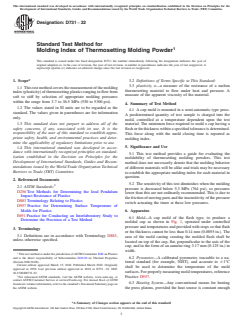
FIG. 1 Cup Mold
to maintain the molding temperature within 61°C of the of 0.15 to 0.20 mm (0.006 to 0.008 in.) shall be molded (see
specified temperature (see 9.2). Note 2). The adhering fin shall be removed and the cup
weighed to the nearest 0.1 g. This weight multiplied by 1.1
6.4 Pressure System—A semiautomatic press with a fixed
shall be the weight of the test specimen used. For materials
mold and fully insulated to minimize heat losses shall be used.
having an impact above 27 J/m (0.50 ft-lb/in.) of notch, the
The hydraulic system shall be provided with a means of
specimen weight is determined in a similar manner, except that
pressure regulation so that the load on the mold shall differ by
cup flash shall not be more than 0.66 mm (0.026 in.) or less
not more than 61112 N (6250 lbf) from the stated value. The
than 0.51 mm (0.020 in.), and the amount of material shall be
capacity of the hydraulic system shall permit a ram travel of
1.05 times the weight of this cup. The test specimen shall be in
approximately 25 mm/s (1 in./s). The ram diameter shall not
the form of loose powder unless preforming is necessary for
exceed 100 mm (4 in.).
materialsofhighbulk.Minimumpressureshallbeemployedin
NOTE 1—The use of hand molds is not recommended but may be used
the preforming operation to minimize the increase in closing
to give an estimate of the molding index.
time resulting from the use of preforms.
7. Test Specimen NOTE 2—While the mold is provided with stops so that the flash or fin
thickness cannot be less than 0.15 6 0.013 mm (0.006 6 0.0005 in.), the
7.1 To determine the weight of the test specimen for
molded cup itself may have a flash thickness of 0.15 to 0.20 mm (0.006
materials having an Izod impact strength of 27 J/m (0.50
6 0.0008 in.) as the micro switch controlling the closing time must have
ft-lb/in.) of notch, or less, a cup having a flash or fin thickness a tolerance in which to operate.
D731 − 22
8. Conditioning
59 161 (13 300) 19.4 (2821)
66 723 (15 000) 21.9 (3181)
8.1 Materials are normally tested in the “as received”
88 964 (20 000) 29.2 (4242)
condition, except in referee tests, when they shall be condi- 111 206(25 000) 36.5 (5302)
tioned in accordance with 8.2 (see Note 3).
NOTE 4—These fixed mold loads are recommended based upon
common practice and materials and plasticities currently available. Other
8.2 For referee testing, all materials shall be shipped and
moldloadsmaybedefined,ifagreedtobysupplierandcustomer,tobetter
stored in sealed moisture barrier containers. These materials
define the plasticity of a material.
shall be stored for a minimum period of 48 h at standard
9.4 The time of flow in seconds shall be measured from the
laboratory temperature before breaking the seal on the carton.
instant that the hydraulic gage indicates an applied load of
A representative sample shall be taken from this carton
4448 N (1000 lb) to the instant that the fin has reached 0.20
immediately after opening and tested within 3 min in order to
mm (0.008 in.) in thickness for materials with an Izod impact
pres
...
This document is not an ASTM standard and is intended only to provide the user of an ASTM standard an indication of what changes have been made to the previous version. Because
it may not be technically possible to adequately depict all changes accurately, ASTM recommends that users consult prior editions as appropriate. In all cases only the current version
of the standard as published by ASTM is to be considered the official document.
Designation: D731 − 18 D731 − 22
Standard Test Method for
Molding Index of Thermosetting Molding Powder
This standard is issued under the fixed designation D731; the number immediately following the designation indicates the year of
original adoption or, in the case of revision, the year of last revision. A number in parentheses indicates the year of last reapproval. A
superscript epsilon (´) indicates an editorial change since the last revision or reapproval.
1. Scope*
1.1 This test method covers the measurement of the molding index (plasticity) of thermosetting plastics ranging in flow from soft
to stiff by selection of appropriate molding pressures within the range from 3.7 to 36.5 MPa (530 to 5300 psi).
1.2 The values stated in SI units are to be regarded as the standard. The values given in parentheses are for information only.
1.3 This standard does not purport to address all of the safety concerns, if any, associated with its use. It is the responsibility
of the user of this standard to establish appropriate safety, health, and environmental practices and determine the applicability of
regulatory limitations prior to use.
1.4 This international standard was developed in accordance with internationally recognized principles on standardization
established in the Decision on Principles for the Development of International Standards, Guides and Recommendations issued
by the World Trade Organization Technical Barriers to Trade (TBT) Committee.
2. Referenced Documents
2.1 ASTM Standards:
D256 Test Methods for Determining the Izod Pendulum Impact Resistance of Plastics
D883 Terminology Relating to Plastics
D957 Practice for Determining Surface Temperature of Molds for Plastics
E691 Practice for Conducting an Interlaboratory Study to Determine the Precision of a Test Method
3. Terminology
3.1 Definitions are in accordance with Terminology D883, unless otherwise specified.
3.2 Definitions of Terms Specific to This Standard:
3.3 plasticity—plasticity, n—a measure of the resistance of a molten thermosetting material to flow under heat and pressure. A
measure of the apparent viscosity of the material.
4. Summary of Test Method
4.1 A cup mold is mounted in a semi-automatic type press. A predetermined quantity of test sample is charged into the mold,
This test method is under the jurisdiction of ASTM Committee D20 on Plastics and is the direct responsibility of Subcommittee D20.30Thermal Properties.30 on
ThermalThermal Properties Properties (Section D20.30.08).
Current edition approved May 1, 2018March 15, 2022. Published May 2018March 2022. Originally approved in 1950. Last previous edition approved in 20102018 as
D731 - 10.D731 - 18. DOI: 10.1520/D0731-18.10.1520/D0731-22.
For referenced ASTM standards, visit the ASTM website, www.astm.org, or contact ASTM Customer Service at service@astm.org. For Annual Book of ASTM Standards
volume information, refer to the standard’s Document Summary page on the ASTM website.
*A Summary of Changes section appears at the end of this standard
Copyright © ASTM International, 100 Barr Harbor Drive, PO Box C700, West Conshohocken, PA 19428-2959. United States
D731 − 22
controlled at a temperature dependent upon the test material. The minimum force required to mold a cup having a flash or fin
thickness within a specified tolerance is determined. This force along with the mold closing time is reported as molding index.
5. Significance and Use
5.1 This test method provides a guide for evaluating the moldability of thermosetting molding powders. This test method does not
necessarily denote that the molding behavior of different materials will be alike and trials may be necessary to establish the
appropriate molding index for each material in question.
5.2 The sensitivity of this test diminishes when the molding pressure is decreased below 5.3 MPa (764 psi), so pressures lower
than this are not ordinarily recommended. This is due to the friction of moving parts and the insensitivity of the pressure switch
actuating the timer at these low pressures.
6. Apparatus
6.1 Mold—A cup mold of the flash type, to produce a molded cup as shown in Fig. 1, operated under controlled pressure and
temperatures and provided with stops so that flash or fin thickness cannot be less than 0.14 mm (0.0055 in.). The area of the mold
FIG. 1 Cup Mold
D731 − 22
casting creating the molded flash shall be located on top of the cup, flat, perpendicular to the axis of the cup, and in the form of
an annular ring 3.17 mm (0.125 in.) in width.
6.2 Pyrometer—A calibrated pyrometer, traceable to a national standard (for example, NIST), and accurate to 61°C shall be used
to determine the temperature of the mold surfaces. For properly measuring mold temperatures, reference Practice D957.
6.3 Heating System—Any conventional means for heating the press platens, provided the heat source is constant enough to
maintain the molding temperature within 61°C of the specified temperature (see 9.2).
6.4 Pressure System—A semiautomatic press with a fixed mold and fully insulated to minimize heat losses shall be used. The
hydraulic system shall be provided with a means of pressure regulation so that the load on the mold shall differ by not more than
61112 N (6250 lbf) from the stated value. The capacity of the hydraulic system shall permit a ram travel of approximately 25
mm/s (1 in./s). The ram diameter shall not exceed 100 mm (4 in.).
NOTE 1—The use of hand molds is not recommended but may be used to give an estimate of the molding index.
7. Test Specimen
7.1 To determine the weight of the test specimen for materials having an Izod impact strength of 27 J/m (0.50 ft-lb/in.) of notch,
or less, a cup having a flash or fin thickness of 0.15 to 0.20 mm (0.006 to 0.008 in.) shall be molded (see Note 2). The adhering
fin shall be removed and the cup weighed to the nearest 0.1 g. This weight multiplied by 1.1 shall be the weight of the test specimen
used. For materials having an impact above 27 J/m (0.50 ft-lb/in.) of notch, the specimen weight is determined in a similar manner,
except that cup flash shall not be more than 0.66 mm (0.026 in.) or less than 0.51 mm (0.020 in.), and the amount of material shall
be 1.05 times the weight of this cup. The test specimen shall be in the form of loose powder unless preforming is necessary for
materials of high bulk. Minimum pressure shall be employed in the preforming operation to minimize the increase in closing time
resulting from the use of preforms.
NOTE 2—While the mold is provided with stops so that the flash or fin thickness cannot be less than 0.15 6 0.013 mm (0.006 6 0.0005 in.), the molded
cup itself may have a flash thickness of 0.15 to 0.20 mm (0.006 6 0.0008 in.) as the micro switch controlling the closing time must have a tolerance
in which to operate.
8. Conditioning
8.1 Materials are normally tested in the “as received” condition, except in referee tests, when they shall be conditioned in
accordance with 8.2 (see Note 3).
8.2 For referee testing, all materials shall be shipped and stored in sealed moisture barrier containers. These materials shall be
stored for a minimum period of 48 h at standard laboratory temperature before breaking the seal on the carton. A representative
sample shall be taken from this carton immediately after opening and tested within 3 min in order to preserve the original moisture
content. Alternative methods of conditioning samples are acceptable provided they are mutually agreed upon between the
manufacturer and the purchaser.
NOTE 3—Conditioning may alter the moisture content of most materials and thereby change their molding index or molding behavior.
9. Procedure
9.1 Mount the mold in the semi-automatic press. The rate of flow is sensitive to the condition of the mold surfaces. To avoid
erroneous results, any residue deposited from prior tests shall be completely removed from the mold surfaces. Discard the first few
cups molded and accept the flow time as correct when two successive cups molded under test do not differ by more than 1 s in
time of flow.
9.2 The preferred mold temperature for testing the molding index for the following materials shall be
...