

ASTM D6342-22
(Practice)Standard Practice for Polyurethane Raw Materials: Determining Hydroxyl Number of Polyols by Near Infrared (NIR) Spectroscopy
General Information
- Abstract
SIGNIFICANCE AND USE
5.1 General Utility:
5.1.1 It is necessary to know the hydroxyl number of polyols in order to formulate polyurethane systems.
5.1.2 This practice is suitable for research, quality control, specification testing, and process control.
5.2 Limitations:
5.2.1 Factors affecting the NIR spectra of the analyte polyols need to be determined before a calibration procedure is started. Chemical structure, interferences, any nonlinearities, the effect of temperature, and the interaction of the analyte with other sample components such as catalyst, water and other polyols needs to be understood in order to properly select samples that will model those effects which cannot be adequately controlled.
5.2.2 Calibrations are generally considered valid only for the specific NIR instrument used to generate the calibration. Using different instruments (even when made by the same manufacturer) for calibration and analysis can seriously affect the accuracy and precision of the measured hydroxyl number. Procedures used for transferring calibrations between instruments are problematic and are to be utilized with caution following the guidelines in Section 16. These procedures generally require a completely new validation and statistical analysis of errors on the new instrument.
5.2.3 The analytical results are statistically valid only for the range of hydroxyl numbers used in the calibration. Extrapolation to lower or higher hydroxyl values can increase the errors and degrade precision. Likewise, the analytical results are only valid for the same chemical composition as used for the calibration set. A significant change in composition or contaminants can also affect the results. Outlier detection, as discussed in Practices E1655, is a tool that can be used to detect the possibility of problems such as those mentioned above.
SCOPE
1.1 This standard covers a practice for the determination of hydroxyl numbers of polyols using NIR spectroscopy.
1.2 Definitions, terms, and calibration techniques are described. Procedures for selecting samples, and collecting and treating data for developing NIR calibrations are outlined. Criteria for building, evaluating, and validating the NIR calibration model are also described. Finally, the procedure for sample handling, data gathering and evaluation are described.
1.3 The implementation of this standard requires that the NIR spectrometer has been installed in compliance with the manufacturer's specifications.
1.4 The values stated in SI units are to be regarded as standard. No other units of measurement are included in this standard.
1.5 This standard does not purport to address all of the safety concerns, if any, associated with its use. It is the responsibility of the user of this standard to establish appropriate safety, health, and environmental practices and determine the applicability of regulatory limitations prior to use.
Note 1: This standard is equivalent ISO 15063.
1.6 This international standard was developed in accordance with internationally recognized principles on standardization established in the Decision on Principles for the Development of International Standards, Guides and Recommendations issued by the World Trade Organization Technical Barriers to Trade (TBT) Committee.
- Status
- Published
- Publication Date
- 30-Jun-2022
- Technical Committee
- D20 - Plastics
- Drafting Committee
- D20.22 - Cellular Materials - Plastics and Elastomers
Buy Documents
ASTM D6342-22 - Standard Practice for Polyurethane Raw Materials: Determining Hydroxyl Number of Polyols by Near Infrared (NIR) Spectroscopy
REDLINE ASTM D6342-22 - Standard Practice for Polyurethane Raw Materials: Determining Hydroxyl Number of Polyols by Near Infrared (NIR) Spectroscopy
Overview
ASTM D6342-22 sets forth a standardized practice for determining the hydroxyl number of polyols-critical raw materials in polyurethane manufacturing-using Near Infrared (NIR) Spectroscopy. Precise knowledge of the hydroxyl number is essential for formulating high-performance polyurethane systems, enabling consistency and quality in end products. This standard provides guidelines for sample selection, data collection, NIR calibration model development, evaluation, and validation methods, supporting various needs in the polyurethane industry, including research, process control, and specification testing.
Key Topics
Hydroxyl Number Determination
- The hydroxyl number quantifies hydroxyl group content in polyols, impacting polyurethane properties.
- Accurate measurement is foundational for the design and manufacture of polyurethane systems.
NIR Spectroscopy for Polyols
- NIR offers rapid, non-destructive analysis with multivariate calibration models for accurate quantification.
- The method supports quality control and routine analysis by correlating specific NIR absorbance spectra to reference hydroxyl numbers.
Calibration Model Development
- Multilinear Regression (MLR), Principal Component Regression (PCR), and Partial Least Squares (PLS) are applied to build calibration models.
- Comprehensive protocols for data pretreatment, outlier identification, and validation ensure reliable results.
- Emphasizes the necessity for extensive, representative sample sets covering the expected range of hydroxyl numbers and compositions.
- Calibration integrity is foundational-the model is robust only for sample types, compositions, and NIR instrument conditions mirrored in calibration.
Limitations and Considerations
- NIR calibration models are instrument- and composition-specific; using different instruments or straying outside calibration sample ranges can degrade accuracy.
- Environmental factors (such as temperature), sample matrix interferences, and chemical structure variation must be accounted for during both calibration and routine measurement.
- Model validity is bound to the chemical nature of the polyols in the calibration set; significant changes may necessitate recalibration.
Applications
Quality Control in Polyurethane Manufacturing
- Enables consistent assessment of polyol hydroxyl numbers, directly affecting product quality and batch-to-batch uniformity.
- Facilitates rapid at-line or in-process testing for real-time process adjustments.
Research and Development
- Supports the investigation of new polyol formulations by providing a reliable, efficient method for hydroxyl number assessment.
- Aids in developing custom polyurethane systems with targeted properties for diverse industrial uses.
Specification Testing and Process Control
- Allows manufacturers and suppliers to certify polyol shipments meet contractual hydroxyl number specifications.
- Enhances overall process stability by enabling early detection of out-of-spec material or equipment drift.
Related Standards
- ISO 15063: Plastics-Polyols for use in the production of polyurethanes-Determination of hydroxyl number by NIR spectroscopy (equivalent standard)
- ASTM D4274: Test Methods for Polyurethane Raw Materials: Determination of Hydroxyl Numbers of Polyols
- ASTM E1655: Practices for Infrared Multivariate Quantitative Analysis (for outlier detection, calibration, and validation)
- ASTM E168: Practices for General Techniques of Infrared Quantitative Analysis
- ASTM E1899: Test Method for Hydroxyl Groups Using Reaction with p-Toluenesulfonyl Isocyanate and Potentiometric Titration
Practical Value
The use of ASTM D6342-22 enables the polyurethane industry to adopt faster, greener, and more efficient quality assurance workflows, reducing reliance on labor-intensive wet chemical methods. The standard supports robust, traceable, and validated analyses, giving manufacturers confidence in product consistency and supporting compliance with global quality expectations. By leveraging NIR spectroscopy and this globally recognized methodology, organizations can improve productivity, responsiveness, and product quality in polyurethane supply chains.
Relations
- Effective Date
- 01-Feb-2024
- Effective Date
- 01-Nov-2023
- Effective Date
- 01-Jan-2020
- Effective Date
- 01-Aug-2019
- Effective Date
- 15-Apr-2019
- Effective Date
- 01-Feb-2019
- Effective Date
- 01-Dec-2018
- Effective Date
- 01-Nov-2018
- Effective Date
- 15-Aug-2017
- Effective Date
- 15-Nov-2012
- Effective Date
- 15-May-2011
- Effective Date
- 01-Feb-2011
- Effective Date
- 01-Mar-2010
- Effective Date
- 01-Mar-2010
- Effective Date
- 01-Mar-2008
Buy Documents
ASTM D6342-22 - Standard Practice for Polyurethane Raw Materials: Determining Hydroxyl Number of Polyols by Near Infrared (NIR) Spectroscopy
REDLINE ASTM D6342-22 - Standard Practice for Polyurethane Raw Materials: Determining Hydroxyl Number of Polyols by Near Infrared (NIR) Spectroscopy
Get Certified
Connect with accredited certification bodies for this standard

DIN CERTCO
DIN Group product certification.

Smithers Quality Assessments
US management systems and product certification.
Sponsored listings
Frequently Asked Questions
ASTM D6342-22 is a standard published by ASTM International. Its full title is "Standard Practice for Polyurethane Raw Materials: Determining Hydroxyl Number of Polyols by Near Infrared (NIR) Spectroscopy". This standard covers: SIGNIFICANCE AND USE 5.1 General Utility: 5.1.1 It is necessary to know the hydroxyl number of polyols in order to formulate polyurethane systems. 5.1.2 This practice is suitable for research, quality control, specification testing, and process control. 5.2 Limitations: 5.2.1 Factors affecting the NIR spectra of the analyte polyols need to be determined before a calibration procedure is started. Chemical structure, interferences, any nonlinearities, the effect of temperature, and the interaction of the analyte with other sample components such as catalyst, water and other polyols needs to be understood in order to properly select samples that will model those effects which cannot be adequately controlled. 5.2.2 Calibrations are generally considered valid only for the specific NIR instrument used to generate the calibration. Using different instruments (even when made by the same manufacturer) for calibration and analysis can seriously affect the accuracy and precision of the measured hydroxyl number. Procedures used for transferring calibrations between instruments are problematic and are to be utilized with caution following the guidelines in Section 16. These procedures generally require a completely new validation and statistical analysis of errors on the new instrument. 5.2.3 The analytical results are statistically valid only for the range of hydroxyl numbers used in the calibration. Extrapolation to lower or higher hydroxyl values can increase the errors and degrade precision. Likewise, the analytical results are only valid for the same chemical composition as used for the calibration set. A significant change in composition or contaminants can also affect the results. Outlier detection, as discussed in Practices E1655, is a tool that can be used to detect the possibility of problems such as those mentioned above. SCOPE 1.1 This standard covers a practice for the determination of hydroxyl numbers of polyols using NIR spectroscopy. 1.2 Definitions, terms, and calibration techniques are described. Procedures for selecting samples, and collecting and treating data for developing NIR calibrations are outlined. Criteria for building, evaluating, and validating the NIR calibration model are also described. Finally, the procedure for sample handling, data gathering and evaluation are described. 1.3 The implementation of this standard requires that the NIR spectrometer has been installed in compliance with the manufacturer's specifications. 1.4 The values stated in SI units are to be regarded as standard. No other units of measurement are included in this standard. 1.5 This standard does not purport to address all of the safety concerns, if any, associated with its use. It is the responsibility of the user of this standard to establish appropriate safety, health, and environmental practices and determine the applicability of regulatory limitations prior to use. Note 1: This standard is equivalent ISO 15063. 1.6 This international standard was developed in accordance with internationally recognized principles on standardization established in the Decision on Principles for the Development of International Standards, Guides and Recommendations issued by the World Trade Organization Technical Barriers to Trade (TBT) Committee.
SIGNIFICANCE AND USE 5.1 General Utility: 5.1.1 It is necessary to know the hydroxyl number of polyols in order to formulate polyurethane systems. 5.1.2 This practice is suitable for research, quality control, specification testing, and process control. 5.2 Limitations: 5.2.1 Factors affecting the NIR spectra of the analyte polyols need to be determined before a calibration procedure is started. Chemical structure, interferences, any nonlinearities, the effect of temperature, and the interaction of the analyte with other sample components such as catalyst, water and other polyols needs to be understood in order to properly select samples that will model those effects which cannot be adequately controlled. 5.2.2 Calibrations are generally considered valid only for the specific NIR instrument used to generate the calibration. Using different instruments (even when made by the same manufacturer) for calibration and analysis can seriously affect the accuracy and precision of the measured hydroxyl number. Procedures used for transferring calibrations between instruments are problematic and are to be utilized with caution following the guidelines in Section 16. These procedures generally require a completely new validation and statistical analysis of errors on the new instrument. 5.2.3 The analytical results are statistically valid only for the range of hydroxyl numbers used in the calibration. Extrapolation to lower or higher hydroxyl values can increase the errors and degrade precision. Likewise, the analytical results are only valid for the same chemical composition as used for the calibration set. A significant change in composition or contaminants can also affect the results. Outlier detection, as discussed in Practices E1655, is a tool that can be used to detect the possibility of problems such as those mentioned above. SCOPE 1.1 This standard covers a practice for the determination of hydroxyl numbers of polyols using NIR spectroscopy. 1.2 Definitions, terms, and calibration techniques are described. Procedures for selecting samples, and collecting and treating data for developing NIR calibrations are outlined. Criteria for building, evaluating, and validating the NIR calibration model are also described. Finally, the procedure for sample handling, data gathering and evaluation are described. 1.3 The implementation of this standard requires that the NIR spectrometer has been installed in compliance with the manufacturer's specifications. 1.4 The values stated in SI units are to be regarded as standard. No other units of measurement are included in this standard. 1.5 This standard does not purport to address all of the safety concerns, if any, associated with its use. It is the responsibility of the user of this standard to establish appropriate safety, health, and environmental practices and determine the applicability of regulatory limitations prior to use. Note 1: This standard is equivalent ISO 15063. 1.6 This international standard was developed in accordance with internationally recognized principles on standardization established in the Decision on Principles for the Development of International Standards, Guides and Recommendations issued by the World Trade Organization Technical Barriers to Trade (TBT) Committee.
ASTM D6342-22 is classified under the following ICS (International Classification for Standards) categories: 83.080.10 - Thermosetting materials. The ICS classification helps identify the subject area and facilitates finding related standards.
ASTM D6342-22 has the following relationships with other standards: It is inter standard links to ASTM D883-24, ASTM D883-23, ASTM D883-20, ASTM D883-19c, ASTM D883-19a, ASTM D883-19, ASTM D883-18a, ASTM D883-18, ASTM D883-17, ASTM D883-12e1, ASTM D883-11, ASTM D4274-11, ASTM E131-10, ASTM E222-10, ASTM D883-08. Understanding these relationships helps ensure you are using the most current and applicable version of the standard.
ASTM D6342-22 is available in PDF format for immediate download after purchase. The document can be added to your cart and obtained through the secure checkout process. Digital delivery ensures instant access to the complete standard document.
Standards Content (Sample)
This international standard was developed in accordance with internationally recognized principles on standardization established in the Decision on Principles for the
Development of International Standards, Guides and Recommendations issued by the World Trade Organization Technical Barriers to Trade (TBT) Committee.
Designation: D6342 − 22
Standard Practice for
Polyurethane Raw Materials: Determining Hydroxyl Number
of Polyols by Near Infrared (NIR) Spectroscopy
This standard is issued under the fixed designation D6342; the number immediately following the designation indicates the year of
original adoption or, in the case of revision, the year of last revision. A number in parentheses indicates the year of last reapproval. A
superscript epsilon (´) indicates an editorial change since the last revision or reapproval.
1. Scope* D4274 Test Methods for Testing Polyurethane Raw Materi-
als: Determination of Hydroxyl Numbers of Polyols
1.1 This standard covers a practice for the determination of
E131 Terminology Relating to Molecular Spectroscopy
hydroxyl numbers of polyols using NIR spectroscopy.
E168 Practices for General Techniques of Infrared Quanti-
1.2 Definitions, terms, and calibration techniques are de-
tative Analysis
scribed. Procedures for selecting samples, and collecting and
E222 Test Methods for Hydroxyl Groups Using Acetic
treating data for developing NIR calibrations are outlined.
Anhydride Acetylation
Criteria for building, evaluating, and validating the NIR
E1655 Practices for Infrared Multivariate Quantitative
calibration model are also described. Finally, the procedure for
Analysis
sample handling, data gathering and evaluation are described.
E1899 Test Method for Hydroxyl Groups Using Reaction
1.3 The implementation of this standard requires that the with p-ToluenesulfonylIsocyanate(TSI)andPotentiomet-
ric Titration with Tetrabutylammonium Hydroxide
NIR spectrometer has been installed in compliance with the
manufacturer’s specifications. 2.2 ISO Standard:
ISO 15063 Plastics—Polyols for use in the production of
1.4 The values stated in SI units are to be regarded as
polyurethanes—Determination of hydroxyl number by
standard. No other units of measurement are included in this
NIR spectroscopy
standard.
1.5 This standard does not purport to address all of the 3. Terminology
safety concerns, if any, associated with its use. It is the
3.1 Definitions—Terminology used in this practice follows
responsibility of the user of this standard to establish appro-
that defined in Terminology D883. For terminology related to
priate safety, health, and environmental practices and deter-
molecular spectroscopy methods, refer to Terminology E131.
mine the applicability of regulatory limitations prior to use.
For terms relating to multivariate analysis, refer to Practice
E1655.
NOTE 1—This standard is equivalent ISO 15063.
1.6 This international standard was developed in accor- 3.2 Definitions of Terms Specific to This Standard:
dance with internationally recognized principles on standard-
3.2.1 hydroxyl number—the milligrams of potassium hy-
ization established in the Decision on Principles for the droxide equivalent to the hydroxyl content of1gof sample.
Development of International Standards, Guides and Recom-
4. Summary of Practice
mendations issued by the World Trade Organization Technical
Barriers to Trade (TBT) Committee. 4.1 Multivariate mathematics is applied to correlate the NIR
absorbance values for a set of calibration samples to the
2. Referenced Documents
respective reference hydroxyl number for each sample. The
resultant multivariate calibration model is then applied to the
2.1 ASTM Standards:
analysis of unknown samples to provide an estimate of their
D883 Terminology Relating to Plastics
hydroxyl numbers.
4.2 Multilinear regression (MLR), principal components
This practice is under the jurisdiction ofASTM Committee D20 on Plastics and
regression (PCR), and partial least squares regression (PLS)
is the direct responsibility of Subcommittee D20.22 on Cellular Materials - Plastics
and Elastomers.
are the mathematical techniques used for the development of
Current edition approved July 1, 2022. Published July 2022. Originally approved
the calibration model.
ɛ1
in 1998. Last previous edition approved in 2017 as D6342 - 12(2017) . DOI:
10.1520/D6342-22.
4.3 Statistical tests are used to detect outliers during the
For referenced ASTM standards, visit the ASTM website, www.astm.org, or
development of the calibration model. Outliers can include
contact ASTM Customer Service at service@astm.org. For Annual Book of ASTM
high leverage samples and samples whose hydroxyl numbers
Standards volume information, refer to the standard’s Document Summary page on
the ASTM website. are inconsistent with the model.
*A Summary of Changes section appears at the end of this standard
Copyright © ASTM International, 100 Barr Harbor Drive, PO Box C700, West Conshohocken, PA 19428-2959. United States
D6342 − 22
4.4 Validation of the calibration model is performed by
using the model to analyze a set of validation samples. The
hydroxyl number estimates for the validation set are statisti-
cally compared to the reference hydroxyl number for this set to
test for agreement of the model with the reference method.
4.5 Statistical expressions are given for calculating the
precision and bias of the NIR method relative to the reference
method.
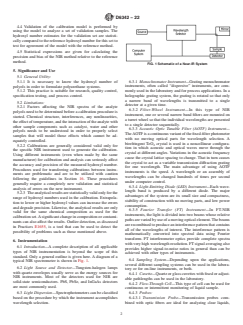
FIG. 1 Schematic of a Near-IR System
5. Significance and Use
5.1 General Utility:
6.3.1 Monochromator Instrument—Grating monochromator
5.1.1 It is necessary to know the hydroxyl number of
instruments, often called “dispersive” instruments, are com-
polyols in order to formulate polyurethane systems.
monly used in the laboratory and for process applications. In a
5.1.2 This practice is suitable for research, quality control,
holographic grating system, the grating is rotated so that only
specification testing, and process control.
a narrow band of wavelengths is transmitted to a single
5.2 Limitations:
detector at a given time.
5.2.1 Factors affecting the NIR spectra of the analyte
6.3.2 Filter-Wheel Instrument—In this type of NIR
polyols need to be determined before a calibration procedure is
instrument, one or several narrow band filters are mounted on
started. Chemical structure, interferences, any nonlinearities,
a turret wheel so that the individual wavelengths are presented
theeffectoftemperature,andtheinteractionoftheanalytewith
to a single detector sequentially.
other sample components such as catalyst, water and other
6.3.3 Acoustic Optic Tunable Filter (AOTF) Instrument—
polyols needs to be understood in order to properly select
TheAOTFisacontinuousvariantofthefixed-filterphotometer
samples that will model those effects which cannot be ad-
with no moving optical parts for wavelength selection. A
equately controlled.
birefringent TeO crystal is used in a noncollinear configura-
5.2.2 Calibrations are generally considered valid only for
tion in which acoustic and optical waves move through the
the specific NIR instrument used to generate the calibration.
crystal at different angles. Variations in the acoustic frequency
Using different instruments (even when made by the same
cause the crystal lattice spacing to change. That in turn causes
manufacturer) for calibration and analysis can seriously affect
the crystal to act as a variable transmission diffraction grating
the accuracy and precision of the measured hydroxyl number.
for one wavelength. The main advantage of using AOTF
Procedures used for transferring calibrations between instru-
instruments is the speed. A wavelength or an assembly of
ments are problematic and are to be utilized with caution
wavelengths can be changed hundreds of times per second
following the guidelines in Section 16. These procedures
under computer control.
generally require a completely new validation and statistical
6.3.4 Light-Emitting Diode (LED) Instrument—Each wave-
analysis of errors on the new instrument.
length band is produced by a different diode. The major
5.2.3 Theanalyticalresultsarestatisticallyvalidonlyforthe
advantages of the system are its small size and compactness,
range of hydroxyl numbers used in the calibration. Extrapola-
stability of construction with no moving parts, and low power
tion to lower or higher hydroxyl values can increase the errors
consumption.
and degrade precision. Likewise, the analytical results are only
6.3.5 Fourier Transfer (FT) Instrument—In FT-NIR
valid for the same chemical composition as used for the
instruments, the light is divided into two beams whose relative
calibrationset.Asignificantchangeincompositionorcontami-
pathsarevariedbyuseofamovingopticalelement.Thebeams
nants can also affect the results. Outlier detection, as discussed
are recombined to produce an interference pattern that contains
in Practices E1655, is a tool that can be used to detect the
all of the wavelengths of interest. The interference pattern is
possibility of problems such as those mentioned above.
mathematically converted into spectral data using Fourier
transform. FT interferometer optics provide complete spectra
6. Instrumentation
with very high wavelength resolution. FTsignal averaging also
6.1 Introduction—A complete description of all applicable
provides higher signal-to-noise ratios in general than can be
types of NIR instrumentation is beyond the scope of this
achieved with other types of instruments.
standard. Only a general outline is given here. A diagram of a
6.4 Sampling System—Depending upon the applications,
typical NIR spectrometer is shown in Fig. 1.
several different sampling systems can be used in the labora-
6.2 Light Source and Detector—Tungsten-halogen lamps
tory or for on-line instruments, or both.
with quartz envelopes usually serve as the energy sources for
6.4.1 Cuvette—Quartzorglasscuvetteswithfixedoradjust-
NIR instruments. Most of the detectors used for NIR are
able pathlengths can be used in the laboratory.
solid-state semiconductors. PbS, PbSe, and InGaAs detectors
6.4.2 Flow-Through Cell—This type of cell can be used for
are most commonly used.
continuous or intermittent monitoring of liquid sample.
6.3 Light Dispersion—Spectrophotometers can be classified 6.4.3 Probes:
based on the procedure by which the instrument accomplishes 6.4.3.1 Transmission Probe—Transmission probes com-
wavelength selection. bined with optic fibers are ideal for analyzing clear liquids,
D6342 − 22
slurries, suspensions, and other high viscosity samples. Low 7. Near-IR Spectral Measurements
absorptivity in the NIR region permits sampling pathlengths of
7.1 NIR spectral measurements are based on Beer’s law,
up to 10 cm.
namely, the absorbance of a homogeneous sample containing
6.4.3.2 Immersion Probe—The immersion system uses a
an absorbing substance is linearly proportional to the concen-
bi-directional optic fiber bundle and variable pathlength probe
tration of the absorbing species. The absorbance of a sample is
for sample measurements. Radiation from the source is trans-
defined as the logarithm to the base ten of the reciprocal of the
mitted to the sample by the inner ring of fibers, and diffuse
Transmittance (T):
transmitted radiation is collected by the outer ring of fibers for
A 5 log 1/T (1)
~ !
detection.
where:
6.4.3.3 Attenuated Total Reflection (ATR) Probe—
Attenuated total reflection occurs when an absorbing medium
T = the ratio of radiant power transmitted by the sample to
(the sample) is in close contact with the surface of a crystal
the radiant power incident on the sample.
material of higher refractive index. At an optimized angle, the
7.1.1 For most types of instrumentation, the radiant power
NIR beam reflects internally along the crystal faces, penetrat-
incident on the sample cannot be measured directly. Instead, a
ing a few microns into the sample surface, where selective
reference (background) measurement of the radiant power is
absorption occurs. The resulting spectrum is very close to the
made without the sample being present in the light beam.
conventional transmission spectrum for the sample. There are
7.1.2 A measurement is then conducted with the sample
many designs ofATR plates and rods for specific applications.
present, and the ratio, T, is calculated. The background
Single or multiple reflection units are available.ATR sampling
measurement can be conducted in a variety of ways depending
accessories are available for the laboratory and, in the form of
on the application and instrumentation. The sample and its
fiber optic probes, can be used for on-line analysis. This is an
holder can be physically removed from the light beam and a
advantage when handling viscous liquids and highly absorbing
background measurement made on the “empty beam”. The
materials.
sample holder (cell) can be emptied, and a background
6.5 Software—The ideal software has the following capa-
measurement taken for the empty cell. The cell can be filled
bilities:
with a material that has minimal absorption in the spectral
6.5.1 The capability to record all sample identification and range of interest, and the background measurement taken.
spectral data accurately and to access the reference data, Alternatively, split the light beam or alternately pass the light
beam through the sample and through an empty beam, and
6.5.2 The capability to record the date and time of day that
empty cell, or a background material in the cell.
all spectra and files were recorded or created,
7.1.3 The particular background referencing scheme that is
6.5.3 The capability to move or copy spectra, or both, from
usedcanvaryamonginstruments,andamongapplications.The
file to file,
same sample background referencing scheme must be em-
6.5.4 The capability to add or subtract spectral data, and to
ployed for the measurement of all spectra of calibration
average spectra,
samples, validation samples, and unknown samples to be
6.5.5 The capability to perform transformations of log l/R
analyzed.Any differences between instrument conditions used
optical data into derivatives, or other forms of mathematical
for referencing and measurement are to be minimized.
treatment, and to reverse the transformation,
7.2 Traditionally, a sample is manually brought to the
6.5.6 The capability to compute multiple linear regression
instrument and placed in a suitable optical container (a cell,
(MLR), principal component regression (PCR), and partial
vial, or cuvette with windows that transmit in the region of
least squares regression (PLS),
interest). Alternatively, transfer pipes can continuously flow
6.5.7 The capability to store PCR or PLS loading, weights,
liquid through an optical cell in the instrument for continuous
scores or other desirable data, and to display these data for
analysis. With optical fibers, the sample can be analyzed
subsequent examination and interpretation,
remotely from the instrument. Light is sent to the sample
6.5.8 The capability to enable the operator to evaluate the
through an optical fiber or fibers and returned to the instrument
calibrationmodelbycomputingthestandarderrorofvalidation
by means of another fiber or group of fibers. Instruments have
(SEV), coefficient of regression, and the root mean square
been developed that use a single fiber to transmit and receive
deviation (RMSD), and to display various plots,
the light, as well as use bundles of fibers for this purpose.
6.5.9 The capability to perform cross-validation
Detectors and light sources external to the instrument can also
automatically,
be used, in which case only one fiber or bundle is needed. The
6.5.10 The capability to identify an outlier(s), and
appropriate grade of optical fibers for use in the NIR range
6.5.11 The capability to develop and save regression needstobespecified.Generally,thesearefiberswithlowwater
equations and analyze a sample to calculate a hydroxyl
content (Low-OH). Total fiber length is not to exceed manu-
number.
facturer’s recommendations.
6.6 Software Packages—Most NIR instruments provide 7.3 For most NIR instrumentation, a variety of adjustable
necessary software for collecting and modeling data. Several parameters is available to control the collection and computa-
non-instrumentalcompaniesalsosupplychemometricsoftware tion of the spectral data. These parameters control the optical
packages that can be used to analyze NIR data. and digital resolution and the rate of data acquisition (scan
D6342 − 22
speed). Other important program parameters include the num- samples is less than five times the standard deviation of the
ber of wavelengths, number of scans, and number of data reference method, then r replicate analyses are to be performed
points. Additional instrumental considerations for multivariate such that (r) ⁄2 times the range of the calibration set is greater
calibrations include temperature control and compensation, than three times (preferably five times) the standard deviation
cell pathlength uniformity, and wavelength stability. It is of the reference method.
essential that all adjustable parameters and other factors not
8.5 A calibration model is developed using one of several
included in the model that control the collection and compu-
available methods, for example, MLR, PCR, and PLS. The
tation of spectral data be maintained constant while collecting
quality of the calibration curve can be tested by several
spectra of calibration samples, validation samples, and samples
statistical tools described in Section 12. The calibration model
for analysis.
is tested using cross-validation methods (see 12.8.4). Other
7.4 For definitions and further description of general infra- statistics can also be used to judge the overall quality of the
red techniques, refer to Practice E168. calibration.
8.6 Ifthestatisticalanalysisofthecalibrationandvalidation
8. Procedure to Develop a Feasibility Calibration
sets suggests the method is capable of providing adequate
precision,themodelcanbetunedbyaddingadditionalsamples
8.1 For each type of polyol or new process to produce the
to assure a boxcar distribution (an even distribution of values
polyol, it is necessary to perform a feasibility calibration. The
along a defined interval of the hydroxyl number range).Afinal
relationship between NIR spectra and the hydroxyl number is
model can be developed and validated as described in Section
generally evaluated during a feasibility study which will
12.
identify the possible interferences and determine whether an
adequate model can be constructed for the desired precision.
8.7 Ifthecalibrationsetconsistsofarangeofdifferenttypes
Following a successful feasibility study, the calibration can be
of polyols, and reliable calibration cannot be obtained, it is
expanded and validated.
necessary to group samples by chemistry, and to develop a
separate calibration model for each chemical grouping. Ex-
8.2 A sample set having all of the characteristics of the
amples of possible groups are polyether, polyester, segregation
samples of interest is to be identified. The samples chosen are
to include the expected hydroxyl number ranges and all the based on the manufacturing technique (that is, the EO/PO
ratio), or the functionality.
possible interferences in the sample matrix. In addition, inter-
relations between components in the samples are to be avoided
9. Selection of Calibration Samples
unless these interactions are expected in the routine samples
being analyzed. The number of samples is to be large (prefer-
9.1 Samples selected for the calibration set will ideally
ably 30 to 50 samples, especially if PLS regression is used to comply with the following guidelines as well as those estab-
evaluate the calibration model) and is to be evenly distributed
lished in 8.2:
throughout the hydroxyl number range. The range of the 9.1.1 The samples chosen are to include all components
samplesetistocoveratleastthreetimes,butpreferablyatleast
which are expected to be present in the samples of interest,
five times the standard deviation of the reference method. An 9.1.2 The samples chosen are to include and ideally exceed
independent set of samples, known as the validation sample
the expected hydroxyl number range,
set, is to be identified and set aside to evaluate the calibration 9.1.3 The sample hydroxyl numbers are to be evenly dis-
model for feasibility. The size of the validation set will depend
tributed throughout the calibration range as to provide a
on the number of samples used to evaluate the calibration “boxcar” distribution of samples (evenly distributed through-
model,generallyonesampleforeveryfoursamplesusedinthe
out the range of interest),
calibration. 9.1.4 The number of samples chosen are to be large enough
8.2.1 If samples with a wide range of hydroxyl number are to statistically define the relationship between the spectral
not available, it can be necessary to perform spiking experi- variables and the hydroxyl numbers to be modeled, and
ments to expand the range and to optimize the regression line. 9.1.5 The spectra of all samples are to be similar to avoid
Blending samples to achieve varying hydroxyl numbers is erroneousmodeling.Forexample,thesamepathlengthistobe
preferredoverspiking.Ifspikingisutilized,caremustbetaken used for all samples, and the baseline, peak maxima, and peak
to avoid changes that can affect the matrix and ultimately minima are to be similar. See 8.7.
compatibility with the spectra of the calibration set.
9.2 Themodelistoexcludeallpotentialsourcesofvariation
8.3 Samples are to be collected in a manner which reflects that can be excluded in the actual applications. If these sources
the actual process conditions and sample handling techniques cannot be eliminated they must be included in the sample set,
which are expected to be used during routine collection for if possible. Sources of variation can include the following:
analysis. Sample spectra are to be collected in a manner which 9.2.1 Chemical composition:
reflects the actual conditions, techniques, and sample handling
9.2.2 Physical characteristics, and
procedures which are expected to be employed. If these and 9.2.3 Sample handling, temperature, and humidity.
other such variations cannot be controlled, the range of
9.3 The number of samples required to calibrate the NIR
variation is to be included in the sample set of calibration.
model is dependent on the complexity of the samples being
8.4 The calibration sample set is to be analyzed at least in analyzed. Simple models which contain only a few compo-
duplicate by the primary or reference method. If the range of nents that vary in concentration will have only a small number
D6342 − 22
ofspectralvariablesandtypicallydonotrequirealargesample 10.4.4 Depending on how tight the production specifica-
set to define relationships. On the other hand, complex systems tions are and how accurate the lab method is, the time required
containing several components which vary in concentration to reach an acceptable temperature can be crucial. It is
will require a large number of samples to define the relation- necessary to determine the optimal equilibration time for the
ships and to assure the model development is adequate. various products in order to reduce total analysis time or to
tighten production specifications.
9.3.1 If a multivariate model is developed with 5 or fewer
variables (wavelengths in MLR or factors in PCR or PLS), the
11. Reference Method and Reference Values
calibration must contain a minimum of 30 samples after
elimination of outliers.
11.1 The hydroxyl numbers in the calibration set must be
determined by a standard analytical method (Test Methods
9.3.2 If a multivariate model is developed with k (>5)
D4274, E222, E1899, or
...
This document is not an ASTM standard and is intended only to provide the user of an ASTM standard an indication of what changes have been made to the previous version. Because
it may not be technically possible to adequately depict all changes accurately, ASTM recommends that users consult prior editions as appropriate. In all cases only the current version
of the standard as published by ASTM is to be considered the official document.
´1
Designation: D6342 − 12 (Reapproved 2017) D6342 − 22
Standard Practice for
Polyurethane Raw Materials: Determining Hydroxyl Number
of Polyols by Near Infrared (NIR) Spectroscopy
This standard is issued under the fixed designation D6342; the number immediately following the designation indicates the year of
original adoption or, in the case of revision, the year of last revision. A number in parentheses indicates the year of last reapproval. A
superscript epsilon (´) indicates an editorial change since the last revision or reapproval.
ε NOTE—Reapproved with editorial changes in August 2017.
1. Scope Scope*
1.1 This standard covers a practice for the determination of hydroxyl numbers of polyols using NIR spectroscopy.
1.2 Definitions, terms, and calibration techniques are described. Procedures for selecting samples, and collecting and treating data
for developing NIR calibrations are outlined. Criteria for building, evaluating, and validating the NIR calibration model are also
described. Finally, the procedure for sample handling, data gathering and evaluation are described.
1.3 The implementation of this standard requires that the NIR spectrometer has been installed in compliance with the
manufacturer’s specifications.
1.4 The values stated in SI units are to be regarded as standard. No other units of measurement are included in this standard.
1.5 This standard does not purport to address all of the safety concerns, if any, associated with its use. It is the responsibility
of the user of this standard to establish appropriate safety safety, health, and healthenvironmental practices and determine the
applicability of regulatory limitations prior to use.
NOTE 1—This standard is equivalent ISO 15063.
1.6 This international standard was developed in accordance with internationally recognized principles on standardization
established in the Decision on Principles for the Development of International Standards, Guides and Recommendations issued
by the World Trade Organization Technical Barriers to Trade (TBT) Committee.
2. Referenced Documents
2.1 ASTM Standards:
D883 Terminology Relating to Plastics
D4274 Test Methods for Testing Polyurethane Raw Materials: Determination of Hydroxyl Numbers of Polyols
D4855 Practice for Comparing Test Methods (Withdrawn 2008)
E131 Terminology Relating to Molecular Spectroscopy
E168 Practices for General Techniques of Infrared Quantitative Analysis
This practice is under the jurisdiction of ASTM Committee D20 on Plastics and is the direct responsibility of Subcommittee D20.22 on Cellular Materials - Plastics and
Elastomers.
Current edition approved Aug. 1, 2017July 1, 2022. Published August 2017July 2022. Originally approved in 1998. Last previous edition approved in 20122017 as
ɛ1
D6342 - 12.D6342 - 12(2017) . DOI: 10.1520/D6342-12R17E01.10.1520/D6342-22.
For referenced ASTM standards, visit the ASTM website, www.astm.org, or contact ASTM Customer Service at service@astm.org. For Annual Book of ASTM Standards
volume information, refer to the standard’s Document Summary page on the ASTM website.
*A Summary of Changes section appears at the end of this standard
Copyright © ASTM International, 100 Barr Harbor Drive, PO Box C700, West Conshohocken, PA 19428-2959. United States
D6342 − 22
E222 Test Methods for Hydroxyl Groups Using Acetic Anhydride Acetylation
E275 Practice for Describing and Measuring Performance of Ultraviolet and Visible Spectrophotometers
E456 Terminology Relating to Quality and Statistics
E1655 Practices for Infrared Multivariate Quantitative Analysis
E1899 Test Method for Hydroxyl Groups Using Reaction with p-Toluenesulfonyl Isocyanate (TSI) and Potentiometric Titration
with Tetrabutylammonium Hydroxide
2.2 ISO Standard:
ISO 15063 Plastics—Polyols for use in the production of polyurethanes—Determination of hydroxyl number by NIR
spectroscopy
3. Terminology
3.1 Definitions—Terminology used in this practice follows that defined in Terminology D883. For terminology related to
molecular spectroscopy methods, refer to Terminology E131. For terms relating to multivariate analysis, refer to Practice E1655.
3.2 Definitions of Terms Specific to This Standard:
3.2.1 hydroxyl number—the milligrams of potassium hydroxide equivalent to the hydroxyl content of 1 g of sample.
4. Summary of Practice
4.1 Multivariate mathematics is applied to correlate the NIR absorbance values for a set of calibration samples to the respective
reference hydroxyl number for each sample. The resultant multivariate calibration model is then applied to the analysis of unknown
samples to provide an estimate of their hydroxyl numbers.
4.2 Multilinear regression (MLR), principal components regression (PCR), and partial least squares regression (PLS) are the
mathematical techniques used for the development of the calibration model.
4.3 Statistical tests are used to detect outliers during the development of the calibration model. Outliers can include high leverage
samples and samples whose hydroxyl numbers are inconsistent with the model.
4.4 Validation of the calibration model is performed by using the model to analyze a set of validation samples. The hydroxyl
number estimates for the validation set are statistically compared to the reference hydroxyl number for this set to test for agreement
of the model with the reference method.
4.5 Statistical expressions are given for calculating the precision and bias of the NIR method relative to the reference method.
5. Significance and Use
5.1 General Utility:
5.1.1 It is necessary to know the hydroxyl number of polyols in order to formulate polyurethane systems.
5.1.2 This practice is suitable for research, quality control, specification testing, and process control.
5.2 Limitations:
5.2.1 Factors affecting the NIR spectra of the analyte polyols need to be determined before a calibration procedure is started.
Chemical structure, interferences, any nonlinearities, the effect of temperature, and the interaction of the analyte with other sample
components such as catalyst, water and other polyols needs to be understood in order to properly select samples that will model
those effects which cannot be adequately controlled.
5.2.2 Calibrations are generally considered valid only for the specific NIR instrument used to generate the calibration. Using
different instruments (even when made by the same manufacturer) for calibration and analysis can seriously affect the accuracy
and precision of the measured hydroxyl number. Procedures used for transferring calibrations between instruments are problematic
and are to be utilized with caution following the guidelines in Section 16. These procedures generally require a completely new
validation and statistical analysis of errors on the new instrument.
D6342 − 22
5.2.3 The analytical results are statistically valid only for the range of hydroxyl numbers used in the calibration. Extrapolation to
lower or higher hydroxyl values can increase the errors and degrade precision. Likewise, the analytical results are only valid for
the same chemical composition as used for the calibration set. A significant change in composition or contaminants can also affect
the results. Outlier detection, as discussed in Practices E1655, is a tool that can be used to detect the possibility of problems such
as those mentioned above.
6. Instrumentation
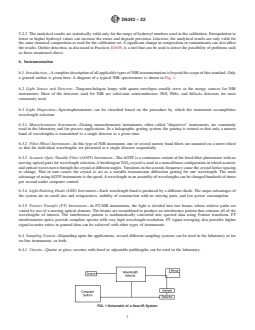
6.1 Introduction—A complete description of all applicable types of NIR instrumentation is beyond the scope of this standard. Only
a general outline is given here. A diagram of a typical NIR spectrometer is shown in Fig. 1.
6.2 Light Source and Detector—Tungsten-halogen lamps with quartz envelopes usually serve as the energy sources for NIR
instruments. Most of the detectors used for NIR are solid-state semiconductors. PbS, PbSe, and InGaAs detectors are most
commonly used.
6.3 Light Dispersion—Spectrophotometers can be classified based on the procedure by which the instrument accomplishes
wavelength selection.
6.3.1 Monochromator Instrument—Grating monochromator instruments, often called “dispersive” instruments, are commonly
used in the laboratory and for process applications. In a holographic grating system, the grating is rotated so that only a narrow
band of wavelengths is transmitted to a single detector at a given time.
6.3.2 Filter-Wheel Instrument—In this type of NIR instrument, one or several narrow band filters are mounted on a turret wheel
so that the individual wavelengths are presented to a single detector sequentially.
6.3.3 Acoustic Optic Tunable Filter (AOTF) Instrument—The AOTF is a continuous variant of the fixed-filter photometer with no
moving optical parts for wavelength selection. A birefringent TeO crystal is used in a noncollinear configuration in which acoustic
and optical waves move through the crystal at different angles. Variations in the acoustic frequency cause the crystal lattice spacing
to change. That in turn causes the crystal to act as a variable transmission diffraction grating for one wavelength. The main
advantage of using AOTF instruments is the speed. A wavelength or an assembly of wavelengths can be changed hundreds of times
per second under computer control.
6.3.4 Light-Emitting Diode (LED) Instrument—Each wavelength band is produced by a different diode. The major advantages of
the system are its small size and compactness, stability of construction with no moving parts, and low power consumption.
6.3.5 Fourier Transfer (FT) Instrument—In FT-NIR instruments, the light is divided into two beams whose relative paths are
varied by use of a moving optical element. The beams are recombined to produce an interference pattern that contains all of the
wavelengths of interest. The interference pattern is mathematically converted into spectral data using Fourier transform. FT
interferometer optics provide complete spectra with very high wavelength resolution. FT signal averaging also provides higher
signal-to-noise ratios in general than can be achieved with other types of instruments.
6.4 Sampling System—Depending upon the applications, several different sampling systems can be used in the laboratory or for
on-line instruments, or both.
6.4.1 Cuvette—Quartz or glass cuvettes with fixed or adjustable pathlengths can be used in the laboratory.
FIG. 1 Schematic of a Near-IR System
D6342 − 22
6.4.2 Flow-Through Cell—This type of cell can be used for continuous or intermittent monitoring of liquid sample.
6.4.3 Probes:
6.4.3.1 Transmission Probe—Transmission probes combined with optic fibers are ideal for analyzing clear liquids, slurries,
suspensions, and other high viscosity samples. Low absorptivity in the NIR region permits sampling pathlengths of up to 10 cm.
6.4.3.2 Immersion Probe—The immersion system uses a bi-directional optic fiber bundle and variable pathlength probe for sample
measurements. Radiation from the source is transmitted to the sample by the inner ring of fibers, and diffuse transmitted radiation
is collected by the outer ring of fibers for detection.
6.4.3.3 Attenuated Total Reflection (ATR) Probe—Attenuated total reflection occurs when an absorbing medium (the sample) is
in close contact with the surface of a crystal material of higher refractive index. At an optimized angle, the NIR beam reflects
internally along the crystal faces, penetrating a few microns into the sample surface, where selective absorption occurs. The
resulting spectrum is very close to the conventional transmission spectrum for the sample. There are many designs of ATR plates
and rods for specific applications. Single or multiple reflection units are available. ATR sampling accessories are available for the
laboratory and, in the form of fiber optic probes, can be used for on-line analysis. This is an advantage when handling viscous
liquids and highly absorbing materials.
6.5 Software—The ideal software has the following capabilities:
6.5.1 The capability to record all sample identification and spectral data accurately and to access the reference data,
6.5.2 The capability to record the date and time of day that all spectra and files were recorded or created,
6.5.3 The capability to move or copy spectra, or both, from file to file,
6.5.4 The capability to add or subtract spectral data, and to average spectra,
6.5.5 The capability to perform transformations of log l/R optical data into derivatives, or other forms of mathematical treatment,
and to reverse the transformation,
6.5.6 The capability to compute multiple linear regression (MLR), principal component regression (PCR), and partial least squares
regression (PLS),
6.5.7 The capability to store PCR or PLS loading, weights, scores or other desirable data, and to display these data for subsequent
examination and interpretation,
6.5.8 The capability to enable the operator to evaluate the calibration model by computing the standard error of validation (SEV),
coefficient of regression, and the root mean square deviation (RMSD), and to display various plots,
6.5.9 The capability to perform cross-validation automatically,
6.5.10 The capability to identify an outlier(s), and
6.5.11 The capability to develop and save regression equations and analyze a sample to calculate a hydroxyl number.
6.6 Software Packages—Most NIR instruments provide necessary software for collecting and modeling data. Several non-
instrumental companies also supply chemometric software packages that can be used to analyze NIR data.
7. Near-IR Spectral Measurements
7.1 NIR spectral measurements are based on Beer’s law, namely, the absorbance of a homogeneous sample containing an
absorbing substance is linearly proportional to the concentration of the absorbing species. The absorbance of a sample is defined
as the logarithm to the base ten of the reciprocal of the Transmittance (T):
A 5 log 1/T (1)
~ !
D6342 − 22
where:
T = the ratio of radiant power transmitted by the sample to the radiant power incident on the sample.
7.1.1 For most types of instrumentation, the radiant power incident on the sample cannot be measured directly. Instead, a reference
(background) measurement of the radiant power is made without the sample being present in the light beam.
7.1.2 A measurement is then conducted with the sample present, and the ratio, T, is calculated. The background measurement can
be conducted in a variety of ways depending on the application and instrumentation. The sample and its holder can be physically
removed from the light beam and a background measurement made on the “empty beam”. The sample holder (cell) can be emptied,
and a background measurement taken for the empty cell. The cell can be filled with a material that has minimal absorption in the
spectral range of interest, and the background measurement taken. Alternatively, split the light beam or alternately pass the light
beam through the sample and through an empty beam, and empty cell, or a background material in the cell.
7.1.3 The particular background referencing scheme that is used can vary among instruments, and among applications. The same
sample background referencing scheme must be employed for the measurement of all spectra of calibration samples, validation
samples, and unknown samples to be analyzed. Any differences between instrument conditions used for referencing and
measurement are to be minimized.
7.2 Traditionally, a sample is manually brought to the instrument and placed in a suitable optical container (a cell, vial, or cuvette
with windows that transmit in the region of interest). Alternatively, transfer pipes can continuously flow liquid through an optical
cell in the instrument for continuous analysis. With optical fibers, the sample can be analyzed remotely from the instrument. Light
is sent to the sample through an optical fiber or fibers and returned to the instrument by means of another fiber or group of fibers.
Instruments have been developed that use a single fiber to transmit and receive the light, as well as use bundles of fibers for this
purpose. Detectors and light sources external to the instrument can also be used, in which case only one fiber or bundle is needed.
The appropriate grade of optical fibers for use in the NIR range needs to be specified. Generally, these are fibers with low water
content (Low-OH). Total fiber length is not to exceed manufacturer’s recommendations.
7.3 For most NIR instrumentation, a variety of adjustable parameters is available to control the collection and computation of the
spectral data. These parameters control the optical and digital resolution and the rate of data acquisition (scan speed). Other
important program parameters include the number of wavelengths, number of scans, and number of data points. Additional
instrumental considerations for multivariate calibrations include temperature control and compensation, cell pathlength uniformity,
and wavelength stability. It is essential that all adjustable parameters and other factors not included in the model that control the
collection and computation of spectral data be maintained constant while collecting spectra of calibration samples, validation
samples, and samples for analysis.
7.4 For definitions and further description of general infrared techniques, refer to Practice E168.
8. Procedure to Develop a Feasibility Calibration
8.1 For each type of polyol or new process to produce the polyol, it is necessary to perform a feasibility calibration. The
relationship between NIR spectra and the hydroxyl number is generally evaluated during a feasibility study which will identify the
possible interferences and determine whether an adequate model can be constructed for the desired precision. Following a
successful feasibility study, the calibration can be expanded and validated.
8.2 A sample set having all of the characteristics of the samples of interest is to be identified. The samples chosen are to include
the expected hydroxyl number ranges and all the possible interferences in the sample matrix. In addition, interrelations between
components in the samples are to be avoided unless these interactions are expected in the routine samples being analyzed. The
number of samples is to be large (preferably 30 to 50 samples, especially if PLS regression is used to evaluate the calibration
model) and is to be evenly distributed throughout the hydroxyl number range. The range of the sample set is to cover at least three
times, but preferably at least five times the standard deviation of the reference method. An independent set of samples, known as
the validation sample set, is to be identified and set aside to evaluate the calibration model for feasibility. The size of the validation
set will depend on the number of samples used to evaluate the calibration model, generally one sample for every four samples used
in the calibration.
8.2.1 If samples with a wide range of hydroxyl number are not available, it can be necessary to perform spiking experiments to
D6342 − 22
expand the range and to optimize the regression line. Blending samples to achieve varying hydroxyl numbers is preferred over
spiking. If spiking is utilized, care must be taken to avoid changes that can affect the matrix and ultimately compatibility with the
spectra of the calibration set.
8.3 Samples are to be collected in a manner which reflects the actual process conditions and sample handling techniques which
are expected to be used during routine collection for analysis. Sample spectra are to be collected in a manner which reflects the
actual conditions, techniques, and sample handling procedures which are expected to be employed. If these and other such
variations cannot be controlled, the range of variation is to be included in the sample set of calibration.
8.4 The calibration sample set is to be analyzed at least in duplicate by the primary or reference method. If the range of samples
is less than five times the standard deviation of the reference method, then r replicate analyses are to be performed such that (r) ⁄2
times the range of the calibration set is greater than three times (preferably five times) the standard deviation of the reference
method.
8.5 A calibration model is developed using one of several available methods, for example, MLR, PCR, and PLS. The quality of
the calibration curve can be tested by several statistical tools described in Section 12. The calibration model is tested using
cross-validation methods (see 12.8.4). Other statistics can also be used to judge the overall quality of the calibration.
8.6 If the statistical analysis of the calibration and validation sets suggests the method is capable of providing adequate precision,
the model can be tuned by adding additional samples to assure a boxcar distribution (an even distribution of values along a defined
interval of the hydroxyl number range). A final model can be developed and validated as described in Section 12.
8.7 If the calibration set consists of a range of different types of polyols, and reliable calibration cannot be obtained, it is necessary
to group samples by chemistry, and to develop a separate calibration model for each chemical grouping. Examples of possible
groups are polyether, polyester, segregation based on the manufacturing technique (that is, the EO/PO ratio), or the functionality.
9. Selection of Calibration Samples
9.1 Samples selected for the calibration set will ideally comply with the following guidelines as well as those established in 8.2:
9.1.1 The samples chosen are to include all components which are expected to be present in the samples of interest,
9.1.2 The samples chosen are to include and ideally exceed the expected hydroxyl number range,
9.1.3 The sample hydroxyl numbers are to be evenly distributed throughout the calibration range as to provide a “boxcar”
distribution of samples (evenly distributed throughout the range of interest),
9.1.4 The number of samples chosen are to be large enough to statistically define the relationship between the spectral variables
and the hydroxyl numbers to be modeled, and
9.1.5 The spectra of all samples are to be similar to avoid erroneous modeling. For example, the same path length is to be used
for all samples, and the baseline, peak maxima, and peak minima are to be similar. See 8.7.
9.2 The model is to exclude all potential sources of variation that can be excluded in the actual applications. If these sources cannot
be eliminated they must be included in the sample set, if possible. Sources of variation can include the following:
9.2.1 Chemical composition:
9.2.2 Physical characteristics, and
9.2.3 Sample handling, temperature, and humidity.
9.3 The number of samples required to calibrate the NIR model is dependent on the complexity of the samples being analyzed.
Simple models which contain only a few components that vary in concentration will have only a small number of spectral variables
D6342 − 22
and typically do not require a large sample set to define relationships. On the other hand, complex systems containing several
components which vary in concentration will require a large number of samples to define the relationships and to assure the model
development is adequate.
9.3.1 If a multivariate model is developed with 5 or fewer variables (wavelengths in MLR or factors in PCR or PLS), the
calibration must contain a minimum of 30 samples after elimination of outliers.
9.3.2 If a multivariate model is developed with k (>5) variables (wavelengths in MLR or factors in PCR or PLS), the calibration
set must include a minimum of 6 k samples after elimination of outliers.
10. Collecting NIR Spectra
10.1 Before developing a calibration model, it is necessary to determine the optimal pathlength at which to perform the analysis.
The optimal pathlen
...