

ASTM D7858-13(2018)
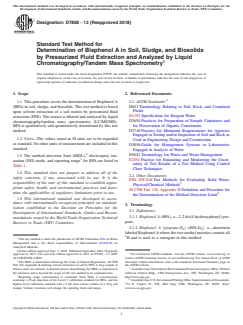
(Test Method)Standard Test Method for Determination of Bisphenol A in Soil, Sludge, and Biosolids by Pressurized Fluid Extraction and Analyzed by Liquid Chromatography/Tandem Mass Spectrometry
General Information
- Abstract
SIGNIFICANCE AND USE
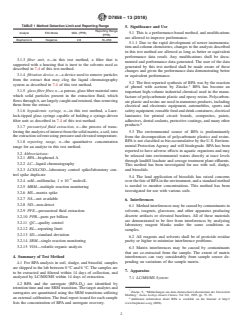
5.1 This is a performance-based method, and modifications are allowed to improve performance.
5.1.1 Due to the rapid development of newer instrumentation and column chemistries, changes to the analysis described in this test method are allowed as long as better or equivalent performance data result. Any modifications shall be documented and performance data generated. The user of the data generated by this test method shall be made aware of these changes and given the performance data demonstrating better or equivalent performance.
5.2 The first reported synthesis of BPA was by the reaction of phenol with acetone by Zincke.7 BPA has become an important high-volume industrial chemical used in the manufacture of polycarbonate plastic and epoxy resins. Polycarbonate plastic and resins are used in numerous products, including electrical and electronic equipment, automobiles, sports and safety equipment, reusable food and drink containers, electrical laminates for printed circuit boards, composites, paints, adhesives, dental sealants, protective coatings, and many other products.8
5.3 The environmental source of BPA is predominantly from the decomposition of polycarbonate plastics and resins. BPA is not classified as bio-accumulative by the U.S. Environmental Protection Agency and will biodegrade. BPA has been reported to have adverse effects in aquatic organisms and may be released into environmental waters directly at trace levels through landfill leachate and sewage treatment plant effluents. This method has been investigated for use with soil, sludge, and biosolids.
5.4 The land application of biosolids has raised concerns over the fate of BPA in the environment, and a standard method is needed to monitor concentrations. This method has been investigated for use with various soils.
SCOPE
1.1 This procedure covers the determination of Bisphenol A (BPA) in soil, sludge, and biosolids. This test method is based upon solvent extraction of a soil matrix by pressurized fluid extraction (PFE). The extract is filtered and analyzed by liquid chromatography/tandem mass spectrometry (LC/MS/MS). BPA is qualitatively and quantitatively determined by this test method.
1.2 Units—The values stated in SI units are to be regarded as standard. No other units of measurement are included in this standard.
1.3 The method detection limit (MDL),2 electrospray ionization (ESI) mode, and reporting range3 for BPA are listed in Table 1.
1.4 This standard does not purport to address all of the safety concerns, if any, associated with its use. It is the responsibility of the user of this standard to establish appropriate safety, health, and environmental practices and determine the applicability of regulatory limitations prior to use.
1.5 This international standard was developed in accordance with internationally recognized principles on standardization established in the Decision on Principles for the Development of International Standards, Guides and Recommendations issued by the World Trade Organization Technical Barriers to Trade (TBT) Committee.
- Status
- Published
- Publication Date
- 31-Aug-2018
- Technical Committee
- D34 - Waste Management
- Drafting Committee
- D34.01.06 - Analytical Methods
Overview
ASTM D7858-13(2018) is the standard test method for determining Bisphenol A (BPA) in soil, sludge, and biosolids utilizing pressurized fluid extraction (PFE) followed by analysis via liquid chromatography/tandem mass spectrometry (LC/MS/MS). Developed by ASTM International, this method provides a reliable approach for detecting and quantifying trace levels of BPA in various environmental matrices. BPA, a key component in manufacturing polycarbonate plastics and epoxy resins, has raised environmental and health concerns due to its widespread use and potential release into the environment.
Key Topics
Performance-Based Flexibility:
The method allows modifications to accommodate advancements in instrumentation or column chemistries, provided that any changes are documented and supported by equivalent or improved performance data.Pressurized Fluid Extraction (PFE):
BPA is extracted from samples using PFE, which enhances efficiency and consistency in isolating analytes from complex solid matrices such as soil, sludge, and biosolids.LC/MS/MS Detection:
Extracted analytes are analyzed via liquid chromatography coupled with tandem mass spectrometry, offering high sensitivity and specificity for both qualitative and quantitative BPA determinations.Quality Control (QC):
The standard stipulates rigorous calibration, quality control, and validation steps (including method detection limits and reporting limits), ensuring accuracy and reproducibility across laboratories.Environmental Significance:
The standard addresses the importance of monitoring BPA as its presence in the environment is mainly due to the degradation of plastics and resins, with documented adverse effects on aquatic organisms.
Applications
Environmental Monitoring:
This standard is crucial for environmental laboratories, regulatory agencies, and researchers assessing BPA contamination in soils, sewage sludge, and biosolids-especially where biosolids are land-applied.Waste Management Compliance:
Facilities managing solid waste, biosolids, and sludge can employ this method to fulfill regulatory obligations and demonstrate compliance with environmental safety standards related to endocrine-disrupting compounds.Product Impact Assessment:
Companies that manufacture or handle products containing polycarbonate plastics and epoxy resins may use this test method to evaluate the potential environmental impact of BPA leaching from their products or operations.Remediation Projects:
Environmental consultants and remediation professionals use this method to assess contamination levels at sites impacted by BPA and monitor cleanup effectiveness.
Related Standards
- ASTM D653 – Terminology Relating to Soil, Rock, and Contained Fluids
- ASTM D1193 – Specification for Reagent Water
- ASTM D3694 – Practices for Preparation of Sample Containers and for Preservation of Organic Constituents
- ASTM D3740 – Practice for Minimum Requirements for Agencies Engaged in Testing and/or Inspection of Soil and Rock
- ASTM D3856 – Guide for Management Systems in Laboratories Engaged in Analysis of Water
- EPA SW-846 – Test Methods for Evaluating Solid Waste, Physical/Chemical Methods
- 40 CFR Part 136, Appendix B – Definition and Procedure for the Determination of the Method Detection Limit
Practical Value
Implementing ASTM D7858-13(2018) ensures accurate, performance-based detection of BPA in a variety of matrices, supporting environmental assessments, regulatory compliance, and public health initiatives. The method’s allowance for technological updates and its comprehensive QC requirements make it especially valuable in laboratories committed to high-quality environmental testing. By following this standard, practitioners gain confidence in both the precision and reliability of their BPA determination results.
Relations
- Effective Date
- 01-Sep-2018
- Effective Date
- 01-Apr-2024
- Effective Date
- 01-Nov-2023
- Effective Date
- 01-Nov-2023
- Effective Date
- 01-Oct-2019
- Effective Date
- 01-Nov-2018
- Effective Date
- 01-Apr-2018
- Effective Date
- 01-Apr-2018
- Effective Date
- 01-Sep-2017
- Effective Date
- 01-Nov-2016
- Effective Date
- 01-Feb-2016
- Effective Date
- 01-Aug-2014
- Effective Date
- 01-Apr-2013
- Effective Date
- 01-Feb-2013
- Effective Date
- 01-May-2012
Get Certified
Connect with accredited certification bodies for this standard

CIS Institut d.o.o.
Personal Protective Equipment (PPE) certification body. Notified Body NB-2890 for EU Regulation 2016/425 PPE.

Kiwa BDA Testing
Building and construction product certification.
Kmetijski inštitut Slovenije
Agricultural Institute of Slovenia. Soil testing, plant health, agricultural product analysis.
Sponsored listings
Frequently Asked Questions
ASTM D7858-13(2018) is a standard published by ASTM International. Its full title is "Standard Test Method for Determination of Bisphenol A in Soil, Sludge, and Biosolids by Pressurized Fluid Extraction and Analyzed by Liquid Chromatography/Tandem Mass Spectrometry". This standard covers: SIGNIFICANCE AND USE 5.1 This is a performance-based method, and modifications are allowed to improve performance. 5.1.1 Due to the rapid development of newer instrumentation and column chemistries, changes to the analysis described in this test method are allowed as long as better or equivalent performance data result. Any modifications shall be documented and performance data generated. The user of the data generated by this test method shall be made aware of these changes and given the performance data demonstrating better or equivalent performance. 5.2 The first reported synthesis of BPA was by the reaction of phenol with acetone by Zincke.7 BPA has become an important high-volume industrial chemical used in the manufacture of polycarbonate plastic and epoxy resins. Polycarbonate plastic and resins are used in numerous products, including electrical and electronic equipment, automobiles, sports and safety equipment, reusable food and drink containers, electrical laminates for printed circuit boards, composites, paints, adhesives, dental sealants, protective coatings, and many other products.8 5.3 The environmental source of BPA is predominantly from the decomposition of polycarbonate plastics and resins. BPA is not classified as bio-accumulative by the U.S. Environmental Protection Agency and will biodegrade. BPA has been reported to have adverse effects in aquatic organisms and may be released into environmental waters directly at trace levels through landfill leachate and sewage treatment plant effluents. This method has been investigated for use with soil, sludge, and biosolids. 5.4 The land application of biosolids has raised concerns over the fate of BPA in the environment, and a standard method is needed to monitor concentrations. This method has been investigated for use with various soils. SCOPE 1.1 This procedure covers the determination of Bisphenol A (BPA) in soil, sludge, and biosolids. This test method is based upon solvent extraction of a soil matrix by pressurized fluid extraction (PFE). The extract is filtered and analyzed by liquid chromatography/tandem mass spectrometry (LC/MS/MS). BPA is qualitatively and quantitatively determined by this test method. 1.2 Units—The values stated in SI units are to be regarded as standard. No other units of measurement are included in this standard. 1.3 The method detection limit (MDL),2 electrospray ionization (ESI) mode, and reporting range3 for BPA are listed in Table 1. 1.4 This standard does not purport to address all of the safety concerns, if any, associated with its use. It is the responsibility of the user of this standard to establish appropriate safety, health, and environmental practices and determine the applicability of regulatory limitations prior to use. 1.5 This international standard was developed in accordance with internationally recognized principles on standardization established in the Decision on Principles for the Development of International Standards, Guides and Recommendations issued by the World Trade Organization Technical Barriers to Trade (TBT) Committee.
SIGNIFICANCE AND USE 5.1 This is a performance-based method, and modifications are allowed to improve performance. 5.1.1 Due to the rapid development of newer instrumentation and column chemistries, changes to the analysis described in this test method are allowed as long as better or equivalent performance data result. Any modifications shall be documented and performance data generated. The user of the data generated by this test method shall be made aware of these changes and given the performance data demonstrating better or equivalent performance. 5.2 The first reported synthesis of BPA was by the reaction of phenol with acetone by Zincke.7 BPA has become an important high-volume industrial chemical used in the manufacture of polycarbonate plastic and epoxy resins. Polycarbonate plastic and resins are used in numerous products, including electrical and electronic equipment, automobiles, sports and safety equipment, reusable food and drink containers, electrical laminates for printed circuit boards, composites, paints, adhesives, dental sealants, protective coatings, and many other products.8 5.3 The environmental source of BPA is predominantly from the decomposition of polycarbonate plastics and resins. BPA is not classified as bio-accumulative by the U.S. Environmental Protection Agency and will biodegrade. BPA has been reported to have adverse effects in aquatic organisms and may be released into environmental waters directly at trace levels through landfill leachate and sewage treatment plant effluents. This method has been investigated for use with soil, sludge, and biosolids. 5.4 The land application of biosolids has raised concerns over the fate of BPA in the environment, and a standard method is needed to monitor concentrations. This method has been investigated for use with various soils. SCOPE 1.1 This procedure covers the determination of Bisphenol A (BPA) in soil, sludge, and biosolids. This test method is based upon solvent extraction of a soil matrix by pressurized fluid extraction (PFE). The extract is filtered and analyzed by liquid chromatography/tandem mass spectrometry (LC/MS/MS). BPA is qualitatively and quantitatively determined by this test method. 1.2 Units—The values stated in SI units are to be regarded as standard. No other units of measurement are included in this standard. 1.3 The method detection limit (MDL),2 electrospray ionization (ESI) mode, and reporting range3 for BPA are listed in Table 1. 1.4 This standard does not purport to address all of the safety concerns, if any, associated with its use. It is the responsibility of the user of this standard to establish appropriate safety, health, and environmental practices and determine the applicability of regulatory limitations prior to use. 1.5 This international standard was developed in accordance with internationally recognized principles on standardization established in the Decision on Principles for the Development of International Standards, Guides and Recommendations issued by the World Trade Organization Technical Barriers to Trade (TBT) Committee.
ASTM D7858-13(2018) is classified under the following ICS (International Classification for Standards) categories: 13.080.10 - Chemical characteristics of soils. The ICS classification helps identify the subject area and facilitates finding related standards.
ASTM D7858-13(2018) has the following relationships with other standards: It is inter standard links to ASTM D7858-13, ASTM D3694-96(2024), ASTM D3740-23, ASTM D5681-23, ASTM D3740-19, ASTM D5681-18, ASTM E2554-18, ASTM E2554-18e1, ASTM D5681-17, ASTM D5681-16a, ASTM D5681-16, ASTM D653-14, ASTM E2554-13, ASTM D5681-13, ASTM D3740-12a. Understanding these relationships helps ensure you are using the most current and applicable version of the standard.
ASTM D7858-13(2018) is available in PDF format for immediate download after purchase. The document can be added to your cart and obtained through the secure checkout process. Digital delivery ensures instant access to the complete standard document.
Standards Content (Sample)
This international standard was developed in accordance with internationally recognized principles on standardization established in the Decision on Principles for the
Development of International Standards, Guides and Recommendations issued by the World Trade Organization Technical Barriers to Trade (TBT) Committee.
Designation: D7858 − 13 (Reapproved 2018)
Standard Test Method for
Determination of Bisphenol A in Soil, Sludge, and Biosolids
by Pressurized Fluid Extraction and Analyzed by Liquid
Chromatography/Tandem Mass Spectrometry
This standard is issued under the fixed designation D7858; the number immediately following the designation indicates the year of
original adoption or, in the case of revision, the year of last revision.Anumber in parentheses indicates the year of last reapproval.A
superscript epsilon (´) indicates an editorial change since the last revision or reapproval.
1. Scope 2. Referenced Documents
1.1 ThisprocedurecoversthedeterminationofBisphenolA 2.1 ASTM Standards:
D653Terminology Relating to Soil, Rock, and Contained
(BPA) in soil, sludge, and biosolids. This test method is based
Fluids
upon solvent extraction of a soil matrix by pressurized fluid
D1193Specification for Reagent Water
extraction (PFE).The extract is filtered and analyzed by liquid
D3694Practices for Preparation of Sample Containers and
chromatography/tandem mass spectrometry (LC/MS/MS).
for Preservation of Organic Constituents
BPAis qualitatively and quantitatively determined by this test
D3740Practice for Minimum Requirements for Agencies
method.
Engaged inTesting and/or Inspection of Soil and Rock as
1.2 Units—The values stated in SI units are to be regarded
Used in Engineering Design and Construction
asstandard.Nootherunitsofmeasurementareincludedinthis
D3856Guide for Management Systems in Laboratories
standard.
Engaged in Analysis of Water
D5681Terminology for Waste and Waste Management
1.3 The method detection limit (MDL), electrospray ion-
E2554Practice for Estimating and Monitoring the Uncer-
ization (ESI) mode, and reporting range for BPAare listed in
tainty of Test Results of a Test Method Using Control
Table 1.
Chart Techniques
1.4 This standard does not purport to address all of the
2.2 Other Documents:
safety concerns, if any, associated with its use. It is the
EPA SW-846Test Methods for Evaluating Solid Waste,
responsibility of the user of this standard to establish appro-
Physical/Chemical Methods
priate safety, health, and environmental practices and deter-
40 CFR Part 136,Appendix BDefinition and Procedure for
mine the applicability of regulatory limitations prior to use. 6
the Determination of the Method Detection Limit
1.5 This international standard was developed in accor-
dance with internationally recognized principles on standard-
3. Terminology
ization established in the Decision on Principles for the
3.1 Definitions:
Development of International Standards, Guides and Recom-
3.1.1 Bisphenol A (BPA), n—2,2-bis(4-hydroxyphenyl) pro-
mendations issued by the World Trade Organization Technical
pane.
Barriers to Trade (TBT) Committee.
3.1.2 Bisphenol A (propane-D ) (BPA-D ), n—deuterium
6 6
labeledBisphenolAwherethetwomethylmoietiescontainall
1 H and is used as a surrogate in this method.
This test method is under the jurisdiction ofASTM Committee D34 on Waste
Management and is the direct responsibility of Subcommittee D34.01.06 on
Analytical Methods.
Current edition approved Sept. 1, 2018. Published September 2018. Originally
approved in 2013. Last previous edition approved in 2013 as D7858–13. DOI: For referenced ASTM standards, visit the ASTM website, www.astm.org, or
10.1520/D7858-13R18. contact ASTM Customer Service at service@astm.org. For Annual Book of ASTM
The MDL is determined following the Code of Federal Regulations, 40 CFR Standardsvolumeinformation,refertothestandard’sDocumentSummarypageon
Part 136,Appendix B utilizing solvent extraction of soil by PFE.A10-g sample of the ASTM website.
Ottawa sand was utilized.Adetailed process determining the MDL is explained in AvailablefromUnitedStatesEnvironmentalProtectionAgency(EPA),William
the reference and is beyond the scope of this test method to be explained here. Jefferson Clinton Bldg., 1200 Pennsylvania Ave., NW, Washington, DC 20460,
Reporting range concentration is calculated from Table 4 concentrations http://www.epa.gov.
assuming a 25-µL injection of the Level 1 calibration standard for BPA, and the AvailablefromU.S.GovernmentPrintingOfficeSuperintendentofDocuments,
highest level calibration standard with a 5-mL final extract volume of a 10-g soil 732 N. Capitol St., NW, Mail Stop: SDE, Washington, DC 20401, http://
sample. Volume variations will change the reporting limit and ranges. www.access.gpo.gov.
Copyright © ASTM International, 100 Barr Harbor Drive, PO Box C700, West Conshohocken, PA 19428-2959. United States
D7858 − 13 (2018)
TABLE 1 Method Detection Limit and Reporting Range
5. Significance and Use
Reporting Range
Analyte ESI Mode MDL (PPB) 5.1 This is a performance-based method, and modifications
(PPB)
are allowed to improve performance.
Bisphenol A Negative 2.8 10–250
5.1.1 Due to the rapid development of newer instrumenta-
tionandcolumnchemistries,changestotheanalysisdescribed
in this test method are allowed as long as better or equivalent
performance data result. Any modifications shall be docu-
3.1.3 filter unit, n—in this test method, a filter that is
mented and performance data generated. The user of the data
supported with a housing that is inert to the solvents used as
generated by this test method shall be made aware of these
described in 7.4 of this test method.
changes and given the performance data demonstrating better
3.1.4 filtration device, n—a device used to remove particles
or equivalent performance.
from the extract that may clog the liquid chromatography
5.2 The first reported synthesis of BPAwas by the reaction
system as described in 7.4 of this test method.
of phenol with acetone by Zincke. BPA has become an
3.1.5 glass fiber filter, n—a porous, glass fiber material onto
important high-volume industrial chemical used in the manu-
which solid particles present in the extraction fluid, which
facture of polycarbonate plastic and epoxy resins. Polycarbon-
flowsthroughit,arelargelycaughtandretained,thusremoving
ateplasticandresinsareusedinnumerousproducts,including
them from the extract.
electrical and electronic equipment, automobiles, sports and
safetyequipment,reusablefoodanddrinkcontainers,electrical
3.1.6 hypodermic syringe, n—in this test method, a Luer-
lock-tipped glass syringe capable of holding a syringe-driven laminates for printed circuit boards, composites, paints,
adhesives, dental sealants, protective coatings, and many other
filter unit as described in 7.4 of this test method.
products.
3.1.7 pressurized fluid extraction, n—the process of trans-
ferringtheanalytesofinterestfromthesolidmatrix,asoil,into 5.3 The environmental source of BPA is predominantly
theextractionsolventusingpressureandelevatedtemperature.
from the decomposition of polycarbonate plastics and resins.
BPAisnotclassifiedasbio-accumulativebytheU.S.Environ-
3.1.8 reporting range, n—the quantitative concentration
mental Protection Agency and will biodegrade. BPA has been
range for an analyte in this test method.
reported to have adverse effects in aquatic organisms and may
3.2 Abbreviations:
be released into environmental waters directly at trace levels
3.2.1 BPA—bisphenol A
through landfill leachate and sewage treatment plant effluents.
3.2.2 LC—liquid chromatography
This method has been investigated for use with soil, sludge,
and biosolids.
3.2.3 LCS/LCSD—laboratory control spike/laboratory con-
trol spike duplicate
5.4 The land application of biosolids has raised concerns
–3
3.2.4 mM—millimolar,1×10 moles/L overthefateofBPAintheenvironment,andastandardmethod
is needed to monitor concentrations. This method has been
3.2.5 MRM—multiple reaction monitoring
investigated for use with various soils.
3.2.6 MS—matrix spike
3.2.7 NA—not available
6. Interferences
3.2.8 ND—non-detect
6.1 Methodinterferencesmaybecausedbycontaminantsin
3.2.9 PFE—pressurized fluid extraction solvents, reagents, glassware, and other apparatus producing
discrete artifacts or elevated baselines. All of these materials
3.2.10 PPB—parts per billion
are demonstrated to be free from interferences by analyzing
3.2.11 QC—quality control
laboratory reagent blanks under the same conditions as
3.2.12 RL—reporting limit
samples.
3.2.13 SD—standard deviation
6.2 All reagents and solvents shall be of pesticide residue
3.2.14 SRM—single reaction monitoring purity or higher to minimize interference problems.
3.2.15 VOA—volatile organic analysis
6.3 Matrix interferences may be caused by contaminants
that are co-extracted from the sample. The extent of matrix
4. Summary of Test Method
interferences can vary considerably from sample source de-
pending on variations of the sample matrix.
4.1 For BPA analysis in soil, sludge, and biosolid, samples
are shipped to the lab between 0°C and 6°C.The samples are
7. Apparatus
to be extracted and filtered within 14 days of collection, and
analyzed by LC/MS/MS within 14 days of extraction. 7.1 LC/MS/MS System:
4.2 BPA and the surrogate (BPA-D ) are identified by
retentiontimeandoneSRMtransition.Thetargetanalytesand
Zincke, T., “Mittheilungen aus dem chemischen Laboratorium der Universitat
surrogates are quantitated using the SRM transitions utilizing
Marburg,” Justus Leibigs Annals Chemie, Vol 343, 1905, pp. 75–79.
an external calibration.The final report issued for each sample
Additional information about BPA is available on the Internet at http://
lists the concentration of BPA and surrogate recovery. www.bisphenol-a.org (2008).
D7858 − 13 (2018)
7.1.1 Liquid Chromatography (LC) System —A complete 7.4.1.1 A 10-mL lock-tip glass syringe size is
LC system is required in order to analyze samples. An LC recommended, since a 3-mL sample extract results after
system that is capable of performing at the flows, pressures, blow-down.
controlled temperatures, sample volumes, and requirements of 7.4.2 Filter Unit —Filter units of polyvinylidene fluoride
the standard shall be used. (PVDF) with a glass fiber prefilter were used to filter the PFE
extracts.
7.1.2 Analytical Column —A column that achieves ad-
7.4.3 Discussion—A filter unit shall be used that meets the
equate resolution shall be used. The retention times and order
requirements of the test method.
ofelutionmaychangedependingonthecolumnusedandneed
to be monitored. A reverse-phase analytical column that
8. Reagents and Materials
combines the desirable characteristics of a reversed-phase
8.1 Purity of Reagents—High-performance liquid chroma-
HPLC column with the ability to separate polar compounds
was used to develop this test method. tography (HPLC) pesticide residue analysis and
spectrophotometry-grade chemicals shall be used in all tests.
7.1.3 Tandem Mass Spectrometer (MS/MS) System —A
Unlessindicatedotherwise,itisintendedthatallreagentsshall
MS/MS system capable of multiple reaction monitoring
conform to the Committee on Analytical Reagents of the
(MRM)analysis,oranysystemthatiscapableofperformingat
American Chemical Society. Other reagent grades may be
the requirements in this test method, shall be used.
used, provided they are first determined to be of sufficiently
7.2 Pressurized Fluid Extraction Device (PFE):
highpuritytopermittheirusewithoutaffectingtheaccuracyof
7.2.1 A PFE system was used for this test method with
the measurements.
appropriatelysizedextractioncells.Cellsareavailablethatwill
8.2 Purity of Water—Unless otherwise indicated, references
accommodate the 10-g sample sizes used in this test method.
to water shall mean reagent water conforming toASTM Type
Cells shall be made of stainless steel or other material capable
I of Specification D1193. It must be demonstrated that this
of withstanding the pressure requirements (≥2000 psi) neces-
water does not contain contaminants at concentrations suffi-
sary for this procedure. A pressurized fluid extraction device
cient to interfere with the analysis.
shall be used that can meet the necessary requirements in this
8.3 Gases—Nitrogen (purity ≥97 %) and argon (purity
test method.
≥99.999 %).
7.2.2 Glass Fiber Filters.
7.2.3 Amber VOA Vials—60 mL, for sample extracts for 8.4 Acetonitrile (CH CN, CAS # 75-05-8).
PFE.
8.5 Ethyl acetate (CH COOC H , CAS # 141-78-6).
3 2 5
7.3 Organic Solvent Evaporation Device.
8.6 2-Propanol (C H O, CAS # 67-63-0).
3 8
7.4 Filtration Device: 8.7 Methanol (CH OH, CAS # 67-56-1).
7.4.1 Hypodermic Syringe—A Luer-lock tip glass syringe
8.8 Ammonium acetate (CH CO NH , CAS # 631-61-8).
3 2 4
capable of holding a syringe-driven filter unit.
8.9 Bisphenol A (C H O , 2,2’-Bis(4-hydroxyphenyl)
15 16 2
propane, CAS # 80-05-7).
8.10 Bisphenol A (Propane-D ) represents deuterium la-
9 6
A Waters Acquity UPLC® H-Class System was used to develop this test
beled Bisphenol A where the two methyl moieties contain all
method and generate the precision and bias data presented in Section 16. Waters
H.
Corporation, Milford, MA01757. Instrumentation from other vendors may also be
able to generate similar method performance.
8.10.1 Discussion—BPA-D is used as a surrogate in this
A Waters-UPLC® T3, 100 mm x 2.1 mm, 1.8-µm particle size, was used to
test method.
develop this test method and generate the precision and bias data presented in
Section 16. Waters Corporation, Milford, MA01757. Columns from other vendors
8.11 Ottawa sand (CAS # 14808-60-7) or equivalent.
that are able to generate similar method performance and that achieve adequate
resolution may be used. A guard column was also used, VanGuard™ Pre-Column, 8.12 Drying agent.
2.1 × 5 mm, 1.8-µm particle size.
11 8.13 Sodium sulfate (Na SO , CAS # 7757-82-6).
AWatersQuattromicro™APImassspectrometerwasusedtodevelopthistest 2 4
method and generate the precision and bias data presented in Section 16. Waters
Corporation, Milford, MA01757. Instrumentation from other vendors may also be
able to generate similar method performance. Pall®-Acrodisc® Premium 25-mm Syringe Filter with GxF/0.2 µm PVDF
ADionexAccelerated Solvent Extraction (ASE® 200) system with appropri- Membrane (Pall Corporation, Catalog # AP-4793, were used to develop this test
ately sized extraction cells was used to develop this test method and generate the method and generate the precision and bias data presented in Section 16. Filters
precisionandbiasdatapresentedinSection16.DionexCorporation,Sunnyvale,CA from other vendors may also be able to generate similar method performance.
94088. Instrumentation from other vendors may also be able to generate similar Reagent Chemicals, American Chemical Society Specifications, American
method performance. Chemical Society, Washington, DC. For suggestions on the testing of reagents not
Whatman Glass Fiber Filters 19.8 mm, Dionex Corporation, Part # 047017 listed by the American Chemical Society, see Analar Standards for Laboratory
specially designed for the PFE system were used to develop this test method and Chemicals, BDH Ltd., Poole, Dorset, U.K., and the United States Pharmacopeia
generate the precision and bias data presented in Section 16. Filters from other and National Formulary, U.S. Pharmacopeial Convention, Inc. (USPC), Rockville,
vendors may also be able to generate similar method performance. MD.
14 17
A TurboVap LV was used in this test method from Caliper Life Sciences, Varian-Chem Tube-Hydromatrix®, 1 kg (Part # 198003) was used to develop
Hopkinton,MA01748andanN-Evap24-portnitrogenevaporationdevicewasused thistestmethodandgeneratetheprecisionandbiasdatapresentedinSection16by
in this test method from Organomation Associates Inc., West Berlin, MA 01503. recommendation of the PFE manufacturer. Drying agent from other vendors may
In-house built or devices from other vendors may also be able to generate similar also be able to generate similar method performance. Note—Some drying agents
methodperformance. have been shown to clog PFE transfer lines.
D7858 − 13 (2018)
TABLE 2 Gradient Conditions for Liquid Chromatography
8.14 Sodium chloride (NaCl, CAS # 7647-14-5).
Percent
9. Hazards Percent 100 mM
Time Flow Percent 95 % NH OAc
9.1 Normal laboratory safety applies to this method. Ana-
(min) (µL/min) CH CN Water: 5 % in 95 %
CH CN Water: 5 %
lysts shall wear safety glasses, gloves, and lab coats when 3
CH CN
working in the lab. Analysts shall review the Material Safety
0 300 0 95 5
Data Sheets (MSDS) for all reagents used in this test method
1 300 0 95 5
and shall be fully trained to perform this test method.
3 300 50 45 5
4 300 60 35 5
6 300 70 25 5
10. Glassware Washing, Sampling, and Preservation
7 300 70 25 5
10.1 Glassware Washing—All glassware is washed in hot
9 300 95 0 5
12 300 95 0 5
tap water with a detergent and rinsed in hot water, thenASTM
13 300 0 95 5
TypeIofSpecificationD1193.Theglasswareisthendriedand
16 300 0 95 5
heated in an oven at 250°C for 15 to 30 min.All glassware is
subsequently cleaned with acetone and methanol, respectively.
Thecleanedglasswareshouldbeprotectedfromcontamination
by placing in a sealed cabinet or covering with foil to reduce
impurities from entering.
11.1.5 Specific instrument manufacturer wash and purge
10.2 Sampling—Grab samples must be collected in pre- specifications shall be followed in order to eliminate sample
cleaned glass jars with polytetrafluoroethylene (PTFE)-lined
carry-over in the analysis.
capsdemonstratedtobefreeofinterferences.Thistestmethod
11.2 Mass Spectrometer Parameters:
requires at least a 10-g sample size per analysis. A 100-g
11.2.1 To acquire the maximum number of data points per
sampleamountshouldbecollectedtoallowforqualitycontrol
SRM channel while maintaining adequate sensitivity, the tune
samples and re-analysis. Field blanks are needed to follow
parameters shall be optimized according to the instrument.
conventional sampling practices.
Eachpeakshouldhaveatleasttenscansperpeakforadequate
10.3 Preservation—Store samples between 0°C and 6°C
quantitation. Variable parameters regarding retention times,
from the time of collection until analysis. Extract the samples
SRM transitions, and cone and collision energies are shown in
within 14 days of collection. If the samples are above 6°C
Table 3. Mass spectrometer parameters used in the develop-
when received or during storage or not extracted within 14
ment of this method are listed below:
days of collection, the data are qualified and noted in the case
The instrument is set in the Electrospray source setting
narrativethataccompaniesthedatathattheywerenotextracted
Capillary Voltage: 3.5 kV
within the preliminary holding time. The sample extracts are
Cone: Variable depending on analyte (Table 3)
analyzed within 14 days of extraction or the data are qualified
Extractor: 2 V
RF Lens: 0.2 V
and noted in the case narrative that accompanies the data that
Source Temperature: 120 °C
they were not analyzed within the preliminary holding time.
Desolvation Temperature: 300 °C
Desolvation Gas Flow: 800 L/hr
11. Preparation of LC/MS/MS
Cone Gas Flow: 100 L/hr
Low-Mass Resolution 1: 14.0
11.1 LC Operating Conditions, used to develop this test
High-Mass Resolution 1: 14.0
method: Ion Energy 1: 0.6 V
Entrance Energy: –1 V
11.1.1 Injection volumes of all calibration standards and
Collision Energy: Variable depending on analyte (Table 3)
samples are 25 µL and are composed of 50 % water/50 %
Exit Energy: 1 V
methanol.The first sample analyzed after the calibration curve
Low-Mass Resolution 2: 14
High-Mass Resolution 2: 14
is a blank to ensure there is no carry-over. The gradient
Ion Energy 2: 1.5 V
conditions for the liquid chromatograph are shown in Table 2.
Multiplier: 650 V
11.1.2 Temperatures—Column, 35 °C; sample Gas Cell Pirani Gauge: 0.60 Pa
Inter-Channel Delay: 0.02 s
compartment, 20°C.
Inter-Scan Delay: 0.010 s
11.1.3 Wash Solvent—60 % acetonitrile/40 % 2-Propanol,
Repeats: 1
pre- and post-inject wash solvent: 6 s. Span: 0 Daltons
Dwell: 0.05 to 0.1 s to optimize scans
11.1.4 Purge Solvent—50 % water/50 % acetonitrile.
TABLE 3 Retention Times, SRM Transitions, and Analyte-Specific Mass Spectrometer Parameters
Retention Time SRM Mass Transition Cone Voltage Collision Energy
Analyte ESI Mode
(min) (Parent > Product) (Volts) (eV)
BPA negative 4.2 227.3 > 212.2 40 18
A
BPA confirmatory negative 4.2 227.3 > 133.1 40 25
BPA-D (Surrogate) negative 4.2 233.3 > 215.3 40 19
A
BPA-D confirmatory (Surrogate) negative 4.2 233.3 > 138.2 40 25
A
Confirmatory transitions are optional but should be included for added qualitative information.
D7858 − 13 (2018)
12. Calibration and Standardization mended.Eachcalibrationpointusedtogeneratethecurveshall
have a calculated percent deviation less than 30 % from the
12.1 The mass spectrometer shall be calibrated per manu-
generated curve. Refer to 12.2.4.1 and 12.2.4.2 to determine if
facturer specifications before analysis. In order to obtain valid
linear or quadratic calibration curves may be used.
andaccurateanalyticalvalueswithintheconfidencelimits,the
12.2.4.1 Linear calibration may be used if the coefficient of
following procedures shall be followed when performing the
determination, r , is >0.98 for the analyte. The point of origin
test method.
is excluded, and a fit weighting of 1/X is used in order to give
12.2 Calibration and Standardization—To calibrate the
more emphasis to the lower concentrations. If one of the
instrument, analyze seven calibration standards containing the
calibration standards other than the high or low point causes
seven concentration levels of BPA and surrogate prior to 2
ther ofthecurvetobe<0.98,thispointshallbere-injectedor
analysis as shown in Table 4. A calibration stock standard
anewcalibrationcurveshallberegenerated.Iftheloworhigh
solution is prepared from standard materials or purchased as
point, or both, is excluded, minimally a five-point curve is
certified solutions. Stock standard solution A (Level 7) con-
acceptable, the reporting range shall be modified to reflect this
tainingBPAandsurrogateispreparedatLevel7concentration,
change.
and aliquots of that solution are diluted in 50 % water/50 %
12.2.4.2 Quadraticcalibrationmaybeusedifthecoefficient
methanol to prepare Levels 1 through 6. The following steps
of determination, r , is >0.99 for the analyte. The point of
will produce standards with the concentration values shown in
origin is excluded, and a fit weighting of 1/X is used in order
Table 4. The analyst is responsible for recording initial
to give more emphasis to the lower concentrations. If one of
component weights carefully when working with pure materi-
thecalibrationstandards,otherthanthehighorlow,causesthe
als and correctly carrying the weights through the dilution
curve to be <0.99, this point shall be re-injected or a new
calculations. Calibration standards are not filtered.
calibrationcurveshallberegenerated.Iftheloworhighpoint,
12.2.1 Prepare stock standard solution A (Level 7) by
or both, is excluded, a six-point curve is acceptable using a
adding to a 25-mL volumetric flask 1.0 mL of target and
quadratic fit. An initial seven-point curve over the calibration
surrogatespikesolutions(12.4and12.6)anddilutingto25mL
range is suggested in the event that the low or high point must
with 50 % water/50 % methanol solution. The preparation of
be excluded to obtain a coefficient of determination >0.99. In
the Level 7 standard can be accomplished using different
this event, the reporting range shall be modified to reflect this
volumesandconcentrationsofstocksolutionsasisaccustomed
change.
in the individual laboratory. Depending on stock concentra-
12.2.5 The retention time window of the SRM transitions
tions prepared, the solubility at that concentration shall be
shall be within 5 % of the retention time of the analyte in a
ensured.
midpoint calibration standard.Amidpoint calibration standard
12.2.2 Aliquots of Solution A are then diluted with 50 %
is defined at or between Levels 3 and 5 in Table 4 in this test
water/50 % methanol to prepare the desired calibration levels
method. If this is not the case, re-analyze the calibration curve
in2-mLamberglassLCvialsatconcentrationsshowninTable
to determine if there was a shift in retention time during the
4. Calibration standards are not filtered. The calibration stan-
analysis and re-inject the sample. If the retention time is still
dard vials shall be used within 24 h to ensure optimum results.
incorrect in the sample, refer to the analyte as an unknown.
Stockcalibrationstandardsolutionsarereplacedevery28days
12.2.6 A midpoint calibration check standard shall be ana-
if not previously discarded for quality control failure.
lyzed at the end of each batch of 20 samples or within 24 h
12.2.3 Inject each calibration standard and obtain its chro-
after the initial calibration curve was generated. This end
matogram. External calibration curves are generated from the
calibration check shall be the same calibration standard that
calibration standards monitoring the SRM transition of each
wasusedtogeneratetheinitialcurve.Theresultsfromthe
...