

ASTM E2866-21
(Test Method)Standard Test Method for Determination of Diisopropyl Methylphosphonate, Ethyl Methylphosphonic Acid, Isopropyl Methylphosphonic Acid, Methylphosphonic Acid, and Pinacolyl Methylphosphonic Acid in Soil by Pressurized Fluid Extraction and Analyzed by Liquid Chromatography/Tandem Mass Spectrometry
General Information
- Abstract
SIGNIFICANCE AND USE
5.1 This is a performance-based method, and modifications are allowed to improve performance.
5.1.1 Due to the rapid development of newer instrumentation and column chemistries, changes to the analysis described in this standard are allowed as long as better or equivalent performance data result. Any modifications shall be documented and performance data generated. The user of the data generated by this standard shall be made aware of these changes and given the performance data demonstrating better or equivalent performance.
5.2 Organophosphate pesticides affect the nervous system by disrupting the enzyme that regulates acetylcholine, a neurotransmitter. They were developed during the early 19th century, but their effects on insects, which were similar to their effects on humans, were discovered in 1932. Some are poisonous and were used as chemical weapon agents. Organophosphate pesticides are usually not persistent in the environment.7,8
5.3 This test method is for the analysis of selected organophosphorous based pesticide degradation products.
5.4 This method has been investigated for use with various soils.
SCOPE
1.1 This procedure covers the determination of Diisopropyl Methylphosphonate (DIMP), Ethyl Methylphosphonic Acid (EMPA), Isopropyl Methylphosphonic Acid (IMPA), Methylphosphonic Acid (MPA), and Pinacolyl Methylphosphonic Acid (PMPA), referred to collectively as organophosphonates (OPs) in this test method, in soil. This method is based upon solvent extraction of a soil by pressurized fluid extraction (PFE). The extract is filtered and analyzed by liquid chromatography/tandem mass spectrometry (LC/MS/MS). OPs are qualitatively and quantitatively determined by this method.
1.2 Units—The values stated in SI units are to be regarded as standard. No other units of measurement are included in this standard.
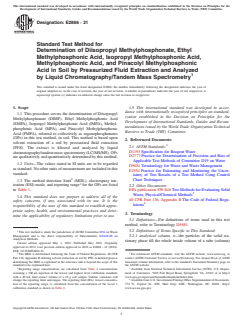
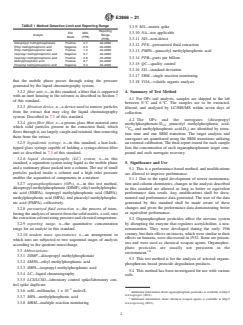
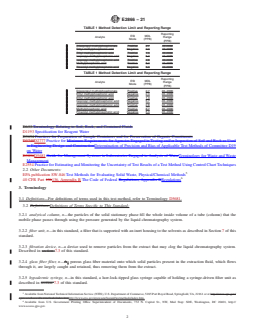
1.3 The method detection limit2 (MDL), electrospray ionization (ESI) mode, and reporting range3 for the OPs are listed in Table 1.
1.4 This standard does not purport to address all of the safety concerns, if any, associated with its use. It is the responsibility of the user of this standard to establish appropriate safety, health, and environmental practices and determine the applicability of regulatory limitations prior to use.
1.5 This international standard was developed in accordance with internationally recognized principles on standardization established in the Decision on Principles for the Development of International Standards, Guides and Recommendations issued by the World Trade Organization Technical Barriers to Trade (TBT) Committee.
- Status
- Published
- Publication Date
- 30-Apr-2021
- Technical Committee
- D34 - Waste Management
- Drafting Committee
- D34.01.06 - Analytical Methods
Buy Documents
ASTM E2866-21 - Standard Test Method for Determination of Diisopropyl Methylphosphonate, Ethyl Methylphosphonic Acid, Isopropyl Methylphosphonic Acid, Methylphosphonic Acid, and Pinacolyl Methylphosphonic Acid in Soil by Pressurized Fluid Extraction and Analyzed by Liquid Chromatography/Tandem Mass Spectrometry

REDLINE ASTM E2866-21 - Standard Test Method for Determination of Diisopropyl Methylphosphonate, Ethyl Methylphosphonic Acid, Isopropyl Methylphosphonic Acid, Methylphosphonic Acid, and Pinacolyl Methylphosphonic Acid in Soil by Pressurized Fluid Extraction and Analyzed by Liquid Chromatography/Tandem Mass Spectrometry
Overview
ASTM E2866-21 is an internationally recognized standard test method developed by ASTM International for the determination of specific organophosphonate compounds in soil samples. This standard utilizes pressurized fluid extraction (PFE) followed by analysis with liquid chromatography/tandem mass spectrometry (LC/MS/MS) to quantify and qualify the presence of diisopropyl methylphosphonate (DIMP), ethyl methylphosphonic acid (EMPA), isopropyl methylphosphonic acid (IMPA), methylphosphonic acid (MPA), and pinacolyl methylphosphonic acid (PMPA). These compounds are collectively known as organophosphonates (OPs), which often appear as degradation products from organophosphorus-based pesticides and chemical agents.
ASTM E2866-21 is a performance-based method, allowing laboratories to implement modifications that improve analytical performance as long as the new approach is well-documented and yields equivalent or better results. The standard is widely used in environmental monitoring, especially for the assessment of soil contamination by pesticide residues or related chemical substances.
Key Topics
- Target Analytes: The test method focuses on detection and quantification of five key organophosphonates-DIMP, EMPA, IMPA, MPA, and PMPA-in soil samples.
- Analytical Procedure:
- Extraction: Uses pressurized fluid extraction (PFE) to efficiently extract organophosphonates from soil matrices.
- Detection: Employs advanced liquid chromatography/tandem mass spectrometry (LC/MS/MS) for high sensitivity and specificity.
- Performance-Based Flexibility: Laboratories can adopt different instrumentation or column chemistries provided the performance criteria-such as method detection limits and reporting ranges for OPs-are met and fully documented.
- Quality Control: Includes requirements for quality assurance through surrogate spike recovery, method blanks, calibration, and laboratory control samples to ensure data reliability.
- Reporting Range: The standard defines method detection limits (MDLs) and reporting ranges, ensuring quantifiable results typically from 40 to 2000 parts per billion (ppb), depending on the analyte.
Applications
- Environmental Remediation: Facilitates the assessment and cleanup of sites contaminated by organophosphonate pesticide degradation products.
- Regulatory Compliance: Assists government agencies and environmental consultants in meeting regulatory requirements for soil monitoring related to hazardous substances.
- Research and Public Health: Supports scientific studies on the fate, transport, and environmental impact of organophosphate compounds, which are known to affect nervous system function.
- Emergency Response: Enables rapid quantification of chemical weapon agent degradation products during incident response and site investigations.
- Waste Management: Aids in evaluating soils for safe reuse, disposal, or treatment related to hazardous wastes.
Related Standards
- ASTM D653 – Terminology Relating to Soil, Rock, and Contained Fluids
- ASTM D1193 – Specification for Reagent Water
- ASTM D3694 – Practices for Preparation of Sample Containers and Preservation of Organic Constituents
- ASTM D2777 – Practice for Determination of Precision and Bias of Applicable Test Methods of Committee D19 on Water
- ASTM E2554 – Practice for Estimating and Monitoring the Uncertainty of Test Results of a Test Method Using Control Chart Techniques
- EPA SW-846 – Test Methods for Evaluating Solid Waste, Physical/Chemical Methods
Practical Value
- Accuracy and Traceability: The combination of PFE and LC/MS/MS offers highly accurate, reproducible results with established calibration routines and QC criteria.
- Adaptability: The performance-based approach provides flexibility, enabling laboratories to leverage advancements in analytical technologies while adhering to internationally recognized best practices.
- Comprehensive Scope: Suitable for a wide range of soil types, ensuring broad applicability in environmental science and cleanup projects.
- Safety and Documentation: Encourages rigorous safety, health, and environmental procedures, as well as thorough documentation of analytical methods and modifications.
By adhering to ASTM E2866-21, laboratories, regulatory bodies, and consultants can confidently assess soil for organophosphonate contamination using scientifically robust and internationally acknowledged methodology.
Relations
- Effective Date
- 01-Nov-2023
- Effective Date
- 01-Nov-2018
- Effective Date
- 01-Apr-2018
- Effective Date
- 01-Apr-2018
- Effective Date
- 01-Sep-2017
- Effective Date
- 01-Nov-2016
- Effective Date
- 01-Feb-2016
- Effective Date
- 01-Apr-2013
- Effective Date
- 01-Feb-2013
- Effective Date
- 15-Jun-2012
- Effective Date
- 01-Jul-2009
- Effective Date
- 01-Sep-2008
- Effective Date
- 15-Jan-2008
- Effective Date
- 01-May-2007
- Effective Date
- 15-Aug-2006
Buy Documents
ASTM E2866-21 - Standard Test Method for Determination of Diisopropyl Methylphosphonate, Ethyl Methylphosphonic Acid, Isopropyl Methylphosphonic Acid, Methylphosphonic Acid, and Pinacolyl Methylphosphonic Acid in Soil by Pressurized Fluid Extraction and Analyzed by Liquid Chromatography/Tandem Mass Spectrometry
REDLINE ASTM E2866-21 - Standard Test Method for Determination of Diisopropyl Methylphosphonate, Ethyl Methylphosphonic Acid, Isopropyl Methylphosphonic Acid, Methylphosphonic Acid, and Pinacolyl Methylphosphonic Acid in Soil by Pressurized Fluid Extraction and Analyzed by Liquid Chromatography/Tandem Mass Spectrometry
Get Certified
Connect with accredited certification bodies for this standard

CIS Institut d.o.o.
Personal Protective Equipment (PPE) certification body. Notified Body NB-2890 for EU Regulation 2016/425 PPE.

Kiwa BDA Testing
Building and construction product certification.
Kmetijski inštitut Slovenije
Agricultural Institute of Slovenia. Soil testing, plant health, agricultural product analysis.
Sponsored listings
Frequently Asked Questions
ASTM E2866-21 is a standard published by ASTM International. Its full title is "Standard Test Method for Determination of Diisopropyl Methylphosphonate, Ethyl Methylphosphonic Acid, Isopropyl Methylphosphonic Acid, Methylphosphonic Acid, and Pinacolyl Methylphosphonic Acid in Soil by Pressurized Fluid Extraction and Analyzed by Liquid Chromatography/Tandem Mass Spectrometry". This standard covers: SIGNIFICANCE AND USE 5.1 This is a performance-based method, and modifications are allowed to improve performance. 5.1.1 Due to the rapid development of newer instrumentation and column chemistries, changes to the analysis described in this standard are allowed as long as better or equivalent performance data result. Any modifications shall be documented and performance data generated. The user of the data generated by this standard shall be made aware of these changes and given the performance data demonstrating better or equivalent performance. 5.2 Organophosphate pesticides affect the nervous system by disrupting the enzyme that regulates acetylcholine, a neurotransmitter. They were developed during the early 19th century, but their effects on insects, which were similar to their effects on humans, were discovered in 1932. Some are poisonous and were used as chemical weapon agents. Organophosphate pesticides are usually not persistent in the environment.7,8 5.3 This test method is for the analysis of selected organophosphorous based pesticide degradation products. 5.4 This method has been investigated for use with various soils. SCOPE 1.1 This procedure covers the determination of Diisopropyl Methylphosphonate (DIMP), Ethyl Methylphosphonic Acid (EMPA), Isopropyl Methylphosphonic Acid (IMPA), Methylphosphonic Acid (MPA), and Pinacolyl Methylphosphonic Acid (PMPA), referred to collectively as organophosphonates (OPs) in this test method, in soil. This method is based upon solvent extraction of a soil by pressurized fluid extraction (PFE). The extract is filtered and analyzed by liquid chromatography/tandem mass spectrometry (LC/MS/MS). OPs are qualitatively and quantitatively determined by this method. 1.2 Units—The values stated in SI units are to be regarded as standard. No other units of measurement are included in this standard. 1.3 The method detection limit2 (MDL), electrospray ionization (ESI) mode, and reporting range3 for the OPs are listed in Table 1. 1.4 This standard does not purport to address all of the safety concerns, if any, associated with its use. It is the responsibility of the user of this standard to establish appropriate safety, health, and environmental practices and determine the applicability of regulatory limitations prior to use. 1.5 This international standard was developed in accordance with internationally recognized principles on standardization established in the Decision on Principles for the Development of International Standards, Guides and Recommendations issued by the World Trade Organization Technical Barriers to Trade (TBT) Committee.
SIGNIFICANCE AND USE 5.1 This is a performance-based method, and modifications are allowed to improve performance. 5.1.1 Due to the rapid development of newer instrumentation and column chemistries, changes to the analysis described in this standard are allowed as long as better or equivalent performance data result. Any modifications shall be documented and performance data generated. The user of the data generated by this standard shall be made aware of these changes and given the performance data demonstrating better or equivalent performance. 5.2 Organophosphate pesticides affect the nervous system by disrupting the enzyme that regulates acetylcholine, a neurotransmitter. They were developed during the early 19th century, but their effects on insects, which were similar to their effects on humans, were discovered in 1932. Some are poisonous and were used as chemical weapon agents. Organophosphate pesticides are usually not persistent in the environment.7,8 5.3 This test method is for the analysis of selected organophosphorous based pesticide degradation products. 5.4 This method has been investigated for use with various soils. SCOPE 1.1 This procedure covers the determination of Diisopropyl Methylphosphonate (DIMP), Ethyl Methylphosphonic Acid (EMPA), Isopropyl Methylphosphonic Acid (IMPA), Methylphosphonic Acid (MPA), and Pinacolyl Methylphosphonic Acid (PMPA), referred to collectively as organophosphonates (OPs) in this test method, in soil. This method is based upon solvent extraction of a soil by pressurized fluid extraction (PFE). The extract is filtered and analyzed by liquid chromatography/tandem mass spectrometry (LC/MS/MS). OPs are qualitatively and quantitatively determined by this method. 1.2 Units—The values stated in SI units are to be regarded as standard. No other units of measurement are included in this standard. 1.3 The method detection limit2 (MDL), electrospray ionization (ESI) mode, and reporting range3 for the OPs are listed in Table 1. 1.4 This standard does not purport to address all of the safety concerns, if any, associated with its use. It is the responsibility of the user of this standard to establish appropriate safety, health, and environmental practices and determine the applicability of regulatory limitations prior to use. 1.5 This international standard was developed in accordance with internationally recognized principles on standardization established in the Decision on Principles for the Development of International Standards, Guides and Recommendations issued by the World Trade Organization Technical Barriers to Trade (TBT) Committee.
ASTM E2866-21 is classified under the following ICS (International Classification for Standards) categories: 13.080.10 - Chemical characteristics of soils. The ICS classification helps identify the subject area and facilitates finding related standards.
ASTM E2866-21 has the following relationships with other standards: It is inter standard links to ASTM D5681-23, ASTM D5681-18, ASTM E2554-18e1, ASTM E2554-18, ASTM D5681-17, ASTM D5681-16a, ASTM D5681-16, ASTM E2554-13, ASTM D5681-13, ASTM D2777-12, ASTM D5681-09, ASTM D5681-08, ASTM D2777-08, ASTM E2554-07, ASTM D2777-06. Understanding these relationships helps ensure you are using the most current and applicable version of the standard.
ASTM E2866-21 is available in PDF format for immediate download after purchase. The document can be added to your cart and obtained through the secure checkout process. Digital delivery ensures instant access to the complete standard document.
Standards Content (Sample)
This international standard was developed in accordance with internationally recognized principles on standardization established in the Decision on Principles for the
Development of International Standards, Guides and Recommendations issued by the World Trade Organization Technical Barriers to Trade (TBT) Committee.
Designation: E2866 − 21
Standard Test Method for
Determination of Diisopropyl Methylphosphonate, Ethyl
Methylphosphonic Acid, Isopropyl Methylphosphonic Acid,
Methylphosphonic Acid, and Pinacolyl Methylphosphonic
Acid in Soil by Pressurized Fluid Extraction and Analyzed
by Liquid Chromatography/Tandem Mass Spectrometry
This standard is issued under the fixed designation E2866; the number immediately following the designation indicates the year of
original adoption or, in the case of revision, the year of last revision.Anumber in parentheses indicates the year of last reapproval.A
superscript epsilon (´) indicates an editorial change since the last revision or reapproval.
1. Scope 1.5 This international standard was developed in accor-
dance with internationally recognized principles on standard-
1.1 This procedure covers the determination of Diisopropyl
ization established in the Decision on Principles for the
Methylphosphonate (DIMP), Ethyl Methylphosphonic Acid
Development of International Standards, Guides and Recom-
(EMPA), Isopropyl Methylphosphonic Acid (IMPA), Methyl-
mendations issued by the World Trade Organization Technical
phosphonic Acid (MPA), and Pinacolyl Methylphosphonic
Barriers to Trade (TBT) Committee.
Acid (PMPA), referred to collectively as organophosphonates
(OPs) in this test method, in soil. This method is based upon
2. Referenced Documents
solvent extraction of a soil by pressurized fluid extraction
2.1 ASTM Standards:
(PFE). The extract is filtered and analyzed by liquid
D1193Specification for Reagent Water
chromatography/tandemmassspectrometry(LC/MS/MS).OPs
D2777Practice for Determination of Precision and Bias of
arequalitativelyandquantitativelydeterminedbythismethod.
Applicable Test Methods of Committee D19 on Water
1.2 Units—The values stated in SI units are to be regarded
D5681Terminology for Waste and Waste Management
asstandard.Nootherunitsofmeasurementareincludedinthis
E2554Practice for Estimating and Monitoring the Uncer-
standard.
tainty of Test Results of a Test Method Using Control
Chart Techniques
1.3 The method detection limit (MDL), electrospray ion-
ization (ESI) mode, and reporting range for the OPs are listed
2.2 Other Documents:
in Table 1.
EPApublication SW-846Test Methods for Evaluating Solid
Waste, Physical/Chemical Methods
1.4 This standard does not purport to address all of the
40 CFR Part 136, Appendix BThe Code of Federal Regu-
safety concerns, if any, associated with its use. It is the
lations
responsibility of the user of this standard to establish appro-
priate safety, health, and environmental practices and deter-
3. Terminology
mine the applicability of regulatory limitations prior to use.
3.1 Definitions—For definitions of terms used in this test
method, refer to Terminology D5681.
3.2 Definitions of Terms Specific to This Standard:
This test method is under the jurisdiction ofASTM Committee D34 on Waste
Management and is the direct responsibility of Subcommittee D34.01.06 on
3.2.1 analytical column, n—the particles of the solid sta-
Analytical Methods.
tionary phase fill the whole inside volume of a tube (column)
Current edition approved May 1, 2021. Published May 2021. Originally
approved in 2012. Last previous edition approved in 2016 as E2866–12 (2016).
DOI: 10.1520/E2866-21.
2 4
The MDL is determined following the Code of Federal Regulations, 40 CFR For referenced ASTM standards, visit the ASTM website, www.astm.org, or
Part136,Appendix B utilizingsolventextractionofsoilbyPFE.Adetailedprocess contact ASTM Customer Service at service@astm.org. For Annual Book of ASTM
determining the MDL is explained in the reference and is beyond the scope of this Standards volume information, refer to the standard’s Document Summary page on
standard to be explained here. the ASTM website.
3 5
Reporting range concentrations are calculated from Table 4 concentrations Available from National Technical Information Service (NTIS), U.S. Depart-
assuming a 100 µL injection of the lowest and highest level calibration standards ment of Commerce, 5285 Port Royal Road, Springfield, VA, 22161 or at http://
with a 40 mL final extract volume of a 10 g soil sample. Volume variations will www.epa.gov/epawaste/hazard/testmethods/index.htm.
change the reporting limit and ranges. The reporting limit (RL), lowest concentra- AvailablefromU.S.GovernmentPrintingOfficeSuperintendentofDocuments,
tion of the reporting range, is calculated from the concentration of the Level 1 732 N. Capitol St., NW, Mail Stop: SDE, Washington, DC 20401, http://
calibration standard as shown in Table 4. www.access.gpo.gov.
Copyright © ASTM International, 100 Barr Harbor Drive, PO Box C700, West Conshohocken, PA 19428-2959. United States
E2866 − 21
TABLE 1 Method Detection Limit and Reporting Range
3.3.9 MS—matrix spike
Reporting
3.3.10 NA—not applicable
ESI MDL
Analyte Range
Mode (PPB)
(PPB)
3.3.11 ND—non-detect
Diisopropyl methylphosphonate Positive 2.7 40–2000
3.3.12 PFE—pressurized fluid extraction
Ethyl methylphosphonic acid Negative 2.3 40–2000
Ethyl methylphosphonic acid Positive 1.3 40–2000
3.3.13 PMPA—pinacolyl methylphosphonic acid
Isopropyl methylphosphonic acid Negative 5.7 40–2000
Isopropyl methylphosphonic acid Positive 2.8 40–2000 3.3.14 PPB—parts per billion
Methylphosphonic acid Positive 8.7 40–2000
3.3.15 QC—quality control
Pinacolyl methylphosphonic acid Negative 5.3 40–2000
3.3.16 SD—standard deviation
3.3.17 SRM—single reaction monitoring
that the mobile phase passes through using the pressure
3.3.18 VOA—volatile organic analysis
generated by the liquid chromatography system.
3.2.2 filter unit, n—inthisstandard,afilterthatissupported
4. Summary of Test Method
with an inert housing to the solvents as described in Section 7
4.1 For OPs soil analysis, samples are shipped to the lab
of this standard.
between 0°C and 6°C. The samples are to be extracted,
3.2.3 filtration device, n—a device used to remove particles
filtered, and analyzed by LC/MS/MS within seven days of
from the extract that may clog the liquid chromatography
collection.
system. Described in 7.3 of this standard.
4.2 The OPs and the surrogates (diisopropyl
3.2.4 glass fiber filter, n—a porous glass fiber material onto
methylphosphonate-D , pinacolyl methylphosphonic acid-
which solid particles present in the extraction fluid, which
C , and methylphosphonic acid-D ) are identified by reten-
6 3
flowsthroughit,arelargelycaughtandretained,thusremoving
tion time and one SRM transition. The target analytes and
them from the extract.
surrogates are quantitated using the SRM transitions utilizing
3.2.5 hypodermic syringe, n—in this standard, a luer-lock-
an external calibration.The final report issued for each sample
tipped glass syringe capable of holding a syringe-driven filter
lists the concentration of each organophosphonate target com-
unit as described in 7.3 of this standard.
pound and each surrogate recovery.
3.2.6 liquid chromatography (LC) system, n—in this
5. Significance and Use
standard, a separation system using liquid as the mobile phase
and a stationary phase packed into a column. The use of small
5.1 This is a performance-based method, and modifications
particles packed inside a column and a high inlet pressure
are allowed to improve performance.
enables the separation of components in a mixture.
5.1.1 Due to the rapid development of newer instrumenta-
3.2.7 organophosphonates (OPs), n—in this test method, tion and column chemistries, changes to the analysis described
diisopropylmethylphosphonate(DIMP),ethylmethylphospho-
in this standard are allowed as long as better or equivalent
nic acid (EMPA), isopropyl methylphosphonic acid (IMPA), performance data result. Any modifications shall be docu-
methylphosphonic acid (MPA), and pinacolyl methylphospho-
mented and performance data generated. The user of the data
nic acid (PMPA), collectively. generated by this standard shall be made aware of these
changes and given the performance data demonstrating better
3.2.8 pressurized fluid extraction, n—the process of trans-
or equivalent performance.
ferringtheanalytesofinterestfromthesolidmatrix,asoil,into
theextractionsolventusingpressureandelevatedtemperature.
5.2 Organophosphate pesticides affect the nervous system
by disrupting the enzyme that regulates acetylcholine, a neu-
3.2.9 reporting range, n—the quantitative concentration
rotransmitter. They were developed during the early 19th
range for an analyte in this standard.
century,buttheireffectsoninsects,whichweresimilartotheir
3.2.10 tandem mass spectrometer, n—an arrangement in
effects on humans, were discovered in 1932. Some are poison-
which ions are subjected to two sequential stages of analysis
ous and were used as chemical weapon agents. Organophos-
according to the quotient mass/charge.
phate pesticides are usually not persistent in the
7,8
3.3 Abbreviations:
environment.
3.3.1 DIMP—diisopropyl methylphosphonate
5.3 This test method is for the analysis of selected organo-
3.3.2 EMPA—ethyl methylphosphonic acid
phosphorous based pesticide degradation products.
3.3.3 IMPA—isopropyl methylphosphonic acid
5.4 This method has been investigated for use with various
3.3.4 LC—liquid chromatography
soils.
3.3.5 LCS/LCSD—laboratory control spike/laboratory con-
trol spike duplicate
–3
3.3.6 mM—millimolar,1×10 moles/L
Additional information about organophosphate pesticides is available at http://
www.epa.gov (2011).
3.3.7 MPA—methylphosphonic acid
Additional information about chemical weapon agents is available at http://
3.3.8 MRM—multiple reaction monitoring www.opcw.org (2011).
E2866 − 21
6. Interferences sary for this procedure. A pressurized fluid extraction device
shall be used that can meet the necessary requirements in this
6.1 Methodinterferencesmaybecausedbycontaminantsin
test method.
solvents, reagents, glassware, and other apparatus producing
7.2.2 Glass Fiber Filters.
discrete artifacts or elevated baselines. All of these materials
7.2.3 Amber VOA Vials—40 mL for sample extracts and
are demonstrated to be free from interferences by analyzing
60mL for PFE.
laboratory reagent blanks under the same conditions as
7.3 Filtration Device:
samples.
7.3.1 Hypodermic Syringe—A luer-lock tip glass syringe
6.2 All reagents and solvents shall be of pesticide residue
capable of holding a syringe driven filter unit.
purity or higher to minimize interference problems.
7.3.1.1 A50mLlock-tipglasssyringesizeisrecommended
6.3 Matrix interferences may be caused by contaminants since a 40 mL sample extract may result.
that are co-extracted from the sample. The extent of matrix 7.3.2 Filter Unit —Filter units of polyvinylidene fluoride
interferences can vary considerably from sample source de- (PVDF) were used to filter the PFE extracts.
pending on variations of the sample matrix. 7.3.2.1 A filter unit that meets the requirements of the test
method shall be used.
7. Apparatus
8. Reagents and Materials
7.1 LC/MS/MS System:
8.1 Purity of Reagents—High performance liquid chroma-
7.1.1 Liquid Chromatography (LC) System —A complete
tography (HPLC) pesticide residue analysis and spectropho-
LC system is required in order to analyze samples. An LC
tometry grade chemicals shall be used in all tests. Unless
system that is capable of performing at the flows, pressures,
indicated otherwise, it is intended that all reagents shall
controlled temperatures, sample volumes, and requirements of
conform to the Committee on Analytical Reagents of the
the standard shall be used. 15
American Chemical Society. Other reagent grades may be
7.1.2 Analytical Column —A column that achieves ad-
used provided they are first determined to be of sufficiently
equate resolution shall be used. The retention times and order
highpuritytopermittheirusewithoutaffectingtheaccuracyof
ofelutionmaychangedependingonthecolumnusedandneed
the measurements.
to be monitored. A reverse-phase analytical column that
8.2 Purity of Water—Unless otherwise indicated, references
combines the desirable characteristics of a reversed-phase
to water shall mean reagent water conforming toASTM Type
HPLC column with the ability to separate polar compounds
I of Specification D1193. It must be demonstrated that this
was used to develop this test method. MPAelutes early in the
water does not contain contaminants at concentrations suffi-
chromatograph, at approximately 2 min, which is just beyond
cient to interfere with the analysis.
the instrument void volume of 1.5 min. A column is required
that elutes MPA after the instrument void volume. 8.3 Gases—Nitrogen (purity ≥97%) and argon (purity
≥99.999%).
7.1.3 Tandem Mass Spectrometer (MS/MS) System —An
MS/MS system capable of multiple reaction monitoring
8.4 Acetonitrile (CH CN, CAS No. 75-05-8).
(MRM)analysisoranysystemthatiscapableofperformingat
8.5 2-Propanol (C H O, CAS No. 67-63-0).
3 8
the requirements in this standard shall be used.
8.6 Methanol (CH OH, CAS No. 67-56-1).
12 3
7.2 Pressurized Fluid Extraction Device (PFE):
8.7 Formic acid (HCO H, ≥95%, CAS No. 64-18-6).
7.2.1 A PFE system was used for this test method with
appropriatelysizedextractioncells.Cellsareavailablethatwill
8.8 Diisopropyl methylphosphonate (C H O P, DIMP,
7 17 3
accommodate the 10 g sample sizes used in this test method. CAS No. 1445-75-6).
Cells shall be made of stainless steel or other material capable
8.9 Ethyl methylphosphonic acid (C H O P, EMPA, CAS
3 9 3
of withstanding the pressure requirements (≥2000 psi) neces-
No. 1832-53-7).
8.10 Isopropyl methylphosphonic acid (C H O P, IMPA,
4 11 3
CAS No. 1832-54-8).
AWatersAcquity UPLC H-Class System was used to develop this test method
andgeneratetheprecisionandbiasdatapresentedinSection16.AnyHPLCsystem
thatproducesresultsthatmeetorexceedtheperformancecriteriaofthistestmethod WhatmanGlassFiberFilters19.8mm,PartNo.047017,speciallydesignedfor
may be used. the PFE system, were used to develop this test method and generate the precision
AWaters-Atlantis dC18, 150 mm by 2.1 mm, 3 µm particle size, was used to and bias data presented in Section 16.Any filter that produces results that meet or
develop this test method and generate the precision and bias data presented in exceed the performance criteria of this test method may be used.
Section 16.Any column that produces results that meet or exceed the performance Millex-GV Syringe-Driven Filter Units PVDF 0.22 µm (Catalog No.
criteria of this test method may be used. SLGV033NS)wereusedtodevelopthistestmethodandgeneratetheprecisionand
AWaters Quattro microAPI mass spectrometer was used to develop this test biasdatapresentedinSection16.Anyfilterthatproducesresultsthatmeetorexceed
method and generate the precision and bias data presented in Section 16.Any mass the performance criteria of this test method may be used.
spectrometer that produces results that meet or exceed the performance criteria of Reagent Chemicals, American Chemical Society Specifications, American
this test method may be used. Chemical Society, Washington, D.C. For Suggestions on the testing of reagents not
A Dionex Accelerated Solvent Extraction (ASE 200) system with appropri- listed by the American Chemical Society, see Analar Standards for Laboratory
ately sized extraction cells was used to develop this test method and generate the Chemicals, BDH Ltd., Poole, Dorset, U.K., and the United States Pharmacopeia
precisionandbiasdatapresentedinSection16.Anyextractionsystemthatproduces and National Formulary, U.S. Pharmacopeial Convention, Inc. (USPC), Rockville,
resultsthatmeetorexceedtheperformancecriteriaofthistestmethodmaybeused. MD.
E2866 − 21
TABLE 2 Gradient Conditions for Liquid Chromatography
8.11 Methylphosphonic acid (CH O P, MPA, CAS No.
5 3
993-13-5). Percent
Time Flow Percent Percent 2 % Formic
8.12 Pinacolyl methylphosphonic acid (C H O P, PMPA,
(min) (µL/min) CH CN Water Acid in
7 17 3 3
Water
CAS No. 616-52-4).
0 300 0 95 5
8.13 Diisopropyl methylphosphonate-D (C H D O P,
4 300 0 95 5
14 7 3 14 3
5 300 45 50 5
DIMP-D , unlabeled CAS No. 1445-75-6).
9 300 45 50 5
8.13.1 DIMP-D represents deuterium labeled diisopropyl
10 300 95 0 5
methylphosphonate where the two isopropyl moieties contain
13 300 95 0 5
14 300 0 95 5
all H.
20 300 0 95 5
8.14 Methylphosphonic acid-D (CH D O P, MPA-D , un-
3 2 3 3 3
labeled CAS No. 993-13-5).
8.14.1 MPA-D represents deuterium labeled methylphos-
3 11. Preparation of LC/MS/MS
phonic acid where the methyl moiety contains all H.
11.1 LC Operating Conditions Used to Develop This Test
8.15 Pinacolyl methylphosphonic acid- C (C H O P,
Method:
6 7 17 3
PMPA- C , unlabeled CAS No. 616-52-4).
6 11.1.1 Injection volumes of all calibration standards and
13 13
8.15.1 PMPA- C represents Clabeledpinacolylmethyl-
samples are 100 µLand are composed of primarily water. The
phosphonic acid where all the trimethylpropyl carbon atoms
first sample analyzed after the calibration curve is a blank to
are uniformly labeled C.
ensure there is no carry-over. The gradient conditions for the
liquid chromatograph are shown in Table 2.
8.16 Ottawa sand (CAS No. 14808-60-7) or equivalent.
11.1.2 Temperatures—Column, 30 °C; Sample
8.17 Drying agent.
compartment, 15°C.
11.1.3 Wash and Purge Solvent—60% Acetonitrile/40%
9. Hazards
2-Propanol; Pre- and post-inject wash solvent: 6 s.
11.1.4 Specific instrument manufacturer wash and purge
9.1 Normal laboratory safety applies to this method. Ana-
specifications shall be followed in order to eliminate sample
lysts shall wear safety glasses, gloves, and lab coats when
carry-over in the analysis.
working in the lab. Analysts shall review the Safety Data
Sheets(SDS)forallreagentsusedinthistestmethodandshall
11.2 Mass Spectrometer Parameters:
be fully trained to perform this test method.
11.2.1 To acquire the maximum number of data points per
SRM channel while maintaining adequate sensitivity, the tune
10. Glassware Washing, Sampling, and Preservation
parameters shall be optimized according to the instrument.
Each peak requires at least ten scans per peak for adequate
10.1 Glassware Washing—All glassware is washed in hot
quantitation. This test method contains five target compounds
tap water with a detergent and rinsed in hot water conforming
and three surrogates which are in different SRM experiment
toASTMTypeIofSpecificationD1193.Theglasswareisthen
windows in order to optimize the number of scans and
dried and heated in an oven at 250°C for 15 to 30 min. All
sensitivity. Variable parameters regarding retention times,
glassware is subsequently cleaned with acetone and methanol,
SRM transitions, and cone and collision energies are shown in
respectively.
Table 3. Mass spectrometer parameters used in the develop-
10.2 Sampling—Grab samples must be collected in pre-
ment of this method are listed below:
cleaned glass jars with polytetrafluoroethylene (PTFE) lined
The instrument is set in the Electrospray source setting.
capsdemonstratedtobefreeofinterferences.Thistestmethod
Capillary Voltage: 3.5 kV
requiresatleasta10gsamplesizeperanalysis.A100gsample Cone: Variable depending on analyte (Table 3)
Extractor: 2 V
amountshouldbecollectedtoallowforqualitycontrolsamples
RF Lens: 0.2 V
andre-analysis.Fieldblanksareneededtofollowconventional
Source Temperature: 120 °C
sampling practices. Desolvation Temperature: 300 °C
Desolvation Gas Flow: 700 L/h
10.3 Preservation—Store samples between 0°C and 6°C
Cone Gas Flow: 25 L/h
Low Mass Resolution 1: 14.0
from the time of collection until analysis.Analyze the samples
High Mass Resolution 1: 14.0
within seven days of collection. If the samples are above 6°C
Ion Energy 1: 0.8 V
when received or during storage or not analyzed within seven
Entrance Energy: –1 V
Collision Energy: Variable depending on analyte (Table 3)
days of collection, the data are qualified, estimated, and noted
Exit Energy: 2 V
in the case narrative that accompanies the data.
Low Mass Resolution 2: 14
High Mass resolution 2: 14
Ion Energy 2: 1.0 V
Multiplier: 650 V
Gas Cell Pirani Gauge: 0.60 Pa
Varian – Chem Tube – Hydromatrix, 1kg (Part No. 198003) was used to
Inter-Channel Delay: 0.02 s
develop this test method and generate the precision and bias data presented in
Inter-Scan Delay: 0.1 s if acquiring in one ESI mode, 0.4 s if
Section16byrecommendationofthePFEmanufacturer.(Note:Somedryingagents
acquiring in both.
havebeenshowntoclogPFEtransferlines.)Anydryingagentthatproducesresults
Repeats: 1
that meet or exceed the performance criteria of this test method may be used.
E2866 − 21
TABLE 3 Retention Times, SRM Transitions, and Analyte-Specific Mass Spectrometer Parameters
Retention Time SRM Mass Transition Cone Voltage Collision Energy
Analyte ESI Mode
(min) (Parent > Product) (Volts) (eV)
Diisopropyl methylphosphonate Positive 8.8 181.2 > 139.1 25 6
Ethyl methylphosphonic acid Negative 3.6 123.0 > 94.9 30 12
Ethyl methylphosphonic acid Positive 3.6 125.0 > 96.9 25 10
Isopropyl methylphosphonic acid Negative 7.5 137.0 > 94.9 28 13
Isopropyl methylphosphonic acid Positive 7.5 139.1 > 96.9 25 7
Methylphosphonic acid Positive 2.0 96.9 > 78.8 45 15
Pinacolyl methylphosphonic acid Negative 8.6 179.1 > 94.9 35 18
DIMP-D (Surrogate) Positive 8.8 195.2 > 147.1 23 7
PMPA- C (Surrogate) Negative 8.6 185.1 > 94.9 35 18
MPA-D (Surrogate) Positive 2.0 99.9 > 81.8 40 15
tationofthetargetanalytesandsurrogates.TheSRMtransition
Span: 0 Daltons
Dwell: 0.1 s
of each analyte is used for quantitation and confirmation. The
use of SRM transitions gives additional confirmation than by
12. Calibration and Standardization
theselectiveionmonitoringtechniquebecausetheparentionis
12.1 The mass spectrometer shall be calibrated per manu-
isolated and fragmented to the product ion.
facturer specifications before analysis. In order to obtain valid
12.2.4 Thecalibrationsoftwaremanualshallbeconsultedto
and accurate analytical values within the confidence limits, the
usethesoftwarecorrectly.Thequantitationmethodissetasan
following procedures shall be followed when performing the
external calibration using the peak areas in ppb units. Concen-
test method.
trations may be calculated using the data system software to
generate linear regression or quadratic calibration curves.
12.2 Calibration and Standardization—To calibrate the
Forcing the calibration curve through the origin is not recom-
instrument, analyze eight calibration standards containing the
mended.Eachcalibrationpointusedtogeneratethecurveshall
eight concentration levels of the organophosphonates and
have a calculated percent deviation less than 30% from the
surrogates prior to analysis as shown in Table 4.Acalibration
generated curve. Refer to 12.2.4.1 and 12.2.4.2 to determine if
stock standard solution is prepared from standard materials or
linear or quadratic calibration curves may be used.
purchased as certified solutions. Stock standard Solution A
12.2.4.1 Linear calibration may be used if the coefficient of
(Level 8) containing the organophosphonates diisopropyl
determination, r , is >0.98 for the analyte. The point of origin
methylphosphonate-D , pinacolyl methylphosphonic acid-
is excluded, and a fit weighting of 1/X is used in order to give
C , and methylphosphonic acid-D is prepared at Level 8
6 3
more emphasis to the lower concentrations. If one of the
concentration and aliquots of that solution are diluted to
calibration standards other than the high or low point causes
prepare Levels 1 through 7. The following steps will produce
ther ofthecurvetobe<0.98,thispointshallbere-injectedor
standards with the concentration values shown in Table 4. The
anewcalibrationcurveshallberegenerated.Iftheloworhigh
analyst is responsible for recording initial component weights
point is excluded, or both, minimally a five-point curve is
carefully when working with pure materials and correctly
acceptable; the reporting range shall be modified to reflect this
carryingtheweightsthroughthedilutioncalculations.Calibra-
change.
tion standards are not filtered.
12.2.4.2 Quadraticcalibrationmaybeusedifthecoefficient
12.2.1 Prepare stock standard Solution A (Level 8) by
adding to a 50 mL volumetric flask individual methanol of determination, r , is >0.99 for the analyte. The point of
origin is excluded, and a fit weighting of 1/X is used in order
solutions of the following: 250 µL of 100 µg/mL solutions of
DIMP,EMPA,IMPA,MPA,PMPA,MPA-D ,andPMPA- C , to give more emphasis to the lower concentrations. If one of
3 6
and 25 µL of 1000 µg/mL of DIMP-D and then dilute to thecalibrationstandards,otherthanthehighorlow,causesthe
50mLwith water.The preparation of the Level 8 standard can curve to be <0.99, this point shall be re-injected or a new
beaccomplishedusingdifferentvolumesandconcentrationsof calibration curve shall be regenerated. If the low or high point
is excluded, or both, a six-point curve is acceptable using a
stock solutions as is accustomed in the individual laboratory.
Depending on stock concentrations prepared, the solubility at quadratic fit. An initial eight-point curve over the calibration
range is suggested in the event that the low or high point must
that concentration shall be ensured.
12.2.2 Aliquots of SolutionAare then diluted with water to be excluded to obtain a coefficient of determination >0.99. In
this event, the reporting range shall be modified to reflect this
prepare the desired calibration levels in 2 mL amber glass LC
vials at concentrations shown in Table 4; calibration standards change.
are not filtered. The calibration standard vials shall be used 12.2.5 The retention time window of the SRM transitions
within 24 h to ensure optimum results. Stock calibration shall be within 5% of the retention time of the analyte in a
standard solutions are replaced every 14 days if not previously midpoint calibration standard.Amidpoint calibration standard
discarded for quality control failure. is defined at or between Levels 4 and 6 in Table 4 in this test
12.2.3 Inject each calibration standard and obtain its chro- method. If this is not the case, re-analyze the calibration curve
matogram. External calibration curves are generated from the to determine if there was a shift in retention time during the
calibration standards monitoring the SRM transition of each analysis and re-inject the sample. If the retention time is still
analyte. Calibration software is utilized to conduct the quanti- incorrect in the sample, refer to the analyte as an unknown.
E2866 − 21
TABLE 4 Concentrations of Calibration Standards (PPB)
Analyte/Surrogate LV 1 LV 2 LV 3 LV 4 LV 5 LV 6 LV 7 LV 8
Diisopropyl methylphosphonate 10 25 50 100 200 300 400 500
Ethyl methylphosphonic acid 10 25 50 100 200 300 400 500
Isopropyl methylphosphonic acid 10 25 50 100 200 300 400 500
Methylphosphonic acid 10 25 50 100 200 300 400 500
Pinacolyl methylphosphonic acid 10 25 50 100 200 300 400 500
DIMP-D (Surrogate) 10 25 50 100 200 300 400 500
PMPA- C (Surrogate) 10 25 50 100 200 300 400 500
MPA-D (Surrogate) 10 25 50 100 200 300 400 500
NOTE 1—The chromatographic peak shape for EMPA in the Nebraska
compare to the acceptable ranges of the quality control (QC)
soil was poor compared to the other soils tested.Ablank soil, “unspiked
acceptancecriteriafortheinitialdemonstrationofperformance
soil,” and matrix spike soils were analyzed for each soil type for quality
in Table 5.
control purposes. The EMPA peak shape in the calibration curve and
12.3.3 This study shall be repeated until the single-operator
Nebraska soil is shown in Fig. X1.1 in both the ESI positive and negative
precision and mean recovery are within the limits in Table 5.
modes. Monitoring the SRM transition for EMPAin both the positive and
negative electrospray modes resulted in similar chromatographic peak
12.3.4 The QC acceptance criteria for the initial demonstra-
shape in the matrix spike sample.Acomparison to an unspiked soil shall
tion of performance in Table 5 are preliminary until a collab-
be made by the analyst to determine presence or absence of the target
orative study is conducted. Single-laboratory data is shown in
analyte in soils where chromatographic peak shape may be an issue. Data
Section 16. The analyst shall be aware that the performance
for EMPA and IMPA are collected in both the electrospray positive and
negative modes providing more information for an analyst to make such data generated from single-laboratory data tend to be signifi-
a decision in those cases. The PMPA, DIMP, IMPA, and MPAchromato-
cantly tighter than those generated from multi-laboratory data.
graphic peak shapes were shown to be less affected by the various
The laboratory shall generate its own in-house QC acceptance
matrices tested.
criteria which meet or exceed the criteria in this test method.
12.2.6 A midpoint calibration check standard shall be ana-
References on how to generate QC acceptance criteria are
lyzed at the end of each batch of 20 samples or within 24 h
found in Practice E2554 or Method 8000B in EPApublication
after the initial calibration curve was generated. This end
SW-846.
calibration check shall be the same calibration standard that
12.4 Surrogate Spiking Solution:
wasusedtogeneratetheinitialcurve.Theresultsfromtheend
12.4.1 A surrogate standard solution containing MPA-D ,
calibration check standard shall have a percent deviation less
PMPA- C , and DIMP-D is added to each 10 g soil sample.
6 14
than 35% from the calculated concentration for the target
A stock surrogate spiking solution is prepared in methanol at
analytes and surrogates. If the results are not within these
40 ppm for MPA-D , PMPA- C , and DIMP-D . The surro-
3 6 14
criteria,theproblemshallbecorrectedandeitherallsamplesin
gates are added to each sample to achieve a concentration of
the batch shall be re-analyzed against a new calibration curve
400 ppb (that is, 100 µL of a 40 ppm methanol solution
or the affected results shall be qualified with an indication that
containing MPA-D , PMPA- C , and DIMP-D is added to a
3 6 14
they do not fall within the performance criteria of the test
10 g soil sample). The result obtained for the surrogate
method. If the analyst inspects the vial containing the end
recovery shall fall within the limits of Table 5. If the limits are
calibration check standard and notices that the sample evapo-
not met, the affected results shall be qualified with an indica-
rated affecting the concentration, a new end calibration check
tion that they do not fall within the performance criteria of the
standard shall be made and analyzed. If this new end calibra-
test method.
tioncheckstandardhasapercentdeviationlessthan35%from
12.5 Method Blank:
the calculated concentration for the target analytes and
surrogates, the results shall be reported unqualified if all other 12.5.1 Analyze a sample blank, Ottawa sand, with each
quality control parameters are acceptable. batch of 20 or fewer samples. The concentration of target
analytes found in the blank must be three times below the
12.3 If a laboratory has not performed the test before or if
reporting limit. If the concentration of target analytes is found
there has been a major change in the measurement system, for
above this level, analysis of samples is halted until the
example, new analyst or new instrument, perform a precision
contamination is eliminated and a blank shows no contamina-
and bias study to demonstrate laboratory capability and verify
tion at or above this level, or the results shall be qualified with
that all technicians are adequately trained and follow relevant
an indication that there is a blank contamination and report the
safety procedures. Refer to Practice D2777 as a guide.
concentration found in the blank sample.
12.3.1 Analyze at least four replicates of a sampl
...
This document is not an ASTM standard and is intended only to provide the user of an ASTM standard an indication of what changes have been made to the previous version. Because
it may not be technically possible to adequately depict all changes accurately, ASTM recommends that users consult prior editions as appropriate. In all cases only the current version
of the standard as published by ASTM is to be considered the official document.
Designation: E2866 − 12 (Reapproved 2016) E2866 − 21
Standard Test Method for
Determination of Diisopropyl Methylphosphonate, Ethyl
Methylphosphonic Acid, Isopropyl Methylphosphonic Acid,
Methylphosphonic Acid, and Pinacolyl Methylphosphonic
Acid in Soil by Pressurized Fluid Extraction and Analyzed
by Liquid Chromatography/Tandem Mass Spectrometry
This standard is issued under the fixed designation E2866; the number immediately following the designation indicates the year of
original adoption or, in the case of revision, the year of last revision. A number in parentheses indicates the year of last reapproval. A
superscript epsilon (´) indicates an editorial change since the last revision or reapproval.
1. Scope
1.1 This procedure covers the determination of Diisopropyl Methylphosphonate (DIMP), Ethyl Methylphosphonic Acid (EMPA),
Isopropyl Methylphosphonic Acid (IMPA), Methylphosphonic Acid (MPA)(MPA), and Pinacolyl Methylphosphonic Acid
(PMPA), referred to collectively as organophosphonates (OPs) in this test method, in soil. This method is based upon solvent
extraction of a soil by pressurized fluid extraction (PFE). The extract is filtered and analyzed by liquid chromatography/tandem
mass spectrometry (LC/MS/MS). OPs are qualitatively and quantitatively determined by this method.
1.2 Units—The values stated in SI units are to be regarded as standard. No other units of measurement are included in this
standard.
1.3 The Method Detection Limitmethod detection limit (MDL), electrospray ionization (ESI) mode, and Reporting Rangere-
porting range for the OPs are listed in Table 1.
1.4 This standard does not purport to address all of the safety concerns, if any, associated with its use. It is the responsibility
of the user of this standard to establish appropriate safety, health, and environmental practices and determine the applicability of
regulatory limitations prior to use.
1.5 This international standard was developed in accordance with internationally recognized principles on standardization
established in the Decision on Principles for the Development of International Standards, Guides and Recommendations issued
by the World Trade Organization Technical Barriers to Trade (TBT) Committee.
2. Referenced Documents
2.1 ASTM Standards:
This test method is under the jurisdiction of ASTM Committee D34 on Waste Management and is the direct responsibility of Subcommittee D34.01.06 on Analytical
Methods.
Current edition approved June 1, 2016May 1, 2021. Published July 2016May 2021. Originally approved in 2012. Last previous edition approved in 20122016 as
E2866 – 12.E2866 – 12 (2016). DOI: 10.1520/E2866-12R16.10.1520/E2866-21.
The MDL is determined following the Code of Federal Regulations, 40 CFR Part 136, Appendix B utilizing solvent extraction of soil by PFE. A detailed process
determining the MDL is explained in the reference and is beyond the scope of this Standardstandard to be explained here.
Reporting range concentrations are calculated from Table 4 concentrations assuming a 100 μL injection of the lowest and highest level calibration standards with a 40
mL final extract volume of a 10 gramg soil sample. Volume variations will change the reporting limit and ranges. The reporting limit (RL), lowest concentration of the
reporting range, is calculated from the concentration of the Level 1 calibration standard as shown in Table 4.
For referenced ASTM standards, visit the ASTM website, www.astm.org, or contact ASTM Customer Service at service@astm.org. For Annual Book of ASTM Standards
volume information, refer to the standard’s Document Summary page on the ASTM website.
Copyright © ASTM International, 100 Barr Harbor Drive, PO Box C700, West Conshohocken, PA 19428-2959. United States
E2866 − 21
TABLE 1 Method Detection Limit and Reporting Range
Reporting
ESI MDL
Analyte Range
Mode (PPB)
(PPB)
Diisopropyl methylphosphonate Positive 2.7 40-2000
Ethyl methylphosphonic acid Negative 2.3 40-2000
Ethyl methylphosphonic acid Positive 1.3 40-2000
Isopropyl methylphosphonic acid Negative 5.7 40-2000
Isopropyl methylphosphonic acid Positive 2.8 40-2000
Methylphosphonic acid Positive 8.7 40-2000
Pinacolyl methylphosphonic acid Negative 5.3 40-2000
TABLE 1 Method Detection Limit and Reporting Range
Reporting
ESI MDL
Analyte Range
Mode (PPB)
(PPB)
Diisopropyl methylphosphonate Positive 2.7 40–2000
Ethyl methylphosphonic acid Negative 2.3 40–2000
Ethyl methylphosphonic acid Positive 1.3 40–2000
Isopropyl methylphosphonic acid Negative 5.7 40–2000
Isopropyl methylphosphonic acid Positive 2.8 40–2000
Methylphosphonic acid Positive 8.7 40–2000
Pinacolyl methylphosphonic acid Negative 5.3 40–2000
D653 Terminology Relating to Soil, Rock, and Contained Fluids
D1193 Specification for Reagent Water
D3694 Practices for Preparation of Sample Containers and for Preservation of Organic Constituents
D3740D2777 Practice for Minimum Requirements for Agencies Engaged in Testing and/or Inspection of Soil and Rock as Used
in Engineering Design and ConstructionDetermination of Precision and Bias of Applicable Test Methods of Committee D19
on Water
D3856D5681 Guide for Management Systems in Laboratories Engaged in Analysis of WaterTerminology for Waste and Waste
Management
E2554 Practice for Estimating and Monitoring the Uncertainty of Test Results of a Test Method Using Control Chart Techniques
2.2 Other Documents:
EPA publication SW-846 Test Methods for Evaluating Solid Waste, Physical/Chemical Methods
40 CFR Part 136136, Appendix B The Code of Federal Regulations, Appendix BRegulations
3. Terminology
3.1 Definitions—For definitions of terms used in this test method, refer to Terminology D5681.
3.2 Definitions:Definitions of Terms Specific to This Standard:
3.2.1 analytical column, n—the particles of the solid stationary phase fill the whole inside volume of a tube (column) that the
mobile phase passes through using the pressure generated by the liquid chromatography system.
3.2.2 filter unit, n—in this standard, a filter that is supported with an inert housing to the solvents as described in Section 7 of this
standard.
3.2.3 filtration device, n—a device used to remove particles from the extract that may clog the liquid chromatography system.
Described in section 7.3 of this standard.
3.2.4 glass fiber filter, n—Aa porous glass fiber material onto which solid particles present in the extraction fluid, which flows
through it, are largely caught and retained, thus removing them from the extract.
3.2.5 hypodermic syringe, n—in this standard, a luer-lock-tipped glass syringe capable of holding a syringe-driven filter unit as
described in section 7.3 of this standard.
Available from National Technical Information Service (NTIS), U.S. Department of Commerce, 5285 Port Royal Road, Springfield, VA, 22161 or at http://www.epa.gov/
epawaste/hazard/testmethods/index.htmhttp://www.epa.gov/epawaste/hazard/testmethods/index.htm.
Available from U.S. Government Printing Office Superintendent of Documents, 732 N. Capitol St., NW, Mail Stop: SDE, Washington, DC 20401, http://
www.access.gpo.gov.
E2866 − 21
3.2.6 liquid chromatography (LC) system, n—in this standard, a separation system using liquid as the mobile phase and a
stationary phase packed into a column. The use of small particles packed inside a column and a high inlet pressure enables the
separation of components in a mixture.
3.2.7 organophosphonates (OPs), n—in this test method, Diisopropyl Methylphosphonate (DIMP), Ethyl Methylphosphonic Acid
(EMPA), Isopropyl Methylphosphonic Acid (IMPA), Methylphosphonic Acid (MPA) and Pinacolyl Methylphosphonic Acid
(PMPA)diisopropyl methylphosphonate (DIMP), ethyl methylphosphonic acid (EMPA), isopropyl methylphosphonic acid (IMPA),
methylphosphonic acid (MPA), and pinacolyl methylphosphonic acid (PMPA), collectively.
3.2.8 pressurized fluid extraction, n—the process of transferring the analytes of interest from the solid matrix, a soil, into the
extraction solvent using pressure and elevated temperature.
3.2.9 reporting range, n—the quantitative concentration range for an analyte in this standard.
3.2.10 tandem mass spectrometer, n—an arrangement in which ions are subjected to two sequential stages of analysis according
to the quotient mass/charge.
3.3 Abbreviations:
3.3.1 DIMP—diisopropyl methylphosphonate
3.3.2 EMPA—ethyl methylphosphonic acid
3.3.3 IMPA—isopropyl methylphosphonic acid
3.3.4 LC—liquid chromatography
3.3.5 LCS/LCSD—laboratory control spike/laboratory control spike duplicate
–3
3.3.6 mM—millimolar, 1 × 10 moles/L
3.3.7 MPA—methylphosphonic acid
3.3.8 MRM—multiple reaction monitoring
3.3.9 MS—matrix spike
3.3.10 NA—not applicable
3.3.11 ND—non-detect
3.3.12 PFE—pressurized fluid extraction
3.3.13 PMPA—pinacolyl methylphosphonic acid
3.3.14 PPB—parts per billion
3.3.15 QC—quality control
3.3.16 SD—standard deviation
3.3.17 SRM—single reaction monitoring
E2866 − 21
3.3.18 VOA—volatile organic analysis
4. Summary of Test Method
4.1 For OPs soil analysis, samples are shipped to the lab between 0°C0 °C and 6°C.6 °C. The samples are to be extracted, filtered,
and analyzed by LC/MS/MS within 7seven days of collection.
4.2 The OPs and the surrogates (diisopropyl methylphosphonate-D , pinacolyl methylphosphonic acid- C , and methylphos-
14 6
phonic acid-D ) are identified by retention time and one SRM transition. The target analytes and surrogates are quantitated using
the SRM transitions utilizing an external calibration. The final report issued for each sample lists the concentration of each
organophosphonate target compound and each surrogate recovery.
5. Significance and Use
5.1 This is a performance based performance-based method, and modifications are allowed to improve performance.
5.1.1 Due to the rapid development of newer instrumentation and column chemistries, changes to the analysis described in this
standard are allowed as long as better or equivalent performance data result. Any modifications shall be documented and
performance data generated. The user of the data generated by this Standardstandard shall be made aware of these changes and
given the performance data demonstrating better or equivalent performance.
5.2 Organophosphate pesticides affect the nervous system by disrupting the enzyme that regulates acetylcholine, a neurotrans-
mitter. They were developed during the early 19th century, but their effects on insects, which were similar to their effects on
humans, were discovered in 1932. Some are poisonous and were used as chemical weapon agents. Organophosphate pesticides are
7,8
usually not persistent in the environment.
5.3 This test method is for the analysis of selected organophosphorous based pesticide degradation products.
5.4 This method has been investigated for use with various soils.
6. Interferences
6.1 Method interferences may be caused by contaminants in solvents, reagents, glassware, and other apparatus producing discrete
artifacts or elevated baselines. All of these materials are demonstrated to be free from interferences by analyzing laboratory reagent
blanks under the same conditions as samples.
6.2 All reagents and solvents shall be of pesticide residue purity or higher to minimize interference problems.
6.3 Matrix interferences may be caused by contaminants that are co-extracted from the sample. The extent of matrix interferences
can vary considerably from sample source depending on variations of the sample matrix.
7. Apparatus
7.1 LC/MS/MS System:
9,
7.1.1 Liquid Chromatography (LC) System —A complete LC system is required in order to analyze samples. AAn LC system that
is capable of performing at the flows, pressures, controlled temperatures, sample volumes, and requirements of the standard shall
be used.
Additional information about organophosphate pesticides is available on the Internet at http://www.epa.gov (2011).
Additional information about chemical weapon agents is available on the Internet at http://www.opcw.org (2011).
A Waters Acquity UPLC H-Class System was used to develop this test method and generate the precision and bias data presented in Section 16. The sole source of supply
known to the committee at this time is Waters Corporation, Milford, MA 01757.Any HPLC system that produces results that meet or exceed the performance criteria of this
test method may be used.
If you are aware of alternative suppliers, please provide this information to ASTM International Headquarters. Your comments will receive careful consideration at a
meeting of the responsible technical committee, which you may attend.
E2866 − 21
,10
7.1.2 Analytical Column —A column that achieves adequate resolution shall be used. The retention times and order of elution
may change depending on the column used and need to be monitored. A reverse-phase analytical column that combines the
desirable characteristics of a reversed-phase HPLC column with the ability to separate polar compounds was used to develop this
test method. MPA elutes early in the chromatograph, at approximately 2 minutes,min, which is just beyond the instrument void
volume of 1.5 minutes.min. A column is required that elutes MPA after the instrument void volume.
11,
7.1.3 Tandem Mass Spectrometer (MS/MS) System —AAn MS/MS system capable of multiple reaction monitoring (MRM)
analysis or any system that is capable of performing at the requirements in this standard shall be used.
12,
7.2 Pressurized Fluid Extraction Device (PFE):
7.2.1 A PFE system was used for this test method with appropriately-sized appropriately sized extraction cells. Cells are available
that will accommodate the 10 g sample sizes used in this test method. Cells shall be made of stainless steel or other material capable
of withstanding the pressure requirements (≥2000 psi) necessary for this procedure. A pressurized fluid extraction device shall be
used that can meet the necessary requirements in this test method.
13,
7.2.2 Glass Fiber Filters.
7.2.3 Amber VOA Vials—40 mL for sample extracts and 60 mL 60 mL for PFE.
7.3 Filtration Device:
7.3.1 Hypodermic Syringe—A luer-lock tip glass syringe capable of holding a syringe driven filter unit.
7.3.1.1 A 50 mL Lock Tip Glass Syringe lock-tip glass syringe size is recommended since a 40 mL sample extract may result.
14,
7.3.2 Filter Unit —Filter units of polyvinylidene fluoride (PVDF) were used to filter the PFE extracts.
7.3.2.1 Discussion—A filter unit shall be used that meets the requirements of the test method.method shall be used.
8. Reagents and Materials
8.1 Purity of Reagents—High Performance Liquid Chromatographyperformance liquid chromatography (HPLC) pesticide residue
analysis and spectrophotometry grade chemicals shall be used in all tests. Unless indicated otherwise, it is intended that all reagents
shall conform to the Committee on Analytical Reagents of the American Chemical Society. Other reagent grades may be used
provided they are first determined to be of sufficiently high purity to permit their use without affecting the accuracy of the
measurements.
8.2 Purity of Water—Unless otherwise indicated, references to water shall mean reagent water conforming to ASTM Type I of
Specification D1193. It must be demonstrated that this water does not contain contaminants at concentrations sufficient to interfere
with the analysis.
A Waters-Atlantis®Waters-Atlantis dC18, 150 mm ×by 2.1 mm, 3 μm particle size, was used to develop this test method and generate the precision and bias data
presented in Section 16. The sole source of supply known to the committee at this time is Waters Corporation, Milford, MA 01757.Any column that produces results that
meet or exceed the performance criteria of this test method may be used.
A Waters Quattro micro™micro API mass spectrometer was used to develop this test method and generate the precision and bias data presented in Section 16. The sole
source of supply known to the committee at this time is Waters Corporation, Milford, MA 01757.Any mass spectrometer that produces results that meet or exceed the
performance criteria of this test method may be used.
A Dionex Accelerated Solvent Extraction (ASE®(ASE 200) system with appropriately sized extraction cells was used to develop this test method and generate the
precision and bias data presented in Section 16. The sole source of supply known to the committee at this time is Dionex Corporation, Sunnyvale, CA 94088.Any extraction
system that produces results that meet or exceed the performance criteria of this test method may be used.
Whatman Glass Fiber Filters 19.8 mm, Part #No. 047017, specially designed for the PFE system, were used to develop this test method and generate the precision
and bias data presented in Section 16. The sole source of supply known to the committee at this time is Dionex Corporation, Sunnyvale, CA 94088.Any filter that produces
results that meet or exceed the performance criteria of this test method may be used.
Millex®-GV Syringe Driven Millex-GV Syringe-Driven Filter Units PVDF 0.22 μm (Catalog #No. SLGV033NS) were used to develop this test method and generate
the precision and bias data presented in Section 16. The sole source of supply known to the committee at this time is Millipore Corporation.Any filter that produces results
that meet or exceed the performance criteria of this test method may be used.
Reagent Chemicals, American Chemical Society Specifications, American Chemical Society, Washington, D.C. For Suggestions on the testing of reagents not listed by
the American Chemical Society, see AnnualAnalar Standards for Laboratory Chemicals, BDH Ltd., Poole, Dorset, U.K., and the United States Pharmacopeia and National
Formulators,Formulary, U.S. Pharmacopeial Convention, Inc. (USPC), Rockville, MD.
E2866 − 21
8.3 Gases—Nitrogen (purity ≥97%)≥97 %) and Argonargon (purity ≥99.999%).≥99.999 %).
8.4 Acetonitrile (CH CN, CAS #No. 75-05-8).
8.5 2-Propanol (C H O, CAS #No. 67-63-0).
3 8
8.6 Methanol (CH OH, CAS #No. 67-56-1).
8.7 Formic Acidacid (HCO H, ≥95%,≥95 %, CAS #No. 64-18-6).
8.8 Diisopropyl Methylphosphonatemethylphosphonate (C H O P, DIMP, CAS #No. 1445-75-6).
7 17 3
8.9 Ethyl Methylphosphonic Acidmethylphosphonic acid (C H O P, EMPA, CAS #No. 1832-53-7).
3 9 3
8.10 Isopropyl Methylphosphonic Acidmethylphosphonic acid (C H O P, IMPA, CAS #No. 1832-54-8).
4 11 3
8.11 Methylphosphonic Acidacid (CH O P, MPA, CAS #No. 993-13-5).
5 3
8.12 Pinacolyl Methylphosphonic Acidmethylphosphonic acid (C H O P, PMPA, CAS #No. 616-52-4).
7 17 3
8.13 Diisopropyl Methylphosphonate-Dmethylphosphonate-D (C H D O P, DIMP-D , Unlabeledunlabeled CAS #No. 1445-
14 7 3 14 3 14
75-6).
8.13.1 DIMP-D represents deuterium labeled diisopropyl methylphosphonate where the two isopropyl moieties contain all H.
8.14 Methylphosphonic Acid-Dacid-D (CH D O P, MPA-D , Unlabeledunlabeled CAS #No. 993-13-5).
3 2 3 3 3
8.14.1 MPA-D represents deuterium labeled methylphosphonic acid where the methyl moiety contains all H.
13 13
8.15 Pinacolyl Methylphosphonic Acid-methylphosphonic acid- C (C H O P, PMPA- C , Unlabeledunlabeled CAS #No.
6 7 17 3 6
616-52-4).
13 13
8.15.1 PMPA- C represents C labeled pinacolyl methylphosphonic acid where all the trimethylpropyl carbon atoms are
uniformly labeled C.
8.16 Ottawa Sandsand (CAS #No. 14808-60-7) or equivalent.
16,
8.17 Drying Agent.agent.
9. Hazards
9.1 Normal laboratory safety applies to this method. Analysts shall wear safety glasses, gloves, and lab coats when working in
the lab. Analysts shall review the Material Safety Data Sheets (MSDS)(SDS) for all reagents used in this test method and shall
be fully trained to perform this test method.
10. Glassware Washing, Sampling, and Preservation
10.1 Glassware Washing—All glassware is washed in hot tap water with a detergent and rinsed in hot water conforming to ASTM
Varian – Chem Tube – Hydromatrix®, 1kgHydromatrix, 1 kg (Part #No. 198003) was used to develop this test method and generate the precision and bias data presented
in Section 16 by recommendation of the PFE manufacturer. The sole source of supply known to the committee at this time is Agilent Technologies, Inc., 5301 Stevens Creek
Blvd., Santa Clara, CA 95051. (Note: Some drying agents have been shown to clog PFE transfer lines.)(Note: Some drying agents have been shown to clog PFE transfer
lines.) Any drying agent that produces results that meet or exceed the performance criteria of this test method may be used.
E2866 − 21
TABLE 2 Gradient Conditions for Liquid Chromatography
Percent
2%2 %
Time Flow Percent Percent
Formic
(min) (μL/min) CH CN Water
Acid in
Water
0 300 0 95 5
4 300 0 95 5
5 300 45 50 5
9 300 45 50 5
10 300 95 0 5
13 300 95 0 5
14 300 0 95 5
20 300 0 95 5
Type I of Specification D1193. The glassware is then dried and heated in an oven at 250°C250 °C for 15 to 30 minutes.min. All
glassware is subsequently cleaned with acetone and methanol, respectively.
10.2 Sampling—Grab samples must be collected in pre-cleaned glass jars with polytetrafluoroethylene (PTFE) lined caps
demonstrated to be free of interferences. This test method requires at least a 10 g sample size per analysis. A 100 g sample amount
should be collected to allow for quality control samples and re-analysis. Field blanks are needed to follow conventional sampling
practices.
10.3 Preservation—Store samples between 0°C0 °C and 6°C6 °C from the time of collection until analysis. Analyze the samples
within 7seven days of collection. If the samples are above 6°C6 °C when received or during storage or not analyzed within 7seven
days of collection, the data are qualified estimatedqualified, estimated, and noted in the case narrative that accompanies the data.
11. Preparation of LC/MS/MS
11.1 LC Operating Conditions Used to Develop This Test Method:
11.1.1 Injection volumes of all calibration standards and samples are 100 μL and are composed of primarily water. The first sample
analyzed after the calibration curve is a blank to ensure there is no carry-over. The gradient conditions for the liquid chromatograph
are shown in Table 2.
11.1.2 Temperatures—Column, 30°C;30 °C; Sample compartment, 15°C.15 °C.
11.1.3 Wash and Purge Solvent—60% Acetonitrile/40% 2-Propanol,60 % Acetonitrile/40 % 2-Propanol; Pre- and Post Inject Wash
Solvent: 6 Seconds.post-inject wash solvent: 6 s.
11.1.4 Specific instrument manufacturer wash and purge specifications shall be followed in order to eliminate sample carry-over
in the analysis.
11.2 Mass Spectrometer Parameters:
11.2.1 To acquire the maximum number of data points per SRM channel while maintaining adequate sensitivity, the tune
parameters shall be optimized according to the instrument. Each peak requires at least 10ten scans per peak for adequate
quantitation. This test method contains five target compounds and three surrogates which are in different SRM experiment
windows in order to optimize the number of scans and sensitivity. Variable parameters regarding retention times, SRM transitions,
and cone and collision energies are shown in Table 3. Mass spectrometer parameters used in the development of this method are
listed below:
The instrument is set in the Electrospray source setting.
Capillary Voltage: 3.5 kV
Cone: Variable depending on analyte (Table 3)
Extractor: 2 V
RF Lens: 0.2 V
Source Temperature: 120 °C
Desolvation Temperature: 300 °C
Desolvation Gas Flow: 700 L/hr
Desolvation Gas Flow: 700 L/h
E2866 − 21
TABLE 3 Retention Times, SRM Transitions, and Analyte-Specific Mass Spectrometer Parameters
Retention Time SRM Mass Transition Cone Voltage Collision Energy
Analyte ESI Mode
(min) (Parent >Product) (Volts) (eV)
Diisopropyl methylphosphonate Positive 8.8 181.2>139.1 25 6
Ethyl methylphosphonic acid Negative 3.6 123.0>94.9 30 12
Ethyl methylphosphonic acid Positive 3.6 125.0>96.9 25 10
Isopropyl methylphosphonic acid Negative 7.5 137.0>94.9 28 13
Isopropyl methylphosphonic acid Positive 7.5 139.1>96.9 25 7
Methylphosphonic acid Positive 2.0 96.9>78.8 45 15
Pinacolyl methylphosphonic acid Negative 8.6 179.1>94.9 35 18
DIMP-D (Surrogate) Positive 8.8 195.2>147.1 23 7
PMPA- C (Surrogate) Negative 8.6 185.1>94.9 35 18
MPA-D (Surrogate) Positive 2.0 99.9>81.8 40 15
TABLE 3 Retention Times, SRM Transitions, and Analyte-Specific Mass Spectrometer Parameters
Retention Time SRM Mass Transition Cone Voltage Collision Energy
Analyte ESI Mode
(min) (Parent > Product) (Volts) (eV)
Diisopropyl methylphosphonate Positive 8.8 181.2 > 139.1 25 6
Ethyl methylphosphonic acid Negative 3.6 123.0 > 94.9 30 12
Ethyl methylphosphonic acid Positive 3.6 125.0 > 96.9 25 10
Isopropyl methylphosphonic acid Negative 7.5 137.0 > 94.9 28 13
Isopropyl methylphosphonic acid Positive 7.5 139.1 > 96.9 25 7
Methylphosphonic acid Positive 2.0 96.9 > 78.8 45 15
Pinacolyl methylphosphonic acid Negative 8.6 179.1 > 94.9 35 18
DIMP-D (Surrogate) Positive 8.8 195.2 > 147.1 23 7
PMPA- C (Surrogate) Negative 8.6 185.1 > 94.9 35 18
MPA-D (Surrogate) Positive 2.0 99.9 > 81.8 40 15
Cone Gas Flow: 25 L/hr
Cone Gas Flow: 25 L/h
Low Mass Resolution 1: 14.0
High Mass Resolution 1: 14.0
Ion Energy 1: 0.8 V
Entrance Energy: -1 V
Entrance Energy: –1 V
Collision Energy: Variable depending on analyte (Table 3)
Exit Energy: 2 V
Low Mass Resolution 2: 14
High Mass resolution 2: 14
Ion Energy 2: 1.0 V
Multiplier: 650 V
Gas Cell Pirani Gauge: 0.60 Pa
Inter-Channel Delay: 0.02 s
Inter-Scan Delay: 0.1 s if acquiring in one ESI mode, 0.4 s if
acquiring in both.
Repeats: 1
Span: 0 Daltons
Dwell: 0.1 s
12. Calibration and Standardization
12.1 The mass spectrometer shall be calibrated per manufacturer specifications before analysis. In order to obtain valid and
accurate analytical values within the confidence limits, the following procedures shall be followed when performing the test
method.
12.2 Calibration and Standardization—To calibrate the instrument, analyze eight calibration standards containing the eight
concentration levels of the organophosphonates and surrogates prior to analysis as shown in Table 4. A calibration stock standard
solution is prepared from standard materials or purchased as certified solutions. Stock standard solutionSolution A (Level 8)
containing the organophosphonates,organophosphonates diisopropyl methylphosphonate-D , pinacolyl methylphosphonic acid-
C , and methylphosphonic acid-D is prepared at Level 8 concentration and aliquots of that solution are diluted to prepare Levels
6 3
1 through 7. The following steps will produce standards with the concentration values shown in Table 4. The analyst is responsible
for recording initial component weights carefully when working with pure materials and correctly carrying the weights through
the dilution calculations. Calibration standards are not filtered.
12.2.1 Prepare stock standard solutionSolution A (Level 8) by adding to a 50 mL volumetric flask individual methanol solutions
of the following: 250 μL of 100 μg/mL solutions of DIMP, EMPA, IMPA, MPA, PMPA, MPA-D , and PMPA- C , and 25 μL of
3 6
10001000 μg/mL of DIMP-D and then dilute to 50 mL 50 mL with water. The preparation of the Level 8 standard can be
E2866 − 21
TABLE 4 Concentrations of Calibration Standards (PPB)
Analyte/Surrogate LV 1 LV 2 LV 3 LV 4 LV 5 LV 6 LV 7 LV 8
Diisopropyl methylphosphonate 10 25 50 100 200 300 400 500
Ethyl methylphosphonic acid 10 25 50 100 200 300 400 500
Isopropyl methylphosphonic acid 10 25 50 100 200 300 400 500
Methylphosphonic acid 10 25 50 100 200 300 400 500
Pinacolyl methylphosphonic acid 10 25 50 100 200 300 400 500
DIMP-D (Surrogate) 10 25 50 100 200 300 400 500
PMPA- C (Surrogate) 10 25 50 100 200 300 400 500
MPA-D (Surrogate) 10 25 50 100 200 300 400 500
accomplished using different volumes and concentrations of stock solutions as is accustomed in the individual laboratory.
Depending on stock concentrations prepared, the solubility at that concentration shall be ensured.
12.2.2 Aliquots of Solution A are then diluted with water to prepare the desired calibration levels in 2 mL amber glass LC vials
at concentrations shown in Table 4,; calibration standards are not filtered. The calibration standard vials shall be used within 24
hoursh to ensure optimum results. Stock calibration standard solutions are replaced every 14 days if not previously discarded for
quality control failure.
12.2.3 Inject each calibration standard and obtain its chromatogram. External calibration curves are generated from the calibration
standards monitoring the SRM transition of each analyte. Calibration software is utilized to conduct the quantitation of the target
analytes and surrogates. The SRM transition of each analyte is used for quantitation and confirmation. The use of SRM transitions
gives additional confirmation than by the selective ion monitoring technique because the parent ion is isolated and fragmented to
the product ion.
12.2.4 The calibration software manual shall be consulted to use the software correctly. The quantitation method is set as an
external calibration using the peak areas in ppb units. Concentrations may be calculated using the data system software to generate
linear regression or quadratic calibration curves. Forcing the calibration curve through the origin is not recommended. Each
calibration point used to generate the curve shall have a calculated percent deviation less than 30%30 % from the generated curve.
Refer to sections 12.2.4.1 and 12.2.4.2 to determine if linear or quadratic calibration curves may be used.
12.2.4.1 Linear calibration may be used if the coefficient of determination, r , is >0.98 for the analyte. The point of origin is
excluded, and a fit weighting of 1/X is used in order to give more emphasis to the lower concentrations. If one of the calibration
standards other than the high or low point causes the r of the curve to be <0.98, this point shall be re-injected or a new calibration
curve shall be regenerated. If the low or high point is excluded, or both, minimally a five point five-point curve is
acceptable,acceptable; the reporting range shall be modified to reflect this change.
12.2.4.2 Quadratic calibration may be used if the coefficient of determination, r , is >0.99 for the analyte. The point of origin is
excluded, and a fit weighting of 1/X is used in order to give more emphasis to the lower concentrations. If one of the calibration
standards, other than the high or low, causes the curve to be <0.99, this point shall be re-injected or a new calibration curve shall
be regenerated. If the low or high point is excluded, or both, a six point six-point curve is acceptable using a quadratic fit. An initial
eight point eight-point curve over the calibration range is suggested in the event that the low or high point must be excluded to
obtain a coefficient of determination >0.99. In this event, the reporting range shall be modified to reflect this change.
12.2.5 The retention time window of the SRM transitions shall be within 5%5 % of the retention time of the analyte in a midpoint
calibration standard. A midpoint calibration standard is defined at or between Levels 4-6 4 and 6 in Table 4 in this test method.
If this is not the case, re-analyze the calibration curve to determine if there was a shift in retention time during the analysis and
re-inject the sample. If the retention time is still incorrect in the sample, refer to the analyte as an unknown.
12.2.5.1 The chromatographic peak shape for EMPA in the Nebraska soil was poor compared to the other soils tested. A blank
soil, “unspiked soil,” and matrix spike soils were analyzed for each soil type for quality control purposes. The EMPA peak shape
in the calibration curve and Nebraska soil is shown in Fig. X1.1 in both the ESI positive and negative modes. Monitoring the SRM
transition for EMPA in both the positive and negative electrospray modes resulted in similar chromatographic peak shape in the
matrix spike sample. A comparison to an unspiked soil shall be made by the analyst to determine presence or absence of the target
analyte in soils where chromatographic peak shape may be an issue. Data for EMPA and IMPA are collected in both the
electrospray positive and negative modes providing more information for an analyst to make such a decision in those cases. The
PMPA, DIMP, IMPA and MPA chromatographic peak shapes were shown to be less affected by the various matrices tested.
NOTE 1—The chromatographic peak shape for EMPA in the Nebraska soil was poor compared to the other soils tested. A blank soil, “unspiked soil,” and
E2866 − 21
TABLE 5 Quality Control Acceptance Criteria (Test Concentration at 400 ppb)
Initial Demonstration of Performance Lab Control Sample
Analyte ESI Mode Recovery (%) Precision Recovery (%)
Lower Limit Upper Limit Maximum % RSD Lower Limit Upper Limit
Diisopropyl methylphosphonate + 70 130 30 70 130
Ethyl methylphosphonic acid + 70 130 30 70 130
Ethyl methylphosphonic acid - 70 130 30 70 130
Isopropyl methylphosphonic acid + 70 130 30 70 130
Isopropyl methylphosphonic acid - 70 130 30 70 130
Methylphosphonic acid + 50 150 40 50 150
Pinacolyl methylphosphonic acid - 70 130 30 70 130
DIMP-D (Surrogate) + 70 130 30 70 130
PMPA- C (Surrogate) - 70 130 30 70 130
MPA-D (Surrogate) + 50 150 40 50 150
matrix spike soils were analyzed for each soil type for quality control purposes. The EMPA peak shape in the calibration curve and Nebraska soil is shown
in Fig. X1.1 in both the ESI positive and negative modes. Monitoring the SRM transition for EMPA in both the positive and negative electrospray modes
resulted in similar chromatographic peak shape in the matrix spike sample. A comparison to an unspiked soil shall be made by the analyst to determine
presence or absence of the target analyte in soils where chromatographic peak shape may be an issue. Data for EMPA and IMPA are collected in both
the electrospray positive and negative modes providing more information for an analyst to make such a decision in those cases. The PMPA, DIMP, IMPA,
and MPA chromatographic peak shapes were shown to be less affected by the various matrices tested.
12.2.6 A midpoint calibration check standard shall be analyzed at the end of each batch of 20 samples or within 24 hoursh after
the initial calibration curve was generated. This end calibration check shall be the same calibration standard that was used to
generate the initial curve. The results from the end calibration check standard shall have a percent deviation less than 35%35 %
from the calculated concentration for the target analytes and surrogates. If the results are not within these criteria, the problem shall
be corrected and either all samples in the batch shall be re-analyzed against a new calibration curve or the affected results shall
be qualified with an indication that they do not fall within the performance criteria of the test method. If the analyst inspects the
vial containing the end calibration check standard and notices that the sample evaporated affecting the concentration, a new end
calibration check standard shall be made and analyzed. If this new end calibration check standard has a percent deviation less than
35%35 % from the calculated concentration for the target analytes and surrogates, the results shall be reported unqualified if all
other quality control parameters are acceptable.
12.3 If a laboratory has not performed the test before or if there has been a major change in the measurement system, for
example:example, new analyst or new instrument, perform a precision and bias study to demonstrate laboratory capability and
verify that all technicians are adequately trained and follow relevant safety procedures. Refer to Practice D2777 as a guide.
12.3.1 Analyze at least four replicates of a sample containing the target compounds and surrogates at a concentration between 200
and 800 ppb in Ottawa sand. This test method was tested at 400 ppb. Each replicate shall be taken through the complete analytical
test method including any sample preservation and pretreatment steps.
12.3.2 Calculate the mean (average) percent recovery and relative standard deviation (RSD) of the four values and compare to the
acceptable ranges of the quality control (QC) acceptance criteria for the Initial Demonstrationinitial demonstration of
Performanceperformance in Table 5.
12.3.3 This study shall be repeated until the single operator single-operator precision and mean recovery are within the limits in
Table 5.
12.3.4 The QC acceptance criteria for the Initial Demonstrationinitial demonstration of Performanceperformance in Table 5 are
preliminary until a collaborative study is conducted. Single-laboratory data is shown in theSection 16Precision and Bias Section.
. The analyst shall be aware that the performance data generated from single-laboratory data tend to be significantly tighter than
those generated from multi-laboratory data. The laboratory shall generate its own in-house QC acceptance criteria which meet or
exceed the criteria in this test method. References on how to generate QC acceptance criteria are ASTM Standard found in Practice
E2554 or Method 8000B in EPA publication SW-846.
12.4 Surrogate Spiking Solution:
12.4.1 A surrogate standard solution containing MPA-D , PMPA- C , and DIMP-D is added to each 10 g soil sample. A stock
3 6 14
surrogate spiking solution is prepared in methanol at 40 ppm for MPA-D , PMPA- C , and DIMP-D . The surrogates are added
3 6 14
to each sample to achieve a concentration of 400 ppb (that is, 100 μL of a 40 ppm methanol solution containing MPA-D ,
E2866 − 21
PMPA- C , and DIMP-D is added to a 10 g soil sample). The result obtained for the surrogate recovery shall fall within the
6 14
limits of Table 5. If the limits are not met, the affected results shall be qualified with an indication that they do not fall within the
performance criteria of the test method.
12.5 Method Blank:
12.5.1 Analyze a sample blank, Ottawa sand, with each batch of 20 or fewer samples. The concentration of target analytes found
in the blank must be three times below the reporting limit. If the concentration of target analytes is found above this level, analysis
of samples is halted until the contamination is eliminated,eliminated and a blank shows no contamination at or above this level,
or the results shall be qualified with an indication that there is a blank contamination and report the concentration found in the blank
sample.
12.6 Laboratory Control Sample (LCS):
12.6.1 To ensure that the test method is in control, analyze aan LCS prepared with the OPs and surrogates at a concentration
between 200 and 800 ppb. This test method was tested at 400 ppb. 400 ppb. The LCS is prepared following the analytical method
and analyzed with each batch of 20 samples or less. Prepare a stock matrix spiking solution in methanol containing EMPA, MPA,
IMPA, DIMP, and PMPA each at 40 ppm. An Ottawa sand sample is spiked with the matrix spiking solution to achieve a
concentration of 400 ppb (that is, 100 μL of a 40 ppm methanol solution containing of DIMP, EMPA, IMPA, MPA, and PMPA
is added to a 10 g soil sample). The results obtained for the LCS shall fall within the limits in Table 5.
12.6.2 If the results are not within these limits, analysis of samples is halted until the problem is corrected, and either all samples
in the batch shall be re-analyzed or the results shall be qualified with an indication that they do not fall within the performance
criteria of the test method.
12.7 Matrix Spike (MS):
12.7.1 To check for interferences in the specific matrix being tested, perform aan MS on at least one sample from each batch of
ten or fewer samples. This is accomplished by spiking the sample with a known concentration of OPs and following the analytical
method. Prepare a stock matrix spiking solution in methanol containing EMPA, MPA, IMPA, DIMP, and PMPA each at 40 ppm.
Spiking 100 μL of this stock solution into 10 g 10 g of soil to yield a concentration of 400 ppb for EMPA, MPA, IMPA, PMPA,
and DIMP in the soil.
12.7.2 If the spiked concentration plus the background concentration exceeds that of the Level 8 calibration standard, the sample
shall be diluted to a level near the midpoint of the calibration curve.
12.7.3 Calculate the percent recovery of the spike (P)(P) using Eq 1:
A V 1V 2 BV
~ !
? s s?
P 5 100 (1)
CV
where:
A = concentration found in spiked sample,
B = concentration found in unspiked sample,
C = concentration of analyte in spiking solution,
V = volume of sample used,
s
V = volume of spiking solution added, and
P = percent recovery.
12.7.4 The percent recovery of the spike shall fall within the limits in Table 6. If the percent recovery is not within these limits,
a matrix interference may be present in the selected sample, a matrix suppression or enhancement of the response or extraction
efficiency of the analyte, or both, may be poor in the soil matrix. The results shall be qualified with an indication that they do not
fall within the performance criteria of the test method. The recoveries of OPs in the matrix spike samples are required for all data
generated and shall accompany the analytical results due to the variation in recoveries in the various soil matrices as shown in
Precision and Accuracy Section 16. It has been demonstrated that in certain soil types, primarily clay, recoveries are low or, for
MPA, less than the reporting limit (see Section 16).
E2866 − 21
TABLE 6 MS/MSD Quality Control Acceptance Criteria
MS/MSD
Recovery (%) Precision
Analyte/Surrogate ESI Mode Test Conc. (ppb)
Maximum RPD
Lower Limit Upper Limit
(%)
Diisopropyl methylphosphonate + 400 30 130 30
Ethyl methylphosphonic acid + 400 30 130 30
Ethyl methylphosphonic acid - 400 30 130 30
Isopropyl methylphosphonic acid + 400 30 130 30
Isopropyl methylphosphonic acid - 400 30 130 30
Methylphosphonic acid + 400 30 130 30
Pinacolyl methylphosphonic acid - 400 30 130 30
DIMP-D (Surrogate) + 400 30 130 30
PMPA- C (Surrogate) - 400 30 130 30
MPA-D (Surrogate) + 400 30 130 30
12.7.4.1 Various extraction solvents and procedures were studied. The extraction procedures included PFE, sonication, and
tumbling. The solvents included water, methanol, and acetonitrile in various combinations. The adjustment of pH was also
investigated and included the use of ammonium hydroxide, acetic acid, and sodium hydroxide. Water was shown to produce the
overall best results in these studies.
12.7.5 The matrix spike/matrix spike duplicate (MS/MSD) limits in Table 6 are preliminary until a collaborative study is
completed. from a single-lab study. Matrix spike recovery data for six different soils is included in the Precision and Accuracy
Section 16. The matrix spike recovery data is variable amongst the soils tested. The matrix variation between different soils may
tend to generate significantly wider control limits than those generated by a single laboratory in one soil matrix. It is recommended
that the laboratory generate its own in-house QC acceptance criteria which meet or exceed the criteria shown in Table 6 in this
test method.
12.7.5.1 The laboratory shall generate its own in-house QC acceptance criteria after the analysis of 15–20 15 to 20 matrix spike
samples of a particular soil matrix. References on how to generate QC acceptance criteria are ASTM Standard found in Practice
E2554 or Method 8000B in EPA publication SW-846.
12.8 Duplicate:
12.8.1 To check the precision of sample analyses, analyze a sample in duplicate with each batch of 10ten or fewer samples. If the
sample contains the analyte at a level greater than 5five times the detection limit of the method, the sample and duplicate may be
analyzed unspiked; otherwise, an MSD shall be used.
12.8.2 Calculate the relative percent difference (RPD) between the duplicate values (or MS/MSD values) as shown in Eq 2.
Compare to the RPD limit in Table 6.
MSR 2 MSDR
? ?
RPD 5 3100 (2)
...