

ASTM D8360-22
(Test Method)Standard Test Method for Determination of Rutting Tolerance Index of Asphalt Mixture Using the Ideal Rutting Test
General Information
- Abstract
SIGNIFICANCE AND USE
5.1 The ideal rutting test (IRT) is used to determine asphalt mixture rutting resistance at high temperature in the range of 50 ± 15 °C, depending on local climate. The specimens are readily obtained from Superpave Gyratory Compactor (SGC) compacted cylinders with a diameter of 150 ± 2 mm, with no cutting, gluing, drilling, or instrumentation required. Similarly, field cores with a diameter of 150 ± 2 mm can be tested to measure rutting resistance of in-place asphalt mixtures.
Note 1: Field cores may need cutting to a right thickness ranging from 38 mm to 95 mm. This test standard is not applicable to the specimens with a diameter other than 150 ± 2 mm, regardless of laboratory-compacted specimens or field cores.
5.2 The RTIndex of an asphalt mixture is calculated from the peak load (or shear strength). The RTIndex is a performance indicator of the rutting resistance of asphalt mixtures containing various asphalt binders, asphalt binder modifiers and additives, aggregate blends, fibers, and recycled materials. Generally, the higher the RTIndex value, the better the rutting resistance and consequently the smaller the rut depth in the field. Users can employ the RTIndex and associated criteria to identify rutting-prone mixtures during mix design and production quality control/assurance.
Note 2: The quality of the results produced by this standard are dependent on the competence of the personnel performing the procedure and the capability, calibration, and maintenance of the equipment used. Agencies that meet the criteria of Specification D3666 are generally considered capable of competent and objective testing, sampling, inspection, etc. Users of this standard are cautioned that compliance with Specification D3666 alone does not completely ensure reliable results. Reliable results depend on many factors; following the suggestions of Specification D3666 or some similar acceptable guideline provides a means of evaluating and controlling some of those factors.
SCOPE
1.1 This test method covers the procedures for preparing, testing, and measuring asphalt mixture rutting resistance at high temperatures using cylindrical laboratory-prepared asphalt mix samples or pavement cores. The test method describes the determination of the rutting tolerance index, RTIndex, and other parameters determined from the load-displacement curve. These parameters can be used to evaluate the resistance of asphalt mixtures to rutting.
1.2 The values stated in SI units are to be regarded as standard. No other units of measurement are included in this standard.
1.3 The text of this standard references notes and footnotes which provide explanatory material. These notes and footnotes (excluding those in tables and figures) shall not be considered as requirements of the standard.
1.4 The within-laboratory repeatability standard deviation of rutting tolerance index has been determined to be 2.42, based on two labs, 30 test replicates, and ten different samples. The between-laboratory reproducibility of this test method is being determined and will be available on or before December 31, 2026. Therefore, this standard should not be used for acceptance or rejection of a material for purchasing purpose.
1.5 This standard does not purport to address all of the safety concerns, if any, associated with its use. It is the responsibility of the user of this standard to establish appropriate safety, health, and environmental practices and determine the applicability of regulatory limitations prior to use.
1.6 This international standard was developed in accordance with internationally recognized principles on standardization established in the Decision on Principles for the Development of International Standards, Guides and Recommendations issued by the World Trade Organization Technical Barriers to Trade (TBT) Committee.
- Status
- Published
- Publication Date
- 30-Sep-2022
- Technical Committee
- D04 - Road and Paving Materials
- Drafting Committee
- D04.26 - Fundamental/Mechanistic Tests
Overview
ASTM D8360-22 specifies the standard test method for determining the Rutting Tolerance Index (RTIndex) of asphalt mixtures using the Ideal Rutting Test (IRT). This method evaluates the rutting resistance of asphalt mixtures at high temperatures, typically within the range of 50 ± 15°C, according to local climate needs. The IRT is applicable to cylindrical specimens with a diameter of 150 ± 2 mm, which can be obtained from Superpave Gyratory Compactor (SGC) samples or field roadway cores. The standard provides a reliable, practical approach for assessing the performance of asphalt mixtures in resisting rutting deformation, a common and critical concern in pavement durability and safety.
Key Topics
Rutting Tolerance Index (RTIndex):
- A quantitative performance indicator derived from peak load (shear strength) during the test.
- Higher RTIndex values indicate better rutting resistance, leading to reduced rut depth in field applications.
Applicable Specimens:
- SGC laboratory-compacted cylinders (150 ± 2 mm diameter).
- Field cores of the same diameter, prepared to the correct thickness (38 to 95 mm).
Testing Method:
- Subjects cylindrical asphalt specimens to a controlled compressive load.
- Measures load and displacement to derive rutting resistance characteristics.
- No cutting, gluing, or instrumentation is required for SGC samples.
Testing Conditions:
- Conducted at elevated temperatures (50 ± 15°C) to simulate high-temperature pavement performance.
- Considers both laboratory and field-prepared specimens.
Repeatability:
- Within-laboratory repeatability has a standard deviation of 2.42 for the RTIndex, based on extensive multi-lab testing.
Air Voids Correction:
- Provides a method to normalize RTIndex values for samples with air void contents differing from 7%.
Applications
Pavement Mixture Design:
- Enables engineers and researchers to evaluate and compare the rutting resistance of different mix designs during development.
- Supports optimization of aggregate blends, asphalt binder selection, and use of recycled materials.
Quality Control and Assurance:
- Useful during construction and production for routine quality monitoring of asphalt mixtures.
- Helps identify rutting-prone mixtures before field placement, reducing maintenance costs and improving performance.
Assessment of In-Place Asphalt:
- Field core testing allows direct evaluation of in-place mixtures, supporting maintenance planning and forensic analysis.
Material Performance Evaluation:
- Assesses the effectiveness of modifiers, fibers, and additives intended to enhance rutting resistance.
Related Standards
- ASTM D8 - Terminology for Materials for Roads and Pavements
- ASTM D979/D979M - Sampling Bituminous Paving Mixtures
- ASTM D3203/D3203M - Percent Air Voids in Compacted Asphalt Mixtures
- ASTM D3666 - Requirements for Agencies Testing Road and Paving Materials
- ASTM D6925 - Preparation and Density Determination of Asphalt Mix Specimens by SGC
- ASTM D6926/D6927 - Preparation and Marshall Stability/Flow of Asphalt Mixtures
- AASHTO Standards:
- R30 - Hot Mix Asphalt Mixture Conditioning
- T324 - Hamburg Wheel-Track Testing
- T340 - Rutting Susceptibility Testing with Asphalt Pavement Analyzer
- T378 - Dynamic Modulus and Flow Number for Asphalt Mixtures
- TP116 - Rutting Resistance Using Incremental Repeated Load Permanent Deformation
By following ASTM D8360-22, stakeholders in the road construction and pavement industries can enhance the reliability and longevity of asphalt pavements through focused evaluation and control of rutting performance in both laboratory and field settings. This standard provides a streamlined, efficient testing approach for improving pavement quality and service life under challenging temperature conditions.
Relations
- Effective Date
- 01-Dec-2023
- Effective Date
- 01-Jan-2020
- Effective Date
- 01-Aug-2019
- Effective Date
- 15-Dec-2018
- Effective Date
- 15-Aug-2018
- Effective Date
- 01-Jul-2018
- Effective Date
- 01-Feb-2018
- Effective Date
- 15-Jul-2017
- Effective Date
- 15-Jun-2017
- Effective Date
- 01-May-2017
- Effective Date
- 01-Mar-2017
- Effective Date
- 15-Dec-2016
- Effective Date
- 01-Dec-2016
- Effective Date
- 01-Oct-2016
- Effective Date
- 15-Sep-2016
Get Certified
Connect with accredited certification bodies for this standard

Zavod za gradbeništvo Slovenije (ZAG) - Inšpekcija
ZAG inspection body for construction products, structures, and materials.
Sponsored listings
Frequently Asked Questions
ASTM D8360-22 is a standard published by ASTM International. Its full title is "Standard Test Method for Determination of Rutting Tolerance Index of Asphalt Mixture Using the Ideal Rutting Test". This standard covers: SIGNIFICANCE AND USE 5.1 The ideal rutting test (IRT) is used to determine asphalt mixture rutting resistance at high temperature in the range of 50 ± 15 °C, depending on local climate. The specimens are readily obtained from Superpave Gyratory Compactor (SGC) compacted cylinders with a diameter of 150 ± 2 mm, with no cutting, gluing, drilling, or instrumentation required. Similarly, field cores with a diameter of 150 ± 2 mm can be tested to measure rutting resistance of in-place asphalt mixtures. Note 1: Field cores may need cutting to a right thickness ranging from 38 mm to 95 mm. This test standard is not applicable to the specimens with a diameter other than 150 ± 2 mm, regardless of laboratory-compacted specimens or field cores. 5.2 The RTIndex of an asphalt mixture is calculated from the peak load (or shear strength). The RTIndex is a performance indicator of the rutting resistance of asphalt mixtures containing various asphalt binders, asphalt binder modifiers and additives, aggregate blends, fibers, and recycled materials. Generally, the higher the RTIndex value, the better the rutting resistance and consequently the smaller the rut depth in the field. Users can employ the RTIndex and associated criteria to identify rutting-prone mixtures during mix design and production quality control/assurance. Note 2: The quality of the results produced by this standard are dependent on the competence of the personnel performing the procedure and the capability, calibration, and maintenance of the equipment used. Agencies that meet the criteria of Specification D3666 are generally considered capable of competent and objective testing, sampling, inspection, etc. Users of this standard are cautioned that compliance with Specification D3666 alone does not completely ensure reliable results. Reliable results depend on many factors; following the suggestions of Specification D3666 or some similar acceptable guideline provides a means of evaluating and controlling some of those factors. SCOPE 1.1 This test method covers the procedures for preparing, testing, and measuring asphalt mixture rutting resistance at high temperatures using cylindrical laboratory-prepared asphalt mix samples or pavement cores. The test method describes the determination of the rutting tolerance index, RTIndex, and other parameters determined from the load-displacement curve. These parameters can be used to evaluate the resistance of asphalt mixtures to rutting. 1.2 The values stated in SI units are to be regarded as standard. No other units of measurement are included in this standard. 1.3 The text of this standard references notes and footnotes which provide explanatory material. These notes and footnotes (excluding those in tables and figures) shall not be considered as requirements of the standard. 1.4 The within-laboratory repeatability standard deviation of rutting tolerance index has been determined to be 2.42, based on two labs, 30 test replicates, and ten different samples. The between-laboratory reproducibility of this test method is being determined and will be available on or before December 31, 2026. Therefore, this standard should not be used for acceptance or rejection of a material for purchasing purpose. 1.5 This standard does not purport to address all of the safety concerns, if any, associated with its use. It is the responsibility of the user of this standard to establish appropriate safety, health, and environmental practices and determine the applicability of regulatory limitations prior to use. 1.6 This international standard was developed in accordance with internationally recognized principles on standardization established in the Decision on Principles for the Development of International Standards, Guides and Recommendations issued by the World Trade Organization Technical Barriers to Trade (TBT) Committee.
SIGNIFICANCE AND USE 5.1 The ideal rutting test (IRT) is used to determine asphalt mixture rutting resistance at high temperature in the range of 50 ± 15 °C, depending on local climate. The specimens are readily obtained from Superpave Gyratory Compactor (SGC) compacted cylinders with a diameter of 150 ± 2 mm, with no cutting, gluing, drilling, or instrumentation required. Similarly, field cores with a diameter of 150 ± 2 mm can be tested to measure rutting resistance of in-place asphalt mixtures. Note 1: Field cores may need cutting to a right thickness ranging from 38 mm to 95 mm. This test standard is not applicable to the specimens with a diameter other than 150 ± 2 mm, regardless of laboratory-compacted specimens or field cores. 5.2 The RTIndex of an asphalt mixture is calculated from the peak load (or shear strength). The RTIndex is a performance indicator of the rutting resistance of asphalt mixtures containing various asphalt binders, asphalt binder modifiers and additives, aggregate blends, fibers, and recycled materials. Generally, the higher the RTIndex value, the better the rutting resistance and consequently the smaller the rut depth in the field. Users can employ the RTIndex and associated criteria to identify rutting-prone mixtures during mix design and production quality control/assurance. Note 2: The quality of the results produced by this standard are dependent on the competence of the personnel performing the procedure and the capability, calibration, and maintenance of the equipment used. Agencies that meet the criteria of Specification D3666 are generally considered capable of competent and objective testing, sampling, inspection, etc. Users of this standard are cautioned that compliance with Specification D3666 alone does not completely ensure reliable results. Reliable results depend on many factors; following the suggestions of Specification D3666 or some similar acceptable guideline provides a means of evaluating and controlling some of those factors. SCOPE 1.1 This test method covers the procedures for preparing, testing, and measuring asphalt mixture rutting resistance at high temperatures using cylindrical laboratory-prepared asphalt mix samples or pavement cores. The test method describes the determination of the rutting tolerance index, RTIndex, and other parameters determined from the load-displacement curve. These parameters can be used to evaluate the resistance of asphalt mixtures to rutting. 1.2 The values stated in SI units are to be regarded as standard. No other units of measurement are included in this standard. 1.3 The text of this standard references notes and footnotes which provide explanatory material. These notes and footnotes (excluding those in tables and figures) shall not be considered as requirements of the standard. 1.4 The within-laboratory repeatability standard deviation of rutting tolerance index has been determined to be 2.42, based on two labs, 30 test replicates, and ten different samples. The between-laboratory reproducibility of this test method is being determined and will be available on or before December 31, 2026. Therefore, this standard should not be used for acceptance or rejection of a material for purchasing purpose. 1.5 This standard does not purport to address all of the safety concerns, if any, associated with its use. It is the responsibility of the user of this standard to establish appropriate safety, health, and environmental practices and determine the applicability of regulatory limitations prior to use. 1.6 This international standard was developed in accordance with internationally recognized principles on standardization established in the Decision on Principles for the Development of International Standards, Guides and Recommendations issued by the World Trade Organization Technical Barriers to Trade (TBT) Committee.
ASTM D8360-22 is classified under the following ICS (International Classification for Standards) categories: 93.080.20 - Road construction materials. The ICS classification helps identify the subject area and facilitates finding related standards.
ASTM D8360-22 has the following relationships with other standards: It is inter standard links to ASTM D6925-23, ASTM D6926-20, ASTM D8-19, ASTM D8-18c, ASTM D8-18b, ASTM D8-18a, ASTM D8-18, ASTM D8-17c, ASTM D8-17b, ASTM D8-17a, ASTM D8-17, ASTM D6926-16, ASTM D8-16b, ASTM D3666-16, ASTM D8-16a. Understanding these relationships helps ensure you are using the most current and applicable version of the standard.
ASTM D8360-22 is available in PDF format for immediate download after purchase. The document can be added to your cart and obtained through the secure checkout process. Digital delivery ensures instant access to the complete standard document.
Standards Content (Sample)
This international standard was developed in accordance with internationally recognized principles on standardization established in the Decision on Principles for the
Development of International Standards, Guides and Recommendations issued by the World Trade Organization Technical Barriers to Trade (TBT) Committee.
Designation: D8360 − 22
Standard Test Method for
Determination of Rutting Tolerance Index of Asphalt Mixture
Using the Ideal Rutting Test
This standard is issued under the fixed designation D8360; the number immediately following the designation indicates the year of
original adoption or, in the case of revision, the year of last revision.Anumber in parentheses indicates the year of last reapproval.A
superscript epsilon (´) indicates an editorial change since the last revision or reapproval.
1. Scope 2. Referenced Documents
2.1 ASTM Standards:
1.1 This test method covers the procedures for preparing,
D8Terminology Relating to Materials for Roads and Pave-
testing, and measuring asphalt mixture rutting resistance at
ments
high temperatures using cylindrical laboratory-prepared as-
D979/D979MPractice for Sampling Bituminous Paving
phalt mix samples or pavement cores. The test method de-
Mixtures
scribes the determination of the rutting tolerance index,
D3203/D3203MTest Method for PercentAirVoids in Com-
RT , and other parameters determined from the load-
Index
pacted Asphalt Mixtures
displacement curve. These parameters can be used to evaluate
D3666Specification for Minimum Requirements for Agen-
the resistance of asphalt mixtures to rutting.
cies Testing and Inspecting Road and Paving Materials
1.2 The values stated in SI units are to be regarded as
D6925Test Method for Preparation and Determination of
standard. No other units of measurement are included in this
theRelativeDensityofAsphaltMixSpecimensbyMeans
standard.
of the Superpave Gyratory Compactor
D6926Practice for Preparation of Asphalt Mixture Speci-
1.3 The text of this standard references notes and footnotes
whichprovideexplanatorymaterial.Thesenotesandfootnotes mens Using Marshall Apparatus
D6927Test Method for Marshall Stability and Flow of
(excluding those in tables and figures) shall not be considered
as requirements of the standard. Asphalt Mixtures
2.2 AASHTO Standards:
1.4 The within-laboratory repeatability standard deviation
R30Practice for Mixture Conditioning of Hot MixAsphalt
of rutting tolerance index has been determined to be 2.42,
(HMA)
basedontwolabs,30testreplicates,andtendifferentsamples.
T 324Standard Method of Test for Hamburg Wheel-Track
The between-laboratory reproducibility of this test method is
Testing of Compacted Asphalt Mixtures
being determined and will be available on or before December
T 340Standard Method of Test for Determining Rutting
31, 2026. Therefore, this standard should not be used for
Susceptibility of Hot Mix Asphalt (HMA) Using the
acceptance or rejection of a material for purchasing purpose.
Asphalt Pavement Analyzer (APA)
1.5 This standard does not purport to address all of the
T 378Standard Method of Test for Determining the Dy-
safety concerns, if any, associated with its use. It is the
namic Modulus and Flow Number for Asphalt Mixtures
responsibility of the user of this standard to establish appro-
Using the Asphalt Mixture Performance Tester (AMPT)
priate safety, health, and environmental practices and deter-
TP 116Standard Method of Test for Rutting Resistance of
mine the applicability of regulatory limitations prior to use.
Asphalt Mixtures Using Incremental Repeated Load Per-
1.6 This international standard was developed in accor- manent Deformation (iRLPD)
dance with internationally recognized principles on standard-
3. Terminology
ization established in the Decision on Principles for the
Development of International Standards, Guides and Recom-
3.1 Definitions—For definitions of terms used in this
mendations issued by the World Trade Organization Technical
standard, refer to Terminology D8.
Barriers to Trade (TBT) Committee.
For referenced ASTM standards, visit the ASTM website, www.astm.org, or
contact ASTM Customer Service at service@astm.org. For Annual Book of ASTM
This test method is under the jurisdiction of ASTM Committee D04 on Road Standards volume information, refer to the standard’s Document Summary page on
and Paving Materials and is the direct responsibility of Subcommittee D04.26 on the ASTM website.
Fundamental/Mechanistic Tests. Available from American Association of State Highway and Transportation
Current edition approved Oct. 1, 2022. Published October 2022. DOI: 10.1520/ Officials (AASHTO), 444 N. Capitol St., NW, Suite 249, Washington, DC 20001,
D8360-22. http://www.transportation.org.
Copyright © ASTM International, 100 Barr Harbor Drive, PO Box C700, West Conshohocken, PA 19428-2959. United States
D8360 − 22
3.2 Definitions of Terms Specific to This Standard: 6. Apparatus
3.2.1 RT ,n—rutting tolerance index, the value used to
Index 6.1 Test Apparatus—An IRT test apparatus consists of an
evaluate mixture resistance to rutting.
axial loading device, a load cell, one upper loading strip and
lower supporting cradle, specimen deformation measurement
3.2.2 P ,n—peak load (kN). See 10.3.
max
devices, and a data acquisition system. Alternatively, the load
3.2.3 τ,n—shear strength (MPa).
f
cell, top loading strip and lower supporting cradle, specimen
deformation measurement devices, data acquisition system, or
4. Summary of Test Method
combinations thereof can be integrated into a test fixture.
4.1 The ideal rutting testing is conducted through the
6.1.1 Axial Loading Device—Theloadingapparatusshallbe
application of a monotonic compressive load along a vertical capableofdeliveringloadingincompressionwithacapacityof
diametral plane of a cylindrical specimen of asphalt concrete at least 15 kN. It shall be capable of maintaining an average
centered in the testing apparatus. The load is applied such that
constantdeformationrateof50 62.0mm/min.Ahydraulic,an
an average constant load-line displacement (LLD) rate of 50.0 electromechanical,screw-driven,orapneumaticloadingframe
6 2.0 mm/min is obtained and maintained for the duration of
may be used if it can maintain a displacement rate required to
the test. Both the load and LLD are measured during the entire induce the average constant deformation rate of 50 6 2.0
duration of the test and are used to calculate the RT .
mm/min.
Index
6.1.2 Load Cell—The load cell shall have a readability of
4.2 This test procedure considers both elastic/viscoelastic
10N and a capacity of at least 15 kN.
properties of the asphalt mix and its strain-hardening charac-
6.1.3 Upper Loading Strip and Lower Supporting Cradle—
teristics and is developed based on shear strength principle.
Steel loading and supporting cradle with a concave surface
having a radius of curvature equal to the nominal radius of the
5. Significance and Use
test specimen. For specimens with a nominal diameter of 150
5.1 The ideal rutting test (IRT) is used to determine asphalt
62mm,theupperloadingstripshallbe19.05 60.3mmwide
mixture rutting resistance at high temperature in the range of
and the lower supporting cradle shall be as depicted in Fig. 1.
50 6 15°C, depending on local climate. The specimens are
The length of the loading strips shall exceed the thickness of
readily obtained from Superpave Gyratory Compactor (SGC)
the specimen by at least 5 mm. The outer edges of the bottom
compacted cylinders with a diameter of 150 6 2 mm, with no
supporting cradle shall incorporate a fillet (Fig. 1) to remove
cutting, gluing, drilling, or instrumentation required. Similarly,
sharp edges.
field cores with a diameter of 150 6 2 mm can be tested to
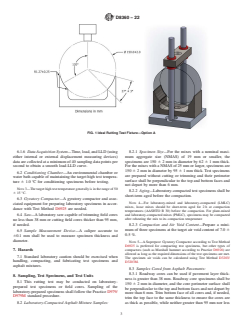
6.1.3.1 Option A—The loading strip and cradle can be part
measure rutting resistance of in-place asphalt mixtures.
of a test fixture, similar to that shown in Fig. 1, in which the
lower supporting cradle is mounted on a base having two
NOTE1—Fieldcoresmayneedcuttingtoarightthicknessrangingfrom
perpendicularguiderodsorpostsextendingupward.Theupper
38 mm to 95 mm. This test standard is not applicable to the specimens
with a diameter other than 150 6 2 mm, regardless of laboratory- loading strip shall be clean and freely sliding on the posts.
compacted specimens or field cores.
Guide sleeves in the upper segment of the test fixture shall
direct the specimen contact strip without appreciable binding
5.2 The RT of an asphalt mixture is calculated from the
Index
or loose motion in the guide rods.
peak load (or shear strength). The RT is a performance
Index
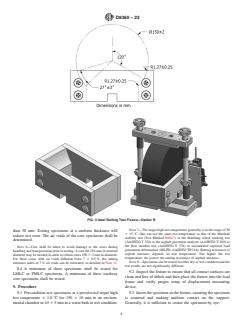
6.1.3.2 Option B—The loading strip and cradle can be part
indicator of the rutting resistance of asphalt mixtures contain-
of a test fixture, similar to that shown in Fig. 2, in which the
ing various asphalt binders, asphalt binder modifiers and
lower supporting cradle is mounted on the lower loading strip
additives, aggregate blends, fibers, and recycled materials.
of an indirect tensile fixture with two perpendicular guide rods
Generally, the higher the RT value, the better the rutting
Index
or posts extending upward. The upper loading strip shall be
resistance and consequently the smaller the rut depth in the
cleanandfreelyslidingontheposts.Guidesleevesintheupper
field. Users can employ the RT and associated criteria to
Index
segment of the test fixture shall direct the specimen contact
identify rutting-prone mixtures during mix design and produc-
strip without appreciable binding or loose motion in the guide
tion quality control/assurance.
rods.
NOTE 2—The quality of the results produced by this standard are
6.1.4 Internal Displacement Measuring Device—The dis-
dependent on the competence of the personnel performing the procedure
placement measurement acquisition system shall have a read-
and the capability, calibration, and maintenance of the equipment used.
ability of 0.01 mm and a range sufficiently large to handle the
Agencies that meet the criteria of Specification D3666 are generally
considered capable of competent and objective testing, sampling, expected total displacement during the test. The machine
inspection, etc. Users of this standard are cautioned that compliance with
stroke linear variable differential transformer (LVDT) or other
Specification D3666 alone does not completely ensure reliable r
...