

ASTM A434/A434M-18
(Specification)Standard Specification for Steel Bars, Alloy, Hot-Wrought or Cold-Finished, Quenched and Tempered
General Information
- Abstract
ABSTRACT
This specification covers hot-wrought and cold-finished quenched and tempered alloy steel bars. The steel materials shall be melt processed by using open-heart, basic oxygen, or electric furnace and shall conform to the austenitic grain size requirement. Tension tests shall be performed wherein the steel specimens shall conform to the required values of yield strength, tensile strength, and elongation.
SCOPE
1.1 This specification covers hot-wrought and cold-finished quenched and tempered alloy steel bars.
1.2 Hot-wrought bars are available in three strength level classes designated BB, BC, and BD, and cold-finished bars in two strength level classes designated BB and BC. The bars are available in the conditions specified in 4.4 subject to the size limitations shown.
1.3 The values stated in either SI units or inch-pound units are to be regarded separately as standard. The values stated in each system may not be exact equivalents; therefore, each system shall be used independently of the other. Combining values from the two systems may result in non-conformance with the standard.
1.4 This international standard was developed in accordance with internationally recognized principles on standardization established in the Decision on Principles for the Development of International Standards, Guides and Recommendations issued by the World Trade Organization Technical Barriers to Trade (TBT) Committee.
- Status
- Published
- Publication Date
- 30-Jun-2018
- Technical Committee
- A01 - Steel, Stainless Steel and Related Alloys
- Drafting Committee
- A01.15 - Bars
Buy Documents

ASTM A434/A434M-18 - Standard Specification for Steel Bars, Alloy, Hot-Wrought or Cold-Finished, Quenched and Tempered

REDLINE ASTM A434/A434M-18 - Standard Specification for Steel Bars, Alloy, Hot-Wrought or Cold-Finished, Quenched and Tempered
Overview
ASTM A434/A434M-18: Standard Specification for Steel Bars, Alloy, Hot-Wrought or Cold-Finished, Quenched and Tempered is an internationally recognized specification developed by ASTM International. This standard covers requirements for hot-wrought and cold-finished quenched and tempered alloy steel bars, widely used across various industries due to their high strength and durability. It specifies production methods, mechanical properties, heat treatment, grain size, surface finish, and testing requirements to ensure performance and reliability in demanding applications.
Key Topics
- Scope of Application: Applies to both hot-wrought and cold-finished alloy steel bars that are quenched and tempered.
- Strength Classes: Hot-wrought bars are available in three strength classes (BB, BC, BD) and cold-finished bars in two (BB, BC). Each class offers distinct mechanical properties tailored to specific engineering needs.
- Manufacturing Methods: Bars can be produced using open-hearth, basic-oxygen, or electric-furnace processes. Secondary melting methods like vacuum arc remelting or electroslag remelting are permitted for enhanced material quality.
- Mechanical Properties: Specifies minimum requirements for yield strength, tensile strength, elongation, and reduction of area to guarantee consistency and performance.
- Heat Treatment: All bars covered by ASTM A434/A434M-18 must undergo quenching and tempering, with detailed requirements for proper heat treatment processes to achieve the desired properties.
- Grain Size Requirement: Mandates a fine austenitic grain size as per ASTM A29/A29M to ensure toughness and workability.
- Testing and Certification: Includes protocols for mechanical testing (such as tension tests), grain size verification, and optional supplementary hardness requirements, along with guidelines for manufacturer certification and test reports.
Applications
ASTM A434/A434M-18 alloy steel bars are designed for critical applications requiring superior mechanical properties and reliability. They are commonly used in:
- Automotive and Transportation: Components such as axles, shafts, and connecting rods that demand high strength and resistance to dynamic stresses.
- Manufacturing and Heavy Equipment: Gears, spindles, and other machinery parts requiring robust mechanical properties and consistent quality.
- Energy and Power Generation: Structural components subject to significant loads and thermal cycling.
- Construction and Infrastructure: Engineering structures where safety, durability, and long-term performance are crucial.
The standard ensures that finished steel bars are suitable for machining, fabrication, and final assembly, offering value across a broad spectrum of engineering projects.
Related Standards
For comprehensive quality assurance and compatibility, ASTM A434/A434M-18 references several other key ASTM standards, including:
- ASTM A29/A29M - General Requirements for Steel Bars, Carbon and Alloy, Hot-Wrought: Defines chemical composition ranges and material grades.
- ASTM A108 - Specification for Steel Bar, Carbon and Alloy, Cold-Finished: Covers requirements specific to cold-finished bars.
- ASTM A370 - Test Methods and Definitions for Mechanical Testing of Steel Products: Details procedures for mechanical performance evaluation.
- ASTM E112 - Test Methods for Determining Average Grain Size: (referenced historically) Provides methods for grain size assessment.
Practical Value
Using steel bars conforming to ASTM A434/A434M-18 ensures:
- Reliable Mechanical Performance: Adherence to specified yield and tensile strengths.
- Consistent Product Quality: Stringent process and testing requirements ensure repeatability.
- Applicability in High-Load Environments: Enhanced safety and service life for critical components.
- Compatibility with International Suppliers: Standardization facilitates global sourcing and compliance.
Keywords: quenched and tempered steel bars, alloy steel bars, hot-wrought steel bars, cold-finished steel bars, ASTM A434/A434M-18, mechanical properties, manufacturing standards, heat-treated steel bars.
Relations
- Effective Date
- 01-Jul-2018
- Effective Date
- 01-Mar-2024
- Effective Date
- 01-Mar-2024
- Effective Date
- 01-Jul-2019
- Effective Date
- 01-Nov-2018
- Refers
ASTM A370-17a - Standard Test Methods and Definitions for Mechanical Testing of Steel Products - Effective Date
- 15-Nov-2017
- Effective Date
- 01-Jan-2017
- Effective Date
- 01-Nov-2015
- Effective Date
- 01-Nov-2015
- Effective Date
- 15-May-2014
- Effective Date
- 15-Nov-2013
- Effective Date
- 15-Aug-2013
- Refers
ASTM A370-12a - Standard Test Methods and Definitions for Mechanical Testing of Steel Products - Effective Date
- 15-Oct-2012
- Effective Date
- 01-May-2012
- Effective Date
- 01-May-2012
Buy Documents
ASTM A434/A434M-18 - Standard Specification for Steel Bars, Alloy, Hot-Wrought or Cold-Finished, Quenched and Tempered
REDLINE ASTM A434/A434M-18 - Standard Specification for Steel Bars, Alloy, Hot-Wrought or Cold-Finished, Quenched and Tempered
Get Certified
Connect with accredited certification bodies for this standard

Element Materials Technology
Materials testing and product certification.

Inštitut za kovinske materiale in tehnologije
Institute of Metals and Technology. Materials testing, metallurgical analysis, NDT.
Sponsored listings
Frequently Asked Questions
ASTM A434/A434M-18 is a technical specification published by ASTM International. Its full title is "Standard Specification for Steel Bars, Alloy, Hot-Wrought or Cold-Finished, Quenched and Tempered". This standard covers: ABSTRACT This specification covers hot-wrought and cold-finished quenched and tempered alloy steel bars. The steel materials shall be melt processed by using open-heart, basic oxygen, or electric furnace and shall conform to the austenitic grain size requirement. Tension tests shall be performed wherein the steel specimens shall conform to the required values of yield strength, tensile strength, and elongation. SCOPE 1.1 This specification covers hot-wrought and cold-finished quenched and tempered alloy steel bars. 1.2 Hot-wrought bars are available in three strength level classes designated BB, BC, and BD, and cold-finished bars in two strength level classes designated BB and BC. The bars are available in the conditions specified in 4.4 subject to the size limitations shown. 1.3 The values stated in either SI units or inch-pound units are to be regarded separately as standard. The values stated in each system may not be exact equivalents; therefore, each system shall be used independently of the other. Combining values from the two systems may result in non-conformance with the standard. 1.4 This international standard was developed in accordance with internationally recognized principles on standardization established in the Decision on Principles for the Development of International Standards, Guides and Recommendations issued by the World Trade Organization Technical Barriers to Trade (TBT) Committee.
ABSTRACT This specification covers hot-wrought and cold-finished quenched and tempered alloy steel bars. The steel materials shall be melt processed by using open-heart, basic oxygen, or electric furnace and shall conform to the austenitic grain size requirement. Tension tests shall be performed wherein the steel specimens shall conform to the required values of yield strength, tensile strength, and elongation. SCOPE 1.1 This specification covers hot-wrought and cold-finished quenched and tempered alloy steel bars. 1.2 Hot-wrought bars are available in three strength level classes designated BB, BC, and BD, and cold-finished bars in two strength level classes designated BB and BC. The bars are available in the conditions specified in 4.4 subject to the size limitations shown. 1.3 The values stated in either SI units or inch-pound units are to be regarded separately as standard. The values stated in each system may not be exact equivalents; therefore, each system shall be used independently of the other. Combining values from the two systems may result in non-conformance with the standard. 1.4 This international standard was developed in accordance with internationally recognized principles on standardization established in the Decision on Principles for the Development of International Standards, Guides and Recommendations issued by the World Trade Organization Technical Barriers to Trade (TBT) Committee.
ASTM A434/A434M-18 is classified under the following ICS (International Classification for Standards) categories: 77.140.60 - Steel bars and rods. The ICS classification helps identify the subject area and facilitates finding related standards.
ASTM A434/A434M-18 has the following relationships with other standards: It is inter standard links to ASTM A434/A434M-17, ASTM A370-24, ASTM A108-24, ASTM A370-19, ASTM A108-18, ASTM A370-17a, ASTM A370-17, ASTM A370-15, ASTM A29/A29M-15, ASTM A370-14, ASTM A370-13, ASTM A108-13, ASTM A370-12a, ASTM A29/A29M-12, ASTM A29/A29M-12e1. Understanding these relationships helps ensure you are using the most current and applicable version of the standard.
ASTM A434/A434M-18 is available in PDF format for immediate download after purchase. The document can be added to your cart and obtained through the secure checkout process. Digital delivery ensures instant access to the complete standard document.
Standards Content (Sample)
This international standard was developed in accordance with internationally recognized principles on standardization established in the Decision on Principles for the
Development of International Standards, Guides and Recommendations issued by the World Trade Organization Technical Barriers to Trade (TBT) Committee.
Designation:A434/A434M −18
Standard Specification for
Steel Bars, Alloy, Hot-Wrought or Cold-Finished, Quenched
and Tempered
This standard is issued under the fixed designationA434/A434M; the number immediately following the designation indicates the year
of original adoption or, in the case of revision, the year of last revision.Anumber in parentheses indicates the year of last reapproval.
A superscript epsilon (´) indicates an editorial change since the last revision or reapproval.
This standard has been approved for use by agencies of the U.S. Department of Defense.
1. Scope* 3. Ordering Information
1.1 This specification covers hot-wrought and cold-finished 3.1 Orders for material under this specification should
quenched and tempered alloy steel bars. include the following information:
3.1.1 Quantity (weight or number of pieces),
1.2 Hot-wrought bars are available in three strength level
3.1.2 Name of material (heat-treated alloy steel bars),
classes designated BB, BC, and BD, and cold-finished bars in
3.1.3 Method of finish (condition) (4.4),
two strength level classes designated BB and BC.The bars are
available in the conditions specified in 4.4 subject to the size
3.1.4 Dimensions, including length (if hot-wrought bars are
limitations shown.
for cold finishing, the cold-finished size should also be
specified),
1.3 The values stated in either SI units or inch-pound units
3.1.5 ASTM designation and date of issue,
are to be regarded separately as standard. The values stated in
3.1.6 Chemical composition grade (Section 5),
each system may not be exact equivalents; therefore, each
system shall be used independently of the other. Combining 3.1.7 Strength class (Table 1),
values from the two systems may result in non-conformance
3.1.8 Test report, if required (Section 11),
with the standard.
3.1.9 Supplementary Requirements or Special Require-
ments, if required, and
1.4 This international standard was developed in accor-
dance with internationally recognized principles on standard- 3.1.10 End use.
ization established in the Decision on Principles for the
NOTE 1—A typical ordering description is as follows: 10000 lb,
Development of International Standards, Guides and Recom-
Heat-Treated Alloy Steel Bars, Hot Rolled, 1.000 in. diameter × 10 ft,
mendations issued by the World Trade Organization Technical
ASTM A434 dated ____, Grade 4140, Class BB, Test Report Required,
Barriers to Trade (TBT) Committee. Motor Shafts.
2. Referenced Documents 4. Materials and Manufacture
2.1 ASTM Standards: 4.1 Melting Practice—The steel shall be made by any
A29/A29MSpecificationforGeneralRequirementsforSteel commercially viable primary steelmaking process. The pri-
Bars, Carbon and Alloy, Hot-Wrought mary melting may incorporate separate degassing or refining
A108Specification for Steel Bar, Carbon and Alloy, Cold- and may be followed by secondary melting using electroslag
Finished remelting or vacuum arc remelting. Where secondary melting
A370Test Methods and Definitions for Mechanical Testing is employed, the heat shall be defined as all of the ingots
of Steel Products remelted from a single primary heat.
4.2 Discard—Sufficient discard shall be made to secure
freedom from injurious piping and undue segregation.
This specification is under the jurisdiction ofASTM Committee A01 on Steel,
4.3 Slow Cooling—Hot-wrought alloy bars shall, immedi-
Stainless Steel and RelatedAlloys and is the direct responsibility of Subcommittee
A01.15 on Bars. ately after rolling, be allowed to cool to a temperature below
CurrenteditionapprovedJuly1,2018.PublishedJuly2018.Originallyapproved
thecriticalrangeundersuitableconditionstopreventinjuryby
in 1959. Last previous edition approved in 2017 as A434/A434M–17. DOI:
too rapid cooling.
10.1520/A0434_A0434M–18.
For referenced ASTM standards, visit the ASTM website, www.astm.org, or
4.4 Condition—Barsshallbefurnishedinoneofthefollow-
contact ASTM Customer Service at service@astm.org. For Annual Book of ASTM
ing conditions, as specified by the purchaser. Generally, size
Standards volume information, refer to the standard’s Document Summary page on
the ASTM website. limits for various methods of processing round bars are:
*A Summary of Changes section appears at the end of this standard
Copyright © ASTM International, 100 Barr Harbor Drive, PO Box C700, West Conshohocken, PA 19428-2959. United States
A434/A434M−18
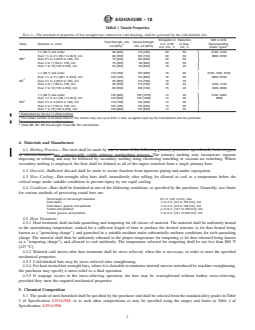
TABLE 1 Tensile Properties
NOTE 1—The mechanical properties of hot-wrought bars ordered for cold finishing, shall be governed by the cold-finished size.
Elongation in Reduction SAE or AISI
Yield Strength, min, Tensile Strength,
Class Diameter, in. [mm] 2 in. or 50 of Area, Representative
A
ksi [MPa] min, ksi [MPa]
B
mm, min, % min, % Grade Types
1 ⁄2 [38.1] and under 90 [620] 110 [760] 20 50 3100, 4100,
1 1
Over 1 ⁄2 to 2 ⁄2 [38.1 to 63.5], incl 80 [550] 105 [720] 20 50 8600, 8700
C
BB Over 2 ⁄2 to 4 [63.5 to 102], incl 75 [520] 100 [690] 20 50
Over 4 to 7 [102 to 178], incl 75 [520] 95 [660] 20 50
Over 7 to 10 [178 to 254], incl 65 [450] 90 [620] 18 40
1 ⁄2 [38.1] and under 110 [760] 130 [900] 16 50 3100, 4100, 6100,
1 1
Over 1 ⁄2 to 2 ⁄2 [38.1 to 63.5], incl 105 [720] 125 [860] 16 50 8600, 8700
J
C 1
BC Over 2 ⁄2 to 4 [63.5 to 102], incl 95 [660] 115 [790] 16 45
Over 4 to 7 [102 to 178], incl 85 [590] 110 [760] 16 45 3100, 4100
J
Over 7 to 10 [178 to 254], incl 80 [550] 105 [720] 15 40 4300, 9800
1 ⁄2 [38.1] and under 130 [900] 155 [1070] 14 35 4100, 4300,
1 1
Over 1 ⁄2 to 2 ⁄2 [38.1 to 63.5], incl 120 [830] 150 [1030] 14 35 9800
C
BD Over 2 ⁄2 to 4 [63.5 to 102], incl 110 [760] 140 [960] 14 35
Over 4 to 7 [102 to 178], incl 105 [720] 135 [930] 14 35
Over 7 to 10 [178 to 254], incl 100 [690] 130 [900] 14 35
A
Determined by the 0.2 % offset method.
B
The carbon content of all steels listed in this column may vary up to 0.55 % max, as agreed upon by the manufacturer and the purchaser.
C
Class BB, BC, BD hot-wrought; Class BB, BC cold-finished.
5.2 In all cases, the grade specified shall be capable of
Hot-wrought or hot-wrought descaled 9 ⁄2 in. [241.3 mm], max
Cold-drawn ⁄8 to 4 in. [3.2 to 102 mm], incl
developing the required mechanical properties. If, in the
Cold-drawn, ground, and polished ⁄8 to 4 in. [3.2 to 102 mm], incl
opinion of the manufacturer, the grade specified is not capable
Turned and polished ⁄4 to 9 in. [19.1 to 229 mm], incl
of developing the mechanical properties, the manufacturer
Turned, ground, and polished ⁄4 to 9 in. [19.1 to 229 mm], incl
shall notify the purchaser and whenever possible suggest an
4.5 Heat Treatment:
alternative grade.
4.5.1 Heat treatment shall include quenching and tempering
for all classes of material. The material shall be uniformly
5.3 Representative grade types listed for the resp
...
This document is not an ASTM standard and is intended only to provide the user of an ASTM standard an indication of what changes have been made to the previous version. Because
it may not be technically possible to adequately depict all changes accurately, ASTM recommends that users consult prior editions as appropriate. In all cases only the current version
of the standard as published by ASTM is to be considered the official document.
Designation: A434/A434M − 17 A434/A434M − 18
Standard Specification for
Steel Bars, Alloy, Hot-Wrought or Cold-Finished, Quenched
and Tempered
This standard is issued under the fixed designation A434/A434M; the number immediately following the designation indicates the year
of original adoption or, in the case of revision, the year of last revision. A number in parentheses indicates the year of last reapproval.
A superscript epsilon (´) indicates an editorial change since the last revision or reapproval.
This standard has been approved for use by agencies of the U.S. Department of Defense.
1. Scope*
1.1 This specification covers hot-wrought and cold-finished quenched and tempered alloy steel bars.
1.2 Hot-wrought bars are available in three strength level classes designated BB, BC, and BD, and cold-finished bars in two
strength level classes designated BB and BC. The bars are available in the conditions specified in 4.4 subject to the size limitations
shown.
1.3 The values stated in either SI units or inch-pound units are to be regarded separately as standard. The values stated in each
system may not be exact equivalents; therefore, each system shall be used independently of the other. Combining values from the
two systems may result in non-conformance with the standard.
1.4 This international standard was developed in accordance with internationally recognized principles on standardization
established in the Decision on Principles for the Development of International Standards, Guides and Recommendations issued
by the World Trade Organization Technical Barriers to Trade (TBT) Committee.
2. Referenced Documents
2.1 ASTM Standards:
A29/A29M Specification for General Requirements for Steel Bars, Carbon and Alloy, Hot-Wrought
A108 Specification for Steel Bar, Carbon and Alloy, Cold-Finished
A370 Test Methods and Definitions for Mechanical Testing of Steel Products
E112 Test Methods for Determining Average Grain Size
3. Ordering Information
3.1 Orders for material under this specification should include the following information:
3.1.1 Quantity (weight or number of pieces),
3.1.2 Name of material (heat-treated alloy steel bars),
3.1.3 Method of finish (condition) (4.4),
3.1.4 Dimensions, including length (if hot-wrought bars are for cold finishing, the cold-finished size should also be specified),
3.1.5 ASTM designation and date of issue,
3.1.6 Chemical composition grade (Section 5),
3.1.7 Strength class (Table 1),
3.1.8 Test report, if required (Section 11),
3.1.9 Supplementary Requirements or Special Require-
ments, if required, and
3.1.10 End use.
NOTE 1—A typical ordering description is as follows: 10 000 lb, Heat-Treated Alloy Steel Bars, Hot Rolled, 1.000 in. diameter × 10 ft, ASTM A434
dated ____, Grade 4140, Class BB, Test Report Required, Motor Shafts.
This specification is under the jurisdiction of ASTM Committee A01 on Steel, Stainless Steel and Related Alloys and is the direct responsibility of Subcommittee A01.15
on Bars.
Current edition approved March 15, 2017July 1, 2018. Published March 2017July 2018. Originally approved in 1959. Last previous edition approved in 20152017 as
A434/A434M – 15.A434/A434M–17. DOI: 10.1520/A0434_A0434M-17.10.1520/A0434_A0434M–18.
For referenced ASTM standards, visit the ASTM website, www.astm.org, or contact ASTM Customer Service at service@astm.org. For Annual Book of ASTM Standards
volume information, refer to the standard’s Document Summary page on the ASTM website.
*A Summary of Changes section appears at the end of this standard
Copyright © ASTM International, 100 Barr Harbor Drive, PO Box C700, West Conshohocken, PA 19428-2959. United States
A434/A434M − 18
TABLE 1 Tensile Properties
NOTE 1—The mechanical properties of hot-wrought bars ordered for cold finishing, shall be governed by the cold-finished size.
Elongation in Reduction SAE or AISI
Yield Strength, min, Tensile Strength,
Class Diameter, in. [mm] 2 in. or 50 of Area, Representative
A
ksi [MPa] min, ksi [MPa]
B
mm, min, % min, % Grade Types
1 ⁄2 [38.1] and under 90 [620] 110 [760] 20 50 3100, 4100,
1 1
Over 1 ⁄2 to 2 ⁄2 [38.1 to 63.5], incl 80 [550] 105 [720] 20 50 8600, 8700
C
BB Over 2 ⁄2 to 4 [63.5 to 102], incl 75 [520] 100 [690] 20 50
Over 4 to 7 [102 to 178], incl 75 [520] 95 [660] 20 50
Over 7 to 10 [178 to 254], incl 65 [450] 90 [620] 18 40
1 ⁄2 [38.1] and under 110 [760] 130 [900] 16 50 3100, 4100, 6100,
1 1
Over 1 ⁄2 to 2 ⁄2 [38.1 to 63.5], incl 105 [720] 125 [860] 16 50 8600, 8700
J
C
BC Over 2 ⁄2 to 4 [63.5 to 102], incl 95 [660] 115 [790] 16 45
Over 4 to 7 [102 to 178], incl 85 [590] 110 [760] 16 45 3100, 4100
J
Over 7 to 10 [178 to 254], incl 80 [550] 105 [720] 15 40 4300, 9800
1 ⁄2 [38.1] and under 130 [900] 155 [1070] 14 35 4100, 4300,
1 1
Over 1 ⁄2 to 2 ⁄2 [38.1 to 63.5], incl 120 [830] 150 [1030] 14 35 9800
C
BD Over 2 ⁄2 to 4 [63.5 to 102], incl 110 [760] 140 [960] 14 35
Over 4 to 7 [102 to 178], incl 105 [720] 135 [930] 14 35
Over 7 to 10 [178 to 254], incl 100 [690] 130 [900] 14 35
A
Determined by the 0.2 % offset method.
B
The carbon content of all steels listed in this column may vary up to 0.55 % max, as agreed upon by the manufacturer and the purchaser.
B
Determined by the 0.2 % offset method.
C
Class BB, BC, BD hot-wrought; Class BB, BC cold-finished.
4. Materials and Manufacture
4.1 Melting Practice—The steel shall be made by one or more of the following primary processes: open-hearth, basic-oxygen,
or electric-furnace. any commercially viable primary steelmaking process. The primary melting may incorporate separate
degassing or refining and may be followed by secondary melting using electroslag remelting or vacuum arc remelting. Where
secondary melting is employed, the heat shall be defined as all of the ingots remelted from a single primary heat.
4.2 Discard—Sufficient discard shall be made to secure freedom from injurious piping and undue segregation.
4.3 Slow Cooling—Hot-wrought alloy bars shall, immediately after rolling, be allowed to cool to a temperature below the
critical range under suitable conditions to prevent injury by too rapid cooling.
4.4 Condition—Bars shall be furnished in one of the following conditions, as specified by the purchaser. Generally, size limits
for various methods of processing round bars are:
Hot-wrought or hot-wrought descaled 9 ⁄2 in. [241.3 mm], max
Cold-drawn ⁄8 to 4 in. [3.2 to 102 mm], incl
Cold-drawn, ground, and polished ⁄8 to 4 in. [3.2 to 102 mm], incl
Turned and polished ⁄4 to 9 in. [19.1 to 229 mm], incl
Turned, ground, and polished ⁄4 to 9 in. [19.1 to 229 mm], incl
4.5 Heat Treatment:
4.5.1 Heat treatment shall include quenching and tempering for all classes of material. The material shall be uniformly heated
to the austenitizing temperature, soaked for a sufficient length of time to produce the desired structure (a lot thus heated being
known as a “quenching charge”), and quenched in a suitable medium under substantially uniform conditions for each quenching
charge. The material shall then be uniformly reheated to the proper temperature for tempering (a lot thus reheated being known
as a “tempering charge”), and allowed to cool uniformly. The temperature selected for tempering shall be not less than 800 °F
[427 °C].
4.5.2 M
...