

ASTM C1889-21
(Practice)Standard Practice for Minimum Structural Design Loading for Monolithic or Sectional Precast Concrete Utility, Water, and Wastewater Structures Using AASHTO LRFD Design
General Information
- Abstract
SIGNIFICANCE AND USE
4.1 This practice is intended to standardize the minimum structural loads used to design a precast concrete product using AASHTO LRFD.
4.2 The user is cautioned to properly correlate the anticipated field conditions and requirements with the design loads. Field conditions may dictate loads greater than described here.
SCOPE
1.1 This practice describes the minimum loads to be applied when designing monolithic or sectional precast concrete utility structures, or sectional precast concrete water and wastewater structures, where AASHTO LRFD design is required. Concrete pipe, box culverts, and material covered in Specification C478 are excluded from this practice. Structures not requiring AASHTO LRFD design are to be designed using the loads specified in ASTM C857 or ASTM C890, as applicable.
1.2 The values stated in inch-pound units are to be regarded as the standard. The values given in parentheses are provided for information only.
1.3 This standard does not purport to address all of the safety concerns, if any, associated with its use. It is the responsibility of the user of this standard to establish appropriate safety, health, and environmental practices and determine the applicability of regulatory limitations prior to use.
1.4 This international standard was developed in accordance with internationally recognized principles on standardization established in the Decision on Principles for the Development of International Standards, Guides and Recommendations issued by the World Trade Organization Technical Barriers to Trade (TBT) Committee.
- Status
- Published
- Publication Date
- 31-Dec-2020
- Technical Committee
- C27 - Precast Concrete Products
- Drafting Committee
- C27.30 - Water and Wastewater Containers
Buy Documents
ASTM C1889-21 - Standard Practice for Minimum Structural Design Loading for Monolithic or Sectional Precast Concrete Utility, Water, and Wastewater Structures Using AASHTO LRFD Design
REDLINE ASTM C1889-21 - Standard Practice for Minimum Structural Design Loading for Monolithic or Sectional Precast Concrete Utility, Water, and Wastewater Structures Using AASHTO LRFD Design
Overview
ASTM C1889-21 is the Standard Practice for Minimum Structural Design Loading for Monolithic or Sectional Precast Concrete Utility, Water, and Wastewater Structures Using AASHTO LRFD Design. Developed by ASTM International, this practice establishes the minimum structural loads required for the design of precast concrete utility and water/wastewater structures where compliance with AASHTO LRFD (Load and Resistance Factor Design) is specified. It does not cover concrete pipe, box culverts, or structures addressed by ASTM C478, and is intended to help engineers and designers ensure robust, safe, and regulatory-compliant precast concrete enclosures for underground infrastructure.
Key Topics
- Minimum Structural Loads:
Defines the basic load requirements (permanent and imposed loads) using AASHTO LRFD methodology for monolithic and sectional precast concrete utility and water/wastewater structures. - Load Types Addressed:
- Dead loads: The weight of the structure and other permanent components
- Live loads: Vehicles, pedestrians, and equipment influences
- Lateral earth, hydrostatic, and surcharge loads
- Construction, lifting, and handling loads per related ASTM standards
- Design Units:
Standard values are provided in inch-pound units, with metric equivalents for reference. - Applicability and Limitations:
Explicitly outlines the types of precast concrete structures included, and points users to related ASTM standards (C857 or C890) for structures not covered by this practice. - Safety and Regulatory Considerations:
Emphasizes the responsibility of the user to consider safety, health, regulatory, and environmental factors in adoption and application.
Applications
ASTM C1889-21 is essential for professionals involved in the design and specification of precast concrete structures used in utility, water, and wastewater infrastructure. Key practical applications include:
- Precast Utility Structures:
Includes enclosures for electric, gas, or communication utilities, ensuring structural adequacy under typical and worst-case loading conditions. - Water and Wastewater Infrastructure:
Applies to holding tanks, septic tanks, reservoirs, wet wells, pumping stations, grease traps, and similar below-ground structures constructed from precast concrete segments. - Infrastructure Resilience:
Assists in evaluating structures for resistance to soil, traffic, hydrostatic, and construction loads, supporting safe installation and long-term performance. - Regulatory and Engineering Compliance:
Provides a harmonized design approach required for projects subject to AASHTO standards, ensuring compliance with national and state-level infrastructure requirements.
Related Standards
When using ASTM C1889-21, professionals should also consider the following related standards for a complete approach to precast concrete structure design:
- ASTM C478: Specification for circular precast reinforced concrete manhole sections (excluded from C1889-21)
- ASTM C857: Practice for minimum structural design loading for underground precast concrete utility structures (for projects not requiring AASHTO LRFD design)
- ASTM C890: Practice for minimum structural design loading for monolithic or sectional precast concrete water and wastewater structures (when LRFD design is not required)
- AASHTO LRFD Bridge Design Specifications: Governs the overall design methodology and load criteria referenced in this practice
By referencing ASTM C1889-21 and its related standards, engineers and designers ensure that underground precast concrete utility, water, and wastewater structures are safe, durable, and compliant with recognized industry and regulatory criteria. This standard supports the reliable development of resilient infrastructure systems.
Relations
- Effective Date
- 01-Jul-2019
- Refers
ASTM C478-18 - Standard Specification for Circular Precast Reinforced Concrete Manhole Sections - Effective Date
- 01-Jan-2018
- Effective Date
- 01-Sep-2016
- Refers
ASTM C478-15a - Standard Specification for Circular Precast Reinforced Concrete Manhole Sections - Effective Date
- 15-Oct-2015
- Refers
ASTM C478-15 - Standard Specification for Circular Precast Reinforced Concrete Manhole Sections - Effective Date
- 01-Jan-2015
- Effective Date
- 15-Sep-2014
- Effective Date
- 01-Mar-2014
- Effective Date
- 01-Apr-2013
- Effective Date
- 15-Jan-2013
- Effective Date
- 01-Jan-2013
- Effective Date
- 01-Oct-2012
- Effective Date
- 15-Sep-2012
- Effective Date
- 01-Apr-2012
- Effective Date
- 15-Jan-2012
- Effective Date
- 01-Nov-2011
Buy Documents
ASTM C1889-21 - Standard Practice for Minimum Structural Design Loading for Monolithic or Sectional Precast Concrete Utility, Water, and Wastewater Structures Using AASHTO LRFD Design
REDLINE ASTM C1889-21 - Standard Practice for Minimum Structural Design Loading for Monolithic or Sectional Precast Concrete Utility, Water, and Wastewater Structures Using AASHTO LRFD Design
Get Certified
Connect with accredited certification bodies for this standard

DIBt (Deutsches Institut für Bautechnik)
German Institute for Building Technology.
DIN CERTCO
DIN Group product certification.

Aboma Certification B.V.
Specialized in construction, metal, and transport sectors.
Sponsored listings
Frequently Asked Questions
ASTM C1889-21 is a standard published by ASTM International. Its full title is "Standard Practice for Minimum Structural Design Loading for Monolithic or Sectional Precast Concrete Utility, Water, and Wastewater Structures Using AASHTO LRFD Design". This standard covers: SIGNIFICANCE AND USE 4.1 This practice is intended to standardize the minimum structural loads used to design a precast concrete product using AASHTO LRFD. 4.2 The user is cautioned to properly correlate the anticipated field conditions and requirements with the design loads. Field conditions may dictate loads greater than described here. SCOPE 1.1 This practice describes the minimum loads to be applied when designing monolithic or sectional precast concrete utility structures, or sectional precast concrete water and wastewater structures, where AASHTO LRFD design is required. Concrete pipe, box culverts, and material covered in Specification C478 are excluded from this practice. Structures not requiring AASHTO LRFD design are to be designed using the loads specified in ASTM C857 or ASTM C890, as applicable. 1.2 The values stated in inch-pound units are to be regarded as the standard. The values given in parentheses are provided for information only. 1.3 This standard does not purport to address all of the safety concerns, if any, associated with its use. It is the responsibility of the user of this standard to establish appropriate safety, health, and environmental practices and determine the applicability of regulatory limitations prior to use. 1.4 This international standard was developed in accordance with internationally recognized principles on standardization established in the Decision on Principles for the Development of International Standards, Guides and Recommendations issued by the World Trade Organization Technical Barriers to Trade (TBT) Committee.
SIGNIFICANCE AND USE 4.1 This practice is intended to standardize the minimum structural loads used to design a precast concrete product using AASHTO LRFD. 4.2 The user is cautioned to properly correlate the anticipated field conditions and requirements with the design loads. Field conditions may dictate loads greater than described here. SCOPE 1.1 This practice describes the minimum loads to be applied when designing monolithic or sectional precast concrete utility structures, or sectional precast concrete water and wastewater structures, where AASHTO LRFD design is required. Concrete pipe, box culverts, and material covered in Specification C478 are excluded from this practice. Structures not requiring AASHTO LRFD design are to be designed using the loads specified in ASTM C857 or ASTM C890, as applicable. 1.2 The values stated in inch-pound units are to be regarded as the standard. The values given in parentheses are provided for information only. 1.3 This standard does not purport to address all of the safety concerns, if any, associated with its use. It is the responsibility of the user of this standard to establish appropriate safety, health, and environmental practices and determine the applicability of regulatory limitations prior to use. 1.4 This international standard was developed in accordance with internationally recognized principles on standardization established in the Decision on Principles for the Development of International Standards, Guides and Recommendations issued by the World Trade Organization Technical Barriers to Trade (TBT) Committee.
ASTM C1889-21 is classified under the following ICS (International Classification for Standards) categories: 91.100.30 - Concrete and concrete products. The ICS classification helps identify the subject area and facilitates finding related standards.
ASTM C1889-21 has the following relationships with other standards: It is inter standard links to ASTM C857-19, ASTM C478-18, ASTM C857-16, ASTM C478-15a, ASTM C478-15, ASTM C478-14, ASTM C857-14, ASTM C478-13, ASTM C890-13, ASTM C857-13, ASTM C478-12a, ASTM C890-12, ASTM C478-12, ASTM C857-12a, ASTM C478-11. Understanding these relationships helps ensure you are using the most current and applicable version of the standard.
ASTM C1889-21 is available in PDF format for immediate download after purchase. The document can be added to your cart and obtained through the secure checkout process. Digital delivery ensures instant access to the complete standard document.
Standards Content (Sample)
This international standard was developed in accordance with internationally recognized principles on standardization established in the Decision on Principles for the
Development of International Standards, Guides and Recommendations issued by the World Trade Organization Technical Barriers to Trade (TBT) Committee.
Designation: C1889 − 21
Standard Practice for
Minimum Structural Design Loading for Monolithic or
Sectional Precast Concrete Utility, Water, and Wastewater
Structures Using AASHTO LRFD Design
This standard is issued under the fixed designation C1889; the number immediately following the designation indicates the year of
original adoption or, in the case of revision, the year of last revision. A number in parentheses indicates the year of last reapproval. A
superscript epsilon (´) indicates an editorial change since the last revision or reapproval.
1. Scope C890 Practice for Minimum Structural Design Loading for
Monolithic or Sectional Precast Concrete Water and
1.1 This practice describes the minimum loads to be applied
Wastewater Structures
when designing monolithic or sectional precast concrete utility
2.2 AASHTO Standard:
structures, or sectional precast concrete water and wastewater
AASHTO LRFD BridgeDesignSpecifications(CurrentEdi-
structures,whereAASHTOLRFDdesignisrequired.Concrete
tion)
pipe, box culverts, and material covered in Specification C478
are excluded from this practice. Structures not requiring
3. Terminology
AASHTO LRFD design are to be designed using the loads
specified in ASTM C857 or ASTM C890, as applicable.
3.1 Definitions of Terms Specific to This Standard:
3.1.1 above ground structures, n—all structures with their
1.2 The values stated in inch-pound units are to be regarded
base above ground.
as the standard. The values given in parentheses are provided
for information only.
3.1.2 bearing loads, n—foundation pressure reaction to all
loads acting on the structure.
1.3 This standard does not purport to address all of the
safety concerns, if any, associated with its use. It is the
3.1.3 below ground structures, n—all structures other than
responsibility of the user of this standard to establish appro-
those with their base at or above ground.
priate safety, health, and environmental practices and deter-
3.1.4 construction loads—all loads superimposed on the
mine the applicability of regulatory limitations prior to use.
structure due to equipment and vehicles related to the instal-
1.4 This international standard was developed in accor-
lation of the structure and subsequent construction activities in
dance with internationally recognized principles on standard-
the vicinity of the structure.
ization established in the Decision on Principles for the
3.1.5 dead loads, n—weight of the structure and all perma-
Development of International Standards, Guides and Recom-
nent loads imposed on the structure.
mendations issued by the World Trade Organization Technical
3.1.6 dynamic load allowance (Impact)—percentage incre-
Barriers to Trade (TBT) Committee.
ment to be added to the traffic load to account for wheel load
impact from moving vehicles.
2. Referenced Documents
3.1.7 equipment loads, n—loads induced into the structure
2.1 ASTM Standards:
by equipment installed on mounting devices cast into the
C478 Specification for Circular Precast Reinforced Concrete
structure or mechanically and permanently attached to the
Manhole Sections (Metric) C0478_C0478M
structure.
C857 Practice for Minimum Structural Design Loading for
Underground Precast Concrete Utility Structures
3.1.8 ground level, n—ground surface elevation at the fin-
ished surface of the structure.
3.1.9 height of the structure, n—total height from outside
This test method is under the jurisdiction ofASTM Committee C27 on Precast
bottom of the structure to the ground level.
ConcreteProductsandisthedirectresponsibilityofSubcommitteeC27.30onWater
3.1.10 hydrostatic loads, n—all pressures due to the weight
and Wastewater Containers.
Current edition approved Jan. 1, 2021. Published January 2021. Originally
of water or other liquids.
approved in 2019. Last previous edition approved in 2019 as C1889 - 19. DOI:
10.1520/C1889-21
For referenced ASTM standards, visit the ASTM website, www.astm.org, or
contact ASTM Customer Service at service@astm.org. For Annual Book of ASTM Available from American Association of State Highway and Transportation
Standards volume information, refer to the standard’s Document Summary page on Officials (AASHTO), 444 N. Capitol St., NW, Suite 249, Washington, DC 20001,
the ASTM website. http://www.transportation.org.
Copyright © ASTM International, 100 Barr Harbor Drive, PO Box C700, West Conshohocken, PA 19428-2959. United States
C1889 − 21
3.1.11 KIP, n—1000 lbf. (kilo pound) where:
W = soil-structure interaction variable for unfactored earth
e
3.1.12 KSI, n—KIPs per square inch.
load, lbf/ft ,
H
3.1.13 lane load—a uniform load applied to a 10-foot-wide
F = 1 + 0.20 (not to exceed 1.15),
e
Bc
3 3
lane on a bridge deck where the span exceeds 15 feet.
γ = unit weight of soil, lb/ft (120 lb/ft unless noted
otherwise),
3.1.14 lateral earth loads, n—all pressures due to the
B = width of structure (OD), ft, and
c
effective weight of adjacent earth backfill.
H = height of fill between wheels (ground level) and
3.1.15 lateral surcharge loads—lateral pressure due to ver-
structure, ft.
tical loads superimposed on the adjacent earth backfill.
NOTE 2—Soil Structure interaction loads refer to AASHTO LRFD
Section 12.11.2.2.
3.1.16 lifting loads, n—forces induced into the structure
during handling at the precast plant and the construction site. 5.1.4 Traffıc Loads:
5.1.5 The vehicle loading arrangement, spacing, and
3.1.17 live loads—all loads superimposed on the structure
weights of vehicle axles for an AASHTO HL-93 design truck
or adjacent earth fill due to vehicles or pedestrians.
are shown in Fig. 1, and the AASHTO Design Tandem axles
3.1.18 Load and Resistance Factor Design (LRFD)—a de-
are shown in Fig. 2.
sign philosophy used in the design of concrete structures that
NOTE 3—Vehicle loads per AASHTO LRFD Section 3.6.1.2.2.
takes variability in the behavior of structural elements and
loads into account.
5.1.6 For spans greater than 15 ft where the structure is
subjected to direct traffic loads, a lane load shall be applied.
3.1.19 multiple presence factor—additional live load factor
The lane load shall consist of a 640 lbf/linear foot (in the travel
to account for the probability of simultaneous lane occupation
direction) live load, transversely distributed over a width of 10
by the full AASHTO HL-93 design live load.
ft, but not subject to the dynamic load allowance.
3.1.20 OD—outside Dimension of a structure.
5.1.7 For structures designed for a single truck, the multiple
presence factor of 1.2 shall be applied. For structures where
3.1.21 utility structure—a structure that is used by an
two (2) vehicles side by side are considered in the design, the
electric, gas, communication or similar industries.
multiple presence factor shall be 1.0.
3.1.22 water and wastewater structures—solar heating
5.1.8 Distribution of Wheel Loads at the Surface:
reservoirs, septic tanks, cisterns, holding tanks, leaching tanks,
5.1.8.1 For structures where the depth of fill is less than 2.0
extended aeration tanks, wet wells, pumping stations, grease
ft, concentrated live loads from a single traffic wheel, shall be
traps, distribution boxes, oil-water separators, treatment plants,
distributed perpendicular to the span by an amount equal to E,
manure pits, catch basins, drop inlets, and similar structures.
theeffectivewidth.Thisshallbeconsideredfortraffictraveling
both parallel or perpendicular to the span:
4. Significance and Use
E 5 4□ft106S (2)
4.1 This practice is intended to standardize the minimum
where:
structural loads used to design a precast concrete product using
AASHTO LRFD.
E = equivalent distribution width, ft and
S = design span, ft.
4.2 The user is cautioned to properly correlate the antici-
NOTE 4—E width distribution is determined by concrete properties, not
pated field conditions and requirements with the design loads.
soil properties, and may need to be reduced for structural slab widths less
Field conditions may dictate loads greater than described here.
than the E width calculated here. Large openings, or unsupported edges of
slabs will typically require reduced E widths.
5. Design Loads
5.1.9 Distribution of Wheel Loads through Earth Fills:
5.1 Vertical Loads: 5.1.9.1 For below ground structures where earth fill is 2.0 ft
or greater above the structure, the vehicle wheel loads shall be
5.1.1 Permanent vertical loads typically include the weight
distributed as a truncated pyramid as shown in Fig. 3. The
of the concrete structure, road bed, walkways, earth fill and
loaded area for each wheel shall be:
access opening covers.
A 5 W 1 1.15 H * L 1 1.15 H (3)
5.1.2 Minimum unit weights of materials for design, unless ~ ! ~ !
...
This document is not an ASTM standard and is intended only to provide the user of an ASTM standard an indication of what changes have been made to the previous version. Because
it may not be technically possible to adequately depict all changes accurately, ASTM recommends that users consult prior editions as appropriate. In all cases only the current version
of the standard as published by ASTM is to be considered the official document.
Designation: C1889 − 19 C1889 − 21
Standard Practice for
Minimum Structural Design Loading for Monolithic or
Sectional Precast Concrete Utility, Water, and Wastewater
Structures Using AASHTO LRFD Design
This standard is issued under the fixed designation C1889; the number immediately following the designation indicates the year of
original adoption or, in the case of revision, the year of last revision. A number in parentheses indicates the year of last reapproval. A
superscript epsilon (´) indicates an editorial change since the last revision or reapproval.
1. Scope
1.1 This practice describes the minimum loads to be applied when designing monolithic or sectional precast concrete utility
structures, or sectional precast concrete water and wastewater structures, where AASHTO LRFD design is required. Concrete pipe,
box culverts, and material covered in Specification C478C478/C478M are excluded from this practice. Structures not requiring
AASHTO LRFD design are to be designed using the loads specified in ASTM C857 or ASTM C890, as applicable.
1.2 The values stated in inch-pound units are to be regarded as the standard. The values given in parentheses are provided for
information only.
1.3 This standard does not purport to address all of the safety concerns, if any, associated with its use. It is the responsibility
of the user of this standard to establish appropriate safety, health, and environmental practices and determine the applicability of
regulatory limitations prior to use.
1.4 This international standard was developed in accordance with internationally recognized principles on standardization
established in the Decision on Principles for the Development of International Standards, Guides and Recommendations issued
by the World Trade Organization Technical Barriers to Trade (TBT) Committee.
2. Referenced Documents
2.1 ASTM Standards:
C478C478/C478M Specification for Circular Precast Reinforced Concrete Manhole Sections (Metric) C0478_C0478M
C857 Practice for Minimum Structural Design Loading for Underground Precast Concrete Utility Structures
C890 Practice for Minimum Structural Design Loading for Monolithic or Sectional Precast Concrete Water and Wastewater
Structures
2.2 AASHTO Standard:
AASHTO LRFD Bridge Design Specifications (Current Edition)
3. Terminology
3.1 Definitions of Terms Specific to This Standard:
This test method is under the jurisdiction of ASTM Committee C27 on Precast Concrete Products and is the direct responsibility of Subcommittee C27.30 on Water and
Wastewater Containers.
Current edition approved Nov. 1, 2019Jan. 1, 2021. Published December 2019January 2021. Originally approved in 2019. Last previous edition approved in 2019 as
C1889 - 19. DOI: 10.1520/C1889–1910.1520/C1889-21
For referenced ASTM standards, visit the ASTM website, www.astm.org, or contact ASTM Customer Service at service@astm.org. For Annual Book of ASTM Standards
volume information, refer to the standard’s Document Summary page on the ASTM website.
Available from American Association of State Highway and Transportation Officials (AASHTO), 444 N. Capitol St., NW, Suite 249, Washington, DC 20001,
http://www.transportation.org.
Copyright © ASTM International, 100 Barr Harbor Drive, PO Box C700, West Conshohocken, PA 19428-2959. United States
C1889 − 21
3.1.1 above ground structures, n—all structures with their base above ground.
3.1.2 bearing loads, n—foundation pressure reaction to all loads acting on the structure.
3.1.3 below ground structures, n—all structures other than those with their base at or above ground.
3.1.4 construction loads—all loads superimposed on the structure due to equipment and vehicles related to the installation of the
structure and subsequent construction activities in the vicinity of the structure.
3.1.5 dead loads, n—weight of the structure and all permanent loads imposed on the structure.
3.1.6 dynamic load allowance (Impact)—percentage increment to be added to the traffic load to account for wheel load impact
from moving vehicles.
3.1.7 equipment loads, n—loads induced into the structure by equipment installed on mounting devices cast into the structure or
mechanically and permanently attached to the structure.
3.1.8 ground level, n—ground surface elevation at the finished surface of the structure.
3.1.9 height of the structure, n—total height from outside bottom of the structure to the ground level.
3.1.10 hydrostatic loads, n—all pressures due to the weight of water or other liquids.
3.1.11 KIP, n—1000 lbf. (kilo pound)
3.1.12 KSI, n—KIPs per square inch.
3.1.13 lane load—a uniform load applied to a 10-foot-wide lane on a bridge deck where the span exceeds 15 feet.
3.1.14 lateral earth loads, n—all pressures due to the effective weight of adjacent earth backfill.
3.1.15 lateral surcharge loads—lateral pressure due to vertical loads superimposed on the adjacent earth backfill.
3.1.16 lifting loads, n—forces induced into the structure during handling at the precast plant and the construction site.
3.1.17 live loads—all loads superimposed on the structure or adjacent earth fill due to vehicles or pedestrians.
3.1.18 Load and Resistance Factor Design (LRFD)—a design philosophy used in the design of concrete structures that takes
variability in the behavior of structural elements and loads into account.
3.1.19 load modifier—additional load factor to account for the ductility (n ), redundancy (n ), and the operational importance (n )
D R I
of a bridge or other structure.
3.1.19.1 Discussion—
Buried structures are considered to be non-redundant under earth fill (n = 1.05), and redundant under live and dynamic load
R
allowance loads (n = 1.00) according to AASHTO LRFD 1.3.4 and 12.5.4. Typical value of the operational importance
R
classification for precast structures (n ) is 1.00, but may be reduced to 0.95 when the structure is considered non-critical.
I
3.1.19 multiple presence factor—additional live load factor to account for the probability of simultaneous lane occupation by the
full AASHTO HL-93 design live load.
3.1.20 OD—outside Dimension of a structure.
C1889 − 21
3.1.21 utility structure—a structure that is used by an electric, gas, communication or similar industries.
3.1.22 water and wastewater structures—solar heating reservoirs, septic tanks, cisterns, holding tanks, leaching tanks, extended
aeration tanks, wet wells, pumping stations, grease traps, distribution boxes, oil-water separators, treatment plants, manure pits,
catch basins, drop inlets, and similar structures.
4. Significance and Use
4.1 This practice is intended to standardize the minimum structural loads used to design a precast concrete product using AASHTO
LRFD.
4.2 The user is cautioned to properly correlate the anticipated field conditions and requirements with the design loads. Field
conditions may dictate loads greater than described here.
5. Design Loads
5.1 Vertical Loads:
5.1.1 Permanent vertical loads typically include the weight of the concrete structure, road bed, walkways, earth fill and access
opening covers.
5.1.2 Minimum unit weights of materials for design, unless specified otherwise, shall be: 140 lb/ft for compacted aggregate or
3 3
bituminous paving; 145 lb/ft for concrete (Compressive strength ≤ 5.0 KSI); 120 lb/ft for compacted soils.
NOTE 1—Unit weights are as shown in AASHTO LRFD Section 3.5.1, Table 1.
5.1.3 Earth fill loading on top of the structure shall be modified for soil-structure interaction by a value of W , per the following:
e
W 5 F *γ*H (1)
e e
where:
W = soil-structure interaction variable for unfactored earth load, lbf/ft ,
e
H
F = 1 + 0.20 (not to exceed 1.15),
e
Bc
3 3
γ = unit weight of soil, lb/ft (120 lb/ft unless noted otherwise),
B = width of structure (OD), ft, and
c
H = height of fill between wheels (ground level) and structure, ft.
NOTE 2—Soil Structure interaction loads refer to AASHTO LRFD Section 12.11.2.2.
5.1.4 Traffıc Loads:
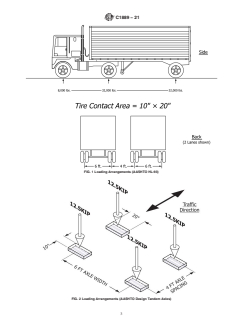
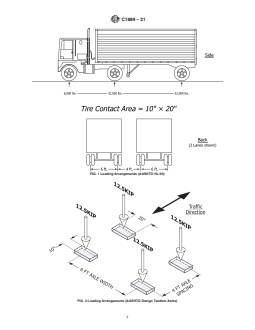
5.1.5 The vehicle loading arrangement, spacing, and weights of vehicle axles for an AASHTO HL-93 design truck are shown in
Fig. 1, and the AASHTO Design Tandem axles are shown in Fig. 2.
NOTE 3—Vehicle loads per AASHTO LRFD Section 3.6.1.2.2.
5.1.6 For spans greater than 15 ft where the structure is subjected to direct traffic loads, a lane load shall be applied. The lane load
shall consist of a 640 lbf/linear foot (in the travel direction) live load, transversely distributed over a width of 10 ft, but not subject
to the dynamic load allowance.
5.1.7 For structures designed for a single truck, the multiple presence factor of 1.2 shall be applied. For structures where two (2)
vehicles side by side are considered in the design, the multiple presence factor shall be 1.0.
5.1.8 Distribution of Wheel Loads at the Surface:
C1889 − 21
FIG. 1 Loading Arrangements (AASHTO HL-93)
FIG. 2 Loading Arrangements (AASHTO Design Tandem Axles)
C1889 − 21
5.1.8.1 For structures where the depth of fill is less than 2.0 ft, concentrated live loads from a single traffic whe
...