

ASTM C1230-96(2023)
(Test Method)Standard Test Method for Performing Tension Tests on Glass-Fiber Reinforced Concrete (GFRC) Bonding Pads
General Information
- Abstract
SIGNIFICANCE AND USE
3.1 Tensile loads determined by this test method are useful for quality control of GFRC architectural panels manufactured using the steel panel frame support design. In addition, test results may be used to verify compliance with governing specifications, research and development, and generating data for use in product design.
SCOPE
1.1 This test method covers determination of the tensile load capacity of glass-fiber reinforced concrete (GFRC) bonding pads used for attaching steel anchors to GFRC architectural panels.
1.2 The values stated in inch-pound units are to be regarded as standard. The values given in parentheses are mathematical conversions to SI units that are provided for information only and are not considered standard.
1.3 This standard does not purport to address all of the safety concerns, if any, associated with its use. It is the responsibility of the user of this standard to establish appropriate safety, health, and environmental practices and determine the applicability of regulatory limitations prior to use.
1.4 This international standard was developed in accordance with internationally recognized principles on standardization established in the Decision on Principles for the Development of International Standards, Guides and Recommendations issued by the World Trade Organization Technical Barriers to Trade (TBT) Committee.
- Status
- Published
- Publication Date
- 30-Apr-2023
- Technical Committee
- C27 - Precast Concrete Products
- Drafting Committee
- C27.40 - Glass Fiber Reinforced Concrete

Overview
ASTM C1230-96(2023), Standard Test Method for Performing Tension Tests on Glass-Fiber Reinforced Concrete (GFRC) Bonding Pads, outlines a reliable procedure to determine the tensile load capacity of GFRC bonding pads used to attach steel anchors to GFRC architectural panels. This test method is critical for quality control, specification compliance, research and development, and the structural design of GFRC panels. Developed under the guidance of ASTM Committee C27 on Precast Concrete Products, this international standard is recognized in alignment with the World Trade Organization’s principles for technical barriers to trade.
Key Topics
Purpose and Scope
- Covers testing of tensile strength in GFRC bonding pads.
- Primary focus on pads used in fastening steel anchors to GFRC panels.
- Utilizes inch-pound units as standard, with SI units as reference only.
Testing Methodology
- Specifies the use of a calibrated testing machine with specific deflection and force accuracy.
- Specifies preparation and mounting of test specimens, ensuring the anchor is centrally placed.
- Requires specimens be conditioned identically to production panels before testing.
Evaluation and Reporting
- Maximum tensile force and corresponding displacement are recorded at failure.
- Measurement of bonding pad and specimen dimensions is required.
- Reporting includes specimen identification, age, dimensions, anchor and pad details, load data, and failure mode.
Precision and Safety
- Emphasizes user responsibility for safety, health, and environmental practices.
- Calls for compliance with referenced ASTM standards for machine calibration and operation.
Applications
This standard has broad application across industries utilizing GFRC architectural panels, particularly where structural integrity and reliable anchor attachment are essential:
Quality Control in Manufacturing
- Ensures that bonding pads consistently meet required load capacities, supporting long-term performance and safety in building façades and cladding systems.
Design and Product Development
- Provides data for the engineering design of GFRC panels, helping manufacturers select safe and efficient anchor systems.
- Used for R&D to innovate stronger or more cost-effective bonding pad and anchoring solutions.
Specification Compliance
- Verifies adherence to project or regulatory requirements for GFRC panel installations.
- Useful in certifications and third-party assessments for construction materials.
Research and Industry Standards
- Supplies standardized comparison data for academic and industrial research on GFRC material behavior.
- Facilitates consistent criteria in technical documents and procurement specifications.
Related Standards
ASTM E4 – Practices for Force Calibration and Verification of Testing Machines
- Specifies calibration procedures for force measurement to support reliable data in tensile tests.
ASTM D76/D76M – Specification for Tensile Testing Machines for Textiles
- Provides requirements for testing equipment applicable to procedures in this test method.
International Principles
- Conforms with principles set by the World Trade Organization’s Technical Barriers to Trade (TBT) for the development of international standards.
Keywords: GFRC, glass-fiber reinforced concrete, tensile load, bonding pads, anchor strength, architectural panels, quality control, ASTM C1230, strength testing, compliance, precast concrete, building materials standards.
Relations
- Effective Date
- 01-Jun-2014
- Effective Date
- 01-Dec-2011
- Effective Date
- 01-Jun-2010
- Effective Date
- 01-Nov-2009
- Effective Date
- 01-Apr-2009
- Effective Date
- 01-Dec-2008
- Effective Date
- 01-Jan-2007
- Effective Date
- 10-Aug-2003
- Effective Date
- 10-Nov-2002
- Effective Date
- 10-Apr-2001
- Effective Date
- 10-Apr-2001
Get Certified
Connect with accredited certification bodies for this standard

DIBt (Deutsches Institut für Bautechnik)
German Institute for Building Technology.
DIN CERTCO
DIN Group product certification.

Aboma Certification B.V.
Specialized in construction, metal, and transport sectors.
Sponsored listings
Frequently Asked Questions
ASTM C1230-96(2023) is a standard published by ASTM International. Its full title is "Standard Test Method for Performing Tension Tests on Glass-Fiber Reinforced Concrete (GFRC) Bonding Pads". This standard covers: SIGNIFICANCE AND USE 3.1 Tensile loads determined by this test method are useful for quality control of GFRC architectural panels manufactured using the steel panel frame support design. In addition, test results may be used to verify compliance with governing specifications, research and development, and generating data for use in product design. SCOPE 1.1 This test method covers determination of the tensile load capacity of glass-fiber reinforced concrete (GFRC) bonding pads used for attaching steel anchors to GFRC architectural panels. 1.2 The values stated in inch-pound units are to be regarded as standard. The values given in parentheses are mathematical conversions to SI units that are provided for information only and are not considered standard. 1.3 This standard does not purport to address all of the safety concerns, if any, associated with its use. It is the responsibility of the user of this standard to establish appropriate safety, health, and environmental practices and determine the applicability of regulatory limitations prior to use. 1.4 This international standard was developed in accordance with internationally recognized principles on standardization established in the Decision on Principles for the Development of International Standards, Guides and Recommendations issued by the World Trade Organization Technical Barriers to Trade (TBT) Committee.
SIGNIFICANCE AND USE 3.1 Tensile loads determined by this test method are useful for quality control of GFRC architectural panels manufactured using the steel panel frame support design. In addition, test results may be used to verify compliance with governing specifications, research and development, and generating data for use in product design. SCOPE 1.1 This test method covers determination of the tensile load capacity of glass-fiber reinforced concrete (GFRC) bonding pads used for attaching steel anchors to GFRC architectural panels. 1.2 The values stated in inch-pound units are to be regarded as standard. The values given in parentheses are mathematical conversions to SI units that are provided for information only and are not considered standard. 1.3 This standard does not purport to address all of the safety concerns, if any, associated with its use. It is the responsibility of the user of this standard to establish appropriate safety, health, and environmental practices and determine the applicability of regulatory limitations prior to use. 1.4 This international standard was developed in accordance with internationally recognized principles on standardization established in the Decision on Principles for the Development of International Standards, Guides and Recommendations issued by the World Trade Organization Technical Barriers to Trade (TBT) Committee.
ASTM C1230-96(2023) is classified under the following ICS (International Classification for Standards) categories: 91.100.30 - Concrete and concrete products. The ICS classification helps identify the subject area and facilitates finding related standards.
ASTM C1230-96(2023) has the following relationships with other standards: It is inter standard links to ASTM E4-14, ASTM D76/D76M-11, ASTM E4-10, ASTM E4-09a, ASTM E4-09, ASTM E4-08, ASTM E4-07, ASTM E4-03, ASTM E4-02, ASTM E4-99, ASTM E4-01. Understanding these relationships helps ensure you are using the most current and applicable version of the standard.
ASTM C1230-96(2023) is available in PDF format for immediate download after purchase. The document can be added to your cart and obtained through the secure checkout process. Digital delivery ensures instant access to the complete standard document.
Standards Content (Sample)
This international standard was developed in accordance with internationally recognized principles on standardization established in the Decision on Principles for the
Development of International Standards, Guides and Recommendations issued by the World Trade Organization Technical Barriers to Trade (TBT) Committee.
Designation: C1230 − 96 (Reapproved 2023)
Standard Test Method for
Performing Tension Tests on Glass-Fiber Reinforced
Concrete (GFRC) Bonding Pads
This standard is issued under the fixed designation C1230; the number immediately following the designation indicates the year of
original adoption or, in the case of revision, the year of last revision. A number in parentheses indicates the year of last reapproval. A
superscript epsilon (´) indicates an editorial change since the last revision or reapproval.
1. Scope results may be used to verify compliance with governing
specifications, research and development, and generating data
1.1 This test method covers determination of the tensile load
for use in product design.
capacity of glass-fiber reinforced concrete (GFRC) bonding
pads used for attaching steel anchors to GFRC architectural
4. Apparatus
panels.
4.1 Testing Machine, a properly calibrated testing machine
1.2 The values stated in inch-pound units are to be regarded
that can be operated at constant rates of crosshead motion and
as standard. The values given in parentheses are mathematical
in which the error in the force measuring system shall not
conversions to SI units that are provided for information only
exceed 61.0 % of the maximum force expected to be mea-
and are not considered standard.
sured. Equip the testing machine with a deflection measuring
1.3 This standard does not purport to address all of the
and recording device. The stiffness of the testing machine shall
safety concerns, if any, associated with its use. It is the
be such that the total elastic deformation of the system does not
responsibility of the user of this standard to establish appro-
exceed 1.0 % of the total deflection of the test specimen during
priate safety, health, and environmental practices and deter-
the test, or appropriate corrections shall be made. The force-
mine the applicability of regulatory limitations prior to use.
indicating mechanism shall be essentially free of inertial lag at
1.4 This international standard was developed in accor-
the crosshead rate used. The accuracy of the testing machine
dance with internationally recognized principles on standard-
shall be verified in accordance with Practices E4 and Specifi-
ization established in the Decision on Principles for the
cation D76/D76M.
Development of International Standards, Guides and Recom-
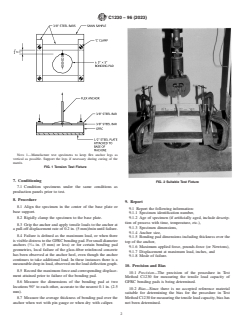
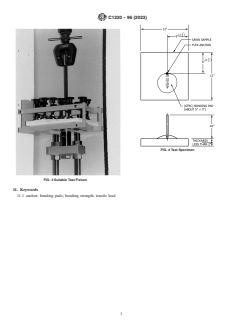
4.2 Loading Fixture—The load fixture for applying tensile
mendations issued by the World Trade Organization Technical
load is shown schematically in Fig. 1. It consists of a ⁄2 in.
Barriers to Trade (TBT) Committee.
(13-mm) thick steel base plate. A suitable mechanism for test
fixtures is shown in Fig. 2 and Fig. 3. The design of the loading
2. Referenced Documents
fixture shall be such that the specimen is rigidly attached to the
2.1 ASTM Standards:
base support. In particular, the section of the specimen adjacent
D76/D76M Specification for Tensile Testing Machines for
to the flex anchor shall not be allowed to bend while the anchor
Textiles
is being pulled in tension, in order to avoid force eccentricity.
E4 Practices for Force Calibration and Verification of Test-
4.3 Gripping Device, a suitable mechanical gripping device
ing Machines
or jaws to grip the steel anchor. Use a universal joint between
the grip and crosshead of the testing machine to ensure the
3. Significance and Use
application of a tensile load for the duration of the test.
3.1 Tensile loads determined by this test method are useful
for quality control of GFRC architectural panels manufactured
5. Sampling
using the steel panel frame support design. In addition, test
5.1 The sampling method shall be in accordance with
governing specifications.
This test method is under the jurisdiction of ASTM Committee C27 on Precast
6. Test Specimen
Concrete Products and is the direct responsibility of Subcommittee C27.40 on Glass
Fiber Reinforced Concrete.
6.1 Saw the test specimens from a test board panel prepared
Current edition approved May 1, 2023. Published May 2023. Originally
at the same time and in a manner identical to production
approved in 1993. Last previous edition approved in 2015 as C1230 – 96(2015).
DOI: 10.1520/C1230-96R23.
panels. Saw the test specimens so they are nominally 12 in.
For referenced ASTM
...