

ASTM C890-21
(Practice)Standard Practice for Minimum Structural Design Loading for Monolithic or Sectional Precast Concrete Water and Wastewater Structures
General Information
- Abstract
SIGNIFICANCE AND USE
4.1 This practice is intended to standardize the minimum loads to be used to structurally design a precast product.
4.2 The user is cautioned that he must properly correlate the anticipated field conditions and requirements with the design loads. Field conditions may dictate loads greater than minimum.
SCOPE
1.1 This practice describes the minimum loads to be applied when designing monolithic or sectional precast concrete water and wastewater structures with the exception of concrete pipe, box culverts, utility structures, and material covered in Specification C478/C478M.
1.2 The values stated in inch-pound units are to be regarded as standard. The values given in parentheses are mathematical conversions to SI units that are provided for information only and are not considered standard.
1.3 This standard does not purport to address all of the safety concerns, if any, associated with its use. It is the responsibility of the user of this standard to establish appropriate safety, health, and environmental practices and determine the applicability of regulatory limitations prior to use.
1.4 This international standard was developed in accordance with internationally recognized principles on standardization established in the Decision on Principles for the Development of International Standards, Guides and Recommendations issued by the World Trade Organization Technical Barriers to Trade (TBT) Committee.
- Status
- Published
- Publication Date
- 31-Jul-2021
- Technical Committee
- C27 - Precast Concrete Products
- Drafting Committee
- C27.30 - Water and Wastewater Containers
Buy Documents
ASTM C890-21 - Standard Practice for Minimum Structural Design Loading for Monolithic or Sectional Precast Concrete Water and Wastewater Structures
REDLINE ASTM C890-21 - Standard Practice for Minimum Structural Design Loading for Monolithic or Sectional Precast Concrete Water and Wastewater Structures
Overview
ASTM C890-21 is the international standard practice that defines the minimum structural design loading requirements for monolithic or sectional precast concrete water and wastewater structures. Issued by ASTM International, this standard offers a unified approach for designers and manufacturers to determine the essential loading conditions that these structures must safely withstand throughout their service life. ASTM C890-21 specifically excludes concrete pipe, box culverts, utility structures, and those covered under ASTM C478/C478M.
This standard is pivotal for ensuring that precast concrete water and wastewater containers - such as septic tanks, holding tanks, wet wells, cisterns, and similar structures - meet consistent, reliable strength and durability benchmarks, regardless of site-specific conditions.
Key Topics
- Minimum Loading Requirements: Outlines the basic loads that must be considered in structural design, including dead loads, traffic loads, hydrostatic loads, lateral earth loads, equipment, and lifting loads.
- Load Combinations: Clarifies how load types must be combined for both above-ground and below-ground installation scenarios, factoring real-world variables such as snow, wind, or vehicle impact.
- Surcharge and Lateral Pressures: Details how to assess lateral pressure caused by adjacent soil, surcharge from vehicles, and hydrostatic or liquid pressure.
- Special Considerations: Addresses unique situations such as vibration, ice, thrust, buoyancy, shrinkage, and thermal movements, including minimum reinforcement requirements.
- Field Conditions: Emphasizes the importance of matching design loads to actual field conditions; minimum loads specified in the standard may not always suffice for specific projects.
- Units and Conversions: Primary values are given in inch-pound units, with SI approximations for reference.
- Limitations and Responsibilities: Clearly delegates responsibility for safety, health, environmental practices, and compliance with regulations to the end-user.
Applications
ASTM C890-21 is an essential resource for:
- Designers of Precast Concrete Structures: Ensures load calculations for tanks, reservoirs, manholes, and treatment plant components meet industry requirements.
- Engineers and Specifiers: Provides minimum standards to guide the selection and specification of precast water and wastewater systems in municipal, industrial, and private projects.
- Manufacturers of Precast Concrete Products: Assures structural products are designed to safely resist all relevant loads, facilitating compliance during quality control and third-party inspections.
- Municipal and Regulatory Authorities: Assists in verifying that submittals for precast structures meet required safety and performance criteria.
Correct application of ASTM C890-21 increases structural integrity, extends service life, and minimizes risk of failures due to underestimating load conditions. Field conditions, such as ground water tables, soil properties, and traffic proximity, must be consistently correlated with standard load prescriptions to ensure public safety and regulatory compliance.
Related Standards
Professionals using ASTM C890-21 may also refer to:
- ASTM C478/C478M: Specification for Circular Precast Reinforced Concrete Manhole Sections
- AASHTO Standard Specifications for Highway Bridges: For traffic loading references and designations
- ACI 318: Building Code Requirements for Reinforced Concrete - for reinforcement, material properties, and general concrete design
Using ASTM C890-21 in combination with these and other applicable standards helps ensure robust, comprehensive structural design for precast concrete water and wastewater structures.
For official documents, visit the ASTM website.
Buy Documents
ASTM C890-21 - Standard Practice for Minimum Structural Design Loading for Monolithic or Sectional Precast Concrete Water and Wastewater Structures
REDLINE ASTM C890-21 - Standard Practice for Minimum Structural Design Loading for Monolithic or Sectional Precast Concrete Water and Wastewater Structures
Get Certified
Connect with accredited certification bodies for this standard

DIBt (Deutsches Institut für Bautechnik)
German Institute for Building Technology.
DIN CERTCO
DIN Group product certification.

Aboma Certification B.V.
Specialized in construction, metal, and transport sectors.
Sponsored listings
Frequently Asked Questions
ASTM C890-21 is a standard published by ASTM International. Its full title is "Standard Practice for Minimum Structural Design Loading for Monolithic or Sectional Precast Concrete Water and Wastewater Structures". This standard covers: SIGNIFICANCE AND USE 4.1 This practice is intended to standardize the minimum loads to be used to structurally design a precast product. 4.2 The user is cautioned that he must properly correlate the anticipated field conditions and requirements with the design loads. Field conditions may dictate loads greater than minimum. SCOPE 1.1 This practice describes the minimum loads to be applied when designing monolithic or sectional precast concrete water and wastewater structures with the exception of concrete pipe, box culverts, utility structures, and material covered in Specification C478/C478M. 1.2 The values stated in inch-pound units are to be regarded as standard. The values given in parentheses are mathematical conversions to SI units that are provided for information only and are not considered standard. 1.3 This standard does not purport to address all of the safety concerns, if any, associated with its use. It is the responsibility of the user of this standard to establish appropriate safety, health, and environmental practices and determine the applicability of regulatory limitations prior to use. 1.4 This international standard was developed in accordance with internationally recognized principles on standardization established in the Decision on Principles for the Development of International Standards, Guides and Recommendations issued by the World Trade Organization Technical Barriers to Trade (TBT) Committee.
SIGNIFICANCE AND USE 4.1 This practice is intended to standardize the minimum loads to be used to structurally design a precast product. 4.2 The user is cautioned that he must properly correlate the anticipated field conditions and requirements with the design loads. Field conditions may dictate loads greater than minimum. SCOPE 1.1 This practice describes the minimum loads to be applied when designing monolithic or sectional precast concrete water and wastewater structures with the exception of concrete pipe, box culverts, utility structures, and material covered in Specification C478/C478M. 1.2 The values stated in inch-pound units are to be regarded as standard. The values given in parentheses are mathematical conversions to SI units that are provided for information only and are not considered standard. 1.3 This standard does not purport to address all of the safety concerns, if any, associated with its use. It is the responsibility of the user of this standard to establish appropriate safety, health, and environmental practices and determine the applicability of regulatory limitations prior to use. 1.4 This international standard was developed in accordance with internationally recognized principles on standardization established in the Decision on Principles for the Development of International Standards, Guides and Recommendations issued by the World Trade Organization Technical Barriers to Trade (TBT) Committee.
ASTM C890-21 is classified under the following ICS (International Classification for Standards) categories: 91.100.30 - Concrete and concrete products. The ICS classification helps identify the subject area and facilitates finding related standards.
ASTM C890-21 is available in PDF format for immediate download after purchase. The document can be added to your cart and obtained through the secure checkout process. Digital delivery ensures instant access to the complete standard document.
Standards Content (Sample)
This international standard was developed in accordance with internationally recognized principles on standardization established in the Decision on Principles for the
Development of International Standards, Guides and Recommendations issued by the World Trade Organization Technical Barriers to Trade (TBT) Committee.
Designation: C890 − 21
Standard Practice for
Minimum Structural Design Loading for Monolithic or
Sectional Precast Concrete Water and Wastewater
Structures
This standard is issued under the fixed designation C890; the number immediately following the designation indicates the year of
original adoption or, in the case of revision, the year of last revision. A number in parentheses indicates the year of last reapproval. A
superscript epsilon (´) indicates an editorial change since the last revision or reapproval.
1. Scope 2.3 ACI Standard:
ACI 318 Building Code Requirements for Reinforced Con-
1.1 This practice describes the minimum loads to be applied
crete
when designing monolithic or sectional precast concrete water
and wastewater structures with the exception of concrete pipe,
3. Terminology
box culverts, utility structures, and material covered in Speci-
3.1 Definitions of Terms Specific to This Standard:
fication C478/C478M.
3.1.1 above ground structures, n—all structures with their
1.2 The values stated in inch-pound units are to be regarded
base at or above ground.
as standard. The values given in parentheses are mathematical
3.1.2 bearing loads, n—the foundation pressure reaction to
conversions to SI units that are provided for information only
all other loads acting on the structure.
and are not considered standard.
3.1.3 below ground structures, n—all structures other than
1.3 This standard does not purport to address all of the
those with their base at or above ground.
safety concerns, if any, associated with its use. It is the
3.1.4 dead loads, n—the mass of the structure and all
responsibility of the user of this standard to establish appro-
permanent loads imposed on the structure.
priate safety, health, and environmental practices and deter-
mine the applicability of regulatory limitations prior to use. 3.1.5 equipment loads, n—loads induced into the structure
1.4 This international standard was developed in accor-
by equipment installed on mounting devices cast into the
dance with internationally recognized principles on standard- structure.
ization established in the Decision on Principles for the
3.1.6 hydrostaticloads,n—allpressuresduetotheweightof
Development of International Standards, Guides and Recom-
water or other liquids.
mendations issued by the World Trade Organization Technical
3.1.7 lateral earth loads, n—the lateral pressure due to the
Barriers to Trade (TBT) Committee.
effective weight of adjacent earth backfill.
2. Referenced Documents 3.1.8 lifting loads, n—the forces induced into the structure
2 during handling at the precast plant and the construction site.
2.1 ASTM Standards:
3.1.9 surcharge loads, n—the lateral pressure due to vertical
C478/C478M Specification for Circular Precast Reinforced
loads superimposed on the adjacent earth backfill.
Concrete Manhole Sections
2.2 AASHTO Standard: 3.1.10 traffıc loads, n—all loads superimposed on the struc-
Standard Specifications for Highway Bridges, 16th Edition ture or adjacent earth backfill due to vehicles or pedestrians.
3.1.11 water and wastewater structures, n—solar heating
reservoirs, septic tanks, cisterns, holding tanks, leaching tanks,
This practice is under the jurisdiction of ASTM Committee C27 on Precast
extended aeration tanks, wet wells, pumping stations, grease
Concrete Products and is the direct responsibility of Subcommittee C27.30 on Water
traps, distribution boxes, oil-water separators, treatment plants,
and Wastewater Containers.
Current edition approved Aug. 1, 2021. Published August 2021. Originally
manure pits, catch basins, drop inlets, and similar structures.
approved in 1978. Last previous edition approved in 2019 as C890– 19. DOI:
10.1520/C0890-21.
4. Significance and Use
For referenced ASTM standards, visit the ASTM website, www.astm.org, or
4.1 This practice is intended to standardize the minimum
contact ASTM Customer Service at service@astm.org. For Annual Book of ASTM
Standards volume information, refer to the standard’s Document Summary page on
loads to be used to structurally design a precast product.
the ASTM website.
Available from American Association of State Highway and Transportation
Officials (AASHTO), 444 N. Capitol St., NW, Suite 249, Washington, DC 20001, Available fromAmerican Concrete Institute (ACI), P.O. Box 9094, Farmington
http://www.transportation.org. Hills, MI 48333-9094, http://www.concrete.org.
Copyright © ASTM International, 100 Barr Harbor Drive, PO Box C700, West Conshohocken, PA 19428-2959. United States
C890 − 21
TABLE 2 Vehicle and Pedestrian Load Designations
4.2 The user is cautioned that he must properly correlate the
anticipated field conditions and requirements with the design Designation Load, max Uses
A
loads. Field conditions may dictate loads greater than mini- A-16 (HS20-44) 16 000 lbf (71 200 N) per wheel heavy traffic
A
A-12 (HS15-44) 12 000 lbf (53 400 N) per wheel medium traffic
mum.
A
A-8 (H10-44) 8000 lbf (35 600 N) per wheel light traffic
A-03 300 lbf/ft (14 400 Pa) walkways
5. Design Loads
A
The designations in parentheses are corresponding AASHTO designations.
5.1 Dead Loads:
5.1.1 Permanent vertical loads typically include the weight
of the road bed, walkways, earth backfill, and access opening
covers.
5.1.2 Recommendedunitweightsofmaterialsfordesign are
shown in Table 1.
5.2 Traffıc Loads:
5.2.1 The vehicle and pedestrian loadings are shown in
Table 2.
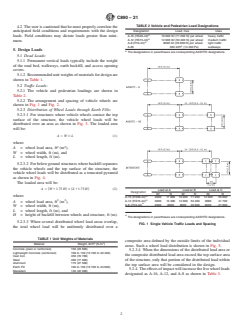
5.2.2 The arrangement and spacing of vehicle wheels are
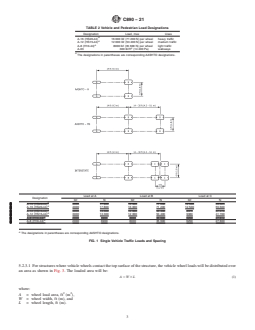
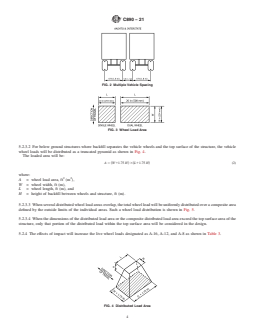
shown in Fig. 1 and Fig. 2.
5.2.3 Distribution of Wheel Loads through Earth Fills:
5.2.3.1 For structures where vehicle wheels contact the top
surface of the structure, the vehicle wheel loads will be
distributed over an area as shown in Fig. 3. The loaded area
will be:
A 5 W 3L (1)
where:
2 2
A = wheel load area, ft (m ),
W = wheel width, ft (m), and
L = wheel length, ft (m).
5.2.3.2 Forbelowgroundstructureswherebackfillseparates
the vehicle wheels and the top surface of the structure, the
vehicle wheel loads will be distributed as a truncated pyramid
as shown in Fig. 4.
The loaded area will be:
A 5 ~W11.75 H! 3 ~L11.75 H! (2)
Load at A Load at B Load at C
Designation
lbf N lbf N lbf N
where: A
A-16 (HS20-44) 4000 17 800 16 000 71 200 12 500 55 600
2 2 A
A-12 (HS15-44) 3000 13 300 12 000 53 400 9380 41 700
A = wheel load area, ft (m ),
A
A-8 (H10-44) 2000 8900 8000 35 600 6250 27 800
W = wheel width, ft (m),
L = wheel length, ft (m), and
H = height of backfill between wheels and structure, ft (m).
A
The designations in parentheses are corresponding AASHTO designations.
5.2.3.3 When several distributed wheel load areas overlap,
FIG. 1 Single Vehicle Traffic Loads and Spacing
the total wheel load will be uniformly distributed over a
TABLE 1 Unit Weights of Materials
composite area defined by the outside limits of the individual
3 3
Material Weight, lbf/ft (N ⁄m )
areas. Such a wheel load distribution is shown in Fig. 5.
Concrete (plain or reinforced) 150 (23 600)
5.2.3.4 When the dimensions of the distributed load area or
Lightweight Concrete (reinforced) 100 to 130 (15 700 to 20 400)
the composite distributed load area exceed the top surface area
Cast Iron 450 (70 700)
Steel 490 (77 000) of the structure, only that portion of the distributed load within
Aluminum 175 (27 500)
the top surface area will be considered in the design.
Earth Fill 100 to 150 (15 700 to 23 600)
5.2.4 Theeffectsofimpactwillincreasethelivewheelloads
Macadam 140 (22 000)
designated as A-16, A-12, and A-8 as shown in Table 3.
C890 − 21
TABLE 3 Wheel Load Increases for Impact
Height of Backfill Between Wheel and Structure Increase
0 to 12 in. (0 to 305 mm) 30 %
13 to 24 in. (330 to 610 mm) 20 %
25 to 35 in. (635 to 890 mm) 10 %
36 in. (915 mm) or greater 0 %
where:
P = hydrostatic pressure, lbf/ft (Pa),
W
3 3
W = unit weight of water, lbf/ft (N/m ), and
W
H = distance from the ground water surface to the point on
W
the structure under consideration, ft (m).
FIG. 2 Multiple Vehicle Spacing
5.3
...
This document is not an ASTM standard and is intended only to provide the user of an ASTM standard an indication of what changes have been made to the previous version. Because
it may not be technically possible to adequately depict all changes accurately, ASTM recommends that users consult prior editions as appropriate. In all cases only the current version
of the standard as published by ASTM is to be considered the official document.
Designation: C890 − 19 C890 − 21
Standard Practice for
Minimum Structural Design Loading for Monolithic or
Sectional Precast Concrete Water and Wastewater
Structures
This standard is issued under the fixed designation C890; the number immediately following the designation indicates the year of
original adoption or, in the case of revision, the year of last revision. A number in parentheses indicates the year of last reapproval. A
superscript epsilon (´) indicates an editorial change since the last revision or reapproval.
1. Scope
1.1 This practice describes the minimum loads to be applied when designing monolithic or sectional precast concrete water and
wastewater structures with the exception of concrete pipe, box culverts, utility structures, and material covered in Specification
C478C478/C478M.
1.2 The values stated in inch-pound units are to be regarded as standard. The values given in parentheses are mathematical
conversions to SI units that are provided for information only and are not considered standard.
1.3 This standard does not purport to address all of the safety concerns, if any, associated with its use. It is the responsibility
of the user of this standard to establish appropriate safety, health, and environmental practices and determine the applicability of
regulatory limitations prior to use.
1.4 This international standard was developed in accordance with internationally recognized principles on standardization
established in the Decision on Principles for the Development of International Standards, Guides and Recommendations issued
by the World Trade Organization Technical Barriers to Trade (TBT) Committee.
2. Referenced Documents
2.1 ASTM Standards:
C478C478/C478M Specification for Circular Precast Reinforced Concrete Manhole Sections (Metric) C0478_C0478M
2.2 AASHTO Standard:
Standard Specifications for Highway Bridges, 16th Edition
2.3 ACI Standard:
ACI 318 Building Code Requirements for Reinforced Concrete
3. Terminology
3.1 Definitions of Terms Specific to This Standard:
3.1.1 above ground structures—structures, n—all structures with their base at or above ground.
This practice is under the jurisdiction of ASTM Committee C27 on Precast Concrete Products and is the direct responsibility of Subcommittee C27.30 on Water and
Wastewater Containers.
Current edition approved July 1, 2019Aug. 1, 2021. Published July 2019August 2021. Originally approved in 1978. Last previous edition approved in 20132019 as
C890– 13.– 19. DOI: 10.1520/C0890-19.10.1520/C0890-21.
For referenced ASTM standards, visit the ASTM website, www.astm.org, or contact ASTM Customer Service at service@astm.org. For Annual Book of ASTM Standards
volume information, refer to the standard’s Document Summary page on the ASTM website.
Available from American Association of State Highway and Transportation Officials (AASHTO), 444 N. Capitol St., NW, Suite 249, Washington, DC 20001,
http://www.transportation.org.
Available from American Concrete Institute (ACI), P.O. Box 9094, Farmington Hills, MI 48333-9094, http://www.concrete.org.
Copyright © ASTM International, 100 Barr Harbor Drive, PO Box C700, West Conshohocken, PA 19428-2959. United States
C890 − 21
3.1.2 bearing loads—loads, n—the foundation pressure reaction to all other loads acting on the structure.
3.1.3 below ground structures—structures, n—all structures other than those with their base at or above ground.
3.1.4 dead loads—loads, n—the mass of the structure and all permanent loads imposed on the structure.
3.1.5 equipment loads—loads, n—loads induced into the structure by equipment installed on mounting devices cast into the
structure.
3.1.6 hydrostatic loads—loads, n—all pressures due to the weight of water or other liquids.
3.1.7 lateral earth loads—loads, n—the lateral pressure due to the effective weight of adjacent earth backfill.
3.1.8 lifting loads—loads, n—the forces induced into the structure during handling at the precast plant and the construction site.
3.1.9 surcharge loads—loads, n—the lateral pressure due to vertical loads superimposed on the adjacent earth backfill.
3.1.10 traffıc loads—loads, n—all loads superimposed on the structure or adjacent earth backfill due to vehicles or pedestrians.
3.1.11 water and wastewater structures—structures, n—solar heating reservoirs, septic tanks, cisterns, holding tanks, leaching
tanks, extended aeration tanks, wet wells, pumping stations, grease traps, distribution boxes, oil-water separators, treatment plants,
manure pits, catch basins, drop inlets, and similar structures.
4. Significance and Use
4.1 This practice is intended to standardize the minimum loads to be used to structurally design a precast product.
4.2 The user is cautioned that he must properly correlate the anticipated field conditions and requirements with the design loads.
Field conditions may dictate loads greater than minimum.
5. Design Loads
5.1 Dead Loads:
5.1.1 Permanent vertical loads typically include the weight of the road bed, walkways, earth backfill, and access opening covers.
5.1.2 Recommended unit weights of materials for design are shown in Table 1.
5.2 Traffıc Loads:
5.2.1 The vehicle and pedestrian loadings are shown in Table 2.
5.2.2 The arrangement and spacing of vehicle wheels are shown in Fig. 1 and Fig. 2.
5.2.3 Distribution of Wheel Loads through Earth Fills:
TABLE 1 Unit Weights of Materials
3 3
Material Weight, lbf/ft (N ⁄m )
Concrete (plain or reinforced) 150 (23 600)
Lightweight Concrete (reinforced) 100 to 130 (15 700 to 20 400)
Cast Iron 450 (70 700)
Steel 490 (77 000)
Aluminum 175 (27 500)
Earth Fill 100 to 150 (15 700 to 23 600)
Macadam 140 (22 000)
C890 − 21
TABLE 2 Vehicle and Pedestrian Load Designations
Designation Load, max Uses
A
A-16 (HS20-44) 16 000 lbf (71 200 N) per wheel heavy traffic
A
A-12 (HS15-44) 12 000 lbf (53 400 N) per wheel medium traffic
A
A-8 (H10-44) 8000 lbf (35 600 N) per wheel light traffic
A-03 300 lbf/ft (14 400 Pa) walkways
A
The designations in parentheses are corresponding AASHTO designations.
Load at A Load at B Load at C
Designation
lbf N lbf N lbf N
A
A-16 (HS20-44) 4000 17 800 16 000 71 200 12 500 55 625
A
A-16 (HS20-44) 4000 17 800 16 000 71 200 12 500 55 600
A
A-12 (HS15-44) 3000 13 300 12 000 53 400 8375 37 270
A
A-12 (HS15-44) 3000 13 300 12 000 53 400 9380 41 700
A
A-8 (H10-44) 2000 8900 8000 35 600 6250 27 812
A
A-8 (H10-44) 2000 8900 8000 35 600 6250 27 800
A
The designations in parentheses are corresponding AASHTO designations.
FIG. 1 Single Vehicle Traffic Loads and Spacing
5.2.3.1 For structures where vehicle wheels contact the top surface of the structure, the vehicle wheel loads will be distributed over
an area as shown in Fig. 3. The loaded area will be:
A 5 W 3L (1)
where:
2 2
A = wheel load area, ft (m ),
W = wheel width, ft (m), and
L = wheel length, ft (m).
C890 − 21
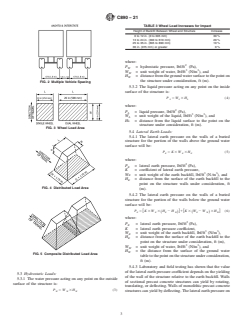
FIG. 2 Multiple Vehicle Spacing
FIG. 3 Wheel Load Area
5.2.3.2 For below ground structures where backfill separates the vehicle wheels and the top surface of the structure, the vehicle
wheel loads will be distributed as a truncated pyramid as shown in Fig. 4.
The loaded area will be:
A 5 W11.75 H 3 L11.75 H (2)
~ ! ~ !
where:
2 2
A = wheel load area, ft (m ),
W = wheel width, ft (m),
L = wheel length, ft (m), and
H = height of backfill between wheels and structure, ft (m).
5.2.3.3 When several distributed wheel load areas overlap, the total wheel load will be uniformly distributed over a composite area
defined by the outside limits of the individual areas. Such a wheel load distribution is shown in Fig. 5.
5.2.3.4 When the dimensions of the distributed load area or the composite distributed load area exceed the top surface area of the
structure, only that portion of the distributed load within the top surface area will be considered in the design.
5.2.4 The effects of impact will increase the live wheel loads designated as A-16, A-12, and A-8 as shown in Table 3.
FIG. 4 Distributed Load Area
C890 − 21
FIG. 5 Composite Distributed Load Area
TABLE 3 Wheel Load Increases for Impact
Height of Backfill Between Wheel and Structure Increase
0 to 12 in. (0 to 305 mm) 30 %
13 to 24 in. (330 t
...