

ASTM C1229-94(2023)
(Test Method)Standard Test Method for Determination of Glass Fiber Content in Glass Fiber Reinforced Concrete (GFRC) (Wash-Out Test)
General Information
- Abstract
SIGNIFICANCE AND USE
4.1 Glass fiber contents, determined by this test method, are useful for quality control of GFRC products to ensure that manufacturing equipment has been set up to deliver the correct proportions of glass fiber reinforcement in a GFRC composite.
SCOPE
1.1 This test method covers determination of the fiber content in an uncured, glass fiber reinforced concrete (GFRC) sample panel.
1.2 The values stated in inch-pound units are to be regarded as standard. The values given in parentheses are mathematical conversions to SI units that are provided for information only and are not considered standard.
1.3 This standard does not purport to address all of the safety concerns, if any, associated with its use. It is the responsibility of the user of this standard to establish appropriate safety, health, and environmental practices and determine the applicability of regulatory limitations prior to use.
1.4 This international standard was developed in accordance with internationally recognized principles on standardization established in the Decision on Principles for the Development of International Standards, Guides and Recommendations issued by the World Trade Organization Technical Barriers to Trade (TBT) Committee.
- Status
- Published
- Publication Date
- 30-Apr-2023
- Technical Committee
- C27 - Precast Concrete Products
- Drafting Committee
- C27.40 - Glass Fiber Reinforced Concrete


Overview
ASTM C1229-94(2023) - Standard Test Method for Determination of Glass Fiber Content in Glass Fiber Reinforced Concrete (GFRC) (Wash-Out Test) provides a standardized method for accurately measuring the glass fiber content in uncured glass fiber reinforced concrete (GFRC) samples. Developed under the guidance of ASTM International and aligned with globally recognized standardization principles, this test method supports manufacturers and quality control teams in the concrete industry by ensuring the correct proportion of glass fiber reinforcement in GFRC products.
Implementing this standard helps verify that production equipment is calibrated for optimal reinforcement levels, leading to reliable and consistent structural performance in GFRC composites.
Key Topics
- Purpose: Establishes a reliable wash-out test procedure for determining fiber content in uncured GFRC sample panels.
- Scope: Applies to uncured GFRC materials, detailing the sampling, testing, and calculation process to ensure consistent results.
- Units of Measurement: Uses inch-pound units as the standard; SI units may be included for informational purposes.
- Safety: Highlights the user’s responsibility to adhere to relevant safety, health, and environmental protocols when conducting the test.
- International Standardization: Developed in accordance with World Trade Organization (WTO) requirements, promoting compatibility with global standards.
Applications
The ASTM C1229-94(2023) standard is essential in a variety of practical GFRC applications, especially where quality control of composite construction materials is critical:
- Quality Control: Enables manufacturers to monitor and adjust glass fiber dosing in GFRC, ensuring products meet design and structural specifications.
- Process Optimization: Assists production teams in verifying correct setup and calibration of fiber dispensing equipment, reducing defects and minimizing material waste.
- Product Certification: Provides a recognized method for certifying GFRC panels and components before curing, offering assurance to clients, regulators, and third-party assessors.
- Research and Development: Supports the evaluation of new mix designs and fiber reinforcement techniques by providing a consistent way to compare fiber content across samples.
- Regulatory Compliance: Ensures materials meet regional and international standards, facilitating acceptance in a global construction market.
Related Standards
For comprehensive GFRC testing and specification, the following ASTM standards are closely associated with ASTM C1229-94(2023):
- ASTM C1228 - Practice for Preparing Coupons for Flexural and Wash-Out Tests on Glass Fiber Reinforced Concrete: Outlines sample preparation for subsequent GFRC testing, including the wash-out test.
- ASTM C27 - Precast Concrete Products: Encompasses broader standards for precast concrete, including those reinforced with glass fibers.
- WTO Principles: The standard is developed in accordance with internationally recognized principles on standardization established by the World Trade Organization Technical Barriers to Trade (TBT) Committee.
Practical Value
Implementing ASTM C1229-94(2023) delivers practical benefits by:
- Promoting consistency in manufacturing processes and end products
- Reducing the risk of structural failures due to inadequate fiber content
- Enabling effective process control and material traceability for GFRC elements
By adhering to this standard, manufacturers, quality assurance specialists, and project owners ensure the long-term performance, safety, and compliance of glass fiber reinforced concrete products used in buildings, facades, infrastructure, and architectural elements.
Keywords: ASTM C1229-94(2023), glass fiber reinforced concrete, GFRC, wash-out test, fiber content determination, quality control, construction materials, standards compliance, structural performance.
Relations
- Effective Date
- 01-May-2009
- Effective Date
- 01-Dec-2004
- Effective Date
- 01-Jan-1996
Get Certified
Connect with accredited certification bodies for this standard

DIBt (Deutsches Institut für Bautechnik)
German Institute for Building Technology.
DIN CERTCO
DIN Group product certification.

Aboma Certification B.V.
Specialized in construction, metal, and transport sectors.
Sponsored listings
Frequently Asked Questions
ASTM C1229-94(2023) is a standard published by ASTM International. Its full title is "Standard Test Method for Determination of Glass Fiber Content in Glass Fiber Reinforced Concrete (GFRC) (Wash-Out Test)". This standard covers: SIGNIFICANCE AND USE 4.1 Glass fiber contents, determined by this test method, are useful for quality control of GFRC products to ensure that manufacturing equipment has been set up to deliver the correct proportions of glass fiber reinforcement in a GFRC composite. SCOPE 1.1 This test method covers determination of the fiber content in an uncured, glass fiber reinforced concrete (GFRC) sample panel. 1.2 The values stated in inch-pound units are to be regarded as standard. The values given in parentheses are mathematical conversions to SI units that are provided for information only and are not considered standard. 1.3 This standard does not purport to address all of the safety concerns, if any, associated with its use. It is the responsibility of the user of this standard to establish appropriate safety, health, and environmental practices and determine the applicability of regulatory limitations prior to use. 1.4 This international standard was developed in accordance with internationally recognized principles on standardization established in the Decision on Principles for the Development of International Standards, Guides and Recommendations issued by the World Trade Organization Technical Barriers to Trade (TBT) Committee.
SIGNIFICANCE AND USE 4.1 Glass fiber contents, determined by this test method, are useful for quality control of GFRC products to ensure that manufacturing equipment has been set up to deliver the correct proportions of glass fiber reinforcement in a GFRC composite. SCOPE 1.1 This test method covers determination of the fiber content in an uncured, glass fiber reinforced concrete (GFRC) sample panel. 1.2 The values stated in inch-pound units are to be regarded as standard. The values given in parentheses are mathematical conversions to SI units that are provided for information only and are not considered standard. 1.3 This standard does not purport to address all of the safety concerns, if any, associated with its use. It is the responsibility of the user of this standard to establish appropriate safety, health, and environmental practices and determine the applicability of regulatory limitations prior to use. 1.4 This international standard was developed in accordance with internationally recognized principles on standardization established in the Decision on Principles for the Development of International Standards, Guides and Recommendations issued by the World Trade Organization Technical Barriers to Trade (TBT) Committee.
ASTM C1229-94(2023) is classified under the following ICS (International Classification for Standards) categories: 91.100.30 - Concrete and concrete products. The ICS classification helps identify the subject area and facilitates finding related standards.
ASTM C1229-94(2023) has the following relationships with other standards: It is inter standard links to ASTM C1228-96(2009), ASTM C1228-96(2004), ASTM C1228-96. Understanding these relationships helps ensure you are using the most current and applicable version of the standard.
ASTM C1229-94(2023) is available in PDF format for immediate download after purchase. The document can be added to your cart and obtained through the secure checkout process. Digital delivery ensures instant access to the complete standard document.
Standards Content (Sample)
This international standard was developed in accordance with internationally recognized principles on standardization established in the Decision on Principles for the
Development of International Standards, Guides and Recommendations issued by the World Trade Organization Technical Barriers to Trade (TBT) Committee.
Designation: C1229 − 94 (Reapproved 2023)
Standard Test Method for
Determination of Glass Fiber Content in Glass Fiber
Reinforced Concrete (GFRC) (Wash-Out Test)
This standard is issued under the fixed designation C1229; the number immediately following the designation indicates the year of
original adoption or, in the case of revision, the year of last revision. A number in parentheses indicates the year of last reapproval. A
superscript epsilon (´) indicates an editorial change since the last revision or reapproval.
1. Scope 4. Significance and Use
4.1 Glass fiber contents, determined by this test method, are
1.1 This test method covers determination of the fiber
useful for quality control of GFRC products to ensure that
content in an uncured, glass fiber reinforced concrete (GFRC)
manufacturing equipment has been set up to deliver the correct
sample panel.
proportions of glass fiber reinforcement in a GFRC composite.
1.2 The values stated in inch-pound units are to be regarded
as standard. The values given in parentheses are mathematical
5. Apparatus
conversions to SI units that are provided for information only
5.1 Balance, 2 kg capacity, sensitive to the nearest 0.1 g.
and are not considered standard.
5.2 Mesh Basket or Strainer, approximately 30 in. (493
1.3 This standard does not purport to address all of the
cm ) capacity of woven stainless steel wire and mesh size
safety concerns, if any, associated with its use. It is the
3 1
between ⁄16 (4.5 mm) and ⁄16 (1.5 mm). Overall dimensions
responsibility of the user of this standard to establish appro-
must totally accept the test sample without any overhang, and
priate safety, health, and environmental practices and deter-
depth should be approximately twice the thickness of the test
mine the applicability of regulatory limitations prior to use.
sample. Gage and construction must be such that mesh
1.4 This international standard was developed in accor-
dimension cannot easily enlarge, allowing glass reinforcement
dance with internationally recognized principles on standard-
to escape.
ization established in the Decision on Principles for the
5.3 Drying Chamber, an oven that can be set at 230 6 10°F
Development of International Standards, Guides and Recom-
(110 6 10°C), or a muffle furnace set at 900 6 10°F (482 6
mendations issued by the World Trade Organization Technical
10°C).
Barriers to Trade (TBT) Committee.
5.4 Razor Knife, capable of 6 in. blade extension.
2. Referenced Documents
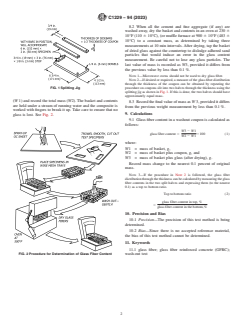
5.5 Splitting Jig, see Fig. 1.
2.1 ASTM Standards:
6. Sampling
C1228 Practice for Preparing Coupons for Flexural and
Washout Tests on Glass Fiber Reinforced Concrete
6.1 Sampling should be in accordance with governing
specifications.
3. Terminology
7. Test Specimens
3.1 Definitions:
7.1 Cut the coupons with a razor knife from a freshly cast,
3.1.1 glass fiber reinforced concrete (GFRC)—a composi-
damp, uncured sample panel. When cutting out the test coupon,
tion of cementitious material, aggregates, water, admixtures,
the sample panel shall have sufficient cohesiveness such that:
and alkali-resistant glass fiber.
(a) a clean cut can be made without pulling out fibers from the
test coupon or the adjacent material, and (b) that material is not
lost from the test coupon prior to determining mass.
This test method is under the jurisdiction of ASTM Committee C27 on Precast
2 2
Concrete Products and is the direct responsibility of Subcommittee C27.40 on Glass
7.2 The test specimen shall be between 12 in. (78 cm ) and
2 2
Fiber Reinforced Concrete.
16 in. (103 cm ).
Current edition approved May 1, 2023. Published May 2023. Originally
approved in 1993. Last previous edition approved in 2015 as C1229 – 94(2015).
8. Procedure
DOI: 10.1520/C1229-94R23.
For referenced ASTM standards, visit the ASTM website, www.astm.org, or
8.1 Cut two test coupons with a razor knife from a freshly
contact ASTM Customer Service at service@astm.org. For Annual Book of ASTM
produced, damp, uncured sample panel as done i
...