

ASTM F1802-22
(Test Method)Standard Test Method for Performance Testing of Excess Flow Valves
General Information
- Abstract
SIGNIFICANCE AND USE
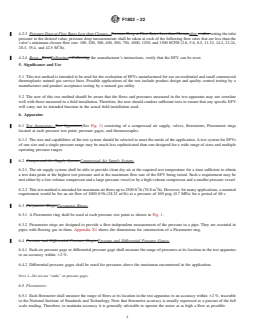
5.1 This test method is intended to be used for the evaluation of EFVs manufactured for use on residential and small commercial thermoplastic natural gas service lines. Possible applications of the test include product design and quality control testing by a manufacturer and product acceptance testing by a natural gas utility.
5.2 The user of this test method should be aware that the flows and pressures measured in the test apparatus may not correlate well with those measured in a field installation. Therefore, the user should conduct sufficient tests to ensure that any specific EFV will carry out its intended function in the actual field installation used.
SCOPE
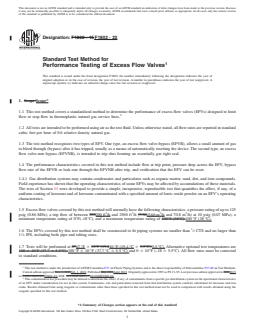
1.1 This test method covers a standardized method to determine the performance of excess flow valves (EFVs) designed to limit flow or stop flow in thermoplastic natural gas service lines.2
1.2 All tests are intended to be performed using air as the test fluid. Unless otherwise stated, all flow rates are reported in standard cubic feet per hour of 0.6 relative density natural gas.
1.3 The test method recognizes two types of EFV. One type, an excess flow valve-bypass (EFVB), allows a small amount of gas to bleed through (bypass) after it has tripped, usually as a means of automatically resetting the device. The second type, an excess flow valve-non bypass (EFVNB), is intended to trip shut forming an essentially gas tight seal.
1.4 The performance characteristics covered in this test method include flow at trip point, pressure drop across the EFV, bypass flow rate of the EFVB or leak rate through the EFVNB after trip, and verification that the EFV can be reset.
1.4.1 Gas distribution systems may contain condensates and particulates such as organic matter, sand, dirt, and iron compounds. Field experience has shown that the operating characteristics of some EFVs may be affected by accumulations of these materials. The tests of Section 11 were developed to provide a simple, inexpensive, reproducible test that quantifies the effect, if any, of a uniform coating of kerosene and of kerosene contaminated with a specified amount of ferric oxide powder on an EFV's operating characteristics.
1.5 Excess flow valves covered by this test method will normally have the following characteristics: a pressure rating of up to 125 psig (0.86 MPa); a trip flow of between 200 ft3/h and 2500 ft3/h (5.66 m3/h and 70.8 m3/h) at 10 psig (0.07 MPa); a minimum temperature rating of 0°F(–18°C), and a maximum temperature rating of 100 °F (38 °C).
1.6 The EFVs covered by this test method shall be constructed to fit piping systems no smaller than 1/2 CTS and no larger than 11/4 IPS, including both pipe and tubing sizes.
1.7 Tests will be performed at 67 °F ± 10 °F (19.4 °C ± 5.5 °C). Alternative optional test temperatures are 100 °F ± 10 °F (37.7 °C ± 5.5 °C) and 0 ± 10°F (–18 ± 5.5°C). All flow rates must be corrected to standard conditions.
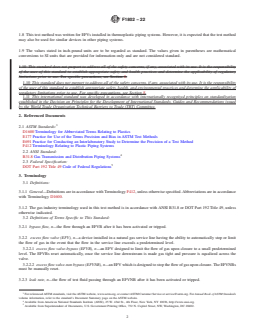
1.8 This test method was written for EFVs installed in thermoplastic piping systems. However, it is expected that the test method may also be used for similar devices in other piping systems.
1.9 The values stated in inch-pound units are to be regarded as standard. The values given in parentheses are mathematical conversions to SI units that are provided for information only and are not considered standard.
1.10 This standard does not purport to address all of the safety concerns, if any, associated with its use. It is the responsibility of the user of this standard to establish appropriate safety, health, and environmental practices and determine the applicability of regulatory limitations prior to use. For specific precautions, see Section 8.
1.11 This international standard was developed in accordance with internationally recognized principles on standardization established in the Decision on Principles for the Development of International Standards, Guides and Recommendations issued by the...
- Status
- Published
- Publication Date
- 31-Jan-2022
- Technical Committee
- F17 - Plastic Piping Systems
- Drafting Committee
- F17.40 - Test Methods
Overview
ASTM F1802-22 is the Standard Test Method for Performance Testing of Excess Flow Valves (EFVs) as designated by ASTM International. This standard outlines a reliable, reproducible method to determine the performance of EFVs used in thermoplastic natural gas service lines for residential and small commercial applications. By providing clear guidelines for evaluating EFVs, this test method helps promote safety and consistency in gas distribution systems, ensuring devices meet essential requirements for flow limitation or shut-off during abnormal conditions.
Key Topics
- Types of Excess Flow Valves:
- Excess Flow Valve-Bypass (EFVB): Allows a controlled amount of gas to bypass after tripping, supporting automatic reset.
- Excess Flow Valve-Non Bypass (EFVNB): Designed to shut off gas flow almost completely when tripped, typically requiring manual reset.
- Performance Characteristics Assessed:
- Trip flow rate (activation flow)
- Pressure drop across the EFV
- Bypass or leak rate post-trip
- Reset verification
- Effects of possible contaminants on performance (e.g., kerosene and ferric oxide)
- Testing Scope and Conditions:
- Tests are performed using air, with flow rates reported as standard cubic feet per hour (SCFH) of 0.6 relative density natural gas.
- Temperature ranges: 0°F to 100°F (-18°C to 38°C), with tests typically conducted at 67°F (19.4°C).
- EFVs evaluated must fit thermoplastic piping systems between 1/2 CTS and 1-1/4 IPS, rated for pressures up to 125 psig.
Applications
ASTM F1802-22 is used by various stakeholders for several critical applications:
- Product Design and Development: Manufacturers utilize this standard to ensure newly developed EFVs meet performance expectations, especially regarding trip flow, reset function, and resistance to environmental contaminants.
- Quality Control: Regular testing per ASTM F1802-22 enables manufacturers to maintain consistent production quality, verifying each batch of EFVs performs within specified parameters.
- Utility Acceptance Testing: Natural gas utilities apply this method to evaluate and approve EFVs for installation in residential or small commercial natural gas service lines, promoting safer distribution networks.
- Field Performance Validation: While the standardized test may not perfectly represent field conditions, its use helps refine selection and deployment of EFVs by establishing comparability and performance baselines.
- Contamination Impact Assessment: The method includes procedures for evaluating how exposure to kerosene or kerosene-ferric oxide mixtures may impact EFV functionality, reflecting real-world pipeline conditions.
Related Standards
When implementing or referencing ASTM F1802-22, the following standards and codes are often relevant:
- ANSI B31.8: Provides requirements for gas transmission and distribution piping systems, including terminology and safety.
- DOT Part 192 (49 CFR): Federal regulations for pipeline safety in natural gas distribution.
- ASTM D1600: Covers abbreviations related to plastics.
- ASTM E177: Details how to use terms precision and bias in ASTM test methods.
- ASTM E691: Guides conducting interlaboratory studies to determine test method precision.
- ASTM F412: Defines terminology for plastic piping systems.
Practical Value
Adhering to ASTM F1802-22 ensures that excess flow valves installed in thermoplastic gas service lines are thoroughly tested for performance and resilience, reducing the risk of uncontrolled gas release. This standard supports regulatory compliance, product quality assurance, and the overall safety and reliability of natural gas distribution systems. Following its protocol also enables utilities and manufacturers to consistently assess and report EFV performance, facilitating improved system maintenance and public safety.
Keywords: Excess Flow Valve (EFV), performance testing, thermoplastic natural gas service, bypass EFV, non-bypass EFV, ASTM F1802-22, gas safety standards, gas distribution, valve testing.
Relations
- Effective Date
- 01-Apr-2020
- Effective Date
- 01-Jan-2019
- Refers
ASTM D1600-18 - Standard Terminology for Abbreviated Terms Relating to Plastics (Withdrawn 2024) - Effective Date
- 01-Jan-2018
- Effective Date
- 01-Aug-2017
- Effective Date
- 01-Feb-2017
- Effective Date
- 15-Nov-2016
- Effective Date
- 01-Aug-2016
- Effective Date
- 01-Jun-2015
- Effective Date
- 01-May-2014
- Effective Date
- 01-Feb-2014
- Effective Date
- 01-May-2013
- Effective Date
- 01-May-2013
- Effective Date
- 15-Apr-2013
- Effective Date
- 15-Feb-2013
- Effective Date
- 01-Apr-2012
Get Certified
Connect with accredited certification bodies for this standard

Institut za varilstvo d.o.o. (Welding Institute)
Slovenia's leading welding institute since 1952. ISO 3834, EN 1090, pressure equipment certification, NDT personnel, welder qualification. Only IIW Au
Sponsored listings
Frequently Asked Questions
ASTM F1802-22 is a standard published by ASTM International. Its full title is "Standard Test Method for Performance Testing of Excess Flow Valves". This standard covers: SIGNIFICANCE AND USE 5.1 This test method is intended to be used for the evaluation of EFVs manufactured for use on residential and small commercial thermoplastic natural gas service lines. Possible applications of the test include product design and quality control testing by a manufacturer and product acceptance testing by a natural gas utility. 5.2 The user of this test method should be aware that the flows and pressures measured in the test apparatus may not correlate well with those measured in a field installation. Therefore, the user should conduct sufficient tests to ensure that any specific EFV will carry out its intended function in the actual field installation used. SCOPE 1.1 This test method covers a standardized method to determine the performance of excess flow valves (EFVs) designed to limit flow or stop flow in thermoplastic natural gas service lines.2 1.2 All tests are intended to be performed using air as the test fluid. Unless otherwise stated, all flow rates are reported in standard cubic feet per hour of 0.6 relative density natural gas. 1.3 The test method recognizes two types of EFV. One type, an excess flow valve-bypass (EFVB), allows a small amount of gas to bleed through (bypass) after it has tripped, usually as a means of automatically resetting the device. The second type, an excess flow valve-non bypass (EFVNB), is intended to trip shut forming an essentially gas tight seal. 1.4 The performance characteristics covered in this test method include flow at trip point, pressure drop across the EFV, bypass flow rate of the EFVB or leak rate through the EFVNB after trip, and verification that the EFV can be reset. 1.4.1 Gas distribution systems may contain condensates and particulates such as organic matter, sand, dirt, and iron compounds. Field experience has shown that the operating characteristics of some EFVs may be affected by accumulations of these materials. The tests of Section 11 were developed to provide a simple, inexpensive, reproducible test that quantifies the effect, if any, of a uniform coating of kerosene and of kerosene contaminated with a specified amount of ferric oxide powder on an EFV's operating characteristics. 1.5 Excess flow valves covered by this test method will normally have the following characteristics: a pressure rating of up to 125 psig (0.86 MPa); a trip flow of between 200 ft3/h and 2500 ft3/h (5.66 m3/h and 70.8 m3/h) at 10 psig (0.07 MPa); a minimum temperature rating of 0°F(–18°C), and a maximum temperature rating of 100 °F (38 °C). 1.6 The EFVs covered by this test method shall be constructed to fit piping systems no smaller than 1/2 CTS and no larger than 11/4 IPS, including both pipe and tubing sizes. 1.7 Tests will be performed at 67 °F ± 10 °F (19.4 °C ± 5.5 °C). Alternative optional test temperatures are 100 °F ± 10 °F (37.7 °C ± 5.5 °C) and 0 ± 10°F (–18 ± 5.5°C). All flow rates must be corrected to standard conditions. 1.8 This test method was written for EFVs installed in thermoplastic piping systems. However, it is expected that the test method may also be used for similar devices in other piping systems. 1.9 The values stated in inch-pound units are to be regarded as standard. The values given in parentheses are mathematical conversions to SI units that are provided for information only and are not considered standard. 1.10 This standard does not purport to address all of the safety concerns, if any, associated with its use. It is the responsibility of the user of this standard to establish appropriate safety, health, and environmental practices and determine the applicability of regulatory limitations prior to use. For specific precautions, see Section 8. 1.11 This international standard was developed in accordance with internationally recognized principles on standardization established in the Decision on Principles for the Development of International Standards, Guides and Recommendations issued by the...
SIGNIFICANCE AND USE 5.1 This test method is intended to be used for the evaluation of EFVs manufactured for use on residential and small commercial thermoplastic natural gas service lines. Possible applications of the test include product design and quality control testing by a manufacturer and product acceptance testing by a natural gas utility. 5.2 The user of this test method should be aware that the flows and pressures measured in the test apparatus may not correlate well with those measured in a field installation. Therefore, the user should conduct sufficient tests to ensure that any specific EFV will carry out its intended function in the actual field installation used. SCOPE 1.1 This test method covers a standardized method to determine the performance of excess flow valves (EFVs) designed to limit flow or stop flow in thermoplastic natural gas service lines.2 1.2 All tests are intended to be performed using air as the test fluid. Unless otherwise stated, all flow rates are reported in standard cubic feet per hour of 0.6 relative density natural gas. 1.3 The test method recognizes two types of EFV. One type, an excess flow valve-bypass (EFVB), allows a small amount of gas to bleed through (bypass) after it has tripped, usually as a means of automatically resetting the device. The second type, an excess flow valve-non bypass (EFVNB), is intended to trip shut forming an essentially gas tight seal. 1.4 The performance characteristics covered in this test method include flow at trip point, pressure drop across the EFV, bypass flow rate of the EFVB or leak rate through the EFVNB after trip, and verification that the EFV can be reset. 1.4.1 Gas distribution systems may contain condensates and particulates such as organic matter, sand, dirt, and iron compounds. Field experience has shown that the operating characteristics of some EFVs may be affected by accumulations of these materials. The tests of Section 11 were developed to provide a simple, inexpensive, reproducible test that quantifies the effect, if any, of a uniform coating of kerosene and of kerosene contaminated with a specified amount of ferric oxide powder on an EFV's operating characteristics. 1.5 Excess flow valves covered by this test method will normally have the following characteristics: a pressure rating of up to 125 psig (0.86 MPa); a trip flow of between 200 ft3/h and 2500 ft3/h (5.66 m3/h and 70.8 m3/h) at 10 psig (0.07 MPa); a minimum temperature rating of 0°F(–18°C), and a maximum temperature rating of 100 °F (38 °C). 1.6 The EFVs covered by this test method shall be constructed to fit piping systems no smaller than 1/2 CTS and no larger than 11/4 IPS, including both pipe and tubing sizes. 1.7 Tests will be performed at 67 °F ± 10 °F (19.4 °C ± 5.5 °C). Alternative optional test temperatures are 100 °F ± 10 °F (37.7 °C ± 5.5 °C) and 0 ± 10°F (–18 ± 5.5°C). All flow rates must be corrected to standard conditions. 1.8 This test method was written for EFVs installed in thermoplastic piping systems. However, it is expected that the test method may also be used for similar devices in other piping systems. 1.9 The values stated in inch-pound units are to be regarded as standard. The values given in parentheses are mathematical conversions to SI units that are provided for information only and are not considered standard. 1.10 This standard does not purport to address all of the safety concerns, if any, associated with its use. It is the responsibility of the user of this standard to establish appropriate safety, health, and environmental practices and determine the applicability of regulatory limitations prior to use. For specific precautions, see Section 8. 1.11 This international standard was developed in accordance with internationally recognized principles on standardization established in the Decision on Principles for the Development of International Standards, Guides and Recommendations issued by the...
ASTM F1802-22 is classified under the following ICS (International Classification for Standards) categories: 23.060.20 - Ball and plug valves. The ICS classification helps identify the subject area and facilitates finding related standards.
ASTM F1802-22 has the following relationships with other standards: It is inter standard links to ASTM F412-20, ASTM F412-19, ASTM D1600-18, ASTM F412-17a, ASTM F412-17, ASTM F412-16a, ASTM F412-16, ASTM F412-15, ASTM E177-14, ASTM D1600-14, ASTM E177-13, ASTM E691-13, ASTM D1600-13, ASTM F412-13, ASTM F412-12. Understanding these relationships helps ensure you are using the most current and applicable version of the standard.
ASTM F1802-22 is available in PDF format for immediate download after purchase. The document can be added to your cart and obtained through the secure checkout process. Digital delivery ensures instant access to the complete standard document.
Standards Content (Sample)
This international standard was developed in accordance with internationally recognized principles on standardization established in the Decision on Principles for the
Development of International Standards, Guides and Recommendations issued by the World Trade Organization Technical Barriers to Trade (TBT) Committee.
Designation: F1802 − 22
Standard Test Method for
Performance Testing of Excess Flow Valves
This standard is issued under the fixed designation F1802; the number immediately following the designation indicates the year of
original adoption or, in the case of revision, the year of last revision. A number in parentheses indicates the year of last reapproval. A
superscript epsilon (´) indicates an editorial change since the last revision or reapproval.
3 3 3
1. Scope* and 2500 ft /h (5.66 m /h and 70.8 m /h) at 10 psig (0.07
MPa); a minimum temperature rating of 0°F(–18°C), and a
1.1 This test method covers a standardized method to
maximum temperature rating of 100 °F (38 °C).
determine the performance of excess flow valves (EFVs)
designed to limit flow or stop flow in thermoplastic natural gas 1.6 The EFVs covered by this test method shall be con-
service lines. structed to fit piping systems no smaller than ⁄2 CTS and no
larger than 1 ⁄4 IPS, including both pipe and tubing sizes.
1.2 All tests are intended to be performed using air as the
test fluid. Unless otherwise stated, all flow rates are reported in 1.7 Tests will be performed at 67 °F 6 10 °F (19.4 °C 6
standard cubic feet per hour of 0.6 relative density natural gas. 5.5 °C). Alternative optional test temperatures are 100 °F 6
10 °F (37.7 °C 6 5.5 °C) and 0 6 10°F (–18 6 5.5°C). All
1.3 The test method recognizes two types of EFV. One type,
flow rates must be corrected to standard conditions.
anexcessflowvalve-bypass(EFVB),allowsasmallamountof
gas to bleed through (bypass) after it has tripped, usually as a 1.8 This test method was written for EFVs installed in
means of automatically resetting the device. The second type, thermoplastic piping systems. However, it is expected that the
an excess flow valve-non bypass (EFVNB), is intended to trip test method may also be used for similar devices in other
shut forming an essentially gas tight seal. piping systems.
1.4 The performance characteristics covered in this test 1.9 The values stated in inch-pound units are to be regarded
method include flow at trip point, pressure drop across the as standard. The values given in parentheses are mathematical
EFV, bypass flow rate of the EFVB or leak rate through the conversions to SI units that are provided for information only
EFVNB after trip, and verification that the EFV can be reset. and are not considered standard.
1.4.1 Gas distribution systems may contain condensates and
1.10 This standard does not purport to address all of the
particulates such as organic matter, sand, dirt, and iron com-
safety concerns, if any, associated with its use. It is the
pounds. Field experience has shown that the operating charac-
responsibility of the user of this standard to establish appro-
teristics of some EFVs may be affected by accumulations of
priate safety, health, and environmental practices and deter-
these materials. The tests of Section 11 were developed to
mine the applicability of regulatory limitations prior to use.
provide a simple, inexpensive, reproducible test that quantifies
For specific precautions, see Section 8.
the effect, if any, of a uniform coating of kerosene and of
1.11 This international standard was developed in accor-
kerosene contaminated with a specified amount of ferric oxide
dance with internationally recognized principles on standard-
powder on an EFV’s operating characteristics.
ization established in the Decision on Principles for the
Development of International Standards, Guides and Recom-
1.5 Excess flow valves covered by this test method will
mendations issued by the World Trade Organization Technical
normally have the following characteristics: a pressure rating
Barriers to Trade (TBT) Committee.
of up to 125 psig (0.86 MPa); a trip flow of between 200 ft /h
2. Referenced Documents
This test method is under the jurisdiction of ASTM Committee F17 on Plastic 2.1 ASTM Standards:
Piping Systems and is the direct responsibility of Subcommittee F17.40 on Test
D1600 TerminologyforAbbreviatedTermsRelatingtoPlas-
Methods.
tics
Current edition approved Feb. 1, 2022. Published April 2022. Originally
E177 Practice for Use of the Terms Precision and Bias in
approved in 1995 as PS 13–95. Last previous edition approved in 2015 as
F1802–15. DOI: 10.1520/F1802-22.
ASTM Test Methods
This contamination test procedure may be utilized to determine the effect, if
any, of contaminants from a specific gas distribution system on the operational
characteristics of an EFV under consideration for use in that system. Condensates,
oils and particulates removed from that distribution system could be substituted for For referenced ASTM standards, visit the ASTM website, www.astm.org, or
keroseneandironoxide.Resultsobtainedfromusingreagentsorcontaminantsother contact ASTM Customer Service at service@astm.org. For Annual Book of ASTM
than those specified in this test method must not be used in comparison with results Standards volume information, refer to the standard’s Document Summary page on
obtained using the reagents specified in this test method. the ASTM website.
*A Summary of Changes section appears at the end of this standard
Copyright © ASTM International, 100 Barr Harbor Drive, PO Box C700, West Conshohocken, PA 19428-2959. United States
F1802 − 22
E691 Practice for Conducting an Interlaboratory Study to service line downstream is made gas tight and pressure is
Determine the Precision of a Test Method equalized across the valve.
F412 Terminology Relating to Plastic Piping Systems
3.2.2.2 excess flow valve-non bypass (EFVNB), n—an EFV
2.2 ANSI Standard:
which is designed to stop the flow of gas upon closure. The
B31.8 Gas Transmission and Distribution Piping Systems
EFVNBs must be manually reset.
2.3 Federal Specification:
3.2.3 leak rate, n—the flow of test fluid passing through an
DOT Part 192 Title 49 Code of Federal Regulations
EFVNB after it has been activated or tripped.
3. Terminology
3.2.4 Piezometer ring, n—a device installed at a pressure
measurement point in a flowing gas stream intended to
3.1 Definitions:
eliminate the effect of the flowing gas on the measurement
3.1.1 General—Definitions are in accordance with Termi-
device. See Appendix X1.
nology F412, unless otherwise specified. Abbreviations are in
accordance with Terminology D1600.
3.2.5 pipe, n—refers to both pipe and tubing.
3.1.2 The gas industry terminology used in this test method
3.2.6 standard conditions, n—for gas flow conversion, 0.6
is in accordance with ANSI B31.8 or DOT Part 192 Title 49,
relative density natural gas at 14.7 psia (0.1 MPa) and 60 °F
unless otherwise indicated.
(16.6 °C).
3.2 Definitions of Terms Specific to This Standard:
3.2.7 trip, n—activationofthemechanismofanEFVtostop
3.2.1 bypass flow, n—the flow through an EFVB after it has
or limit the flow of natural gas in the service line.
been activated or tripped.
3.2.8 trip flow, n—theflowpassingthroughanEFVrequired
3.2.2 excess flow valve (EFV), n—a device installed in a
to cause its activation to stop or limit flow.
natural gas service line having the ability to automatically stop
or limit the flow of gas in the event that the flow in the service
4. Summary of Test Method
line exceeds a predetermined level.
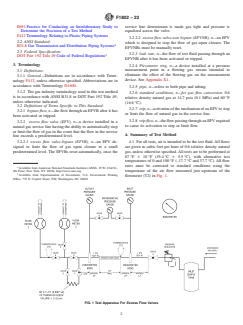
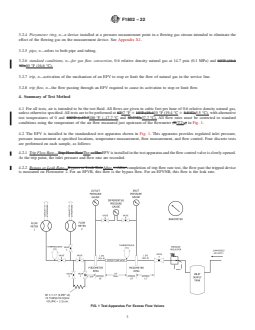
3.2.2.1 excess flow valve-bypass (EFVB), n—an EFV de- 4.1 For all tests, air is intended to be the test fluid.All flows
signed to limit the flow of gas upon closure to a small are given in cubic feet per hour of 0.6 relative density natural
predetermined level. The EFVBs reset automatically, once the gas, unless otherwise specified.All tests are to be performed at
67 °F 6 10 °F (19.4 °C 6 5.5 °C), with alternative test
temperatures of 0 and 100 °F (–17.7 °C and 37.7 °C).All flow
4 rates must be corrected to standard conditions using the
Available fromAmerican National Standards Institute (ANSI), 25 W. 43rd St.,
temperature of the air flow measured just upstream of the
4th Floor, New York, NY 10036, http://www.ansi.org.
Available from Superintendent of Documents, U.S. Government Printing
flowmeter (T2) in Fig. 1.
Office, 732 N. Capitol Street, NW, Washington, DC 20402.
FIG. 1 Test Apparatus For Excess Flow Valves
F1802 − 22
4.2 The EFV is installed in the standardized test apparatus 6.3.1 A Piezometer ring shall be used at each pressure test
shown in Fig. 1. This apparatus provides regulated inlet point as shown in Fig. 1.
pressure, pressure measurement at specified locations, tem-
6.3.2 Piezometer rings are designed to provide a flow-
perature measurement, flow measurement, and flow control. independent measurement of the pressure in a pipe. They are
Four discrete tests are performed on each sample, as follows:
essential in pipes with flowing gas in them. Appendix X1
4.2.1 Trip Flow Rate—The EFV is installed in the test shows the dimensions for construction of a Piezometer ring.
apparatus and the flow control valve is slowly opened. At the
6.4 Pressure and Differential Pressure Gages:
trip point, the inlet pressure and flow rate are recorded.
6.4.1 Each air pressure gage or differential pressure gage
4.2.2 Bypass or Leak Rate—After completion of trip flow
shall measure the range of pressures at its location in the test
rate test, the flow past the tripped device is measured on
apparatus to an accuracy within 62%.
Flowmeter2.ForanEFVB,thisflowisthebypassflow.Foran
6.4.2 Differential pressure gages shall be rated for pressures
EFVNB, this flow is the leak rate.
above the maximum encountered in the application.
4.2.3 Pressure Drop at Flow Rates Less than Closure—after
setting the inlet pressure to the desired value, pressure drop NOTE 1—Do not use “snubs” on pressure gages.
measurementsshallbetakenateachofthefollowingflowrates
6.5 Flowmeters:
that are less than the valve’s minimum closure flow rate: 100,
6.5.1 Each flowmeter shall measure the range of flows at its
200, 300, 400, 500, 750, 1000, 1250, and 1500 SCFH (2.8, 5.6,
location in the test apparatus to an accuracy within 62%,
8.5, 11.32, 14.2, 21.24, 28.3, 35.4, and 42.5 M /h).
traceabletotheNationalInstituteofStandardsandTechnology.
4.2.4 Reset—Following the manufacturer’s instructions,
Note that flowmeter accuracy is usually expressed as a percent
verify that the EFV can be reset.
of the full scale reading. Therefore, to maintain accuracy it is
generally advisable to operate the meter at as high a flow as
5. Significance and Use
possible.
5.1 This test method is intended to be used for the evalua-
6.5.2 Each flowmeter shall have manufacturer supplied
tion of EFVs manufactured for use on residential and small
correction factors for conversion of air flow rates measured at
commercial thermoplastic natural gas service lines. Possible
the metering pressure and temperature to corrected flow rates
applications of the test include product design and quality
of 0.6 relative density natural gas at standard conditions. Some
control testing by a manufacturer and product acceptance
users have found it convenient to use flowmeters calibrated to
testing by a natural gas utility.
measure air, but that indicate flow rates for natural gas.
5.2 The user of this test method should be aware that the
6.5.3 Flowmeters shall not generate pressure or flow fluc-
flows and pressures measured in the test apparatus may not
tuations in the flowing air stream that could adversely affect
correlate well with those measured in a field installation.
either the measurement of these values or the operation of the
Therefore, the user should conduct sufficient tests to ensure
EFV.
that any specific EFVwill carry out its intended function in the
6.5.4 Flowmeters shall be easy to clean and to keep clean.
actual field installation used.
6.5.5 Flow Control Valve B—Thisvalve,asitismovedfrom
full closed to full open, shall be capable of producing a
6. Apparatus
uniformly increasing air flow. An NPS 1 valve such as a full
6.1 TestApparatus—(SeeFig.1)consistingofacompressed
port globe or gate valve or automated flow device have been
airsupply,valves,flowmeters,Piezometerringslocatedateach
found satisfactory.
pressure test point, pressure gages, and thermocouples.
6.5.6 Inlet ValveA, Bypass Valves D, E, F, and Flow Control
6.1.1 The size and capabilities of the test system should be
Valve C—These shall be full port NPS 1 valves.
selected to meet the needs of the application.Atest system for
6.6 Piping—Using Schedule 40, NPS 1 steel for inlet and
EFVsofonesizeandasinglepressurerangemaybemuchless
outlet piping and associated fittings for the EFV.
sophisticated than one designed for a wide range of sizes and
multiple operating pressure ranges.
6.7 Thermocouple—Two thermocouples are required and
shall measure temperature to an accuracy of 63 °F (1.7 °C).
6.2 Compressed Air Supply System:
One shall be installed so as to measure the temperature of the
6.2.1 The air supply system shall be able to provide clean
EFV being tested. One shall be installed in the flowing air
dry air at the required test temperature for a time sufficient to
obtain a test data point at the highest test pressure and at the stream to measure the temperature immediately upstream of
Flowmeter 1.
maximum flow rate of the EFV being tested. Such a require-
ment may be met either by a low-volume compressor and a
6.8 Temperature Control—The apparatus to control test
large pressure vessel or by a high-volume compressor and a
temperature shall be such that the temperature of the EFV(T1)
smaller pressure vessel.
and of the air flow measured by the thermocouple upstream of
6.2.2 Thistestmethodisintendedformaximumairflowsup
the flowmeter (T2) shall be within 610 °F of 67 °F (5.5 °C of
3 3
to 2500 ft /h (70.8 m /h). However, for many applications, a
19.4 °C).Fortestingat0 °F(–17.7 °C)andat100 °F(37.7 °C),
nominal requirement would be for an air flow of 1000 ft /h
the temperature of the EFV (T1) shall be within 610 °F
(28.32 m /h) at a pressure of 100 psig (0.7 MPa) for a period
(5.5 °C) of the test temperature. The test apparatus and test
of 60 s.
EFV shall be insulated as appropriate so as to maintain the test
6.3 Piezometer Rings: temperature.
F1802 − 22
6.9 Reset Volume—A 60 ft (18.28 m) long coil of ⁄2 CTS 10.2.1 System Cleanliness Inspection —After the test
0.090 in. ( ⁄3 mm) wall PE tubing or pipe with an equivalent apparatus, connecting pipe, and sample are assembled, or after
3 3
volume of 112 in. (1,835 cm ).The inside coil radius shall not significant modifications to the test assembly, the system shall
be less than 16 in. (406.4 mm) (minimum bend radius = 25 be inspected for visible contaminants. This is accomplished by
times the outside tube diameter). means of a high-flow purge of the system using the highest
anticipated test flow rate. For this inspection, a fine filter with
7. Sample Preparation
a suitable pressure rating is placed downstream of the EFV
location. (A“dummy” EFV may be used to prevent damage to
7.1 The user of this test method will select the EFV
the test sample.) After the purge, disassemble the filter and
configuration to be tested. However, the configuration will
inspect for visible contamination. If contaminants are present,
affect the test results. For example, the pressure drop and the
the system, flow elements, and filter shall be cleaned and the
trip-flow rate values will be different when the EFV is inserted
procedure repeated until no contaminants are present.
in a straight length of thermoplastic pipe, as compared to an
10.2.2 EFV Sample Inspection:
EFV inserted in the outlet of a thermoplastic punch tee. This
10.2.2.1 Install the EFV in the test apparatus as shown in
must be borne in mind when selecting the sample configura-
Fig. 1, pressurize, and inspect for movement or leakage.
tion.
10.2.2.2 Record the manufacturer’s designation and the
7.2 Any adapters used to install the EFV in the test
style or configuration of the EFV tested.
apparatus shall not restrict the flow to a degree which contrib-
10.3 Trip flow:
utes to the measured pressure drop. In addition, these adapters
10.3.1 Close all valves.
shall not generate pressure or fluctuations in the flowing air
10.3.2 Set and control the air supply pressure to within
stream that could adversely affect either the measurement of
these values or the operation of the EFV. Five samples of each 62 % of the desired EFV inlet pressure.
10.3.3 Open Valve D to the full open position.
EFV shall be tested in accordance with Section 10.
10.3.4 Open Valve A very slowly to a full open position to
8. Precautions and Safety Considerations
prevent overpressure of the device.
10.3.5 Check that the inlet and downstream pressure gages
8.1 Test personnel shall be trained in the use and op
...
This document is not an ASTM standard and is intended only to provide the user of an ASTM standard an indication of what changes have been made to the previous version. Because
it may not be technically possible to adequately depict all changes accurately, ASTM recommends that users consult prior editions as appropriate. In all cases only the current version
of the standard as published by ASTM is to be considered the official document.
Designation: F1802 − 15 F1802 − 22
Standard Test Method for
Performance Testing of Excess Flow Valves
This standard is issued under the fixed designation F1802; the number immediately following the designation indicates the year of
original adoption or, in the case of revision, the year of last revision. A number in parentheses indicates the year of last reapproval. A
superscript epsilon (´) indicates an editorial change since the last revision or reapproval.
1. Scope Scope*
1.1 This test method covers a standardized method to determine the performance of excess flow valves (EFVs) designed to limit
flow or stop flow in thermoplastic natural gas service lines.
1.2 All tests are intended to be performed using air as the test fluid. Unless otherwise stated, all flow rates are reported in standard
cubic feet per hour of 0.6 relative density natural gas.
1.3 The test method recognizes two types of EFV. One type, an excess flow valve-bypass (EFVB), allows a small amount of gas
to bleed through (bypass) after it has tripped, usually as a means of automatically resetting the device. The second type, an excess
flow valve-non bypass (EFVNB), is intended to trip shut forming an essentially gas tight seal.
1.4 The performance characteristics covered in this test method include flow at trip point, pressure drop across the EFV, bypass
flow rate of the EFVB or leak rate through the EFVNB after trip, and verification that the EFV can be reset.
1.4.1 Gas distribution systems may contain condensates and particulates such as organic matter, sand, dirt, and iron compounds.
Field experience has shown that the operating characteristics of some EFVs may be affected by accumulations of these materials.
The tests of Section 11 were developed to provide a simple, inexpensive, reproducible test that quantifies the effect, if any, of a
uniform coating of kerosene and of kerosene contaminated with a specified amount of ferric oxide powder on an EFV’s operating
characteristics.
1.5 Excess flow valves covered by this test method will normally have the following characteristics: a pressure rating of up to 125
3 3 3 3
psig (0.86 MPa); a trip flow of between 200200 ft /h and 2500 ft /h (5.66(5.66 m /h and 70.8 m /h) at 10 psig (0.07 MPa); a
minimum temperature rating of 0°F(–18°C), and a maximum temperature rating of 100°F (38°C).100 °F (38 °C).
1.6 The EFVs covered by this test method shall be constructed to fit piping systems no smaller than ⁄2 CTS and no larger than
1 ⁄4 IPS, including both pipe and tubing sizes.
1.7 Tests will be performed at 6767 °F 6 10°F (19.410 °F (19.4 °C 6 5.5°C).5.5 °C). Alternative optional test temperatures are
100 6 10°F (37.7 6 5.5°C) 100 °F 6 10 °F (37.7 °C 6 5.5 °C) and 0 6 10°F (–18 6 5.5°C). All flow rates must be corrected
to standard conditions.
This test method is under the jurisdiction of ASTM Committee F17 on Plastic Piping Systems and is the direct responsibility of Subcommittee F17.40 on Test Methods.
Current edition approved Nov. 1, 2015Feb. 1, 2022. Published May 2016April 2022. Originally approved in 1995 as PS 13–95. Last previous edition approved in 20102015
as F1802–04(2010).F1802–15. DOI: 10.1520/F1802-15.10.1520/F1802-22.
This contamination test procedure may be utilized to determine the effect, if any, of contaminants from a specific gas distribution system on the operational characteristics
of an EFV under consideration for use in that system. Condensates, oils and particulates removed from that distribution system could be substituted for kerosene and iron
oxide. Results obtained from using reagents or contaminants other than those specified in this test method must not be used in comparison with results obtained using the
reagents specified in this test method.
*A Summary of Changes section appears at the end of this standard
Copyright © ASTM International, 100 Barr Harbor Drive, PO Box C700, West Conshohocken, PA 19428-2959. United States
F1802 − 22
1.8 This test method was written for EFVs installed in thermoplastic piping systems. However, it is expected that the test method
may also be used for similar devices in other piping systems.
1.9 The values stated in inch-pound units are to be regarded as standard. The values given in parentheses are mathematical
conversions to SI units that are provided for information only and are not considered standard.
1.10 This standard does not purport to address all of the safety concerns, if any, associated with its use. It is the responsibility
of the user of this standard to establish appropriate safety and health practices and determine the applicability of regulatory
limitations prior to use. For specific precautions, see Section 8.
1.10 This standard does not purport to address all of the safety concerns, if any, associated with its use. It is the responsibility
of the user of this standard to establish appropriate safety, health, and environmental practices and determine the applicability of
regulatory limitations prior to use. For specific precautions, see Section 8.
1.11 This international standard was developed in accordance with internationally recognized principles on standardization
established in the Decision on Principles for the Development of International Standards, Guides and Recommendations issued
by the World Trade Organization Technical Barriers to Trade (TBT) Committee.
2. Referenced Documents
2.1 ASTM Standards:
D1600 Terminology for Abbreviated Terms Relating to Plastics
E177 Practice for Use of the Terms Precision and Bias in ASTM Test Methods
E691 Practice for Conducting an Interlaboratory Study to Determine the Precision of a Test Method
F412 Terminology Relating to Plastic Piping Systems
2.2 ANSI Standard:
B31.8 Gas Transmission and Distribution Piping Systems
2.3 Federal Specification:
DOT Part 192 Title 49 Code of Federal Regulations
3. Terminology
3.1 Definitions:
3.1.1 General—Definitions are in accordance with Terminology F412, unless otherwise specified. Abbreviations are in accordance
with Terminology D1600.
3.1.2 The gas industry terminology used in this test method is in accordance with ANSI B31.8 or DOT Part 192 Title 49, unless
otherwise indicated.
3.2 Definitions of Terms Specific to This Standard:
3.2.1 bypass flow, n—the flow through an EFVB after it has been activated or tripped.
3.2.2 excess flow valve (EFV), n—a device installed in a natural gas service line having the ability to automatically stop or limit
the flow of gas in the event that the flow in the service line exceeds a predetermined level.
3.2.2.1 excess flow valve-bypass (EFVB), n—an EFV designed to limit the flow of gas upon closure to a small predetermined
level. The EFVBs reset automatically, once the service line downstream is made gas tight and pressure is equalized across the
valve.
3.2.2.2 excess flow valve-non bypass (EFVNB), n—an EFV which is designed to stop the flow of gas upon closure. The EFVNBs
must be manually reset.
3.2.3 leak rate, n—the flow of test fluid passing through an EFVNB after it has been activated or tripped.
For referenced ASTM standards, visit the ASTM website, www.astm.org, or contact ASTM Customer Service at service@astm.org. For Annual Book of ASTM Standards
volume information, refer to the standard’s Document Summary page on the ASTM website.
Available from American National Standards Institute (ANSI), 25 W. 43rd St., 4th Floor, New York, NY 10036, http://www.ansi.org.
Available from Superintendent of Documents, U.S. Government Printing Office, 732 N. Capitol Street, NW, Washington, DC 20402.
F1802 − 22
3.2.4 Piezometer ring, n—a device installed at a pressure measurement point in a flowing gas stream intended to eliminate the
effect of the flowing gas on the measurement device. See Appendix X1.
3.2.5 pipe, n—refers to both pipe and tubing.
3.2.6 standard conditions, n—for gas flow conversion, 0.6 relative density natural gas at 14.7 psia (0.1 MPa) and 60°F (16.6
°C).60 °F (16.6 °C).
3.2.7 trip, n—activation of the mechanism of an EFV to stop or limit the flow of natural gas in the service line.
3.2.8 trip flow, n—the flow passing through an EFV required to cause its activation to stop or limit flow.
4. Summary of Test Method
4.1 For all tests, air is intended to be the test fluid. All flows are given in cubic feet per hour of 0.6 relative density natural gas,
unless otherwise specified. All tests are to be performed at 6767 °F 6 10°F (19.410 °F (19.4 °C 6 5.5°C),5.5 °C), with alternative
test temperatures of 0 and 100°F (–17.7100 °F (–17.7 °C and 37.7°C).37.7 °C). All flow rates must be corrected to standard
conditions using the temperature of the air flow measured just upstream of the flowmeter (T(T2) ) in Fig. 1.
4.2 The EFV is installed in the standardized test apparatus shown in Fig. 1. This apparatus provides regulated inlet pressure,
pressure measurement at specified locations, temperature measurement, flow measurement, and flow control. Four discrete tests
are performed on each sample, as follows:
4.2.1 Trip Flow Rate—Trip Flow RateThe —The EFV is installed in the test apparatus and the flow control valve is slowly opened.
At the trip point, the inlet pressure and flow rate are recorded.
4.2.2 Bypass or Leak Rate—Bypass or Leak RateAfter —After completion of trip flow rate test, the flow past the tripped device
is measured on Flowmeter 2. For an EFVB, this flow is the bypass flow. For an EFVNB, this flow is the leak rate.
FIG. 1 Test Apparatus For Excess Flow Valves
F1802 − 22
4.2.3 Pressure Drop at Flow Rates Less than Closure—Pressure Drop at Flow Rates Less than Closureafter —after setting the inlet
pressure to the desired value, pressure drop measurements shall be taken at each of the following flow rates that are less than the
valve’s minimum closure flow rate: 100, 200, 300, 400, 500, 750, 1000, 1250, and 1500 SCFH (2.8, 5.6, 8.5, 11.32, 14.2, 21.24,
28.3, 35.4, and 42.5 M /h).
4.2.4 Reset—ResetFollowing—Following the manufacturer’s instructions, verify that the EFV can be reset.
5. Significance and Use
5.1 This test method is intended to be used for the evaluation of EFVs manufactured for use on residential and small commercial
thermoplastic natural gas service lines. Possible applications of the test include product design and quality control testing by a
manufacturer and product acceptance testing by a natural gas utility.
5.2 The user of this test method should be aware that the flows and pressures measured in the test apparatus may not correlate
well with those measured in a field installation. Therefore, the user should conduct sufficient tests to ensure that any specific EFV
will carry out its intended function in the actual field installation used.
6. Apparatus
6.1 Test Apparatus—Test Apparatus,(See Fig. 1) consisting of a compressed air supply, valves, flowmeters, Piezometer rings
located at each pressure test point, pressure gages, and thermocouples.
6.1.1 The size and capabilities of the test system should be selected to meet the needs of the application. A test system for EFVs
of one size and a single pressure range may be much less sophisticated than one designed for a wide range of sizes and multiple
operating pressure ranges.
6.2 Compressed Air Supply System:Compressed Air Supply System:
6.2.1 The air supply system shall be able to provide clean dry air at the required test temperature for a time sufficient to obtain
a test data point at the highest test pressure and at the maximum flow rate of the EFV being tested. Such a requirement may be
met either by a low-volume compressor and a large pressure vessel or by a high-volume compressor and a smaller pressure vessel.
3 3
6.2.2 This test method is intended for maximum air flows up to 2500 ft /h (70.8 m /h). However, for many applications, a nominal
3 3
requirement would be for an air flow of 1000 ft /h (28.32 m /h) at a pressure of 100 psig (0.7 MPa) for a period of 60 s.
6.3 Piezometer Rings:Piezometer Rings:
6.3.1 A Piezometer ring shall be used at each pressure test point as shown in Fig. 1.
6.3.2 Piezometer rings are designed to provide a flow-independent measurement of the pressure in a pipe. They are essential in
pipes with flowing gas in them. Appendix X1 shows the dimensions for construction of a Piezometer ring.
6.4 Pressure and Differential Pressure Gages:Pressure and Differential Pressure Gages:
6.4.1 Each air pressure gage or differential pressure gage shall measure the range of pressures at its location in the test apparatus
to an accuracy within 62 %.
6.4.2 Differential pressure gages shall be rated for pressures above the maximum encountered in the application.
NOTE 1—Do not use “snubs” on pressure gages.
6.5 Flowmeters:
6.5.1 Each flowmeter shall measure the range of flows at its location in the test apparatus to an accuracy within 62 %, traceable
to the National Institute of Standards and Technology. Note that flowmeter accuracy is usually expressed as a percent of the full
scale reading. Therefore, to maintain accuracy it is generally advisable to operate the meter at as high a flow as possible.
F1802 − 22
6.5.2 Each flowmeter shall have manufacturer supplied correction factors for conversion of air flow rates measured at the metering
pressure and temperature to corrected flow rates of 0.6 relative density natural gas at standard conditions. Some users have found
it convenient to use flowmeters calibrated to measure air, but that indicate flow rates for natural gas.
6.5.3 Flowmeters shall not generate pressure or flow fluctuations in the flowing air stream that could adversely affect either the
measurement of these values or the operation of the EFV.
6.5.4 Flowmeters shall be easy to clean and to keep clean.
6.5.5 Flow Control Valve B—Flow Control Valve BThis —This valve, as it is moved from full closed to full open, shall be capable
of producing a uniformly increasing air flow. An NPS 1 valve such as a full port globe or gate valve or automated flow device have
been found satisfactory.
6.5.6 Inlet Valve A, Bypass Valves D, E, F, and Flow Control Valve C—Inlet Valve A, Bypass Valves D, E, F, and Flow Control
Valve CThese —These shall be full port NPS 1 valves.
6.6 Piping—PipingUsing—Using Schedule 40, NPS 1 steel for inlet and outlet piping and associated fittings for the EFV.
6.7 Thermocouple—ThermocoupleTwo—Three thermocouples are required and shall measure temperature to an accuracy of
63°F (1.7°C).63 °F (1.7 °C). One shall be installed so as to measure the temperature of the EFV being tested. TwoOne shall be
installed in the flowing air stream to measure the temperature immediately upstream of Flowmeter 1, and immediately upstream
of the EFV under test.1.
6.8 Temperature Control—Temperature ControlThe —The apparatus to control test temperature shall be such that the temperature
of the EFV (T1) and of the air flow measured by the thermocouple upstream of the flowmeter (T3)(T2) shall be within
610°F610 °F of 67°F (5.5°C67 °F (5.5 °C of 19.4°C).19.4 °C). For testing at 0°F (–17.7°C)0 °F (–17.7 °C) and at 100°F
(37.7°C),100 °F (37.7 °C), the temperature of the EFV (T1) shall be within 610°F (5.5°C)610 °F (5.5 °C) of the test temperature.
The test apparatus and test EFV shall be insulated as appropriate so as to maintain the test temperature.
1 2
6.9 Reset Volume—Reset Volume—A 60 ftA60 ft (18.28 m) long coil of ⁄2 CTS 0.090 in. ( ⁄3 mm) wall PE tubing or pipe with
3 3
an equivalent volume of 112 in. (1,835 cm(1,835 cm ). The inside coil radius shall not be less than 16 in. (406.4 mm) (minimum
bend radius = 25 times the outside tube diameter).
7. Sample Preparation
7.1 The user of this test method will select the EFV configuration to be tested. However, the configuration will affect the test
results. For example, the pressure drop and the trip-flow rate values will be different when the EFV is inserted in a straight length
of thermoplastic pipe, as compared to an EFV inserted in the outlet of a thermoplastic punch tee. This must be borne in mind when
selecting the sample configuration.
7.2 Any adapters used to install the EFV in the test apparatus shall not restrict the flow to a degree which contributes to the
measured pressure drop. In addition, these adapters shall not generate pressure or fluctuations in the flowing air stream that could
adversely affect either the measurement of these values or the operation of the EFV. Five samples of each EFV shall be tested in
accordance with Section 10.
8. Precautions and Safety Considerations
8.1 Test personnel shall be trained in the use and operation of this test apparatus and be familiar with safe use of compressed air.
Any outlets or relief vents from the air system should be directed away from the areas occupied by personnel. Face, eye, hand,
and hearing protection should be worn as necessary.
9. Flow Calculations
9.1 The raw air flow rate data must be converted into an equivalent air flow rate at the calibration conditions, pressure and
temperature, of the flow meter. In addition this calculated air flow rate must be corrected to an equivalent natural gas flow rate at
standard conditions.
F1802 − 22
9.2 Flow rate conversions shall be performed using the flow rate correction method provided by the manufacturer of the flow
meter. Inlet pressure, barometric pressure, and air stream temperature (T3),(T2), must be included in th
...