

ASTM F1794-97(2021)
(Specification)Standard Specification for Hand-Operated, Globe-Style Valves for Gas (Except Oxygen Gas) and Hydraulic Systems
General Information
- Abstract
ABSTRACT
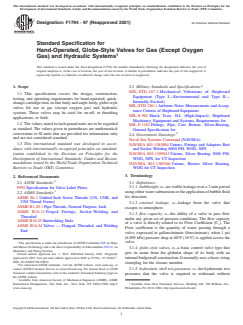
This specification covers the design, construction, testing, and operating requirements for hand operated, quick-change cartridge trim, in-line body and angle-body, globe-style valves for use in gas (except oxygen gas) and hydraulic systems. These valves may be used for on-off, and/or throttling applications. Valves under this specification shall be Type I or Type II; Style I or Style II; and shall have the specified size, pressure rating, and end connections. Valves furnished under this specification shall be soft-seated, globe-style valves using a cartridge in which all working parts including the seat are removable as an assembly. The pressure containing envelope shall be made of corrosion-resistant steel, nickel-copper, nickel-aluminum-bronze, or bronze. Internal parts in contact with the line media shall be made of corrosion-resistant steel, nickel-copper, copper-nickel, bronze, nickel-aluminum bronze, or naval brass. Valve construction requirements for the following are detailed: (1) soft-seating insert, (2) pressure envelope, (3) threads, (4) accessibility, (5) nonmetallic element interchangeability, (6) maintainability, (7) reversibility, (8) adjustments, (9) bidirectional operation and bubbletight shut off, (10) guiding, (11) valve operating force, (12) pressurizing rate, (13) operation, and (14) envelope dimensions. Valves shall meet the performance requirements of flow capacity, seat tightness, and external leakage. Each valve shall pass the following tests: visual examination, hydrostatic shell test, seat tightness test, and external leakage test. The envelope dimensions for angle body and inline body construction are illustrated.
SCOPE
1.1 This specification covers the design, construction, testing, and operating requirements for hand-operated, quick-change cartridge trim, in-line body and angle-body, globe-style valves for use in gas (except oxygen gas) and hydraulic systems. These valves may be used for on-off, or throttling applications, or both.
1.2 The values stated in inch-pound units are to be regarded as standard. The values given in parentheses are mathematical conversions to SI units that are provided for information only and are not considered standard.
1.3 This international standard was developed in accordance with internationally recognized principles on standardization established in the Decision on Principles for the Development of International Standards, Guides and Recommendations issued by the World Trade Organization Technical Barriers to Trade (TBT) Committee.
- Status
- Published
- Publication Date
- 31-Dec-2020
- Technical Committee
- F25 - Ships and Marine Technology
- Drafting Committee
- F25.11 - Machinery and Piping Systems
Overview
ASTM F1794-97(2021): Standard Specification for Hand-Operated, Globe-Style Valves for Gas (Except Oxygen Gas) and Hydraulic Systems provides comprehensive requirements for the design, construction, testing, and operation of globe-style, hand-operated valves. These valves are intended for use in a broad range of gas (excluding oxygen gas) and hydraulic system applications, offering both on-off and throttling capabilities. The standard ensures valves meet strict criteria for performance, safety, and maintainability, making it crucial for industries requiring reliable flow control in challenging environments.
Key Topics
- Scope of Application: The standard covers in-line body and angle-body globe-style valves with quick-change cartridge trim, suitable for various gases (except oxygen) and hydraulic systems.
- Valve Types and Styles: Defines Type I (angle body) and Type II (in-line body), and Style I (shut-off) and Style II (throttling) valves with multiple sizes and pressure ratings.
- Materials: Specifies corrosion-resistant construction including 300 series stainless steel, nickel-copper alloys, bronze, and naval brass for critical components.
- End Connections: Outlines standardized end connection requirements for butt-weld, socket-weld, threaded, and silver-brazed union types compatible with ASME and NAVSEA specifications.
- Design and Construction Features: Includes requirements for soft-seated operation, cartridge-based trim for easy maintenance, accessibility, non-metallic part interchangeability, and maintainability.
- Performance Requirements: Covers flow capacity, seat tightness (bubbletight shut-off), bidirectional operation, guiding, operating force, and hydrostatic shell integrity.
- Required Testing: Encompasses visual examination, hydrostatic shell testing, seat tightness, and external leakage verification.
- Marking and Identification: Mandates labeling for traceability, pressure rating, and part identification.
Applications
ASTM F1794-97(2021) valves are engineered for reliability and performance in demanding applications:
- Industrial Gas Handling: Used to control non-oxygen process gases in manufacturing, processing, and distribution lines where safety and leak-tight performance are critical.
- Hydraulic Systems: Suitable for precise flow control and shut-off in hydraulic circuits for machinery, marine equipment, and mobile systems.
- Marine and Shipboard Systems: Designed to meet rigorous military and shipboard specifications, ideal for onboard gas and hydraulic applications subject to vibration, pressure, and environmental stress.
- Utility and Infrastructure: Effective for gas and liquid flow management in utility services, power plants, and municipal works.
- Maintenance and Replacement: Cartridge design allows for rapid, easy maintenance and field replacement of internal parts, reducing downtime and operational costs.
Related Standards
For optimal compatibility and compliance, ASTM F1794-97(2021) references several important standards:
- ASTM F992: Valve Label Plates
- ASME B1.1: Unified Inch Screw Threads
- ASME B1.20.1: Pipe Threads, General Purpose, Inch
- ASME B16.11 & ASME B16.25: Forged/Buttwelding Fittings
- ASME B16.34: Valves - Flanged, Threaded, and Welding End
- MIL-STD-167-1: Mechanical Vibrations of Shipboard Equipment
- MIL-STD-740-1: Airborne Noise Measurements
- MIL-S-901: Shipboard Shock Tests
- NAVSEA Drawings: Navy-specific union and fitting requirements
Practical Value
Adhering to ASTM F1794-97(2021) ensures that hand-operated, globe-style valves deliver reliable performance, maintainability, and safety across a diverse range of gas and hydraulic system applications. By specifying rigorous testing, material compatibility, and quality assurance measures, this standard supports quality control, operational efficiency, and risk reduction in critical environments. Organizations leveraging this standard benefit from enhanced system integrity, reduced maintenance time, and more predictable flow control performance.
Keywords: globe-style valve, hand-operated valve, gas valve, hydraulic valve, ASTM F1794, industrial valve standard, corrosion-resistant valve, cartridge trim, bubbletight shutoff, valve testing.
Relations
- Effective Date
- 01-Apr-2011
- Effective Date
- 01-Feb-2006
- Effective Date
- 27-Mar-1986
Get Certified
Connect with accredited certification bodies for this standard

Institut za varilstvo d.o.o. (Welding Institute)
Slovenia's leading welding institute since 1952. ISO 3834, EN 1090, pressure equipment certification, NDT personnel, welder qualification. Only IIW Au
Sponsored listings
Frequently Asked Questions
ASTM F1794-97(2021) is a technical specification published by ASTM International. Its full title is "Standard Specification for Hand-Operated, Globe-Style Valves for Gas (Except Oxygen Gas) and Hydraulic Systems". This standard covers: ABSTRACT This specification covers the design, construction, testing, and operating requirements for hand operated, quick-change cartridge trim, in-line body and angle-body, globe-style valves for use in gas (except oxygen gas) and hydraulic systems. These valves may be used for on-off, and/or throttling applications. Valves under this specification shall be Type I or Type II; Style I or Style II; and shall have the specified size, pressure rating, and end connections. Valves furnished under this specification shall be soft-seated, globe-style valves using a cartridge in which all working parts including the seat are removable as an assembly. The pressure containing envelope shall be made of corrosion-resistant steel, nickel-copper, nickel-aluminum-bronze, or bronze. Internal parts in contact with the line media shall be made of corrosion-resistant steel, nickel-copper, copper-nickel, bronze, nickel-aluminum bronze, or naval brass. Valve construction requirements for the following are detailed: (1) soft-seating insert, (2) pressure envelope, (3) threads, (4) accessibility, (5) nonmetallic element interchangeability, (6) maintainability, (7) reversibility, (8) adjustments, (9) bidirectional operation and bubbletight shut off, (10) guiding, (11) valve operating force, (12) pressurizing rate, (13) operation, and (14) envelope dimensions. Valves shall meet the performance requirements of flow capacity, seat tightness, and external leakage. Each valve shall pass the following tests: visual examination, hydrostatic shell test, seat tightness test, and external leakage test. The envelope dimensions for angle body and inline body construction are illustrated. SCOPE 1.1 This specification covers the design, construction, testing, and operating requirements for hand-operated, quick-change cartridge trim, in-line body and angle-body, globe-style valves for use in gas (except oxygen gas) and hydraulic systems. These valves may be used for on-off, or throttling applications, or both. 1.2 The values stated in inch-pound units are to be regarded as standard. The values given in parentheses are mathematical conversions to SI units that are provided for information only and are not considered standard. 1.3 This international standard was developed in accordance with internationally recognized principles on standardization established in the Decision on Principles for the Development of International Standards, Guides and Recommendations issued by the World Trade Organization Technical Barriers to Trade (TBT) Committee.
ABSTRACT This specification covers the design, construction, testing, and operating requirements for hand operated, quick-change cartridge trim, in-line body and angle-body, globe-style valves for use in gas (except oxygen gas) and hydraulic systems. These valves may be used for on-off, and/or throttling applications. Valves under this specification shall be Type I or Type II; Style I or Style II; and shall have the specified size, pressure rating, and end connections. Valves furnished under this specification shall be soft-seated, globe-style valves using a cartridge in which all working parts including the seat are removable as an assembly. The pressure containing envelope shall be made of corrosion-resistant steel, nickel-copper, nickel-aluminum-bronze, or bronze. Internal parts in contact with the line media shall be made of corrosion-resistant steel, nickel-copper, copper-nickel, bronze, nickel-aluminum bronze, or naval brass. Valve construction requirements for the following are detailed: (1) soft-seating insert, (2) pressure envelope, (3) threads, (4) accessibility, (5) nonmetallic element interchangeability, (6) maintainability, (7) reversibility, (8) adjustments, (9) bidirectional operation and bubbletight shut off, (10) guiding, (11) valve operating force, (12) pressurizing rate, (13) operation, and (14) envelope dimensions. Valves shall meet the performance requirements of flow capacity, seat tightness, and external leakage. Each valve shall pass the following tests: visual examination, hydrostatic shell test, seat tightness test, and external leakage test. The envelope dimensions for angle body and inline body construction are illustrated. SCOPE 1.1 This specification covers the design, construction, testing, and operating requirements for hand-operated, quick-change cartridge trim, in-line body and angle-body, globe-style valves for use in gas (except oxygen gas) and hydraulic systems. These valves may be used for on-off, or throttling applications, or both. 1.2 The values stated in inch-pound units are to be regarded as standard. The values given in parentheses are mathematical conversions to SI units that are provided for information only and are not considered standard. 1.3 This international standard was developed in accordance with internationally recognized principles on standardization established in the Decision on Principles for the Development of International Standards, Guides and Recommendations issued by the World Trade Organization Technical Barriers to Trade (TBT) Committee.
ASTM F1794-97(2021) is classified under the following ICS (International Classification for Standards) categories: 23.060.20 - Ball and plug valves. The ICS classification helps identify the subject area and facilitates finding related standards.
ASTM F1794-97(2021) has the following relationships with other standards: It is inter standard links to ASTM F992-86(2011), ASTM F992-86(2006), ASTM F992-86(2001). Understanding these relationships helps ensure you are using the most current and applicable version of the standard.
ASTM F1794-97(2021) is available in PDF format for immediate download after purchase. The document can be added to your cart and obtained through the secure checkout process. Digital delivery ensures instant access to the complete standard document.
Standards Content (Sample)
This international standard was developed in accordance with internationally recognized principles on standardization established in the Decision on Principles for the
Development of International Standards, Guides and Recommendations issued by the World Trade Organization Technical Barriers to Trade (TBT) Committee.
Designation:F1794 −97 (Reapproved 2021) An American National Standard
Standard Specification for
Hand-Operated, Globe-Style Valves for Gas (Except Oxygen
Gas) and Hydraulic Systems
This standard is issued under the fixed designation F1794; the number immediately following the designation indicates the year of
original adoption or, in the case of revision, the year of last revision. A number in parentheses indicates the year of last reapproval. A
superscript epsilon (´) indicates an editorial change since the last revision or reapproval.
1. Scope 2.3 Military Standards and Specifications:
MIL-STD-167-1 Mechanical Vibrations of Shipboard
1.1 This specification covers the design, construction,
Equipment (Type I—Environmental and Type II—
testing, and operating requirements for hand-operated, quick-
Internally Excited)
change cartridge trim, in-line body and angle-body, globe-style
MIL-STD-740-1 Airborne Noise Measurements and Accep-
valves for use in gas (except oxygen gas) and hydraulic
tance Criteria of Shipboard Equipment
systems. These valves may be used for on-off, or throttling
MIL-S-901 Shock Tests, H.I. (High-Impact); Shipboard
applications, or both.
Machinery, Equipment and Systems, Requirements for
1.2 The values stated in inch-pound units are to be regarded
MIL-F-1183 Fittings, Pipe, Cast Bronze, Silver-Brazing,
as standard. The values given in parentheses are mathematical
General Specification for
conversions to SI units that are provided for information only 4
2.4 Government Drawings:
and are not considered standard.
Naval Sea Systems Command (NAVSEA)
1.3 This international standard was developed in accor-
NAVSEA 803-1385884 Unions, Fittings and Adapters Butt
dance with internationally recognized principles on standard- and Socket Welding 6000 PSI, WOG, NPS
ization established in the Decision on Principles for the
NAVSEA 803-1385943 Unions, Silver Brazing 3000 PSI,
Development of International Standards, Guides and Recom- WOG, NPS, for UT Inspection
mendations issued by the World Trade Organization Technical
NAVSEA 803-1385946 Unions, Bronze Silver Brazing,
Barriers to Trade (TBT) Committee. WOG for UT Inspection
3. Terminology
2. Referenced Documents
3.1 Definitions:
2.1 ASTM Standards:
3.1.1 bubbletight, n—no visible leakage over a 3-min period
F992 Specification for Valve Label Plates
usingeitherwatersubmersionortheapplicationofbubblefluid
2.2 ASME Standards:
for detection.
ASME B1.1 Unified Inch Screw Threads (UN, UNR, and
UNJ Thread Forms)
3.1.2 external leakage, n—leakage from the valve that
ASME B1.20.1 Pipe Threads, General Purpose, Inch
escapes to atmosphere.
ASME B16.11 Forged Fittings, Socket-Welding and
3.1.3 flow capacity, n—the ability of a valve to pass flow
Threaded
under any given set of pressure conditions. The flow capacity
ASME B16.25 Buttwelding Ends
of a valve is directly related to its Flow Coefficient (C ). The
v
ASME B16.34 Valves — Flanged, Threaded, and Welding
Flow coefficient is the quantity of water passing through a
End
valve, expressed in gallons/minute (litres/minute), when 1 psi
(6.895 kPa) pressure drop at 60°F (16°C) is applied across the
valve.
This specification is under the jurisdiction of ASTM Committee F25 on Ships
and Marine Technology and is the direct responsibility of Subcommittee F25.11 on
3.1.4 globe-style valves, n—a basic control valve type that
Machinery and Piping Systems.
gets its name from the globular shape of its body with an
Current edition approved Jan. 1, 2021. Published January 2021. Originally
ɛ1
approved in 1997. Last previous edition approved in 2016 as F1794 – 97 (2016) . internal bridgewall construction. It normally uses a basic rising
DOI: 10.1520/F1794-97R21.
stem/plug for the closure member.
For referenced ASTM standards, visit the ASTM website, www.astm.org, or
3.1.5 hydrostatic shell test pressures, n—the hydrostatic test
contact ASTM Customer Service at service@astm.org. For Annual Book of ASTM
Standards volume information, refer to the standard’s Document Summary page on
pressures that the valve is required to withstand without
the ASTM website.
Available from American Society of Mechanical Engineers (ASME), ASME
International Headquarters, Two Park Ave., New York, NY 10016-5990, http:// Available from DLA Document Services, Building 4/D, 700 Robbins Ave.,
www.asme.org. Philadelphia, PA 19111-5094, http://quicksearch.dla.mil.
Copyright © ASTM International, 100 Barr Harbor Drive, PO Box C700, West Conshohocken, PA 19428-2959. United States
F1794−97 (2021)
damage. Valve operation is not required during application of The inlet and outlet pressure ratings of the valve shall be
shell test pressure, but the valve must meet all performance identical for any given valve.
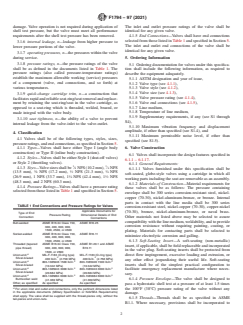
requirements after the shell test pressure has been removed. 4.1.5 End Connections—Valves shall have end connections
selected from those listed in Table 1 and specified in Section 5.
3.1.6 internal leakage, n—leakage from higher pressure to
The inlet and outlet end connections of the valve shall be
lower pressure portions of the valve.
identical for any given valve.
3.1.7 operating pressures, n—the pressures within the valve
during service.
5. Ordering Information
3.1.8 pressure ratings, n—the pressure ratings of the valve
5.1 Ordering documentation for valves under this specifica-
shall be as defined in the documents listed in Table 1. The
tion shall include the following information, as required to
pressure ratings (also called pressure-temperature ratings)
describe the equipment adequately.
establish the maximum allowable working (service) pressures
5.1.1 ASTM designation and year of issue,
of a component (valve, end connections, and so forth) at
5.1.2 Valve type (see 4.1.1),
various temperatures.
5.1.3 Valve style (see 4.1.2),
5.1.4 Valve size (see 4.1.3),
3.1.9 quick-change cartridge trim, n—a construction that
5.1.5 Valve pressure rating (see 4.1.4),
facilitatesrapidandreliableseat-ring/seatremovalandreplace-
5.1.6 Valve end connections (see 4.1.5),
ment by retaining the seat-ring/seat in the valve cartridge, as
5.1.7 Line medium,
opposed to a seat-ring which is threaded, welded, brazed, or
5.1.8 Temperature of line medium,
made integral with the valve body.
5.1.9 Supplementary requirements, if any (see S1 through
3.1.10 seat tightness, n—the ability of a valve to prevent
S4),
internal leakage from the valve-inlet to the valve-outlet.
5.1.10 Maximum vibration frequency and displacement
amplitude, if other than specified (see S1.4), and
4. Classification
5.1.11 Maximum permissible noise level, if other than
4.1 Valves shall be of the following types, styles, sizes,
specified (see S1.5).
pressureratings,andendconnections,asspecifiedinSection5.
4.1.1 Types—Valves shall have either Type I (angle body 6. Valve Construction
construction) or Type II (inline body construction).
6.1 Valves shall incorporate the design features specified in
4.1.2 Styles—Valves shall be either Style I (shut-off valves)
6.1.1 – 6.1.17.
or Style 2 (throttling valves).
6.1.1 General Requirements:
1 1
4.1.3 Sizes—Valve sizes shall be ⁄8 NPS (10.2 mm), ⁄4 NPS
6.1.1.1 Valves furnished under this specification shall be
3 1 3
(13.5 mm), ⁄8 NPS (17.2 mm), ⁄2 NPS (21.3 mm), ⁄4 NPS
soft-seated, globe-style valves using a cartridge in which all
1 1
(26.9 mm), 1 NPS (33.7 mm), 1 ⁄4 NPS (42.4 mm), 1 ⁄2 NPS
working parts including the seat are removable as an assembly.
(48.3 mm), and 2 NPS (60.3 mm).
6.1.2 Materials of Construction—Material requirements for
4.1.4 Pressure Ratings—Valves shall have a pressure rating
these valves shall be as follows: The pressure containing
selected from those listed in Table 1 and specified in Section 5.
envelope shall be 300 series corrosion-resistant steel, nickel-
copper (70-30), nickel-aluminum-bronze, or bronze. Internal
parts in contact with the line media shall be 300 series
TABLE 1 End Connections and Pressure Ratings for Valves
corrosion-resistant steel, nickel-copper (70-30), copper-nickel
Applicable Documents for
(70-30), bronze, nickel-aluminum-bronze, or naval brass.
Type of End
Pressure Rating Dimensional Details of End
Connection
Other materials not listed above may be selected to assure
Connections
compatibility with the line medium, weldability, and to provide
Butt-welded ASME B16.34 Class 150, ASME B16.25
300, 400, 600, 900, corrosion resistance without requiring painting, coating, or
1500, 2500, or 4500
plating. Materials for contacting parts shall be selected to
Socket-welded ASME B16.34 Class 150, ASME B16.11
minimize electrolytic corrosion and galling.
300, 400, 600, 900,
1500, 2500, or 4500 6.1.3 Soft-Seating Insert—A soft-seating (non-metallic)
Threaded (tapered ASME B16.34 Class 150, ASME B1.20.1 and ASME
insert, if applicable, shall be field replaceable and incorporated
pipe thread) 300, 400, 600, 900, B16.11
in the valve plug. Soft-seating inserts shall be protected from
1500, or 2500
A
Union-end, MIL-F-1183 (O-ring type) MIL-F-1183 (O-ring type) direct flow impingement, excessive loading and extrusion, or
2 2
Silver-brazed
400 lb/in. (2.758 MPa) 400 lb/in. (2.758 MPa)
any other effect jeopardizing their useful life. Soft-seating
A 2 2
Union-end, 803-1385946 1500 lb/in. 803-1385946 1500 lb/in.
inserts shall be of the simplest practical configuration to
Silver-brazed
(10.342 MPa) (10.342 MPa)
A 2 2
Union-end, 803-1385943 3000 lb/in. 803-1385943 3000 lb/in.
facilitate emergency replacement manufacture where neces-
Silver-brazed
(20.684 MPa) (20.684 MPa)
sary.
A 2 2
Union-end, 803-1385884 6000 lb/in. 803-1385884 6000 lb/in.
Butt/socket weld 6.1.4 Pressure Envelope—The valve shall be designed to
(41.369 MPa) (41.369 MPa)
Other, as specified As specified As specified
pass a hydrostatic shell test at a pressure of at least 1.5 times
A
For union inlet and outlet end connections, only the pertinent dimensions listed the 100°F (38°C) pressure rating of the valve without any
in the applicable documents (Military Specification or NAVSEA Requirements)
damage.
shall apply. The valve shall be supplied with the thread-pieces only, without the
6.1.5 Threads—Threads shall be as specified in ASME
tail-pieces and union-nuts.
B1.1. Where necessary, provisions shall be incorporated to
F1794−97 (2021)
prevent the accidental loosening of threaded parts. The design
shallbesuchthatstandardwrenchescanbeusedonallexternal
bolting.Lock-wireshallnotbeused.Anyexposedthreadsshall
be protected by plastic caps for shipping.
6.1.6 Accessibility—All internal parts of the valve shall be
accessible for adjustment or service, without removing the
valve body from the line.
6.1.7 Interchangeability—The valve, including all associ-
ated piece parts, shall have part number identity, and shall be
replaceable from stock or the manufacturer on a nonselective
and random basis. Parts having the same manufacturer’s part
number shall be directly interchangeable with each other with
respect to installation (physical) and performance (function).
Physically interchangeable assemblies, components, and parts
are those which are capable of being readily installed,
removed, or replaced without alteration, misalignment, or
damage to parts being installed or to adjoining parts. Fabrica-
tion operations such as cutting, filing, drilling, reaming,
hammering, bending, prying, or forcing shall not be required.
6.1.8 Nonmetallic Element Interchangeability—
Nonmetallic elements, including but not limited to, seat rings,
soft-seating inserts, cushions, and O-rings shall be treated as
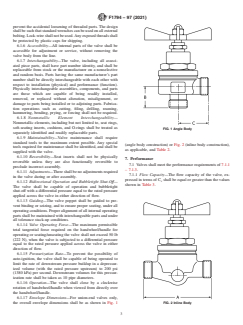
FIG. 1Angle Body
separately identified and readily replaceable parts.
6.1.9 Maintainability—Valve maintenance shall require
standard tools to the maximum extent possible. Any special
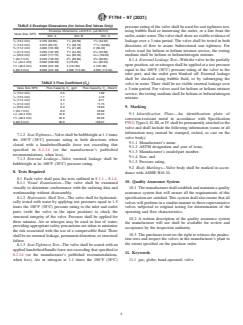
(angle body construction) or Fig. 2 (inline body construction),
tools required for maintenance shall be identified, and shall be
as applicable, and Table 2.
supplied with the valve.
6.1.10 Reversibility—Seat inserts shall not be physically
7. Performance
reversible unless they are also functionally reversible to
7.1 Valves shall meet the performance requirements of 7.1.1
preclude incorrect assembly.
– 7.1.3.
6.1.11 Adjustments—There shall be no adjustments required
7.1.1 Flow Capacity—The flow capacity of the valve, ex-
in the valve during or after assembly.
pressed in terms of C shall be equal or greater than the values
v
6.1.12 Bidirectional Operation and Bubbletight Shut-Off—
shown in Table 3.
The valve shall be capable of operation and bubbletight
shut-off with a differential pressure equal to the rated pressure
applied across the valve in either direction of flow.
6.1.13 Guiding—The valve poppet shall be guided to pre-
vent binding or seizing, and to ensure proper seating, under all
operating conditions. Proper alignment of all internal operating
parts shall be maintained with interchangeable parts and under
all tolerance stack-up conditions.
6.1.14 Valve Operating Force—The maximum permissible
total tangential force required on the handwheel/handle for
operating or seating/unseating the valve shall not exceed 50 lb
(222 N), when the valve is subjected to a differential pressure
equal to the rated pressure applied across the valve in either
direction of flow.
6.1.15 Pressurization Rate—To prevent the possibility of
auto-ignition, the valve shall be capable of being operated to
limit the rate of downstream pressure buildup in a depressur-
ized volume (with the rated pressure upstream) to 200 psi
(1380 kPa) per second. Downstream volumes for this pressur-
ization rate shall be taken as 10 pipe diameters.
6.1.16 Operation—The valve shall close by a clockwise
rotation of handwheel/handle when viewed from directly over
the handwheel/handle.
6.1.17 Envelope Dimensions—For union-end valves only,
the overall envelope dimensions shall be as shown in Fig. 1 FIG. 2Inline Body
F1794−97 (2021)
TABLE 2 Envelope Dimensions (for Union-End Valves Only)
pressure rating of the valve shall be used for seat tightness test,
Envelope Dimensions, ±0.015 in. (±0.38 mm) using bubble fluid or immersing the outlet, or a line from the
Valve Size, NPS
Dim. A Dim. B Dim. C outlet,underwater.Thevalveshallshownovisibleevidenceof
1 1 3
⁄8 (10.2 mm) 2.750 (69.85) 1 ⁄8 (28.59) 1 ⁄8 (34.92) leakage over a 3-min period. The valve shall be tested in both
1 1 11
⁄4 (13.5 mm) 3.375 (85.73) 1 ⁄2 (38.10) 1 ⁄16 (42.86)
directions of flow to assure bidirectional seat tightness. For
3 5
⁄8 (17.2 mm) 4.000 (101.60) 1 ⁄8 (41.28) 2 (50.40)
valves used for helium or helium mixture service, the testing
1 3 1
⁄2 (21.3 mm) 4.250 (107.95) 1 ⁄4 (44.45) 2 ⁄8 (53.98)
3 3 5
⁄4 (26.9 mm) 4.625 (117.75) 2 ⁄8 (60.33) 2 ⁄16 (59.05) medium shall be helium or helium/nitrogen mixture.
3 5
1 (33.7 mm) 5.250 (133.35) 2 ⁄4 (69.85) 2 ⁄8 (66.65)
8.1.4 External Leakage Test—With the valve in the partially
1 1
1 ⁄4 (42.4 mm) 6.500 (228.60) 3 (76.20) 3 ⁄4 (82.55)
open position, air or nitrogen shall be applied at a test pressure
1 ⁄2 (48.3 mm) 9.000 (241.30) 4 (101.60) 4 (101.60)
2 (60.3 mm) 9.500 (241.30) 4.500 (114.30) 4.500 (114.30)
equal to the 100°F (38°C) pressure rating of the valve to the
inlet port, and the outlet port blanked off. External leakage
shall be checked using bubble fluid, or by submerging the
TABLE 3 Flow Coefficient (C )
v
valve in water. There shall be no visible external leakage over
Valve Size NPS Flow Capacity, C , gpm Flow Capacity, C , litres/m
v v a 3-min period. For valves used for helium or helium mixture
⁄8 (10.2 mm) 0.5 1.89
service, the testing medium shall be helium or helium/nitrogen
⁄4 (13.5 mm) 1.1 4.16
mixture.
⁄8 (17.2 mm) 2.3 8.71
⁄2 (21.3 mm) 3.1 11.73
⁄4 (26.9 mm) 5.0 18.93 9. Marking
1 (33.7 mm) 8.9 33.69
9.1 Identification Plate—An identification plate of
1 ⁄4 (42.4 mm) 13.8 52.24
1 ⁄2 (48.3 mm) 22.0 83.28
corrosion-resistant metal in accordance with Specification
2 (60.3 mm) 36.0 136.27
F992;TypesI,II,III,orIVshallbeper
...