

ASTM D4460-22a
(Practice)Standard Practice for Calculating Precision Limits Where Values Are Calculated from Other Test Methods
General Information
- Abstract
SIGNIFICANCE AND USE
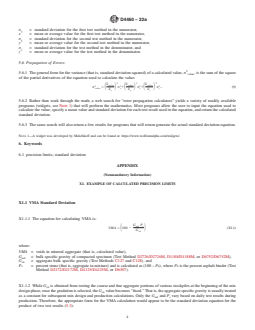
4.1 Precision statements for calculated values can be developed using this approach. Users can also evaluate how an individual test method’s precision influences the variability of calculated values.
4.2 The standard deviation of a calculated value that is the sum, difference, product, or quotient of two or more test method results, each with their own precision statement, can be calculated so long as the individual variables (that is, test results) are independent and the standard deviations are small relative to their mean values. These restrictions are usually met in ASTM methods. In those cases where these restrictions are not met, other methods can be used. Only cases complying with the restrictions are covered in this standard.
SCOPE
1.1 Material and mixture properties such as air voids and voids in mineral aggregates (VMA) are calculated from two or three test results, combined in simple mathematical relationships. The standard deviation equations for these calculated values can be developed using a mathematical process called “propagation of errors” (also called “propagation of uncertainty”). This practice includes uncertainty equations for four forms or material and mixture equations: when two test results are (1) added or subtracted, (2) multiplied together, (3) one divided by the other, and (4) two test results divided by a third.
1.2 This approach to calculating standard deviation equations is only valid when the distributions of the test results from the two standards are independent (that is, not correlated).
1.3 The accuracy of a calculated standard deviation is dependent on the accuracy of the standard deviations used for the individual test result methods.
1.4 Values for the mean and standard deviation for each test method are needed to determine the standard deviation for a calculated value.
1.5 Examples of how to use these equations are shown in Appendix X1.
1.6 A brief explanation of how standard deviation equations are derived for more complicated material and mixture equations is also included.
1.7 The text of this standard references notes and footnotes which provide explanatory material. These notes and footnotes (excluding those in tables and figures) shall not be considered as requirements of the standard.
1.8 This standard does not purport to address all of the safety concerns, if any, associated with its use. It is the responsibility of the user of this standard to establish appropriate safety, health, and environmental practices and determine the applicability of regulatory limitations prior to use.
1.9 This international standard was developed in accordance with internationally recognized principles on standardization established in the Decision on Principles for the Development of International Standards, Guides and Recommendations issued by the World Trade Organization Technical Barriers to Trade (TBT) Committee.
- Status
- Published
- Publication Date
- 31-Oct-2022
- Technical Committee
- D04 - Road and Paving Materials
- Drafting Committee
- D04.94 - Statistical Procedures and Evaluation of Data
Buy Documents

ASTM D4460-22a - Standard Practice for Calculating Precision Limits Where Values Are Calculated from Other Test Methods
REDLINE ASTM D4460-22a - Standard Practice for Calculating Precision Limits Where Values Are Calculated from Other Test Methods
Overview
ASTM D4460-22a: Standard Practice for Calculating Precision Limits Where Values Are Calculated from Other Test Methods provides a systematic method for determining the precision limits-primarily standard deviations-of values derived from multiple test results. This standard practice is widely used in construction materials testing, particularly for properties of mixtures such as asphalt, concrete, or aggregates, where material attributes (e.g., air voids, voids in mineral aggregates) are calculated by combining results from two or more independent ASTM test methods. The main focus is on how uncertainties from individual measurements propagate into calculated properties, using statistical principles such as propagation of errors.
Key Topics
- Propagation of Errors: Explains the calculation of standard deviations for values obtained through mathematical combinations (sum, difference, product, quotient) of independent test results.
- Independence and Validity: Assumes test results are independent and have small standard deviations relative to their means, which is typical in many ASTM methods.
- Forms of Calculation: Covers four primary calculation types for combining test results:
- Addition or subtraction
- Multiplication
- Division
- Multiplication and division with three variables
- Dependence on Input Accuracy: Stresses that the calculated standard deviation's reliability is directly linked to the accuracy of the involved individual test methods’ standard deviations and mean values.
- Practical Examples and Guidance: Includes sample calculations and discussion on determining uncertainty for more complex equations, enhancing user understanding and implementation.
Applications
ASTM D4460-22a is essential in various industries where properties are calculated from standardized test results, most notably in road and paving materials, aggregates, and asphalt mixtures. Its applications include:
- Quality Control and Quality Assurance: Defining the variability in calculated product properties, enabling better monitoring during production and ongoing quality management.
- Mix Design Optimization: Assessing variability in critical properties, such as voids in mineral aggregate (VMA), derived from measurements like specific gravities and binder content, which are pivotal for mix performance.
- Statistical Evaluation of Laboratory Data: Improving laboratory precision statements and understanding how measurement uncertainties affect final calculated values.
- Specification and Compliance: Supporting compliance with contract specifications requiring not just test results but their associated precision statements.
This practice supports decision-making in construction material testing, helping laboratories and engineers to accurately evaluate product consistency and identify potential issues caused by test variability.
Related Standards
Several ASTM and industry standards are commonly referenced or used in conjunction with ASTM D4460-22a:
- ASTM C127 / C128: Test methods for relative density (specific gravity) and absorption of aggregates.
- ASTM D1188/D1188M: Bulk specific gravity and density of compacted asphalt mixtures.
- ASTM D2172/D2172M: Quantitative extraction of asphalt binder.
- ASTM D2726/D2726M: Bulk specific gravity and density of non-absorptive compacted asphalt mixtures.
- ASTM D4125/D4125M / D6307 / D6752/D6752M: Test methods determining asphalt content and gravity/density by various means.
- ASTM E177: Practice for the use of the terms “precision” and “bias” in ASTM test methods.
For organizations involved in materials testing, following ASTM D4460-22a in parallel with the related standards ensures robust calculation and reporting of precision limits, ultimately supporting reliable decision making and specification conformance.
Keywords: ASTM D4460-22a, precision limits, propagation of errors, standard deviation, quality control, mixture properties, road construction, materials testing, uncertainty calculations, ASTM standards.
Relations
- Effective Date
- 01-Nov-2023
- Refers
ASTM D6307-19 - Standard Test Method for Asphalt Content of Asphalt Mixture by Ignition Method - Effective Date
- 01-Jan-2019
- Effective Date
- 15-Aug-2018
- Effective Date
- 01-Jun-2017
- Effective Date
- 01-Jun-2017
- Effective Date
- 01-Apr-2017
- Effective Date
- 01-Apr-2017
- Refers
ASTM D6307-16 - Standard Test Method for Asphalt Content of Asphalt Mixture by Ignition Method - Effective Date
- 01-May-2016
- Effective Date
- 01-May-2014
- Effective Date
- 01-Jul-2013
- Effective Date
- 01-May-2013
- Effective Date
- 01-Apr-2012
- Effective Date
- 01-Apr-2012
- Effective Date
- 01-Jun-2011
- Effective Date
- 01-Feb-2011
Buy Documents
ASTM D4460-22a - Standard Practice for Calculating Precision Limits Where Values Are Calculated from Other Test Methods
REDLINE ASTM D4460-22a - Standard Practice for Calculating Precision Limits Where Values Are Calculated from Other Test Methods
Get Certified
Connect with accredited certification bodies for this standard

Zavod za gradbeništvo Slovenije (ZAG) - Inšpekcija
ZAG inspection body for construction products, structures, and materials.
Sponsored listings
Frequently Asked Questions
ASTM D4460-22a is a standard published by ASTM International. Its full title is "Standard Practice for Calculating Precision Limits Where Values Are Calculated from Other Test Methods". This standard covers: SIGNIFICANCE AND USE 4.1 Precision statements for calculated values can be developed using this approach. Users can also evaluate how an individual test method’s precision influences the variability of calculated values. 4.2 The standard deviation of a calculated value that is the sum, difference, product, or quotient of two or more test method results, each with their own precision statement, can be calculated so long as the individual variables (that is, test results) are independent and the standard deviations are small relative to their mean values. These restrictions are usually met in ASTM methods. In those cases where these restrictions are not met, other methods can be used. Only cases complying with the restrictions are covered in this standard. SCOPE 1.1 Material and mixture properties such as air voids and voids in mineral aggregates (VMA) are calculated from two or three test results, combined in simple mathematical relationships. The standard deviation equations for these calculated values can be developed using a mathematical process called “propagation of errors” (also called “propagation of uncertainty”). This practice includes uncertainty equations for four forms or material and mixture equations: when two test results are (1) added or subtracted, (2) multiplied together, (3) one divided by the other, and (4) two test results divided by a third. 1.2 This approach to calculating standard deviation equations is only valid when the distributions of the test results from the two standards are independent (that is, not correlated). 1.3 The accuracy of a calculated standard deviation is dependent on the accuracy of the standard deviations used for the individual test result methods. 1.4 Values for the mean and standard deviation for each test method are needed to determine the standard deviation for a calculated value. 1.5 Examples of how to use these equations are shown in Appendix X1. 1.6 A brief explanation of how standard deviation equations are derived for more complicated material and mixture equations is also included. 1.7 The text of this standard references notes and footnotes which provide explanatory material. These notes and footnotes (excluding those in tables and figures) shall not be considered as requirements of the standard. 1.8 This standard does not purport to address all of the safety concerns, if any, associated with its use. It is the responsibility of the user of this standard to establish appropriate safety, health, and environmental practices and determine the applicability of regulatory limitations prior to use. 1.9 This international standard was developed in accordance with internationally recognized principles on standardization established in the Decision on Principles for the Development of International Standards, Guides and Recommendations issued by the World Trade Organization Technical Barriers to Trade (TBT) Committee.
SIGNIFICANCE AND USE 4.1 Precision statements for calculated values can be developed using this approach. Users can also evaluate how an individual test method’s precision influences the variability of calculated values. 4.2 The standard deviation of a calculated value that is the sum, difference, product, or quotient of two or more test method results, each with their own precision statement, can be calculated so long as the individual variables (that is, test results) are independent and the standard deviations are small relative to their mean values. These restrictions are usually met in ASTM methods. In those cases where these restrictions are not met, other methods can be used. Only cases complying with the restrictions are covered in this standard. SCOPE 1.1 Material and mixture properties such as air voids and voids in mineral aggregates (VMA) are calculated from two or three test results, combined in simple mathematical relationships. The standard deviation equations for these calculated values can be developed using a mathematical process called “propagation of errors” (also called “propagation of uncertainty”). This practice includes uncertainty equations for four forms or material and mixture equations: when two test results are (1) added or subtracted, (2) multiplied together, (3) one divided by the other, and (4) two test results divided by a third. 1.2 This approach to calculating standard deviation equations is only valid when the distributions of the test results from the two standards are independent (that is, not correlated). 1.3 The accuracy of a calculated standard deviation is dependent on the accuracy of the standard deviations used for the individual test result methods. 1.4 Values for the mean and standard deviation for each test method are needed to determine the standard deviation for a calculated value. 1.5 Examples of how to use these equations are shown in Appendix X1. 1.6 A brief explanation of how standard deviation equations are derived for more complicated material and mixture equations is also included. 1.7 The text of this standard references notes and footnotes which provide explanatory material. These notes and footnotes (excluding those in tables and figures) shall not be considered as requirements of the standard. 1.8 This standard does not purport to address all of the safety concerns, if any, associated with its use. It is the responsibility of the user of this standard to establish appropriate safety, health, and environmental practices and determine the applicability of regulatory limitations prior to use. 1.9 This international standard was developed in accordance with internationally recognized principles on standardization established in the Decision on Principles for the Development of International Standards, Guides and Recommendations issued by the World Trade Organization Technical Barriers to Trade (TBT) Committee.
ASTM D4460-22a is classified under the following ICS (International Classification for Standards) categories: 93.080.20 - Road construction materials. The ICS classification helps identify the subject area and facilitates finding related standards.
ASTM D4460-22a has the following relationships with other standards: It is inter standard links to ASTM D6752/D6752M-23, ASTM D6307-19, ASTM D6752/D6752M-18, ASTM D2726/D2726M-17, ASTM D6752/D6752M-17, ASTM D2172/D2172M-17e1, ASTM D2172/D2172M-17, ASTM D6307-16, ASTM E177-14, ASTM D2726/D2726M-13, ASTM E177-13, ASTM C128-12, ASTM C127-12, ASTM D6752/D6752M-11, ASTM D2172/D2172M-11. Understanding these relationships helps ensure you are using the most current and applicable version of the standard.
ASTM D4460-22a is available in PDF format for immediate download after purchase. The document can be added to your cart and obtained through the secure checkout process. Digital delivery ensures instant access to the complete standard document.
Standards Content (Sample)
This international standard was developed in accordance with internationally recognized principles on standardization established in the Decision on Principles for the
Development of International Standards, Guides and Recommendations issued by the World Trade Organization Technical Barriers to Trade (TBT) Committee.
Designation: D4460 − 22a
Standard Practice for
Calculating Precision Limits Where Values Are Calculated
from Other Test Methods
This standard is issued under the fixed designation D4460; the number immediately following the designation indicates the year of
original adoption or, in the case of revision, the year of last revision. A number in parentheses indicates the year of last reapproval. A
superscript epsilon (´) indicates an editorial change since the last revision or reapproval.
1. Scope 1.9 This international standard was developed in accor-
dance with internationally recognized principles on standard-
1.1 Material and mixture properties such as air voids and
ization established in the Decision on Principles for the
voids in mineral aggregates (VMA) are calculated from two or
Development of International Standards, Guides and Recom-
three test results, combined in simple mathematical relation-
mendations issued by the World Trade Organization Technical
ships. The standard deviation equations for these calculated
Barriers to Trade (TBT) Committee.
values can be developed using a mathematical process called
“propagation of errors” (also called “propagation of uncer-
2. Referenced Documents
tainty”). This practice includes uncertainty equations for four
2.1 ASTM Standards:
forms or material and mixture equations: when two test results
C127 Test Method for Relative Density (Specific Gravity)
are (1) added or subtracted, (2) multiplied together, (3) one
and Absorption of Coarse Aggregate
divided by the other, and (4) two test results divided by a third.
C128 Test Method for Relative Density (Specific Gravity)
1.2 This approach to calculating standard deviation equa-
and Absorption of Fine Aggregate
tionsisonlyvalidwhenthedistributionsofthetestresultsfrom
D1188/D1188M Test Method for Bulk Specific Gravity and
the two standards are independent (that is, not correlated).
Density of Compacted Asphalt Mixtures Using Coated
1.3 The accuracy of a calculated standard deviation is
Samples
dependent on the accuracy of the standard deviations used for
D2172/D2172M TestMethodsforQuantitativeExtractionof
the individual test result methods.
Asphalt Binder from Asphalt Mixtures
D2726/D2726M Test Method for Bulk Specific Gravity and
1.4 Values for the mean and standard deviation for each test
Density of Non-Absorptive Compacted Asphalt Mixtures
method are needed to determine the standard deviation for a
D4125/D4125M Test Methods for Asphalt Content of As-
calculated value.
phalt Mixtures by the Nuclear Method
1.5 Examples of how to use these equations are shown in
D6307 Test Method forAsphalt Content ofAsphalt Mixture
Appendix X1.
by Ignition Method
1.6 Abrief explanation of how standard deviation equations
D6752/D6752M Test Method for Bulk Specific Gravity and
are derived for more complicated material and mixture equa- Density of CompactedAsphalt Mixtures UsingAutomatic
tions is also included.
Vacuum Sealing Method
E177 Practice for Use of the Terms Precision and Bias in
1.7 The text of this standard references notes and footnotes
ASTM Test Methods
which provide explanatory material. These notes and footnotes
(excluding those in tables and figures) shall not be considered
3. Terminology
as requirements of the standard.
3.1 For definitions of terms used in this document, consult
1.8 This standard does not purport to address all of the
3,4,5
Practice E177, or a standard dictionary, or a statistical text.
safety concerns, if any, associated with its use. It is the
responsibility of the user of this standard to establish appro-
priate safety, health, and environmental practices and deter- 2
For referenced ASTM standards, visit the ASTM website, www.astm.org, or
contact ASTM Customer Service at service@astm.org. For Annual Book of ASTM
mine the applicability of regulatory limitations prior to use.
Standards volume information, refer to the standard’s Document Summary page on
the ASTM website.
1 3
This practice is under the jurisdiction of ASTM Committee D04 on Road and Geary, R. C., “The Frequency Distribution of a Quotient,” Journal of the Royal
Paving Materials and is the direct responsibility of Subcommittee D04.94 on Statistical Society, Vol 93, 1930, pp. 442–446.
Statistical Procedures and Evaluation of Data. Fieller,E.C.,“TheDistributionoftheIndexinaNormalBivariatePopulation,”
Current edition approved Nov. 1, 2022. Published November 2022. Originally Biometrika, Vol 24, 1932, pp. 428–440.
approved in 1985. Last previous edition approved in 2022 as D4460 – 22. DOI: Ku, H. H., “Notes on the Use of Propagation of Error Formulas,” Journal of
10.1520/D4460-22A. Research of the National Bureau of Standards, Vol 70C, No. 4, 1966, pp. 331–341.
Copyright © ASTM International, 100 Barr Harbor Drive, PO Box C700, West Conshohocken, PA 19428-2959. United States
D4460 − 22a
4. Significance and Use 5.4.1 This subsection applies when the equation for the
calculated values uses the general formula:
4.1 Precision statements for calculated values can be devel-
value 5 x ⁄ y (5)
oped using this approach. Users can also evaluate how an
individual test method’s precision influences the variability of
5.4.2 It is important to note that the location (that is,
calculated values.
numerator or denominator) of the test method variables in this
4.2 The standard deviation of a calculated value that is the
equation used to calculate the value for which the standard
sum, difference, product, or quotient of two or more test
deviation is calculated is important.
methodresults,eachwiththeirownprecisionstatement,canbe
5.4.3 The standard deviation of the calculated value can be
calculated so long as the individual variables (that is, test
estimated with the following equation:
results) are independent and the standard deviations are small
2 2 2 2
y¯ σ 1x¯ σ
relative to their mean values.These restrictions are usually met x y
σ x 5 (6)
Œ
y
y¯
in ASTM methods. In those cases where these restrictions are
not met, other methods can be used. Only cases complying
where:
with the restrictions are covered in this standard.
x
σ ⁄y = standard deviation for calculated values based on the
quotient of two tests,
5. Procedure
σ = standard deviation for the test method in the
x
numerator,
5.1 Standard deviations that can be used for precision limits
x¯ = mean or average value for the test method in the
for a calculated value can be calculated from the equations in
numerator,
this section. The appropriate equation format is selected based
σ = standard deviation for the test method in the
on how independent individual test results are combined to y
denominator, and
calculate the property. Examples in Appendix X1 illustrate
y¯ = mean or average value for the test method in the
how the equations are used.
denominator.
5.2 Addition or Subtraction of Two Test Results:
5.5 Multiplication and Division Using Three Test Results:
5.2.1 This subsection applies when the equation for the
5.5.1 This subsection applies when the equation for the
calculated values uses the general formula:
calculated
...
This document is not an ASTM standard and is intended only to provide the user of an ASTM standard an indication of what changes have been made to the previous version. Because
it may not be technically possible to adequately depict all changes accurately, ASTM recommends that users consult prior editions as appropriate. In all cases only the current version
of the standard as published by ASTM is to be considered the official document.
Designation: D4460 − 22 D4460 − 22a
Standard Practice for
Calculating Precision Limits Where Values Are Calculated
from Other Test Methods
This standard is issued under the fixed designation D4460; the number immediately following the designation indicates the year of
original adoption or, in the case of revision, the year of last revision. A number in parentheses indicates the year of last reapproval. A
superscript epsilon (´) indicates an editorial change since the last revision or reapproval.
1. Scope
1.1 Material and mixture properties such as air voids and voids in mineral aggregates (VMA) are calculated from two or three test
results, combined in simple mathematical relationships. The standard deviation equations for these calculated values can be
developed using a mathematical process called “propagation of errors” (also called “propagation of uncertainty”). This practice
includes uncertainty equations for four forms or material and mixture equations: when two test results are (1) added or subtracted,
(2) multiplied together, (3) one divided by the other, and (4) two test results divided by a third.
1.2 This approach to calculating standard deviation equations is only valid when the distributions of the test results from the two
standards are independent (that is, not correlated).
1.3 The accuracy of a calculated standard deviation is dependent on the accuracy of the standard deviations used for the individual
test result methods.
1.4 Values for the mean and standard deviation for each test method are needed to determine the standard deviation for a calculated
value.
1.5 Examples of how to use these equations are shown in Appendix X1.
1.6 A brief explanation of how standard deviation equations are derived for more complicated material and mixture equations is
also included.
1.7 The text of this standard references notes and footnotes which provide explanatory material. These notes and footnotes
(excluding those in tables and figures) shall not be considered as requirements of the standard.
1.8 This standard does not purport to address all of the safety concerns, if any, associated with its use. It is the responsibility
of the user of this standard to establish appropriate safety, health, and environmental practices and determine the applicability of
regulatory limitations prior to use.
1.9 This international standard was developed in accordance with internationally recognized principles on standardization
established in the Decision on Principles for the Development of International Standards, Guides and Recommendations issued
by the World Trade Organization Technical Barriers to Trade (TBT) Committee.
This practice is under the jurisdiction of ASTM Committee D04 on Road and Paving Materials and is the direct responsibility of Subcommittee D04.94 on Statistical
Procedures and Evaluation of Data.
Current edition approved June 15, 2022Nov. 1, 2022. Published June 2022November 2022. Originally approved in 1985. Last previous edition approved in 20152022 as
D4460 – 97 (2015).D4460 – 22. DOI: 10.1520/D4460-22.10.1520/D4460-22A.
Copyright © ASTM International, 100 Barr Harbor Drive, PO Box C700, West Conshohocken, PA 19428-2959. United States
D4460 − 22a
2. Referenced Documents
2.1 ASTM Standards:
C127 Test Method for Relative Density (Specific Gravity) and Absorption of Coarse Aggregate
C128 Test Method for Relative Density (Specific Gravity) and Absorption of Fine Aggregate
D1188/D1188M Test Method for Bulk Specific Gravity and Density of Compacted Asphalt Mixtures Using Coated Samples
D2172/D2172M Test Methods for Quantitative Extraction of Asphalt Binder from Asphalt Mixtures
D2726/D2726M Test Method for Bulk Specific Gravity and Density of Non-Absorptive Compacted Asphalt Mixtures
D4125/D4125M Test Methods for Asphalt Content of Asphalt Mixtures by the Nuclear Method
D6307 Test Method for Asphalt Content of Asphalt Mixture by Ignition Method
D6752/D6752M Test Method for Bulk Specific Gravity and Density of Compacted Asphalt Mixtures Using Automatic Vacuum
Sealing Method
E177 Practice for Use of the Terms Precision and Bias in ASTM Test Methods
3. Terminology
3,4,5
3.1 For definitions of terms used in this document, consult Practice E177, or a standard dictionary, or a statistical text.
4. Significance and Use
4.1 Precision statements for calculated values can be developed using this approach. Users can also evaluate how an individual
test method’s precision influences the variability of calculated values.
4.2 The standard deviation of a calculated value that is the sum, difference, product, or quotient of two or more test method results,
each with their own precision statement, can be calculated so long as the individual variables (that is, test results) are independent
and the standard deviations are small relative to their mean values. These restrictions are usually met in ASTM methods. In those
cases where these restrictions are not met, other methods can be used. Only cases complying with the restrictions are covered in
this standard.
5. Procedure
5.1 Standard deviations that can be used for precision limits for a calculated value can be calculated from the equations in this
section. The appropriate equation format is selected based on how independent individual test results are combined to calculate
the property. Examples in Appendix X1 illustrate how the equations are used.
5.2 Addition or Subtraction of Two Test Results:
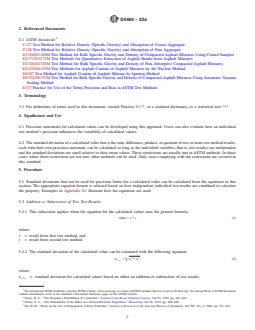
5.2.1 This subsection applies when the equation for the calculated values uses the general formula:
value 5 x1y (1)
where:
x = result from first test method, and
y = result from second test method.
5.2.2 The standard deviation of the calculated value can be estimated with the following equation:
2 2
σ 5=σ 1σ (2)
x6y x y
where:
σ = standard deviation for calculated values based on either an addition or subtraction of test results,
x6y
For referenced ASTM standards, visit the ASTM website, www.astm.org, or contact ASTM Customer Service at service@astm.org. For Annual Book of ASTM Standards
volume information, refer to the standard’s Document Summary page on the ASTM website.
Geary, R. C., “The Frequency Distribution of a Quotient,” Journal of the Royal Statistical Society, Vol 93, 1930, pp. 442–446.
Fieller, E. C., “The Distribution of the Index in a Normal Bivariate Population,” Biometrika, Vol 24, 1932, pp. 428–440.
Ku, H. H., “Notes on the Use of Propagation of Error Formulas,” Journal of Research of the National Bureau of Standards, Vol 70C, No. 4, 1966, pp. 331–341.
D4460 − 22a
σ = standard deviation for first test method, and
x
σ = standard deviation for second test method.
y
5.3 Product of Two Test Results:
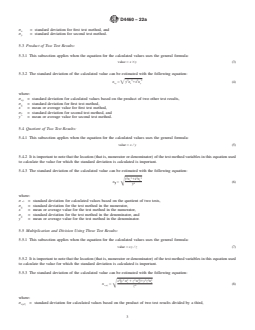
5.3.1 This subsection applies when the equation for the calculated values uses the general formula:
value 5 x 3y (3)
5.3.2 The standard deviation of the calculated value can be estimated with the following equation:
2 2 2 2
σ 5= y¯ σ 1x¯ σ (4)
xy x y
where:
σ = standard deviation for calculated values based on the product of two other test results,
xy
σ = standard deviation for first test method,
x
x¯ = mean or av
...