

ASTM D2714-94(2019)
(Test Method)Standard Test Method for Calibration and Operation of the Falex Block-on-Ring Friction and Wear Testing Machine
General Information
- Abstract
SIGNIFICANCE AND USE
4.1 This test method is used for the calibration of a block-on-ring testing machine by measuring the friction and wear properties of a calibration fluid under the prescribed test conditions.
4.2 The user of this test method should determine to his or her own satisfaction whether results of this test procedure correlate with field performance or other bench test machines. If the test conditions are changed, wear values can change and relative ratings of fluids can be different.
SCOPE
1.1 This test method covers the calibration and operation of a block-on-ring friction and wear testing machine.
1.2 The values in SI units are to be regarded as standard. The values given in parentheses are mathematical conversions to SI units that are provided for information only.
1.3 This standard does not purport to address all of the safety concerns, if any, associated with its use. It is the responsibility of the user of this standard to establish appropriate safety, health, and environmental practices and determine the applicability of regulatory limitations prior to use.
1.4 This international standard was developed in accordance with internationally recognized principles on standardization established in the Decision on Principles for the Development of International Standards, Guides and Recommendations issued by the World Trade Organization Technical Barriers to Trade (TBT) Committee.
- Status
- Published
- Publication Date
- 30-Apr-2019
- Technical Committee
- D02 - Petroleum Products, Liquid Fuels, and Lubricants
- Drafting Committee
- D02.L0.05 - Solid Lubricants

Overview
ASTM D2714-94(2019) sets forth the standard test method for the calibration and operation of the Falex Block-on-Ring Friction and Wear Testing Machine. This international standard, developed by ASTM International, guides the laboratory assessment of friction and wear properties of materials using the block-on-ring method. The protocol ensures the testing equipment is accurately calibrated, enabling reliable and repeatable measurements essential for quality control, research, and comparative analysis of lubricants and materials subjected to frictional forces.
The standard is applicable to a variety of industry sectors, including petroleum, automotive, aerospace, and materials science, where the measurement of friction and wear is crucial to product development and validation. Compliance with ASTM D2714 enhances laboratory credibility and provides critical data for product specifications and regulatory submissions.
Key Topics
- Calibration Procedure: Outlines steps to confirm the Falex Block-on-Ring testing machine produces results within prescribed limits using calibration fluids.
- Test Conditions: Specifies requirements for specimen preparation, machine operation parameters (load, speed, temperature), and fluid immersion.
- Measurement of Friction and Wear: Describes how to record the coefficient of friction, wear scar width, and material loss during standardized test cycles.
- Results Assessment: Details the criteria for repeatability and reproducibility of measurements, contributing to consistent quality control.
- Safety and Environmental Responsibility: Reminds users to establish adequate safety, health, and environmental practices and verify regulatory compliance.
Applications
ASTM D2714 is widely used for:
- Quality Control in Lubricant Manufacturing: Determining how lubricants perform under controlled friction and wear conditions, ensuring product consistency.
- Material Development and Research: Evaluating and comparing the wear resistance and friction coefficients of metals, coatings, and lubricants for automotive, industrial, and aerospace applications.
- Equipment Calibration: Verifying that block-on-ring wear testing machines are functioning properly, guaranteeing the reliability of all subsequent test results.
- Benchmarking and Comparison: Providing standardized data to compare various lubricants and materials, aiding in product selection and certification.
Because the standard employs precise, repeatable testing methods, it enables laboratories to replicate real-world wear scenarios and optimize component longevity, efficiency, and safety.
Related Standards
Compliance with ASTM D2714-94(2019) often involves reference to, or alignment with, other international and ASTM standards, such as:
- ASTM D2266 - Test Method for Wear Preventive Characteristics of Lubricating Grease (Four-Ball Method)
- ASTM G99 - Standard Test Method for Wear Testing with a Pin-on-Disk Apparatus
- ISO 7148 - Plain Bearings - Testing of the Tribological Behaviour of Plain Bearing Materials
- ASTM D4172 - Standard Test Method for Wear Preventive Characteristics of Lubricating Fluid (Four-Ball Method)
These related standards cover alternative friction and wear testing methodologies, ensuring comprehensive evaluation for lubricants and materials in tribology.
Keywords: ASTM D2714, block-on-ring, Falex test, friction test, wear test, calibration, coefficient of friction, wear scar, lubricant evaluation, tribology standards, laboratory testing, industrial quality control.
Relations
- Effective Date
- 01-May-2019
- Effective Date
- 01-May-2019
- Effective Date
- 01-May-2019
- Effective Date
- 01-May-2019
- Referred By
ASTM B607-21 - Standard Specification for Autocatalytic Nickel Boron Coatings for Engineering Use - Effective Date
- 01-May-2019
- Effective Date
- 01-May-2019
- Effective Date
- 01-May-2019
- Effective Date
- 01-May-2019
- Effective Date
- 01-May-2019
Get Certified
Connect with accredited certification bodies for this standard

IMP NDT d.o.o.
Non-destructive testing services. Radiography, ultrasonic, magnetic particle, penetrant, visual inspection.
Inštitut za kovinske materiale in tehnologije
Institute of Metals and Technology. Materials testing, metallurgical analysis, NDT.
Q Techna d.o.o.
NDT and quality assurance specialist. 30+ years experience. NDT personnel certification per ISO 9712, nuclear and thermal power plant inspections, QA/
Sponsored listings
Frequently Asked Questions
ASTM D2714-94(2019) is a standard published by ASTM International. Its full title is "Standard Test Method for Calibration and Operation of the Falex Block-on-Ring Friction and Wear Testing Machine". This standard covers: SIGNIFICANCE AND USE 4.1 This test method is used for the calibration of a block-on-ring testing machine by measuring the friction and wear properties of a calibration fluid under the prescribed test conditions. 4.2 The user of this test method should determine to his or her own satisfaction whether results of this test procedure correlate with field performance or other bench test machines. If the test conditions are changed, wear values can change and relative ratings of fluids can be different. SCOPE 1.1 This test method covers the calibration and operation of a block-on-ring friction and wear testing machine. 1.2 The values in SI units are to be regarded as standard. The values given in parentheses are mathematical conversions to SI units that are provided for information only. 1.3 This standard does not purport to address all of the safety concerns, if any, associated with its use. It is the responsibility of the user of this standard to establish appropriate safety, health, and environmental practices and determine the applicability of regulatory limitations prior to use. 1.4 This international standard was developed in accordance with internationally recognized principles on standardization established in the Decision on Principles for the Development of International Standards, Guides and Recommendations issued by the World Trade Organization Technical Barriers to Trade (TBT) Committee.
SIGNIFICANCE AND USE 4.1 This test method is used for the calibration of a block-on-ring testing machine by measuring the friction and wear properties of a calibration fluid under the prescribed test conditions. 4.2 The user of this test method should determine to his or her own satisfaction whether results of this test procedure correlate with field performance or other bench test machines. If the test conditions are changed, wear values can change and relative ratings of fluids can be different. SCOPE 1.1 This test method covers the calibration and operation of a block-on-ring friction and wear testing machine. 1.2 The values in SI units are to be regarded as standard. The values given in parentheses are mathematical conversions to SI units that are provided for information only. 1.3 This standard does not purport to address all of the safety concerns, if any, associated with its use. It is the responsibility of the user of this standard to establish appropriate safety, health, and environmental practices and determine the applicability of regulatory limitations prior to use. 1.4 This international standard was developed in accordance with internationally recognized principles on standardization established in the Decision on Principles for the Development of International Standards, Guides and Recommendations issued by the World Trade Organization Technical Barriers to Trade (TBT) Committee.
ASTM D2714-94(2019) is classified under the following ICS (International Classification for Standards) categories: 19.060 - Mechanical testing. The ICS classification helps identify the subject area and facilitates finding related standards.
ASTM D2714-94(2019) has the following relationships with other standards: It is inter standard links to ASTM D2714-94(2014), ASTM G115-10(2018), ASTM D2981-94(2019), ASTM D3704-96(2017), ASTM B607-21, ASTM D7755-11(2022), ASTM G176-03(2017), ASTM G77-17(2022), ASTM B733-22. Understanding these relationships helps ensure you are using the most current and applicable version of the standard.
ASTM D2714-94(2019) is available in PDF format for immediate download after purchase. The document can be added to your cart and obtained through the secure checkout process. Digital delivery ensures instant access to the complete standard document.
Standards Content (Sample)
This international standard was developed in accordance with internationally recognized principles on standardization established in the Decision on Principles for the
Development of International Standards, Guides and Recommendations issued by the World Trade Organization Technical Barriers to Trade (TBT) Committee.
Designation: D2714 − 94 (Reapproved 2019)
Standard Test Method for
Calibration and Operation of the Falex Block-on-Ring
Friction and Wear Testing Machine
This standard is issued under the fixed designation D2714; the number immediately following the designation indicates the year of
original adoption or, in the case of revision, the year of last revision. A number in parentheses indicates the year of last reapproval. A
superscript epsilon (´) indicates an editorial change since the last revision or reapproval.
This standard has been approved for use by agencies of the U.S. Department of Defense.
1. Scope 2.1.3 kinetic coeffıcient of friction—the coefficient of fric-
tion under conditions of macroscopic relative motion between
1.1 This test method covers the calibration and operation of
two bodies.
a block-on-ring friction and wear testing machine.
2.1.4 wear—damage to a solid surface, generally involving
1.2 The values in SI units are to be regarded as standard.
progressive loss of material, due to relative motion between
The values given in parentheses are mathematical conversions
that surface and a contacting substance or substances.
to SI units that are provided for information only.
1.3 This standard does not purport to address all of the 3. Summary of Test Method
safety concerns, if any, associated with its use. It is the
3.1 The test machine is operated using a steel test ring
responsibility of the user of this standard to establish appro-
rotating against a steel test block, the specimen assembly being
priate safety, health, and environmental practices and deter-
partially immersed in the lubricant sample. The velocity of the
mine the applicability of regulatory limitations prior to use.
test ring is 7.9 m⁄min 6 0.16 m⁄min (26 ft⁄min 6 0.52 ft⁄min)
1.4 This international standard was developed in accor-
which is equivalent to a spindle speed of 72 r⁄min 6 1 r⁄min.
dance with internationally recognized principles on standard-
The specimens are subjected to 68 kg (150 lb) normal load
ization established in the Decision on Principles for the
applied by 6.8 kg (15 lb) of dead weight on the 10:1 ratio lever
Development of International Standards, Guides and Recom-
system. Test duration is 5000 cycles.
mendations issued by the World Trade Organization Technical
3.2 Three determinations are made: (1) The friction force
Barriers to Trade (TBT) Committee.
after a certain number of revolutions, (2) the average width of
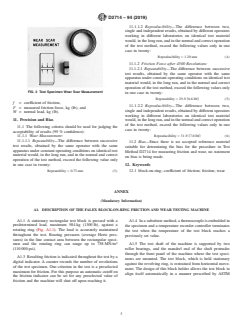
the wear scar on the stationary block at the end of the test, and
2. Terminology
(3)theweightlossforthestationaryblockattheendofthetest.
2.1 Definitions:
2.1.1 coeffıcient of friction, µ or f—in tribology, the dimen-
4. Significance and Use
sionlessratioofthefrictionforce(F)betweentwobodiestothe
4.1 This test method is used for the calibration of a
normal force (N) pressing these two bodies together.
block-on-ring testing machine by measuring the friction and
µ or f 5 F/N (1)
~ !
wear properties of a calibration fluid under the prescribed test
2.1.1.1 Discussion—A distinction is often made between
conditions.
static coeffıcient of friction and kinetic coeffıcient of friction.
4.2 The user of this test method should determine to his or
2.1.2 friction force—the resisting force tangential to the
her own satisfaction whether results of this test procedure
interface between two bodies when, under the action of an
correlate with field performance or other bench test machines.
external force, one body moves or tends to move relative to the
If the test conditions are changed, wear values can change and
other.
relative ratings of fluids can be different.
5. Apparatus
This test method is under the jurisdiction of ASTM Committee D02 on
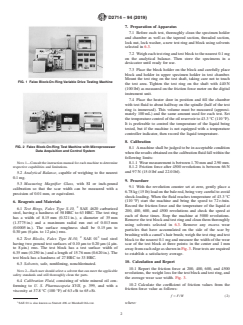
5.1 Falex Block-on-Ring Test Machine, shown in Fig. 1
Petroleum Products, Liquid Fuels, and Lubricants and is the direct responsibility of
Subcommittee D02.L0.05 on Solid Lubricants. and Fig. 2 and described in detail in Annex A1.
This test method was prepared under the joint sponsorship of the American
Society of Lubrication Engineers with the cooperation of the Coordinating Research
Council, Inc. (CRC) Aviation Committee on Bonded Solid-Film Lubricants. The sole source of supply of the apparatus known to the committee at this time
Accepted by ASLE September 1968. is trademarked and manufactured by Falex Corp., 1020 Airpark Dr., Sugar Grove,
Current edition approved May 1, 2019. Published June 2019. Originally IL 60554. If you are aware of alternative suppliers, please provide this information
approved in 1968. Last previous edition approved in 2014 as D2714 – 94 (2014). to ASTM International Headquarters. Your comments will receive careful consid-
DOI: 10.1520/D2714-94R19. eration at a meeting of the responsible technical committee, which you may attend.
Copyright © ASTM International, 100 Barr Harbor Drive, PO Box C700, West Conshohocken, PA 19428-2959. United States
D2714 − 94 (2019)
7. Preparation of Apparatus
7.1 Before each test, thoroughly clean the specimen holder
and chamber as well as the tapered section, threaded section,
lock nut, lock washer, a new test ring and block using solvents
selected in 6.3.
7.2 Weigh each test ring and test block to the nearest 0.1 mg
on the analytical balance. Then store the specimens in a
desiccator until ready for use.
7.3 Place the block holder on the block and carefully place
block and holder in upper specimen holder in test chamber.
Mount the test ring on the test shaft, taking care not to touch
FIG. 1 Falex Block-On-Ring Variable Drive Testing Machine
the test area. Tighten the test ring on the shaft with 440 N
(100 lbf) as measured on the friction force meter on the digital
instrument unit.
7.4 Place the heater door in position and fill the chamber
with test fluid to about halfway on the spindle (half of the test
ring is immersed). This volume must be measured (approxi-
mately 100 mL) and the same amount used for each test. Set
the temperature control of the oil reservoir to 43.3 °C (110 °F).
It is preferable to control the temperature of the liquid being
tested, but if the machine is not equipped with a temperature
controller indicator, then record the liquid temperature.
8. Calibration
FIG. 2 Falex Block-On-Ring Test Machine with Microprocessor
8.1 Amachine shall be judged to be in acceptable condition
Data Acquisition and Control System
whentheresultsobtainedonthecalibrationfluidfallwithinthe
following limits:
8.1.1 Wear measurement is between 1.70 mm and 2.90 mm.
NOTE 1—Consult the instruction manual for each machine to determine
respective capabilities and limitations.
8.1.2 Friction force after 4500 revolutions is between 66 N
and 97 N (15.0 lbf and 22.0 lbf).
5.2 Analytical Balance, capable of weighing to the nearest
0.1 mg.
9. Procedure
5.3 Measuring Magnifier Glass, with SI or inch-pound
9.1 With the revolution counter set at zero, gently place a
calibration so that the scar width can be measured with a
6.78 kg(15 lb)loadonthebalerod,beingverycarefultoavoid
precision of 0.01 mm, or equivalent.
shock-loading. When the fluid reaches temperature of 43.3 °C
(110 °F) start the machine and bring the speed to 72 r⁄min.
6. Reagents and Materials
Record the friction force and the temperature of the liquid at
6.1 Test Rings, Falex Type S-10, SAE 4620 carburized
200, 400, 600, and 4500 revolutions and check the speed at
steel, having a hardness of 58 HRC to 63 HRC. The test ring
each of these times. Stop the machine at 5000 revolutions.
has a width of 8.15 mm (0.321 in.), a diameter of 35 mm
Remove the test block and test ring and clean them thoroughly
(1.3775 in.) and a maximum radial run o
...