

ASTM D3702-94(2019)
(Test Method)Standard Test Method for Wear Rate and Coefficient of Friction of Materials in Self-Lubricated Rubbing Contact Using a Thrust Washer Testing Machine
General Information
- Abstract
SIGNIFICANCE AND USE
4.1 This test method is used to determine the equilibrium rate of wear and coefficient of friction of materials in rubbing contact under useful operating conditions, that is, combinations of pressure and velocity that fall below the PV (pressure × velocity) limit of the test material. The user of this test method should determine to his own satisfaction whether the results of this test procedure correlate with field performance or other bench test machines. If the test conditions are changed, the wear rates may change and the relative value of one material with respect to another may also change.
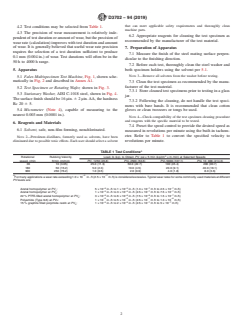
4.2 Test conditions may be selected from Table 1. (A) For many applications a wear rate exceeding 1.0 × 10⁻⁵ in./h (2.5 × 10⁻⁷ m/h) is considered excessive. Typical wear rates for some commonly used materials at different PV levels are:
Acetal homopolymer at PV1:
5 × 10⁻⁶ in./h to 1 × 10⁻⁵ in./h (1.3 × 10⁻⁷ m/h to 2.5 × 10⁻⁷ m/h)
Acetal homopolymer at PV2:
1 × 10⁻⁵ in./h to 3 × 10⁻⁵ in./h (2.5 × 10⁻⁷ m/h to 7.5 × 10⁻⁷ m/h)
22 % PTFE-filled acetal homopolymer at PV2:
3 × 10⁻⁶ in./h to 6 × 10⁻⁶ in./h (7.5 × 10⁻⁸ m/h to 1.5 × 10⁻⁷ m/h)
Polyamide (Type 6-6) at PV2:
1 × 10⁻⁵ in./h to 5 × 10⁻⁵ in./h (2.5 × 10⁻⁷ m/h to 1.3 × 10⁻⁶ m/h)
15 % graphite filled polyimide restin at PV3:
1 × 10⁻⁵ in./h to 2 × 10⁻⁵ in./h (2.5 × 10⁻⁷ m/h to 5 × 10⁻⁷ m/h)
4.3 The precision of wear measurement is relatively independent of test duration or amount of wear, but the precision of wear rate (calculation) improves with test duration and amount of wear. It is generally believed that useful wear rate precision requires the selection of a test duration sufficient to produce 0.1 mm (0.004 in.) of wear. Test durations will often be in the 50 h to 4000 h range.
SCOPE
1.1 This test method covers the determination of wear rate and coefficient of friction for self-lubricated materials in rubbing contact by a testing machine2 that utilizes a thrust washer specimen configuration.
Note 1: This machine may also be used to measure coefficient of friction.
1.2 The values in SI units are to be regarded as the standard. In cases where materials, products, or equipment are available only in inch-pound units, SI values in parentheses are for information only.
1.3 This standard does not purport to address all of the safety concerns, if any, associated with its use. It is the responsibility of the user of this standard to establish appropriate safety, health, and environmental practices and determine the applicability of regulatory limitations prior to use.
1.4 This international standard was developed in accordance with internationally recognized principles on standardization established in the Decision on Principles for the Development of International Standards, Guides and Recommendations issued by the World Trade Organization Technical Barriers to Trade (TBT) Committee.
- Status
- Published
- Publication Date
- 30-Apr-2019
- Technical Committee
- D02 - Petroleum Products, Liquid Fuels, and Lubricants
- Drafting Committee
- D02.L0.05 - Solid Lubricants
Overview
ASTM D3702-94(2019): Standard Test Method for Wear Rate and Coefficient of Friction of Materials in Self-Lubricated Rubbing Contact Using a Thrust Washer Testing Machine establishes standardized procedures for evaluating the wear rate and coefficient of friction of self-lubricated materials in rubbing contact. Developed by ASTM International, this method helps determine material performance under realistic operating conditions-particularly for polymer and composite materials designed to operate without external lubrication.
By measuring wear rate and friction using a thrust washer testing machine, this standard supports industries in selecting optimal materials for reduced maintenance costs and enhanced durability in components such as bushings, bearings, washers, and seals.
Key Topics
- Wear Rate Determination: Measurement of the rate at which material is lost from a test specimen when subjected to defined pressure and velocity (PV) conditions using a thrust washer configuration.
- Coefficient of Friction Measurement: Evaluation of the static and kinetic coefficients of friction between contacting surfaces under controlled normal load and rubbing velocity.
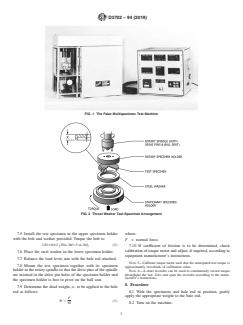
- Test Apparatus: Use of a thrust washer testing machine, such as the Falex Multispecimen Test Machine, to ensure repeatable loading and rotational conditions.
- Test Procedure: Includes specimen preparation, break-in period, load and speed selection (based on PV values), and precise thickness measurement before and after testing.
- Precision and Repeatability: Guidelines for consistent measurement, with considerations for operator variance and laboratory differences.
- Material Suitability: Application to self-lubricated materials including acetal homopolymer, PTFE-filled polymers, polyamide, and graphite-filled polyimide.
Applications
This ASTM standard adds practical value across industries where minimizing wear and controlling friction are critical to operational success. Key applications include:
- Polymer Bearings and Bushings: Enables the benchmarking and selection of materials for high-performance, low-maintenance applications.
- Automotive Components: Evaluates materials used in engine parts, suspension systems, and drive assemblies for reliable, self-lubricating properties.
- Aerospace and Industrial Equipment: Assists in qualifying materials for seals, gaskets, and pivot points where lubrication is impractical or impossible.
- Product Development: Supports research, comparative analysis, and optimization of new materials engineered for low wear rates and stable friction coefficients.
- Quality Control: Ensures batch-to-batch consistency in material performance by providing standardized test data for friction and wear rates.
Related Standards
The following standards are commonly used in conjunction with ASTM D3702-94(2019) for comprehensive testing and evaluation of friction and wear properties:
- ASTM G99: Standard Test Method for Wear Testing with a Pin-on-Disk Apparatus.
- ASTM D1894: Standard Test Method for Static and Kinetic Coefficients of Friction of Plastic Film and Sheeting.
- ASTM G133: Standard Test Method for Linearly Reciprocating Ball-on-Flat Sliding Wear.
- ISO 7148-1: Plain Bearings-Testing of the Tribological Behavior of Bearing Materials-Part 1: Testing of Bearing Metals.
Practical Value
Adhering to ASTM D3702-94(2019) ensures that self-lubricated materials are rigorously and consistently evaluated for wear resistance and friction behavior. By using a standardized thrust washer test, manufacturers and engineers gain reliable data for material selection, product development, and quality assurance-ultimately leading to longer component life, reduced downtime, and improved safety in critical mechanical applications.
Keywords: wear rate, coefficient of friction, self-lubricated materials, thrust washer test, ASTM D3702, friction testing, polymer wear, material characterization, tribology standards.
Relations
- Effective Date
- 01-May-2019
- Effective Date
- 01-May-2019
- Effective Date
- 01-May-2019
- Effective Date
- 01-May-2019
Get Certified
Connect with accredited certification bodies for this standard

IMP NDT d.o.o.
Non-destructive testing services. Radiography, ultrasonic, magnetic particle, penetrant, visual inspection.
Inštitut za kovinske materiale in tehnologije
Institute of Metals and Technology. Materials testing, metallurgical analysis, NDT.
Q Techna d.o.o.
NDT and quality assurance specialist. 30+ years experience. NDT personnel certification per ISO 9712, nuclear and thermal power plant inspections, QA/
Sponsored listings
Frequently Asked Questions
ASTM D3702-94(2019) is a standard published by ASTM International. Its full title is "Standard Test Method for Wear Rate and Coefficient of Friction of Materials in Self-Lubricated Rubbing Contact Using a Thrust Washer Testing Machine". This standard covers: SIGNIFICANCE AND USE 4.1 This test method is used to determine the equilibrium rate of wear and coefficient of friction of materials in rubbing contact under useful operating conditions, that is, combinations of pressure and velocity that fall below the PV (pressure × velocity) limit of the test material. The user of this test method should determine to his own satisfaction whether the results of this test procedure correlate with field performance or other bench test machines. If the test conditions are changed, the wear rates may change and the relative value of one material with respect to another may also change. 4.2 Test conditions may be selected from Table 1. (A) For many applications a wear rate exceeding 1.0 × 10⁻⁵ in./h (2.5 × 10⁻⁷ m/h) is considered excessive. Typical wear rates for some commonly used materials at different PV levels are: Acetal homopolymer at PV1: 5 × 10⁻⁶ in./h to 1 × 10⁻⁵ in./h (1.3 × 10⁻⁷ m/h to 2.5 × 10⁻⁷ m/h) Acetal homopolymer at PV2: 1 × 10⁻⁵ in./h to 3 × 10⁻⁵ in./h (2.5 × 10⁻⁷ m/h to 7.5 × 10⁻⁷ m/h) 22 % PTFE-filled acetal homopolymer at PV2: 3 × 10⁻⁶ in./h to 6 × 10⁻⁶ in./h (7.5 × 10⁻⁸ m/h to 1.5 × 10⁻⁷ m/h) Polyamide (Type 6-6) at PV2: 1 × 10⁻⁵ in./h to 5 × 10⁻⁵ in./h (2.5 × 10⁻⁷ m/h to 1.3 × 10⁻⁶ m/h) 15 % graphite filled polyimide restin at PV3: 1 × 10⁻⁵ in./h to 2 × 10⁻⁵ in./h (2.5 × 10⁻⁷ m/h to 5 × 10⁻⁷ m/h) 4.3 The precision of wear measurement is relatively independent of test duration or amount of wear, but the precision of wear rate (calculation) improves with test duration and amount of wear. It is generally believed that useful wear rate precision requires the selection of a test duration sufficient to produce 0.1 mm (0.004 in.) of wear. Test durations will often be in the 50 h to 4000 h range. SCOPE 1.1 This test method covers the determination of wear rate and coefficient of friction for self-lubricated materials in rubbing contact by a testing machine2 that utilizes a thrust washer specimen configuration. Note 1: This machine may also be used to measure coefficient of friction. 1.2 The values in SI units are to be regarded as the standard. In cases where materials, products, or equipment are available only in inch-pound units, SI values in parentheses are for information only. 1.3 This standard does not purport to address all of the safety concerns, if any, associated with its use. It is the responsibility of the user of this standard to establish appropriate safety, health, and environmental practices and determine the applicability of regulatory limitations prior to use. 1.4 This international standard was developed in accordance with internationally recognized principles on standardization established in the Decision on Principles for the Development of International Standards, Guides and Recommendations issued by the World Trade Organization Technical Barriers to Trade (TBT) Committee.
SIGNIFICANCE AND USE 4.1 This test method is used to determine the equilibrium rate of wear and coefficient of friction of materials in rubbing contact under useful operating conditions, that is, combinations of pressure and velocity that fall below the PV (pressure × velocity) limit of the test material. The user of this test method should determine to his own satisfaction whether the results of this test procedure correlate with field performance or other bench test machines. If the test conditions are changed, the wear rates may change and the relative value of one material with respect to another may also change. 4.2 Test conditions may be selected from Table 1. (A) For many applications a wear rate exceeding 1.0 × 10⁻⁵ in./h (2.5 × 10⁻⁷ m/h) is considered excessive. Typical wear rates for some commonly used materials at different PV levels are: Acetal homopolymer at PV1: 5 × 10⁻⁶ in./h to 1 × 10⁻⁵ in./h (1.3 × 10⁻⁷ m/h to 2.5 × 10⁻⁷ m/h) Acetal homopolymer at PV2: 1 × 10⁻⁵ in./h to 3 × 10⁻⁵ in./h (2.5 × 10⁻⁷ m/h to 7.5 × 10⁻⁷ m/h) 22 % PTFE-filled acetal homopolymer at PV2: 3 × 10⁻⁶ in./h to 6 × 10⁻⁶ in./h (7.5 × 10⁻⁸ m/h to 1.5 × 10⁻⁷ m/h) Polyamide (Type 6-6) at PV2: 1 × 10⁻⁵ in./h to 5 × 10⁻⁵ in./h (2.5 × 10⁻⁷ m/h to 1.3 × 10⁻⁶ m/h) 15 % graphite filled polyimide restin at PV3: 1 × 10⁻⁵ in./h to 2 × 10⁻⁵ in./h (2.5 × 10⁻⁷ m/h to 5 × 10⁻⁷ m/h) 4.3 The precision of wear measurement is relatively independent of test duration or amount of wear, but the precision of wear rate (calculation) improves with test duration and amount of wear. It is generally believed that useful wear rate precision requires the selection of a test duration sufficient to produce 0.1 mm (0.004 in.) of wear. Test durations will often be in the 50 h to 4000 h range. SCOPE 1.1 This test method covers the determination of wear rate and coefficient of friction for self-lubricated materials in rubbing contact by a testing machine2 that utilizes a thrust washer specimen configuration. Note 1: This machine may also be used to measure coefficient of friction. 1.2 The values in SI units are to be regarded as the standard. In cases where materials, products, or equipment are available only in inch-pound units, SI values in parentheses are for information only. 1.3 This standard does not purport to address all of the safety concerns, if any, associated with its use. It is the responsibility of the user of this standard to establish appropriate safety, health, and environmental practices and determine the applicability of regulatory limitations prior to use. 1.4 This international standard was developed in accordance with internationally recognized principles on standardization established in the Decision on Principles for the Development of International Standards, Guides and Recommendations issued by the World Trade Organization Technical Barriers to Trade (TBT) Committee.
ASTM D3702-94(2019) is classified under the following ICS (International Classification for Standards) categories: 19.060 - Mechanical testing. The ICS classification helps identify the subject area and facilitates finding related standards.
ASTM D3702-94(2019) has the following relationships with other standards: It is inter standard links to ASTM D3702-94(2014), ASTM G115-10(2018), ASTM G137-97(2017), ASTM D7755-11(2022). Understanding these relationships helps ensure you are using the most current and applicable version of the standard.
ASTM D3702-94(2019) is available in PDF format for immediate download after purchase. The document can be added to your cart and obtained through the secure checkout process. Digital delivery ensures instant access to the complete standard document.
Standards Content (Sample)
This international standard was developed in accordance with internationally recognized principles on standardization established in the Decision on Principles for the
Development of International Standards, Guides and Recommendations issued by the World Trade Organization Technical Barriers to Trade (TBT) Committee.
Designation: D3702 − 94 (Reapproved 2019)
Standard Test Method for
Wear Rate and Coefficient of Friction of Materials in Self-
Lubricated Rubbing Contact Using a Thrust Washer Testing
Machine
This standard is issued under the fixed designation D3702; the number immediately following the designation indicates the year of
original adoption or, in the case of revision, the year of last revision.Anumber in parentheses indicates the year of last reapproval.A
superscript epsilon (´) indicates an editorial change since the last revision or reapproval.
1. Scope 2.1.1.1 Discussion—A distinction is often made between
static coefficient of friction and kinetic coefficient of friction.
1.1 This test method covers the determination of wear rate
2.1.2 wear—damage to a solid surface, generally involving
and coefficient of friction for self-lubricated materials in
progressive loss of material, due to relative motion between
rubbing contact by a testing machine that utilizes a thrust
that surface and a contacting substance or substances.
washer specimen configuration.
2.1.3 wear rate—the rate of material removal or dimen-
NOTE 1—This machine may also be used to measure coefficient of
sional change due to wear per unit of exposure parameter; for
friction.
example, quantity of material removed (mass, volume, thick-
1.2 ThevaluesinSIunitsaretoberegardedasthestandard.
ness) in unit distance of sliding or unit time.
In cases where materials, products, or equipment are available
only in inch-pound units, SI values in parentheses are for 2.2 Definitions of Terms Specific to This Standard:
information only. 2.2.1 torque—reaction of a tendency to turn due to friction
forces between specimens traveling in a circular path. It is the
1.3 This standard does not purport to address all of the
product of a restraining force and the radius at which it acts to
safety concerns, if any, associated with its use. It is the
balance the frictional torque.
responsibility of the user of this standard to establish appro-
priate safety, health, and environmental practices and deter-
3. Summary of Test Method
mine the applicability of regulatory limitations prior to use.
3.1 The test machine is operated with a test specimen
1.4 This international standard was developed in accor-
rotating under load against a stationary steel washer. Each test
dance with internationally recognized principles on standard-
consists of break-in for 40h followed by a selected test
ization established in the Decision on Principles for the
duration, each at the same selected normal load and speed.
Development of International Standards, Guides and Recom-
Load is obtained by application of dead weights to the 10:1
mendations issued by the World Trade Organization Technical
2 2
lever arm. The contact area is 1.29cm (0.20in. ). The mean
Barriers to Trade (TBT) Committee.
rubbing velocity is related to spindle rotational speed:
2. Terminology 1r⁄min=0.0848m⁄min (0.278ft⁄min).
2.1 Definitions: 3.2 The thickness change of the test specimen and torque
2.1.1 coeffıcient of friction, µ or f—in tribology—thedimen- during test are measured for each test.
sionlessratioofthefrictionforce(F)betweentwobodiestothe
3.3 Wear rate in centimetres per hour (inches per hour) and
normal force (N) pressing these bodies together.
coefficient of friction is reported.
µ or f 5 ~F/N! (1)
4. Significance and Use
4.1 This test method is used to determine the equilibrium
This test method is under the jurisdiction of ASTM Committee D02 on
rate of wear and coefficient of friction of materials in rubbing
Petroleum Products, Liquid Fuels, and Lubricants and is the direct responsibility of
Subcommittee D02.L0.05 on Solid Lubricants.
contactunderusefuloperatingconditions,thatis,combinations
Current edition approved May 1, 2019. Published June 2019. Originally
of pressure and velocity that fall below the PV (pres-
approved in 1978. Last previous edition approved in 2014 as D3702–94(2014).
sure×velocity) limit of the test material. The user of this test
DOI: 10.1520/D3702-94R19.
method should determine to his own satisfaction whether the
An example known to the committee at this time is the Falex Multispecimen
Test Machine, available from Falex Corp., 1020 Airpark Drive, Sugar Grove, IL
resultsofthistestprocedurecorrelatewithfieldperformanceor
60554. This manufacturer recommends a maximum test load of 808 lb (367 kg). If
other bench test machines. If the test conditions are changed,
you are aware of alternative suppliers, please provide this information to ASTM
the wear rates may change and the relative value of one
International Headquarters. Your comments will receive careful consideration at a
meeting of the responsible technical committee, which you may attend. material with respect to another may also change.
Copyright © ASTM International, 100 Barr Harbor Drive, PO Box C700, West Conshohocken, PA 19428-2959. United States
D3702 − 94 (2019)
that can meet applicable safety requirements and thoroughly clean
4.2 Test conditions may be selected from Table 1.
machine parts.
4.3 The precision of wear measurement is relatively inde-
6.2 Appropriate reagents for cleaning the test specimen as
pendentoftestdurationoramountofwear,buttheprecisionof
recommended by the manufacturer of the test material.
wear rate (calculation) improves with test duration and amount
of wear. It is generally believed that useful wear rate precision
7. Preparation of Apparatus
requires the selection of a test duration sufficient to produce
7.1 Measure the finish of the steel mating surface perpen-
0.1mm (0.004in.) of wear. Test durations will often be in the
dicular to the finishing direction.
50h to 4000h range.
7.2 Before each test, thoroughly clean the steel washer and
both specimen holders using the solvent per 5.1.
5. Apparatus
NOTE 3—Remove all solvents from the washer before testing.
5.1 Falex Multispecimen Test Machine, Fig. 1, shown sche-
matically in Fig. 2 and described in Annex A1.
7.3 Clean the test specimen as recommended by the manu-
facturer of the test material.
5.2 Test Specimen or Rotating Wafer, shown in Fig. 3.
7.3.1 Store cleaned test specimens prior to testing in a glass
5.3 Stationary Washer, AISI C-1018 steel, shown in Fig. 4.
jar.
The surface finish should be 16µin. 6 2µin.AA, the hardness
7.3.2 Following the cleaning, do not handle the test speci-
Rc 20 6 5.
mens with bare hands. It is recommended that clean cotton
5.4 Micrometer (Note 4), capable of measuring to the
gloves or clean tweezers or tongs be used.
nearest 0.003mm (0.0001in.).
NOTE 4—Check compatibility of the test specimen cleaning procedure
and reagents with the specific material to be tested.
6. Reagents and Materials
7.4 Preset the speed control to provide the desired speed as
6.1 Solvent, safe, non-film forming, nonchlorinated.
measured in revolutions per minute using the built-in tachom-
eter. Refer to Table 1 to convert the specified velocity to
NOTE 2—Petroleum distillates, formerly used as solvents, have been
eliminated due to possible toxic effects. Each user should select a solvent revolutions per minute.
A
TABLE 1 Test Conditions
Rotational Rubbing Velocity, Load, lb (kg), to Obtain PV, psi × ft ⁄min (kg/cm × m ⁄min) at Selected Speeds
speed, r/min ft/min (m/min) PV 1250 (26.8) PV 2500 (53.6) PV 5000 (107.1) PV 10 000 (214.3)
1 2 3 4
36 10 (3.05) 25.0 (11.3) 50.0 (22.7) 100 (45.4) 200 (90.7)
180 50 (15.2) 5.0 (2.3) 10.0 (4.5) 20.0 (9.1) 40.0 (18.1)
900 250 (76.2) 1.0 (0.5) 2.0 (0.9) 4.0 (1.8) 8.0 (3.6)
A −5 −7
For many applications a wear rate exceeding 1.0 × 10 in. ⁄h(2.5×10 m ⁄h) is considered excessive. Typical wear rates for some commonly used materials at different
PV levels are:
−6 −5 −7 −7
Acetal homopolymer at PV : 5×10 in.⁄hto1×10 in. ⁄h (1.3×10 m⁄hto2.5×10 m⁄h)
−5 −5 −7 −7
Acetal homopolymer at PV : 1×10 in.⁄hto3×10 in. ⁄h (2.5×10 m⁄hto7.5×10 m⁄h)
−6 −6 −8 −7
22 % PTFE-filled acetal homopolymer at PV : 3×10 in.⁄hto6×10 in. ⁄h (7.5×10 m⁄hto1.5×10 m⁄h)
−5 −5 −7 −6
Polyamide (Type 6-6) at PV : 1×10 in.⁄hto5×10 in. ⁄h (2.5×10 m⁄hto1.3×10 m⁄h)
−5
...