

ASTM G77-17(2022)
(Test Method)Standard Test Method for Ranking Resistance of Materials to Sliding Wear Using Block-on-Ring Wear Test
General Information
- Abstract
SIGNIFICANCE AND USE
5.1 The significance of this test method in any overall measurement program directed toward a service application will depend on the relative match of test conditions to the conditions of the service application.
5.2 This test method seeks only to prescribe the general test procedure and method of calculating and reporting data. The choice of test operating parameters is left to the user. A fixed amount of sliding distance must be used because wear is usually non-linear with distance in this test.
SCOPE
1.1 This test method covers laboratory procedures for determining the resistance of materials to sliding wear. The test utilizes a block-on-ring friction and wear testing machine to rank pairs of materials according to their sliding wear characteristics under various conditions.
1.2 An important attribute of this test is that it is very flexible. Any material that can be fabricated into, or applied to, blocks and rings can be tested. Thus, the potential materials combinations are endless. However, the interlaboratory testing has been limited to metals. In addition, the test can be run with various lubricants, liquids, or gaseous atmospheres, as desired, to simulate service conditions. Rotational speed and load can also be varied to better correspond to service requirements.
1.3 The values stated in SI units are to be regarded as standard. The values given in parentheses are for information only. Wear test results are reported as the volume loss in cubic millimetres for both the block and ring. Materials of higher wear resistance will have lower volume loss.
1.4 This standard does not purport to address all of the safety concerns, if any, associated with its use. It is the responsibility of the user of this standard to establish appropriate safety, health, and environmental practices and determine the applicability of regulatory limitations prior to use.
1.5 This international standard was developed in accordance with internationally recognized principles on standardization established in the Decision on Principles for the Development of International Standards, Guides and Recommendations issued by the World Trade Organization Technical Barriers to Trade (TBT) Committee.
- Status
- Published
- Publication Date
- 31-Oct-2022
- Technical Committee
- G02 - Wear and Erosion
- Drafting Committee
- G02.40 - Non-Abrasive Wear
Overview
ASTM G77-17(2022) - Standard Test Method for Ranking Resistance of Materials to Sliding Wear Using Block-on-Ring Wear Test - provides a laboratory procedure to evaluate and rank materials based on their resistance to sliding wear. Issued by ASTM International, this standard is widely used in materials science, tribology, and mechanical engineering to ensure consistent wear testing of metals and other solid materials. The methodology centers on a block-on-ring friction and wear testing machine, allowing practitioners to simulate different service conditions and compare sliding wear performance under controlled, repeatable conditions.
Key Topics
- Sliding Wear Measurement: The main goal is to determine material loss due to relative motion, reported as volume loss for both block and ring in cubic millimeters.
- Flexible Testing Conditions: The procedure can accommodate different lubricants, liquids, gases, rotational speeds, and loads to mimic real-world scenarios.
- Materials Compatibility: Any substance that can be fabricated or applied to standardized blocks and rings may be tested. While interlaboratory studies mainly focus on metals, the method’s adaptability extends its application to plastics, coatings, and composites.
- Precision and Reporting: Emphasizes the necessity of duplicate testing, meticulous surface preparation, calibration (as per ASTM D2714), and detailed reporting of all relevant test parameters and results.
- Safety and Compliance: Users are reminded to establish suitable safety and environmental protocols, as the standard does not address all potential hazards.
Applications
The ASTM G77 block-on-ring wear test method is especially valuable for:
- Material Selection: Manufacturers compare wear resistance of candidate materials for tribological components like bearings, gears, and bushings.
- Quality Control and Assurance: Ensures that incoming material batches meet wear performance expectations.
- R&D and Engineering: Supports new product development and surface engineering by providing quantitative wear data for evaluation and improvement.
- Lubricant and Surface Treatment Evaluation: Assesses the influence of lubricants, coatings, and treatments on sliding wear properties.
- Failure Analysis: Identifies wear-related root causes in failed components under sliding contact.
Test Procedure Highlights
- Test Setup: A standard block is loaded against a rotating ring for a fixed sliding distance.
- Wear Assessment: After predetermined revolutions, wear scars are measured, and volume loss is calculated using scar width and mass change.
- Friction Measurement: The friction force is continuously monitored, providing both static and dynamic coefficient of friction data.
- Comparative Ranking: Lower volume loss equates to higher wear resistance, enabling direct material ranking.
Related Standards
For effective implementation, the following ASTM standards are commonly referenced alongside ASTM G77:
- ASTM D2714: Calibration and operation of the block-on-ring friction and wear testing machine
- ASTM E122: Calculating sample size for estimating averages
- ASTM E177: Use of terms precision and bias in ASTM methods
- ASTM E691: Conducting interlaboratory studies for test method precision
- ASTM G40: Terminology relating to wear and erosion
Keywords: sliding wear, wear resistance, block-on-ring test, ASTM G77, wear testing, material ranking, friction test, wear measurement, laboratory procedure, tribology standard.
Professionals in materials testing, quality assurance, and engineering design rely on ASTM G77 to objectively compare and document material sliding wear performance, supporting informed decisions for product durability and reliability.
Relations
- Effective Date
- 01-May-2019
- Effective Date
- 01-Nov-2015
- Effective Date
- 01-May-2014
- Effective Date
- 01-May-2014
- Effective Date
- 01-Jun-2013
- Effective Date
- 01-May-2013
- Effective Date
- 01-May-2013
- Effective Date
- 01-May-2012
- Effective Date
- 01-Nov-2011
- Effective Date
- 01-Aug-2011
- Effective Date
- 01-Dec-2010
- Effective Date
- 01-Oct-2010
- Effective Date
- 01-Jul-2010
- Effective Date
- 01-Jan-2010
- Effective Date
- 15-Nov-2009
Get Certified
Connect with accredited certification bodies for this standard

Element Materials Technology
Materials testing and product certification.

Inštitut za kovinske materiale in tehnologije
Institute of Metals and Technology. Materials testing, metallurgical analysis, NDT.
Sponsored listings
Frequently Asked Questions
ASTM G77-17(2022) is a standard published by ASTM International. Its full title is "Standard Test Method for Ranking Resistance of Materials to Sliding Wear Using Block-on-Ring Wear Test". This standard covers: SIGNIFICANCE AND USE 5.1 The significance of this test method in any overall measurement program directed toward a service application will depend on the relative match of test conditions to the conditions of the service application. 5.2 This test method seeks only to prescribe the general test procedure and method of calculating and reporting data. The choice of test operating parameters is left to the user. A fixed amount of sliding distance must be used because wear is usually non-linear with distance in this test. SCOPE 1.1 This test method covers laboratory procedures for determining the resistance of materials to sliding wear. The test utilizes a block-on-ring friction and wear testing machine to rank pairs of materials according to their sliding wear characteristics under various conditions. 1.2 An important attribute of this test is that it is very flexible. Any material that can be fabricated into, or applied to, blocks and rings can be tested. Thus, the potential materials combinations are endless. However, the interlaboratory testing has been limited to metals. In addition, the test can be run with various lubricants, liquids, or gaseous atmospheres, as desired, to simulate service conditions. Rotational speed and load can also be varied to better correspond to service requirements. 1.3 The values stated in SI units are to be regarded as standard. The values given in parentheses are for information only. Wear test results are reported as the volume loss in cubic millimetres for both the block and ring. Materials of higher wear resistance will have lower volume loss. 1.4 This standard does not purport to address all of the safety concerns, if any, associated with its use. It is the responsibility of the user of this standard to establish appropriate safety, health, and environmental practices and determine the applicability of regulatory limitations prior to use. 1.5 This international standard was developed in accordance with internationally recognized principles on standardization established in the Decision on Principles for the Development of International Standards, Guides and Recommendations issued by the World Trade Organization Technical Barriers to Trade (TBT) Committee.
SIGNIFICANCE AND USE 5.1 The significance of this test method in any overall measurement program directed toward a service application will depend on the relative match of test conditions to the conditions of the service application. 5.2 This test method seeks only to prescribe the general test procedure and method of calculating and reporting data. The choice of test operating parameters is left to the user. A fixed amount of sliding distance must be used because wear is usually non-linear with distance in this test. SCOPE 1.1 This test method covers laboratory procedures for determining the resistance of materials to sliding wear. The test utilizes a block-on-ring friction and wear testing machine to rank pairs of materials according to their sliding wear characteristics under various conditions. 1.2 An important attribute of this test is that it is very flexible. Any material that can be fabricated into, or applied to, blocks and rings can be tested. Thus, the potential materials combinations are endless. However, the interlaboratory testing has been limited to metals. In addition, the test can be run with various lubricants, liquids, or gaseous atmospheres, as desired, to simulate service conditions. Rotational speed and load can also be varied to better correspond to service requirements. 1.3 The values stated in SI units are to be regarded as standard. The values given in parentheses are for information only. Wear test results are reported as the volume loss in cubic millimetres for both the block and ring. Materials of higher wear resistance will have lower volume loss. 1.4 This standard does not purport to address all of the safety concerns, if any, associated with its use. It is the responsibility of the user of this standard to establish appropriate safety, health, and environmental practices and determine the applicability of regulatory limitations prior to use. 1.5 This international standard was developed in accordance with internationally recognized principles on standardization established in the Decision on Principles for the Development of International Standards, Guides and Recommendations issued by the World Trade Organization Technical Barriers to Trade (TBT) Committee.
ASTM G77-17(2022) is classified under the following ICS (International Classification for Standards) categories: 77.040.10 - Mechanical testing of metals. The ICS classification helps identify the subject area and facilitates finding related standards.
ASTM G77-17(2022) has the following relationships with other standards: It is inter standard links to ASTM D2714-94(2019), ASTM G40-15, ASTM E177-14, ASTM D2714-94(2014), ASTM G40-13, ASTM E177-13, ASTM E691-13, ASTM G40-12, ASTM E691-11, ASTM E122-09e1, ASTM G40-10b, ASTM E177-10, ASTM G40-10a, ASTM G40-10, ASTM G40-09. Understanding these relationships helps ensure you are using the most current and applicable version of the standard.
ASTM G77-17(2022) is available in PDF format for immediate download after purchase. The document can be added to your cart and obtained through the secure checkout process. Digital delivery ensures instant access to the complete standard document.
Standards Content (Sample)
This international standard was developed in accordance with internationally recognized principles on standardization established in the Decision on Principles for the
Development of International Standards, Guides and Recommendations issued by the World Trade Organization Technical Barriers to Trade (TBT) Committee.
Designation: G77 − 17 (Reapproved 2022)
Standard Test Method for
Ranking Resistance of Materials to Sliding Wear Using
Block-on-Ring Wear Test
ThisstandardisissuedunderthefixeddesignationG77;thenumberimmediatelyfollowingthedesignationindicatestheyearoforiginal
adoptionor,inthecaseofrevision,theyearoflastrevision.Anumberinparenthesesindicatestheyearoflastreapproval.Asuperscript
epsilon (´) indicates an editorial change since the last revision or reapproval.
1. Scope 2. Referenced Documents
2.1 ASTM Standards:
1.1 This test method covers laboratory procedures for de-
D2714Test Method for Calibration and Operation of the
termining the resistance of materials to sliding wear. The test
Falex Block-on-Ring Friction and Wear Testing Machine
utilizes a block-on-ring friction and wear testing machine to
E122PracticeforCalculatingSampleSizetoEstimate,With
rank pairs of materials according to their sliding wear charac-
Specified Precision, the Average for a Characteristic of a
teristics under various conditions.
Lot or Process
1.2 An important attribute of this test is that it is very E177Practice for Use of the Terms Precision and Bias in
flexible.Anymaterialthatcanbefabricatedinto,orappliedto, ASTM Test Methods
E691Practice for Conducting an Interlaboratory Study to
blocks and rings can be tested. Thus, the potential materials
Determine the Precision of a Test Method
combinations are endless. However, the interlaboratory testing
G40Terminology Relating to Wear and Erosion
hasbeenlimitedtometals.Inaddition,thetestcanberunwith
various lubricants, liquids, or gaseous atmospheres, as desired,
3. Terminology
to simulate service conditions. Rotational speed and load can
3.1 Definitions:
also be varied to better correspond to service requirements.
3.1.1 sliding wear, n—wearduetotherelativemotioninthe
1.3 The values stated in SI units are to be regarded as
tangential plane of contact between two solid bodies.
standard. The values given in parentheses are for information
3.1.2 wear—damage to a solid surface, generally involving
only.Wear test results are reported as the volume loss in cubic
progressive loss of material, due to relative motion between
millimetres for both the block and ring. Materials of higher
that surface and a contacting substance or substances.
wear resistance will have lower volume loss.
3.1.3 Foradditionaldefinitionspertinenttothistestmethod,
1.4 This standard does not purport to address all of the
see Terminology G40.
safety concerns, if any, associated with its use. It is the
responsibility of the user of this standard to establish appro-
4. Summary of Test Method
priate safety, health, and environmental practices and deter-
4.1 Atest block is loaded against a test ring that rotates at a
mine the applicability of regulatory limitations prior to use.
given speed for a given number of revolutions. Block scar
1.5 This international standard was developed in accor-
volume is calculated from the block scar width, and ring scar
dance with internationally recognized principles on standard-
volume is calculated from ring weight loss. The friction force
ization established in the Decision on Principles for the
required to keep the block in place is continuously measured
Development of International Standards, Guides and Recom-
during the test with a load cell. These data, combined with
mendations issued by the World Trade Organization Technical
normal force data, are converted to coefficient of friction
Barriers to Trade (TBT) Committee.
values and reported.
5. Significance and Use
5.1 The significance of this test method in any overall
measurement program directed toward a service application
This test method is under the jurisdiction of ASTM Committee G02 on Wear
and Erosion and is the direct responsibility of G02.40 on Non-Abrasive Wear. For referenced ASTM standards, visit the ASTM website, www.astm.org, or
Current edition approved Nov. 1, 2022. Published November 2022. Originally contact ASTM Customer Service at service@astm.org. For Annual Book of ASTM
approved in 1983. Last previous edition approved in 2017 as G77–17. DOI: Standards volume information, refer to the standard’s Document Summary page on
10.1520/G0077-17R22. the ASTM website.
Copyright © ASTM International, 100 Barr Harbor Drive, PO Box C700, West Conshohocken, PA 19428-2959. United States
G77 − 17 (2022)
0.203µm (4µin. to 8 µin.) CLA in the direction of motion is
recommended. However, other surface conditions may be
evaluated as desired.
6.4 Analytical Balance, capable of measuring to the nearest
0.1 mg.
6.5 Optical Device (or equivalent), with metric or inch-
pound unit calibration, is also necessary so that scar width can
be measured with a precision of 0.005 mm (0.0002 in.) or
equivalent.
7. Reagents
7.1 Methanol.
8. Preparation and Calibration of Apparatus
8.1 Run the calibration procedure that is in Test Method
D2714 to ensure good mechanical operation of the test
equipment.
9. Procedure
9.1 Clean the block and ring using a procedure that will
remove any scale, oil film, or residue without damaging the
surface.
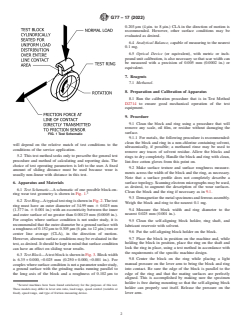
FIG. 1 Test Schematic
9.1.1 For metals, the following procedure is recommended:
clean the block and ring in a non-chlorine containing solvent,
will depend on the relative match of test conditions to the
ultrasonically, if possible; a methanol rinse may be used to
conditions of the service application.
remove any traces of solvent residue. Allow the blocks and
5.2 This test method seeks only to prescribe the general test
rings to dry completely. Handle the block and ring with clean,
procedure and method of calculating and reporting data. The
lint-free cotton gloves from this point on.
choice of test operating parameters is left to the user. A fixed
9.2 Make surface texture and surface roughness measure-
amount of sliding distance must be used because wear is
ments across the width of the block and the ring, as necessary.
usually non-linear with distance in this test.
Note that a surface profile does not completely describe a
surface topology. Scanning electron micrographs may be used,
6. Apparatus and Materials
as desired, to augment the description of the wear surfaces.
6.1 Test Schematic—Aschematic of one possible block-on-
Clean the block and the ring if necessary as in 9.1.
ring wear test geometry is shown in Fig. 1.
9.3 Demagnetizethemetalspecimensandferrousassembly.
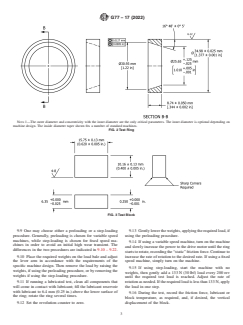
6.2 Test Ring—AtypicaltestringisshowninFig.2.Thetest
Weigh the block and ring to the nearest 0.1 mg.
ring must have an outer diameter of 34.99mm 6 0.025 mm
9.4 Measure the block width and ring diameter to the
(1.377in. 6 0.001 in.) with an eccentricity between the inner
nearest 0.025 mm (0.001 in.).
and outer surface of no greater than 0.00125 mm (0.0005 in.).
For couples where surface condition is not under study, it is
9.5 Clean the self-aligning block holder, ring shaft, and
recommended that the outer diameter be a ground surface with
lubricant reservoir with solvent.
a roughness of 0.152µm to 0.305 µm (6µin. to 12 µin.) rms or
9.6 Put the self-aligning block holder on the block.
center line average (CLA), in the direction of motion.
9.7 Place the block in position on the machine and, while
However, alternate surface conditions may be evaluated in the
holding the block in position, place the ring on the shaft and
test,asdesired.Itshouldbekeptinmindthatsurfacecondition
lock the ring in place, using a test method in accordance with
can have an effect on sliding wear results.
the requirements of the specific machine design.
6.3 Test Block—AtestblockisshowninFig.3.Blockwidth
9.8 Center the block on the ring while placing a light
is 6.35+0.000,−0.025 mm (0.250+0.000,−0.001 in.). For
manual pressure on the lever arm to bring the block and ring
coupleswheresurfaceconditionisnotaparameterunderstudy,
into contact. Be sure the edge of the block is parallel to the
a ground surface with the grinding marks running parallel to
edge of the ring and that the mating surfaces are perfectly
the long axis of the block and a roughness of 0.102µm to
aligned. This is accomplished by making sure the specimen
holder is free during mounting so that the self-aligning block
Several machines have been found satisfactory for the purposes of this test.
holder can properly seat itself. Release the pressure on the
These models may differ in lever arm ratio, load range, speed control (variable or
fixed), speed range, and type of friction measuring device. lever arm.
G77 − 17 (2022)
NOTE 1—The outer diameter and concentricity with the inner diameter are the only critical parameters. The inner diameter is optional depending on
machine design. The inside diameter taper shown fits a number of standard machines.
FIG. 2 Test Ring
FIG. 3 Test Block
9.9 One may choose either a preloading or a step-loading 9.13 Gentlylowertheweights,applyingtherequiredload,if
procedure. Generally, preloading is chosen for variable speed using the preloading procedure.
machines, while step-loading is chosen for fixed speed ma-
9.14 If using a variable speed machine, turn on the machine
chines in order to avoid an initial high wear transient. The
and slowly increase the power to the drive motor until the ring
differences in the two procedures are indicated in 9.10 – 9.22.
startstorotate,recordingthe“static”frictionforce.Continueto
9.10 Place the required weights on the load bale and adjust increase the rate of rotation to the desired rate. If using a fixed
the lever arm in accordance with the requirements of the speed machine, simply turn on the machine.
specific machine design. Then remove the load by raising the
9.15 If using step-loading, start the machine with no
weights, if using the preloading procedure, or by removing the
weights, then gently add a 133N (30lbf) load every 200 rev
weights if using the step-loading procedure.
until the required test load is reached. Adjust the rate of
9.11 If running a lubricated test, clean all components that rotationasneeded.Iftherequiredloadislessthan133N,apply
will come in contact with lubricant; fill the lubricant reservoir the load in one step.
with lubricant to 6.4 mm (0.25 in.) above the lower surface of
9.16 During the test, record the friction force, lubricant or
the ring; rotate the ring several times.
block temperature, as required, and, if desired, the vertical
9.12 Set the revolution counter to zero. displacement of the block.
G77 − 17 (2022)
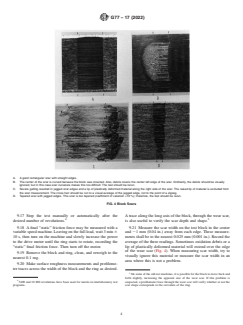
A. A good rectangular scar with straight edges.
B. The center of the scar is curved because the block was crowned. Also, debris covers the center left edge of the scar. Ordinarily, the debris should be visually
ignored, but in this case scar curvature makes this too difficult. The test should be rerun.
C. Severe galling resulted in jagged scar edges and a lip of plastically deformed material along the right side of the scar. The raised lip of material is excluded from
the scar measurement. The cross hair should be run to a visual average of the jagged edge, not to the point of a zigzag.
D. Tapered scar with jagged edges. This scar is too tapered (coefficient of variation >10 %); therefore, the test should be rerun.
FIG. 4 Block Scars
9.17 Stop the test manually or automatically after the Atracealongthelongaxisoftheblock,throughthewearscar,
4 5
desired number of revolutions. is also useful to verify the scar depth and shape.
9.18 Afinal “static” friction force may be measured with a 9.21 Measure the scar width on the test block in the center
variablespeedmachine.Leavingonthefullload,wait3min 6 and ;1 mm (0.04 in.) away from each edge. These measure-
10 s, then turn on the machine and slowly increase the power ments shall be to the nearest 0.025 mm (0.001 in.). Record the
to the drive motor until the ring starts to rotate, recording the average of the three readings. Sometimes oxidation debris or a
“static” final friction force. Then turn off the motor. lip of plastically deformed material will extend over the edge
of the wear scar (Fig. 4). When measuring scar width, try to
9.19 Remove the block and ring, clean, and reweigh to the
visually ignore this material or measure the scar width in an
nearest 0.1 mg.
area where this is not a problem.
9.20 Make surface roughness measurements and profilome-
ter traces across the width of the block and the ring as desired.
On some of the old test machines, it is possible for the block to move back and
forth slightly, increasing the apparent size of the wear scar. If this problem is
5400 and 10 800 revolutions have been used for metals in interlaboratory test suspected, a profilometer trace through the wear scar will verify whether or not the
programs. scar shape corresponds to the curvature of the ring.
G77 − 17 (2022)
θ
t = block width, mm Scar Width
= b5D sin
D t
r = radius of ring, mm Scar volume
5 sθ 2 sin θd
D =2r = diameter of ring, mm
b
b = average scar width, mm where θ
= 2sin.
D
θ = sector angle in radians
D t b b
d = scar depth, mm [ Scar Volume
21 21
5 2sin 2sin 2sin
F S DG
8 D D
FIG. 5 Block Scar Volume Based on the Width of the Scar
9.22 Tapered scars indicate improper block alignment dur-
F = measured friction force, N (lbf), and
ing testing. If the three width measurements on a given scar
W = normal force, N (lbf).
have a coefficient of variation of greater than 10%, the test
10.3 Calculate ring volume loss as follows:
shall be declared invalid.
ringmassloss
volumeloss 5 (2)
10. Calculation
ringdensity
NOTE 1—If the ring gains mass during the test, the volume loss is
10.1 Calculation of Block Scar Volume:
reported as zero with a notation that weight gain occurred. Mass loss is
10.1.1 Block scar volume may be derived from block scar
effected by material transfer from one component to another, by genera-
width by using Table 1 (applicable only when ring diameter is
tion of oxide films, or by infiltration into porous material by the lubricant,
34.99mm 6 0.025 mm (1.377in. 6 0.001 in.) and scar length
or combinations thereof. If material transfer to the ring is obvious, then a
ring scar volume should not be calculated from the weight loss
(block width) is 6.35 + 0.000, −0.025 mm (0.250 + 0.000,
measurement, but a notation should be made that material transfer
−0.001 in.)).
occurred.
10.1.2 The preferred method of calculating block scar
volume is by using the formula shown in Fig. 5. This formula
11. Report
may be programmed on a calculator or computer.
11.1 Report any unusual event or an overload shutoff of the
10.1.3 Block scar volume is not calculated generally from
machine(onsomemachinesitispossibletohaveanautomatic
block mass loss because block mass is subject to effects of
shutoff at a preset frictional load). If the machine malfunctions
materials transfer, generation of oxide films, or penetration of
oratestblockhasataperedscar,thedatashallnotbeused,and
the material by the lubricant. Keeping in mind the above
the test shall be rerun.
factors, block mass loss may be interpreted semiquantitatively
in a comparative evaluation of various material couples. If the
11.2 Report the following:
block scar cannot be accurately measured following 9.21 and
11.2.1 Test Parameters:
the guidance in Fig. 4, a scar volume should not be calculated,
11.2.1.1 Block material and hardness (whenever
but a notation made of the problem; for example, material
applicable),
transfer, plastic deformation, and so forth.
11.2.1.2 Ring material and hardness (whenever applicable),
10.2 Calculate coefficient of friction values from friction
11.2.1.3 Ring and block initial and final surface roughness,
force values as follows:
11.2.1.4 Ring rpm,
11.2.1.5 Lubricant,
f 5 F/W (1)
11.2.1.6 Test load,
where:
11.2.1.7 Test distance (see 14.1), and
f = coefficient of friction
11.2.1.8 Number of duplicates run for each test condition.
TABLE 1 Block Scar Widths and Volumes for Blocks 6.35 mm Wide Mated Against Rings 34.99 mm in Diameter
Block Scar Width Volume Width Volume Width Volume Block Scar Width Volume Width Volume Width Volume
3 3 3 3 3 3
(mm) (mm ) (mm) (mm ) (mm) (mm ) (mm) (mm ) (mm) (mm ) (mm) (mm )
0.30 0.0008 1.01 0.0312 1.72 0.1541 2.42 0.4295 3.12 0.9212 3.83 1.7062
G77 − 17 (2022)
TABLE 1 Continued
Block Scar Width Volume Width Volume Width Volume Block Scar Width Volume Width Volume Width Volume
3 3 3 3 3 3
(mm) (mm ) (mm) (mm ) (mm) (mm ) (mm) (mm ) (mm) (mm ) (mm) (mm )
0.31 0.0009 1.02 0.0321 1.73 0.1568 2.43 0.4348 3.13 0.9301 3.84 1.7196
0.32 0.0010 1.03 0.0331 1.74 0.1595 2.44 0.4402 3.14 0.9391 3.85 1.7331
0.33 0.0011 1.04 0.0340 1.75 0.1623 2.45 0.4456 3.15 0.9481 3.86 1.7467
0.34 0.0012 1.05 0.0350 1.76 0.1651 2.46 0.4511 3.16 0.9572 3.87 1.7603
0.35 0.0013 1.06 0.0360 1.77 0.1679 2.47 0.4567 3.17 0.9663 3.88 1.7740
0.36 0.0014 1.07 0.0371 1.78 0.1708 2.48 0.4622 3.18 0.9755 3.89 1.7878
0.37 0.0015 1.08 0.0381 1.79 0.1737 2.49 0.4679 3.19 0.9847 3.90 1.8017
0.38 0.0017 1.09 0.0392 1.80 0.1766 2.50 0.4735 3.20 0.9940 3.91 1.8156
0.39 0.0018 1.10 0.0403 1.81 0.1796 2.51 0.4792 3.21 1.0034 3.92 18296
0.40 0.0019 1.11 0.0414 1.82 0.1826 2.52 0.4850 3.22 1.0128 3.93 1.9437
0.41 0.0021 1.12 0.0425 1.83 0.1856 2.53 0.4908 3.23 1.0223 3.94 1.8578
0.42 0.0022 1.13 0.0437 1.84 0.1887 2.54 0.4966 3.24 1.0318 3.95 1.8720
0.43 0.0024 1.13 0.0448 1.85 0.1917 2.55 0.5025 3.25 1.0414 3.96 1.8863
0.44 0.0026 1.15 0.0460 1.86 0.1949 2.56 0.5085 3.26 1.0511 3.97 1.9007
0.45 0.0028 1.16 0.0472 1.87 0.1980 2.57 0.5145 3.27 10608 3.98 1.9151
0.46 0.0029 1.17 0.0485 1.88 0.2012 2.58 0.5205 3.28 1.0706 3.99 1.9296
0.47 0.0031 1.18 0.0497 1.89 0.2045 2.59 0.5266 3.29 1.0804
0.48 0.0033 1.19 0.0510 1.90 0.2077 2.60 0.5327 3.30 1.0903 4.00 1.9442
0.49 0.0036 1.20 0.0523 1.91 0.2110 2.61 0.5389 3.31 1.1003 4.01 1.9589
0.50 0.0038 1.21 0.0536 1.92 0.2144 2.62 0.5451 3.32 1.1103 4.02 1.9736
0.51 0.0040 1.22 0.0550 1.93 0.2177 2.63 0.5514 3.33 1.1204 4.03 1.9884
0.52 0.0043 1.23 0.0563 1.94 0.2211 2.64 0.5577 3.34 1.1305 4.04 2.0033
0.53 0.0045 1.24 0.0577 1.95 0.2246 2.65 0.5641 3.35 1.1407 4.05 2.0183
0.54 0.0048 1.25 0.0591 1.96 0.2281 2.66 0.5705 3.36 1.1510 4.06 2.0333
0.55 0.0050 1.26 0.0606 1.97 0.2316 2.67 0.5770 3.37 1.1613 4.07 2.0484
0.56 0.0053 1.27 0.0620 1.98 0.235 2.68 0.5835 3.38 1.1717 4.08 2.0636
0.57 0.0056 1.28 0.0635 1.99 0.2387 2.69 0.5900 3.39 1.1822 4.09 2.0788
0.58 0.0059 1.29 0.0650 2.70 0.5967 3.40 1.1927 4.10 2.0941
0.59 0.0062 1.30 0.0665 2.00 0.2423 2.71 0.6033 3.41 1.2033 4.11 2.1095
0.60 0.0065 1.31 0.0681 2.01 0.2460 2.72 0.6100 3.42 1.2139 4.12 2.1250
0.61 0.0069 1.32 0.0696 2.02 0.2497 2.73 0.6168 3.43 1.2246 4.13 2.1406
0.62 0.0072 1.33 0.0712 2.03 0.2534 2.74 0.6236 3.44 1.2353 4.14 2.1562
0.63 0.0076 1.34 0.0728 2.04 0.2572 2.75 0.6305 3.45 1.2462 4.15 2.1719
0.64 0.0079 1.35 0.0745 2.05 0.2610 2.76 0.6374 3.46 1.2571 4.16 2.1877
0.65 0.0083 1.36 0.0761 2.06 0.2648 2.77 0.6443 3.47 1.2680 4.17 2.2036
0.66 0.0087 1.37 0.0778 2.07 0.2687 2.78 0.6513 3.48 1.2790 4.18 2.2195
0.67 0.0091 1.38 0.0796 2.08 0.2726 2.79 0.6584 3.49 1.2901 4.19 2.2355
0.68 0.0095 1.39 0.0813 2.09 0.2765 2.80 0.6655 3.50 1.3013 4.20 2.2516
0.69 0.0099 1.40 0.0831 2.10 0.2805 2.81 0.6727 3.51 1.3125 4.21 2.2678
0.70 0.0104 1.41 0.0849 2.11 0.2846 2.82 0.6799 3.52 1.3238 4.22 2.2840
0.71 0.0108 1.42 0.0867 2.12 0.2886 2.83 0.6872 3.53 1.3351 4.23 2.3003
0.72 0.0113 1.43 0.0885 2.13 0.2927 2.84 0.6945 3.54 1.3465 4.24 2.3167
0.73 0.0118 1.44 0.0904 2.14 0.2969 2.85 0.7019 3.55 1.3580 4.25 2.3332
0.74 0.0123 1.45 0.0923 2.15 0.3011 2.86 0.7093 3.56 1.3695 4.26 2.3498
0.75 0.0128 1.46 0.0942 2.16 0.3053 2.87 0.7168 3.57 1.3811 4.27 2.3664
0.76 0.0133 1.47 0.0962 2.17 0.3096 2.88 0.7243 3.58 1.3928 4.28 2.3831
0.77 0.0138 1.48 0.0981 2.18 0.3139 2.89 0.7319 3.59 1.4045 4.29 2.3999
0.78 0.0144 1.49 0.1001 2.19 0.3182 2.90 0.7395 3.60 1.4163 4.30 2.4168
0.79 0.0149 1.50 0.1022 2.20 0.3226 2.91 0.7472 3.61 1.4281 4.31 2.4338
0.80 0.0155 1.51 0.1042 2.21 0.3270 2.92 0.7549 3.62 1.4401 4.32 2.4508
0.81 0.0161 1.52 0.1063 2.22 0.3315 2.93 0.7627 3.63 1.4521 4.33 2.4679
0.82 0.0167 1.53 0.1084 2.23 0.3360 2.94 0.7706 3.64 1.4641 4.34 2.4851
0.83 0.0173 1.54 0.1106 2.24 0.3405 2.95 0.7785 3.65 1.4762 4.35 2.5024
0.84 0.0179 1.55 0.1127 2.25 0.3451 2.96 0.7864 3.66 1.4884 4.36 2.4197
0.85
...