

ASTM E517-24
(Test Method)Standard Test Method for Plastic Strain Ratio r for Sheet Metal
General Information
- Abstract
SIGNIFICANCE AND USE
4.1 The plastic strain ratio r is a parameter that indicates the ability of a sheet metal to resist thinning or thickening when subjected to either tensile or compressive forces in the plane of the sheet. It is a measure of plastic anisotropy and is related to the preferred crystallographic orientations within a polycrystalline metal. This resistance to thinning or thickening contributes to the forming of shapes, such as cylindrical flat-bottom cups, by the deep-drawing process. The value of r , therefore, is considered a measure of sheet-metal drawability. It is particularly useful for evaluating materials intended for parts where a substantial portion of the blank is drawn from beneath the blank holder into the die opening.
4.2 For many materials the plastic strain ratio remains essentially constant over a range of plastic strains up to maximum applied force in a tension test. For materials that give different values of r at various strain levels, a superscript is used to designate the percent strain at which the value of r was measured. For example, if a 20 % elongation is used, the report would show r20.
4.3 Materials usually have different values of r when tested in different orientations relative to the rolling direction. The angle of sampling of the individual test specimen is noted by a subscript. Thus, for a test specimen whose length is aligned parallel to the rolling direction, plastic strain ratio, r , is reported as r0. If, in addition, the measurement was made at 20 % elongation and it was deemed necessary to note the percent strain at which the value was measured, the value would be reported as r020.
4.4 A material that has an upper yield strength (yield point) followed by discontinuous yielding stretches unevenly while this yielding is taking place. In steels, this is associated with the propagation of Lüders’ bands on the surface. The accuracy and reproducibility of the determination of plastic strain ratio, r , will be reduced unl...
SCOPE
1.1 This test method covers special tension testing for the measurement of the plastic strain ratio, r, of sheet metal intended for deep-drawing applications.
1.2 The values stated in inch-pound units are to be regarded as standard. The values given in parentheses are mathematical conversions to SI units that are provided for information only and are not considered standard.
1.3 This standard does not purport to address all of the safety concerns, if any, associated with its use. It is the responsibility of the user of this standard to establish appropriate safety, health, and environmental practices and determine the applicability of regulatory limitations prior to use.
1.4 This international standard was developed in accordance with internationally recognized principles on standardization established in the Decision on Principles for the Development of International Standards, Guides and Recommendations issued by the World Trade Organization Technical Barriers to Trade (TBT) Committee.
- Status
- Published
- Publication Date
- 29-Feb-2024
- Technical Committee
- E28 - Mechanical Testing
- Drafting Committee
- E28.02 - Ductility and Formability
Buy Documents
ASTM E517-24 - Standard Test Method for Plastic Strain Ratio <emph type="bdit">r</emph> for Sheet Metal
REDLINE ASTM E517-24 - Standard Test Method for Plastic Strain Ratio <emph type="bdit">r</emph> for Sheet Metal
Overview
ASTM E517-24 is the internationally recognized standard test method for measuring the plastic strain ratio (r-value) of sheet metal. Published by ASTM International, this standard provides essential procedures for determining a material's ability to resist thinning or thickening under tensile or compressive forces within the plane of the sheet. The r-value is a key indicator of plastic anisotropy and is directly related to the drawability of sheet metals, especially for applications such as deep drawing where forming performance is critical. ASTM E517-24 is indispensable for manufacturers and laboratories seeking to qualify materials for demanding forming operations.
Key Topics
- Plastic Strain Ratio (r-value): The r-value quantifies the material’s resistance to thickness changes during plastic deformation. Higher r-values suggest improved deep-drawability, which is crucial for forming components like cylindrical cups.
- Anisotropy Evaluation: The test identifies variations in r-values based on sample orientation relative to the rolling direction (parallel, diagonal, transverse), providing insight into the material's formability characteristics.
- Testing Procedures: ASTM E517-24 details manual, automatic, and combined methods for precise measurement of axial and transverse strains using extensometers and gauge marks.
- Specimen Requirements: Guidelines for specimen geometry, preparation, and dimension measurement ensure consistent and reproducible results.
- Measurement Accuracy and Uncertainty: The standard highlights factors affecting measurement reliability, such as specimen preparation and extensometer placement, and gives statistical approaches for assessing result precision.
- Reporting Results: Requirements include specifying testing conditions, methods used, values determined, and relevant test parameters to ensure transparency and traceability.
Applications
- Material Qualification: Used by steel and aluminum producers to ensure sheet metals meet specifications for automotive, appliance, and packaging components demanding high formability and minimal earing.
- Product Design: Aids engineers and designers in selecting suitable sheet metals for shape-critical applications, reducing risk of failure or defects in deep-drawn products.
- Quality Control: Serves as a quality benchmark in production environments, detecting variations in sheet metal properties that might affect forming processes.
- Research and Development: Supports investigation into new alloys and processing methods by correlating crystallographic texture with material performance in forming operations.
- Interlaboratory Validation: Facilitates consistency in measurements across different facilities, supporting product standardization and compliance with international quality systems.
Related Standards
- ASTM E6 - Terminology Relating to Methods of Mechanical Testing
- ASTM E8/E8M - Test Methods for Tension Testing of Metallic Materials
- ASTM E83 - Practice for Verification and Classification of Extensometer Systems
- ASTM E92 - Test Methods for Vickers Hardness and Knoop Hardness of Metallic Materials
- ASTM E177 - Practice for Use of the Terms Precision and Bias in ASTM Test Methods
- ASTM E691 - Practice for Conducting an Interlaboratory Study to Determine the Precision of a Test Method
Keywords: ASTM E517, plastic strain ratio, r-value, sheet metal testing, deep-drawing, anisotropy, metal formability, standard test method, mechanical testing of metals, drawability, earing tendency
By adhering to ASTM E517-24, organizations ensure precise, repeatable evaluation of sheet metal forming properties, leading to optimized material selection, enhanced product performance, and reliable quality assurance in manufacturing processes.
Relations
- Effective Date
- 01-Mar-2024
- Effective Date
- 01-Mar-2024
- Effective Date
- 01-Mar-2024
- Effective Date
- 01-Mar-2024
Buy Documents
ASTM E517-24 - Standard Test Method for Plastic Strain Ratio <emph type="bdit">r</emph> for Sheet Metal
REDLINE ASTM E517-24 - Standard Test Method for Plastic Strain Ratio <emph type="bdit">r</emph> for Sheet Metal
Get Certified
Connect with accredited certification bodies for this standard

Element Materials Technology
Materials testing and product certification.

Inštitut za kovinske materiale in tehnologije
Institute of Metals and Technology. Materials testing, metallurgical analysis, NDT.
Sponsored listings
Frequently Asked Questions
ASTM E517-24 is a standard published by ASTM International. Its full title is "Standard Test Method for Plastic Strain Ratio <emph type="bdit">r</emph> for Sheet Metal". This standard covers: SIGNIFICANCE AND USE 4.1 The plastic strain ratio r is a parameter that indicates the ability of a sheet metal to resist thinning or thickening when subjected to either tensile or compressive forces in the plane of the sheet. It is a measure of plastic anisotropy and is related to the preferred crystallographic orientations within a polycrystalline metal. This resistance to thinning or thickening contributes to the forming of shapes, such as cylindrical flat-bottom cups, by the deep-drawing process. The value of r , therefore, is considered a measure of sheet-metal drawability. It is particularly useful for evaluating materials intended for parts where a substantial portion of the blank is drawn from beneath the blank holder into the die opening. 4.2 For many materials the plastic strain ratio remains essentially constant over a range of plastic strains up to maximum applied force in a tension test. For materials that give different values of r at various strain levels, a superscript is used to designate the percent strain at which the value of r was measured. For example, if a 20 % elongation is used, the report would show r20. 4.3 Materials usually have different values of r when tested in different orientations relative to the rolling direction. The angle of sampling of the individual test specimen is noted by a subscript. Thus, for a test specimen whose length is aligned parallel to the rolling direction, plastic strain ratio, r , is reported as r0. If, in addition, the measurement was made at 20 % elongation and it was deemed necessary to note the percent strain at which the value was measured, the value would be reported as r020. 4.4 A material that has an upper yield strength (yield point) followed by discontinuous yielding stretches unevenly while this yielding is taking place. In steels, this is associated with the propagation of Lüders’ bands on the surface. The accuracy and reproducibility of the determination of plastic strain ratio, r , will be reduced unl... SCOPE 1.1 This test method covers special tension testing for the measurement of the plastic strain ratio, r, of sheet metal intended for deep-drawing applications. 1.2 The values stated in inch-pound units are to be regarded as standard. The values given in parentheses are mathematical conversions to SI units that are provided for information only and are not considered standard. 1.3 This standard does not purport to address all of the safety concerns, if any, associated with its use. It is the responsibility of the user of this standard to establish appropriate safety, health, and environmental practices and determine the applicability of regulatory limitations prior to use. 1.4 This international standard was developed in accordance with internationally recognized principles on standardization established in the Decision on Principles for the Development of International Standards, Guides and Recommendations issued by the World Trade Organization Technical Barriers to Trade (TBT) Committee.
SIGNIFICANCE AND USE 4.1 The plastic strain ratio r is a parameter that indicates the ability of a sheet metal to resist thinning or thickening when subjected to either tensile or compressive forces in the plane of the sheet. It is a measure of plastic anisotropy and is related to the preferred crystallographic orientations within a polycrystalline metal. This resistance to thinning or thickening contributes to the forming of shapes, such as cylindrical flat-bottom cups, by the deep-drawing process. The value of r , therefore, is considered a measure of sheet-metal drawability. It is particularly useful for evaluating materials intended for parts where a substantial portion of the blank is drawn from beneath the blank holder into the die opening. 4.2 For many materials the plastic strain ratio remains essentially constant over a range of plastic strains up to maximum applied force in a tension test. For materials that give different values of r at various strain levels, a superscript is used to designate the percent strain at which the value of r was measured. For example, if a 20 % elongation is used, the report would show r20. 4.3 Materials usually have different values of r when tested in different orientations relative to the rolling direction. The angle of sampling of the individual test specimen is noted by a subscript. Thus, for a test specimen whose length is aligned parallel to the rolling direction, plastic strain ratio, r , is reported as r0. If, in addition, the measurement was made at 20 % elongation and it was deemed necessary to note the percent strain at which the value was measured, the value would be reported as r020. 4.4 A material that has an upper yield strength (yield point) followed by discontinuous yielding stretches unevenly while this yielding is taking place. In steels, this is associated with the propagation of Lüders’ bands on the surface. The accuracy and reproducibility of the determination of plastic strain ratio, r , will be reduced unl... SCOPE 1.1 This test method covers special tension testing for the measurement of the plastic strain ratio, r, of sheet metal intended for deep-drawing applications. 1.2 The values stated in inch-pound units are to be regarded as standard. The values given in parentheses are mathematical conversions to SI units that are provided for information only and are not considered standard. 1.3 This standard does not purport to address all of the safety concerns, if any, associated with its use. It is the responsibility of the user of this standard to establish appropriate safety, health, and environmental practices and determine the applicability of regulatory limitations prior to use. 1.4 This international standard was developed in accordance with internationally recognized principles on standardization established in the Decision on Principles for the Development of International Standards, Guides and Recommendations issued by the World Trade Organization Technical Barriers to Trade (TBT) Committee.
ASTM E517-24 is classified under the following ICS (International Classification for Standards) categories: 77.040.10 - Mechanical testing of metals. The ICS classification helps identify the subject area and facilitates finding related standards.
ASTM E517-24 has the following relationships with other standards: It is inter standard links to ASTM E517-19, ASTM E2218-23, ASTM A1083/A1083M-23, ASTM A1008/A1008M-23e1. Understanding these relationships helps ensure you are using the most current and applicable version of the standard.
ASTM E517-24 is available in PDF format for immediate download after purchase. The document can be added to your cart and obtained through the secure checkout process. Digital delivery ensures instant access to the complete standard document.
Standards Content (Sample)
This international standard was developed in accordance with internationally recognized principles on standardization established in the Decision on Principles for the
Development of International Standards, Guides and Recommendations issued by the World Trade Organization Technical Barriers to Trade (TBT) Committee.
Designation: E517 − 24
Standard Test Method for
Plastic Strain Ratio r for Sheet Metal
This standard is issued under the fixed designation E517; the number immediately following the designation indicates the year of
original adoption or, in the case of revision, the year of last revision. A number in parentheses indicates the year of last reapproval. A
superscript epsilon (´) indicates an editorial change since the last revision or reapproval.
1. Scope* 3. Terminology
1.1 This test method covers special tension testing for the
3.1 Definitions of Terms Common to Mechanical Testing:
measurement of the plastic strain ratio, r, of sheet metal
3.1.1 The definitions relating to tension testing appearing in
intended for deep-drawing applications.
Terminology E6 shall apply to this test method. Some of those
important terms include discontinuous yielding, gauge length,
1.2 The values stated in inch-pound units are to be regarded
as standard. The values given in parentheses are mathematical axial strain, true strain, reduced section, yield-point elongation,
and upper yield strength.
conversions to SI units that are provided for information only
and are not considered standard.
3.2 Definitions of Terms Specific to This Standard:
1.3 This standard does not purport to address all of the
3.2.1 axial gauge length, l , n—a gauge length aligned with
i
safety concerns, if any, associated with its use. It is the
the long axis of the specimen.
responsibility of the user of this standard to establish appro-
3.2.1.1 Discussion—The specific measurement to be used
priate safety, health, and environmental practices and deter-
for the axial gauge length is based on which procedure
mine the applicability of regulatory limitations prior to use.
(Manual, Automatic, or Combined) and specimen type are
1.4 This international standard was developed in accor-
used.
dance with internationally recognized principles on standard-
3.2.1.2 Discussion—Since “gauge length” is by definition
ization established in the Decision on Principles for the
the original length, the final length associated with the axial
Development of International Standards, Guides and Recom-
gauge length would be the final axial length, l .
f
mendations issued by the World Trade Organization Technical
3.2.1.3 Discussion—In uniaxial testing, dimensions aligned
Barriers to Trade (TBT) Committee.
with the longitudinal or long axis of the specimen are fre-
quently referred to as “axial” dimensions, for example, axial
2. Referenced Documents
gauge length. The word “longitudinal” describes the long-axis
2.1 ASTM Standards:
direction of the specimen and has no assumed relationship to
E6 Terminology Relating to Methods of Mechanical Testing
the rolling direction of the sheet metal being tested.
E8/E8M Test Methods for Tension Testing of Metallic Ma-
3.2.2 earing tendency, delta r or ∆r, n—measure of the
terials
tendency of sheet to draw in nonuniformly and to form ears in
E83 Practice for Verification and Classification of Exten-
the flange of deep-drawn cylindrical parts in the directions of
someter Systems
higher values of r (see 10.4).
E92 Test Methods for Vickers Hardness and Knoop Hard-
ness of Metallic Materials
3.2.2.1 Discussion—In cold-reduced and annealed low-
E177 Practice for Use of the Terms Precision and Bias in
carbon steel sheet, r and r are usually greater than r , while
0 90 45
ASTM Test Methods
in hot-rolled steels r can be greater. Other earing tendencies
E691 Practice for Conducting an Interlaboratory Study to
occur; thus, for some materials the earing tendency can be
Determine the Precision of a Test Method
better represented by r − r .
max min
3.2.3 plastic strain ratio, r, n—in sheet metal that has been
strained by uniaxial tension sufficiently to induce plastic flow,
This test method is under the jurisdiction of ASTM Committee E28 on
the ratio of the true strain that has occurred in a transverse
Mechanical Testing and is the direct responsibility of Subcommittee E28.02 on
Ductility and Formability. direction (ɛ ) perpendicular to the direction of applied stress
w
Current edition approved March 1, 2024. Published April 2024. Originally
and in the plane of the sheet, to the concomitant true strain in
approved in 1981. Last previous edition approved in 2019 as E517 – 19. DOI:
the thickness direction (ɛ ).
t
10.1520/E0517-24.
For referenced ASTM standards, visit the ASTM website, www.astm.org, or
3.2.3.1 Discussion—The plastic strain ratio, r, is numeri-
contact ASTM Customer Service at service@astm.org. For Annual Book of ASTM
cally equal to
Standards volume information, refer to the standard’s Document Summary page on
the ASTM website. r 5 ε /ε (1)
w t
*A Summary of Changes section appears at the end of this standard
Copyright © ASTM International, 100 Barr Harbor Drive, PO Box C700, West Conshohocken, PA 19428-2959. United States
E517 − 24
where: 3.2.5.3 Discussion—Since the thickness of the specimen is
also referred to in this test method, the symbol w is used for the
ε = true transverse strain, and
w
transverse length rather than t to prevent confusion with the
ε = true thickness strain.
t
measurements in the thickness direction.
3.2.3.2 Discussion—Due to difficulty in measuring thick-
3.2.5.4 Discussion—The term “transverse” describes the
ness changes with sufficient precision, in practice an equivalent
width direction of the specimen and has no assumed relation-
relationship is commonly used, based on axial and transverse
ship to the rolling direction of the sheet metal being tested.
strain measurements (see 9.1.2).
3.2.6 transverse strain, n—in sheet products, linear strain in
3.2.3.3 Discussion—The term “transverse” describes the
the plane of the specimen perpendicular to the longitudinal axis
width direction of the specimen and has no assumed relation-
of the specimen.
ship to the rolling direction of the sheet metal being tested.
3.2.4 reduced parallel section, n—the central portion of the
3.2.6.1 Discussion—This definition of transverse strain, in
specimen that has a nominally uniform cross section, that is
sheet products, is a more specific version of the term “trans-
smaller than that of the ends that are gripped, not including the
verse strain” as defined in Terminology E6, but transverse
fillets.
strain in sheet products is limited to the width direction of the
3.2.4.1 Discussion—This term is often called the “parallel
specimen.
length” in other standards.
3.2.6.2 Discussion—The true transverse strain is denoted as
3.2.4.2 Discussion—This term is very similar to the Termi-
ε in this standard.
w
nology E6 term “reduced parallel section”, except in this
3.2.6.3 Discussion—The terms “transverse” and “longitudi-
standard the tolerance on the reduced parallel section parallel-
nal” describe the in-plane directions of the specimen and have
ism is much tighter, as shown in Fig. 1.
no assumed relationship to the rolling direction of the sheet
3.2.5 transverse gauge length, w , n—in sheet products, a
i
metal being tested.
gauge length aligned across the width of the specimen and
3.2.7 thickness strain, n—in sheet products, linear strain
perpendicular to the axial gauge length.
through the thickness of the specimen perpendicular to the
3.2.5.1 Discussion—The specific measurement to be used
longitudinal axis of the specimen.
for the transverse gauge length is based on which procedure
3.2.7.1 Discussion—This definition of thickness strain, in
(Manual, Automatic, or Combined) and specimen type are
used. sheet products, is a more specific version of the term “trans-
verse strain” as defined in Terminology E6, but thickness strain
3.2.5.2 Discussion—Since “gauge length” is by definition
the original length, the final length associated with the trans- in sheet products is limited to the thickness direction of the
verse gauge length would be the final transverse length, w . specimen.
f
+ gauge mark or extensometer
Dimensions
Specimen A
Standard Alternative
in. mm in. mm
G Axial gauge mark spacing 2.00 ± 0.01 50 ± 0.25 1.00 ± 0.005 25 ± 0.13
W Width (Note 1 and Note 2) 0.500 ± 0.01 12.5 ± 0.25 0.500 ± 0.01 12.5 ± 0.25
T Thickness thickness of material thickness of material
1 1
R Radius of fillet, min ⁄2 13 ⁄2 13
L Overall length, min 8 200 7 ⁄4 180
A Length of reduced parallel section, min 3 75 2 ⁄4 60
B Length of grip section, min 2 50 2 50
3 3
C Width of grip section, approximate ⁄4 20 ⁄4 20
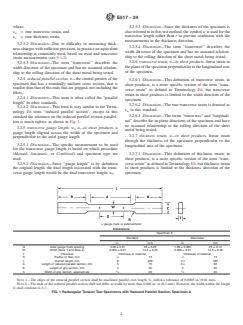
NOTE 1—The edges of the reduced parallel section shall be machined parallel over length, G, within a tolerance of 0.0005 in. (0.01 mm).
NOTE 2—The ends of the reduced parallel section shall not differ in width by more than 0.005 in. or (0.1 mm). However, the width within the length
G shall conform to 8.3.
FIG. 1 Rectangular Tension Test Specimens with Reduced Parallel Section, Specimen A
E517 − 24
3.2.7.2 Discussion—The true thickness strain is denoted as accuracy and reproducibility of determinations of plastic strain
ε in this standard. ratio, r, made at low strains.
t
3.2.7.3 Discussion—The terms “transverse” and “longitudi-
5. Interferences
nal” describe the in-plane directions of the specimen and have
no assumed relationship to the rolling direction of the sheet
5.1 Many factors affect the measurements taken for deter-
metal being tested.
mining the value of r. In particular, errors in the measurement
3.2.8 weighted-average plastic strain ratio, r , n—the of the change in width can cause the reported value of r to be
m
weighted average of values of r obtained in three in-plane
invalid. The following phenomena are known to cause severe
directions: 0° (parallel), 45° (diagonal), and 90° (transverse) to errors in the measurement of the change in width and affect the
the rolling direction.
value of r reported.
5.1.1 Canoeing—Canoeing is a phenomenon that occurs in
3.2.8.1 Discussion—Some materials exhibit significantly
some materials when they are stretched. In these materials, the
different values of plastic strain ratio, r, for other test
test specimen bows about its longitudinal axis and takes on a
directions, in which case the weighted-average plastic strain
shape resembling the bottom of a canoe. In this case, unless the
ratio may include these values when special note is made and
transverse measurements of the change in width are compen-
another subscript is used to avoid confusion with r as defined
m
sated for, there will be significant errors in the calculated value
in 3.2.8.
of r.
3.2.8.2 Discussion—Symbols that are often used inter-
5.1.2 Sharp Knife Edges—Knife edges, used to measure the
changeably with r are r¯ and r-Bar.
m
transverse change in width automatically, while the specimen
is stretched longitudinally, can cause localized deformation of
4. Significance and Use
the specimen under the knife edges. This problem is intensified
if the knife edges are sharp and attached to the specimen with
4.1 The plastic strain ratio r is a parameter that indicates the
high forces. This combination produces a compressive stress
ability of a sheet metal to resist thinning or thickening when
90° to the tensile stress being applied to stretch the specimen,
subjected to either tensile or compressive forces in the plane of
which causes localized deformation. As a result, excessively
the sheet. It is a measure of plastic anisotropy and is related to
high values of r are calculated.
the preferred crystallographic orientations within a polycrys-
talline metal. This resistance to thinning or thickening contrib-
6. Apparatus
utes to the forming of shapes, such as cylindrical flat-bottom
cups, by the deep-drawing process. The value of r, therefore, is
6.1 Dimension-Measuring Devices—Instruments for mea-
considered a measure of sheet-metal drawability. It is particu-
suring length and width shall be checked for accuracy and be
larly useful for evaluating materials intended for parts where a
graduated to permit measurements to be made to 60.001 in. (6
substantial portion of the blank is drawn from beneath the
0.02 mm) or better.
blank holder into the die opening.
6.2 Extensometer Systems—If the axial strain or the trans-
verse strain, or both, are to be obtained using an extensometer
4.2 For many materials the plastic strain ratio remains
essentially constant over a range of plastic strains up to system (mechanical, optical, or otherwise), then the extensom-
eter system shall conform to Practice E83 as Class C or better,
maximum applied force in a tension test. For materials that
including verification over the range of strains used in the
give different values of r at various strain levels, a superscript
determination of plastic strain ratio, r.
is used to designate the percent strain at which the value of r
was measured. For example, if a 20 % elongation is used, the
6.3 Testing Machine—The testing machine used to strain the
report would show r .
specimen shall be capable of uniaxially straining the specimen
in accordance with the requirements in 9.2.5 or 9.3.4.
4.3 Materials usually have different values of r when tested
in different orientations relative to the rolling direction. The
7. Test Specimen
angle of sampling of the individual test specimen is noted by a
subscript. Thus, for a test specimen whose length is aligned
7.1 Type—Any of three types of specimen may be used.
parallel to the rolling direction, plastic strain ratio, r, is
Other types including subsize specimens may be used provided
reported as r . If, in addition, the measurement was made at
they give comparable values of equivalent accuracy.
20 % elongation and it was deemed necessary to note the
7.1.1 Specimen A, with reduced parallel section, as shown
percent strain at which the value was measured, the value
in Fig. 1—While this is similar to the Sheet-Type Specimen of
would be reported as r .
Test Methods E8/E8M, the reduced parallel section shall be
parallel-sided rather than tapered.
4.4 A material that has an upper yield strength (yield point)
7.1.2 Specimen B, with a uniform width of 0.75 in. (20 mm),
followed by discontinuous yielding stretches unevenly while
machined edges, and no reduced section, as shown in Fig. 2.
this yielding is taking place. In steels, this is associated with the
7.1.3 Specimen C with a uniform width of 1.125 in. (28.58
propagation of Lüders’ bands on the surface. The accuracy and
mm), precision-sheared or with machined edges and no re-
reproducibility of the determination of plastic strain ratio, r,
duced section, as shown in Fig. 3.
will be reduced unless the test is continued beyond this
yield-point elongation. Similarly, the discontinuous yielding 7.2 Size—The length and width of the specimen are not
associated with large grain size in a material decreases the critical, provided care is used to stretch the gauge section in a
E517 − 24
+ gauge mark or extensometer
Dimensions
Specimen B
Standard Alternative
in. mm in. mm
G Axial gauge mark spacing 2.00 ± 0.01 50 ± 0.25 1.00 ± 0.005 25 ± 0.1
W Width (Note 1) 0.75 ± 0.005 20 ± 0.13 0.75 ± 0.005 20 ± 0.13
T Thickness thickness of material
L Overall length, min 8 200 7 175
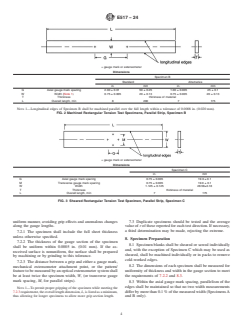
NOTE 1—Longitudinal edges of Specimen B shall be machined parallel over the full length within a tolerance of 0.0008 in. (0.020 mm).
FIG. 2 Machined Rectangular Tension Test Specimens, Parallel Strip, Specimen B
+ gauge mark or extensometer
Dimensions
Specimen C
in. mm
G Axial gauge mark spacing 0.75 ± 0.005 19.0 ± 0.1
M Transverse gauge mark spacing 0.75 ± 0.005 19.0 ± 0.1
W Width 1.125 ± 0.125 28.58±3.18
T Thickness thickness of material
L Overall length, min 7 175
FIG. 3 Sheared Rectangular Tension Test Specimen, Parallel Strip, Specimen C
uniform manner, avoiding grip effects and anomalous changes 7.3 Duplicate specimens should be tested and the average
along the gauge lengths. value of r of these reported for each test direction. If necessary,
a third determination may be made, rejecting the extreme.
7.2.1 The specimen shall include the full sheet thickness
unless otherwise specified.
8. Specimen Preparation
7.2.2 The thickness of the gauge section of the specimen
8.1 Specimen blanks shall be sheared or sawed individually
shall be uniform within 0.0005 in. (0.01 mm). If the as-
and, with the exception of Specimen C which may be used as
received surface is nonuniform, the surface shall be prepared
sheared, shall be machined individually or in packs to remove
by machining or by grinding to this tolerance.
cold-worked edges.
7.2.3 The distance between a grip and either a gauge mark,
8.2 The dimensions of each specimen shall be measured for
mechanical extensometer attachment point, or the pattern/
uniformity of thickness and width in the gauge section to meet
feature to be measured by an optical extensometer system shall
the requirements of 7.2.2 and 8.3.
be at least twice the specimen width, W, (or transverse gauge
mark spacing, M, for parallel strips).
8.3 Within the axial gauge mark spacing, parallelism of the
edges shall be maintained so that no two width measurements
NOTE 1—To permit proper gripping of the specimen while meeting the
differ by more than 0.1 % of the measured width (Specimens A
7.2.3 requirement, the overall length dimension, L, is listed as a minimum,
thus allowing for longer specimens to allow more grip section length. and B only).
E517 − 24
8.4 Gauge Marks: 9.2.1 Determine the transverse gauge length of the
8.4.1 Reasonable care shall be taken to position the gauge specimen, w , within 60.0005 in. (60.013 mm). If an axial
i
marks symmetrically to the midpoint and centerline of the gauge mark spacing of 0.75 in. (20 mm) is used, as for
specimen or reduced parallel section. Specimen C, one transverse gauge length measurement is
sufficient. If an axial gauge mark spacing of 1.00 in. (25 mm)
8.4.2 Gauge marks for the Manual Procedure (9.2) shall be
lightly scribed or punched in the surface of the specimen or or longer is used, make transverse gauge length measurements
at a minimum of three evenly spaced places within the axial
made with a Vickers diamond indenter described in Test
Method E92. gauge mark spacing and use the average.
8.4.3 Gauge marks used for an optical extensometer system 9.2.1.1 For Specimens A or B, use the specimen width, W in
should be made in a manner appropriate for that system, but the
Fig. 1 or Fig. 2, as the transverse gauge length, w .
i
gauge mark locations used for measurement shall comply with
9.2.1.2 For Specimen C, use the transverse gauge mark
8.4.1.
spacing, M in Fig. 3, as the transverse gauge length, w .
i
8.4.4 For the Automatic Procedure (9.3), mechanical or
9.2.2 Measure the axial gauge length, l , within 60.001 in.
i
optical extensometer systems that measure the specimen at the
(60.025 mm) in a 1.00 in. (25 mm), or a 0.75 in. (20 mm) axial
surface gauge mark locations and meet the requirements of 6.2
gauge mark spacing, and within 60.002 in. (6 0.05 mm) in a
may be used.
2.00 in. (50 mm) axial gauge mark spacing.
8.4.5 The gauge mark locations shall comply with 7.2.3.
9.2.2.1 For Specimens A, B, or C, the axial gauge mark
8.4.6 For Specimen A, the axial gauge mark spacing shall be
spacing, G in Fig. 1, Fig. 2, or Fig. 3 respectivel
...
This document is not an ASTM standard and is intended only to provide the user of an ASTM standard an indication of what changes have been made to the previous version. Because
it may not be technically possible to adequately depict all changes accurately, ASTM recommends that users consult prior editions as appropriate. In all cases only the current version
of the standard as published by ASTM is to be considered the official document.
Designation: E517 − 19 E517 − 24
Standard Test Method for
Plastic Strain Ratio r for Sheet Metal
This standard is issued under the fixed designation E517; the number immediately following the designation indicates the year of
original adoption or, in the case of revision, the year of last revision. A number in parentheses indicates the year of last reapproval. A
superscript epsilon (´) indicates an editorial change since the last revision or reapproval.
1. Scope*
1.1 This test method covers special tension testing for the measurement of the plastic strain ratio, r, of sheet metal intended for
deep-drawing applications.
1.2 The values stated in inch-pound units are to be regarded as standard. The values given in parentheses are mathematical
conversions to SI units that are provided for information only and are not considered standard.
1.3 This standard does not purport to address all of the safety concerns, if any, associated with its use. It is the responsibility
of the user of this standard to establish appropriate safety, health, and environmental practices and determine the applicability of
regulatory limitations prior to use.
1.4 This international standard was developed in accordance with internationally recognized principles on standardization
established in the Decision on Principles for the Development of International Standards, Guides and Recommendations issued
by the World Trade Organization Technical Barriers to Trade (TBT) Committee.
2. Referenced Documents
2.1 ASTM Standards:
E6 Terminology Relating to Methods of Mechanical Testing
E8/E8M Test Methods for Tension Testing of Metallic Materials
E83 Practice for Verification and Classification of Extensometer Systems
E92 Test Methods for Vickers Hardness and Knoop Hardness of Metallic Materials
E177 Practice for Use of the Terms Precision and Bias in ASTM Test Methods
E691 Practice for Conducting an Interlaboratory Study to Determine the Precision of a Test Method
3. Terminology
3.1 Definitions of Terms Common to Mechanical Testing:
3.1.1 The definitions relating to tension testing appearing in Terminology E6 shall apply to this test method. Some of those
important terms include discontinuous yielding, gauge length, axial strain, true strain, reduced section, yield-point elongation, and
upper yield strength.
3.2 Definitions of Terms Specific to This Standard:
This test method is under the jurisdiction of ASTM Committee E28 on Mechanical Testing and is the direct responsibility of Subcommittee E28.02 on Ductility and
Formability.
Current edition approved Oct. 1, 2019March 1, 2024. Published October 2019April 2024. Originally approved in 1981. Last previous edition approved in 20182019 as
E517 – 18.E517 – 19. DOI: 10.1520/E0517-19.10.1520/E0517-24.
For referenced ASTM standards, visit the ASTM website, www.astm.org, or contact ASTM Customer Service at service@astm.org. For Annual Book of ASTM Standards
volume information, refer to the standard’s Document Summary page on the ASTM website.
*A Summary of Changes section appears at the end of this standard
Copyright © ASTM International, 100 Barr Harbor Drive, PO Box C700, West Conshohocken, PA 19428-2959. United States
E517 − 24
3.2.1 axial gauge length, l , n—a gauge length aligned with the long axis of the specimen.
i
3.2.1.1 Discussion—
The specific measurement to be used for the axial gauge length is based on which procedure (Manual,Automatic, or Combined)
and specimen type are used.
3.2.1.2 Discussion—
Since “gauge length” is by definition the original length, the final length associated with the axial gauge length would be the final
axial length, l .
f
3.2.1.3 Discussion—
In uniaxial testing, dimensions aligned with the longitudinal or long axis of the specimen are frequently referred to as “axial”
dimensions, for example, axial gauge length. The word “longitudinal” describes the long-axis direction of the specimen and has
no assumed relationship to the rolling direction of the sheet metal being tested.
3.2.2 earing tendency, delta r or ∆r, n—measure of the tendency of sheet to draw in nonuniformly and to form ears in the flange
of deep-drawn cylindrical parts in the directions of higher values of r (see 10.4).
3.2.2.1 Discussion—
In cold-reduced and annealed low-carbon steel sheet, r and r are usually greater than r , while in hot-rolled steels r can be
0 90 45 45
greater. Other earing tendencies occur; thus, for some materials the earing tendency can be better represented by r − r .
max min
3.2.3 plastic strain ratio, r, n—in sheet metal that has been strained by uniaxial tension sufficiently to induce plastic flow, the ratio
of the true strain that has occurred in a widthtransverse direction (ɛ w) perpendicular to the direction of applied stress and in the
w
plane of the sheet, to the concomitant true strain in the thickness direction (ɛ t.).
t
3.2.3.1 Discussion—
The plastic strain ratio, r, is numerically equal to
r 5 ε /ε (1)
w t
where:
ε = width strain, and
w
ε = thickness strain.
t
ε = true transverse strain, and
w
ε = true thickness strain.
t
3.2.3.2 Discussion—
Due to difficulty in measuring thickness changes with sufficient precision, in practice an equivalent relationship is commonly used,
based on length and widthaxial and transverse strain measurements (see 9.1.2).
3.2.3.3 Discussion—
The term “transverse” describes the width direction of the specimen and has no assumed relationship to the rolling direction of
the sheet metal being tested.
3.2.4 reduced parallel section, n—the central portion of the specimen that has a nominally uniform cross section, that is smaller
than that of the ends that are gripped, not including the fillets.
3.2.4.1 Discussion—
This term is often called the “parallel length” in other standards.
3.2.4.2 Discussion—
This term is very similar to the Terminology E6 term “reduced parallel section”, except in this standard the tolerance on the reduced
parallel section parallelism is much tighter, as shown in Fig. 1.
3.2.5 transverse gauge length, w , n—in sheet products, a gauge length aligned across the width of the specimen and perpendicular
i
to the axial gauge length.
3.2.5.1 Discussion—
The specific measurement to be used for the transverse gauge length is based on which procedure (Manual,Automatic, or
Combined) and specimen type are used.
3.2.5.2 Discussion—
Since “gauge length” is by definition the original length, the final length associated with the transverse gauge length would be the
final transverse length, w .
f
E517 − 24
+ gauge mark or extensometer
Dimensions
Specimen A
Standard Alternative
in. mm in. mm
G Gauge length 2.00 ± 0.01 50± 0.25 1.00 ± 0.005 25 ± 0.13
G Axial gauge mark 2.00 ± 0.01 50 ± 0.25 1.00 ± 0.005 25 ± 0.13
spacing
W Width (Note 1 and 0.500 ± 0.01 12.5 ± 0.25 0.500 ± 0.01 12.5 ± 0.25
Note 2)
T Thickness thickness of material
thickness of material
1 1
R Radius of fillet, min ⁄2 13 ⁄2 13
L Overall length, min 8 200 7 ⁄4 180
A Length of reduced 3 75 2 ⁄4 60
parallel section, min
B Length of grip section, 2 50 2 50
min
3 3
C Width of grip section, ⁄4 20 ⁄4 20
approximate
NOTE 1—The edges of the reduced parallel section shall be machined parallel over thelength, gaugeG, length within a tolerance of 0.0005 in.
(0.012(0.01 mm).
NOTE 2—The ends of the reduced parallel section shall not differ in width by more than 0.005 in. or 0.013 mm.(0.1 mm). However, the width within
the gauge length G shall conform to 8.3.
FIG. 1 Rectangular Tension Test Specimens with Reduced Parallel SectionSection, Specimen A
3.2.5.3 Discussion—
Since the thickness of the specimen is also referred to in this test method, the symbol w is used for the transverse length rather
than t to prevent confusion with the measurements in the thickness direction.
3.2.5.4 Discussion—
The term “transverse” describes the width direction of the specimen and has no assumed relationship to the rolling direction of
the sheet metal being tested.
3.2.6 transverse strain, n—in sheet products, linear strain in the plane of the specimen perpendicular to the longitudinal axis of
the specimen.
3.2.6.1 Discussion—
This definition of transverse strain, in sheet products, is a more specific version of the term “transverse strain” as defined in
Terminology E6, but transverse strain in sheet products is limited to the width direction of the specimen.
3.2.6.2 Discussion—
The true transverse strain is denoted as ε in this standard.
w
3.2.6.3 Discussion—
The terms “transverse” and “longitudinal” describe the in-plane directions of the specimen and have no assumed relationship to
the rolling direction of the sheet metal being tested.
3.2.7 thickness strain, n—in sheet products, linear strain through the thickness of the specimen perpendicular to the longitudinal
axis of the specimen.
3.2.7.1 Discussion—
This definition of thickness strain, in sheet products, is a more specific version of the term “transverse strain” as defined in
Terminology E6, but thickness strain in sheet products is limited to the thickness direction of the specimen.
3.2.7.2 Discussion—
The true thickness strain is denoted as ε in this standard.
t
E517 − 24
3.2.7.3 Discussion—
The terms “transverse” and “longitudinal” describe the in-plane directions of the specimen and have no assumed relationship to
the rolling direction of the sheet metal being tested.
3.2.8 weighted-average plastic strain ratio, r , n—the weighted average of values of r obtained in three in-plane directions: 0°
m
(parallel), 45° (diagonal), and 90° (transverse) to the rolling direction.
3.2.8.1 Discussion—
Some materials exhibit significantly different values of plastic strain ratio, r, for other test directions, in which case the
weighted-average plastic strain ratio may include these values when special note is made and another subscript is used to avoid
confusion with r as defined in 3.2.33.2.8.
m
3.2.8.2 Discussion—
Symbols that are often used interchangeably with r are r¯ and r-Bar.
m
4. Significance and Use
4.1 The plastic strain ratio r is a parameter that indicates the ability of a sheet metal to resist thinning or thickening when subjected
to either tensile or compressive forces in the plane of the sheet. It is a measure of plastic anisotropy and is related to the preferred
crystallographic orientations within a polycrystalline metal. This resistance to thinning or thickening contributes to the forming of
shapes, such as cylindrical flat-bottom cups, by the deep-drawing process. The value of r, therefore, is considered a measure of
sheet-metal drawability. It is particularly useful for evaluating materials intended for parts where a substantial portion of the blank
is drawn from beneath the blank holder into the die opening.
4.2 For many materials the plastic strain ratio remains essentially constant over a range of plastic strains up to maximum applied
force in a tension test. For materials that give different values of r at various strain levels, a superscript is used to designate the
percent strain at which the value of r was measured. For example, if a 20 % elongation is used, the report would show r .
4.3 Materials usually have different values of r when tested in different orientations relative to the rolling direction. The angle of
sampling of the individual test specimen is noted by a subscript. Thus, for a test specimen whose length is aligned parallel to the
rolling direction, plastic strain ratio, r, is reported as r . If, in addition, the measurement was made at 20 % elongation and it was
deemed necessary to note the percent strain at which the value was measured, the value would be reported as r .
4.4 A material that has an upper yield strength (yield point) point followed by discontinuous yielding stretches unevenly while this
yielding is taking place. In steels, this is associated with the propagation of Lüders’Lüders’ bands on the surface. The accuracy and
reproducibility of the determination of plastic strain ratio, r, will be reduced unless the test is continued beyond this yield-point
elongation. Similarly, the discontinuous yielding associated with large grain size in a material decreases the accuracy and
reproducibility of determinations of plastic strain ratio, r, made at low strains.
5. Interferences
5.1 Many factors affect the measurements taken for determining the value of r. In particular, errors in the measurement of the
change in width can cause the reported the value of r to be invalid. The following phenomena are known to cause severe errors
in the measurement of the change in width and affect the value of r reported.
5.1.1 Canoeing—Canoeing is a phenomenon that occurs in some materials when they are stretched. In these materials, the test
specimen bows about its longitudinal axis and takes on a shape resembling the bottom of a canoe. In this case, unless the transverse
measurements of the change in width are compensated for, there will be significant errors in the calculated value of r.
5.1.2 Sharp Knife Edges—Knife edges, used to measure the transverse change in width automatically, while the specimen is
stretched, stretched longitudinally, can cause localized deformation of the specimen under the knife edges. This problem is
intensified if the knife edges are sharp and attached to the specimen with high forces. This combination produces a compressive
stress 90° to the tensile stress being applied to stretch the specimen, which causes localized deformation. As a result, excessively
high values of r are calculated.
6. Apparatus
6.1 Dimension-Measuring Devices—Instruments for measuring length and width shall be checked for accuracy and be graduated
to permit measurements to be made to 60.001 in. (6 0.02 mm) or better.
E517 − 24
6.2 Measuring Devices: Extensometer Systems—
6.1.1 Instruments for measuring length and width shall be checked for accuracy and be graduated to permit measurements to be
made to 60.001 in. (6 0.02 mm) or better.If the axial strain or the transverse strain, or both, are to be obtained using an
extensometer system (mechanical, optical, or otherwise), then the extensometer system shall conform to Practice E83 as Class C
or better, including verification over the range of strains used in the determination of plastic strain ratio, r.
6.1.2 If the longitudinal strain or the transverse strain, or both, are to be obtained using an extensometer, the extensometer system
shall conform to Practice E83 as Class C or better. The extensometer system shall be verified over a range appropriate for the
strains used to determine the plastic strain ratio, r.
6.3 Testing Machine—The testing machine used to strain the specimen shall be capable of uniaxially straining the specimen in
accordance with the requirements in 9.2.5 or 9.3.4.
7. Test Specimen
7.1 Type—Any of three types of specimen may be used. Other types including subsize specimens may be used provided they give
comparable values of equivalent accuracy.
7.1.1 Specimen A, with reduced parallel section, as shown in Fig. 1—While this is similar to the Sheet-Type Specimen of Test
Methods E8/E8M, the reduced parallel section shall be parallel-sided rather than tapered.
7.1.2 Specimen B, with a uniform width of 0.75 in. (20 mm), machined edges, and no reduced section, as shown in Fig. 2.
7.1.3 Specimen C with a uniform width of 1.125 in. (28.58 mm), precision-sheared or with machined edges and no reduced section,
as shown in Fig. 3.
7.2 Size—The length and width of the specimen are not critical, provided care is used to stretch the gauge section in a uniform
manner, avoiding grip effects and anomalous changes along the gauge lengths.
+ gauge mark or extensometer
Dimensions
Specimen B
Standard Alternative
in. mm in. mm
G Gauge length 2.00 ± 0.01 50 ± 0.25 1.00 ± 0.005 25 ± 0.13
W Gauge width 0.75 ± 0.005 20 ± 0.13 0.75 ± 0.005 20 ± 0.13
G Axial gauge 2.00 ± 0.01 50 ± 0.25 1.00 ± 0.005 25 ± 0.1
mark spacing
W Width (Note 1) 0.75 ± 0.005 20 ± 0.13 0.75 ± 0.005 20 ± 0.13
T Thickness
thickness of material
L Overall length, min 8 200 7 175
C Width of specimen 0.75 ± 0.005 20 ± 0.13 0.75 ± 0.005 20 ± 0.13
(Note)
NOTE 1—Edges Longitudinal edges of Specimen B shall be machined parallel over the full length within a tolerance of 0.0008 in. (0.020 mm).
FIG. 2 Machined Rectangular Tension Test Specimens, Parallel StripStrip, Specimen B
E517 − 24
+ gauge mark or extensometer
Dimensions
Specimen C
in. mm
G Gauge length 0.75 ± 0.005 20 ± 0.13
G Axial gauge mark spacing 0.75 ± 0.005 19.0 ± 0.1
M Transverse gauge mark spacing 0.75 ± 0.005 19.0 ± 0.1
W Gauge width 0.75 ± 0.005 20 ± 0.13
W Width 1.125 ± 0.125 28.58±3.18
T Thickness thickness of material
L Overall length, min 7 175
C Width of specimen 1.125 ± 0.125 28.58 ± 3.17
FIG. 3 Sheared Rectangular Tension Test Specimen, Parallel
StripStrip, Specimen C
7.2.1 The specimen shall include the full sheet thickness unless otherwise specified.
7.2.2 The thickness of the gauge section of the specimen shall be uniform within 0.0005 in. (0.013 mm) in the gauge section. (0.01
mm). If the as-received surface is nonuniform, the surface shall be prepared by machining or by grinding to this tolerance.
7.2.3 The distance between a gauge mark and a grip grip and either a gauge mark, mechanical extensometer attachment point, or
the pattern/feature to be measured by an optical extensometer system shall be at least twice the width ofspecimen width, theW,
reduced section (or gauge width transverse gauge mark spacing, M, for parallel strips) of the specimen.strips).
NOTE 1—To permit proper gripping of the specimen while meeting the 7.2.3 requirement, the overall length dimension, L, is listed as a minimum, thus
allowing for longer specimens to allow more grip section length.
7.1.4 Duplicate specimens should be tested and the average value of r of these reported for each test direction. If necessary, a third
determination may be made, rejecting the extreme.
7.3 Type—Any Duplicate specimens should be tested and the average value of threer types of specimen may be used. Other types
including subsize specimens may be used provided they give comparable values of equivalent accuracy.of these reported for each
test direction. If necessary, a third determination may be made, rejecting the extreme.
7.2.1 Specimen A, with reduced section, as shown in Fig. 1—While this is similar to Fig. 6 of Test Methods E8/E8M, the reduced
section shall be parallel-sided rather than tapered.
7.2.2 Specimen B, with a uniform width of 0.75 in. (20 mm), machined edges, and no reduced section, as shown in Fig. 2.
7.2.3 Specimen C, precision-sheared a uniform width of 1.125 in. (28.58 mm), or with machined edges and no reduced section,
as shown in Fig. 3.
7.2.3.1 Gauge lengths for Specimen C shall be marked on the sheet surface perpendicular to and parallel to the specimen edges.
The gauge marks shall be made with Vickers diamond indenters described in Test Method E92, or similar precise marks.
8. Specimen Preparation
8.1 Specimen blanks shall be sheared or sawed individually and, with the exception of Specimen C,C which may be used as
sheared, shall be machined individually or in packs to remove cold-worked edges.
E517 − 24
8.2 The dimensions of each specimen shall be measured for uniformity of thickness and width in the gauge section to meet the
requirements of 7.1.27.2.2 and 8.3.
8.3 Within the gauge length, axial gauge mark spacing, parallelism of the edges shall be maintained so that no two width
measurements differ by more than 0.1 % of the measured width (Specimens A and B only).
8.4 Reasonable care shall be taken to position the gauge marks symmetrically to the midpoint and centerline of the specimen or
reduced section.Gauge Marks:
8.4.1 Reasonable care shall be taken to position the gauge marks symmetrically to the midpoint and centerline of the specimen
or reduced parallel section.
8.4.2 Gauge marks for the Manual Procedure (9.2) shall be lightly scribed or punched in the surface of the specimen or made with
a Vickers diamond indenter.indenter described in Test Method E92.
8.4.3 Gauge marks used for an optical extensometer system should be made in a manner appropriate for that system, but the gauge
mark locations used for measurement shall comply with 8.4.1.
8.4.4 For the Automatic Procedure (9.3), mechanical or optical extensometer systems that measure the specimen at the surface
gauge mark locations and meet the requirements of 6.2 may be used.
8.4.5 The gauge lengths mark locations shall comply with 7.1.37.2.3.
8.4.6 For Specimen A, the gauge length axial gauge mark spacing shall be centered in the reduced parallel section.
8.4.7 or Specimen A or B, if the optical extensometer system requires surface marking for transverse strain measurement (that is,
it does not use the edges of the specimen for width measurement), then those transverse gauge marks should be placed as close
as practical to the edges of the specimen width.
8.4.8 For Specimen C, a double set of gauge marks shall be used in compliance with used.7.2.3.1.
8.4.8.1 The measurement of the longitudinal edges of Specimen C, shall not be used for transverse strain measurement.
NOTE 2—Due to the poor quality of the sheared edges, the width is not well defined making it not suitable for transverse strain measurement.
8.4.8.2 The pairs of axial and transverse gauge marks for Specimen C shall be marked on the sheet surface parallel to, and
...